About QUANZHOU JUNYUAN BAGS: a sourcing and programme team for creators
Three named people per programme, one verified production base, and a quality system built on AQL 2.5, ISO 9001:2015 and BSCI. This page sets out roles, audits, delivery steps and how clients typically engage.
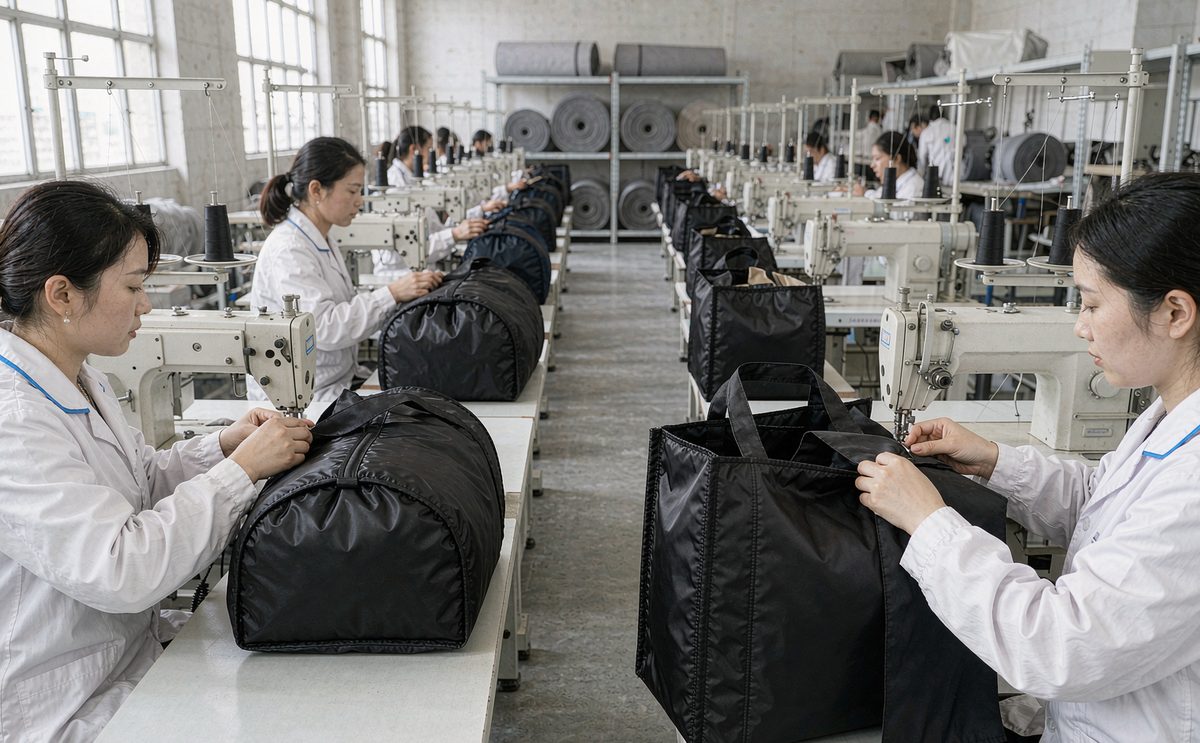
QUANZHOU JUNYUAN BAGS works with crowdfunding creators who need a bag built to a specification, costed honestly and delivered inside a published window. The team sits between the campaign and the production floor: screening what can be made, checking what the destination market will require, holding inspection before freight departs, and answering questions fast enough that distance stops being a variable. This page sets out who does what, how capacity is evaluated, which standards the quality system is built on, and how clients actually engage.
The legal entity behind the service is QUANZHOU JUNYUAN COMMERCIAL AND TRADING CO., LTD., registered in Fujian with commercial roots reaching back to 2004 and formally established in 2014. The name creators deal with day to day is QUANZHOU JUNYUAN BAGS. Everything else on this page describes how that entity runs programmes rather than what it claims to own.
How the team is structured
Every programme is assigned three named people rather than a queue. That structure exists because campaigns fail at handoffs: a specification understood beautifully during sampling and then reinterpreted during bulk. Keeping accountability in three hands — one commercial and scheduling owner, one technical owner, one inspection owner — is the cheap way to stop that happening. There are no tickets forwarded between departments and no client-portal message that belongs to nobody.
| Role | Owns | Typical turnaround | You contact them for |
|---|---|---|---|
| Programme coordinator | Schedule, cost, documentation, payment milestones | Written reply within 1 business day | Quotations, volume tiers, launch dates, invoices |
| Sourcing partner | Feasibility, materials, costing structure, lines | Technical answer within 1-2 business days | Whether a design can be built, and what it costs to build it |
| QC liaison | Spec sheets, samples, AQL 2.5 inspection, reports | Report within 2 business days of lot completion | Spec locking, samples, defect classification, release decisions |
What each role does day to day
Programme coordinator
The coordinator is the single accountable owner of your timeline. They convert a reward ladder into billable line items, hold the 500 pcs per style and colourway arithmetic honest, issue three-tier unit cost bands rather than a single number, and track the 35-50 day build against the date you published. When a shipment needs documentation for a specific port, they are the one assembling it.
Sourcing partner
The sourcing partner answers whether a design can be built at cost before anybody quotes it. That means reading a tech pack, identifying which components are standard and which need tooling, checking whether a requested fabric exists at usable lead time, and flagging anything that will not survive 500 pieces of repeatability. If something in your specification is going to be expensive later, this is the stage where it should surface.
QC liaison
The QC liaison owns everything measurable. They reconcile the approved pre-production sample against the spec sheet, classify defects as critical, major or minor before booking inspection, size the sample to the lot under ISO 2859-1, and issue the report that decides whether freight departs. Nothing leaves the production site on their silence — the report either accepts, requires rework, or rejects.
Key takeaways
- The programme coordinator owns the delivery date you published — if the build slips, one person is accountable for telling you early
- The sourcing partner owns feasibility — if a design cannot be repeated at volume, it surfaces before deposit rather than after it
- The QC liaison owns the release decision — no lot departs on silence, only on a report that accepts it
- All three answer in writing within one business day, so nothing depends on which shift happens to be working
- You are introduced to all three by name before any money moves
Ask who owns your programme and ask for their names. A quotation without a named owner usually means the person who priced it will not be the person who answers you in week six, which is exactly when the answers start to matter.
How we evaluate production capacity before you commit
Capacity is not a claim, it is a set of verifiable facts: floor area, headcount, line count, machine count, monthly output, audit status and management-system certification. We evaluate the sites a programme will run against all seven before quoting, and re-check on a schedule rather than once. The current figures are a 4,950 m² SGS-verified site, 137 staff, 7 lines, 149 machines and roughly 200,000 pcs of monthly output.
- Verify the business licence and any relevant export documentation against the entity placing the goods.
- Confirm physical capacity: floor area, line count, machine inventory and realistic monthly throughput.
- Review social-compliance audit status, including BSCI where a buyer or market requires it.
- Confirm the quality management system is certified to ISO 9001:2015 and still in date.
- Walk the process capability: cutting tolerance, print registration, seam construction and hardware attachment.
- Check material traceability from fabric and trim lots through to the finished carton.
- Re-audit on a schedule rather than treating one past audit as permanent evidence.
The audit checklist in practice
An audit produces evidence, not impressions. The point is that a client asking why a site was chosen receives documents rather than reassurance, and that anything found deficient has a date attached to its correction.
| Area | What is examined | Evidence kept on file |
|---|---|---|
| Legal and entity | Business licence, export eligibility, registered address | Licence copies with issue dates |
| Physical capacity | Floor area, lines, machines, shift pattern | Verified site report and equipment inventory |
| Social compliance | Working hours, health and safety, grievance channels | BSCI audit report and corrective action plan |
| Management system | Document control, corrective action, internal audit | ISO 9001:2015 certificate and scope statement |
| Process capability | Print registration, seam strength, hardware pull tests | Test records and retained reference samples |
| Traceability | Fabric lots, trim batches, carton identification | Lot records tied to purchase orders |
Quality management: four systems that support one another
Crowdfunding is unforgiving about defects because the refund window and the reputational window open at the same moment. The quality approach leans on four things that do different jobs: a sampling standard that decides what passes, a management system that makes the process repeatable, a social-compliance framework that keeps the site auditable, and independent verification of the physical facts.
| Standard | What it governs | What it means for your order |
|---|---|---|
| AQL 2.5 to ISO 2859-1 | Sampling plan, accept and reject thresholds, defect classes | A defined number of acceptable defects per lot, agreed before booking |
| ISO 9001:2015 | Documented process, corrective action, continual improvement | A build that is repeatable across 500 or 5,000 units rather than once |
| BSCI | Social compliance, working conditions, grievance mechanisms | An auditable workplace record a buyer or marketplace can ask for |
| SGS verification | Independent confirmation of site facts | Floor area, headcount and equipment figures that are checked externally |
Ask for the inspection level in writing. AQL 2.5 and AQL 1.0 look similar on a quotation line and behave very differently on a 1,000-piece lot with stitching variance — the level belongs on the purchase order, not in a conversation.
These four do not replace each other. A good sampling plan cannot rescue a process with no documented control, and a certificate on the wall says nothing about the lot shipping this week. That is why inspection remains independently booked at lot completion, before freight rather than after it lands, as set out in Kickstarter campaign bag QA and QC.
Inspection mechanics on a real lot
AQL is not a percentage of defects allowed. It is a sampling plan: a sample size drawn from your lot size under ISO 2859-1, with a defined number of acceptable defects inside that sample. The table below uses general inspection level II at AQL 2.5, which is the default reference for the kind of soft-goods runs campaigns book.
| Lot size | Sample size | Accept | Reject |
|---|---|---|---|
| 91-150 pcs | 20 | 1 | 2 |
| 151-280 pcs | 32 | 2 | 3 |
| 281-500 pcs | 50 | 3 | 4 |
| 501-1,200 pcs | 80 | 5 | 6 |
| 1,201-3,200 pcs | 125 | 7 | 8 |
| 3,201-10,000 pcs | 200 | 10 | 11 |
Reading it correctly matters. A 1,000-piece lot draws 80 units and accepts up to five minor-class defects before the lot is rejected — which is not generosity, it is statistics. Where a defect sits in the classification is where the real discretion lies, which is why the QC liaison classifies defects with you before booking rather than after the sample is drawn.
The delivery process, stage by stage
The process below is the same whether the destination is Los Angeles, Liverpool or Lyon. What varies by market is freight, documentation and destination compliance, all covered market by market in the regional service overview.
- Send a specification: bag type, quantity per colourway, launch date, destination and target pledge.
- Receive a three-tier unit cost band with tooling, sampling and freight quoted as separate fixed lines.
- Review the technical proposal — fabrics, hardware, print method, estimated carton specification.
- Fund a sample: 6-10 working days for standard builds, 12-15 for complex ones, plus courier transit.
- Approve the pre-production sample as the physical reference for bulk.
- Pay the 30% deposit, which releases materials and books your slot in the 35-50 day build.
- Take the AQL 2.5 inspection report at lot completion and decide: accept, rework, or reject.
- Release the 70% balance against the report and packing record, then ship under FOB Xiamen or DDP.
Nothing in the process depends on you being an expert. Sending a reference photograph and a rough target price is enough to start — the technical proposal is what comes back, and it is written in the same plain language used here.
How clients typically work with us
Engagement patterns cluster into four. None of them is contractual — they are simply what tends to happen, and knowing which one you are helps the first conversation start three steps further along.
| Model | Who it suits | Starting point | Shape of the timeline |
|---|---|---|---|
| Campaign reward launch | First-time and experienced creators | One hero style plus a colourway plan | Sampling before launch, bulk after funding closes |
| Recurring reorder | Brands replenishing a proven style | Existing reference sample and a target volume | Spec already locked, so bulk starts sooner |
| Pilot then scale | Creators testing a new category | Small run at 500 pcs in one colourway | Learn the unit economics, then widen the ladder |
| Joint development | Teams with a design but no tech pack | Drawings, photographs or a competitor sample | Feasibility work before any quotation is issued |
The second and third models are where most long-running relationships begin. A single campaign that ships well tends to convert into a recurring seasonal reorder, and the work done locking the first spec sheet is reused rather than paid for twice. See low MOQ bag production for creators for how the volume tiers interact with that choice.
Boundaries worth stating plainly
Clarity about scope prevents more problems than any amount of promises. We are a sourcing and programme partner: We evaluate and coordinate production capacity, we do not own a production site, and we do not hold inventory in any market we serve. Here is what that means concretely.
- We do not hold inventory abroad, so replacements for damaged units ship from the production origin with its own transit time.
- We will decline a build we do not believe can meet the published window, rather than accept it and miss the date.
- Quotations separate production-side lines from destination-side ones, because blending them hides assumptions.
- We do not quote against a single unit price when the volume is unknown; cost comes as three tiers.
- Compliance obligations are flagged at quotation stage, not discovered at clearance, and we will say when a market requirement falls outside what we can support.
Start a conversation
The useful first message is short. Send what you know and let the technical proposal fill in the rest: bag type, quantity per colourway, campaign launch date, destination address and the pledge price you need to hold. Requests reach service@junyuanbags.com or the quote request form, and the reply carries a three-tier cost band, every fixed line itemised, and a realistic sampling window. Further reading sits across Custom Bags for Kickstarter, crowdfunding bag sample prototyping, bag sourcing for campaign creators and the crowdfunding bag guide.
- Custom Bags for Kickstarter — the campaign sourcing hub
- Low MOQ bag production for creators
- Crowdfunding bag sample prototyping
- Kickstarter campaign bag QA and QC
- Bag sourcing for campaign creators
- Regional service overview for six markets
- Custom bag categories
- Indiegogo crowdfunding bags
- Send a five-line specification, or a photograph plus a target price if that is all that exists yet.
- Receive a technical proposal covering feasibility, materials and three volume tiers.
- Meet your programme coordinator, sourcing partner and QC liaison by name before anything is paid.
- Approve the sample, then the pre-production reference, then the 30% deposit.
Talk to the team that will run your programme
Send bag type, quantity per colourway, launch date and destination. You receive a technical proposal, a three-tier unit cost band with every fixed line itemised separately, and named contacts for your programme within one business day.
Frequently Asked Questions
Who is QUANZHOU JUNYUAN BAGS and what does the team do?
QUANZHOU JUNYUAN BAGS coordinates bag production programmes for crowdfunding creators, with commercial roots since 2004 and the entity formally established in 2014. Each programme receives 3 named people: a programme coordinator, a sourcing partner and a QC liaison, introduced before any deposit moves.
What does a programme coordinator actually handle?
One coordinator owns your schedule, costing and paperwork end to end: converting the reward ladder into billable line items, issuing cost bands at three volumes, tracking the 35-50 day build against your published date, and assembling export documentation. You are not passed between departments after quoting.
How do you evaluate production sites before quoting?
Against 7 standing checks: entity documents, physical capacity, social-compliance status including BSCI, management-system certification to ISO 9001:2015, process capability, material traceability and scheduled re-audits. Verified figures today are 4,950 m² with 137 staff across 7 lines. Any deficiency found carries a date attached to its correction rather than a promise.
What quality standards back the programme?
Four systems working together: AQL 2.5 sampling to ISO 2859-1 for release decisions, a quality management system certified to ISO 9001:2015 for repeatability, BSCI social-compliance auditing for workplace accountability, and independent SGS verification of site figures. They complement rather than replace one another — a certificate does not inspect your lot, and a sampling plan cannot rescue an undocumented process.
What does AQL 2.5 mean on a 1,000-piece lot?
Under general inspection level II, a 1,000-piece lot draws a sample of 80 units, with 5 defects accepted and 6 triggering rejection. Defects are classified as critical, major or minor before inspection is booked, so the classification is agreed rather than improvised afterwards.
What is the minimum quantity and why is it set there?
500 pcs per style and per colourway. Each colourway needs its own dye lot, printing set-up and minimum run through a line, so a lower threshold would leave partial lots and idle machine time that show up in unit cost.
How long do sampling and bulk production take?
Sampling takes 6-10 working days for standard builds and 12-15 for complex ones such as bonded or multi-panel constructions, plus courier transit of another 3-5 days. production 35-50 days after the deposit clears and the pre-production sample is approved.
What payment terms do you work on?
T/T throughout: a 30% deposit released to secure materials and book the production slot, and a 70% balance due against delivery of the AQL 2.5 inspection report and the packing record. Each side carries its own bank transfer fee.
Do you hold inventory in the countries you serve?
No overseas warehouses or inventory pools exist anywhere in the 6 markets covered. Replacement units for damaged or defective rewards ship from the production origin, adding another transit leg of roughly 20-40 days, which is why reserving 3-5% of landed cost as contingency matters before a campaign closes.
What happens if my inspection fails?
The QC liaison issues the report and you choose 1 of 3 outcomes: accept the lot, rework and reinspect it, or reject it outright. Nothing ships on a failed report. Because inspection lands before freight is booked, rework stays possible rather than becoming a refund conversation with backers.
Can you work from a design rather than a tech pack?
Yes. Many creators arrive with drawings, photographs or a competitor sample instead of a specification, and the sourcing partner handles feasibility first. Cost follows feasibility rather than the other way round, so nothing is quoted before it is buildable and no deposit is taken against a 500 pcs run that cannot be repeated.
Which crowdfunding platforms and campaign types do you support?
Kickstarter and Indiegogo campaigns across bag categories including backpacks, travel bags, duffles and totes. Support has covered 20+ campaigns to date, and the same 500 pcs minimum, the same 35-50 day build and the same AQL 2.5 inspection apply whether the order repeats seasonally or ships only once.
People Also Ask
What role does a sourcing partner play on a bag project?
The sourcing partner answers feasibility and cost structure before quoting: whether a design can be built repeatably at 500 units, which components are standard, which need tooling, and where hidden cost sits. That is where expensive surprises should surface, before deposit.
Why does a QC liaison matter separately from the coordinator?
Because schedule pressure and quality judgment pull in opposite directions at exactly the moment a lot finishes. Separating them means the person who reported your delivery date is not the person deciding whether those units pass inspection.
What is the difference between ISO 9001:2015 and AQL 2.5?
ISO 9001:2015 is the management system that makes a process repeatable — documented work, corrective action, internal audit. AQL 2.5 is the sampling standard applied to one lot. The first prevents defects, the second decides what happens to the ones that remain.
How are audits kept current rather than historic?
By scheduling re-audits and attaching dates to corrective actions rather than treating a single past certificate as permanent evidence. Client-facing figures such as 4,950 m² and 137 staff are re-verified, including through SGS verification of site facts.
What information should I send to start a project?
Five lines: bag type, quantity per colourway, launch date, destination address and target pledge price. A photograph plus a target price is enough when no specification exists, and the technical proposal that comes back fills in materials, hardware and print method.