Bag QC & Compliance for Kickstarter Campaigns
You are funding a Kickstarter bag reward and need to know the goods will pass before they leave. The direct answer: book single sampling at AQL 2.5 under ISO 2859-1, screen materials against CPSIA and REACH before bulk cutting, and hold shipment release until the signed report is in your hand. Four numbers shape that work — 500 pcs MOQ per style and colourway, 6-10 working days for sampling, 12-15 when the build is complex, and a 35-50 day bulk window after deposit and approved pre-production sample. Everything below prices those gates.
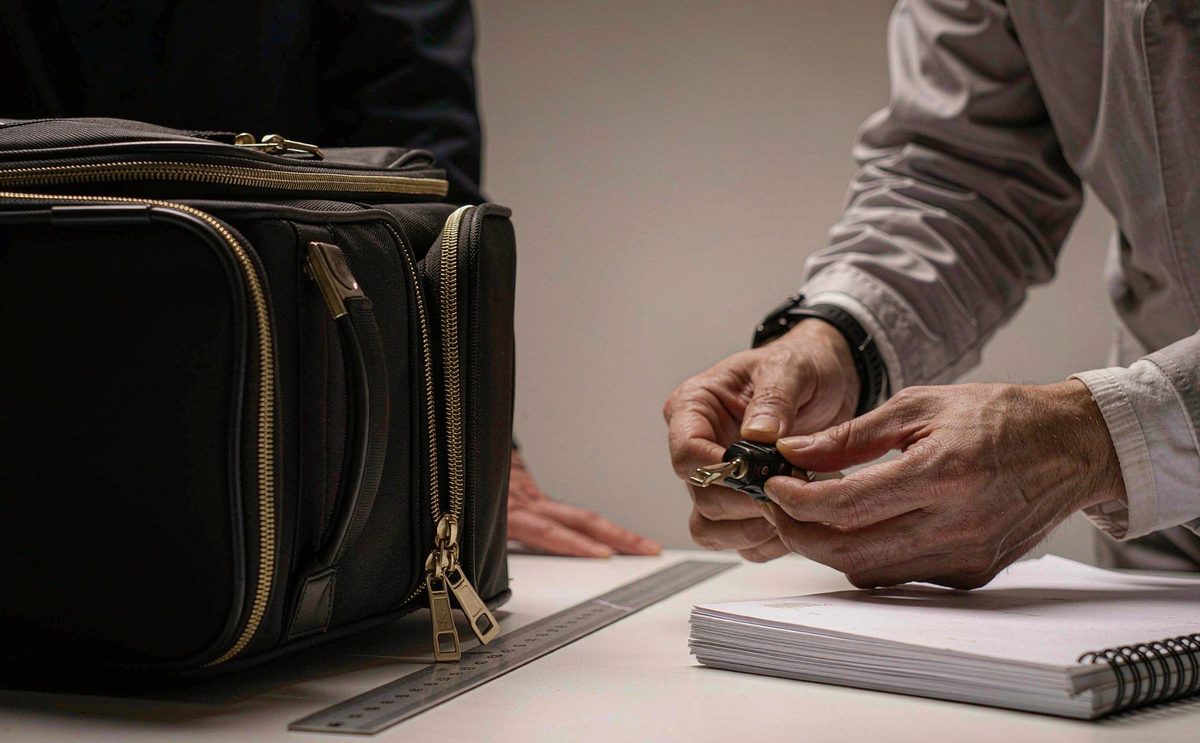
- Four inspection gates before a parcel ships
- Reading an AQL 2.5 plan as the buyer
- Lot size to sample size: switching rules
- Critical, major, minor: pricing each class
- In-line findings beat final findings
- Physical tests every bag RFQ names
- Zipper cycles, strap pull, corrosion
- Colour transfer and crocking losses
- CPSIA for US-bound shipments
- REACH SVHC and Annex XVII for the EU
- Proposition 65 as a documentation decision
- OEKO-TEX Standard 100 and GRS
- EU GPSR paperwork a 3PL will request
- Choosing a lab, budgeting turnaround
- Cost of failure: re-work and air freight
- Writing criteria into the purchase order
Four inspection gates before a parcel ships
A campaign reward is not a normal wholesale order. A wholesale buyer can accept a late lot, negotiate a credit note and move on. You have several thousand people with a delivery date in their heads and a public comment thread if the date slips. Quality control on a crowdfunding bag programme therefore has to be staged, documented and paid for before the campaign goes live, not negotiated afterwards.
Four gates do the work. The first is a material gate, where fabric, lining, foam, webbing, zips and metal trim are checked against the tech pack before cutting starts; this is where substitutions get caught, and it is the single cheapest gate to enforce. The second is an in-line gate, usually placed when 20-30% of the run is assembled and seam allowances, bar-tack placement and print registration can still be corrected on the remaining pieces.
- Gate 1 — material and trim verification: before cutting. Checks fabric weight, colour reference, coating behaviour, zip grade and metal finish against spec.
- Gate 2 — in-line inspection: at roughly 20-30% assembled. Catches construction drift while most of the run is still uncut and unsewn.
- Gate 3 — final random inspection: at 100% packed or 80% packed per your agreement. The statistical release decision under ISO 2859-1.
- Gate 4 — document and compliance review: before vessel loading. Confirms test reports, declarations and labelling match the destination market.
The third gate is the final random inspection, taken from sealed cartons, and it is the one everybody quotes because it produces the ATP (Accepted to Pass) or the hold. The fourth is a paperwork review, and on regulated markets it is the one that actually stops your goods at customs or at the 'Please complete your survey' stage of your pledge manager. If you are planning the sequence from the start, read the crowdfunding bag guide alongside this page, because defects and delays share the same root causes.
Reading an AQL 2.5 plan as the buyer
AQL stands for acceptance quality limit. It is not a promise that your batch is 97.5% good, and it is not a defect rate you can quote to backers. It is the worst process average that the sampling plan is designed to accept most of the time. Under AQL 2.5 with single sampling and general inspection level II, a plan will pass lots coming from a process averaging around 2.5% defective far more often than it will pass lots from a process averaging ten times that.
What matters commercially is the inverse: for any given plan, some poor lots still get through. That residual risk is called consumer's risk, and it is why the plan choice matters less than the defect classification behind it. A plan at AQL 2.5 that counts a broken zipper pull as one major defect is a very different commercial instrument from the same plan that also counts loose threads as majors. Write the defect list first, then pick the numbers.
Every dispute about an inspection result eventually comes down to a definition written too late. Attach a numbered defect dictionary to the purchase order, agree the critical / major / minor split before deposit, and require the inspector to cite the line number for each finding.
Your production partner will usually propose ISO 2859-1 single normal sampling with level II. That is the market default and it is defensible. Insist on three things being recorded with the plan: the inspection level, the sampling scheme state (normal, tightened or reduced), and whether the lot was 80% or 100% packed at the time of drawing. A report without those three facts cannot be compared with your next one.
Lot size to sample size: switching rules
Campaign orders cluster between 500 and 5,000 pieces because that is where reward mathematics lands once you have priced tier structure and stretch goals. Those lot sizes sit comfortably inside the standard code-letter range, so your sample sizes are small, predictable and cheap. Below is the single normal sampling column at AQL 2.5, general inspection level II.
| Lot size (pcs) | Code letter | Sample size | Accept | Reject |
|---|---|---|---|---|
| 51-90 | E | 13 | 0 | 1 |
| 91-150 | F | 20 | 1 | 2 |
| 151-280 | G | 32 | 2 | 3 |
| 281-500 | H | 50 | 3 | 4 |
| 501-1200 | J | 80 | 5 | 6 |
| 1201-3200 | K | 125 | 7 | 8 |
| 3201-10000 | L | 200 | 10 | 11 |
| 10001-35000 | M | 315 | 14 | 15 |
Two practical consequences follow from that table. First, a 500-piece first run is drawn at 50 pieces, which is enough to find systematic problems and not much more; you should treat the in-line gate as equally important because it touches every unit, not a sample. Second, going from 500 to 2,000 pieces only takes your sample from 50 to 125, so inspection cost per piece falls sharply as volume rises.
Switching rules then decide how strict your next lot is. Normal inspection is the starting state. Move to tightened inspection when two of five consecutive lots or batches fail, which raises the effective bar because you accept fewer defects at the same sample size. Return to normal after five consecutive lots pass under tightened rules. Reduced inspection is possible only when ten consecutive lots have passed and production has been steady, and it should rarely be used on a first programme.
Critical, major, minor: pricing each class
Defects are not equal and your tolerance should not be either. Critical defects make the product unsafe or illegal: a needle left in the lining, a detachable small part on anything marketed to children, an exposed sharp edge on hardware. Major defects make the bag unsaleable to a reasonable backer: a failed zip slider, a torn load-bearing seam, a 12 mm panel mismatch on the front face. Minor defects are cosmetic and countable in dozens: stray thread ends, light creasing, a slightly off-centre label.
| Class | Typical example on a bag programme | Usual tolerance at AQL 2.5 | Typical remedy |
|---|---|---|---|
| Critical | Broken needle fragment inside lining, sharp hardware burr | Zero acceptance, any finding fails the lot | 100% re-screen of the lot plus metal-detection pass |
| Major | Zip slider failure, split load seam, wrong colourway panel | Counted against the AQL 2.5 figure | Re-work pass then re-inspection at your cost allocation |
| Minor | Thread ends, light creasing, print registration within 1 mm of target | Counted against a looser limit such as AQL 4.0 | Accept with written note, or re-work if concentration is high |
| Functional spec miss | Capacity short by 8%, laptop sleeve 5 mm tight | Usually treated as major once tolerance is written | Requires engineering change, extension to the window |
Notice the fourth row. Dimensions are the most common cause of a campaign complaint that is not technically a defect at all. The bag is made perfectly to the drawing and the drawing was wrong. That is why your tech pack and sampling rounds must record dimensional tolerance explicitly — plus or minus a stated number of millimetres — rather than relying on an unqualified dimension.
Agreeing the critical and major line before deposit saves the most money, because it converts a subjective argument at the final gate into a checklist the inspector applies mechanically. Budget roughly one re-inspection occurrence per campaign programme in your risk line; most first-time programmes use it at least once, typically on print registration or hardware finish.
In-line findings beat final findings
Every defect has three prices: the price of finding it before cutting, the price of finding it on the line, and the price of finding it after packing. Those prices differ by an order of magnitude each step. A fabric shade mismatch caught at the material gate costs fabric replacement and a few days. The same mismatch found at final random inspection costs the full run, the packing labour, the booking slot and usually the freight.
- Book the in-line visit explicitly in the purchase order, not as an optional extra quoted later.
- Fix the trigger point as a percentage of assembled units, commonly 20-30%, so the visit cannot drift to the last day.
- Require photographs of the finding, the affected workstation and the corrected unit in the same report.
- Require a corrective-action note naming the changed parameter, because a concession to 'be more careful' changes nothing.
The single highest-yield inspection item on a bag run is stitch consistency at load-bearing joins: strap roots, handle attachments, bottom panel corners and any bar-tack. Set a stitches-per-inch figure in the tech pack and put a seam-ripper and a counter in the inspector's hand. A bag that passes every visual criterion can still fail at the strap root on day eleven of use, and that failure interviews badly on a public campaign page.
A re-work line under time pressure is the least reliable place to catch defects. Ask for the AQL sampling result first, then use 100% screening as the remedy for a failed lot — never as the plan itself.
Physical tests every bag RFQ names
Chemical compliance gets the headlines; physical testing gets the returns. Your RFQ should name the test method, the target value and the standard, so the quotation prices the test rather than guessing at it. Below is the core list we recommend for a first production run of 500 pcs or more, with the understanding that technical fabrics and structured builds add rows.
| Property | Common test method | What you are buying with it | Why it pays on a campaign |
|---|---|---|---|
| Seam strength | ASTM D5034 grab test, or ISO 13934-1 | Minimum force in newtons before seam failure | Strap-root and bottom-seam failures are the top field complaint |
| Abrasion resistance | ISO 12947-2 Martindale, ASTM D4966 | Cycles to yarn break or colour change | Separates a shell fabric that lasts a season from one that lasts years |
| Colourfastness to rubbing | ISO 105-X12 dry and wet crocking | Grey-scale rating 4-5 target | Prevents dye rubbing onto clothing in shipping and in use |
| Water repellency | AATCC 22 spray test | Spray rating after stated washes | Substantiates any water-resistant claim in your campaign copy |
| Dimensional check | Measured against approved PPS | Tolerance in millimetres as written in the tech pack | Protects laptop fit, carry-on fit and stated capacity |
Test fees are quoted per test per material, and a typical first programme needs somewhere between 8 and 14 discrete tests once shell, lining, webbing and trim are counted. Budget a few hundred dollars, not thousands, for the physical set — but budget it early, because the results feed design freeze. If your hero reward is a structured carry-on or weekender, cross-reference the travel bag build notes for the trolley-sleeve and wheel-base tests that also apply.
Reading seam and abrasion results
ASTM D5034 measures the force required to rupture a specimen gripped in the centre of its width, so it is a reasonable proxy for the way a strap root behaves when someone swings a loaded bag onto one shoulder. The useful output is not the pass mark itself but the margin. A seam that passes at twice your minimum will survive stitch-length drift; a seam that passes at 10% above your minimum will fail as soon as the line changes needle or operator.
Ask for the raw value, not a pass/fail tick. Martindale abrasion deserves the same treatment: a shell fabric that reaches 30,000 cycles on a Martindale head is a different product from one that stops at 10,000, even if both technically meet the same clause. For a gym or sports reward carried daily and dropped on changing-room floors, that difference is the difference between a five-star reward and a refund request. See the sports bag specification route for the heavier fabric grades usually specified there.
Where a cost saving is offered late in sourcing — a lighter coating, a marginally thinner interlining, an unbranded foam — ask for the test values of the substituted input before agreeing. Substitutions are normal and often sensible; unmeasured substitutions are how a documented spec quietly becomes a different bag.
Zipper cycles, strap pull, corrosion
Hardware failures dominate campaign complaints for a structural reason: zips and sliders are the only moving parts in most soft goods, and they absorb every cycle the backer puts into the bag. Specify zip grade, chain material and slider model by name in the tech pack, then specify a cycle figure — commonly several thousand open-and-close cycles without separation or slider failure — and test it on a sample before bulk.
- Slider failure: usually the pull tab casting or the slider body, not the teeth. Specify return-lock and non-lock variants deliberately, because they suit different uses.
- Separation under load: indicates a chain too light for the panel tension. Appears when the bag is overpacked, which backers reliably do.
- Plating and finish: black nickel and gunmetal finishes vary hugely in durability. Ask for a sample plus a stated salt-spray exposure figure such as ISO 9227.
- Strap and handle pull: set a minimum load in kilograms held for a stated duration at the strongest joint and at the webbing-to-body junction.
- Magnetic and fidlock-class closures: check pull-force and cycle behaviour, plus any effect on cards or devices in adjacent pockets.
Corrosion testing deserves a word because it is cheap and rarely requested. A neutral salt-spray exposure of 24 to 48 hours is a normal ask for metal trim and it will separate a well-plated buckle from one that spots in a humid container within a six-week ocean transit. For tech-adjacent builds with metal plates near device pockets, add a nickel-release check and read the laptop bag compliance notes alongside this section.
Colour transfer and crocking losses
Colour problems are the most visible failure mode in a campaign and the one backers photograph most often. Dark indigo, deep red and saturated black linings are the usual suspects. ISO 105-X12 wet and dry crocking against a grey scale gives you a defensible figure; a target of 4-5 for dry and 4 for wet is a normal specification for a bag that will be carried against clothing.
Three additional fastness properties matter for specific rewards: perspiration (ISO 105-E04) for any strap or back panel that sits against skin, light (ISO 105-B02) for a product shipped to high-UV markets, and perspiration-plus-light for anything carried outdoors every day. A backpack that fades unevenly across the front panel generates more complaints than one that simply wears.
Print and decoration have their own adhesion figure. Screen prints cure differently on coated nylon versus canvas, and a print that survives 20 wash cycles on one substrate can crack on another. Ask for a wash-cycle and rub-cycle target in the PO, and note that the cost of getting this right sits mostly in the sampling phase rather than in the production price.
Test the material, not the intention. A written claim of 'premium hardware' is worth exactly the cycle figure you put behind it.
Kickstarter Creator Handbook
CPSIA for US-bound shipments
QC during sampling
Where test submission fits inside the 6-10 working days of sampling window and the 12-15 day complex path.
QC before parcels ship
How the release decision hands over to packing, cartons and backer addresses.
QC cost at low volume
Why a 500-piece first run still deserves the full inspection and test schedule.
For United States backers you are dealing with the Consumer Product Safety Improvement Act, enforced by the CPSC. Two headline limits apply to products regulated as children's products: total lead content in accessible substrates capped at 100 ppm, and lead in paint or surface coatings capped at 90 ppm. Phthalates are restricted at 0.1% each for DEHP, DBP and BBP in children's toys and child care articles, with additional listed phthalates covered by separate rules.
The threshold question is classification. An ordinary backpack marketed to adults is not a children's product, and many campaign bags sit comfortably outside CPSIA's children's scope. But if your marketing, sizing or artwork targets children — a school bag, a youth team kit, anything with cartoon artwork and a twelve-inch height — you enter that scope and you inherit third-party testing by a CPSC-accepted laboratory and a Children's Product Certificate, plus permanent tracking labels identifying the production run.
| Regulation | Applies when | Evidence a broker or 3PL asks for | Typical lead time |
|---|---|---|---|
| CPSIA lead limits | Product is marketed or sized for children under 12 | Third-party lab report plus Children's Product Certificate | About 5-8 working days for the lab portion |
| CPSIA phthalates | Children's toy or child care article, PVC or printed coatings present | Lab report covering the listed phthalates | About 5-8 working days |
| Tracking label | Children's products, permanently affixed | Visible label with location, date and run reference | Resolved at packing spec stage |
| REACH SVHC screening | Placing goods on the EU or UK market | Substance screening or full declaration plus SCIP reference where relevant | About 6-10 working days |
| California Proposition 65 | Products sold into California with a listed substance above safe-harbour level | Warning text, or a risk-assessment memo | Concurrent with material selection |
Note the timing column. None of these short, but all of them have to run before the bulk cut, which means they sit inside your sampling window rather than after it. If you have already read the low-MOQ production route, treat lab work as a sampling-phase line item rather than a production contingency.
REACH SVHC and Annex XVII for the EU
REACH governs chemical substances placed on the European Union market, and for a bag programme two mechanisms matter. The Substances of Very High Concern candidate list maintained by ECHA is revised roughly twice a year and is now several hundred entries long; where a listed substance is present above 0.1% by weight in an article, communication duties and, above a volume threshold, notification duties attach. Annex XVII carries the outright restrictions, including those on azo dyes, nickel release, chromium VI and cadmium.
In practice you satisfy this with two documents, not one. The first is a material-level test report — usually per substrate, per colour — from an accredited laboratory. The second is a supplier declaration that flows from your material source and travels with the lot. Since January 2021 there has also been the SCIP notification route to ECHA for articles containing candidate-list substances above the threshold, which matters more once you move into retail channels beyond the campaign.
Two practical points decide cost here. First, test per colourway, not per fabric family: a dark reactive dye behaves differently from a pale pigment version of the same cloth. Second, ask for the declaration at quotation stage, because a supplier unable to produce one is telling you something about traceability that you want to hear during sourcing rather than during customs clearance. Cost per extra colourway is modest and predictable; the cost of discovering the gap during clearance is not.
Proposition 65 as a documentation decision
California's Proposition 65 is a right-to-know law rather than a product standard. It requires a clear warning before exposing California residents to a listed substance above a safe-harbour level, and it carries a private-enforcement mechanism, which is why it generates litigation out of proportion to the technical risk. The listed chemicals number around nine hundred, so the default assumption for any consumer textile or accessory is that something on the list may be present.
For bags, the common exposures are lead in PVC or printed coatings, phthalates in coated fabrics, and cadmium in pigments. None of these are unusual inputs; all are controllable if specified out. The decision you face is economic: either test the specific inputs and document why no warning is required, or apply the warning text to packaging and listings. Applying the warning is cheap. Discovering mid-fulfilment that you needed it is not.
Fold the decision into your packing spec, because the warning belongs on the retail package or hangtag and therefore has a print lead time attached. If you are routing inspection documentation anywhere, route it into the same folder as your reward fulfilment pack so the 3PL sees one consistent story.
OEKO-TEX Standard 100 and GRS
Two voluntary certifications come up repeatedly in bag RFQs. OEKO-TEX Standard 100 tests for harmful substances across product classes, with Class I for babies and toddlers, Class II for items with direct skin contact, Class III for items without direct skin contact and Class IV for decoration materials. A bag that touches bare skin — a gym harness — is Class II territory, and that is normally the class worth specifying.
GRS (Global Recycled Standard) certifies recycled content along with social and environmental criteria, and it carries transaction-certificate requirements downstream. Your certification body will confirm the current minimum recycled-content threshold for the label, so do not fix that figure in stone in your own spec. What you should fix is the requirement that a valid, current scope certificate plus transaction certificate travel with the lot, because that is the document a retail buyer will later ask for.
A recycled-content claim made in campaign copy without transaction certificates behind it becomes a substantiation problem the moment a retailer or a marketplace compliance team asks for evidence. Order the certificates with the goods.
Whether these certificates earn their cost depends entirely on your follow-on channel. If the campaign is the whole business, standard Class II OEKO-TEX coverage plus your REACH and CPSIA documentation is usually sufficient. If you intend to sell into outdoor retail, department stores or EU marketplaces afterwards, certification is cheaper booked in the first run than retrofitted to a re-order, because re-testing an already-produced lot costs more than testing it once correctly. The tote category notes show how this works out on the simplest build.
EU GPSR paperwork a 3PL will request
The EU General Product Safety Regulation (Regulation (EU) 2023/988) applies from December 2024 and replaces the previous directive framework. For your purposes it imposes three things: a responsible person established in the EU who holds the technical file, technical documentation describing the product and its risk assessment, and product identification labelling sufficient to trace the unit. None of it is difficult, and all of it has to exist before your goods reach a European warehouse.
Your destination 3PL is often the first party to notice a gap, because it cannot intake an untraceable SKU into a bonded or fulfilment environment without the identification data. Build the file as you go rather than at the end: composition tables from material sourcing, test reports from the lab phase, photographs of the approved pre-production sample, packing spec, and the declaration-of-conformity document set.
The practical rule is to assign ownership early. Somebody — you, your production team, or your compliance adviser — should hold a single folder with a document register listing date, version and issuing body. When a re-order happens eight months later with a different trim lot, that register tells you immediately which line needs re-testing and which does not.
Choosing a lab, budgeting turnaround
Third-party laboratory work is quoted by accredited international houses such as SGS, Intertek, Bureau Veritas and TUV, all of which maintain textile and soft-goods laboratories in the major production regions. Choose on three criteria: accreditation scope covering the exact standard you need, turnaround quoted in working days rather than calendar days, and willingness to accept your own composite testing plan rather than forcing a package.
- Decide whether you need per-colourway or per-material reporting, because that choice doubles or halves the line.
- Ask for turnaround in working days and add three days of courier and administrative slack.
- Bundle physical and chemical testing into one submission where the same material appears in both schedules.
- Request the report in digital form with the accreditation body's mark visible on each page.
- Retain reports for at least three years; re-orders and retail reviews both ask for them.
Turnaround for a combined physical schedule usually runs about five to eight working days for chemistry and a similar range for physical testing, though abrasion tests using Martindale heads to high target values can take longer because they cannot be accelerated. On a programme with 6-10 working days of sampling, that means submitting test material on day two or three of the sampling window, not at the end. Your production partner coordinates the submission; your responsibility is deciding what goes in it.
Cost of failure: re-work and air freight
Failure economics are worth pricing explicitly because they decide whether a borderline lot is worth arguing about. A failed lot that must be re-worked costs four things sequentially: the labour to open cartons and re-screen, the labour to fix or replace, the re-inspection day rate, and the calendar. That fourth cost is invisible until it pushes you past a freight cut-off.
| Failure found at | Typical cost scope | Calendar impact | Backer-visible outcome |
|---|---|---|---|
| Material gate | Replacement fabric or trim only | A few days inside the sampling window | None |
| In-line at 25% | Correction on remaining units plus some re-work | Usually absorbed within the 35-50 day window | None if caught early |
| Final inspection | Full re-screen, re-work, re-inspection day rate | Commonly 5-12 additional days | Delayed survey closure |
| After vessel departure | Replacement run plus possible air freight differential | Can exceed a full month | Missed stated delivery month |
Read the last row twice. The most expensive version of this is always the version where the goods have already shipped, because now you are choosing between shipping replacements by air at several times the per-unit sea cost or refunding backers. Air freight on a 2,000-piece backer parcel programme can consume the entire margin line that took you three months to negotiate. This is the strongest argument for paying for the in-line visit.
A useful rule of thumb: spend one to two per cent of the total production value on inspection and testing, and expect it to return several multiples on any programme where a single failure mode is systematic rather than random. Random defects get through regardless. Systematic ones are exactly what staged inspection exists to catch.
Writing criteria into the purchase order
Everything above is only enforceable if it appears in the document that governs payment. Your purchase order should carry, as numbered clauses: inspection standard and level (ISO 2859-1, single normal, general level II, AQL 2.5), the defect dictionary with critical/major/minor classification, the dimensional tolerance table, the physical and chemical test schedule with target values, the document set required before shipment release, and the cost allocation for re-inspection.
Two clauses get omitted most often. The first is cost allocation for re-inspection, which should state who pays the day rate and re-work when a lot fails and who pays when it passes. The second is the gold-seal reference: both parties should hold an identical PPS signed and dated, and the PO should say that bulk must match that unit, since 'matches sample' is meaningless without naming which sample.
Payment terms and inspection interact, and you should plan both together. With T/T 30/70, the 30% deposit books your 35-50 day production window and the 70% balance is due before shipment release, which gives you leverage precisely at the moment the inspection report lands. Sequence matters: inspection first, then balance, then release. On FOB Xiamen terms, title and risk pass at loading, so your inspection right has to be exercised before that point.
Key takeaways
- Stage four gates — material, in-line, final random and document review — and pay for the cheap ones early.
- Agree the critical, major and minor defect dictionary before deposit, not after a failed inspection.
- A 500-piece lot draws 50 units at level II and AQL 2.5; a 2,000-piece lot draws 125, so inspection cost per unit falls as you scale.
- Submit laboratory material in the first third of the sampling window so results land before the bulk cut.
- Write standard, level, defect dictionary, tolerances and re-inspection cost allocation into the purchase order as numbered clauses.
- Exercise the inspection right before the 70% balance is released and before risk passes at FOB loading.
Map the quality gates onto the calendar before you commit to a delivery month in the campaign copy. Working backwards from backer delivery: 6-10 working days of sampling (12-15 if the build is complex), then PPS sign-off, then a 35-50 day bulk window after deposit and approved PPS, then freight and fulfilment. Quality activity has to fit inside those blocks, not after them.
| Window | Day range | Quality activity inside it | Decision it protects |
|---|---|---|---|
| Sampling | Day 1-10 (or 12-15 complex) | Lab submission, physical test draft, material verification | Design freeze and PPS approval |
| Pre-production | Day 11-18 | Material and trim gate, pre-production meeting, revised PPS | Confirms bulk input is the same as the approved unit |
| Bulk production | Day 19-55 | In-line inspection at 20-30% assembled | Corrects drift while most units are uncut |
| Pre-shipment | Day 56-62 | Final random inspection, document review, balance payment | Shipment release and title transfer at FOB Xiamen |
| Transit and fulfilment | Day 63 onward | Replacement stock planning, claim substantiation file | Protects your survey closure and review scores |
Capacity also has a quality dimension. A production floor of 4,950 m2 verified by SGS, staffed by 137 people across 7 lines with 149 machines, running at up to 200,000 pieces per month, is not the constraint on a 500 to 5,000 piece campaign order. The constraint is the *slot*: a window booked and reserved, with material confirmed and the line scheduled, so nobody is tempted to compress inspection because the vessel is waiting. When you request a quotation, ask what slot you are being offered and what happens to it if the PPS slips. Our coordinating team has been running bag quality programmes since 2014, drawing on trade experience going back to 2004, and has supported more than 20 crowdfunding campaigns through exactly these gates.
Finally, keep the file. Every test report, every inspection result, every signed PPS and every supplier declaration should sit in one version-controlled folder, because the second production run is where this pays off. A re-order with complete documentation can often skip part of the lab schedule and move directly to verification against the retained golden sample, which shortens the calendar by days at zero cost.
Backpacks and tech-carry
Strap-root loads, zip cycle targets and drop-test criteria that apply to structured carrying builds.
Duffel and weekender builds
Where the load path fails first on high-volume soft bags, and which tests predict it.
Cosmetic and small formats
Leak, closure and chemical-contact documentation for compact goods.
- Full crowdfunding bag programme guide
- Sampling rounds and pre-production sign-off
- Rewards fulfilment and packing specification
- Low-MOQ production economics
- All bag categories for campaign rewards
- Request a quotation for your QC schedule
Get a QC schedule priced for your reward
Send us your bag category, target volume and destination markets and we will return an inspection and compliance quote plus a calendar that fits the 35-50 day window.
Frequently Asked Questions
What does AQL 2.5 actually mean for my 500-piece Kickstarter bag order?
AQL 2.5 is an acceptance quality limit used with a sampling plan, not a guarantee of a 2.5% defect rate. For a 500-piece lot at general inspection level II under ISO 2859-1, the sample size is 50 units with 3 defects accepted and 4 rejected. Lots from a process averaging roughly 2.5% defective will usually pass; some worse lots will still slip through.
Do I need CPSIA testing if my backpacks are sold to adult backers?
Usually not. CPSIA's children's product limits apply when the product is marketed or sized for children under 12. An adult-commuter backpack with no child-directed artwork typically falls outside that scope. But if you add youth sizing or child-directed graphics, you inherit testing, a Children's Product Certificate and tracking labels.
How many units will the inspector open on a 2,000-piece bag run?
Under ISO 2859-1 single normal sampling at general inspection level II and AQL 2.5, a lot of 1,201 to 3,200 pieces draws a code letter K sample of 125 units, with 7 defects accepted and 8 rejected. That small number is why the in-line inspection at 20-30% assembled matters so much on every campaign run.
What lead time should I allow for third-party laboratory testing?
Budget 5-8 working days for chemical screening and a similar range for physical testing, plus about 3 days of courier and administrative slack. Abrasion runs using Martindale heads to high target values can take longer because they cannot be sped up. Submit material by day 2 or 3 of your 6-10 working days of sampling window.
Is REACH compliance required for crowdfunding rewards shipped to EU backers?
Yes, once you place goods on the EU market you take on REACH duties regardless of the sales channel. In practice you need per-material or per-colourway test reports plus supplier declarations covering SVHC screening and Annex XVII restrictions. Above 0.1% by weight in an article you take on communication duties, and above 1 tonne per importer per year notification duties attach. Above that threshold an SCIP reference like the one required since January 2021 may also be expected by a European warehouse.
How much should inspection and testing cost as a share of my budget?
Plan on 1-2% of total production value covering all four gates and the full test schedule. Typical first programmes need 8-14 discrete physical tests plus a chemical run. The return comes from catching systematic failures early, where the same problem found after vessel departure costs several times more.
Who pays for re-inspection when a lot fails the final random check?
Whoever your purchase order says pays, which is exactly why the clause has to be written before deposit. Common practice allocates re-work to the production side and the re-inspection day rate to whoever's specification caused the finding. Common practice allocates re-work labour to the production side and the re-inspection day rate to whoever's specification caused the finding. Agree the 3 defect classes first, then allocate cost, then order re-inspection within 5-12 days.
Which physical test catches the most failures on crowdfunding bags?
Stitch consistency and seam strength at load-bearing joins, because strap roots and bottom seams carry every cycle the backer puts into the bag. Specify stitches per inch in the tech pack and test grab strength to ASTM D5034. Request raw newton values so you can see the margin above your minimum rather than a bare pass mark.
Should I specify zip hardware by brand name in my tech pack?
Yes, specify chain grade, material and slider model by name, then add a measurable cycle target of several thousand open-and-close cycles without separation. Specify the zip declaration when 6-10 working days of sampling are still ahead of you, since fitting different hardware after the bulk cut is impossible. Slider body failures generate more field complaints than any seam issue.
Does Proposition 65 require me to change my bag design?
Not usually. Proposition 65 is a right-to-know law rather than a product standard, so either test the specific inputs such as lead, cadmium and phthalates and document why no warning is needed, or print the warning on retail packaging. Decide during the packing spec stage, because the warning has a print lead time attached.
Do I really need a 100%-metal-detection pass on my first run?
Metal detection is standard practice for soft goods and cheap relative to the downside. Around 900 chemicals are listed, so assume something may apply. A single needle fragment or elevated lead reading is a critical defect that voids any pass result. Request it combined with any re-screen.
Is OEKO-TEX Standard 100 certification worth the fee on a first campaign?
It works across 4 product classes, and Class II covers anything worn against bare skin such as straps or harnesses, at a modest cost per SKU. It clearly pays if retail follows, because booking it in run 1 is cheaper than retro-fitting a completed run 2.
What is the European responsible person requirement under GPSR?
Regulation (EU) 2023/988 requires a responsible person established in the EU holding the technical file, plus documentation describing the product and its risk assessment, plus traceability labelling on the unit. It applies from December 2024. Your destination 3PL may refuse intake without it, so build the folder during the production window.
How do I keep colourfastness problems out of a dark indigo canvas run?
Specify ISO 105-X12 dry and wet crocking targets of 4-5 dry and 4 wet against the grey scale, and add perspiration fastness to ISO 105-E04 for strap and back panels. Dark reactive dyes are the usual offenders. Test per colourway rather than per fabric family, since the same cloth behaves differently across colours.
When during the production cycle should I exercise my inspection right?
Three times: at the material gate before cutting, in-line at 20-30% assembled, and at final random inspection before shipment release. With T/T 30/70 terms the 70% balance is the leverage point, so sequence inspection first, then balance payment, then release. On FOB Xiamen, risk passes at loading, so nothing waits until afterwards.
Can I reuse test reports from my first run for a re-order?
Often yes, if materials and trims are unchanged and the reports are still within their validity window, Validity commonly runs 1 to 3 years depending on the scheme. Any changed trim lot or new colourway needs fresh testing. Retain dates and issuing bodies so verification against the golden sample can skip repeatable lines.
People Also Ask
What is a good AQL level for bags?
AQL 2.5 for major defects and AQL 4.0 for minor defects under ISO 2859-1 single normal sampling is the widely used commercial default for soft goods.
How much does third-party bag testing cost?
A combined physical and chemical schedule for a first campaign run commonly lands in the low hundreds of US dollars per material, quoted per test per colourway.
Can I ship to EU backers without REACH documents?
You can physically ship, but a customs broker or EU fulfilment warehouse can hold the goods, and untraceable units create exposure that is far more expensive than the screening.
What happens if my bags fail final inspection?
The lot is held, re-worked or re-screened, then re-inspected. Expect 5-12 additional days, and check your purchase order clause to see who carries the day rate and re-work labour.
How many samples do inspectors check on small orders?
Sample sizes are set by lot size, not by order value. A 500-piece lot draws 50 units, while a 2,000-piece lot draws 125 units at general inspection level II under AQL 2.5.
Do tote bags need the same tests as backpacks?
Fewer. A printed canvas tote usually needs colourfastness and print-adhesion work more than abrasion and strap-load testing, which reduces the schedule and the associated laboratory spend.
Why did my sample look perfect but bulk units differ?
Almost always tolerance drift or an unrecorded material substitution. Insist on a signed, retained golden PPS, a written dimensional tolerance table and a change-control record for every input.
Should compliance testing happen before or during sampling?
During. Submit laboratory material in the first third of the 6-10 working days of sampling window so that results inform design freeze rather than arriving after the bulk cut.