Custom Cosmetic & Toiletry Bags for Kickstarter — Beauty Campaign Rewards
Custom cosmetic and toiletry bags for a Kickstarter campaign start at MOQ 500 pcs per style and colourway, sample in 6-10 working days and run 35-50 days in bulk at AQL 2.5 to ISO 2859-1. Small formats are priced by labour rather than material, so lining choice, coating route and zipper grade decide unit cost. This hub explains leak-resistance engineering, cosmetic-contact safety documentation and what a beauty category RFQ must contain.
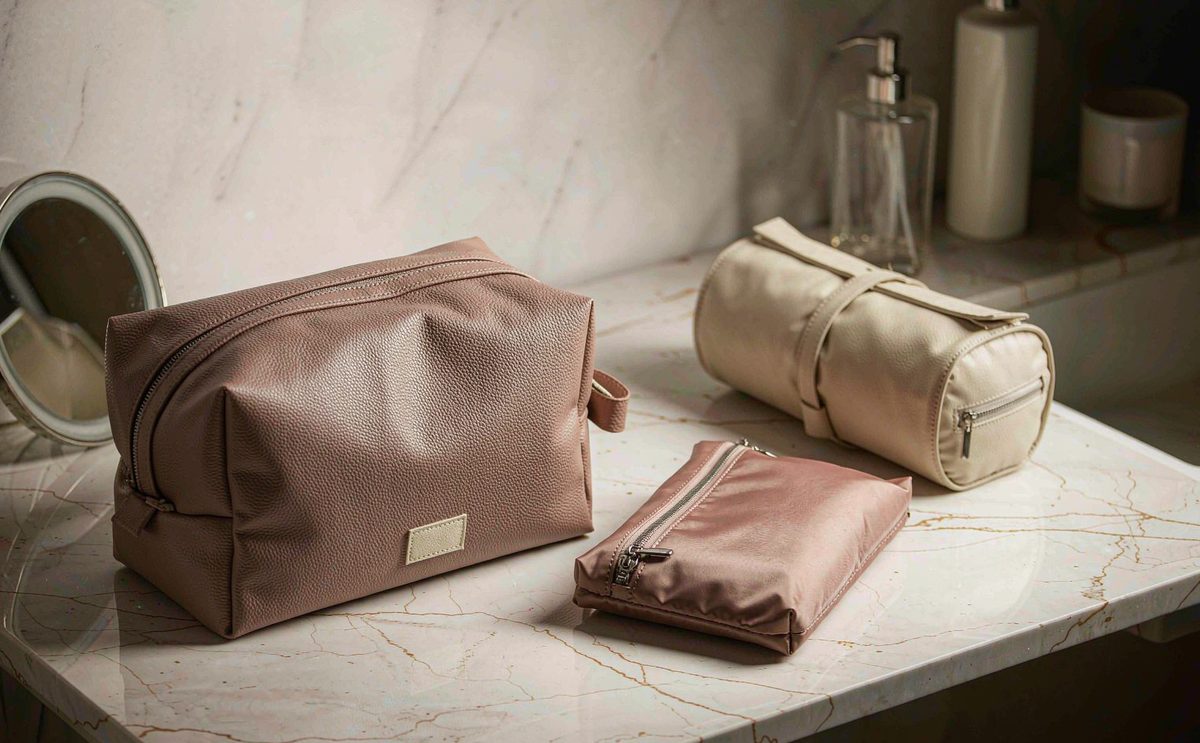
- Why small-format bags are priced on labour
- Shape families across beauty and toiletry rewards
- Lining selection and interior finish
- PU versus TPU coatings as measurable figures
- Zipper grading for cosmetic and toiletry formats
- Small-format assembly and cycle-time economics
- Branding and decoration on compact surfaces
- Handles, loops and hanging hardware
- Unit cost from 500 to 2,000 small-format units
- Sampling cosmetic bags for leak and closure testing
- Inspection criteria specific to small-format runs
- CPSIA, cosmetic-contact and chemical documentation
- Packaging, presentation and secondary boxing
- Freight economics of light high-cube shipments
- A beauty category RFQ that prices accurately
Why small-format bags are priced on labour
A cosmetic pouch contains very little material. A flat 20 by 12 centimetre case might use a fraction of a square metre of shell fabric, a similar amount of lining and a single zip. Material is not the cost driver. What sets the price is the number of operations required to build something small: cutting, turning, binding, edge finishing and closure assembly all consume more time per unit than they do on a larger bag.
That inversion has a direct commercial consequence. Volume discounts on small formats are shallower than on backpacks or duffels, because doubling an order does not shorten the time it takes to turn a tiny seam. Where a large bag might move meaningfully on price between 500 and 1,000 pcs, a cosmetic pouch often moves very little, and a campaign that budgets for a twenty percent improvement will be disappointed.
The practical response is to simplify construction rather than to negotiate. A flat pouch with one zip and one turned seam is genuinely cheap to make at any volume. A boxed case with an internal mirror panel, elastic loops, a bound divider and a hanging loop becomes a multi-station build in a very small footprint, and that is where unit cost quietly doubles. Programme parameters are unchanged across categories: 500 pcs per style and colourway, 6-10 working days of sampling and 35-50 days of bulk, as set out in the campaign sourcing hub.
Every additional stitch operation adds time that volume cannot remove. Before approving a cosmetic bag design, count the operations rather than the materials. Two functionally similar pouches can differ by a factor of nearly two in unit cost purely through the way the interior is assembled.
Campaign bag hub
Programme parameters, cost structure and RFQ standards shared by every category.
Toiletry bags
Travel organisation formats with hanging and packing features.
Pouches
Flat formats for entry tiers and shared-fabric add-ons.
Tech pouches
Structured small formats for cable and accessory organisation.
Shape families across beauty and toiletry rewards
Four shape families cover almost every beauty reward, and each sits at a different point on the cost and complexity scale. The right choice depends on what the campaign is promising: a flat pouch reads as a companion accessory, while a structured case reads as a product with architecture, and it is priced accordingly.
| Shape family | Construction profile | Cost position | Typical reward role |
|---|---|---|---|
| Flat zip pouch | Two panels, one closure, turned and topstitched | Lowest | High-volume entry tier or an add-on shared with the hero bag |
| Boxed base case | Base panel plus sidewalls, structured opening | Mid to high | Hero reward where a formed silhouette carries the page |
| Hanging roll or travel wrap | Multiple compartments, binding, hanging hardware | Mid to high | Toiletry positioning where packing organisation is the promise |
| Structured vanity case | Rigid or semi-rigid frame, internal mirror, dividers | Highest | Premium tier at a higher pledge, usually below 1,000 pcs |
Where a campaign wants both a hero and an accessible entry tier, the efficient structure uses one fabric purchase and one print set-up across two shapes. A flat pouch made from the same shell lot as a structured case adds a low-cost pledge tier without triggering a new minimum, and it photographs well beside the hero product.
Colourway discipline matters just as much here, and the arithmetic is unforgiving: each colourway carries its own 500-pcs minimum. Beauty audiences expect choice, which creates pressure to launch two or three shades. The commercial answer is usually one colourway plus a contrasting interior, since the interior lining colour adds visual interest without creating a second outer shell.
Lining selection and interior finish
The lining is the part of a cosmetic bag that determines whether it survives its first year. It must resist staining from pigments and oils, wipe clean without abrading, and stay flexible at the fold points where a small case is opened hundreds of times. Selecting a lining on colour alone is the most common specification mistake in this category.
- PU-coated 210D polyester as the standard route: wipe clean, good colour retention, economical across all volume tiers.
- TPU-laminated 210D or 300D where leaks from liquids must be contained, including inside a sealed compartment.
- Soft-touch brushed polyester for premium tiers where hand-feel matters more than stain resistance.
- Light-coloured linings chosen deliberately, because cosmetics are easier to find inside a pale interior than a dark one.
- Bound seams inside rather than raw edges, since a raw interior edge abrades quickly against repeated contact with brushes and bottles.
Stain resistance deserves a practical test rather than an assumption. Apply a small amount of foundation or tinted product to a lining swatch, leave it for an hour, wipe with a damp cloth and photograph the result. Most coated linings perform adequately, but uncoated woven linings retain pigment permanently, and that finding is far cheaper to discover on a swatch than on a thousand finished units.
Interior finish also affects perception at unboxing, which is when backers decide whether the reward feels worth the pledge. A bound interior seam with a contrasting colour costs a modest amount per unit and immediately reads as a considered product. Where budget is tight, spend it on the interior rather than on the exterior, because the exterior has already been seen in campaign photography.
PU versus TPU coatings as measurable figures
PU and TPU are both polyurethane chemistries, and the difference that matters commercially is how each behaves when a seam must be sealed or welded. PU is the economical coating applied to a woven base, giving water repellency and a wipe-clean surface at low cost. TPU is a laminate film that can be heat-welded to itself, which is what makes a genuinely sealed compartment possible.
| Coating route | Seam treatment available | Relative cost | Where it belongs in a beauty build |
|---|---|---|---|
| PU coating, light application | Standard stitching only | Baseline | Flat pouches and general toiletry interiors where no leak claim is made |
| PU coating, heavy application | Stitching with taped seams possible | Moderate premium | Cases likely to hold damp items, such as a wet brush pocket |
| TPU laminate | Heat-welded seams and welded zips | Notable premium | The liquid compartment of a hero case, or any tier carrying a leak-resistance claim |
| TPU film on the outer face | Welded construction throughout | Highest | Rigid and semi-rigid vanity cases where the whole body is formed by welding |
Specify coating by measurable figure rather than by name. Ask for coating weight in grams per square metre and, where any water-resistance statement will appear publicly, a hydrostatic head result in millimetres. Those two figures turn a marketing adjective into a specification the line can work to, and they give the campaign something defensible to publish.
The choice also affects the production calendar. Welded construction adds tooling and a slower cycle, pushing sampling from the 6-10 working day band into 12-15 working days. Reserve welded routes for compartments where the leak claim is central to the reward promise, and keep the rest of a build on stitched PU construction to protect both cost and schedule.
Zipper grading for cosmetic and toiletry formats
A zip is proportionally more visible on a cosmetic bag than on any other reward format, because the pouch is small and the closure runs across most of its visible width. It is also the component most likely to be judged as cheap. Zipper selection therefore carries an outsized effect on perceived quality relative to its share of unit cost.
| Zip option | Gauge guidance | Perceived quality | Practical note |
|---|---|---|---|
| Standard coil zip | #3 to #5 for pouches, #5 for cases | Acceptable on an entry tier | Lightest and cheapest; fine where the zip is not a feature |
| Branded coil zip | #5 with a smooth slider | Strong step up | The single most efficient quality upgrade available on a small pouch |
| Reverse coil | #5, teeth facing inward | Reads as premium | Also keeps pigment and powder out of the tooth channel |
| Metal zip | #3 to #5, polished | Highest perception | Heavier and prone to marking light linings; use on vanity cases rather than pouches |
| Water-resistant zip | #5 with a coated chain | Specific and technical | Required where the compartment holds liquids; pairs with a welded or taped seam |
Two-way sliders and lockable pullers are popular requests but carry hidden cost. A two-way slider doubles the hardware component count and adds a hand-on inspection point, while a lockable puller raises the expectation of security that a soft pouch cannot deliver. On small formats, money is better spent upgrading a single-thickness chain to a smoother slider than adding an extra slider.
Zip length determines how a pouch behaves in use rather than just how it looks. A chain that stops short of the corners prevents the bag from opening fully, which is the complaint most often posted about soft cosmetic pouches. Specify chain length to the pattern corners plus a stated allowance, and test the open position on the first physical sample. The zipper pouch category covers closure engineering in more detail.
Small-format assembly and cycle-time economics
Small-format assembly is dominated by turning, binding and edge finishing. Turning a pouch inside out through a short opening takes skill and time; binding a small curved seam is slower than binding a long straight one. These operations are why a cosmetic case can cost nearly as much to make as a simple duffel despite using a fraction of the material.
- Cutting. Small panels are cheaper to cut but harder to nest efficiently, so fabric utilisation is generally lower than on large formats.
- Lining preparation. The lining is cut and often assembled separately before insertion, particularly where a zipped internal pocket is specified.
- Closure installation. The main zip is attached to both shell and lining, an operation that consumes the largest single block of cycle time.
- Turning and shaping. Corners are pushed out, seams positioned and the form corrected, which is hand work rather than machine work.
- Edge finishing. Binding, topstitching or edge painting, depending on the finish promised in the campaign photography.
- Hardware attachment. Loops, hanging hooks and zipper pullers installed and bar-tacked as specified.
- Final press and check. Shaping under heat or pressure, followed by an inline visual check against the reference sample.
Understanding that sequence makes cost conversations productive. Where a quotation looks high for a small pouch, the useful question is which operations are driving it rather than which material could be downgraded. Common answers include an internal zipped pocket, a bound divider or a curved binding run, and each of those can be simplified or removed with a clear effect on the number.
Where unit cost genuinely must fall, an entry-level production route with a simplified construction is usually more effective than a discount request on a complex build. Strip the build back to a flat pouch with a single closure, and the operation count drops immediately.
Branding and decoration on compact surfaces
Compact surfaces constrain decoration. There is no large flat panel for a multi-colour print, and logos must sit within a footprint measured in a few centimetres. That rules out some methods and makes others disproportionately effective, so the branding decision should be made at pattern stage rather than after the sample arrives.
- Embroidery works extremely well at small scale and reads as premium; digitising charges apply per design and pricing follows stitch count.
- Woven labels offer the cheapest branded touch point and can be placed on the exterior seam or inside the closure.
- Heat transfer suits curved and coated surfaces but needs care where the transfer crosses a fold point.
- Screen print suits flat, single-colour marks; multi-colour work becomes costly on a small footprint with limited print area.
- Debossed or moulded patches pair naturally with a vanity case but are difficult on a soft pouch.
The most efficient combination for a beauty reward is typically an embroidered mark on the exterior face plus a woven label inside the closure. Together they provide two branded touch points at a modest unit cost, and both survive the frequent handling a cosmetic bag receives. Add printing only where the campaign artwork genuinely needs colour, because each additional colour is a separate screen charge.
Decoration also interacts with the lining. A metal zip and a dark lining can mark a pale interior through repeated contact, and a dark embroidered mark on a light exterior shows pull distortion more readily. Test decoration options on finished samples under neutral light rather than judging them from digital files, because small marks behave differently on a three-dimensional product.
Handles, loops and hanging hardware
Hardware on small formats falls into two groups: carry elements and hanging elements. Carry elements such as a wrist strap or side handle must be reinforced with bar-tacks even though the loads are light, because the attachment point is small and the leverage on it is high. Hanging elements such as a swivel hook or a fabric loop change how the product is used entirely.
- Wrist strap in 20-25 mm webbing, bar-tacked at both ends, positioned so the pouch hangs level when lifted.
- Side handle in matching shell fabric, folded and topstitched, with reinforcement inside the seam rather than visible on the face.
- Hanging loop in webbing or binding tape, sized to clear a standard towel rail and reinforced with an X-box stitch.
- Swivel hook in metal or heavy acetal, mechanically closed rather than relying on a spring alone.
- D-ring attachment points for a detachable strap, added to the pattern rather than stitched onto a finished unit.
Hanging hardware warrants particular attention because it creates a load path from the hook through the seam and into the shell. A hanging loop stitched onto the surface of a light pouch will pull through within months. The correct construction runs the loop webbing beneath the top seam so the load transfers into the seam rather than into the fabric surface, and that detail is worth stating explicitly in the tech pack.
Unit cost from 500 to 2,000 small-format units
The volume curve for small formats is flatter than in any other category, but it is not absent. Fixed charges still amortise: zip tooling where a custom slider is used, print screens, label loom set-up and the documentation package all spread across a larger run. What does not improve materially is assembly time, and on a small pouch that is the dominant cost.
| Cost element | At 500 pcs | At 1,000 pcs | At 2,000 pcs |
|---|---|---|---|
| Shell and lining fabric | Lot minimum applies across a small material quantity | Better spreading of the lot minimum | Marginal further benefit |
| Zip chain and hardware | Per-unit cost weighted by any tooling or set-up | Set-up effectively halved per unit | Set-up approaching negligible |
| Print, embroidery and label set-up | Fixed charges visibly inflate unit cost | Charges spread across double the output | Minimal further gain |
| Cutting, turning and assembly | Standard cycle time | Essentially unchanged | Essentially unchanged |
| Packaging and inspection | Charged per unit or per carton | Slight improvement | Slight improvement |
Read that table as a warning against over-optimism. A creator expecting a twenty percent unit cost reduction from doubling a pouch order is likely to see less than a third of that. The reliable way to lower unit cost on small formats is simpler construction, not larger volume, which is why the earliest design decision carries more weight than the later purchasing conversation.
Re-order economics still favour the creator strongly. Once pattern, artwork and set-up are paid, a repeat run quotes without those elements and lands materially below the original figure. Build the pledge price on the first-run cost and treat the second run as margin rather than as the assumption.
Sampling cosmetic bags for leak and closure testing
Sampling runs 6-10 working days for a stitched pouch and 12-15 working days where welded construction or custom moulded hardware is involved, counted from approved artwork and excluding courier transit. Because small formats are cheap to sample, a creator can afford to test two construction variants in parallel and select on evidence rather than on description.
- Written pack issued with panel dimensions, lining specification, coating weights and zip gauges stated.
- Materials reserved including the coating swatch, with written notification of any substitution.
- First builds sewn, ideally in two variants where a construction choice is still open.
- Leak test on the liquid compartment using a measured volume and a timed observation period.
- Stain test on the lining with a pigmented product, wiped according to a stated method.
- Closure test opening and closing the zip a stated number of cycles and checking chain alignment.
- Gold-seal approval locking the construction before cosmetic revisions are considered.
Testing a small pouch is cheap, which is precisely why it should be done thoroughly. A measured water test on a sealed compartment, a pigment stain test on the lining and a closure cycle count produce three documented results that can be referenced directly in a campaign update. The prototyping programme explains how those results feed into a revision list before the gold sample is approved.
Inspection criteria specific to small-format runs
Pre-shipment inspection follows AQL 2.5 to ISO 2859-1 for beauty formats as for every category, but the defect list needs category-specific entries. Small items hide problems in corners and interiors where a surface-level check will not look, and those are exactly the areas a backer examines first when the parcel is opened.
- Corner turning quality on every sample drawn, checking for puckering or a corner that has not been fully pushed out.
- Lining attachment verified all around the interior, with particular attention to where the lining meets the closure.
- Seam binding continuity on bound interiors, since an interrupted binding run abrades quickly in use.
- Zip alignment along the full length, including the closed position at both ends of the chain.
- Coating integrity on coated linings, checking for pinholes or thin patches visible under light.
- Hardware security on all bar-tacked attachment points, tested by hand at the inspection station.
Small-format defects are also easier to miss because the inspection sample is physically tiny. Increase the number of units drawn relative to a large-format run, and photograph the interior of each sampled unit rather than only the exterior. A photographic record of the interior is the strongest evidence available in a campaign update, and it costs nothing beyond the inspector's time.
If the pledge promises leak resistance, a written test result supporting that claim must exist before the reward tier publishes. A coating description is not a test result. Sample-based water testing at inspection stage, recorded with volume and observation time, converts an assertion into evidence that survives scrutiny.
CPSIA, cosmetic-contact and chemical documentation
Beauty formats attract the most varied compliance expectations of any reward bag. A pouch that holds cosmetics is not a cosmetic product, so it does not inherit cosmetic regulatory obligations, but it does have to satisfy general product safety requirements, chemical substance limits in its destination markets, and children's product rules where a youth audience is targeted.
| Requirement | When it applies | Documentation produced |
|---|---|---|
| CPSIA | Any reward positioned at children or teens in the United States market | Lead and phthalate test reports plus tracking label implementation |
| REACH | Shipments entering the European Union | Substance declaration covering shell, lining and coatings |
| EU GPSR | Rewards delivered to European consumers | Conformity documentation and an identified responsible economic operator |
| Prop 65 | Shipments destined for California | Declaration covering listed substances in materials and inks |
| OEKO-TEX Standard 100 | Where a skin-contact or skin-safe representation is made | Certificate covering fabric, lining and any mesh |
| GRS | Where recycled content is stated publicly | Transaction certificate against the specific material lot |
The materials most often overlooked in documentation are the lining and the coating. A shell can be certified while the interior laminate is not, and it is the interior that touches products and hands. Extend certification scope across everything that makes contact, and confirm that coating chemistry declarations cover the specific laminate rather than a general product family.
Budget the documentation as a cost line and schedule it inside the sampling window. Test houses work to their own queues, and a certificate requested after bulk production has started can only delay the shipment. Where a campaign ships to several regions, arrange documentation against the strictest destination and reuse it wherever the requirements overlap.
Packaging, presentation and secondary boxing
Packaging carries more weight on beauty rewards than on any other bag category, because the unboxing moment is part of the product promise. A pouch arrives inside a mailer, and the inner presentation is what a backer photographs and posts. That makes secondary packaging a campaign asset rather than a shipping overhead.
- Printed inner sleeve or belly band, offering a branded touch point at low cost and minimal added weight.
- Tissue wrap with a foil or debossed sticker, photographed frequently in backer unboxing posts.
- Reusable drawstring or branded cotton bag as secondary packaging for premium tiers, produced from the same fabric purchase where possible.
- Hangtag carrying the care and material statement, which also supports compliance marking requirements.
- Mailer carton sized to a carrier tariff band, since volumetric charges dominate on light shipments.
Keep presentation weight in check. A beauty pouch is a very light product, and adding a rigid box can multiply the parcel's volumetric weight several times over. Calculate the freight effect of any presentation upgrade before committing to it, because a premium box that adds a pound of volumetric weight across a thousand units can consume the margin the packaging was meant to protect.
Where a campaign bundles a pouch with other items, coordinate presentation across the whole bundle rather than treating each component separately. A gift bag or presentation format can serve as the outer layer for several reward tiers, reducing both packaging cost and the number of carton specifications to manage through fulfilment.
Freight economics of light high-cube shipments
Beauty rewards are light and, once packaged, frequently bulky relative to their weight. That combination means volumetric weight rather than actual weight drives the freight invoice on both the sea leg and the last mile. A thousand cosmetic pouches can occupy far more space than their total mass would suggest, and the packing method therefore has a direct effect on landed cost.
Compression is straightforward on soft formats. Pouches pack flat, and a carton built to the pouch's compressed footprint rather than its filled shape recovers a large share of wasted volume. Where hardware such as a swivel hook is fitted, lay units facing the same direction so carton height stays consistent, which keeps the carton in the intended carrier band.
Delivery terms remain FOB Xiamen with payment at T/T 30/70, so the deposit needs to sit inside the funding target just as it does for any other category. Verify the carton specification with ISTA 3A parcel simulation where units ship individually, so a compression strategy does not trade freight savings for crushed presentation boxes.
Where a campaign offers several reward tiers built from pouches, plan the split at carton level so a single backer receives a complete set rather than components arriving in separate shipments. That is a shipping-plan decision taken before the bulk run begins, not something to resolve once cartons are already on the water.
A beauty category RFQ that prices accurately
Small-format enquiries are frequently underpriced because the brief understates construction. A short paragraph describing a nice cosmetic pouch returns a range that ignores interior pockets, hanging hardware and welded compartments. A production partner can price only what the brief makes explicit. Twelve lines turn the same enquiry into a quotation that will survive contact with production.
- Shape family and external dimensions in centimetres.
- Shell fabric with denier and coating, or a reference product to match.
- Lining specification including coating route and colour.
- Every closure with zip gauge, chain type and slider preference.
- Internal features: pockets, dividers, mirror panel, elastic loops.
- Handle, wrist strap or hanging hardware requirements with attachment method.
- Branding method and placement count, with artwork status confirmed.
- Leak-resistance or stain-resistance claims the campaign intends to publish.
- Order quantity at launch plus the higher volume to be quoted as a stretch target.
- Delivery month intended for the campaign page.
- Destination markets for documentation and freight planning.
- Packaging and presentation format, including any secondary boxing.
That list eliminates the two most common causes of a revised quotation: an interior feature nobody mentioned and a compliance claim that requires a different material. Both surface during costing rather than during sampling, which is where they are cheapest to absorb. Enquiries can be sent through the quote request form, and the category index shows how beauty formats relate to the wider reward range.
Beauty bag sourcing decisions at a glance
- Small formats are priced by operation count, so simplify construction rather than negotiating a discount.
- A cup of fabric is not the cost; turning, binding and closure installation are.
- Upgrade the zip before upgrading the shell, because the closure is the most visible component.
- Reserve welded or TPU construction for the compartment that carries the leak-resistance claim.
- Extend compliance documentation across the lining and coating, not just the outer shell.
- Keep presentation weight in check, since volumetric weight drives freight on light shipments.
Zipper pouches
Closure engineering and chain grading for small formats.
Gift and presentation bags
Secondary packaging formats that lift the unboxing moment.
Packing cubes
Organisation add-ons sharing the hero fabric purchase.
Campaign sourcing blog
Further analysis on quoting, sampling and campaign logistics.
- Campaign bag sourcing hub
- Toiletry bags for campaigns
- Pouches as reward add-ons
- Zipper pouch closure engineering
- Tech pouches for campaigns
- Sampling and prototyping programme
- QA and QC for campaign bags
- Request a beauty bag quotation
Get a beauty pouch priced on operations, not guesses
Send shape, dimensions, lining and coating route, closure specification, internal features, branding method and stretch volume. You receive material options, a three-tier cost band and the sampling window within one business day.
Frequently Asked Questions
What is the MOQ for custom cosmetic and toiletry bags on a campaign?
Cosmetic and toiletry formats carry the same 500-pcs minimum per style and colourway as every other category. Because small formats carry low material costs, that threshold is driven by set-up rather than by fabric. Beauty campaigns usually launch one colourway and vary the interior lining instead, which adds visual interest without creating a second 500-pcs minimum.
How long does sampling take for a cosmetic pouch?
A stitched pouch samples in 6-10 working days from approved artwork. Welded construction or custom moulded hardware pushes that into 12-15 working days. Working days exclude courier transit. Because small formats are inexpensive to sample, many creators test two construction variants in the same round.
Is PU or TPU better for a cosmetic bag lining?
PU coating is the economical standard and handles wipe-clean duties well. TPU laminate is required where seams will be heat-welded to create a genuinely sealed compartment. Specify coating weight in grams per square metre, typically 60-120 gsm, and request a hydrostatic head figure where any water-resistance claim will be published.
How do I make a wet compartment in a toiletry bag leak-resistant?
Use a TPU-laminated lining with heat-welded seams and a water-resistant zip, then test it with a measured water volume over a timed observation period. Welded construction adds tooling and moves sampling into the 12-15 working day band, so reserve it for the compartment carrying the leak claim.
Which zipper grade suits a small cosmetic pouch?
A branded #5 coil zip with a smooth slider is the most efficient upgrade available and is usually worth the modest premium. A #3 chain suits very light pouches. Reverse coil reads as premium and keeps pigment out of the tooth channel, while metal chains suit structured vanity cases rather than flat pouches.
Why is a small pouch nearly as expensive as a larger bag?
Because cost follows operations rather than materials. Turning a short seam, binding a small curve and installing a closure across a narrow face all consume time that barely shortens with volume. A 20 by 12 centimetre case can require most of the same handling steps as a bag several times its size.
How much does unit cost fall when I double a pouch order?
Less than on larger formats. Fixed charges for zip set-up, print screens and label looms amortise, but assembly time does not improve with volume and that is the dominant cost on a small build. Many campaigns see only a fraction of the reduction they anticipate from 500 to 1,000 pcs.
What compliance documents does a beauty bag reward need?
CPSIA testing where the reward targets children or teens in the United States, REACH declarations and EU GPSR documentation for European delivery, and a Prop 65 declaration for California. Add OEKO-TEX Standard 100 for any skin-contact claim and a GRS certificate where recycled content is stated publicly.
How should branding be applied to a small cosmetic pouch?
Embroidery plus a woven label is usually the strongest combination, giving two branded touch points at modest cost. Embroidery reads as premium at small scale, while a woven label is the cheapest branded element available. Screen printing suits single-colour flat marks and becomes costly with multiple colours on a narrow surface. Keeping decoration to 2 elements is usually enough.
What should I test on a first cosmetic bag sample?
Three practical tests. A measured water test in the liquid compartment over a timed period. A pigment stain test on the lining, wiped by a stated method. And a closure cycle count checking chain alignment across the full zip length. All 3 are inexpensive and produce evidence suitable for a campaign update.
How much does a hanging loop cost to add to a toiletry bag?
Little in materials but it requires correct construction. Bring the loop webbing beneath the top seam so load transfers into the seam rather than into the fabric surface, and add an X-box stitch plus bar-tacks. A loop stitched onto the surface of a light pouch will pull through within months. Expect roughly USD 0.10-0.25 per unit in materials plus 2 extra operations.
Does packaging affect freight cost on cosmetic bag rewards?
Significantly, because beauty rewards are light and volumetric weight dominates the invoice. A rigid presentation box can multiply a parcel's volumetric weight several times over. Calculate the freight effect of any presentation upgrade before committing: a rigid box can add 40-60% to volumetric weight. Size cartons to a carrier tariff band.
What inspection points matter most on a small-format run?
Corner turning quality, lining attachment at the closure, binding continuity inside, zip alignment along the full length, coating integrity under light, and security of every bar-tacked hardware point. Under AQL 2.5 to ISO 2859-1, draw more units than on a large-format run because each sample is physically small.
Are cosmetic bags subject to cosmetic product regulations?
No. A pouch that holds cosmetics is a bag, not a cosmetic product, so it does not inherit cosmetic regulatory obligations. It does carry general product safety duties plus chemical substance limits in destination markets, and children's product requirements where a youth tier is offered. Budget 2-4 weeks for testing inside the sampling window.
How long is bulk production for a run of beauty pouches?
production 35-50 days, beginning only when the deposit has cleared and the pre-production sample is approved. Welded constructions sit toward the upper end because of extra tooling and slower cycles. Sea transit of 30-45 days and fulfilment handling sit outside that window rather than within it.
Can a pouch be produced from the same fabric as a larger reward bag?
Yes, and it is the most efficient use of material. A pouch cut from the same shell purchase as the hero bag shares the print set-up and avoids a new 500-pcs minimum, so its incremental unit cost sits well below a standalone equivalent. Contrasting linings can differentiate it visually.
What is the most common specification error in beauty bag campaigns?
Selecting the lining on colour alone. A lining must resist staining from pigments and oils, wipe clean without abrading and stay flexible at fold points. An uncoated woven lining retains pigment permanently, and that discovery is far cheaper to make on a swatch than on a thousand finished units. Test 3 lining candidates before committing.
People Also Ask
How much does a custom cosmetic bag cost per unit for a campaign?
Less in materials than you expect and more in labour than you expect. Small formats are priced by operation count, so a flat pouch with one closure sits far below a boxed case with pockets. Request three tiers to see how little volume changes the number.
Should I launch one colourway or offer several cosmetic bag shades?
One colourway at launch in most cases. Each colourway carries its own 500-pcs minimum and its own dye lot. Vary the interior lining instead, which adds visible choice on the campaign page without committing to a second outer shell.
Do cosmetic bags need a waterproof lining?
Only where the reward promises leak resistance. A PU-coated lining handles damp items and wipes clean, while a sealed TPU compartment is required to contain standing liquid. Publish leak claims only when a documented water test supports them.
What zip works best on a small cosmetic pouch?
A branded #5 coil with a smooth slider. It is the single most efficient perceived-quality upgrade on a small format, and its cost is small relative to the impression it creates. Reserve metal chains for structured vanity cases.
Can I make a beauty pouch in quantities under 500?
Not on a standard production run, because 500 pcs per style and colourway is the minimum that makes set-up costs viable. Where launch volume must stay lower, a staged programme can sequence the commitment across the funding curve instead.
Why does my cosmetic pouch sample open only part way?
Almost always a zip length issue. A chain stopping short of the pattern corners prevents full opening. Specify chain length to the corners plus a stated allowance, and check the fully open position on the first physical sample rather than on a drawing.
Is recycled fabric worth using for a beauty bag reward?
Where the campaign page leads on sustainability, yes, and the appearance is indistinguishable in most finishes. Order the GRS transaction certificate at fabric purchase during sampling so the claim is published with evidence rather than asserted.