Custom Tech Pouches for Kickstarter
A tech pouch is judged on layout, not volume. Elastic loops of 20-25 mm, a brushed tricot lining that will not scratch an anodised surface, and a #5 double-slider clamshell zip cover most builds. Our production team runs tech pouches at 500 pcs per style / colourway, sampling in 6-10 working days and production 35-50 days at AQL 2.5 (ISO 2859-1), with unit cost from 2.40 USD ex-works.
- Minimum order quantity
- 500 pcs per style / colourway
- Sampling
- 6-10 working days (12-15 for complex builds)
- Bulk production
- 35-50 days after deposit + approved pre-production sample
- Inspection
- AQL 2.5 to ISO 2859-1
- Trade term
- FOB Xiamen
- Payment
- T/T 30/70
- Production floor
- 4,950 m² SGS-verified, 137 staff, 7 lines, 149 machines
- Monthly capacity
- 200,000 pcs per month
- Programme contact
- service@junyuanbags.com
Key takeaways before you spec a tech pouch
- Design the layout from the contents list: every item needs a named home, and nothing needs two.
- MOQ is 500 pcs per style and colourway, so a three-size organiser range is three commitments.
- A brushed tricot lining costs little and prevents the scratch complaints that generate replacements.
- Elastic loops of 20-25 mm beat rigid dividers: they hold more sizes and add fewer operations.
- A #5 double-slider zip turns a pouch into a clamshell that opens flat, which is what the format needs.
What a tech pouch should organise, and what it should not
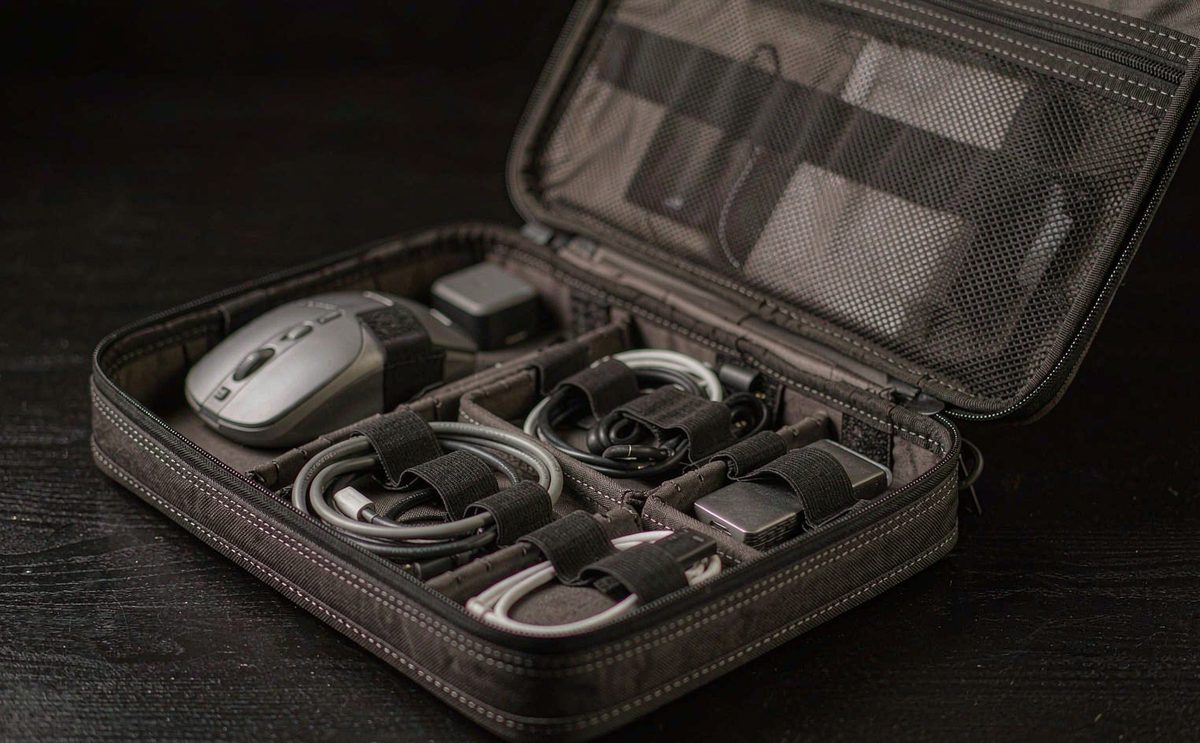
A tech pouch is an organiser, and organisers fail in a specific way: they are designed with more storage positions than the backer has items, so nothing has an obvious home and the pouch ends up as a dumping ground. The fix is to design backwards from a contents list. A typical everyday kit is a charger brick, two cables, a power bank, an external drive, a memory card and a stylus. Six items, six named positions, and no seventh. That logic is the same one our low MOQ production programme applies to every organiser we build.
That discipline also keeps the cost down. Each storage position is an operation: a loop tab sewn into a seam, a mesh pocket with its own binding, a slip pocket with a turned edge. A pouch with twelve positions costs materially more per unit than one with six and is less useful. Where the campaign needs a bigger offer, build a second size rather than a busier interior, and keep both on the same shell so the set shares a material customisation approval.
Sizing around chargers, drives and cables
Sizing starts from the largest rigid item, which is almost always the charger brick. A 65 W USB-C charger measures roughly 6 x 6 x 3 cm; a 100 W brick is closer to 8 x 8 x 3.2 cm and is noticeably heavier. Lay the contents list out on a flat surface in the arrangement you want, measure the bounding box, and add 10-15 mm of clearance in each dimension. That bounding box is the external size, and it is usually larger than the designer's first guess.
Depth is where a tech pouch differs from a flat pouch. Cables coil to roughly 3-4 cm and a power bank sits at 2-3 cm, so a useful organiser needs 5-7 cm of internal depth. Below 4 cm the pouch cannot close over a full kit. Above 9 cm it stops being a pouch and becomes a small cube, which is a different product with a different packing profile. Most programmes land in the 22 x 15 x 6 cm to 28 x 19 x 7 cm band.
| Kit | External size (cm) | Depth | Unit weight |
|---|---|---|---|
| Cables, cards and adapters | 18 x 12 x 5 | 4 - 5 cm | 70 - 100 g |
| Charger plus two cables | 22 x 15 x 6 | 5 - 6 cm | 100 - 140 g |
| Charger, drive, power bank | 26 x 18 x 7 | 6 - 7 cm | 140 - 185 g |
| Tablet, keyboard, chargers | 30 x 21 x 7 | 6 - 7 cm | 185 - 230 g |
| Camera batteries and cards | 20 x 14 x 6 | 5 - 6 cm | 95 - 130 g |
- Lay the kit out flat, measure the bounding box, then add 10-15 mm of clearance per dimension.
- Keep internal depth at 5-7 cm; below 4 cm the pouch will not close, above 9 cm it is a cube.
- Size to the largest charger in the range, including a 100 W brick if you claim compatibility.
- State external dimensions with a plus or minus 5 mm tolerance and publish them.
- Use the same zip gauge and puller across a size range so one hardware order covers it.
Layout: loops, mesh pockets and the fold-out format
Three storage formats cover the whole category. Elastic loops sewn into a seam hold cables, pens and styluses, adapt to different diameters and cost one operation per loop. A mesh zip pocket holds cards, drives and adapters where the contents need to be visible and contained. A slip pocket holds flat items such as a notebook or a phone. Everything else is a variation on one of the three, and most programmes need six to eight positions in total.
The fold-out format is the premium expression and the one worth considering at the top tier. Two panels hinged along one edge, each carrying a row of loops or a mesh pocket, opening flat like a book. It photographs extremely well and makes the organising argument visually, at a cost of roughly 25-35% over a single-panel pouch of the same footprint. Specify a binding along the hinge, because that seam carries the entire opening action.
| Storage element | Cost index | Operations added | Best for |
|---|---|---|---|
| Elastic loop, 20-25 mm | 1.00 | 1 per loop | Cables, pens, styluses |
| Mesh zip pocket | 1.25 | 3 - 4 | Cards, drives, adapters |
| Slip pocket, turned edge | 1.15 | 2 - 3 | Phone, notebook |
| Fold-out second panel | 1.30 | 6 - 8 | Full kit organisers |
| Rigid moulded divider | 1.60 | 5 - 7 | Camera and drone kits |
| SD card slots in webbing | 1.10 | 2 | Memory cards, SIM |
A rigid divider holds one specific item and nothing else, and it adds five to seven operations plus a material to the bill. An elastic loop costs one operation, holds anything from a 3 mm cable to a 20 mm power bank, and tolerates the backer's own kit. Where a programme needs structure, add interlining to the panel instead.
Shell, lining and a device-safe interior
The shell of a tech pouch can be the same 300D or 600D PU-coated polyester used across the rest of a programme, which is one of the reasons the format is so easy to add. The lining is where the specification earns its keep. A brushed tricot or a microfibre lining stops a metal charger, a drive enclosure or a phone backing from being abraded by the shell coating over hundreds of insertion cycles, and a light-coloured lining makes the contents visible in a dim hotel room.
Interlining is the third element and it matters more here than on a general pouch, because a loop row sewn into a soft panel distorts when the loops are loaded. Two to three millimetres of foam laminated behind the shell holds the panel flat, keeps the loops aligned and gives print a stable surface. It adds roughly 8-12% to unit cost and 15-25 g of weight, which is a good trade on a product that is opened every day.
| Specification | Unit weight | Cost index | Best for |
|---|---|---|---|
| 300D polyester, 210D lining | 100 - 185 g | 1.00 | Default everyday organiser |
| 300D plus 2 mm interlining | 115 - 205 g | 1.10 | Structured, print-ready panel |
| 600D polyester, ripstop lining | 125 - 210 g | 1.20 | Rugged field kits |
| 600D plus brushed tricot lining | 140 - 225 g | 1.30 | Device-safe premium kits |
| rPET shell with rPET lining | 110 - 190 g | 1.25 | Sustainability-led campaigns |
| PU leather, microfibre lining | 150 - 240 g | 1.55 | Executive retail tiers |
Zips, pulls and the clamshell decision
A tech pouch is opened more often than almost any other soft good, and the zip is the component that decides whether it still works in year two. A #5 nylon coil is the right default for the main opening, because the run is long relative to the panel and the tape has to stay flat. A double slider turns the pouch into a clamshell that can be opened from either end or parted in the middle, which is the single most useful upgrade on the format.
The zip should be specified with a garage at the top stop, a bar-tack at both ends and a fabric or moulded puller rather than bare metal, because a metal puller rattling against a drive enclosure is exactly the kind of detail a reviewer notices. Water-resistant coil zips are worth the roughly 15-20% hardware premium on field and camera kits. Specify the puller separately in the pack, since it carries its own cost and its own lead time, and confirm it during sample prototyping rather than at inspection.
Branding and internal labelling
A tech pouch gives you two branding surfaces and most programmes use only one. The exterior panel takes the logo, capped at roughly 25% of the face and offset at least 10 mm from the zip line, where registration drifts. The interior is the underused surface: a woven label at the hinge binding or a printed care and contents mark on the lining reinforces the brand every time the pouch is opened, and it costs a fraction of an exterior application.
Method choice follows the panel. Screen print at one or two colours is the most durable on a PU-coated shell and the cheapest at volume. A woven label at a seam survives abrasion better than any print. Embroidery needs a stable panel, which is where the interlining earns its cost twice over. The full comparison sits on our print and embroidery page, alongside guidance on artwork setup.
A woven label sewn into the hinge binding or the lining seam costs a few cents and is seen every time the pouch is opened, which on an organiser is several times a day. Exterior print does the campaign work; the interior label does the retention work, and it is the cheaper of the two.
Packing, freight and QC gates
Tech pouches sit between flat pouches and cubes on the freight curve. A gusseted 26 x 18 x 7 cm organiser weighs 140-185 g and does not fold completely flat, so 60-90 units fill a standard export carton. A carton of 70 units typically measures around 0.048 m3 and weighs roughly 12 kg gross, which is 8 kg of volumetric weight at the 6,000 divisor. Actual weight governs, but the gap is narrower than on a flat pouch, so the carton specification matters.
- Pack 60-90 units per export carton, nested where the gusset allows it.
- Confirm carton dimensions on the packing list so volumetric weight can be quoted accurately.
- Band in stacks of 10 rather than individually bagging every unit to save a packing operation.
- Keep insert cards to one per pouch, not one per pocket, and cost them as labour.
- Our rewards fulfilment page covers the packing specification format we ask for.
Pre-shipment inspection runs at AQL 2.5 to ISO 2859-1, general inspection level II, single sampling plan. Critical is a zip that does not close or a loop row detached from the seam. Major is a print defect on the logo, an out-of-tolerance dimension, or a missing bar-tack at a zip end. Minor is a loose thread, slight shade variation, or a fold crease that relaxes out. Define all three before production starts, not at the gate.
- Confirm carton count, packing list and size split before any carton is opened.
- Measure external dimensions on three units per drawn carton against the stated tolerance.
- Cycle every zip a minimum of 20 times, including both sliders on clamshell builds.
- Load every loop with a cable and a power bank and check that the seam holds.
- Inspect the print block for registration, coverage and puckering behind the panel.
- Verify the branding coordinate and the interior label placement against the pack.
The highest-value check on this format is the loop row under load, because a loop is a single line of stitching holding an item the backer pulls on daily. Ask for a pull figure on the loop attachment and test it on two units per drawn carton. The defect taxonomy we log is set out on the QA and QC page.
Cost, sampling and the tech pouch RFQ checklist
On a 500 pcs run a gusseted 300D polyester tech pouch with a brushed tricot lining, six elastic loops, a mesh zip pocket and a #5 double-slider zip typically quotes in the 2.40 to 6.20 USD ex-works band. The bottom is a flat single-panel build with four loops and a #3 zip; the top is a fold-out organiser with interlining, a tricot lining and branded hardware. Volume pricing steps at 1,000 and 3,000 pcs.
| Quantity | Ex-works unit cost (USD) | What changes |
|---|---|---|
| 500 pcs | 2.40 - 6.20 | Baseline, setup spread over the minimum |
| 1,000 pcs | 2.15 - 5.60 | Better marker yield, setup across 2x |
| 3,000 pcs | 1.95 - 5.10 | Dedicated line, material in rolls |
| 5,000 pcs | 1.85 - 4.80 | Material at roll-lot pricing |
| 10,000 pcs | 1.72 - 4.50 | Full-line booking, tooling amortised |
Sampling runs 6-10 working days per round from a released tech pack, extending to 12-15 working days for a fold-out build or a custom puller. Budget two rounds. production 35-50 days after the 30% deposit under T/T 30/70 has landed and the pre-production sample has been approved in writing. Where a tech pouch sits inside a wider programme, quote it with the custom laptop bag or backpack SKUs so the set lands in one container.
Load the sample with the real charger, cables, drive and power bank named on the campaign page, close it, and leave it in a bag for a day. Loop spacing and depth errors are only visible loaded, and a second sampling round costs far less than a re-order of 2,000 units.
- Contents list: every item the pouch must hold, with the largest charger named by wattage.
- External dimensions in centimetres with a tolerance, plus internal depth.
- Shell by denier, weave and coating; lining by type; interlining by thickness.
- Layout: loop count and width, mesh pocket count, slip pocket count, hinge binding where used.
- Zip gauge, coil direction, slider count, puller type, garage and bar-tack specification.
- Packing specification: pieces per bundle, per inner and per carton, with carton dimensions.
- Quantity per size and colourway against the 500 pcs minimum, and the target delivery month.
- Custom laptop bags for Kickstarter
- Custom backpacks for Kickstarter
- Custom bags for Kickstarter campaigns
- Material customisation for Kickstarter bags
- Print and embroidery options for custom bags
- Crowdfunding rewards fulfilment
- QA, QC and inspection on campaign bag runs
- Request a quotation
Spec a tech organiser that keeps its layout
Send us the contents list, the layout direction and the quantity per colourway. As your production partner we will return a unit cost, a sampling estimate and a carton specification. Write to service@junyuanbags.com.
Frequently Asked Questions
What is the MOQ for custom tech pouches on a Kickstarter campaign?
The minimum is 500 pcs per style and per colourway. A three-size organiser range is normally three separate 500 pcs commitments, unless the sizes are only ever pledged as a bundled set. Confirm the split before you send the RFQ, because it drives the total order value.
How much does a custom tech pouch cost to produce?
On a 500 pcs run a gusseted 300D polyester pouch with a brushed tricot lining, six elastic loops, a mesh zip pocket and a #5 double-slider zip typically quotes between 2.40 and 6.20 USD ex-works. At 3,000 pcs the same build usually drops to 1.95 - 5.10 USD.
What size tech pouch do I need for a charger and cables?
A 65 W USB-C charger measures roughly 6 x 6 x 3 cm and a 100 W brick closer to 8 x 8 x 3.2 cm. Lay the kit out flat, measure the bounding box and add 10-15 mm per dimension. Most kits land at 22 x 15 x 6 cm to 26 x 18 x 7 cm.
Are elastic loops better than rigid dividers in a tech pouch?
Usually yes. A rigid divider holds one item, adds five to seven operations and a material to the bill. An elastic loop costs one operation and holds anything from a 3 mm cable to a 20 mm power bank, so it adapts to the backer's own kit.
Which zip should I use on a tech pouch?
A #5 nylon coil is the right default for the main opening, and a double slider turns the pouch into a clamshell that opens from either end. Specify a zip garage at the top stop, bar-tack both ends, and use a fabric or moulded puller rather than bare metal.
Should a tech pouch be lined with a soft fabric?
Yes, where metal devices go inside. A brushed tricot or microfibre lining stops a charger, drive enclosure or phone backing being abraded by the shell coating over hundreds of cycles. It also improves visibility in low light and adds roughly 10-15% to unit cost.
How long does sampling take for a custom tech pouch?
Sampling runs 6-10 working days per round from a released tech pack, extending to 12-15 working days for a fold-out build or a custom puller. Budget two rounds, or 12-20 working days of calendar, and test the sample loaded with the real kit.
How heavy is a custom tech pouch for freight planning?
A gusseted 26 x 18 x 7 cm organiser weighs 140-185 g. About 70 units fill a carton of roughly 0.048 m3 and 12 kg gross, which is 8 kg of volumetric weight at the 6,000 divisor. Actual weight governs, but the gap is narrow.
What inspection standard applies to a tech pouch order?
AQL 2.5 to ISO 2859-1 at general inspection level II, single sampling plan. Critical is a zip that does not close or a loop row detached from the seam. Major is a print defect, an out-of-tolerance dimension or a missing bar-tack.
Can a tech pouch share a production run with a backpack?
Yes, and it is the cheapest way to add the SKU. Sharing shell, lining, zip family and branding means one material purchase order, one shade approval and one consolidated container. Book both SKUs inside the same 35-50 day production window rather than as two separate orders.
What compliance applies to tech pouches shipped into the US and EU?
United States shipments fall under California Prop 65 where a listed substance is present above threshold, and CPSIA where the product is intended for children. European Union shipments fall under REACH Annex XVII and the EU GPSR. OEKO-TEX Standard 100 covers textile components.
When does bulk production actually start on a tech pouch order?
production 35-50 days after two conditions are met together: the 30% deposit under T/T 30/70 has landed, and the pre-production sample has been approved in writing. Neither condition alone starts the clock. Confirm the slot with a start, completion and inspection date.
People Also Ask
Are tech pouches a good reward for a non-tech campaign?
They work where the backer already carries a kit: travel, camera, drone, EDC and creator programmes. They underperform where the contents have to be explained, because the whole appeal is that everything has an obvious home.
How many storage positions should a tech pouch have?
Six to eight, matching a realistic everyday kit of charger, two cables, power bank, drive, memory card and stylus. More positions than items means nothing has an obvious home and the pouch becomes a dumping ground.
Should the tech pouch open flat like a clamshell?
At the top tier, yes. A double-slider #5 zip lets the pouch open from either end or part in the middle, which makes the organising argument visually and photographs extremely well for the campaign page.
What is the best lining colour for a tech pouch?
A light or mid-tone lining. It makes dark cables and small adapters visible in a dim room, which is where these pouches are usually used. It costs the same as a dark lining if the material is already on the shelf.
Do tech pouch sizes count as their own MOQ?
Yes. Each size and colourway is counted separately against the 500 pcs minimum, so a three-size range is normally three commitments. Where sizes are only pledged as a set, the set can be treated as the style.