Material Customization for Kickstarter Bags
Material selection decides four things at once: what the bag costs, how it wears, how it photographs and what claims the campaign page can legally make. Canvas at 10-16 oz prints beautifully and carries a natural story; nylon at 420-900D resists abrasion and water; recycled rPET carries documented content claims; vegan leather adds perceived value as trim. Sampling takes 6-10 working days, production 35-50 days, and the minimum is 500 pcs per style and colourway. This page compares the families on the criteria a buyer actually quotes against.
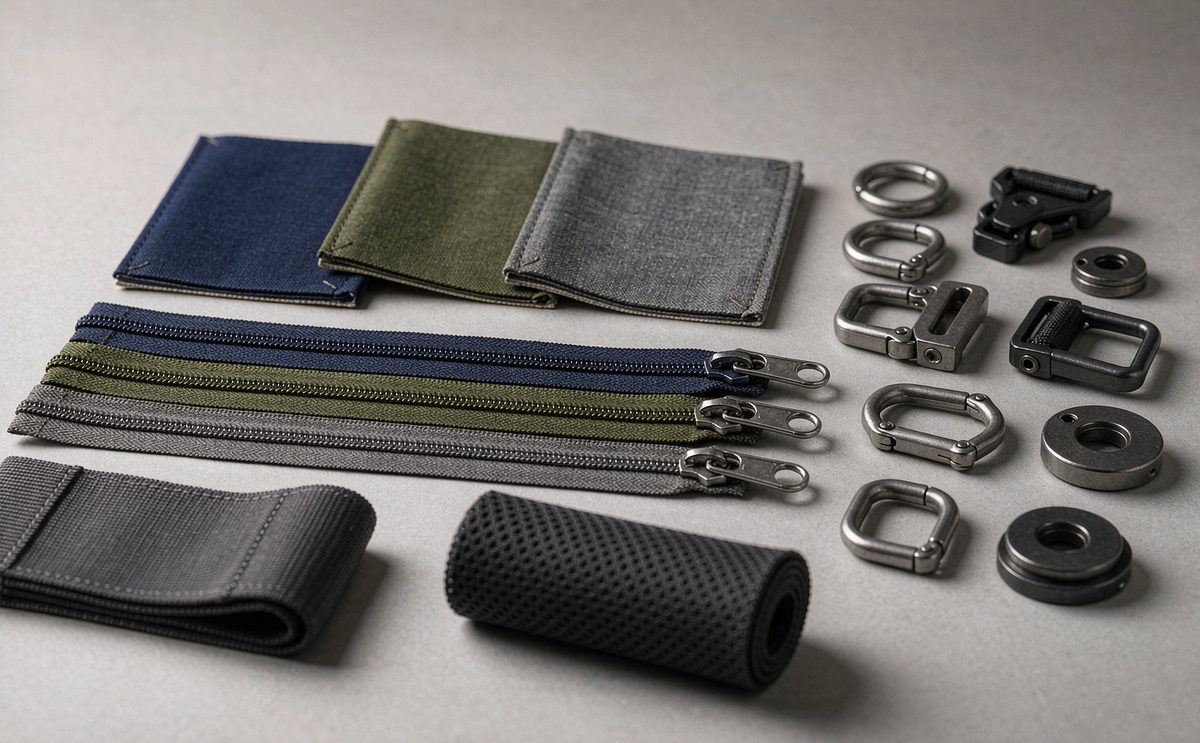
- Material is a positioning decision, not a spec line
- The four material families a campaign can source
- Reading a fabric specification
- Cotton canvas: grades and behaviour
- Nylon and coated synthetics
- Recycled and certified fabrics
- Vegan leather and PU
- Linings, webbing and trims
- Material against decoration method
- Cost and lead-time implications
- Compliance, certification and claim substantiation
- Specifying material in an RFQ
Material is a positioning decision, not a spec line
Creators usually arrive at a material conversation having already chosen a shape and a colour, and treat fabric as the last open variable. That order is backwards. Material sets the hand feel a backer experiences on day one, the weight that determines freight cost, the decoration methods available, the claims that can be substantiated on the campaign page and the unit cost that decides whether the pledge tier clears its margin. Changing it late is possible; changing it late and cheaply is not.
The commercial consequence is that material should be shortlisted alongside the category, not after it. A canvas tote and a nylon tote are different products at different price points with different audiences, and a campaign that has not decided which one it is selling will produce a specification nobody can quote accurately. Start from the positioning sentence — what is this bag for and who carries it — and the material shortlist follows quickly.
- Minimum order quantity
- 500 pcs per style / colourway
- Sampling
- 6-10 working days; 12-15 for complex builds
- Bulk production
- 35-50 days after deposit + approved pre-production sample
- Inspection
- AQL 2.5 to ISO 2859-1
- Common canvas grades
- 8-18 oz, approximately 270-610 gsm
- Common nylon grades
- 210D, 420D, 600D, 900D
- Trade term
- FOB Xiamen; payment T/T 30/70
- Production floor
- 4,950 m² SGS-verified, 137 staff, 7 lines, 149 machines
- Programme contact
- service@junyuanbags.com
Key takeaways on material selection
- Decide material and decoration together, because each constrains the other.
- Confirm mill availability at volume before the fabric enters the tech pack.
- Weight drives freight: canvas is heaviest, rPET lightest at comparable strength.
- Any recycled, organic or waterproof claim needs a document behind it before the page goes live.
- Linings and webbing are specified less often than body fabric and cause just as many problems.
The four material families a campaign can source
In practice a crowdfunding bag programme draws on four families, sometimes two at once in a hybrid build. Each has a distinct cost position, a distinct performance profile and a distinct story. The table is the executive summary; the sections that follow go into the specification detail that turns a family into a purchasable material.
| Family | Cost position | Weight | Water behaviour | The story it tells |
|---|---|---|---|---|
| Cotton canvas | Low to medium | Heaviest | Absorbs unless treated | Natural, craft, renewable |
| Nylon and coated synthetics | Medium | Light | Sheds water, dries fast | Performance, durability, technical |
| Recycled rPET and blends | Low to medium | Lightest | Sheds water, dries fast | Documented environmental claim |
| Vegan leather and PU | Medium to high | Medium | Wipes clean | Premium, minimal, considered |
Hybrid builds deserve a mention because they are underused. A canvas body with a coated base and lining keeps the natural hand feel where the hand touches it and puts water resistance where the bag meets the ground. A nylon body with vegan leather trim lifts perceived value for a fraction of the cost of a full vegan leather shell. Both are single-material-buy strategies if planned deliberately, and both require the shade match to be approved across materials rather than within one.
Reading a fabric specification
Two unit systems cause most specification errors. Woven natural fabrics are quoted in ounces per square yard, where 1 oz is approximately 33.9 g/m², so 12 oz canvas is roughly 407 gsm. Synthetic fabrics are quoted in denier, a measure of linear mass density of the yarn, so a 600D nylon is heavier and more abrasion resistant than a 210D. Neither number tells you the whole story, and both need supporting lines.
| Line | What it controls | Typical notation |
|---|---|---|
| Weight or denier | Hand feel, durability, cost | 12 oz / 407 gsm, or 600D |
| Weave or construction | Surface texture and print sharpness | Plain, basket, duck, ripstop, twill |
| Coating or finish | Water behaviour and stiffness | PU, PVC, TPU, DWR, waxed, calendered |
| Colour reference | Shade repeatability | Dyelot reference plus signed swatch |
| Fastness ratings | Whether colour survives use | Rubbing, light, and wash fastness grades |
| Tensile and tear strength | Durability under load | ASTM D5034 grab test, tear strength |
| Shrinkage allowance | Dimensional stability | Percentage residual after washing |
| Certification | Which claims can be made | GRS, OEKO-TEX Standard 100, recognised fibre standards |
Two of those lines are routinely omitted and routinely cause problems. Fastness ratings determine whether a dark canvas tote transfers colour onto a light shirt, which is a review-generating failure. Shrinkage allowance determines whether a lined bag keeps its dimensions after the first wash, which is a returns-generating failure. Both are cheap to specify and expensive to discover.
Cotton canvas: grades and behaviour
Canvas is the natural choice when the campaign story is craft, natural materials or print-led design. It absorbs pigment, holds a sharp edge on a tight weave, and softens with use in a way backers tend to describe positively. The trade-offs are mass and water: canvas is the heaviest family at comparable strength and it absorbs rather than sheds moisture unless treated.
| Grade | Approximate GSM | Behaviour | Best application |
|---|---|---|---|
| 8 oz | 270 gsm | Soft, drapes, packs flat | Pouches, linings, lowest-cost totes |
| 10 oz | 340 gsm | The standard printed tote weight | Entry-tier printed totes |
| 12 oz | 407 gsm | Firmer, light structure | Mid-tier totes, zip pouches |
| 14 oz | 475 gsm | Structured without interfacing | Premium totes, weekender bodies |
| 16 oz | 542 gsm | Stiff and substantial | Structured totes and duffels |
| 18 oz | 610 gsm | Very stiff, statement grade | Heritage positioning, small runs |
Recycled cotton and recycled blends sit inside this family and change the story rather than the behaviour. They perform close to their virgin equivalents but carry a documentation requirement: a recycled content claim needs a transaction certificate tied to the actual purchase, not a mill marketing statement. If the campaign page will say recycled, that certificate has to exist before the page goes live. Canvas-specific construction detail, including handle attachment and seam finishing, is covered on the canvas bags page and in the sample prototyping guide.
Nylon and coated synthetics
Nylon is the default for anything that has to survive abrasion, weather or load. It is strong per gram, dries quickly, takes a coating for water resistance and holds its shape under repeated packing. It is also the family where coating choice matters most, because the coating determines stiffness, cold-weather behaviour and how the fabric accepts decoration.
- 210D: light lining and ripstop applications, low abrasion exposure.
- 420D: the general-purpose grade for daypacks and light travel bags.
- 600D: the workhorse for backpacks and duffels that see real use.
- 900D and above: base panels, wear zones and premium technical positioning.
- PU coating: flexible, breathable, the most common choice for bags.
- TPU coating: more durable and more expensive, used where abrasion is severe.
- DWR finish: a surface treatment that sheds light rain and needs renewing over time.
One caution specific to nylon: coating and print do not always agree. A heavy coating resists ink adhesion, so artwork intended for screen print usually moves to heat transfer, a patch or a woven label on coated synthetics. Decide the method with the fabric, because discovering at the strike-off stage that the chosen decoration will not hold means either changing the fabric or changing the brand application.
Recycled and certified fabrics
Recycled fabrics have moved from a niche option to a default consideration, and for good reason: they perform at or near virgin equivalents, they are competitive on cost, and they carry a story backers actively look for. The sourcing discipline is documentation and consistency. A recycled claim is only as good as the certificate behind it, and a fabric that varies in shade between dyelots undermines a set that has to look designed.
- rPET from post-consumer bottle flake: the most common recycled bag fabric, available across 300-900D.
- Recycled cotton and cotton blends: closer to canvas in hand feel, with a documented recycled fraction.
- Recycled nylon from pre- or post-industrial waste: higher cost, strong technical positioning.
- GRS transaction certificates: the document that substantiates a recycled content claim on the campaign page.
- OEKO-TEX Standard 100: covers finished fabric safety, frequently requested for skin-contact items.
- Blended constructions: recycled face with a virgin backing, where performance requires it.
A recycled content claim without a transaction certificate tied to the specific purchase is a liability, not a marketing asset. Specify the certification requirement in the material brief, obtain the certificate for the lot you are buying, and keep it with the retained swatch so a re-order can be matched to the same documentation.
Vegan leather and PU
Vegan leather and premium PU are rarely the body material for a crowdfunding bag and almost always the right material for trim. Used on pocket faces, handle wraps, patches and base panels, they lift perceived value out of proportion to their cost because they read as considered rather than technical. Used across an entire shell, they add cost, weight and a set of durability questions around cracking and cold flex.
| Application | Cost impact | Perceived value | Note |
|---|---|---|---|
| Logo patch | Low | High | Deboss or emboss, tooling around USD 120-400 |
| Handle wrap | Medium | High | Comfort upgrade backers notice immediately |
| Pocket face panel | Medium | High | Contrast against a canvas or nylon body |
| Base panel | Medium | Medium | Wipe-clean and abrasion resistant where it matters |
| Full shell | High | Very high | Requires cold-flex and cracking testing before commitment |
| Interior trim and binding | Low to medium | Medium | Cheapest way to signal quality on opening the bag |
The specification question that matters with PU is testing. Lower-grade PU can crack at low temperatures and after repeated flexing, and a bag that cracks in a backer's first winter generates the kind of review that outlasts the campaign. Ask for cold-flex and abrasion results on the specific grade, and treat a vegan leather claim as a performance specification rather than a description.
Linings, webbing and trims
Body fabric gets the attention and linings, webbing and trims cause the failures. A lining that does not match the shell's shrinkage allowance will pull a bag out of shape after the first wash. Webbing that bleeds colour will mark a light shell. A zip tape in a different finish to the sliders will look like a mistake in every photograph. All three are cheap to specify and expensive to correct after 500 units exist.
- Lining: match the shrinkage allowance to the shell, and choose coated polyester where wipe-clean matters.
- Webbing: specify width, breaking strength and colour fastness, not just colour.
- Zipper tape and sliders: one finish across the whole bag, and one finish across a set.
- Binding and edge tape: confirm the shade against the body fabric under the shooting light.
- Thread: nominate a colour and a ticket size, and check contrast against the panel it sits on.
- Padding and interfacing: specify density where a protection or structure claim is made.
Material against decoration method
Material and decoration are a single decision that most briefs split in two. The compatibility matrix below is the practical grid: pick the material row, read off the methods that work, and avoid the ones that will fail at the strike-off or, worse, in the field after delivery.
| Material | Best method | Acceptable alternative | Avoid |
|---|---|---|---|
| Cotton canvas | Water-based screen print | Discharge print, embroidery, woven label | Heavy plastisol on high-flex areas |
| Waxed canvas | Woven label or patch | Embroidery with a stabiliser | Standard screen print |
| Coated nylon | Heat transfer | Embroidered patch, woven label | Direct screen print without a bonding agent |
| Recycled rPET | Heat transfer or sublimation | Screen print with a suitable ink system | High-temperature processes that distort the fabric |
| Vegan leather and PU | Deboss or emboss | Metal plate, laser mark | Thick ink deposits that crack on flex |
| Mesh and ventilation panels | Woven label | Heat-transfer patch | Direct print, which blocks airflow |
Approve every strike-off on the exact production material, on the exact panel, at the exact size, and record it in the inspection checklist used at QA and QC. A logo approved on a flat swatch can behave differently on a padded or curved production panel, and that difference is visible in campaign photography. The full method grid, including stitch-count and screen-charge guidance, is on the print and embroidery page.
Cost and lead-time implications
Material affects cost twice: once through the price of the fabric and once through the weight that determines freight. Those two do not move together. Recycled rPET is often the cheapest per unit and the cheapest to ship, while a heavy canvas is competitive on fabric price and expensive to move. Over 500 units on an express route, the freight difference between the lightest and heaviest option can exceed the fabric difference, which is why packing is planned with the rewards fulfilment route rather than after it.
| Material | Fabric cost position | Freight position | Lead-time risk |
|---|---|---|---|
| Cotton canvas | Low to medium | Highest — heaviest cartons | Low; widely available |
| Nylon and coated synthetics | Medium | Low | Low; mature supply base |
| Recycled rPET | Low to medium | Lowest | Medium; certification paperwork adds days |
| Vegan leather and PU | Medium to high | Medium | Medium; grade availability varies |
| Speciality or mill-exclusive fabrics | High | Varies | High; mill minimums and lead times apply |
Availability at volume is the schedule risk worth naming explicitly. An unusual fabric found in a swatch book may carry a mill minimum measured in thousands of metres or a lead time measured in weeks, neither of which fits a 6-10 working days of sampling window followed by 35-50 days of bulk. Confirm availability before the material enters the tech pack, and keep a nominated second choice in the brief.
Compliance, certification and claim substantiation
Every material claim on a campaign page is a commercial asset when documented and a liability when not. This is not a legal formality; it is the difference between a claim that survives scrutiny and one that generates refund requests. Build the documentation set into the material brief rather than requesting it after the bulk run has shipped.
- Recycled content: GRS transaction certificates tied to the specific fabric purchase.
- Organic fibre content: a recognised fibre certification covering the lot, not a mill statement.
- Skin contact safety: OEKO-TEX Standard 100 on the finished fabric.
- United States market: CPSIA and Prop 65 documentation as applicable.
- European Union market: REACH conformity and EU GPSR documentation.
- Care and composition labelling: must match the materials actually used, including lining and trim.
A test report is only valid for the material that was tested. If the fabric changes after the report is issued — a different mill, a different dyelot, a different coating — the report no longer supports the claim. Request compliance testing during sampling so bulk is built from the tested material.
Specifying material in an RFQ
A material brief that says canvas or waterproof nylon will produce a quotation with a wide band and a long clarification thread. A brief that names the grade, the weave, the coating, the colour reference and the required certification will produce a firm number, usually within two working days. The checklist below is what a production partner needs.
- Family and grade: canvas in ounces and GSM, or synthetic in denier.
- Weave or construction, and any coating or finish with a performance target.
- Colour reference plus the acceptable shade band, and a retained swatch from the approved sample.
- Lining, webbing, binding and hardware finish, nominated together with the body fabric.
- Decoration method, artwork and placement, so compatibility can be confirmed before quoting.
- Quantity per style and colourway, target landed unit cost in USD and destination market.
- Certification and compliance requirements for the target market.
- A nominated second-choice material, in case the first is not available at volume.
Send the brief to our sourcing team with the category you have in mind and we will return a material recommendation with costed options. Start from the category map if the shape is still open, and use the crowdfunding bag guide to work through the decision from the campaign side.
Get a material recommendation and costed quotation
Send your positioning, target pledge price, quantity and destination market. As your sourcing partner we will return two or three material options with unit cost at 500 pcs, a print method recommendation for each, certification guidance and a sampling schedule. Email service@junyuanbags.com or use the quote form.
- Custom bags for Kickstarter
- Custom backpacks for Kickstarter
- Custom tote bags for Kickstarter
- Custom travel bags for Kickstarter
- Print and embroidery for custom bags
- Low MOQ bag production for creators
- Crowdfunding bag sample prototyping
Frequently Asked Questions
Which material is best for a Kickstarter bag reward?
It depends on positioning. Cotton canvas at 10-16 oz is best for a natural, print-led story. Nylon at 420-900D is best for durability and weather performance. Recycled rPET is best for a documented environmental claim and the lowest freight weight. Vegan leather works best as trim that lifts perceived value.
What is the difference between ounces and denier in a fabric spec?
Ounces per square yard measure woven natural fabric weight, where 1 oz is approximately 33.9 g/m², so 12 oz canvas is about 407 gsm. Denier measures the linear mass density of synthetic yarn, so 600D nylon is heavier than 210D. State the family and the unit in the brief to avoid mismatches.
Can I use recycled fabric and still claim it on the campaign page?
Yes, provided a GRS transaction certificate is tied to the specific fabric purchase. A mill marketing statement is not sufficient. Specify the certification requirement in the material brief and obtain the certificate for the lot you are buying, so the claim is documented before the campaign page goes live and survives a re-order 6-12 months later.
How does material choice affect the cost of 500 custom bags?
Material affects cost twice: through fabric price and through freight weight. Recycled rPET is often cheapest on both counts, while heavy canvas is competitive on fabric price but the most expensive to ship. Over 500 units on an express route, the freight difference between the lightest and heaviest option can exceed the fabric difference, which is why packing is planned with the rewards fulfilment route rather than after it.
Does material choice change the sampling timeline?
Standard sampling runs 6-10 working days for all four families, rising to 12-15 for complex builds. The schedule risk is availability rather than processing: a mill-exclusive fabric can carry a minimum of thousands of metres or a multi-week lead time. Confirm availability and nominate a second-choice material in the brief.
Can I print on waterproof nylon?
Direct screen print generally does not bond well to a heavy coating. Use heat transfer, an embroidered patch or a woven label on coated synthetics, and approve the strike-off on the production fabric. Screen charges of roughly USD 40-120 per colour are wasted if the ink will not hold, so confirm compatibility before quoting.
Is vegan leather durable enough for a bag body?
As trim, yes, and it is the most cost-effective way to lift perceived value. As a full shell it needs cold-flex testing, typically at -10 degrees Celsius or below, plus abrasion testing on the specific grade, because lower-grade PU can crack after repeated flexing. Tooling for a debossed patch runs USD 120-400.
What certification should I ask for on bag fabrics?
Ask for GRS transaction certificates for recycled content, OEKO-TEX Standard 100 for skin-contact safety, CPSIA and Prop 65 documentation for the United States, and REACH plus EU GPSR conformity for the European Union. Request all of them during sampling so the bulk build uses the tested material.
Should the lining match the body fabric?
It should match in shrinkage allowance even when it contrasts in colour. A lining that moves 3-4% against a shell that moves 1% will pull the bag out of shape after the first wash. A deliberate contrast lining is a good design choice; an unmatched shrinkage allowance is a defect that appears only after delivery.
What is the lightest material for reducing freight cost?
Recycled rPET is generally the lightest at comparable strength, followed by nylon, with cotton canvas heaviest: a 16 oz canvas shell at roughly 542 gsm can weigh 30-50% more than a 600D rPET equivalent. Because carriers bill on the greater of actual and dimensional weight, packing geometry usually matters more than fabric weight alone.
Can one bag use two different materials?
Yes, and hybrid builds are underused. A canvas body with a coated base keeps the natural hand feel where hands touch it and water resistance where the bag meets the ground. A nylon body with vegan leather trim lifts perceived value for a 5-10% uplift in unit cost. Approve the shade match across both materials under the shooting light.
How do I keep fabric colour consistent between sample and bulk?
Retain a signed swatch from the approved pre-production sample and define an acceptable shade band, typically within a Delta E of 1.5-2.0 under a standard light box. Require bulk panels to be compared against that swatch before cutting begins, and keep the swatch for re-orders.
People Also Ask
Is canvas or nylon better for a crowdfunding bag?
Canvas reads natural and prints beautifully but is heavy and absorbs water. Nylon is lighter, abrasion resistant and sheds water but needs transfer or patch decoration. Choose by audience: lifestyle and eco campaigns lean canvas, technical and travel campaigns lean nylon.
Why does my fabric sample look different from the bulk bag?
Usually a dyelot or grade mismatch. Confirm weight or denier on a cut panel during sampling, retain a signed swatch, and require bulk panels to be compared against it under a light box before cutting starts.
Do I need certification to say a bag is recycled?
Yes. A recycled content claim should be backed by a GRS transaction certificate tied to the specific fabric purchase. Without it the claim is unsubstantiated, which is a compliance and reputation risk rather than a marketing gap.
How heavy should a backpack fabric be?
600D is the workhorse for a backpack that sees daily use, 420D suits lighter daypacks and 900D is reserved for base panels and wear zones. Denier drives abrasion resistance, so match it to where the fabric sits on the bag.
Can I mix vegan leather with canvas?
Yes, and it is one of the most effective combinations. Canvas provides the natural body and print surface, vegan leather adds a premium handle wrap, patch or pocket face. Approve the shade match between the two under the shooting light.