Custom Backpacks for Kickstarter Campaigns — MOQ 500, sampling 6-10 working days
A custom backpack reward starts at MOQ 500 pcs per style and colourway, takes 6-10 working days to sample and 35-50 days to produce in bulk at AQL 2.5 to ISO 2859-1. Unit cost turns on four decisions: shell fabric grade, compartment count, laptop sleeve construction and branding method. This hub prices each one, shows where the 500 to 2,000 pcs volume curve bites, and sets out what a backpack RFQ must contain to return a firm number.
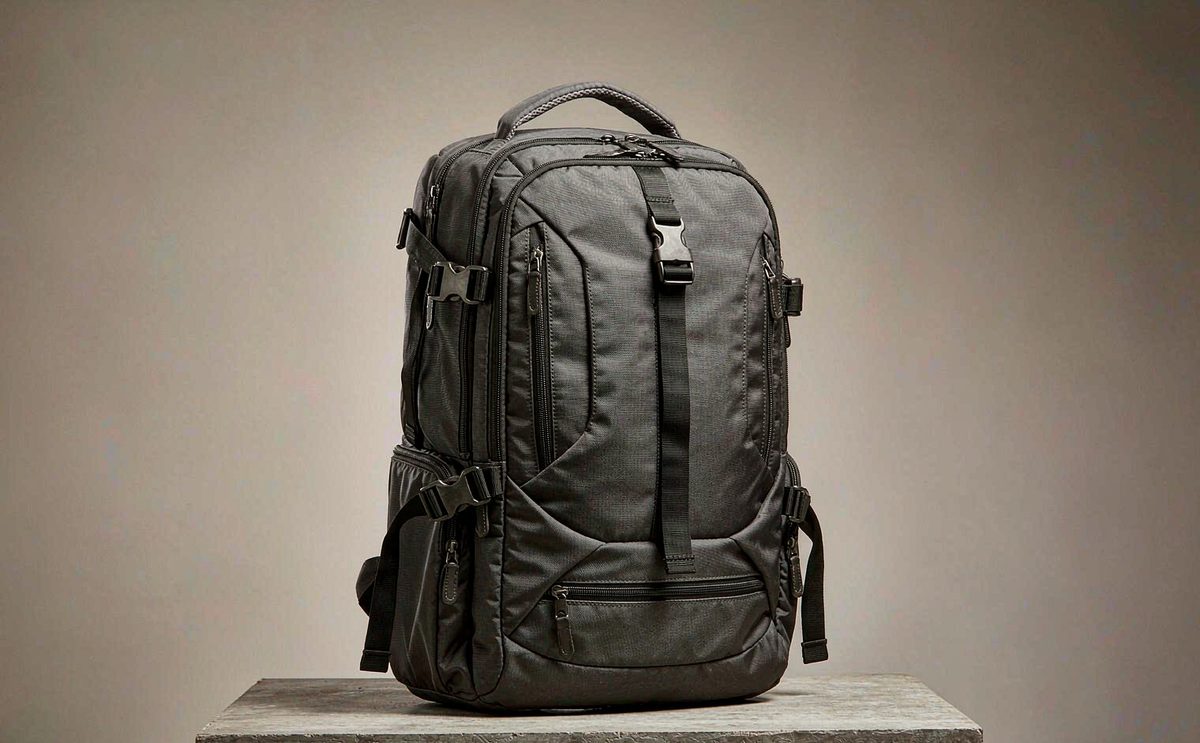
- Why a backpack reward is the hardest line to cost
- Shell fabric selection across three grades
- Reading denier, weave and coating as cost line items
- Compartment architecture and the price of each panel
- Laptop sleeves that survive transit testing
- Harness, straps and load-path engineering
- Zip chains, buckles and backpack hardware grading
- Branding methods compared across panel types
- Weight targets and what they do to freight
- Round one to round two in backpack sampling
- Backpack inspection points at AQL 2.5
- Unit cost behaviour from 500 to 2,000 backpacks
- Carton cubing and parcel testing for backpacks
- Compliance and lab work for tech-carrying builds
- Writing a backpack RFQ that prices cleanly
Why a backpack reward is the hardest line to cost
Backpacks carry more pledged value per unit than any other reward bag, and they carry proportionally more engineering risk. A tote is roughly eleven panels and a straight seam run. A structured backpack with a suspended laptop sleeve, a ventilation channel and a moulded back panel can reach forty components before webbing and thread are counted. Every one of those components is a purchased item with a lot minimum behind it.
That complexity changes how the numbers move. Because assembly time barely improves with volume, the labour portion of a backpack behaves differently from fabric and hardware. Doubling an order amortises a zip tooling charge but does very little for cycle time on a forty-panel build. The practical implication is that structural simplification is usually worth more than negotiating a headline discount, and it should be explored during costing rather than after the campaign funds.
The four parameters governing the programme are fixed regardless of category: MOQ 500 pcs per style and colourway, sampling in 6-10 working days, production 35-50 days after deposit and pre-production sample approval, and pre-shipment inspection at AQL 2.5 to ISO 2859-1. Everything in this hub operates inside those boundaries, detailed further in the campaign sourcing hub.
Removing two panels from a structured build can reduce unit cost more than a five percent across-the-board reduction on a complex bill of materials, because panels carry cutting time, alignment labour and inspection exposure simultaneously. Price both versions before deciding.
Campaign bag hub
Master parameters, cost architecture and RFQ standards shared by every reward format.
Laptop bags
Device-fit engineering and structured tech carry for campaign rewards.
Travel bags
Carry-on dimensions, compression systems and long-cycle durability.
Sports and team bags
Vented compartments and wet-dry separation for training and club orders.
Shell fabric selection across three grades
Most campaign backpacks resolve to one of three shell families, and each carries a distinct cost and story position. Recycled PET has become the default where a sustainability narrative sits at the centre of the campaign page. Ripstop nylon dominates when weight matters more than abrasion resistance. Polyester at higher denier stays the choice where structure and price discipline win the argument.
| Shell option | Typical specification | Relative cost index | Best applied where |
|---|---|---|---|
| Recycled PET (rPET) | 600D or 900D rPET with PU backing, GRS transaction certificate available | 108-125 versus standard polyester | The campaign page leads on recycled content and the certificate can be ordered during sampling |
| Ripstop nylon | 210D to 420D nylon ripstop with silicone or PU finish | 115-140 depending on finish | Weight-sensitive builds such as travel or day packs where tear propagation is the main failure risk |
| Standard polyester | 600D polyester with PU backing | 100 baseline | Volume-constrained campaigns needing a predictable number and the widest colour availability |
| High-denier reinforcement | 1680D polyester on base and lower side panels | 150-180 on those panels only | Abrasion zones on urban commuter builds; used as a panel treatment rather than a full shell |
A useful pattern is a mixed shell: standard or recycled polyester across the body and 1680D at the base panel and lower gusset. That buys the abrasion performance backers associate with quality without paying the high-denier index across the whole silhouette. Because the cost difference applies only to a small surface area, the uplift on the total material bill is usually modest.
Colourway discipline matters here more than anywhere else. Each additional colourway requires its own 500-pcs minimum and its own dye lot, and dye-lot variance between batches is a classic source of a rejected pre-production sample. Decide the hero colourway during material selection, not after the first round, so the lot can be reserved before the price quoted against it expires.
Reading denier, weave and coating as cost line items
Denier is filament thickness, weave is geometry, and coating is applied weight. All three appear separately on a quotation, and conflating them is how creators overspend on properties they never needed. A 600D plain weave with a heavy PU backing can outperform a cheaper 900D weave with no coating in real abrasion testing, and the former usually costs less per square metre.
- Denier drives weight and tear strength: 420D for linings and light day packs, 600D for mainstream carry, 900D to 1680D for load panels and bases.
- Weave drives tear behaviour: ripstop grids stop propagation at low weight, while plain weaves deliver better print registration across large panels.
- Coating drives water performance and hand-feel: PU for economy, TPU for flexibility and weldability, silicone for softness on nylon.
- Hydrostatic head is the figure to request rather than any verbal water-resistance claim, expressed in millimetres of water column.
- Finish additions such as DWR add a small per-metre cost but visibly change how a bag photographs on a campaign page.
Testing turns those properties into evidence. ASTM D5034 gives a comparable grab-test strength figure across fabric candidates, and a hydrostatic head result gives a defensible water claim. Both are cheap to run during sampling and expensive to run in the last production week, when the only available response to a failed result is accepting the shipment or reworking it.
Compartment architecture and the price of each panel
Every pocket, divider and organiser strip is a purchased component plus cutting time plus alignment labour. There is no such thing as a free compartment. Counting them against the bill of materials during the costing phase is the single most effective discipline available to a backpack campaign, because this is the area where a design grows silently after the first quotation was issued.
| Feature | Added components | Effect on cycle time | Typical unit cost impact |
|---|---|---|---|
| Internal slip pocket | One fabric panel plus binding tape | Low; added during assembly rather than restructuring | Marginal, generally below two percent of unit cost |
| Padded laptop sleeve | Foam sheet, lining, binding, suspension webbing | Moderate; alignment tolerance is the constraint | Material uplift, usually the largest single structural addition |
| Zippered mesh divider | Mesh panel, additional zip chain, binding | Moderate; second zip station on the line | Noticeable; doubles zip cost inside that compartment |
| Organiser panel with elastic loops | Elastic lengths, reinforcing panel, multiple bar-tacks | High; bar-tack count rises sharply | Significant labour addition despite cheap materials |
| Structured base with feet | Moulded or EVA base, metal or rubber feet | High; often a separate station | Tooling plus assembly, best reserved for premium tiers |
The pattern to watch is features that look cheap in materials and expensive in labour. Elastic organiser loops cost cents in components and considerably more in bar-tack operations, because each loop receives two reinforcement cycles. Where a backer-facing feature is genuinely needed, position it in the open where it photographs; where it is merely convenient, ask what removing it saves on the thousand-unit figure.
Add-on products are a smarter way to add perceived compartment depth. A removable packing cube or organisers insert produced from the same fabric purchase adds visible value without restructuring the hero bag, and it carries no additional minimum because it shares the existing print set-up.
Laptop sleeves that survive transit testing
A laptop compartment is where a backpack campaign is most likely to generate a replacement claim. The failure modes are consistent: insufficient corner clearance, padding that bottoms out under compression, and no suspension, so a device carried inside the main body transmits every kerb strike straight into a chassis corner. All three are design faults rather than material faults.
| Device class | Internal clearance allowance | Padding specification | Verification |
|---|---|---|---|
| 13-inch ultrabook | 12-15 mm beyond device dimensions on each axis | 6 mm closed-cell foam with 210D lining | Fit check against a physical device plus three prototype devices if available |
| 14 to 15.6-inch laptop | 15-18 mm beyond the widest chassis dimension | 8 mm closed-cell foam with suspension bridge at base | ISTA 3A parcel simulation with a weighted dummy load inside |
| 16-inch workstation | 18-20 mm clearance, with corner radius considered | 10 mm foam plus rigid insert at the base panel | Drop sequence from 450 mm onto concrete, repeated three times |
| Tablet sleeve only | 8-10 mm allowance for folio cases | 4 mm foam with soft-touch lining | Abrasion check on the lining to prevent screen marking |
Suspension is the overlooked element. Padding alone compresses; a suspended sleeve carries the device an inch clear of the base panel so a drop is absorbed by air and webbing rather than by foam against concrete. Adding that suspension bridge costs a modest amount of webbing plus two bar-tacks and is among the highest-value durability additions available per unit of cost.
Clearance tolerances should be written into the tech pack as a range, not a single figure. Device chassis dimensions shift between generations, and a sleeve cut to exact fit will exclude whatever the market treats as a standard laptop eighteen months after delivery. For programmes built around device carry specifically, the laptop bag category hub covers device-fit engineering and structural construction in more detail.
Harness, straps and load-path engineering
The harness system carries every load the backer will ever put in the bag, and it fails visibly and publicly. Its three elements are the shoulder strap construction, the sternum or chest strap, and whatever reinforcement sits behind the panels where load transfers into the body. Each has a measurable specification worth writing down before costing rather than during the second sampling round.
- Shoulder straps in 38 mm webbing with 8-10 mm closed-cell foam for everyday carry, upgraded to contoured EVA where loads exceed roughly 8 kg.
- Load-point reinforcement by bar-tack: every webbing termination receives at least two passes, with X-box stitching at the shoulder yoke.
- Sternum straps as removable acetal buckles on 25 mm webbing, positioned at a stated distance below the collar rather than left to the line.
- Back panels using spacer mesh over EVA, with the channel depth stated in millimetres so hand-feel stays consistent between lots.
- Top handles reinforced with a continuous webbing loop running under the shell, rather than stitched onto the surface.
Load-path thinking is what separates a bag that survives four years from one that survives a month. Trace where weight sits in a loaded pack: typically the shoulder yoke, the top handle and the base seam. Reinforce those three points explicitly in the tech pack with stitch counts stated, because an instruction to reinforce inviably is not something a cutting room can price or verify.
Zip chains, buckles and backpack hardware grading
Hardware is transparently graded by backers. A bag with a smooth #8 coil zip and a solid metal puller reads as premium before the fabric is touched; the same bag with a sticky unbranded #3 zip reads as cheap regardless of its shell specification. Hardware typically sits at 14-22% of unit cost, which is enough to matter and small enough to upgrade selectively.
| Component | Economy route | Upgrade route | Cost and schedule implication |
|---|---|---|---|
| Main zip chain | Unbranded #5 coil | Branded #8 or #10 reverse coil | Upgrade adds modest unit cost and better weather resistance; no tooling unless a custom slider is used |
| Slider and puller | Standard zinc slider with fabric tab | Metal or rubber-moulded puller | Custom moulded puller adds tooling and pushes sampling into the 12-15 working day range |
| Buckles | Standard acetal side-release | Aluminium or steel with stated break strength | Upgrade is cheap per unit; request a tested figure rather than a claim |
| Base feet | Bonded polyester pads | Metal or TPU moulded feet | Requires panels designed to accept them, so decide before first patterns are cut |
| Webbing | 25 mm economy polyester | 38 mm high-tenacity polyester | Higher-tenacity webbing is a small premium with a large perceived-quality return |
Budget for branded chains before custom mouldings. A branded #8 coil solves the two issues backers actually notice — smoothness and noise — while a bespoke puller mostly solves a marketing problem at tooling cost plus weeks of schedule. Where a custom puller is central to the campaign story, order it early enough that the first sampling round can still complete in the 12-15 working day window.
Branding methods compared across panel types
Backpacks offer more branding surface than any other reward bag, and that abundance tempts campaigns into multiple decoration methods that each carry their own set-up charge. Branding usually represents 5-12% of unit cost, and the set-up component is fixed irrespective of run size, which makes print the second-largest amortisation benefit after hardware.
| Method | Suited surfaces | Set-up behaviour | Durability profile |
|---|---|---|---|
| Screen print | Flat woven panels, front pockets | Screen charge per colour per placement | Excellent abrasion resistance; six-plus colour designs become costly |
| Heat transfer | Curved or coated surfaces | Film plate per design | Good; edges can lift on high-flex areas if applied across a fold |
| Embroidery | Front panels, cap and strap webbing | Digitising fee per logo, then stitch-count pricing | Outstanding; raises perceived value substantially at higher cost per unit |
| Woven label | Interior seams, exterior tabs | Loom set-up per design | Excellent; cheapest way to add a branded touch point |
| Rubber or TPU patch | Front and side panels | Mould charge per design | Very high; adds handling time and a second bonding station |
Choose one hero placement and one secondary placement, then stop. Additional print placements add a fixed screen charge plus a handling step, and beyond two positions the marginal cost per additional placement exceeds its contribution to perceived value. A woven label on the exterior webbing plus a single embroidered mark is often the strongest combination available for yield per dollar.
Remember that artwork locks before sampling starts. The 6-10 working days of sampling clock runs from approved artwork, which means a design still in revision when the RFQ is submitted delays the entire programme by however long the logo takes to finalise. Standardise vector formats early and confirm colour references, particularly where the same mark appears across several different materials.
Screen print set-up is charged per colour per placement. A four-colour logo printed in two positions carries eight screen charges before a single unit is produced. Simplify artwork to two colours, or move single-colour marks onto embroidery or woven labels where pricing is driven by stitch count or loom set-up instead.
Weight targets and what they do to freight
Shipped weight is a design decision with a compounding cost effect. Every hundred grams added to a backpack multiplies across the unit count, the sea freight volumetric calculation and the last-mile rate card applied per parcel. A heavy shell choice made for tactile reasons can quietly eliminate the margin that was modelled at a lighter specification.
Model it concretely. Removing 200 g from a unit travelling by parcel into the United States can shift the cost tier on the last mile and reduce the total landed figure materially at 1,000 units. That is why ripstop nylon, despite costing more per metre than polyester, sometimes produces a lower landed cost once freight is counted, because it reaches the target performance at a lower mass.
The companion effect is cubing. Backpacks ship best lightly compressed with the harness folded inward, and a carton dimensioned to a carrier band beats any negotiation on the freight rate card. Plan the flat-pack strategy during pattern development, then validate it with rewards fulfilment before approving the pre-production sample.
Round one to round two in backpack sampling
Backpack sampling takes 6-10 working days for a standard build and 12-15 working days where custom hardware, moulded patches or multi-colour print are involved. Working days exclude transit, so add courier time on both legs. Plan two rounds: the early build proves architecture and fit, and the later one proves colour, print registration and how the harness sits under load.
- Written pack issued. Dimensions, denier, coatings, closure gauges, webbing widths, stitch counts and branding placements defined.
- Material reservation. Shell lots, zip chain, webbing and padding confirmed, with written alternatives where a lot has closed.
- First pattern sewn. Cut on the line intended for bulk rather than in a separate development room.
- Load and fit check. Loaded with weights, worn for a day, and device fit verified against physical hardware.
- Photographic review. Images taken under neutral light and sent alongside physical samples for remote decision making.
- Revision round. Structure corrections proven, then colour and print registered.
- Gold seal. The approved reference locks the build; subsequent changes carry a cost and a schedule effect.
The most valuable thing a creator can do with a first sample is load it. A prototype stuffed with six kilograms and worn for thirty minutes reveals harness geometry, strap spacing and back-panel comfort problems that no amount of flat-lay photography detects. The prototyping programme page sets out how those findings convert into a revision list the line can act on.
Backpack inspection points at AQL 2.5
Pre-shipment inspection follows AQL 2.5 to ISO 2859-1 for backpack runs just as it does for every other category. What changes is which defects matter. Structured bags introduce alignment and symmetry risks that flat constructions simply do not have, and those should be written into the defect classification before the run begins rather than argued afterwards.
- Strap symmetry measured between left and right shoulder straps, with a stated tolerance in millimetres.
- Zip travel checked along the full length of every chain, including reverse-coil exteriors that resist superficial inspection.
- Bar-tack presence verified at every specified load point against the tech pack diagram.
- Print registration assessed against stated tolerance on each placement, particularly across seams.
- Panel alignment inspecting base seam centring and top-handle placement relative to the vertical axis.
- Load test on a small destructive sample pulled from the carton set, repeated at each inspection.
Agreed tolerances are what make an inspection report actionable. A strap asymmetry of fifteen millimetres is minor on a casual day pack and major on a technical harness; only the tech pack can say which. The QA and QC resource details how those thresholds are set and recorded before a bulk run begins.
Unit cost behaviour from 500 to 2,000 backpacks
The volume curve is steepest between 500 and 2,000 pcs because fixed charges dominate at the lower end. Hardware tooling, screen and plate charges, loom set-up and quality documentation all amortise quickly, then flatten. Understanding which elements flatten fastest tells a creator where a stretch goal improves margin and where it merely adds administrative work.
| Cost element | Behaviour at 500 pcs | At 1,000 pcs | At 2,000 pcs |
|---|---|---|---|
| Shell fabric and lining | Dye-lot minimum applies | Materially better spreading of the lot minimum | Marginal further improvement |
| Hardware set-up and tooling | Fully weighted on each unit | Roughly halved per unit | Approaching negligible per unit |
| Print, embroidery and labels | Fixed charges dominate unit cost | Charges amortised across double the run | Minimal further benefit |
| Cutting and sewing labour | Standard cycle time | Essentially unchanged | Essentially unchanged |
| Inspection and documentation | Charged per carton sample drawn | Slightly better spread | Minimal change |
Read that table as an instruction to ask for three quotations rather than one. The shape between 500 and 1,000 is where most campaigns discover that a slightly larger launch volume improves unit economics more than any discount negotiation could. Where cash flow rules out the larger first run, a structured low minimum order programme can stage the commitment instead.
Re-order economics favour the creator strongly. Because the pattern, tooling and artwork are already paid, a re-order quotes without those elements and typically lands noticeably below the original figure. Budget the first run knowing the second will be cheaper, then resist the temptation to publish a pledge price that assumes it.
Carton cubing and parcel testing for backpacks
Backpacks cube badly if shipped assembled and rigid, and cubing is frequently a larger freight cost driver than weight. Compression strategies — harness folded inward, straps routed flat, air expelled — can reduce a carton's effective volume substantially. That reduction arrives twice: once on the sea leg through volumetric calculation and again on the last mile through parcel tariff.
Validate the design with ISTA 3A before committing to a carton specification. That standard simulates parcel handling including drops, vibration and compression, and it is the only reliable way to know whether an individual backer shipment will arrive presentable. Testing is arranged during the sampling window so any carton weakness can be corrected before bulk packing.
Coordinate carton dimensions with the fulfilment warehouse rather than choosing them for the bag's convenience. A box sized to a carrier tariff band can save more per unit than weeks of freight-rate negotiation, and it avoids the situation where a warehouse repacks thousands of units into its own cartons at your expense.
Compliance and lab work for tech-carrying builds
Backpacks aimed at commuters and students attract the broadest compliance exposure of any reward bag. A device compartment raises expectations around lining safety and heat; a youth-market positioning pulls in children's product requirements; and any recycled content claim must be backed by a transaction certificate issued against the specific fabric lot.
| Claim or destination | Expected documentation | Timing | Risk if omitted |
|---|---|---|---|
| Recycled content claim | GRS transaction certificate for that fabric lot | At fabric purchase during sampling | An unbacked claim becomes a compliance exposure that later discounting cannot repair |
| Youth or school positioning | CPSIA lead and phthalate testing plus tracking labels | Before any child-targeted tier is published | Goods held at destination with no remedy available |
| European Union delivery | REACH declaration and EU GPSR conformity file | Before customs entry | Clearance delay that lands directly on the delivery month |
| Skin-contact claim | OEKO-TEX Standard 100 covering shell and lining | During material confirmation | Claim removal after publication, visible to every backer |
| Strength representation | ASTM D5034 grab test on shell and seams | Alongside first sampling round | No defence available once the claim is questioned publicly |
Book everything early. A test house operates to its own queue, and a certificate requested in the final week of production either delays the shipment or forces a choice between shipping undocumented goods and paying for air freight later. The fuller framework for matching documentation to public claims sits in the crowdfunding bag guide.
Writing a backpack RFQ that prices cleanly
A backpack enquiry returns a range when it describes intent and returns a number when it describes components. Because forty-plus parts are involved, the difference between the two responses is larger here than in any other category. Supply the ten lines below and a partner can issue material options, a three-tier cost band and a firm sampling window inside a single business day.
- Capacity in litres plus external dimensions in centimetres.
- Shell preference stated by material and denier, or a reference product to benchmark against.
- Lining grade and any coated or laminated areas.
- Compartment list with the device class each pocket must accommodate.
- Zip chain brand and gauge for every closure, including internal ones.
- Harness specification: webbing width, foam thickness, sternum strap intent.
- Branding method and intended placement count, with artwork status confirmed.
- Launch quantity plus the stretch volume to be costed.
- Delivery month intended for the campaign page.
- Destination markets, which drive both documentation and freight assumptions.
Where the brief sits between categories — a travel-capable day pack, for example — also read the travel bag hub, because carry-on constraints change both dimensions and hardware. Enquiries can be sent directly through the quote request form, and the campaign sourcing hub holds the master programme parameters referenced throughout this page.
Backpack sourcing decisions at a glance
- Mixed shells — standard body plus 1680D base — buy abrasion performance without the full high-denier cost.
- Suspension beats padding in a laptop sleeve; both together cost little and prevent the majority of replacement claims.
- Branded zip chain first, custom moulded puller only if the campaign story genuinely requires it.
- Labour barely improves with volume, so simplify panels rather than negotiate a headline discount.
- Ship every enquiry with a capacity figure, a device class and a stretch volume to price.
Packing cubes
Low-cost add-ons that share the hero fabric purchase and print set-up.
Sampling programme
The revision loop from first build to gold-seal approval.
QA and QC
Tolerances and defect classification set before a bulk run.
Low MOQ programmes
Staging a production commitment across the funding curve.
- Campaign bag sourcing hub
- Laptop bag category
- Packing cubes as reward add-ons
- Travel bags for campaigns
- Sampling and prototyping programme
- QA and QC for campaign bags
- Low MOQ programmes for creators
- Request a backpack quotation
Price your backpack reward three ways
Send capacity, device class, shell preference, branding method and stretch volume. You receive fabric options, a three-tier unit cost band and the applicable sampling window within one business day.
Frequently Asked Questions
What is the MOQ for custom backpacks on a Kickstarter campaign?
Custom backpacks carry a 500-pcs minimum for each individual style and colourway. Because a structured backpack can involve forty-plus components, that threshold is also the point at which hardware tooling and print screens stop dominating the unit figure. Three colourways would each carry their own 500-pcs minimum and need three separate dye lots.
How long does a backpack sample take to produce?
Standard builds take 6-10 working days counted from approved artwork. Where custom pullers, moulded patches or multi-colour print are involved, allow 12-15 working days. Add courier transit in both directions, and budget two rounds before the reward photography session is scheduled.
Which shell fabric gives the best balance of cost and durability?
For most campaigns, 600D recycled PET with PU backing across the body plus 1680D reinforcement at the base. That mixed approach buys abrasion resistance at the wear point without paying high-denier pricing across the whole silhouette, typically adding only a modest uplift to the material bill.
Is recycled PET worth the premium for a backpack campaign?
Usually yes if sustainability carries page conversion. Expect a cost index of roughly 108-125 against standard polyester, and order the GRS transaction certificate at fabric purchase during sampling so the claim can be published with evidence rather than asserted. Recycled shells also accept large front-panel prints well.
What padding thickness should a laptop compartment use?
Six millimetres of closed-cell foam suits a 13-inch ultrabook, eight millimetres with a suspension bridge suits 14 to 15.6-inch machines, and ten millimetres plus a rigid insert suits 16-inch workstations. Allow 12-20 mm internal clearance depending on device class. Ask for foam density as well as thickness, because density determines how quickly padding compresses under repeated load.
How much does a custom zipper puller add to cost and schedule?
It adds a tooling charge plus handling time, and it moves sampling from the 6-10 working day band into the 12-15 day range. A branded #8 or #10 reverse-coil chain usually delivers more perceived quality for far less money and no schedule penalty.
How many print placements make sense on a backpack?
One hero and one secondary placement. Screen charges apply per colour per placement, so a four-colour logo printed twice means eight set-up charges. A woven label plus a single embroidered mark often yields better perceived value than a third print position. Stopping at 2 placements typically saves the equivalent of 1-2% of unit cost.
Which defects matter most when inspecting a backpack run?
Strap symmetry, full-length zip travel, bar-tack presence at specified load points, print registration tolerance and panel alignment. Agree measured tolerances for each before the run begins, because an AQL 2.5 result is only actionable against a written threshold. Repeated failures at the same point across one carton set usually indicate a line problem rather than random variation.
Does unit cost improve significantly between 500 and 1,000 backpacks?
Yes, and more than between 1,000 and 2,000. Hardware tooling, print screens and label loom set-up halve per unit across that first doubling, while cutting and sewing cycle time barely changes, which is why three-tier quoting matters. Costing all three tiers in one enquiry costs nothing and frequently revises the launch plan.
Should a backpack be designed to flat-pack for shipping?
Where possible. Compressed cartons typically cut shipped volume by up to 30%, which lowers volumetric charges on both the sea leg and the last mile. It requires the pattern to anticipate it through foldable harness geometry, and the carton should then be dimensioned to a carrier tariff band rather than to the bag's natural shape.
What testing should be booked before a backpack bulk run?
ASTM D5034 grab testing on shell and seams, ISTA 3A parcel simulation for individual backer shipments, and a hydrostatic head result wherever a water-resistance claim is published. All three are economical during sampling and difficult to arrange in the final production week.
How much should a backpack reward weigh in grams?
Structure the target around freight tiers rather than around a fixed number. Removing roughly 200 g from a unit can shift the last-mile parcel rate and lower landed cost meaningfully at 1,000 units, which sometimes makes lighter ripstop nylon cheaper overall despite a higher per-metre price.
Can a backpack reward include a removable organiser insert?
Yes, and it is usually better than adding internal pockets. An insert produced from the same fabric purchase shares the existing print set-up and carries no new 500-pcs minimum, so incremental unit cost sits well below a standalone equivalent while adding visible compartment value.
Which compliance documents apply to a tech-carrying backpack?
A GRS certificate for any recycled claim, CPSIA testing where a youth tier is offered, a REACH declaration plus EU GPSR documentation for European delivery, and OEKO-TEX Standard 100 for skin-contact representations. Each is arranged during the sampling window. State your destination markets in the RFQ so the correct documents are quoted alongside the unit cost.
How long is bulk production once the gold sample is approved?
production 35-50 days, and the clock starts only when both the deposit has cleared and the pre-production sample is approved. Complex constructions sit at the upper end. Sea transit of 30-45 days plus fulfilment handling sit outside that window.
What should a backpack RFQ specify about hardware?
Name the chain brand and gauge for every closure including internal ones, the webbing width and foam thickness in the harness, whether the sternum strap is removable, and whether base feet are required. Those 5 details determine most hardware cost.
Do marker channels and internal dividers add much cost?
More than most creators expect. A zippered mesh divider doubles zip cost within that compartment and adds a second line station, while elastic organisers are cheap in materials but expensive in bar-tack operations because each loop takes 2 reinforcement passes.
Why do backpack campaigns slip more often than other bag categories?
Component count. 40-plus purchased items each need a lot reservation, and any single delay in hardware stops the line. Add customary second sampling rounds and a complex carton decision, and the schedule absorbs delays that a flat-fold tote would never encounter.
People Also Ask
How much does a custom backpack cost to produce for a campaign?
Unit cost turns on shell grade, panel count, laptop sleeve construction and branding method. Because set-up dominates below 1,000 pcs, request three quotations and compare the shape of the curve rather than a single headline figure.
Can I produce 500 backpacks or is that too small for a structured build?
Five hundred is workable and is the standard minimum, though tooling costs weigh heavily at that volume. Pricing the same design at 1,000 and 2,000 alongside it usually reveals where the economics improve most.
What is better for a laptop sleeve, padding or suspension?
Both together. Padding alone bottoms out under compression, while a suspension bridge lifts the device clear of the base panel so impact energy is absorbed by air and webbing. The addition costs little in materials.
Should I use ripstop nylon or recycled PET for my campaign backpack?
Recycled PET if the sustainability story drives page conversion and a GRS certificate can be secured. Ripstop nylon if weight is the constraint, since it delivers tear resistance at a much lower mass.
Why does my backpack sample feel different from the bulk order?
Usually dye-lot variance or a substitution made when a fabric lot closed. Insist on written notification of substitutions and keep the gold-seal reference physical rather than photographic before bulk is released.
Is embroidery or screen printing better for a backpack logo?
Embroidery raises perceived value and lasts longer but prices on stitch count. Screen printing suits flat woven panels and larger marks. Many campaigns use one embroidered hero placement plus a woven label.
Do I need ISTA 3A testing for a backpack reward?
If units ship individually to backers, yes. It simulates drops, vibration and compression in parcel networks, and it is the only reliable way to confirm a single-backer shipment arrives presentable rather than crushed.