Custom Packing Cubes for Kickstarter
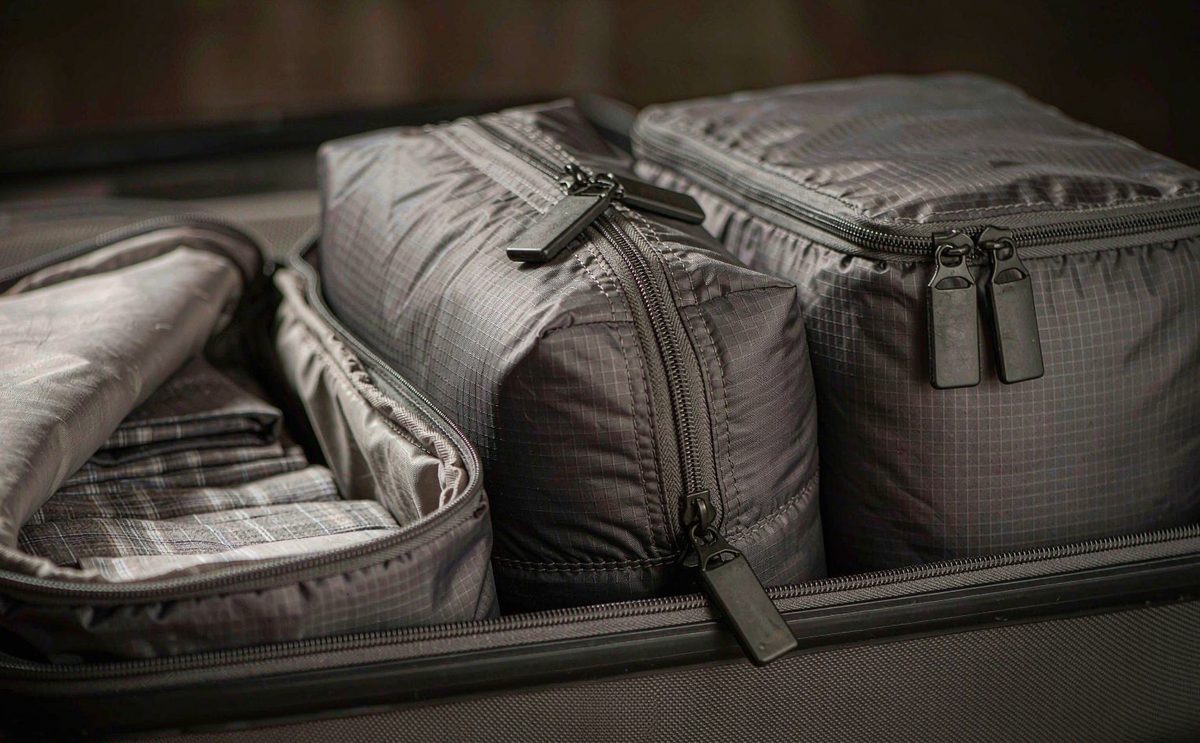
Packing cubes are bought as a set, which changes how you quote them. A four-piece set spans roughly 3.5 to 12 litres per cube, weighs 350-450 g in total, and nests into a carton at 25-40 sets per box. Our production team runs cube sets at 500 pcs per style / colourway, sampling in 6-10 working days and production 35-50 days at AQL 2.5 (ISO 2859-1), with volumetric weight governing the freight line.
- Minimum order quantity
- 500 pcs per style / colourway
- Sampling
- 6-10 working days (12-15 for complex builds)
- Bulk production
- 35-50 days after deposit + approved pre-production sample
- Inspection
- AQL 2.5 to ISO 2859-1
- Trade term
- FOB Xiamen
- Payment
- T/T 30/70
- Production floor
- 4,950 m² SGS-verified, 137 staff, 7 lines, 149 machines
- Monthly capacity
- 200,000 pcs per month
- Programme contact
- service@junyuanbags.com
Key takeaways before you spec a packing cube set
- Decide early whether sizes are sold only as a set or individually, because that decides how the 500 pcs minimum applies.
- A four-piece set spanning 3.5 to 12 litres covers most cabin and checked luggage combinations.
- Mesh placement is a usability decision, not a cost decision: a full mesh top breathes, a mesh window only shows.
- A second compression zip adds roughly 18-25% to unit cost and is the feature backers actually notice.
- Volumetric weight governs the freight line on cubes, so nesting ratio matters more than carton count.
Why a cube set is four SKUs sold as one
A packing cube is rarely bought on its own. Backers buy a set, which means the specification is a composition problem before it is a construction problem: how many sizes, what each size is for, and whether the sizes can also be bought individually. That decision drives the quotation, because the minimum applies per style and colourway, and a three-size set quoted as a set is a different commitment from three sizes quoted separately.
Where sizes are only ever sold together, treat the set as the style, so 500 sets means 500 of each size in the set. Where sizes are also offered individually in a pledge manager, each size becomes its own style against the 500 pcs minimum. Settle this before you send the RFQ, because it is the single largest swing in the total order value. Our custom bags for Kickstarter page sets out how multi-SKU programmes are booked into one production window.
Sizing the set around real luggage
Cube sizing should be checked against the luggage the backer actually owns rather than against a pleasing set of numbers. A cabin roller is typically 55 x 40 x 20 cm internally, and a medium checked case around 67 x 45 x 30 cm. Cubes stack two or three high and two or three across, so a large cube around 40 x 30 cm sits comfortably in either, while anything above 45 cm in length starts dictating how the case is packed rather than helping.
Depth is the dimension that decides whether a cube is useful. A cube 6-8 cm deep holds underwear, socks and tops laid flat. A cube 10-12 cm deep holds rolled garments, a jacket or a pair of shoes. Below 6 cm the cube stops compressing anything and becomes a folder. Publish external dimensions and a stated litre capacity, measured externally, and keep the tolerance at plus or minus 8 mm across a sewn, bound product.
| Cube | External size (cm) | Volume | Unit weight |
|---|---|---|---|
| Small, underwear and socks | 25 x 18 x 8 | 3.5 - 3.8 L | 55 - 75 g |
| Medium, tops laid flat | 32 x 23 x 8 | 5.5 - 6.0 L | 80 - 110 g |
| Large, rolled garments | 40 x 30 x 10 | 11 - 12 L | 120 - 160 g |
| Extra large, jackets or shoes | 45 x 33 x 12 | 17 - 18 L | 165 - 210 g |
| Slim folder, shirts | 35 x 25 x 6 | 5.0 - 5.5 L | 95 - 125 g |
- Check the largest cube against the internal dimensions of the cabin case you name on the campaign page.
- Keep depth at 8 cm or above for any cube intended to compress clothing; 6 cm does not compress.
- Publish litre capacity measured externally and say so, because internal and external figures differ by 10-15%.
- Use the same zip gauge and puller across the set so a single hardware purchase order covers every size.
- Limit the set to four sizes; a fifth size adds a style without adding a use case backers will name.
Shell, mesh and where the two meet
Two materials carry the whole product: a light shell and a mesh panel. The shell default is a 210D ripstop nylon or polyester, which is light, resists tearing at the seam and packs down to almost nothing. A 300D polyester is the more durable, slightly heavier option, and a 420D nylon is the premium tier that holds its shape when the cube is only half full. Heavier shells make a cube feel more expensive and pack worse, which is the wrong trade for this format.
Mesh is where most of the perceived quality lives. A full mesh top lets the cube breathe and lets the backer see contents without opening it, and it is the specification most reviewers comment on. A mesh window on one face is cheaper and stiffer but does neither job well. The failure mode is snagging, so specify the mesh by weight and by aperture, and always bind the mesh edge into a seam rather than butting it against the shell. Take both materials from one material customisation shortlist.
| Specification | Unit weight | Cost index | Best for |
|---|---|---|---|
| 210D ripstop polyester, full mesh top | 55 - 110 g | 1.00 | Default lightweight cube set |
| 210D ripstop nylon, full mesh top | 50 - 100 g | 1.15 | Premium lightweight feel |
| 300D polyester, mesh window | 80 - 150 g | 1.10 | Durable everyday set |
| 420D nylon, full mesh top | 110 - 180 g | 1.40 | Structured premium set |
| rPET ripstop with rPET mesh | 60 - 115 g | 1.25 | Sustainability-led campaigns |
| Non-woven PP shell, no mesh | 45 - 90 g | 0.70 | Lowest cost promotional tier |
Zips, pulls and the compression feature
Every cube in the set has at least one zip, and the zip is the most-used component on the product. A #3 nylon coil is the default on small and medium cubes and a #5 on large and extra-large, because the larger panel carries more tension when the cube is compressed. Reverse coil, where the teeth sit inside, reads cleaner and snags less on the lining. Specify double sliders on the large sizes so the cube can be opened from either end inside a case.
The compression zip is the upgrade that separates a premium set from a generic one. It is a second zip running parallel to the first, roughly 4-6 cm below it; closing both removes air and reduces the packed depth by 20-30%. It adds one panel strip, one zip and one operation, which puts roughly 18-25% on unit cost. In campaigns we support it is the feature backers mention most often in review content, which makes it worth costing before it is worth cutting.
| Closure | Cost index | Defect risk | Perceived value | Best for |
|---|---|---|---|---|
| Zip, #3 coil, single slider | 1.00 | Low | Medium | Small and medium cubes |
| Zip, #3 coil, double slider | 1.10 | Low | Medium-high | Medium cubes opened in a case |
| Zip, #5 coil, double slider | 1.20 | Medium | High | Large and extra-large cubes |
| Reverse coil, #5, double slider | 1.35 | Medium | High | Premium clean-faced sets |
| Main zip plus compression zip | 1.20 - 1.45 | High | Highest | Compression cube sets |
| Roll top with clip closure | 1.15 | Medium | Medium | Compression without a second zip |
A cube zip is cycled hundreds of times in the life of the product, far more than on a bag that is opened twice a day. Ask for a cycle figure rather than a catalogue name, require a bar-tack at both zip ends, and check that the slider does not catch on the mesh binding. Snagged mesh at the zip line is the most common defect on this format.
Handles, labelling and the small parts backers notice
Three small components carry more perceived value than their cost suggests. A webbing pull handle of 20-25 mm on the side of the cube gives the backer something to grab when the cube is stacked in a case. A grip tab at the zip end makes one-handed opening possible. And a labelled panel, either a printed size mark or a woven tab, stops the set becoming four anonymous cubes in a suitcase. Each costs a few cents and each is remembered.
Branding a cube: mesh or panel
A cube offers two branding surfaces and they behave differently. The solid panel takes a print or a woven label cleanly and is the safe route. The mesh top is the larger visible surface when the set is stacked, but printing on mesh gives poor coverage and a patchy edge, and a heat transfer on mesh can stiffen the panel and reduce the breathability that made the mesh worth specifying in the first place. Print on the panel, label on the mesh.
Placement should be pinned to a measured distance from the zip line, at least 10 mm clear, because the zip tape and its binding are where registration drifts. Cap the print block at roughly 20% of the panel face on the small cube; the surface is smaller than it looks in a flat artwork file. The method comparison sits on our print and embroidery page, and our crowdfunding bag guide covers how to present a set on a campaign page.
A single logo application per cube, in the same position and at the same scale relative to the panel, makes a set read as a set. Varying the logo size across sizes to fill the panel is the most common design error on cube programmes: the small cube ends up with a disproportionately large mark and the set looks mismatched in photography.
Nesting, packing and the freight line
Packing cubes are light and bulky, which is the wrong combination for freight. A four-piece set in 210D ripstop weighs roughly 350-450 g, and 30 nested sets fill a 60 x 40 x 40 cm carton at 0.096 m3. At the standard 6,000 divisor that is 16.0 kg of volumetric weight against an actual gross mass of around 14 kg. Volumetric governs, so the nesting ratio, not the carton count, is the lever that moves the freight line.
- Nest the set small-inside-medium-inside-large and ship the assembled nest as one unit.
- Confirm the carton specification before freight is quoted; volumetric weight governs on this format.
- Band the nested set with a paper sleeve or a belly band rather than individually bagging each cube.
- Keep the insert card to one per set, not one per cube, to save three packing operations.
- Our rewards fulfilment page covers the packing specification format we ask for.
QC gates that decide a cube run
Pre-shipment inspection runs at AQL 2.5 to ISO 2859-1, general inspection level II, single sampling plan. Critical is a zip that does not close or a mesh panel detached from the binding. Major is a zip that catches on the mesh, an external dimension outside tolerance by more than 8 mm, or a print defect on the logo. Minor is a loose thread, a slight shade variation between the shell and the binding, or a fold crease that relaxes out.
- Confirm carton count, packing list and set composition before any carton is opened.
- Measure external dimensions on one full set per drawn carton against the stated tolerance.
- Cycle every zip a minimum of 20 times, including both sliders on double-slider sizes.
- Run the compression zip a minimum of 10 times and measure the packed depth reduction.
- Inspect the mesh-to-shell binding for snagging, puckering and skipped stitches.
- Verify the branding coordinate and scale on each size, measured from the zip line.
Because the set is inspected as a set, ask for the inspection report to be broken down by size rather than reported as a single lot figure. A defect concentrated in the large cube is invisible in a blended number, and it is the size most likely to drift, because the larger panel stretches more under the needle. The defect taxonomy we log is set out on the QA and QC page.
Cost breakdown and volume pricing
On a 500 set run a four-piece 210D ripstop set with full mesh tops, #3 and #5 coil zips and webbing pull handles typically quotes in the 4.80 to 9.60 USD per set ex-works band, which is 1.20 to 2.40 USD per cube. Adding a compression zip to the two larger sizes moves the set to roughly 6.20 - 12.40 USD. Volume pricing steps at 1,000 and 3,000 sets, and the step is larger on sets than on single SKUs.
| Quantity | Cost per set (USD) | What changes |
|---|---|---|
| 500 sets | 4.80 - 9.60 | Baseline, setup spread over the minimum |
| 1,000 sets | 4.35 - 8.70 | Better marker yield across four sizes |
| 3,000 sets | 3.95 - 7.90 | Dedicated line, material in full rolls |
| 5,000 sets | 3.70 - 7.40 | Material at roll-lot pricing |
| 10,000 sets | 3.45 - 6.90 | Full-line booking, tooling amortised |
Sampling, compliance and the cube RFQ checklist
Sampling runs 6-10 working days per round from a released tech pack, extending to 12-15 working days where a compression zip or a custom mesh is involved. Sample the full set, not one representative size, because the large cube behaves differently on the line from the small one. production 35-50 days after the 30% deposit under T/T 30/70 has landed and the pre-production sample has been approved in writing.
A cube set approved on a table is not approved. Pack the set with real clothing, stack it in the case you name on the campaign page, and close the case. Most size and compression complaints trace back to a sample that was only ever assessed empty, and a second sampling round costs far less than a re-order of 2,000 pieces.
- Set composition: how many sizes, and whether sizes are also sold individually.
- External dimensions per size in centimetres with a tolerance, plus the stated litre capacity.
- Shell by denier and weave; mesh by weight and aperture; binding specification.
- Zip gauge, coil direction, slider count, puller type and bar-tack specification per size.
- Branding method, maximum print block size, and placement measured from the zip line.
- Packing specification: nested sets per carton, band type, and carton dimensions.
- Quantity per set and colourway against the 500 pcs minimum, and the target delivery month.
- Custom travel bags for Kickstarter
- Custom duffel bags for Kickstarter
- Custom bags for Kickstarter campaigns
- Material customisation for Kickstarter bags
- Print and embroidery options for custom bags
- Crowdfunding rewards fulfilment
- QA, QC and inspection on campaign bag runs
- Request a quotation
Spec a cube set that nests and ships well
Send us the set composition, the shell and mesh direction and the quantity per colourway. As your production partner we will return a unit cost, a sampling estimate and a carton specification. Write to service@junyuanbags.com.
Frequently Asked Questions
What is the MOQ for custom packing cubes on a Kickstarter campaign?
The minimum is 500 pcs per style and colourway. Where sizes are only ever sold together, the set is the style, so 500 sets means 500 of each size in the set. Where sizes are also offered individually in a pledge manager, each size becomes its own 500 pcs commitment.
How many cubes should a packing cube set contain?
Three or four sizes covers most luggage combinations. A typical four-piece set runs 25 x 18 x 8 cm, 32 x 23 x 8 cm, 40 x 30 x 10 cm and 45 x 33 x 12 cm, spanning roughly 3.5 to 18 litres. A fifth size adds a style without adding a use case most backers will name.
How much does a custom packing cube set cost to produce?
On a 500 set run a four-piece 210D ripstop set with full mesh tops and coil zips typically quotes between 4.80 and 9.60 USD per set, which is 1.20 to 2.40 USD per cube. At 3,000 sets the same build usually drops to 3.95 - 7.90 USD per set.
Is a compression zip worth the extra cost?
A second zip running 4-6 cm below the main zip reduces packed depth by 20-30% and adds roughly 18-25% to unit cost, moving a four-piece set from 4.80 - 9.60 to 6.20 - 12.40 USD. In campaigns we support it is the feature most often mentioned in review content, so cost it before cutting it.
What mesh should I specify for a packing cube top?
Specify the mesh by weight and aperture rather than by appearance, and bind the mesh edge into a seam instead of butting it against the shell. Keep the zip tape at least 5 mm clear of the mesh binding. A full mesh top breathes and shows contents; a mesh window does neither well. Snagging at the zip line is the most common defect on this format.
How heavy is a packing cube set for freight planning?
A four-piece set in 210D ripstop weighs roughly 350-450 g. Thirty nested sets fill a 60 x 40 x 40 cm carton at 0.096 m3, which is 16.0 kg of volumetric weight at the 6,000 divisor against about 14 kg actual. Volumetric governs, so nesting ratio matters most.
How long does sampling take for a custom packing cube set?
Sampling runs 6-10 working days per round from a released tech pack, extending to 12-15 working days where a compression zip or a custom mesh is involved. Sample the full set rather than one representative size, because the large cube behaves differently on the line.
Should packing cube sizes be published in litres?
Yes, but state whether the figure is external or internal, because the two differ by 10-15% on a bound, sewn product. Publish external dimensions in centimetres alongside the litre figure and keep the tolerance at plus or minus 8 mm.
What inspection standard applies to a packing cube order?
AQL 2.5 to ISO 2859-1 at general inspection level II, single sampling plan. Critical is a zip that does not close or mesh detached from the binding. Major is a zip catching on the mesh or an out-of-tolerance dimension. Ask for the report broken down by size.
Can packing cubes share a production run with a travel bag?
Yes, and it is the cheapest way to build a travel reward set. Sharing shell, mesh, hardware family and branding means one material purchase order and one consolidated container. Book both inside the same 35-50 day window rather than as two separate orders.
What compliance applies to packing cubes shipped into the US and EU?
United States shipments fall under California Prop 65 where a listed substance is present above threshold, and CPSIA where the product is intended for children. European Union shipments fall under REACH Annex XVII and the EU GPSR. OEKO-TEX Standard 100 covers textile components.
When does bulk production actually start on a cube set order?
production 35-50 days after two conditions are met together: the 30% deposit under T/T 30/70 has landed, and the pre-production sample has been approved in writing. Neither condition alone starts the clock. Confirm the slot in writing with a start, completion and inspection date.
People Also Ask
Are packing cubes a good standalone Kickstarter reward?
They work best inside a travel programme. A cube set alone rarely justifies a campaign, but paired with a duffel or travel bag it lifts the average pledge and shares the same shell, mesh and hardware, so the set lands in one container.
What fabric is best for a custom packing cube?
A 210D ripstop polyester or nylon is the practical default at 50-110 g per cube. It resists tearing at the seam and packs down to almost nothing. 300D polyester is more durable but heavier, and 420D nylon holds shape at a 40% cost premium.
Should the mesh be a full top or a window?
A full mesh top. It lets the cube breathe and lets the backer see contents without opening it, and it is the specification reviewers comment on most. A window is cheaper but does neither job well and stiffens the panel.
How do I stop the zip snagging on the mesh?
Bind the mesh edge into a seam rather than butting it against the shell, keep the zip tape clear of the mesh by at least 5 mm, and use a reverse coil where the teeth sit inside. Cycle test 20 times before approval.
Do packing cubes count as their own MOQ?
The set does, if sizes are only sold together. Where sizes are also offered individually, each size is a separate style against the 500 pcs minimum. Settle this before the RFQ, because it is the largest swing in total order value.