Custom Gym Bags for Kickstarter
How much does a custom gym bag reward cost to produce? A 40-60 litre gym build prices above a drawstring or tote of similar size because the vented shoe bay, the lined wet-kit pocket and the reinforced base panel each add material and labour. Our production team quotes from 500 pcs per style and colourway, samples in 6-10 working days, runs production 35-50 days after deposit and approved pre-production sample, and inspects to AQL 2.5 under ISO 2859-1.
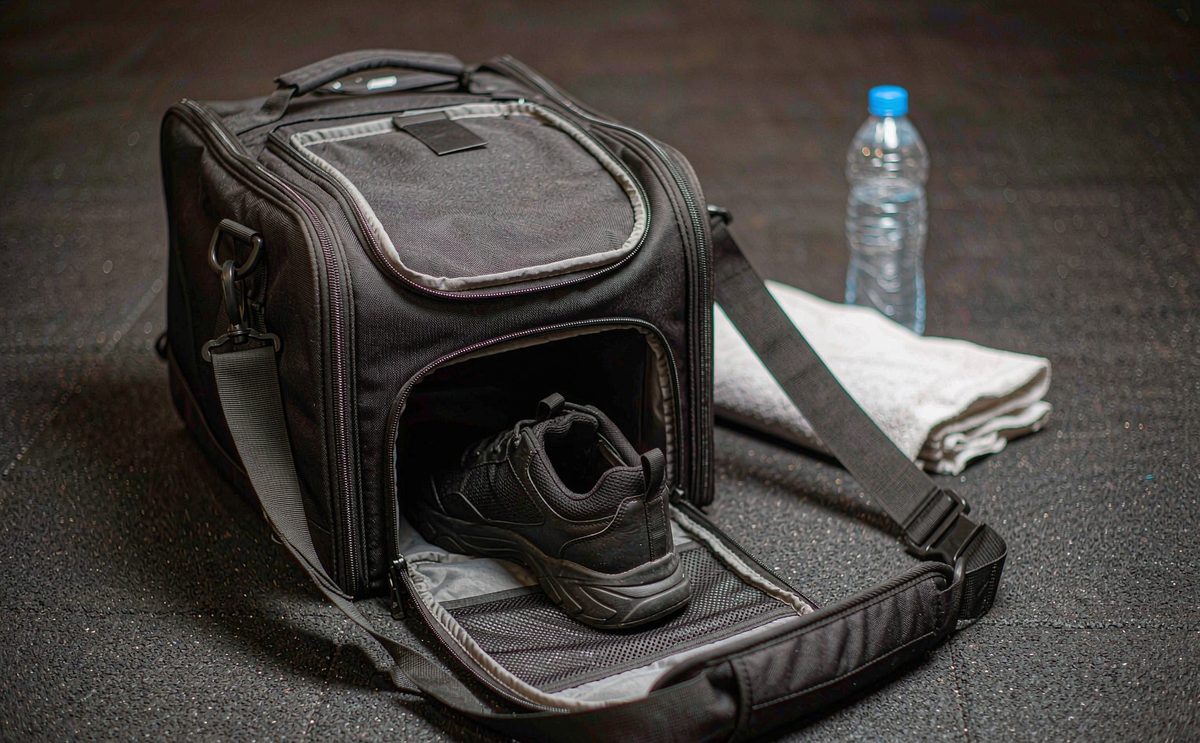
- What a fitness reward has to survive in daily use
- Planning 40-60 litres around real kit volume
- Vented shoe storage: aperture area and mesh grade
- Wet-kit pockets that hold without leaking
- Odour-control finishes and how to specify them
- Shell fabrics ranked for gym and studio carry
- Linings, coatings and cleanability standards
- Volume, dimensions and the packing-cube bundle
- Straps, handles and load distribution on a full kit
- Closure and hardware choices for high-cycle opening
- Team and studio bulk orders: numbering and size runs
- Unit cost drivers in a 40-60 litre build
- Sampling a gym bag: vent, leak and cycle checks
- Inspection points for vented and coated builds
- Compliance and labelling for fitness merchandise
- Carton cubing for 40-60 litre bodies
- A gym bag RFQ that prices without revisions
What a fitness reward has to survive in daily use
A gym bag is the one reward in a fitness campaign that gets used while it is still wet. Backers load it with a damp towel, training shoes and a wash bottle within hours of unboxing, then leave it closed in a car or a locker overnight. That duty cycle drives every downstream specification decision, and it is the reason a 40-60 litre gym build costs more per unit than a custom drawstring bag of the same nominal size.
Four subsystems carry that duty: the vented shoe bay, the wet-kit pocket, the odour-resistant lining and the base panel. Each adds material, labour or both, and each is where a low-cost sample fails first. When you brief a sourcing partner, treat those four as separately specified line items rather than one vague gym bag request, because a quotation built on a bundled description will always be priced on the cheapest possible interpretation of it.
The reward also has to survive the campaign calendar. Fitness campaigns commonly launch into the new-year window and deliver into spring, which puts sampling and bulk production against the same seasonal peaks that team and travel programmes compete for. Securing the production window matters as much as the specification itself, and a delay in sample approval of even five working days can push a delivery month.
Key takeaways
- A 40-60 L gym bag is priced on its four wet-duty subsystems, not on its nominal litre figure.
- MOQ is 500 pcs per style and per colourway; a second colourway is normally a second minimum unless you negotiate a split.
- Sampling takes 6-10 working days, extending to 12-15 where a moulded base or a full tunnel vent is involved.
- Vent area, mesh grade and coating choice are the three specification lines that move unit cost most.
- Team and studio orders add numbering, which is a labour line item rather than a printing line item.
Planning 40-60 litres around real kit volume
Volume claims on fitness bags are frequently optimistic. A backer reads 50 litres and expects a full kit plus shoes to disappear inside; if the body geometry is tall and narrow, the bag holds less than the number suggests and the reward reviews suffer. Specify volume as a measured figure with a stated tolerance, and specify the body dimensions separately so the two cannot be traded against each other during sampling.
| Stated volume | Contents that fit | Typical body size | Campaign use |
|---|---|---|---|
| 40 L | Shoes to EU 44, towel, 750 ml bottle, small kit | 48 x 26 x 26 cm | Studio and class reward tier |
| 50 L | Above plus a hoodie and a wash bag | 52 x 28 x 28 cm | Core single-tier reward |
| 60 L | Full kit plus gloves or ball and a change of clothes | 58 x 30 x 30 cm | Team and club tier |
| 40 L plus cube set | Same body with a three-cube bundle packed inside | 48 x 26 x 26 cm | Bundle or stretch-goal tier |
The 40-60 litre band is the practical range for a fitness reward because it covers both ends of the use case without forcing a second tooling setup. Below 40 litres the bag will not take a pair of training shoes alongside a towel, which is the single most common complaint in fitness reward reviews. Above 60 litres the body stops being a gym bag and starts competing with the custom duffel bag line you may already be planning.
Hold dimensional tolerance at plus or minus 3 percent on all three axes and record it in the tech pack. A 50-litre bag that comes out at 47 litres is a measurable deviation, and without a written tolerance you have no contractual basis to reject the bulk run or to claim a re-make.
Vented shoe storage: aperture area and mesh grade
The shoe bay is the specification line that most often separates a credible fitness reward from a generic sports bag. Ventilation is a geometry problem before it is a materials problem: the air path has to enter low, pass over the shoe, and exit high without being blocked by whatever else is packed on top. A mesh panel covered by a loaded main compartment ventilates nothing.
Specify total open area in square centimetres rather than describing a vent as present. Two 8 mm grommets per side deliver roughly 2 square centimetres of open area, which is decorative. A 200 gsm polyester mesh panel of 18 x 12 cm delivers a genuinely different result, and adding a stand-off baffle behind the panel keeps the air path open when the bag is packed full.
| Vent format | Air path | Unit cost effect | Best for |
|---|---|---|---|
| 6 mm grommet grid, 8 holes | Low, direct | Baseline | Light studio builds |
| 200 gsm polyester mesh panel | Medium, diffuse | +0.40 to 0.70 USD | Most 40-60 L builds |
| Mesh panel plus stand-off baffle | High, indirect | +0.90 to 1.40 USD | Team kits in daily use |
| Full end-cap tunnel, mesh at both ends | Highest | +1.60 to 2.40 USD | Boot and court-shoe tiers |
Where the brief calls for a fully separate shoe compartment, a tunnel vent that runs the full width of the base panel is the most effective build and the most expensive one. It requires an additional panel seam, an internal divider and a second zip run, which together add roughly 12 to 18 minutes of assembly time per unit. That labour, not the mesh, is what the 1.60 to 2.40 USD premium reflects.
If your reward matrix already includes a standalone custom shoe bag, reconsider whether the main bag needs a tunnel at all. A simpler mesh panel on the main body plus a separate shoe bag as a stretch goal often delivers better perceived value at a lower total unit cost than a single over-engineered body.
Wet-kit pockets that hold without leaking
A wet pocket fails in one of two ways: the seam wicks, or the closure weeps. Both are specification problems rather than workmanship problems, and both are cheap to prevent at the tech-pack stage and expensive to fix after bulk has started. The pocket must be a fully sealed liner, not a coated panel sewn into the shell.
- Specify welded or high-frequency sealed seams on the wet liner, not taped seams; taped seams lift after repeated warm washes.
- Use a TPU or PU laminate at 0.15 to 0.25 mm on the liner face; thinner films crack at the fold after roughly 40 cycles.
- Put the wet pocket on an end panel or the base, never against the back panel, so any weep cannot reach the carry system.
- Give the pocket its own zip with a reverse-coil chain and a garage, so the slider does not sit in standing water.
- Give the pocket a drain path or a fully removable liner; a sealed pocket with no drain becomes a mould risk in transit.
Ask your production partner for a filled-water test on the sample: the pocket is filled to 70 percent, zipped, laid flat for four hours on absorbent paper, and then checked for any transfer. It is a thirty-minute test that costs nothing and it removes an entire category of bulk-run dispute. Record the result in the sample approval note so the bulk run is held to the same standard.
A wet pocket described only as water resistant will be built with a coated shell and a standard sewn seam, which will wick within a few uses. State the seam method, the film thickness and the test method in the tech pack, or you will be negotiating the failure after 500 units have shipped.
Odour-control finishes and how to specify them
Odour is the most common negative review theme on fitness carry, and it is also the area where campaign pages make claims their bill of materials cannot support. An antimicrobial finish slows bacterial growth on a fabric surface; it does not remove the source of the smell. If the bag has no ventilation path, no finish will save it.
| Approach | Mechanism | Durability | Documentation to request |
|---|---|---|---|
| Antimicrobial PU coating | Silver-ion or zeolite agent on the lining face | 20 to 30 home washes | OEKO-TEX Standard 100 on the base cloth |
| Activated-carbon bonded liner | Adsorption within a foam or nonwoven layer | Limited, not washable | REACH SVHC statement on the carbon layer |
| Ventilation-first geometry | No finish; airflow path and mesh alone | Permanent | None required |
| Removable washable liner | Mechanical removal of soil and moisture | Full service life | CPSIA documentation where youth market |
From a compliance standpoint, any biocidal claim made on a campaign page needs documentation behind it. Request a treatment certificate naming the active agent and the test method, and request the OEKO-TEX Standard 100 certificate for the base fabric. Where the reward ships into the EU, the EU GPSR requires traceable product identification, so keep the finish certificate attached to the same product file as the sample approval.
The cheapest and most durable answer is usually a ventilation-first design paired with a removable liner. It carries no chemical documentation burden, it survives washing, and it gives you a clean, defensible claim to put on the campaign page without exposing the programme to a substantiation problem.
Shell fabrics ranked for gym and studio carry
Fitness bags take abrasion from locker floors, car boots and gym benches, so the shell fabric choice is driven by abrasion resistance and cleanability rather than by hand feel. Polyester dominates this category because it dries faster than nylon and holds a printed logo better; nylon wins only where weight is the primary constraint.
| Fabric | Weight class | Abrasion behaviour | Unit cost effect at 500 pcs |
|---|---|---|---|
| 420D nylon ripstop | Light | Good, prone to scuff at corners | Baseline |
| 600D polyester, PU coated | Mid | Very good, wipes clean | +0.30 to 0.60 USD |
| 900D polyester, PVC backed | Heavy | Excellent, but stiff in cold | +0.90 to 1.50 USD |
| Recycled 600D rPET, GRS certified | Mid | Very good | +0.70 to 1.20 USD |
Where the campaign page makes a recycled-content claim, the GRS transaction certificate has to cover the specific fabric lot used, not a generic mill certificate. Ask for it at sample stage, because substituting fabric after approval invalidates the claim and, in the worst case, the listing. The premium for certified rPET is real but modest, and it is far cheaper than a claim withdrawal after launch.
Abrasion testing should be specified by method rather than by adjective. Request Martindale or Wyzenbeek results on the exact coated fabric and state the cycle count you require in the tech pack. ASTM D5034 covers breaking strength and elongation and is a useful companion test where the shell carries a load-bearing strap attachment.
Linings, coatings and cleanability standards
The lining is the surface the backer actually touches when they empty the bag, and it is the surface that carries the moisture. A light-coloured lining looks premium in photography and shows every mark after a week of use; a dark lining hides soiling but makes the interior hard to search in a dim locker room. Most fitness programmes resolve this with a mid-tone lining and a light-coloured wet pocket, so the sealed area stays visibly clean.
Specify the coating by weight in grams per square metre, not by name. A PU coating described only as water resistant can be applied at anywhere from 20 to 80 gsm, and the difference is the difference between a bag that sheds a splash and one that soaks through in a minute. Put the number in the tech pack and verify it on the pre-production sample by weighing a cut swatch.
Volume, dimensions and the packing-cube bundle
One of the more efficient ways to raise perceived reward value without changing the bag body is to bundle a cube set inside it. The body stays at 40 litres, the carton stays the same size, and the backer receives three or four additional items that cost a fraction of the bag. Because the cubes nest inside the packed bag, they add almost nothing to freight.
Bundle economics work best when the cubes share fabric with the main body. A custom packing cube line cut from the same 600D roll as the gym bag consumes offcut material that would otherwise be waste, and it lets the whole bundle count as one style for minimum purposes when it is ordered and invoiced as a single stock-keeping unit. Confirm the counting rule with your production partner before you build the pledge tier around it.
Straps, handles and load distribution on a full kit
A full 50-litre kit weighs between 6 and 9 kg, which is well beyond what a single unpadded webbing strap can carry comfortably. The strap specification is therefore a comfort specification and a durability specification at the same time, and it is one of the two areas where cheap fitness bags fail mechanically within the first month.
- Shoulder strap: 38 to 50 mm webbing with a 6 to 8 mm closed-cell foam pad, box-stitched at both ends.
- Grab handles: two 25 mm webbing loops joined by a hook-and-loop wrap, load-tested to 25 kg static.
- Load path: both strap roots must terminate on a reinforcement panel, not on the shell fabric alone.
- Stitch density: 7 to 9 stitches per inch on all load-bearing joins, with back-tack at every start and stop.
- Attachment hardware: zinc-alloy or acetal, rated above the static test load with a safety margin.
Add a load test to the sample protocol rather than relying on a visual check. The bag is filled to its rated volume with a standardised weight, carried for 30 minutes, and then inspected for stitch migration at the strap roots. It is a low-cost test that catches the failure mode which otherwise only appears once backers have the product in hand.
Closure and hardware choices for high-cycle opening
A gym bag is opened and closed far more often than a travel bag, and it is opened with wet hands. Hardware that is specified only for appearance will corrode or jam. Specify slider, chain and pull by grade and finish, and match the finish to the moisture environment rather than to the brand palette.
| Component | Entry specification | Recommended specification | Cycle expectation |
|---|---|---|---|
| Main zip | Unbranded coil, size 5 | Branded coil or Vislon, size 8 or 10 | 5,000 to 10,000 cycles |
| Shoe bay zip | Unbranded coil, size 3 | Branded reverse coil, size 5 | 3,000 to 5,000 cycles |
| Wet pocket zip | Standard coil | Reverse coil with garage and water-shedding tape | 3,000 cycles plus water exposure |
| Sliders | Painted zamak | Nickel or black-oxide finished zamak, corrosion tested | Matches chain life |
| D-rings and hooks | Ungraded steel | Zinc-alloy or acetal, rated to 25 kg | Full service life |
Corrosion testing is worth requesting explicitly. A 24-hour neutral salt-spray result on the finished hardware tells you whether the bag will still open six months into use. It is a standard test with a standard report, and it costs a fraction of the goodwill you lose to 500 backers with jammed zips.
If the reward tier also includes a wash bag or a small accessories pouch, align the hardware finish across the whole set. Mixed finishes read as a sourcing error rather than a design choice, and they are the kind of detail that shows up in unboxing videos. See the custom toiletry bag line for a compatible finishing spec.
Team and studio bulk orders: numbering and size runs
Fitness and studio buyers order differently from individual backers. A club places one order covering a season, wants every bag numbered or named, and expects the numbering to survive a full season of use. That turns the decoration step into a per-unit variable operation, which is priced separately from the base bag and adds to the production window.
Numbering adds roughly 0.30 to 0.90 USD per unit depending on method: heat-transfer numbers are cheapest and least durable, embroidery is most durable and slowest, and sublimated panels sit in between but require a polyester face. Confirm the method against the shell fabric before you quote the club, because embroidery onto a coated 600D polyester behaves differently from embroidery onto a canvas panel.
For club and studio programmes, plan the order so that the base run is consolidated. Twenty-two numbered bags for one squad is not an economical run on its own, but twenty-two squads ordered together against a single 500-piece minimum is. Consolidate at the programme level, then let the custom sports bag and gym specifications share the same shell and hardware so the whole consolidated order counts as one production setup.
Unit cost drivers in a 40-60 litre build
Creators routinely underestimate the cost of a gym reward because they compare it against a tote or a drawstring. The difference is structural: the gym bag has a lined wet pocket, a vented shoe bay, a reinforced base and a padded strap system, and each of those is both a material line and a labour line.
| Cost element | Approximate share | What moves it |
|---|---|---|
| Shell and lining fabric | 26 to 32 percent | Denier, coating weight, recycled certification |
| Hardware and zips | 14 to 18 percent | Brand, size, finish, corrosion testing |
| Cutting and assembly labour | 28 to 34 percent | Panel count, vent format, sealed seams |
| Branding and decoration | 6 to 10 percent | Method, number of positions, colour count |
| Testing, compliance and packaging | 5 to 8 percent | Lab scope, destination market, polybag spec |
| Programme overhead and QC | 7 to 10 percent | Inspection level, documentation depth |
Labour is the largest single block and the one most sensitive to panel count. Every additional panel adds a cutting operation and a sewing operation. Reducing the number of distinct panels by one or two, while keeping the vent and wet-pocket functions intact, is usually worth more per unit than downgrading the fabric.
Spend on the wet-pocket seam method, the base panel and the zip chain, because those are the three failure points backers report. Save on decorative panel breaks and on a second branding position. A bag with one well-executed logo and a sealed wet pocket reviews better than a bag with three logos and a leaking pocket.
Sampling a gym bag: vent, leak and cycle checks
A standard gym bag with a mesh vent and a lined wet pocket samples in 6-10 working days. Add a moulded base, a full tunnel vent or a welded liner and the window extends to 12-15 working days, because those components arrive from a second source and cannot be cut in parallel with the shell.
- Tech pack review and material confirmation, 1 to 2 working days.
- Pattern making and cutting of the first build, 2 to 3 working days.
- Assembly of the first sample including any welded or sealed operations, 2 to 3 working days.
- Internal functional checks: fill, water, zip-cycle and load test, 1 working day.
- Photography and dispatch of sample images or the physical sample, 1 working day.
Where the timeline is tight, ask whether a digital mockup can be approved in parallel with the physical build. A rendered mockup confirms proportion, panel layout and branding placement, but it cannot confirm airflow, seam seal or strap comfort. It is a useful parallel track, never a substitute. The full sampling sequence is set out in the bag sampling and prototyping guide.
Inspection points for vented and coated builds
Pre-shipment inspection on a fitness bag runs at AQL 2.5 under ISO 2859-1, but the defect classification matters more than the sampling level. A cosmetic scuff and an unsealed wet-pocket seam are both defects; only one of them generates returns. Write the classification into the inspection worksheet so the inspector is scoring against your priorities, not against a generic checklist.
- Wet-pocket seam integrity: 100 percent check rather than sample-level, because a single failure produces a return.
- Vent open area: measured against the stated square-centimetre figure on a sample of five units per carton lot.
- Coating weight: swatch weigh-in on three units per 500-piece lot.
- Zip cycle: 200 open-close cycles on three units, checking for slider wear and tape fray.
- Strap root stitch density: counted on five units, with any back-tack omission treated as critical.
- Odour: units sniff-tested after 24 hours in a sealed carton; any chemical smell above threshold is a hold.
The odour check deserves a specific note. A sealed carton of 500 coated bags will hold whatever volatile residue the coating and adhesive left behind, and a carton that smells strongly on opening produces a wave of complaints even if every bag passes dimensional inspection. Specify a 24-hour sealed-carton rest before the sniff test and record the result. Full protocol detail sits in the campaign bag QA and QC page.
Compliance and labelling for fitness merchandise
A gym bag shipped into the United States falls under CPSIA where it is marketed to children, and under California Proposition 65 where any component carries a listed substance above the safe-harbour level. Into the EU it needs EU GPSR identification and, where a recycled claim is made, GRS documentation. Into the UK the equivalent requirements mirror the EU set.
The practical step is to fix your destination list before sampling rather than after. Lab testing scope is priced per destination and per material, and adding a market after the sample has been approved usually means re-testing on a new sample, which costs both money and working days. State the destination list in the RFQ so the quotation includes the correct compliance scope from the start.
Carton cubing for 40-60 litre bodies
Soft gym bags pack well because they compress, but the compression is not free. Over-compressing a coated bag to hit a carton count can crease the coating permanently, so specify a compression limit as well as a carton quantity. A 50-litre bag typically ships 12 to 20 units per carton depending on the compression allowed and whether the strap system is packed flat.
Carton dimensions drive freight cost on both sea and air, and they drive the rewards fulfilment handover cost too. Confirm the carton spec at sample stage, because a carton that is 2 cm larger on one axis can move a pallet count and change the per-unit landed figure across the whole shipment. Ask for ISTA 3A transit testing where the parcel will go through a carrier network rather than a palletised freight lane.
A gym bag RFQ that prices without revisions
Most gym bag quotations come back with a wide range because the request did not pin down the four subsystems. A request that states volume, vent format, wet-pocket seam method and shell specification will return a firm number on the first pass, and that number is comparable across two or three sourcing partners.
- State target volume in litres with a plus or minus 3 percent tolerance and the body dimensions.
- State the vent format, the mesh grade in gsm and the total open area in square centimetres.
- State the wet-pocket liner film, thickness, seam method and the test you will accept it against.
- State shell fabric by denier and coating weight, plus any recycled certification requirement.
- State hardware by brand or grade, finish and any corrosion test requirement.
- State quantity per colourway, destination markets, required certificates and target delivery month.
Send the same RFQ to every partner you are shortlisting. A comparable quotation is only comparable if the inputs are identical, and the fastest way to lose two weeks in a campaign schedule is to spend them reconciling three quotes that were pricing three different bags. Our team returns a line-item breakdown against a specification of this shape, which is also the fastest route to a clean quote request.
Build your reward timeline backwards from the delivery date you promised, not forwards from the day you finish the design.
Kickstarter Creator Handbook
- Minimum order quantity
- 500 pcs per style / colourway
- Gym bag sampling
- 6-10 working days (12-15 with moulded base or tunnel vent)
- Bulk production
- 35-50 days after deposit + approved pre-production sample
- Inspection standard
- AQL 2.5 to ISO 2859-1
- Trade term
- FOB Xiamen
- Payment terms
- T/T 30/70
- Production floor
- 4,950 m², SGS-verified
- Team and capacity
- 137 staff / 7 production lines / 149 machines / 200,000 pcs per month
- Campaigns supported
- 20+ crowdfunding campaigns
- Contact
- service@junyuanbags.com / WhatsApp +86 177 5002 0688
Sports and team carry
Compare the gym build against team formats, boot compartments and club numbering before you fix the spec.
Duffel and weekender formats
Where a rectangular duffel body serves the same reward tier better than a barrel gym build.
Sampling and prototyping
The full sampling sequence, revision rounds and pre-production approval route for a fitness build.
Low-volume production
How the 500-piece minimum counts, and which levers genuinely reduce a first order.
- Crowdfunding bag guide: idea to backer delivery
- Custom shoe bags for Kickstarter
- Custom packing cubes for Kickstarter
- Custom drawstring bags for Kickstarter
- Custom bag categories index
Price your gym bag reward
Send volume, vent format, wet-pocket specification and target quantity per colourway. You will receive a line-item quotation, a sampling window and a production calendar you can plan a delivery month around.
Frequently Asked Questions
What is the MOQ for a custom gym bag on a Kickstarter campaign?
The minimum order quantity is 500 pcs per style and per colourway. A 50-litre body in black and the same body in grey count as two colourways, so the combined order is 1,000 pcs unless the run is negotiated as a split within one production setup. Splits are usually possible where both colourways share fabric, hardware and branding.
How much does a 50-litre custom gym bag cost per unit?
Unit cost depends on shell denier, vent format and wet-pocket construction. At 500 pcs, labour is typically the largest block at 28 to 34 percent, with fabric at 26 to 32 percent and hardware at 14 to 18 percent. A mesh-panel build with one logo position prices meaningfully below a tunnel-vent build with a welded liner and two branding positions.
How long does gym bag sampling take?
A standard gym bag with a mesh vent and a sewn wet pocket samples in 6-10 working days. Where the build includes a moulded base panel, a full-width tunnel vent or a welded liner, allow 12-15 working days, because those components come from a second source and cannot be cut in parallel with the shell.
What is the bulk production lead time for a fitness bag order?
production 35-50 days after the deposit is received and the pre-production sample is approved. Both conditions must be met before the clock starts. Orders placed against the January to March fitness season should book the window earlier, because that period competes with team and travel programmes for the same line capacity.
Can I order two colourways within a single 500-piece minimum?
Usually not as a default, because each colourway requires its own fabric cutting and thread changeover. Where two colourways share the same fabric weight, hardware finish and branding method, a split of 250 plus 250 can sometimes be agreed. Confirm it in writing before you build a pledge tier around the assumption.
How do I specify a vented shoe compartment so it actually ventilates?
Specify total open area in square centimetres and the mesh grade in grams per square metre, rather than writing vented. A 200 gsm mesh panel of roughly 18 by 12 cm is the practical minimum for a 40-60 litre bag. Add a stand-off baffle behind the panel so the air path stays open when the main compartment is packed full.
What stops a wet-kit pocket from leaking in bulk production?
Specify the seam method, the film thickness and the acceptance test. Welded or high-frequency sealed seams on a 0.15 to 0.25 mm TPU or PU laminate will hold; a coated panel with a sewn seam will wick. Require a four-hour filled-water test on the sample and record the result in the approval note.
Do antimicrobial odour-control finishes actually work on gym bags?
They slow bacterial growth on the fabric surface, typically for 20 to 30 home washes, but they do not remove the source of the odour. Without an airflow path, no finish will solve the problem. A ventilation-first geometry with a removable washable liner is cheaper and carries no biocidal claim substantiation burden.
Which certificates should I request for a gym bag sold in the EU?
Request EU GPSR product identification, a REACH SVHC statement for coated fabrics and hardware, and a GRS transaction certificate if the campaign page claims recycled content. Where a biocidal finish is used, request the treatment certificate naming the active agent. Fix the destination list before sampling so the lab scope is quoted correctly.
What inspection level applies to a fitness bag shipment?
Pre-shipment inspection runs at AQL 2.5 under ISO 2859-1. The defect classification matters more than the sampling level: treat wet-pocket seam failure, strap-root stitch omission and coating-weight deviation as critical, and run the wet-pocket check at 100 percent rather than at sample level.
How many gym bags fit in one shipping carton?
A 50-litre soft build typically ships 12 to 20 units per carton, depending on the compression allowed and whether the strap system is packed flat. Over-compressing a coated bag can crease the coating permanently, so specify a compression limit alongside the carton quantity and confirm final carton dimensions at sample stage.
Can I bundle packing cubes with the gym bag under one minimum?
Yes, where the cubes are ordered and invoiced as one stock-keeping unit with the bag and cut from the same fabric roll. The cubes nest inside the packed bag, so they add almost nothing to freight. Confirm the counting rule with your production partner before the pledge tier is built around it.
How does team numbering affect gym bag cost and lead time?
Numbering adds roughly 0.30 to 0.90 USD per unit and 3 to 5 working days to the schedule, depending on method. Heat transfer is cheapest, sublimation needs a polyester face, and embroidery is the most durable and the slowest. Consolidate squad orders so the base run clears the 500-piece minimum in one setup.
What shell fabric is best for a 40-60 litre gym bag?
600D polyester with a PU coating is the default for this volume band: it wipes clean, dries quickly and holds print well. 420D nylon ripstop saves weight but scuffs at the corners. 900D PVC-backed polyester is the most abrasion-resistant and the stiffest in cold conditions. Certified rPET adds 0.70 to 1.20 USD.
What is the payment structure for a first gym bag order?
Standard terms are T/T 30/70: a 30 percent deposit to release materials and book the production window, and the 70 percent balance before shipment against the passed inspection report. Trade term is FOB Xiamen. Sample fees and courier costs are billed separately and are normally credited against the bulk order.
Can I approve a gym bag from a digital mockup instead of a physical sample?
A rendered mockup confirms proportion, panel layout and branding position, but it cannot confirm airflow, seam seal or strap comfort. Use it as a parallel approval track while the physical build is in progress. The physical sample remains the reference for bulk, and the pre-production sample is what production is held to.
What dimensional tolerance should I set on a 50-litre gym bag?
Hold plus or minus 3 percent on all three axes and record it in the tech pack. Volume should be stated as a measured figure with its own tolerance, separately from the body dimensions, so the two cannot be traded against each other during sampling. Without a written tolerance you have no contractual basis to reject the run.
Why does a gym bag cost more than a drawstring bag of similar size?
A gym bag carries four subsystems a drawstring does not: a vented shoe bay, a sealed wet pocket, an odour-resistant lining and a reinforced base panel. Each adds material and labour. Panel count drives assembly time, which is the largest single cost block at 28 to 34 percent of unit cost.
People Also Ask
Are custom gym bags a good Kickstarter reward?
They perform well because the use case is universal and the perceived value is high relative to unit cost. The risk is the wet-duty specification: a bag without a vented shoe bay and a sealed wet pocket generates the exact complaints that damage a campaign's review profile. Budget for those two subsystems before you budget for branding.
How do I choose between a gym bag and a duffel bag for my campaign?
Choose on the reward's primary use. A gym bag fits a fitness or studio audience that carries damp kit and shoes and needs separated storage. A duffel fits a travel or overnight audience that needs packing volume and a simpler interior. If your audience is both, the gym build with a removable liner covers more use cases.
What size gym bag should a fitness campaign offer?
The 40-60 litre band covers the full range. Below 40 litres the bag will not take training shoes alongside a towel, which is the most common complaint. Above 60 litres it overlaps with a duffel. Most single-tier campaigns land at 50 litres, with a 40-litre body plus a cube set as the bundle variant.
Do I need lab testing for a gym bag reward?
Yes if you make a specific claim. A recycled-content claim needs a GRS transaction certificate, a biocidal odour claim needs a treatment certificate, and US-bound youth-market product needs CPSIA documentation. Fix the destination and claim list before sampling so the testing scope is included in the quotation.
Can I get a gym bag sample before committing to 500 units?
Yes. Sampling is a paid, standalone step that runs 6-10 working days for a standard build and 12-15 for one with a moulded base or tunnel vent. Sample fees and courier costs are normally credited against the bulk order when you proceed, and the approved sample becomes the reference for production.
What causes gym bags to smell after a few weeks of use?
Almost always a combination of no airflow path and a lining that cannot be washed. Moisture sits in the shoe bay and the wet pocket, bacteria grow, and the smell becomes permanent. Ventilation geometry with an open air path, plus a removable washable liner, is the durable fix; a surface finish alone is not.
How far ahead of delivery should I start a gym bag programme?
Work backwards from the delivery month. Allow 6-10 working days for sampling, up to 15 for a complex build, then 35-50 days for bulk after deposit and approval, then freight and fulfilment. A January-launch fitness campaign should have the specification agreed well before the seasonal production peak.