Custom Toiletry Bags for Kickstarter
A toiletry bag is a containment product before it is a bag. The everyday band is 24 x 15 x 12 cm at 4-5 litres, a wipe-clean TPU or PEVA lining contains a leak, and the swivel hook carries 3-5 kg when hung. Our production team runs wash kits at 500 pcs per style / colourway, sampling in 6-10 working days and production 35-50 days at AQL 2.5 (ISO 2859-1).
- Minimum order quantity
- 500 pcs per style / colourway
- Sampling
- 6-10 working days (12-15 for complex builds)
- Bulk production
- 35-50 days after deposit + approved pre-production sample
- Inspection
- AQL 2.5 to ISO 2859-1
- Trade term
- FOB Xiamen
- Payment
- T/T 30/70
- Production floor
- 4,950 m² SGS-verified, 137 staff, 7 lines, 149 machines
- Monthly capacity
- 200,000 pcs per month
- Programme contact
- service@junyuanbags.com
Key takeaways before you spec a toiletry bag
- Choose the format first: hanging, standing or a hybrid. Everything else follows from it.
- MOQ is 500 pcs per style and colourway, so a two-size wash kit range is two commitments.
- A wipe-clean TPU or PEVA lining is not optional; a fabric lining will stain and will not contain a leak.
- Specify the swivel hook by load rating and test it at 3-5 kg hung for 60 seconds.
- Run a 24-hour leak test on the lining during sampling and make it a production inspection item.
Hanging, standing or hybrid: choosing the format
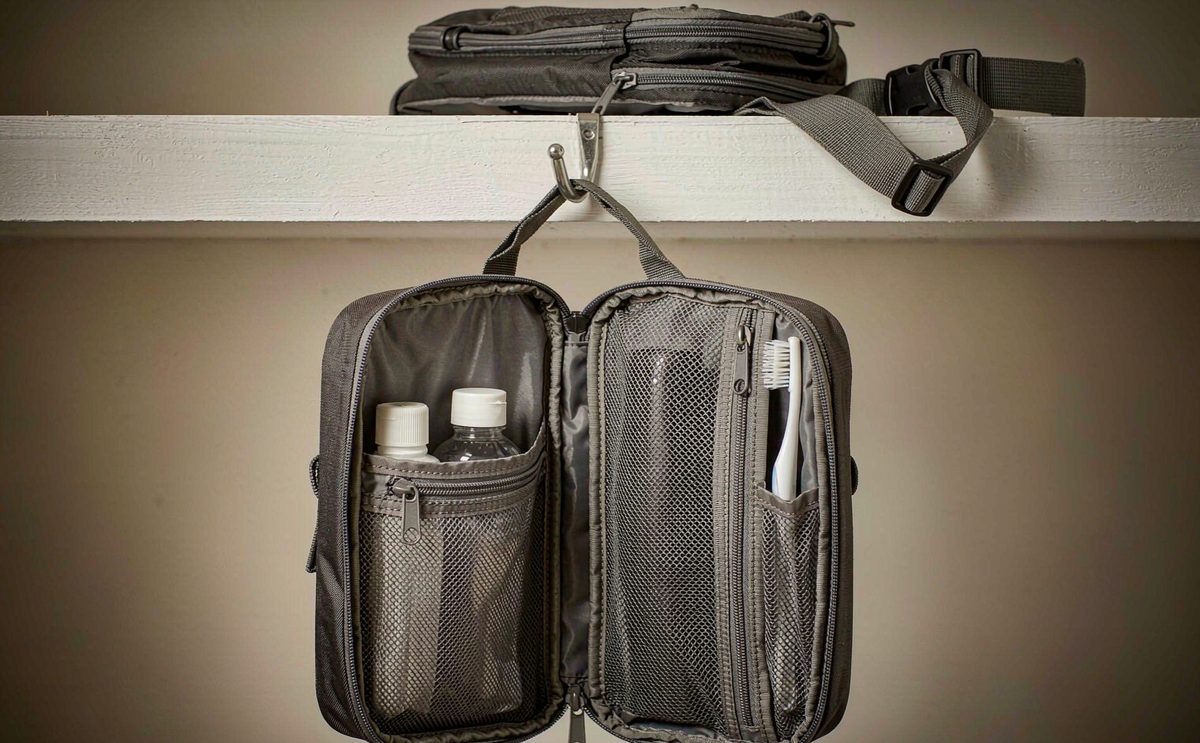
Three formats cover the category and the choice drives the entire specification. A hanging wash kit opens flat from a swivel hook and is the best use of a hotel bathroom door or a shower rail; it is the most complex to build and the most useful in practice. A standing kit is a gusseted box that sits on a counter, is the cheapest to produce and packs the flattest. A hybrid does both, with a hook and a structured base.
The decision should follow the campaign story rather than the cost. A hanging kit suits a travel programme where the backer is moving between rooms; a standing kit suits a gym or a home-storage programme where the product lives on a shelf. In campaigns we support, the hanging format consistently earns better review sentiment despite costing 20-30% more, because it solves a problem the backer actually has.
| Format | Open size (cm) | Cost index | Packs flat | Best for |
|---|---|---|---|---|
| Flat dopp kit | 24 x 15 x 12 | 1.00 | Folds once | Gym and everyday kits |
| Standing gusseted box | 26 x 16 x 14 | 1.20 | No | Counter-top storage |
| Hanging, two panel | 52 x 25 open | 1.30 | Rolls | Hotel and travel use |
| Hanging, three panel | 60 x 28 open | 1.45 | Rolls | Full wash kit ranges |
| Hybrid with hook and base | 26 x 16 x 14 | 1.40 | No | Premium travel tiers |
- Choose the format from the use case, not from the unit cost difference.
- For hanging kits, specify the hook, its attachment reinforcement and its load rating as separate items.
- For standing kits, specify a base stiffener or the bag will collapse on a counter.
- Check the open height against a standard hotel bathroom door or shower rail.
- Keep one format across a size range so the programme shares a single pattern logic.
Sizing around a real wash kit
Wash kit sizing is unusual in that the contents are regulated by travel rather than chosen by the user. A 100 ml travel bottle measures roughly 12 x 4.5 cm, a toothbrush is around 19 cm long, and a razor handle around 15 cm. Lay out the kit the campaign page claims to hold, measure the bounding box, and add 15-20 mm of clearance, because toiletries are rigid and do not compress the way clothing does.
Depth is the dimension that decides whether a wash kit works standing up. Three or four 100 ml bottles side by side need roughly 14-16 cm of internal width, and a bottle standing upright needs 12-14 cm of internal height. Below 10 cm of depth the bag will not stand; above 16 cm it stops being a wash kit and becomes a small duffel. Most travel programmes land at 24 x 15 x 12 cm to 28 x 18 x 14 cm.
| Kit | Closed size (cm) | Volume | Unit weight |
|---|---|---|---|
| Minimal, toothbrush and paste | 20 x 12 x 10 | 2.4 - 2.6 L | 150 - 210 g |
| Standard travel kit | 24 x 15 x 12 | 4.3 - 4.6 L | 210 - 290 g |
| Full kit, bottles upright | 28 x 18 x 14 | 7.0 - 7.5 L | 300 - 420 g |
| Hanging two panel | 26 x 18 x 10 closed | 4.6 - 5.0 L | 260 - 350 g |
| Gym and shower kit | 26 x 16 x 13 | 5.4 - 5.8 L | 230 - 320 g |
Wipe-clean linings and what containment actually requires
The lining is the product. A wash kit lives in a suitcase next to clothing with liquids inside it, and the lining has to survive a leak, a wipe-down and a hundred flights. The default is a TPU laminate bonded to a polyester base, which is soft, wipe-clean and free of the plasticiser concerns associated with PVC. PEVA is the cheaper alternative and performs almost as well. An unlined or fabric-lined kit will stain on first contact and will not contain anything.
Seams are the second half of containment. A sewn seam in a waterproof lining is a line of needle holes, so the specification has to say what happens to them: either a welded construction, or a sewn seam with a sealing tape applied over it, or an accepted leak path at the seam and a lining that is treated as splash-resistant rather than watertight. Be honest about which one you are buying, because a watertight claim on a sewn seam will fail in the field.
Write the containment requirement into the tech pack as a testable statement, not as a marketing adjective: the lining holds 200 ml of water for 24 hours with no migration to the outer shell. Run it during sampling, and repeat it on two units per drawn carton at inspection. It is the difference between a wash kit and a bag with a lining.
| Specification | Unit weight | Cost index | Containment |
|---|---|---|---|
| 210D polyester, unlined | 150 - 250 g | 1.00 | None, stains on contact |
| 210D with PEVA coating | 170 - 280 g | 1.12 | Splash resistant |
| TPU laminate, sewn seams | 190 - 320 g | 1.25 | Splash resistant, seam path |
| TPU laminate, taped seams | 205 - 340 g | 1.42 | Watertight at the seam |
| Fully welded TPU construction | 195 - 330 g | 1.60 | Watertight overall |
| rPET with TPU, taped seams | 215 - 350 g | 1.50 | Watertight, recycled face |
Zips, hooks and the hardware that carries the load
A wash kit has two hardware stories. The zip is the same specification problem as any pouch: a #5 nylon coil for the main opening, a #3 for internal pockets, a zip garage and bar-tacks at both ends. On a wet compartment a water-resistant coil is worth the premium, because the pocket holding a toothbrush or a razor will be wet every single day of use, and corrosion on a slider is a complaint waiting to happen.
The hook is the second story and it is specific to this format. It is a load-bearing metal or POM component attached to a panel that is frequently a single layer of shell fabric. Specify it by load rating, typically 3-5 kg, and by attachment: a webbing loop anchored into a structural seam with a bar-tack, not a tab sewn into the panel. Test it hung and loaded for 60 seconds. A hook that pulls out of a fully loaded wash kit is the worst failure the format can produce.
Compartments, bottle loops and the removable pouch
Two internal elements do most of the work in a wash kit. Elastic bottle loops of 25-30 mm hold travel bottles upright so they do not roll loose when the bag is opened, and they cost one operation each. Mesh zip pockets hold smaller items and let the backer see what is inside without unpacking. A mirror panel is a nice touch on a hanging kit and adds one component plus a protective sleeve.
The removable clear pouch is the addition worth costing carefully. A transparent pouch sized for the 100 ml liquids allowance lets the backer take it through airport security without unpacking the kit, which is a genuine convenience and a strong campaign-page argument. It adds a second production item with its own material, its own zip and its own MOQ implications, so confirm whether it counts as part of the style or as a separate style before quoting.
Four elastic loops of 25-30 mm, sewn into a structural seam at the base of the main compartment, hold a full set of travel bottles upright. They cost one operation each and they solve the single most annoying behaviour of a wash kit, which is that everything rolls to one end when the bag is opened.
Branding a wash kit
A wash kit front panel is usually structured, which makes it one of the better print surfaces in the range. Cap the block at roughly 25-30% of the panel and keep it clear of the zip line by at least 12 mm. Where the shell is a TPU laminate or a coated fabric, test the print method on the actual material during sampling, because adhesion on a low-surface-energy coating is materially worse than on a standard polyester.
The more durable route on this format is a woven label or a debossed PU patch, both of which survive the wet, handled environment better than a print. Where embroidery is required, note that it perforates the shell, which on a coated fabric creates a potential moisture path into the interlining. Methods are compared on our print and embroidery page, and a custom cosmetic bag can share the same shell and hardware family.
Packing, freight and QC gates
Wash kits are structured and do not fold completely flat, which puts them in the middle of the freight range. A 24 x 15 x 12 cm kit weighs 210-290 g and nests partially, so 25-40 units fill a 60 x 40 x 40 cm carton at 0.096 m3. That is 16.0 kg of volumetric weight at the 6,000 divisor against roughly 13 kg actual, so volumetric governs. Rolling a hanging kit rather than folding it usually improves the carton yield by 10-15%.
- Pack 25-40 units per export carton; roll hanging kits rather than folding them.
- Confirm carton dimensions on the packing list so volumetric weight can be quoted accurately.
- Individual polybagging protects the lining and costs roughly 0.07-0.11 USD per unit.
- Keep the kit dry at packing; a lining packed damp will mildew in a container.
- Our rewards fulfilment page covers the packing specification format we ask for.
Pre-shipment inspection runs at AQL 2.5 to ISO 2859-1, general inspection level II, single sampling plan. Critical is a hook that fails its load rating or a lining leak. Major is a print defect, an out-of-tolerance dimension, a seam outside tolerance or a hardware finish defect. Minor is a loose thread, slight shade variation or a fold crease that relaxes out. Define all three before production starts.
- Confirm carton count, packing list and size split before any carton is opened.
- Measure closed external dimensions on three units per drawn carton against the stated tolerance.
- Hang two units per carton loaded to 3-5 kg for 60 seconds and record any deformation.
- Run a 200 ml, 24-hour leak test on the lining of two units per carton.
- Cycle every zip a minimum of 20 times, including internal pocket zips.
- Verify the branding coordinate and finish against the approved sample under standard lighting.
The two checks that matter most are the hook load and the leak test, because both are correctable at specification stage and neither is correctable after the run has shipped. The defect taxonomy we log is set out on the QA and QC page, alongside the sampling sequence we use on a first production order.
Cost, sampling and the wash kit RFQ checklist
On a 500 pcs run a standing 24 x 15 x 12 cm wash kit in 300D polyester with a TPU lining, taped seams, four bottle loops and a #5 coil zip typically quotes in the 3.60 to 9.20 USD ex-works band. A hanging kit with a rated swivel hook and a mirror panel sits at the top; an unlined flat dopp kit at the bottom. Volume pricing steps at 1,000 and 3,000 pcs, with the larger step at 3,000.
| Quantity | Ex-works unit cost (USD) | What changes |
|---|---|---|
| 500 pcs | 3.60 - 9.20 | Baseline, setup spread over the minimum |
| 1,000 pcs | 3.25 - 8.35 | Better marker yield, setup across 2x |
| 3,000 pcs | 2.95 - 7.60 | Dedicated line, material in rolls |
| 5,000 pcs | 2.75 - 7.15 | Material at roll-lot pricing |
| 10,000 pcs | 2.58 - 6.70 | Full-line booking, tooling amortised |
Sampling runs 6-10 working days per round from a released tech pack, extending to 12-15 working days for a welded construction or a custom hook. Budget two rounds. production 35-50 days after the 30% deposit under T/T 30/70 has landed and the pre-production sample has been approved in writing. Where a wash kit is part of a travel set, quote it with the custom travel bag or custom duffel bag SKUs so the set lands in one container.
Fill the sample with real bottles, hang it loaded for an hour, then put 200 ml of water in the lining and leave it for 24 hours. Hook deformation, loop spacing and seam leaks are all invisible in an empty sample, and all three are the complaints that generate replacement requests.
Compliance follows the destination market. United States shipments fall under California Prop 65 where a listed substance is present above threshold. European Union shipments fall under REACH Annex XVII, which restricts certain plasticisers in PVC articles, and the EU GPSR for general product safety. That restriction is the practical reason to specify TPU or PEVA rather than PVC. OEKO-TEX Standard 100 covers textile components, and country-of-origin marking must be applied at the point of manufacture.
- Format: hanging, standing or hybrid, plus open and closed dimensions.
- Shell by denier, weave and coating; lining by type and thickness; seam treatment stated explicitly.
- Containment requirement written as a testable statement with a volume and a duration.
- Hardware: zip gauge and run, hook type and load rating, mirror panel where used.
- Compartments: bottle loop count and width, mesh pocket count, removable pouch specification.
- Packing specification: pieces per polybag, per inner and per carton, with carton dimensions.
- Quantity per size and colourway against the 500 pcs minimum, and the target delivery month.
- Custom travel bags for Kickstarter
- Custom duffel bags for Kickstarter
- Custom cosmetic bags for Kickstarter
- Material customisation for Kickstarter bags
- Print and embroidery options for custom bags
- Crowdfunding rewards fulfilment
- QA, QC and inspection on campaign bag runs
- Request a quotation
Spec a wash kit that contains what it carries
Send us the format, the lining specification and the quantity per colourway. As your production partner we will return a unit cost, a sampling estimate and a carton specification. Write to service@junyuanbags.com.
Frequently Asked Questions
What is the MOQ for custom toiletry bags on a Kickstarter campaign?
The minimum is 500 pcs per style and per colourway. A two-size wash kit range counts as two separate 500 pcs commitments. Where a removable clear liquids pouch is included, confirm with your production partner whether it counts as part of the style or as a separate style.
How much does a custom toiletry bag cost to produce?
On a 500 pcs run a standing 24 x 15 x 12 cm kit in 300D polyester with a TPU lining, taped seams, four bottle loops and a #5 coil zip typically quotes between 3.60 and 9.20 USD ex-works. At 3,000 pcs the same build usually drops to 2.95 - 7.60 USD.
Should I choose a hanging or a standing toiletry bag?
Choose from the use case. A hanging kit suits travel programmes and costs 20-30% more; a standing kit suits gym and home-storage programmes and packs flatter. In campaigns we support the hanging format earns better review sentiment, because it solves a real hotel-bathroom problem.
What size toiletry bag do I need for travel bottles?
A 100 ml travel bottle measures roughly 12 x 4.5 cm, so four upright need about 14-16 cm of internal width and 12-14 cm of height. Most travel programmes land at 24 x 15 x 12 cm to 28 x 18 x 14 cm external, with 15-20 mm of clearance added.
Which lining should I specify for a wash kit?
A TPU laminate bonded to a polyester base is the default: soft, wipe-clean and free of the plasticiser concerns associated with PVC. PEVA is the cheaper alternative at a cost index of 1.12. Avoid an unlined or fabric-lined kit, which stains on contact and contains nothing.
Are the seams in a wash kit watertight?
Only if the specification says so. A sewn seam in a waterproof lining is a line of needle holes, so you need either a welded construction at a cost index of 1.60 or a sewn seam with sealing tape at 1.42. Write it as a testable statement: 200 ml held for 24 hours.
How strong should the hanging hook be?
Specify a load rating of 3-5 kg and test it hung and loaded for 60 seconds on two units per drawn carton. Equally important is the attachment: a webbing loop anchored into a structural seam with a bar-tack, not a tab sewn into a single layer of shell fabric.
How long does sampling take for a custom toiletry bag?
Sampling runs 6-10 working days per round from a released tech pack, extending to 12-15 working days for a welded construction or a custom hook. Budget two rounds, or 12-20 working days of calendar, and test the sample loaded, hung and wet.
Is PVC safe to use in a wash kit lining?
PVC raises plasticiser restrictions under REACH Annex XVII for European Union shipments, and some formulations are listed under California Prop 65. That is the practical reason most programmes specify TPU or PEVA instead. State the destination market in the RFQ so the right lining is quoted.
How heavy is a custom toiletry bag for freight planning?
A 24 x 15 x 12 cm kit weighs 210-290 g and a full 28 x 18 x 14 cm kit 300-420 g. About 25-40 units fill a 60 x 40 x 40 cm carton at 0.096 m3, which is 16.0 kg volumetric at the 6,000 divisor against roughly 13 kg actual.
What inspection standard applies to a toiletry bag order?
AQL 2.5 to ISO 2859-1 at general inspection level II, single sampling plan. Critical is a hook that fails its load rating or a lining leak. Major is a print defect, an out-of-tolerance dimension or a hardware finish defect. Test two units per drawn carton for both the hook load and the leak.
When does bulk production actually start on a wash kit order?
production 35-50 days after two conditions are met together: the 30% deposit under T/T 30/70 has landed, and the pre-production sample has been approved in writing. Neither condition alone starts the clock. Confirm the slot with a start, completion and inspection date.
People Also Ask
Are toiletry bags a good standalone Kickstarter reward?
They work best inside a travel programme. A wash kit alone rarely funds a campaign, but paired with a duffel or travel bag it completes the set and shares the same shell, hardware and branding, so the whole reward lands in one container.
Should a toiletry bag have a hanging hook?
For travel programmes, yes. A rated swivel hook lets the backer hang the kit on a door or rail, which is the problem a hotel bathroom actually presents. Specify the load rating and reinforce the attachment into a structural seam.
What is the best lining material for a wash kit?
A TPU laminate bonded to polyester. It is soft, wipe-clean and avoids the plasticiser restrictions that apply to PVC in the European Union. PEVA is the cheaper alternative and performs nearly as well at a lower cost index.
How do I stop travel bottles rolling around inside the bag?
Add four elastic bottle loops of 25-30 mm sewn into a structural seam at the base of the main compartment. Each costs one operation and holds bottles upright, which is the most common annoyance with a wash kit.
Do toiletry bag sizes count as their own MOQ?
Yes. Each size and colourway is counted separately against the 500 pcs minimum, so a two-size range is normally two separate commitments. Confirm with your production partner how a removable liquids pouch is counted before you send the RFQ.