Custom Laptop & Tech Bags for Kickstarter — Tech Campaign Rewards
A custom laptop or tech bag reward is a protection product sold on a specification, and it is judged on documentation more than on design. Foam density, drop height, device tolerance and zipper grade are the numbers backers compare, and each belongs in the tech pack before sampling starts. Constants: MOQ 500 pcs per style and colourway, sampling 6-10 working days, production 35-50 days after deposit and approved sample, inspection at AQL 2.5 to ISO 2859-1. A tech backpack quotes USD 24-46 per unit at 500 pcs, a messenger USD 19-34, a sleeve USD 8-16.
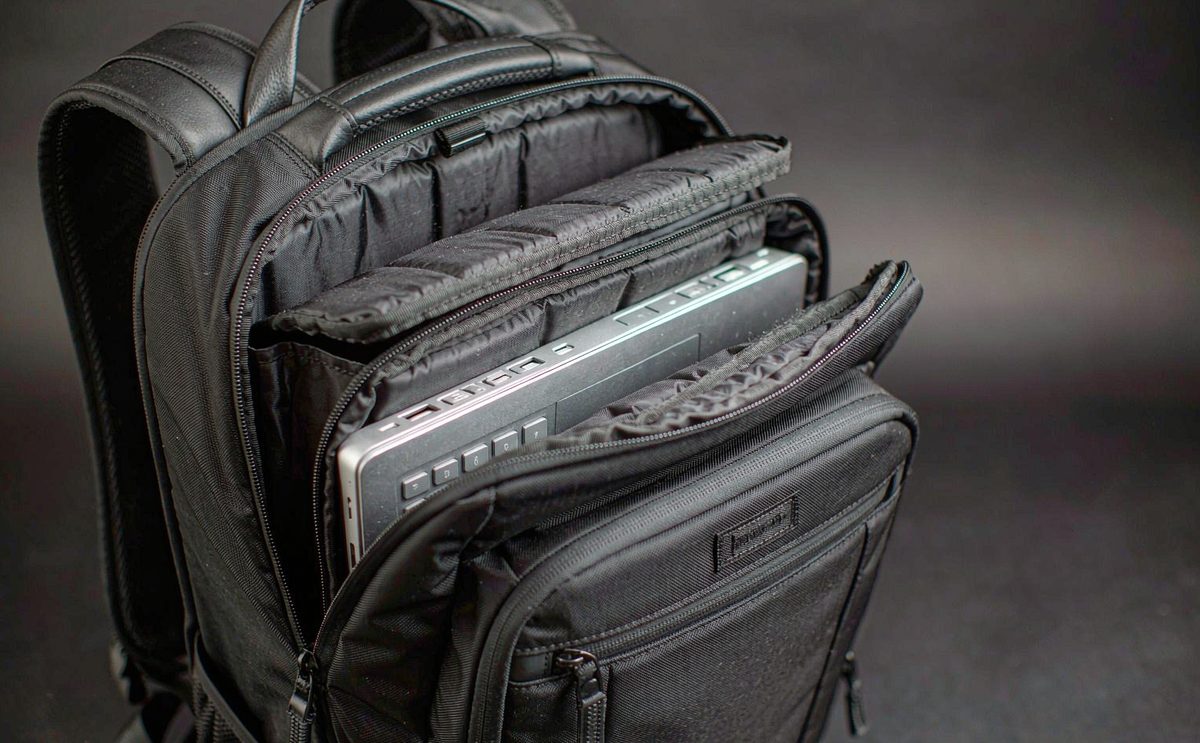
- Why tech carry rewards fail on documentation
- Format selection: sleeve, messenger and backpack
- Foam density and drop protection
- Device sizing, tolerance and fit
- Cable organisers, pockets and interior architecture
- Shell fabrics and linings for tech compartments
- YKK zipper grades and slider specification
- FIDLOCK-class and magnetic hardware
- USB pass-through ports and cable routing
- Tech-pack documentation for a tech build
- Unit cost drivers in the tech tier
- Sampling a tech bag: fit, drop and cycle testing
- Inspection focus for padded and lined builds
- Compliance and electrical-adjacent documentation
- A tech bag RFQ that prices cleanly
Tech carry is the bag category where the buyer reads the specification before the story. A backer who has carried a USD 2,000 laptop through an airport does not respond to adjectives about protection; they look for a device size, a foam specification, a drop figure and a zipper brand, and they compare those numbers against the retail bag they already own. Campaigns that publish vague protection claims lose that comparison before the video finishes.
That makes documentation the deliverable, not an afterthought. The tech pack for a laptop bag has to carry measurable figures for every protection claim the campaign page will make, and the sampling round has to produce test evidence for each of them. Where a claim cannot be evidenced, the correct decision is to remove it from the page rather than to soften the wording, because a softened claim is still a claim.
Why tech carry rewards fail on documentation
Most tech bag campaigns that run into trouble do so on one of four documentation gaps. The device fit is stated as a screen size without an internal dimension, so a 16-inch machine jams in a compartment sized for a 14-inch one. The protection claim has no drop height or foam specification behind it. The zipper is described as heavy duty rather than named by grade. And any electronic element, such as a pass-through port, ships without the compliance file a marketplace or a customs authority may ask for.
Each gap has the same root cause: the specification was written as marketing copy and then handed to a production partner as if it were engineering. A sourcing partner can only build and quote what is measurable. Write internal compartment dimensions in millimetres, foam in density and thickness, drop performance in height and repetitions, and hardware by grade and model, and the quotation arrives as a number rather than a band.
The commercial constants do not move with the category. Minimum 500 pcs per style and colourway, sampling 6-10 working days or 12-15 for complex builds with moulded or electronic components, production 35-50 days from deposit plus approved pre-production sample, pre-shipment inspection at AQL 2.5 to ISO 2859-1, FOB Xiamen and T/T 30/70. Programme-level mechanics sit in the crowdfunding bag guide, and the format map is on custom bag categories.
Key takeaways for tech reward planning
- Write every protection claim as a measurable figure: internal dimensions in mm, foam in density and thickness, drop performance in height and repetitions.
- Name hardware by grade rather than by adjective; a coil chain size and slider type cost the same to specify and remove the leading defect.
- A tech backpack quotes USD 24-46 at 500 pcs, a messenger USD 19-34 and a sleeve USD 8-16.
- Any electronic element needs its compliance file commissioned during sampling, not during the final production week.
Format selection: sleeve, messenger and backpack
Three formats dominate tech rewards and they serve different pledge tiers and different backer behaviours. The sleeve is an accessory: minimal panels, minimal labour, and a low entry price that suits an add-on. The messenger is a single-strap carry with a large flap and a structured body, positioned between an accessory and a full bag. The backpack is the hero format, with a harness, a padded back panel and the highest specification density.
| Format | Typical specification | Unit cost at 500 pcs | Pledge tier |
|---|---|---|---|
| Padded sleeve | 600D or neoprene shell, 5-8 mm foam, #5 coil zip, 1 slip pocket | USD 8-16 | USD 39-69, or an add-on at USD 19-29 |
| Sleeve with organiser | As above plus a cable panel and 2-3 elastic loops | USD 12-20 | USD 59-89 |
| Messenger | 600D shell, 10 mm foam, flap with magnetic or buckle closure | USD 19-34 | USD 89-139 |
| Tech backpack | 420-900D shell, harness, 15-20 mm back foam, dedicated compartment | USD 24-46 | USD 119-179 |
| Briefcase-style tech bag | Structured body, leather or PU trim, organiser panel | USD 28-52 | USD 149-229 |
Format choice should follow the reward matrix rather than the product ambition. A campaign whose funding target depends on 800 backers at USD 65 is better served by a sleeve with an organiser than by a backpack that requires a USD 149 tier to work. The sleeve also carries a far smaller deposit at T/T 30/70, which keeps the 35-50 day production window starting on schedule rather than waiting on cash.
Where the campaign needs two formats, sequence them. Run the hero first and hold the second for a re-order, because two styles mean two 500-pcs minimums and two pre-production samples. Dedicated pages cover the laptop sleeve, messenger and briefcase formats, and the backpack category covers harness and compartment engineering in depth.
Foam density and drop protection
Protection is a function of foam density, foam thickness and the air gap between the foam and the device, and all three should appear in the tech pack. Density is quoted in kilograms per cubic metre and thickness in millimetres; together they determine how much impact energy is absorbed before it reaches the device. A campaign that specifies foam by thickness alone has specified nothing, because 10 mm of low-density foam protects less than 6 mm of the right grade.
| Element | Entry specification | Premium specification | Effect on unit cost |
|---|---|---|---|
| Foam density | 20-25 kg/m3 EPE or EVA | 30-40 kg/m3 EVA or closed-cell | + USD 1.20-3.00 per unit |
| Foam thickness | 5-6 mm in a sleeve | 10-12 mm in a backpack compartment | + USD 0.80-2.20 per unit |
| Suspended base | None; compartment sits on the bag floor | 20 mm air gap with a false floor | + USD 1.00-2.50 per unit |
| Corner reinforcement | Bound corners only | Moulded or double-layer corner pads | + USD 0.90-2.40 per unit |
| Back panel | 8-10 mm flat foam | 15-20 mm contoured with airflow channels | + USD 2.00-4.50 per unit |
| Divider system | Fixed slip pocket | Adjustable hook-and-loop or padded dividers | + USD 1.50-4.00 per unit |
The suspended base is the highest-return protection upgrade and the one most often omitted. A laptop compartment that sits directly on the base of the bag transmits the full energy of a vertical drop to the corner of the device. Raising the compartment 20 mm off the floor with a false panel costs USD 1.00-2.50 per unit and typically doubles the drop height a build survives in testing.
Specify the test, not just the foam. A defensible protocol is a loaded drop from 600-900 mm onto a hard surface at four corners and one flat face, repeated three times per face, with the device inspected afterwards. Document the result and state it as a drop height rather than as a protection adjective. That figure is also what lets a re-order be verified against the original build.
Device sizing, tolerance and fit
Screen size is a marketing convention, not a dimension. A 14-inch laptop spans roughly 310-330 mm in width depending on bezel design, and a 16-inch machine can reach 360 mm. Specify the internal compartment in millimetres and publish that figure, because a backer with a specific machine will measure it and hold the campaign to the number.
- Internal width. State the clear internal width in millimetres; add 8-12 mm of clearance over the widest device you intend to fit.
- Internal depth and height. Depth is the dimension most often omitted and the one that jams; state it in millimetres with a tolerance.
- Tolerance. Hold plus or minus 3 mm on internal compartment dimensions; beyond that, a claimed device size stops being reliable.
- Closure clearance. Measure the compartment when the bag is closed and loaded, not when it is laid open flat.
- Tablet and accessory pockets. State the largest device each pocket accepts in millimetres rather than by screen size.
- Retention. A strap or a snug fit that stops the device sliding when the bag is carried one-handed.
A compartment described as fitting a 16-inch laptop will fail a backer whose 16-inch machine is 360 mm wide, and it will also fail a backer whose 14-inch machine is unusually deep. Publish the internal clear width, depth and height in millimetres with a stated tolerance, and list the largest device dimensions the compartment accepts. It costs nothing and removes the most common tech bag return reason.
Fit should be verified on a physical device rather than on a drawing. Supply the actual laptop or a dimensioned block to the sampling round and require a photograph of the device seated in the compartment with the bag closed. That single photograph prevents a category of complaint that no amount of specification wording will fix after delivery.
Cable organisers, pockets and interior architecture
Interior organisation is where a tech bag earns its price premium, and it is also the most labour-intensive part of the build. Every elastic loop, every divider and every zip pocket adds panels, operations and minutes. The discipline is to specify the organiser by function rather than by count: what does the backer actually carry, and where does each item go?
- Elastic loops. 15-20 mm elastic in rows of 3-6; USD 0.60-1.60 per unit depending on count and width.
- Mesh zip pocket. 210D or mesh with a #3 coil zip; USD 1.10-2.40 per unit and the most valued cable pocket.
- Slip pockets. Flat fabric pockets sized for a charger or a phone; USD 0.40-1.00 per unit each.
- Padded divider. A removable divider for a tablet or a camera insert; USD 1.50-4.00 per unit.
- Pen and card slots. Under USD 0.50 per unit and disproportionately noticed in unboxing photography.
- Key clip and D-ring. Under USD 0.30 per unit; the cheapest perceived-value addition available.
A well-specified organiser panel typically costs USD 3-7 per unit in total and does more for perceived value than the same money spent on the shell fabric. Where the budget is tight, keep the organiser and reduce the shell denier, because the interior is what the backer interacts with every day and the denier is what nobody notices if it is adequate.
Cable management also belongs in the tech pouch category as a separate reward. A pouch produced from the same fabric lot as a hero tech bag shares the fabric minimum and the print set-up, which is why a bag-and-pouch bundle usually costs 20-30% less per unit than the two items quoted apart.
Shell fabrics and linings for tech compartments
The shell of a tech bag has to resist abrasion and shed light rain; the lining of the device compartment has to be non-abrasive and lint-free. Those are different requirements and they are frequently met with the same fabric by accident. Specify them separately, because a lining that scratches a laptop lid generates a complaint that reads as a design failure rather than as a material choice.
- Shell. 600D polyester with PU backing is the default; 900D where the campaign story is durability; 420D nylon where weight matters.
- Device lining. Brushed tricot or a soft 210D with a stated non-abrasive finish; never a coarse or printed surface against the device.
- Water resistance. PU or TPU coating with a stated hydrostatic head; DWR finish where campaign imagery depends on beading.
- Contrast lining. A mid-tone interior costs the same as black and materially improves how the bag photographs when opened.
- Structural inserts. A 1.5-2.5 mm PP board in the back panel and base; keeps the device compartment from bowing under load.
- Recycled content. Recycled PET with GRS documentation at a premium of 8-15% plus certificate handling.
Abrasion testing on the lining is worth commissioning during sampling where the campaign makes a scratch-protection claim. A simple rub test with a standardised abrasive and a defined cycle count gives a figure the page can quote and the inspection can repeat. Fabric and seam strength testing to ASTM D5034 covers the load-bearing side of the same claim.
YKK zipper grades and slider specification
Zips are the most frequently touched component on any bag and the most common source of a critical defect in inspection. Specifying them by brand and grade costs the same as describing them by feel. Coil chain sizes run from #3 for small pockets through #5 for main compartments to #8 and #10 for larger openings, and the slider type determines both the action and the security of the closure.
| Application | Chain specification | Slider | Cost at 500 pcs |
|---|---|---|---|
| Device compartment | #5 coil, reverse coil preferred for a clean interior line | Branded metal pull with garage | USD 1.10-2.40 per unit |
| Main compartment | #8 coil on backpacks, #5 on messengers and sleeves | Autolock slider, lockable housing optional | USD 1.60-3.50 per unit |
| Interior pockets | #3 coil with a branded pull | Moulded or cord pull | USD 0.60-1.40 per pocket |
| Weather-exposed openings | #8 reverse coil with a PU-coated chain | Metal pull with a storm flap | USD 2.40-5.00 per unit |
| Expandable sections | #8 coil with a gusseted panel | Two sliders meeting at the centre | USD 2.80-5.50 per unit |
A branded coil chain costs USD 1.20-3.50 more per unit than an unbranded equivalent on a tech backpack and it removes the leading critical defect in the category. Where the budget is genuinely constrained, spend on the main and device compartment zips and use unbranded chains of the same size on interior pockets. Reverse coil also gives a quieter action, which is a detail backers notice on a bag carried into meetings.
FIDLOCK-class and magnetic hardware
Magnetic and mechanical quick-release hardware has become a signature feature on tech carry, and it is one of the few components that reads as premium in use as well as in photography. FIDLOCK-class magnetic buckles combine a mechanical interlock with magnetic guidance, so the closure self-locates and then locks. They are sourced as stock components rather than as tooling, which keeps the sampling window intact.
- FIDLOCK-class magnetic buckles. Stock components with a stated pull-force rating; add USD 2.50-6.00 per unit over a standard side-release buckle.
- Magnetic flap closures. Hidden magnets sewn into a flap; USD 0.60-1.80 per unit and sensitive to placement tolerance.
- Magnetic zip garages. A small magnet holding the slider; under USD 0.50 per unit and a genuine daily-use improvement.
- Side-release buckles. Acetal with a stated break strength above the webbing rating; the cheapest and most serviceable option.
- Cam and ladderlock hardware. For strap adjustment; specify acetal or zinc alloy by load point.
- Rating discipline. Every load-bearing component should carry a stated rating that exceeds the webbing or strap it terminates.
There is one compliance caveat worth writing into the specification. Strong magnets near a device compartment are a legitimate backer concern, and magnets placed within 30-40 mm of a laptop sleeve should be avoided or shielded. Specify the magnet position relative to the device compartment in the tech pack and confirm the distance on the pre-production sample.
USB pass-through ports and cable routing
A pass-through port is the most requested feature on tech bag briefs and the one most likely to create a compliance problem. The port itself is a passive component, but any cable supplied with it becomes an electrical article in the eyes of a regulator, and a campaign that ships a cable without documentation is shipping an unclassified product into regulated markets.
- Port specification. A moulded or metal grommet with a stated cable diameter, positioned away from the device compartment.
- Internal routing. A fabric or elastic channel from the port to the interior pocket, so a power bank has a defined home.
- Cable supply. Decide whether a cable is included; if it is, commission its compliance file before the campaign page goes live.
- Power bank claim. Do not publish a charging claim; the bag routes a cable, it does not supply power.
- Documentation. Keep the component certificate and the wiring declaration in the tech pack file for customs and marketplace review.
- Alternative. A simple cable pass-through grommet with no supplied cable removes the compliance burden at a cost of under USD 1.00.
A bag with a pass-through port does not charge anything, and publishing a charging claim invites both a backer complaint and a marketplace query. Describe the feature as a cable pass-through with an internal routing channel, ship the cable only if its documentation is complete, and keep the component certificate in the compliance file for customs review.
Tech-pack documentation for a tech build
A tech bag tech pack carries more measurable lines than any other category, and the quality of that document determines both the accuracy of the quotation and the speed of sample approval. It should be possible to hand the pack to a production team and have them build the bag without a single clarifying question.
| Section | Required content | Why it matters |
|---|---|---|
| Dimensions | External dimensions plus internal compartment width, depth and height in mm | Without internal figures the device fit claim cannot be verified or quoted |
| Padding | Foam type, density in kg/m3, thickness in mm, suspended base height | Protection claims are only defensible with all four figures stated |
| Drop performance | Height in mm, surface, repetitions, faces tested | Gives inspection a repeatable test and the page a quotable number |
| Hardware | Chain size and brand, slider type, buckle rating, magnet position | Removes the leading category defect and any magnet-to-device concern |
| Interior | Pocket count, loop count, divider type, lining specification | Interior labour is the largest variable cost in this category |
| Electronics | Port type, cable inclusion, component certificates | Determines whether a compliance file is needed before shipping |
| Branding | Method, placement, artwork format, Pantone references | Artwork delays are the most common cause of a slipped sampling window |
Version control matters as much as content. Every revision between sampling rounds should carry a version number and a dated change list, and the approved pre-production sample should be photographed against that version. When a re-order is placed twelve months later, the version number is what tells the production team which build to make.
Unit cost drivers in the tech tier
Tech bag unit cost sits above a tote and below a structured travel bag, with the interior and the padding carrying more weight than in any other category. Labour is high because organiser panels are slow to assemble, and hardware is significant because a backpack carries a harness, a back panel and multiple zips.
| Cost element | Share of unit cost | Notes for tech builds |
|---|---|---|
| Shell fabric, lining and foam | 28-38% | 600D shell, brushed tricot device lining, EVA foam at 10-12 mm |
| Hardware and trims | 18-28% | Zips, buckles, harness hardware, magnetic closures where specified |
| Cutting, sewing and assembly | 22-32% | Highest labour share of any category; organiser panels dominate |
| Branding | 4-9% | Label, print or moulded patch; small relative to interior cost |
| Packaging | 3-7% | Polybag, hangtag, printed carton; flat-pack where the harness allows |
| Inspection and export handling | 2-5% | AQL 2.5 inspection plus fit and drop checks on sampled units |
Model the pledge backwards. On a USD 139 tech backpack, backer-facing freight runs USD 18-26 and platform plus payment fees take 8-10%, leaving roughly USD 100-112 for landed unit cost, margin and replacement stock. A build at USD 32 FOB lands near USD 42-48, which works at that tier; at USD 46 FOB it lands near USD 58 and the tier only survives with a strong overfund.
Reducing shell denier from 900D to 600D saves roughly USD 1.50-2.50 per unit and is invisible in use. Removing two elastic loops and one mesh pocket saves a similar amount and is immediately noticed. When a tech build needs to hit a price, cut the fabric first and protect the organiser.
Sampling a tech bag: fit, drop and cycle testing
Tech bag sampling runs 6-10 working days from approved artwork and a settled tech pack, and 12-15 working days where the build includes moulded components, magnetic hardware assemblies or an electronic element. Plan two rounds: the first settles structure, harness and compartment fit, the second settles foam feel, hardware action and branding.
- Tech pack issued. All measurable lines from the table above, countersigned, with internal compartment dimensions stated in millimetres.
- Device fit check. The actual laptop or a dimensioned block seated in the compartment with the bag closed and photographed.
- Drop test. Loaded to the stated carry weight, dropped from the specified height onto four corners and one flat face, three repetitions each.
- Zipper cycle test. Main and device compartment zips cycled 500 times and inspected for chain spread and slider wear.
- Hardware action test. Magnetic and quick-release hardware cycled 200 times with the pull force checked at the end.
- Lining abrasion check. Rub test on the device lining against a standard abrasive for a defined cycle count.
- Pre-production approval. The gold sample locks every figure; changes after this point carry cost and schedule impact.
The device fit check and the drop test are the two that matter most, and both need a physical device rather than a drawing. Supply the machine or a dimensioned block with the brief, and require photographs of the fit and the post-drop inspection as part of the sampling output. The revision loop is described in detail on the sample prototyping page.
Inspection focus for padded and lined builds
Pre-shipment inspection runs at AQL 2.5 under ISO 2859-1, with the defect list agreed before the run begins. Padded and lined builds add failure modes that do not exist in an unlined bag: foam that has shifted, lining that has pulled, padding that is thinner than specified, and compartments that do not meet the published internal dimension.
- Critical. Broken or jammed device compartment zip, detached harness strap, foam absent from a stated location, torn device lining.
- Major. Internal compartment dimension outside plus or minus 3 mm, foam thickness below specification, lining pulled taut across the compartment, seam slippage above 3 mm.
- Minor. Loose thread under 10 mm, light print misregistration within tolerance, minor adhesive residue near the port.
- Functional. Device fit verified on 2 units drawn from the inspection sample, not only on the gold sample.
- Hardware. Zips cycled 50 times and magnetic hardware cycled 20 times on sampled units.
- Documentation. Report with photographs and measured internal dimensions issued before cartons are released.
Foam thickness is the defect most likely to pass a visual check and fail a measurement, because a compartment looks correct until it is opened and pressed. Require a measured foam thickness on sampled units using a calliper or a gauge, and record the figure in the inspection report. That single line prevents the most common form of silent specification drift between a first run and a re-order.
Full classification structure and reporting format are set out on the campaign bag QA and QC page. Where the campaign ships individual parcels direct to backers, transit testing to ISTA 3A on the packed carton should be booked during sampling rather than after production.
Compliance and electrical-adjacent documentation
A tech bag with no electronic elements is a textile article with hardware. Add a supplied cable, a power bank pocket positioned as a charging feature, or any powered component, and the documentation set changes materially. Decide early which of those two products the campaign is shipping, because the decision drives both the file and the freight classification.
- REACH substance declarations covering every reward delivered into European Union markets.
- Prop 65 awareness for California delivery, particularly on printed areas, coatings and metal hardware.
- CPSIA applicability where the bag is positioned at students, including lead and phthalate limits.
- OEKO-TEX Standard 100 or GRS where the campaign claims skin-safe or recycled materials, with the certificate in hand first.
- EU GPSR documentation for European delivery, including traceability labelling.
- Component certificates for any cable, port or powered element, held in the tech pack file for customs and marketplace review.
Commission the file during the sampling window. A test report or a component certificate requested in the final week of a 35-50 day run is a schedule risk with no mitigation, and the cost of holding cartons while documentation is obtained exceeds the cost of the testing many times over. Where the campaign claims a recycled content percentage, the transaction certificate must exist before the claim is published.
A tech bag RFQ that prices cleanly
A tech RFQ that names grades gets a firm number back within a business day. One that describes intentions gets a band, and a band cannot be tested against a funding target. The four lines that matter most are internal compartment dimensions, foam specification, zipper grade and whether any electronic component is included.
- Format: sleeve, messenger, backpack or briefcase, with target external dimensions in millimetres.
- Internal device compartment width, depth and height in millimetres, plus the largest device to be supported.
- Padding: foam type, density in kg/m3, thickness in mm, suspended base height and drop test target.
- Zipper chain sizes and slider types by compartment, plus any magnetic or quick-release hardware.
- Interior: pocket and loop count, divider type, lining specification, and port or cable routing if required.
- Branding method and placement with artwork format and Pantone references.
- Order quantity, launch date, the published reward price point and each destination market for compliance.
With those seven items a production partner returns fabric and foam options, hardware alternatives and a three-tier unit cost band. Where the constraint is volume rather than specification, the low MOQ production page sets out how minimums apply by style and colourway. Send the brief through the quote request form, or start from the campaign sourcing hub.
Creators are responsible for fulfilling the reward they showed, and clear communication is what separates a delay from a dispute with backers.
Kickstarter Creator Handbook
- Custom laptop sleeves for Kickstarter
- Custom messenger bags for tech carry
- Custom backpacks for Kickstarter campaigns
- Custom tech pouches for cable organisation
- Custom briefcases for professional rewards
- Custom camera bags for padded protection
- Campaign bag QA and QC protocol
- Request a quotation
Send the tech bag brief and get a quotable number
Format, internal compartment dimensions, foam specification, hardware grades and quantity. You get fabric and foam options, hardware alternatives and a three-tier cost band back within one business day.
Frequently Asked Questions
What is the MOQ for custom laptop bags on a crowdfunding campaign?
The minimum is 500 pcs per style and per colourway. If the campaign needs both a sleeve and a backpack, that is normally two orders with two pre-production samples, so sequence the hero format first and hold the second for a re-order once funding is confirmed.
How much does a custom tech backpack cost per unit at 500 pieces?
A tech backpack typically quotes USD 24-46 FOB Xiamen at 500 pcs. Interior labour is the largest variable at 22-32% of unit cost, followed by shell fabric, lining and foam at 28-38% and hardware at 18-28%, so organiser specification moves the number more than fabric choice.
What foam density should a laptop compartment use?
Specify 20-25 kg/m3 EPE or EVA for an entry build and 30-40 kg/m3 for a premium one, at 5-6 mm in a sleeve and 10-12 mm in a backpack compartment. Thickness alone specifies nothing; density and thickness together set the protection level.
How should a campaign state laptop size compatibility?
State the clear internal width, depth and height in millimetres with a tolerance of plus or minus 3 mm, rather than a screen size. A 16-inch machine can reach 360 mm wide, and publishing screen size alone creates a fit claim the campaign cannot defend.
What drop test should a tech bag be specified against?
A defensible protocol is a loaded drop from 600-900 mm onto a hard surface at four corners and one flat face, with three repetitions per face and the device inspected afterwards. Record the height as a number rather than describing protection in adjectives.
Which zipper grade suits a laptop compartment?
Use a #5 coil chain for a device compartment, preferably reverse coil for a clean interior line, with a branded metal pull and a zip garage. A backpack main compartment takes #8, and interior pockets take #3 with a branded pull.
How much does a branded zipper chain add to unit cost?
A branded coil chain costs USD 1.20-3.50 more per unit than an unbranded equivalent on a tech backpack, and it removes the leading critical defect in the category. Where budget is tight, brand the main and device zips and use unbranded chains of the same size inside.
Are FIDLOCK-class magnetic buckles worth the premium?
They add USD 2.50-6.00 per unit over a standard side-release buckle and are sourced as stock components, so the sampling window is unaffected. Keep any magnet 30-40 mm away from the device compartment to address backer concerns about magnetic fields.
Can a tech bag include a USB pass-through port?
Yes, but decide whether a cable ships with it. A supplied cable becomes an electrical article requiring its own documentation, so commission the component certificate during sampling. A grommet with no supplied cable removes that burden for under USD 1.00 per unit.
How long does sampling take for a tech backpack?
Standard sampling is 6-10 working days from approved artwork and a settled tech pack. Moulded components, magnetic hardware assemblies or an electronic element move the build to 12-15 working days, and courier transit is additional in both directions. Assume two rounds before reward photography.
What is a suspended laptop base and does it matter?
A suspended base raises the device compartment 20 mm off the floor of the bag with a false panel. It costs USD 1.00-2.50 per unit and typically doubles the drop height a build survives, because the compartment no longer transmits full vertical impact energy.
What lining should a device compartment use?
Use brushed tricot or a soft 210D with a stated non-abrasive finish, never a coarse or printed surface against the device. A mid-tone lining costs the same as black and materially improves how the open bag photographs in campaign video.
How much does interior organisation add to tech bag cost?
A well-specified organiser panel costs USD 3-7 per unit in total: elastic loops at USD 0.60-1.60, a mesh zip pocket at USD 1.10-2.40, flat slip pockets at USD 0.40-1.00 each, and a removable padded divider at USD 1.50-4.00 depending on its size and foam thickness.
What inspection defects are specific to padded tech bags?
Beyond the AQL 2.5 standard list, watch for internal compartment dimensions outside plus or minus 3 mm, foam thinner than specified, shifted foam panels and torn or pulled device lining. Require a measured foam thickness on sampled units rather than a visual check.
Does a tech bag reward need electrical compliance documents?
Only if it ships a cable or a powered component. Without those it is a textile article needing REACH, Prop 65 and EU GPSR documentation. With them, hold component certificates in the tech pack file, commissioned during the sampling window.
Should a campaign cut fabric or interior features to hit a price?
Cut the fabric first. Reducing shell denier from 900D to 600D saves roughly USD 1.50-2.50 per unit and is invisible in daily use, while removing two elastic loops and one mesh pocket saves a similar amount and is noticed immediately by every backer who opens the bag.
How should a tech campaign model its pledge price?
Work backwards from the pledge. On a USD 139 tech backpack, backer freight takes USD 18-26 and platform plus payment fees take 8-10%, leaving roughly USD 100-112 for landed unit cost, margin and replacement stock. A USD 32 FOB build lands near USD 42-48.
What should a tech bag RFQ include for an accurate quotation?
Seven items produce a firm number: format and external dimensions, internal compartment dimensions in millimetres, foam type with density and thickness, zipper grades and hardware by compartment, interior specification with any port, branding method, and quantity with launch date and markets.
People Also Ask
How much does a custom laptop bag cost to produce?
At 500 pcs a padded sleeve runs USD 8-16, a messenger USD 19-34 and a tech backpack USD 24-46 FOB Xiamen. Interior labour is the biggest variable, so organiser specification moves the number more than fabric choice does.
What is the best format for a tech bag reward?
It depends on the pledge tier. A sleeve with an organiser supports USD 59-89 and a much smaller deposit, while a tech backpack needs USD 119-179 to work. Many campaigns lead with the sleeve and hold the backpack for a stretch tier.
How do I know if a laptop compartment really protects a device?
Require a drop test with a stated height, surface and repetition count, run on the actual device or a dimensioned block. Foam density in kg/m3 and thickness in mm, plus a suspended base, are the specification lines that determine the result.
Is a 16-inch laptop fit claim safe to publish?
Only if you publish internal dimensions in millimetres rather than a screen size. A 16-inch machine can be 360 mm wide, so state clear internal width, depth and height with a plus or minus 3 mm tolerance.
Do magnetic buckles damage laptops?
Not at normal distances, but keep magnets 30-40 mm away from the device compartment and state that distance in the tech pack. Backers raise this question, and a documented clearance answers it before it becomes a comment thread.
Can a tech bag ship with a charging cable?
Yes, but a supplied cable is an electrical article with its own documentation requirements. Commission the component certificate during sampling and keep it in the compliance file, or ship a pass-through grommet with no cable instead.
Should a tech reward be produced before the campaign funds?
Sampling should be complete before launch so the page can carry real photographs and verified figures. production 35-50 days starts only after deposit and sample approval, so it normally follows funding.