Low MOQ Bag Production for Crowdfunding Creators
Can a first-time creator really order 500 bags without wrecking the campaign budget? Yes, if the run is scoped correctly and the quotation is line-itemed. Our production team works from 500 pcs per style and colourway, samples in 6-10 working days (12-15 for complex builds), and runs production 35-50 days after deposit and approved pre-production sample. Inspection is AQL 2.5 to ISO 2859-1, shipment is FOB Xiamen, and payment is T/T 30/70.
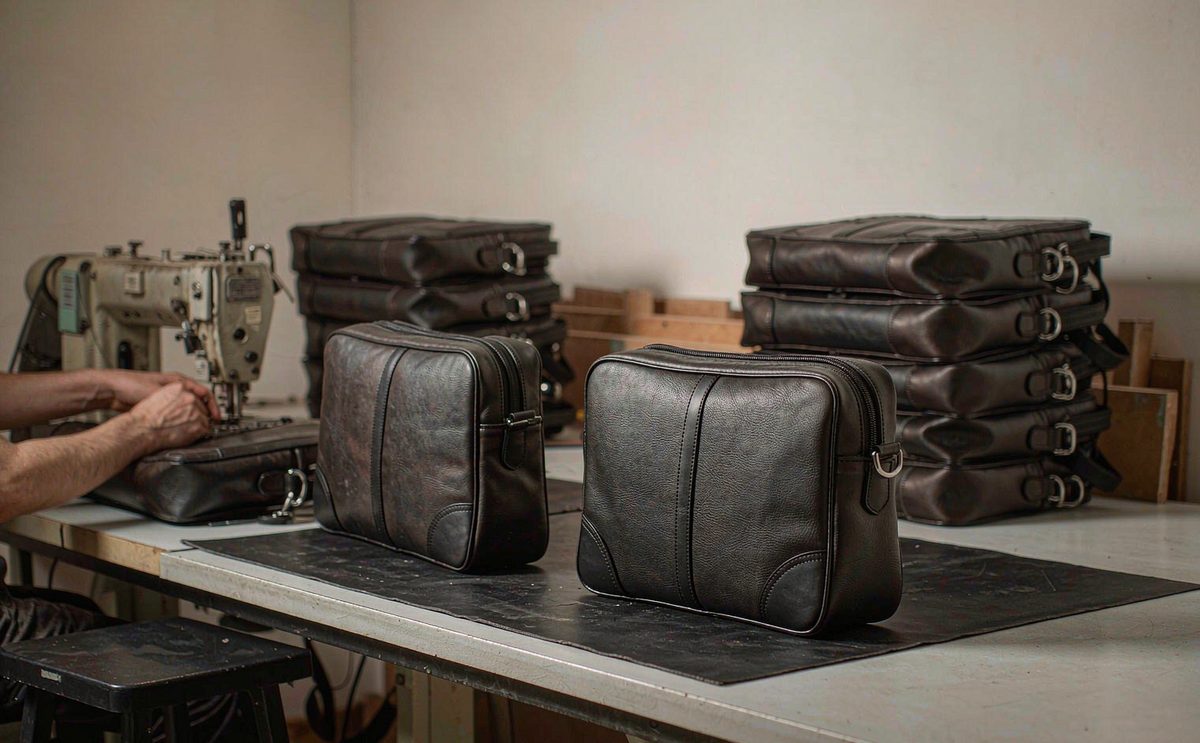
- Why 500 pieces is the working unit of a campaign programme
- How an MOQ of 500 pcs per style and colourway is actually built
- Colourway, size and print options inside a 500-piece run
- What a low-MOQ quotation must show line by line
- Unit cost behaviour from 500 pcs to 5,000 pcs
- Building reward tiers on top of a 500-piece floor
- Pilot runs, re-order windows and volume pricing
- Payment terms, Incoterms and cash-flow timing on FOB Xiamen
- Capacity, lines and how a production slot is reserved
- Inspection at low volume: AQL 2.5 under ISO 2859-1
- Compliance and lab testing inside a small-batch budget
- Freight, duty and landed-cost arithmetic
- A twelve-week calendar from deposit to ex-factory
- Mistakes that quietly eat a low-MOQ margin
- How to choose a production partner for a small-batch campaign
Small-batch bag production is the single decision that determines whether a crowdfunding reward is profitable, on time, and repeatable. Order too few and the unit cost will not support your pledge price; order too many and the campaign cash is trapped in inventory that backers never asked for. The working unit our production team plans around is 500 pcs per style and colourway, sampled in 6-10 working days and produced in 35-50 days after deposit and approved pre-production sample.
Key takeaways
- The planning floor is 500 pcs per style and colourway, not per order, and that distinction drives the whole tier structure.
- Sampling runs 6-10 working days; complex builds with moulded parts, welded seams or multi-material shells take 12-15.
- production 35-50 days from deposit plus approved pre-production sample, so the clock starts only after both exist.
- Inspection is AQL 2.5 to ISO 2859-1; freight terms are FOB Xiamen; payment is T/T 30/70.
- The production floor is 4,950 m2 SGS-verified, staffed by 137 people across 7 lines with 149 machines and 200,000 pcs monthly capacity.
- Low MOQ is a margin strategy, not a rescue plan: it only works when the quotation is line-itemed before the pledge tier is published.
- Volume pricing is negotiated as a ladder at quotation stage, not discovered after the campaign closes.
Why 500 pieces is the working unit of a campaign programme
A minimum order quantity is not an arbitrary gate a partner invents to make life difficult. It is the quantity at which the fixed costs of a style can be spread thinly enough that the unit price is quotable. Those fixed costs are real: pattern development, marker making, cutting setup, machine threading and changeover, trim procurement in mill lots, and the first two or three hours of any line running a new reference while operators learn the sequence.
For a campaign creator, the practical consequence is that the MOQ decides your reward architecture. If the floor is 500 pcs per style, then a single colourway is one commitment, and three colourways are three commitments. A creator who promises four colourways at 500 pcs each is not running a 500-piece programme; they are running a 2,000-piece programme with four times the trim complexity and four times the inspection surface. That is the arithmetic most first campaigns get wrong.
The second consequence is cash. At 500 pcs the unit price carries most of the setup burden, so the difference between 500 and 1,000 pcs is usually far more dramatic in percentage terms than the difference between 5,000 and 10,000. Understanding where that curve flattens is what lets a creator choose a pledge price with a defensible margin rather than a hopeful one. The crowdfunding bag guide walks the same curve from the specification end.
The three questions behind every MOQ conversation
First: is the minimum per order or per style and colourway? These are wildly different commitments, and a quotation that does not state which one applies is not comparable with another that does. Second: does the minimum apply to the first order only, or to re-orders? Some programmes allow a lower re-order quantity once tooling and patterns exist. Third: what happens to the unit price at the next quantity break, and is that break published in writing before you commit?
A 3,000-backer campaign offering three colourways of one backpack is a 1,500-piece commitment at a 500 pcs per colourway floor. Get that number onto the quotation before you set the pledge price.
How an MOQ of 500 pcs per style and colourway is actually built
Breaking the number apart makes it easier to negotiate intelligently. Fabric is bought by the metre in mill lots, and a colourway below a minimum dye lot forces either a surcharge or a substitution. Trim and hardware come with their own supplier minimums: a custom zip pull may carry a 3,000-piece tooling minimum, a woven label a 1,000-piece minimum, and a printed care label a 500-piece minimum. Each of these sits underneath the headline 500-pcs figure.
This is why two quotations for the same backpack can differ by more than the fabric grade explains. One partner has absorbed trim minimums into the unit price; the other has billed them as separate development charges that appear later. A sourcing partner who line-items these costs lets you see exactly which line moves when you change the zip specification or drop a colourway. Always ask for the trim minimum schedule with the quotation, not after it.
Line changeover is the remaining piece. Seven lines and 149 machines give the floor enough scheduling slack to absorb a 500-piece reference without disrupting longer runs, but the changeover still costs setup hours. Those hours are priced into the first-run unit cost and largely disappear on re-order, which is why the re-order conversation belongs at quotation stage rather than at campaign close.
| Cost element | Typical supplier floor | Effect on unit price at 500 pcs |
|---|---|---|
| Body fabric dye lot | Mill minimum per colourway | Absorbed at 500 pcs; surcharge below |
| Custom zip pull tooling | 3,000 pcs equivalent | Amortised into unit price or billed as tooling |
| Woven brand label | 1,000 pcs | Priced per piece, small premium below floor |
| Printed care label | 500 pcs | Neutral at the MOQ |
| Line changeover and setup | Per reference, per run | Heaviest at first run, minimal on re-order |
| Pattern and marker development | Per style | One-off development charge |
Colourway, size and print options inside a 500-piece run
A 500-piece commitment is more flexible than most creators assume, provided the flexibility is declared at specification stage. Three routes usually exist. The first is splitting a single style across colourways, where each colourway carries its own 500-pcs floor. The second is splitting across sizes, which behaves similarly because each size needs its own pattern grading and marker. The third is keeping one colourway and varying the print or embroidery, which is normally the cheapest way to create visual choice.
Print variation deserves particular attention because it is where campaign exclusivity usually lives. A screen print, heat transfer or embroidery file can be changed between colourways without touching the fabric purchase, so the incremental cost is limited to setup per artwork and the per-piece application. That is a materially cheaper way to offer three distinct-looking rewards than three fabric colourways, and it keeps the fabric purchase concentrated in one dye lot.
There is a limit. Every additional artwork is another approval point, another chance of a colour mismatch between the proof and the production piece, and another item on the inspection checklist. A campaign bag specialist will normally cap first-run artwork variation at two or three references and push anything beyond that into the re-order. The custom bag categories pages show which formats tolerate this treatment best.
What a low-MOQ quotation must show line by line
A comparable quotation is a document, not a number. It should separate the per-unit cost into material, labour, trim and packing; list one-off development charges separately; state the quantity the price is valid for; state the Incoterm and port; state the payment terms; and state the validity window of the quotation itself. A quotation missing any of these cannot be compared against one that has them, which means the cheaper-looking number is often simply the less complete one.
The validity window matters more than creators expect. Material prices move, and a quotation left open for ninety days is a quotation the partner will want to revisit. Thirty days is the usual commercial window; if you need longer, say so at RFQ stage and ask for the price to be held against a named production month instead. It is a reasonable request and it removes a nasty surprise from the campaign cash forecast.
Ask also for the quantity ladder on the same sheet. Seeing 500, 1,000, 2,500 and 5,000 pcs priced side by side tells you where the marginal cost curve flattens, and that single piece of information is what lets you decide whether to push a stretch goal or hold the line. If you want the format-specific detail, the bag manufacturing for campaign creators page covers how the ladder is assembled.
| Field | Why it matters | What a vague answer looks like |
|---|---|---|
| Per-unit breakdown | Shows which element drives cost | One blended unit price |
| Development charges | Separates one-off from recurring | Tooling included, no figure |
| Quantity validity | Sets the re-quote trigger | Valid for all volumes |
| Incoterm and port | Defines who pays freight | FOB China, no port named |
| Payment terms | Drives cash timing | Standard terms, unspecified |
| Quotation validity | Protects against price drift | Open-ended |
| Sampling lead time | Sets the pre-launch calendar | About two weeks |
| Inspection standard | Defines the release gate | QC before shipment |
Unit cost behaviour from 500 pcs to 5,000 pcs
Unit cost falls as quantity rises, but not evenly. The steepest part of the curve sits between 500 and roughly 1,500 pcs, because that is where setup, pattern, tooling and changeover stop dominating the arithmetic. Between 1,500 and 5,000 the curve keeps falling but far more slowly, driven mostly by fabric yield improvement, better trim pricing brackets and a line that has settled into the rhythm of the reference.
Fabric yield is the quiet variable. Once a marker is optimised across a full-size range rather than a single sample size, the metres consumed per piece drop, and on a coated or technical fabric that saving is not trivial. Trim brackets behave in steps: crossing 1,000 pieces on a woven label, or 3,000 on a zip pull, moves the price in a visible jump rather than a smooth glide.
For a creator this means the honest question is not what does it cost at 500 but where does the curve flatten, and is my realistic backer count above or below that point. If the realistic count is 900, then pricing the campaign at the 500-pcs unit cost and hoping the volume arrives is a gamble. Pricing it at the 1,000-pcs cost and ordering 1,000 is usually the safer structure, provided the cash forecast supports it.
| Quantity band | Setup share of unit cost | Notes on what changes |
|---|---|---|
| 500 pcs | High | Full pattern, tooling and changeover carried by the first band |
| 1,000 pcs | Moderate | Tooling amortised; fabric lot still modest |
| 2,500 pcs | Low | Trim brackets improve; marker yield optimised across sizes |
| 5,000 pcs | Minimal | Line runs continuously; material bought on a stronger contract |
| Re-order of any band | Minimal | Pattern and tooling exist, so only material and labour price |
Building reward tiers on top of a 500-piece floor
Reward tiers should be designed backwards from the production commitment, not forwards from what looks attractive on the campaign page. Start with the number of distinct physical units you can commit to at 500 pcs each, then map pledge levels onto those units. A campaign with one hero bag, one accessory and one bundle is three commitments and three inspection protocols, which is roughly the practical ceiling for a first-time creator.
Bundles are the efficient way to raise average pledge value without multiplying production complexity. A backpack plus a tech pouch is one backpack commitment and one pouch commitment, and if both share a fabric colourway they can be cut from the same dye lot and inspected under a single AQL 2.5 plan. The custom bag bundles page works through the packaging logic of that structure.
Watch the fulfilment weight of each tier while you design it. A bundle that raises pledge value by 40 USD may push the parcel into a higher carrier weight bracket and give back half the gain. Tier design, unit cost and freight band are one calculation, and the creators who treat them as three separate calculations are the ones who discover the problem in the shipping invoice.
Pilot runs, re-order windows and volume pricing
A pilot run is a deliberate decision to produce a small quantity ahead of the main commitment in order to validate demand, packaging or a material before scaling. On a campaign bag programme the 500-pcs floor already functions as a pilot in most cases, so a separate pilot run only makes sense when the material or construction is genuinely untested, or when the campaign intends to test a second colourway before committing.
Re-order terms are the more valuable conversation. Because pattern, tooling and trim minimums are already covered on the first run, a re-order of an established reference carries a materially lower unit cost. Agree at quotation stage what the re-order floor is, how long the tooling is held, and what notice the production window needs. Without that agreement in writing, a post-campaign re-order is priced as if it were a new programme.
Volume pricing should also be recorded as a ladder rather than a single figure. Knowing the price at 1,000, 2,500 and 5,000 pcs in advance lets a creator commit to a stretch goal without a fresh round of negotiation at the moment the campaign is at its busiest. Build the ladder into the RFQ, and ask for it to be restated on the pro forma invoice.
Payment terms, Incoterms and cash-flow timing on FOB Xiamen
Standard terms on this programme are T/T 30/70: thirty per cent deposit to release the production window and material purchase, seventy per cent against the approved inspection report before the shipment leaves. The deposit is what converts a quotation into a booked slot, and it is the trigger for the 35-50 day bulk clock alongside the approved pre-production sample.
FOB Xiamen means the goods, export clearance and loading onto the nominated vessel are covered up to the port of Xiamen; freight, insurance, import duty and onward delivery from that point are the buyer's account. That is a clean and auditable split, and it is why FOB rather than a delivered term is quoted as standard. Buyers who want a landed figure can request DDP, but the duty and VAT component has to be modelled per destination market.
Cash-flow-wise, the deposit lands before production and the balance lands before shipment, which means the campaign funds need to be collected and available inside that window. Model it explicitly: deposit at week zero, material purchase in weeks one to three, balance at week six or seven, vessel departure around week eight or nine. The regional service page sets out how the onward leg varies by destination.
Capacity, lines and how a production slot is reserved
The programme runs on a 4,950 m2 SGS-verified production floor with 137 staff across 7 lines and 149 machines, giving 200,000 pcs of monthly output. Those numbers matter to a creator for one reason: they determine whether a 500-piece reference can be slotted in without displacing a larger run, and how quickly a re-order can be scheduled once the campaign closes.
A slot is reserved when three things exist simultaneously: an approved specification, an approved pre-production sample, and the deposit. Waiting until the campaign closes to start that sequence is the most common cause of a missed delivery month, because the 35-50 day window then has to run after the funds clear rather than overlapping with the final weeks of the campaign.
Seasonality also bites. The months leading into the northern-hemisphere autumn shipping peak compress available capacity, and freight rates move with it. Booking the window early in the calendar rather than waiting for a confirmed backer count is generally the cheaper mistake, because an unused slot costs far less than a slot that no longer exists.
| Trigger | Owner | Timing |
|---|---|---|
| Written, dated specification | Creator, signed off by partner | Before sampling starts |
| Approved pre-production sample | Creator sign-off in writing | End of the 6-10 day window |
| T/T 30 deposit | Creator | Same week as PPS approval |
| Material purchase released | Production team | Within 5 working days of deposit |
| Bulk window confirmed | Programme coordinator | Deposit plus PPS, then 35-50 days |
Inspection at low volume: AQL 2.5 under ISO 2859-1
Inspection on this programme is AQL 2.5 to ISO 2859-1, which fixes the sample size, the acceptance number and the rejection number for a given lot size. At 500 pcs the sampling plan draws a defined number of cartons and pieces; a lot passes if defects fall at or below the acceptance number and fails if they reach the rejection number. That is an objective, reproducible gate rather than an opinion.
Small lots behave differently from large ones in one important respect: a single systemic defect can consume the entire allowance. If one carton of 50 units shares a misaligned print, the defect count is 50, not one. This is precisely why the pre-production sample matters so much at low volume: it is where a systemic issue is cheapest to catch, because fixing it before bulk costs a revised sample and nothing else.
Defects are classified as critical, major and minor, and each class carries its own acceptance number. Critical defects, which include anything that creates a safety or compliance failure, are normally accepted at zero. The full classification logic and the checklist used on campaign lots sits on the Kickstarter campaign bag QA and QC page.
Approve the pre-production sample against a written checklist rather than by eye. Once bulk starts, a repeated fault across one carton can fail the entire lot and cost the delivery month.
Compliance and lab testing inside a small-batch budget
Compliance is not optional and it is not a large-brand luxury. A bag shipped to the United States falls under CPSIA, and California destinations add Prop 65 warnings. The European Union applies REACH, and from the end of 2024 the General Product Safety Regulation, EU GPSR, requires a named responsible economic operator and technical documentation. Each of these applies to a 500-piece run exactly as it applies to a 50,000-piece run.
Material certification is the efficient route. Sourcing fabric and trim already certified to OEKO-TEX Standard 100, or recycled content certified to GRS, removes the need to test every input from scratch and keeps the testing budget proportional to a small run. Where a specific claim is made, such as a tear-strength figure, the test method should be named: ASTM D5034 for grab and tear testing of woven fabrics is the common reference.
Budget testing as a discrete line at quotation stage, with the report held as part of the technical file. Testing typically runs in parallel with sampling rather than after it, which means it adds calendar time only if the material is not already certified. Our production team will flag which claims need a named standard before the specification is frozen.
Freight, duty and landed-cost arithmetic
Landed cost is the unit cost plus freight, duty, and the handling charges at both ends, divided across the shipment. A 500-piece run is disproportionately exposed to freight because several charges are per shipment rather than per piece: documentation, terminal handling, customs entry and the minimum chargeable weight on an air or express movement. At small volumes those fixed charges can exceed the per-unit freight entirely.
Volume is the other variable. Bags are light and bulky, so a backpack may be charged on volumetric weight rather than actual weight. Compressing the packed carton by a few centimetres, or shipping flat rather than assembled, can move a parcel into a lower band. That is a packaging decision made during specification, not a freight decision made at booking, and it is one of the few places where a first-time creator can recover real money.
Mode selection follows from the calendar. Sea freight is the default for bulk replenishment and is priced per container; air or express is reserved for review units, replacement stock and deadline rescue. The crowdfunding rewards fulfilment pillar carries the full mode-selection and duty arithmetic, including the DDP and IOSS treatment for EU destinations.
| Component | Basis | Who pays under FOB Xiamen |
|---|---|---|
| Ex-works unit cost | Per piece | Included in FOB price |
| Inland haulage to port | Per shipment | Seller, to named port |
| Export clearance | Per shipment | Seller |
| Ocean or air freight | Per container or chargeable kg | Buyer |
| Import duty and VAT | Per shipment, by HS code | Buyer |
| Customs entry and handling | Per shipment | Buyer |
| Onward delivery to 3PL | Per pallet or parcel | Buyer |
A twelve-week calendar from deposit to ex-factory
Working backwards is the only reliable way to plan a campaign delivery month. Fix the date the first parcel must reach a backer, subtract the last-mile transit, subtract the ocean leg and customs clearance, subtract inspection and repacking, and what remains is the date the bulk window must close. Then subtract 35-50 days to find the deposit date, and a further 6-10 working days to find the specification freeze.
In practice a twelve-week calendar looks like this: weeks one and two for specification and quotation, week three for sampling, week four for sample review and revision, week five for material purchase and slot confirmation, weeks six through eleven for bulk production, and week twelve for inspection, packing and vessel loading. Anything that slips inside the first four weeks comes directly out of the delivery promise.
The calendar should be published on the campaign page as a range, not a date. Backers understand a delivery window; what damages trust is a specific date that was never achievable given the sampling and bulk windows. Our programme coordinators recommend stating the month and the conditions that would move it.
- Freeze the written specification and confirm the 500-pcs commitment per style and colourway.
- Request a line-itemed quotation including the quantity ladder and development charges.
- Approve the tech pack, then start the 6-10 working days of sampling window (12-15 if complex).
- Run a structured sample review, log every change, and approve the pre-production sample in writing.
- Release the T/T 30 deposit and confirm the production slot.
- Run production 35-50 days with in-line checks.
- Release the T/T 70 balance against an AQL 2.5 inspection pass, then load at FOB Xiamen.
Mistakes that quietly eat a low-MOQ margin
The first is promising colourways before confirming the per-colourway floor. Four colourways at 500 pcs each is four commitments, and the trim minimums multiply with them. The second is treating sampling as a formality: the 6-10 day window is the cheapest fault-finding period in the whole programme, and compressing it pushes cost into bulk where it is twenty times more expensive to fix.
The third is pricing the reward before the freight band is known. A bundle that looks comfortably profitable at the unit-cost level can be marginal once volumetric weight and the per-shipment charges are added. The fourth is ignoring the seventy per cent balance: campaign funds that arrive late, or that are held by the platform's payout schedule, delay shipment regardless of how well production went.
The fifth is assuming re-orders are automatic. Tooling is held for an agreed period, patterns are held, but the production window is not. A creator who plans a second run should confirm the re-order floor and the notice period in writing at quotation stage, then diarise the booking before the campaign closes. The Indiegogo crowdfunding bags page covers the variant where funds arrive on a different schedule.
How to choose a production partner for a small-batch campaign
Choosing a production partner for a 500-piece campaign is a different exercise from choosing one for a fifty-thousand-piece programme. What matters is not headline capacity but willingness to schedule a short run, quality of technical communication, and whether the quotation is complete enough to be compared. Ask for the quantity ladder, the development charge schedule and the inspection standard on the first response.
Then test the technical response. Send a partial specification and see whether the questions come back about seam construction, fabric weight or hardware grade, or whether a number simply arrives. A partner who interrogates the specification will usually surface a cost or a compliance problem before it becomes a delivery problem. A partner who does not will agree to everything and discover the difficulty in bulk.
Finally, check the campaign track record. This programme has supported 20+ crowdfunding campaigns, operating since 2014 with trade roots going back to 2004. That history is relevant because campaign work is deadline-driven in a way ordinary bag work is not: the shipping date is public, and the backer relationship depends on it. Ask for references on campaign work specifically, not general bag work.
Most delivery problems on a rewards campaign are decided before the campaign launches, in the specification and the sampling window, not in the production run.
Kickstarter Creator Handbook
Where to route your programme next
Three routes cover most first campaigns. If the format is still open, work through the category pages and fix the specification before any quotation is requested. If the design exists but has never been built, go to the sampling and prototyping pillar and plan the 6-10 working day window properly. If production is committed and the question is delivery, the fulfilment pillar carries the freight, duty and last-mile arithmetic.
Crowdfunding bag guide
The eight-stage sequence from specification through quotation, sampling, production, inspection and freight.
Sampling and prototyping
How the sketch becomes a tech pack, a prototype and an approved pre-production sample in 6-10 working days.
Rewards fulfilment
Freight mode selection, duty and VAT treatment, 3PL routing and last-mile carrier planning for backer parcels.
Category routes for a 500-pcs first run
Not every format behaves the same at 500 pcs. Structured backpacks and travel bags carry the highest setup burden because of frame, padding and panel count, while pouches, packing cubes and drawstring bags reach an efficient unit cost at far lower complexity. Choosing a lower-complexity companion item alongside the hero bag is a common way to make the tier ladder work.
- Custom backpacks for Kickstarter
- Custom travel bags for Kickstarter
- Custom duffel bags for Kickstarter
- Custom tote bags for Kickstarter
- Custom packing cubes for Kickstarter
- Custom tech pouches for Kickstarter
- Custom drawstring bags for Kickstarter
- Custom bag bundles for crowdfunding
Programme support routes and next documents
Once the quantity question is settled, three documents carry the programme forward: the inspection checklist used to release the lot, the destination-specific delivery note that covers duty treatment and last-mile routing, and the quotation request that converts the specification into a costed ladder. All three are worth assembling before the pledge tiers are published, because a published tier is a commitment that the specification has to be able to support.
- Kickstarter campaign bag QA and QC
- Regional service by destination
- Indiegogo crowdfunding bags
- Bag manufacturing for campaign creators
- Crowdfunding rewards fulfilment for bags
- Custom sports bags for Kickstarter
- Frequently asked questions
- About us
Programme facts at a glance
- Minimum order quantity
- 500 pcs per style and colourway
- Sampling window
- 6-10 working days (12-15 for complex builds)
- Bulk production
- 35-50 days after deposit and approved PPS
- Inspection standard
- AQL 2.5 to ISO 2859-1
- Trade terms
- FOB Xiamen
- Payment terms
- T/T 30/70
- Production floor
- 4,950 m2, SGS-verified
- Workforce and equipment
- 137 staff, 7 lines, 149 machines
- Monthly capacity
- 200,000 pcs
- Operating since
- 2014, with trade roots since 2004
- Campaign experience
- 20+ crowdfunding campaigns supported
Send your specification and get a line-itemed quotation
Share the format, target quantity per colourway, material direction and destination market. Our production team will return a costed ladder, the sampling schedule and the confirmed production window. Email service@junyuanbags.com or message WhatsApp +86 177 5002 0688, or use the quote request page.
Frequently Asked Questions
What is the minimum order quantity for a crowdfunding bag programme?
The working minimum is 500 pcs per style and colourway, which means a single colourway of one backpack is one 500-pcs commitment. Three colourways of the same backpack become three separate 500-pcs commitments, each carrying its own fabric dye lot and trim minimums. Confirm which basis your quotation uses before publishing any pledge tier that promises a colour choice.
Does the 500-pcs minimum apply to every colourway separately?
Yes, the 500-pcs floor applies per style and per colourway rather than per total order. Fabric is purchased by dye lot, and each colourway triggers its own mill minimum, while trim items such as woven labels carry their own supplier floors around 1,000 pcs. A cheaper route to visual choice is one colourway with two or three printed or embroidered artwork variations.
How long does sampling take before bulk production can start?
Standard sampling runs 6-10 working days from an approved tech pack to a reviewable prototype. Complex builds involving moulded shells, welded seams, multi-material panel construction or custom hardware tooling take 12-15 working days. production 35-50 days begins only once the deposit is received and the pre-production sample has been approved in writing, so both dates must be on the calendar.
When does the 35-50 day bulk production clock actually start?
The bulk window starts on the later of two events: receipt of the T/T 30 deposit and written approval of the pre-production sample. If either is missing, the clock has not started. This is why the sampling window should be run before the campaign closes rather than after, so that the 35-50 days overlap with the final weeks of pledging instead of following them.
What inspection standard is applied to a small-batch bag run?
Inspection is carried out to AQL 2.5 under ISO 2859-1, which defines the sample size, acceptance number and rejection number for the lot size. Defects are classified as critical, major and minor, each with its own acceptance threshold, and critical defects relating to safety or compliance are accepted at zero. A passed inspection is the release condition for the T/T 70 balance.
Why does unit cost fall so sharply between 500 and 1,000 pieces?
At 500 pcs the fixed costs of pattern development, tooling, line changeover and setup are carried by the smallest possible quantity, so they dominate the unit price. Doubling to 1,000 pcs halves that fixed share per piece while material and labour stay roughly constant. Beyond 2,500 pcs the curve flattens, and remaining gains come from better trim brackets and marker yield.
What payment terms should a first-time creator expect?
Standard terms are T/T 30/70: thirty per cent deposit to release the production slot and material purchase, and seventy per cent against the passed inspection report before shipment. Model both dates in the campaign cash forecast, because the balance falls before the goods leave Xiamen rather than after they arrive. The deposit is what converts a quotation into a booked window.
What does FOB Xiamen mean for my landed cost?
FOB Xiamen covers the goods, export clearance and loading onto the nominated vessel at the port of Xiamen. Freight, insurance, import duty, VAT and onward delivery from that point sit with the buyer. Per-shipment charges such as documentation, terminal handling and customs entry are fixed regardless of quantity, so they weigh heavily on a 500-pcs run.
How much production capacity sits behind a 500-pcs campaign order?
The programme runs on a 4,950 m2 SGS-verified production floor with 137 staff across 7 lines and 149 machines, producing 200,000 pcs per month. That scale gives enough scheduling slack to place a 500-piece reference without displacing long runs, and it shortens the notice needed for a post-campaign re-order. Operating since 2014, with trade roots since 2004.
Can I order a pilot run before committing to the full quantity?
In most cases the 500-pcs floor already serves as a pilot, so a separate pilot run only pays for itself when a material or construction is genuinely untested, or when a second colourway needs demand validation. The more valuable agreement is the re-order floor: because pattern and tooling already exist, a re-order carries a materially lower unit cost.
What compliance documentation is needed for a bag shipped to the EU?
EU destinations require REACH compliance, and from late 2024 the General Product Safety Regulation adds a named responsible economic operator plus technical documentation. Using fabric certified to OEKO-TEX Standard 100, or recycled content certified to GRS, removes the need to test every input from scratch and keeps testing proportional to a 500-pcs run.
What compliance applies to bags shipped to the United States?
Bags entering the United States fall under CPSIA, and California destinations add Prop 65 warning requirements. Where a performance claim is made, such as a tear-strength figure, name the test method: ASTM D5034 is the common reference for grab and tear testing of woven fabrics. Hold the test report in the technical file alongside the approved specification.
How should I design reward tiers around a 500-pcs floor?
Work backwards from the production commitment. One hero bag, one accessory and one bundle equals three commitments and three inspection protocols, which is about the practical ceiling for a first campaign. Bundles that share a fabric colourway can be cut from the same dye lot and inspected under a single AQL 2.5 plan, raising pledge value without multiplying complexity.
What should a comparable quotation contain?
It should split the unit cost into material, labour, trim and packing, list development charges separately, state the quantity the price covers, name the Incoterm and port, state payment terms, and give a quotation validity window of around 30 days. A blended single figure cannot be compared against a line-itemed quotation, so the cheaper number is often just the less complete one.
How long is a quotation usually valid for?
Around 30 days is the commercial norm, because material prices move. If the campaign calendar needs the price held longer, request at RFQ stage that the figure be held against a named production month rather than a date. It is a reasonable ask and it removes a re-quote from the middle of the campaign cash forecast.
Can I vary the print artwork between colourways in one run?
Yes, and it is usually the cheapest way to create visual choice because it does not split the fabric dye lot. The incremental cost is limited to setup per artwork plus the per-piece application. The practical limit is approval capacity: each artwork is another proof, another colour-match risk and another inspection item, so first runs are normally capped at 2 or 3 artwork references.
What happens if the inspection fails on a 500-pcs lot?
Under AQL 2.5 the lot is rejected when defects reach the rejection number, and the T/T 70 balance is not released. At 500 pcs a systemic fault such as a misaligned print across one carton of 50 units spends the whole allowance at once. The remedy is rework or re-making, which is why the pre-production sample is the cheapest place to catch a repeated fault.
How far in advance should a production slot be booked?
Book as soon as the specification, pre-production sample and deposit exist, which normally means 4-6 weeks before bulk needs to start. Capacity compresses ahead of the northern-hemisphere autumn shipping peak and freight rates move with it. An unused slot costs far less than a slot that no longer exists, so booking early is the cheaper mistake.
Are re-orders priced the same as the first order?
No. Once pattern, tooling and trim minimums are covered by the first 500 pcs, a re-order of an established reference carries a materially lower unit cost, since only material and labour are priced again. Agree the re-order floor, the tooling holding period and the notice required for the production window at quotation stage, in writing, rather than after the campaign closes.
What is the single most expensive mistake on a small-batch bag campaign?
Promising a colourway choice before confirming that the 500-pcs floor applies per colourway. Four colourways at 500 pcs each is a 2,000-piece commitment with four dye lots, four trim sets and four times the inspection surface. The second most expensive is compressing the 6-10 working days of sampling window, which moves fault-finding into bulk where fixes cost many times more.
People Also Ask
How many bags do I need to order for a Kickstarter campaign?
Plan around 500 pcs per style and colourway. That is the working floor: one colourway of one style is a single 500-pcs commitment, and each additional colourway is another.
Why is small-batch bag production more expensive per unit?
Because fixed costs such as pattern development, tooling, line changeover and fabric dye-lot minimums are spread across fewer pieces. The fixed share per unit falls sharply between 500 and 1,000 pcs, then flattens.
Can I split one style across two colours in a 500-piece order?
Not inside the same 500-pcs commitment. Each colourway carries its own 500-pcs floor because the fabric is bought by dye lot. Splitting means 1,000 pcs total across two colourways.
How long does it take to make custom bags for a campaign?
Sampling takes 6-10 working days, or 12-15 for complex builds, and production 35-50 days after deposit and approved pre-production sample. Plan roughly twelve weeks end to end.
What is AQL 2.5 and why does it matter for my bags?
AQL 2.5 under ISO 2859-1 sets the sample size and the accept and reject numbers for a lot. It turns inspection into an objective release gate instead of an opinion.
Do I pay duty on a shipment of 500 bags?
Yes. Duty and VAT are assessed on the classified HS code at import and are the buyer's cost under FOB Xiamen. Model them per destination market before setting the pledge price.
Is 500 pieces enough to get a good unit price?
It is enough to get a quotable price, not the best one. Ask for the ladder at 1,000, 2,500 and 5,000 pcs at quotation stage so you can see where the curve flattens.