Custom Bag Bundles for Crowdfunding
A bundle is the fastest way to raise average pledge value, but it is also the fastest way to triple your SKU count. Each item in a set carries the 500 pcs minimum per style and colourway, so a three-item bundle is three production orders, not one. Sampling runs 6-10 working days, production 35-50 days after deposit and approved pre-production sample, and pre-shipment inspection at AQL 2.5 applies per item. This page covers bundle design, shared-material strategy, kitting and the cost breakdown.
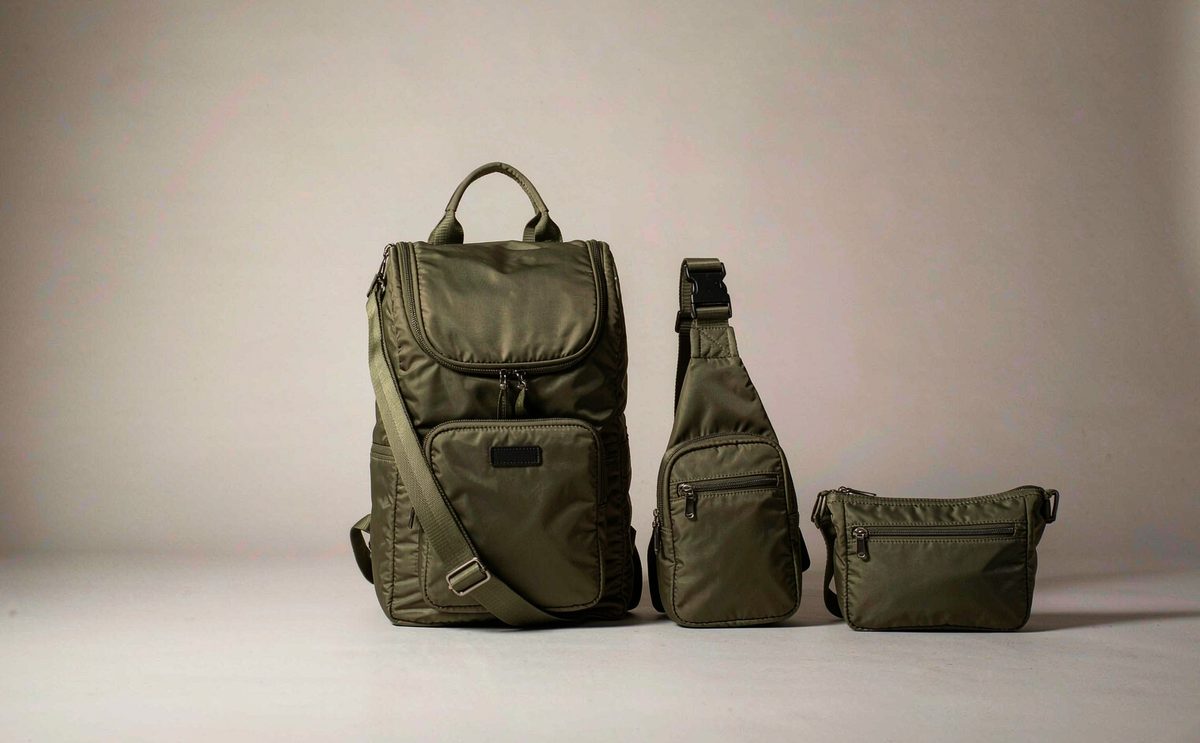
- Why bundles change the economics of a reward tier
- Four bundle archetypes that map to pledge tiers
- Shared material and trim strategy
- Engineering the average pledge value
- Sampling a bundle: which item goes first
- Packaging and kitting: one carton or many
- Freight and dimensional weight
- QC across a multi-SKU set
- Cost breakdown for a three-item set
- Common bundle mistakes and how to avoid them
- Briefing a bundle RFQ
Why bundles change the economics of a reward tier
A single bag has one cost, one sampling slot, one inspection and one carton. A three-item bundle has three of the first and, if the creator is disciplined, one of the last. That asymmetry is the entire commercial case for bundling: backers perceive a set as materially more valuable than the sum of its parts, while the production side can recover much of the apparent generosity through shared materials, shared trims, a single print setup and a single packing line.
The catch is that the recovery only happens if the set is designed as a set. Three unrelated bags bought from three different sources carry three material buys, three tooling sets, three sampling rounds and three inspection visits, and the bundle premium is eaten by overhead before it reaches the margin. Designed properly — one body fabric, one hardware finish, one logo system, one colourway — a three-item set behaves much closer to a single order with a larger quantity.
- Minimum order quantity
- 500 pcs per style / colourway, applied per item in the set
- Sampling
- 6-10 working days; 12-15 for complex builds
- Bulk production
- 35-50 days after deposit + approved pre-production sample
- Inspection
- AQL 2.5 to ISO 2859-1, applied per SKU
- Trade term
- FOB Xiamen
- Payment
- T/T 30/70
- Production floor
- 4,950 m² SGS-verified, 137 staff, 7 lines, 149 machines
- Monthly capacity
- 200,000 pcs per month
- Programme contact
- service@junyuanbags.com
Key takeaways on bundling bag rewards
- Every item in a bundle carries its own 500 pcs minimum, so a three-item set is three orders.
- Shared body fabric, shared hardware finish and one logo system are what make a bundle affordable.
- Sample the hero item first, then approve accessory items against the hero material and branding.
- Decide kitting at origin or at the fulfilment warehouse before you size the master carton.
- Dimensional weight, not actual weight, usually drives freight cost on a bulky bag set.
Four bundle archetypes that map to pledge tiers
Bundles are not all built the same way. The right structure depends on where the set sits in the tier ladder: an entry bundle has to protect margin on a low pledge, while a premium bundle has to justify a high one with genuine function rather than more items. The table sets out the four archetypes that recur across campaigns we support, and where each one breaks down.
| Archetype | Typical contents | Pledge position | Where it breaks |
|---|---|---|---|
| Entry duo | Tote plus flat pouch | Lowest reward tier, often the volume driver | Margin is thin; freight on two items can exceed the pledge |
| Hero plus organiser | Backpack plus tech pouch or packing cube | Mid tier, the most common bundle | The organiser has to solve a real problem or it reads as filler |
| Travel trio | Weekender plus toiletry bag plus luggage tag or shoe bag | Premium tier | Three SKUs means three 500 pcs minimums; volume risk is real |
| Add-on ladder | One hero item plus optional add-ons sold separately | Post-campaign and pledge-manager phase | Add-ons ordered late can miss the production window |
The hero-plus-organiser archetype is the workhorse, and it deserves a note on why. It concentrates the perceived value in one object the backer will use daily, while the second item costs a fraction of the hero to make and solves a specific problem the hero creates — cable clutter in a backpack, wet items in a duffel, cosmetics in a weekender. Bundles that pair two objects of equal status tend to underperform, because neither item reads as the reason to pledge.
Shared material and trim strategy
This is the single biggest lever on bundle unit cost. One body fabric bought once for three items is a different commercial proposition from three fabrics bought in 500-unit lots, and the difference shows up in material price, in colour consistency between items and in the number of inspection variables. The table quantifies where sharing helps and where it genuinely does not.
| Element | Share or differentiate | Why |
|---|---|---|
| Body fabric | Share | One material buy, consistent colour, one set of test certificates |
| Lining fabric | Share, or contrast deliberately | A contrast lining is a cheap way to make items feel distinct |
| Webbing and binding | Share | Trim minimums are per colour; sharing avoids a second buy |
| Zipper tape and slider finish | Share | Hardware finish is the most visible consistency cue across a set |
| Logo method | Share | One digitising file, one screen set, one registration standard |
| Logo size and placement | Differentiate | Placement should follow each item's natural sightline |
| Hardware shape | Differentiate only if functional | Custom shapes add tooling; finishes do not |
| Packaging | Share where possible | One carton size simplifies freight and kitting |
Note what is on the differentiate list: it is almost entirely placement and proportion rather than material. That is deliberate. A set that shares fabric and hardware but varies proportion reads as designed; a set that varies fabric reads as sourced. Campaign photography rewards the first and punishes the second, because mixed materials under one light rarely match the way a mood board promised.
Engineering the average pledge value
Average pledge value is an arithmetic outcome, not a marketing one. It is driven by how many backers land on each tier and what each tier costs to make. A bundle sits at a higher pledge point than its hero item alone, and the question is whether the incremental cost of the second and third items is lower than the incremental pledge they unlock. When the second item is a simple pouch made from the same fabric roll, it usually is — by a wide margin.
The discipline is to price the bundle from the cost side up rather than from the pledge side down. Compute the landed unit cost of each item at the planned quantity, add kitting, add the incremental freight, add the payment processing and platform fee, and only then decide whether the pledge point clears the target margin. Creators who do this in the other order discover the problem at fulfilment, when the only available remedy is a smaller bag.
Sampling a bundle: which item goes first
A bundle should never be sampled as three parallel workstreams. The hero item carries the brand impression and the functional claim, so it is sampled first and approved first; the accessory items are then approved against it, for material match, hardware finish match and logo registration. Parallel sampling produces three items that each look right and do not look right together.
- Nominate the hero item — the one that appears in the campaign hero image and carries the functional claim.
- Build the hero structure sample in the production body fabric and approve dimensions, stiffness and load behaviour.
- Approve the logo method on the hero item, because that strike-off becomes the reference for the whole set.
- Build accessory samples in the same fabric and hardware finish, using the hero strike-off as the colour reference.
- Check the set together under the lighting you will shoot in, not under separate sample-room lighting.
- Pack one full set into the intended master carton and confirm it closes without compression or void fill.
- Approve the pre-production sample for each SKU, then release bulk for all items on the same schedule.
Step five sounds cosmetic and is not. Fabric from the same dyelot still reads differently on a large flat panel than on a small curved pouch, and a logo that registers cleanly on a backpack front panel can look oversized on a toiletry bag. Seeing the three objects side by side under shoot lighting is the cheapest way to catch that before 500 of each exist. The sample prototyping page covers the approval gates in more detail.
Packaging and kitting: one carton or many
Kitting is the decision that most often gets made by accident. If nobody specifies it, items arrive at the fulfilment warehouse as separate SKUs and the warehouse kits them, charging per unit and introducing a pick error rate. If it is specified early, the set is assembled at origin, shipped as one sellable unit and scanned once at the warehouse. The table compares the two routes on the factors that actually move cost and risk.
| Factor | Kitted at origin | Kitted at the fulfilment warehouse |
|---|---|---|
| Per-unit kitting cost | Low, folded into packing labour | Typically USD 0.40-1.50 per set plus pick charges |
| Pick error risk | Low — one SKU per backer | Higher — three picks per backer |
| Inventory flexibility | Low — sets are committed | High — items can be re-mixed between tiers |
| Freight efficiency | Better; one optimised carton per set | Worse; each SKU ships and stores separately |
| Late tier changes | Hard to accommodate | Easy to accommodate |
| Best for | Stable tiers, confirmed volumes | Campaigns still testing tier structure |
The rule of thumb is that origin kitting wins when the tier structure is settled and destination kitting wins when it is not. A creator who is genuinely unsure whether the pouch belongs in the mid tier or the premium tier should keep it as a separate SKU until the pledge manager closes, then kit at the warehouse. A creator with a settled three-tier ladder should kit at origin and take the freight saving.
Freight on a bulky bag set is billed on dimensional weight, not scale weight. A carton 3 cm too large on each axis can add 20-30% to the air or express cost of a set. Pack one real set, measure the closed carton, then quote.
Freight and dimensional weight
Bags are a freight-hostile category: light, bulky and compressible only up to a point. Two items in one carton usually ship more cheaply than two cartons, because the volumetric penalty is paid once on the outer box rather than twice. That is a strong argument for origin kitting and for designing accessories that nest inside the hero item during transit rather than sitting beside it.
Compression is the other lever. A pouches-and-cubes set can be vacuum or roll-packed to a fraction of its packed volume and re-lofted on arrival, while a structured backpack cannot. Ask whether each item in the set tolerates compression for the duration of transit, and specify the packing method in the RFQ so the quote reflects the real carton rather than a nominal one. Freight planning interacts directly with the rewards fulfilment plan, and the two should be designed together.
QC across a multi-SKU set
Inspection on a bundle is per SKU, not per set. AQL 2.5 to ISO 2859-1 is applied to each item independently, which means a set has three chances to fail rather than one. That raises the value of getting the pre-production sample right on every item, because a re-inspection or a rework on one item delays the whole kitting operation even when the other two are perfect.
- Colour consistency between items: compare all three under the same light box against the approved hero strike-off.
- Hardware finish match: sliders, pullers and buckles should be from the same finish batch across the set.
- Logo registration: placement tolerance should be stated per item, since a pouch has less tolerance than a backpack panel.
- Stitch and seam audit: accessory items often run on a different line and need their own first-piece approval.
- Set completeness: if kitted at origin, a count check per master carton catches short-packing before freight.
- Carton drop and stacking: the packed set carton should survive ISTA 3A-style handling for the chosen route.
One practical suggestion: hold a golden set. One complete, approved, kitted set stays at the production site as the physical reference for the whole run, and a second stays with the creator. Every question about shade, placement or packing that arises during bulk gets answered by comparison rather than by description. The full protocol is documented on the QA and QC page.
Cost breakdown for a three-item set
The table below is a representative structure for a three-item bundle quoted at 500 pcs per item, using a shared body fabric and one logo method. Figures are indicative bands in USD rather than a quote; the point is the shape of the breakdown, and in particular how much of a bundle's cost sits outside the bags themselves.
| Cost element | Share of landed cost | Comment |
|---|---|---|
| Hero item unit cost | 45-55% | Dominated by fabric, hardware and labour hours |
| Accessory items unit cost | 18-25% | Low labour, small panels, often cut from marker waste |
| Decoration across the set | 4-8% | One digitising file and one screen set amortised over all three |
| Kitting and packing | 3-6% | Higher if kitted at the destination warehouse |
| Freight and duty | 10-18% | Driven by dimensional weight and the destination market |
| Inspection and testing | 1-3% | AQL 2.5 inspection day plus any compliance testing |
| Non-recurring charges | 2-5% at 500 pcs | Falls toward zero on a re-order |
Two observations follow from that shape. First, the accessory items are cheap precisely because they share material and tooling with the hero, which is the argument for designing the set together rather than sourcing it piecemeal. Second, freight and duty together can exceed the cost of both accessory items, which is why carton design belongs in the costing conversation rather than after it.
Common bundle mistakes and how to avoid them
Almost every bundle problem we see is one of five mistakes, and all five are avoidable at design stage rather than at production stage. Scanning this list before the RFQ goes out is a ten-minute exercise that routinely saves weeks.
- Three items from three sources: guarantees a shade mismatch and triples the inspection and freight overhead.
- No hero item: a set of equals gives the backer no single reason to pledge at the higher tier.
- Oversized third item: an accessory that costs as much as the hero destroys the bundle margin.
- Kitting decided late: the warehouse default is per-unit kitting charges and a higher pick error rate.
- Carton sized after quoting: freight is billed on dimensional weight, so the quote was wrong.
- Colourway sprawl: two colourways across three items is six 500 pcs minimums, not one order.
A two-colourway, three-item bundle is six SKUs at 500 pcs each, or 3,000 units before a single backer has pledged. Launch one colourway and offer the second as a stretch goal, so it becomes a second production run rather than a change inside the first.
Briefing a bundle RFQ
A bundle brief needs everything a single-bag brief needs, plus three things that only exist once there is more than one item: which item is the hero, what the set shares, and how it gets kitted. Include the tier ladder too, because quantity per item depends entirely on where each item sits in the pledge structure.
- Tier ladder: pledge price per tier and the items included at each level.
- Hero nomination: which item carries the campaign image and the functional claim.
- Shared elements: body fabric, lining, webbing, hardware finish and logo method.
- Per-item dimensions, target volumes and any functional requirement such as padding or a wipe-clean lining.
- Quantity per item per colourway, plus the estimated split across tiers.
- Kitting decision: origin or destination, and the packaging specification for each.
- Destination markets and the compliance standards that apply to each item.
- Delivery window, and whether add-ons will be ordered after the campaign closes.
If the tier structure is still fluid, say so. A sourcing partner can quote the hero item firmly and the accessory items as indicative bands, which lets the campaign page be built while the tier ladder settles. Start with the category map if the item mix is still open, then send the brief to our team for a set-level quotation. Material choices across the set are covered on the material customisation page.
Get a bundle quotation and kitting plan
Send your tier ladder, item list and target quantities. As your sourcing partner we will return a per-item unit cost at 500 pcs, a shared-material recommendation, an origin versus destination kitting comparison and a carton-accurate freight estimate. Email service@junyuanbags.com or use the quote form.
- Custom bags for Kickstarter
- Custom backpacks for Kickstarter
- Custom travel bags for Kickstarter
- Custom tote bags for Kickstarter
- Custom cosmetic bags for Kickstarter
- Low MOQ bag production for creators
- Kickstarter success cases
Frequently Asked Questions
What is the minimum order quantity for a bag bundle?
The 500 pcs minimum applies per style and colourway, which means per item in the set. A three-item bundle at 500 units each is 1,500 units in total. Sharing one body fabric across the set keeps the material buy efficient, but it does not merge the minimums into a single 500-unit order.
How much does a custom bag bundle cost to produce?
At 500 pcs per item, the hero item typically accounts for 45-55% of landed cost, both accessories together 18-25%, decoration 4-8%, kitting 3-6% and freight plus duty 10-18%. Exact figures depend on fabric, hardware and carton size. Two colourways across three items would mean 3,000 units, not 1,500.
Which item in a bundle should be sampled first?
The hero item, sampled in 6-10 working days, because it carries the campaign image and the functional claim. Its approved logo strike-off then becomes the colour and registration reference for the accessory items. Sampling all three in parallel produces items that look right individually but do not match as a set.
Should a bundle be kitted at origin or at the fulfilment warehouse?
Origin kitting wins when the tier structure is settled: it avoids USD 0.40-1.50 per set in warehouse kitting charges, cuts pick errors from three per backer to one and ships as one carton. Destination kitting wins when the tier ladder is still changing, because items stay re-mixable until the pledge manager closes.
How does inspection work when a bundle has three different items?
AQL 2.5 to ISO 2859-1 is applied per SKU, so a three-item set has three independent acceptance decisions. That triples the chance one item delays kitting, which is why pre-production samples matter so much on bundles. Hold a golden set at the production site as the physical reference for shade, placement and packing.
Can the items in a bundle use different fabrics?
They can, but it costs more and looks worse. Each additional fabric is a separate material buy at 500-unit scale, a separate set of test certificates and a separate shade variable under campaign lighting. Sharing one body fabric and differentiating with a contrast lining gives most of the visual distinction at a fraction of the cost.
How long does it take to produce a bag bundle after sample approval?
production 35-50 days after the deposit and the approved pre-production sample, with all items scheduled together so they arrive for kitting at the same time. Freight is additional and varies by route. Holding all three items on one schedule matters: a single late item delays the whole kitting operation.
Does bundling actually increase average pledge value?
It raises the pledge point, but margin depends on incremental cost. A pouch cut from the same fabric roll and marker waste typically adds 8-15% to the set cost while supporting a 25-40% higher pledge, so the uplift is mostly margin. An accessory costing 50% of the hero destroys the benefit. Model it from cost upward.
What packaging should a crowdfunding bag bundle use?
Design for one closed master carton per set wherever possible, because freight is billed on dimensional weight. A carton 3 cm oversized on each axis can add 20-30% to express cost. Pack one real set, measure the closed carton, then quote freight and confirm it survives ISTA 3A-style handling.
How many items should a crowdfunding bag bundle contain?
Three is the practical ceiling before complexity starts costing more than the uplift. Each item adds a 500 pcs minimum, an inspection, a carton variable and a pick operation. A hero item plus one purposeful organiser usually outperforms a three-item set where the third item is filler that backers cannot justify.
Can add-on items be added to a bundle after the campaign closes?
Yes, and this is common in the pledge-manager phase. The risk is timing: an add-on ordered after the main run has started may miss the 35-50 day bulk window and need a separate, smaller run at worse unit pricing. Reserve capacity for likely add-ons when placing the main order.
What should a bundle RFQ include that a single-bag RFQ does not?
Three extra items: which of the 3 items is the hero, which elements are shared across the set, and how the set will be kitted. Add the tier ladder with pledge prices, because quantity per item at the 500 pcs minimum depends on where each item sits. Without those, a quote can only price unrelated bags.
People Also Ask
Are bag bundles worth it for a first Kickstarter campaign?
Usually yes, if the second item solves a problem the hero creates. A backpack plus a cable pouch is a real bundle; a backpack plus a random tote is filler. Keep to two or three items, one colourway, and model the landed cost before you set the pledge price.
Why does my bundle quote seem higher than three separate bags?
Because each item carries its own 500 pcs minimum, its own inspection and its own carton. If the items share no fabric or hardware, you are paying three material buys at minimum scale rather than one buy at volume.
Can I mix a tote and a backpack in one reward tier?
Yes, and it is one of the most common structures. The backpack is the hero, the tote is the entry-level partner. Share the body fabric and hardware finish so they read as a designed set rather than two separate purchases.
How do I stop bundles from complicating fulfilment?
Decide kitting location early, standardise on one carton size, and keep the set to three SKUs or fewer. Origin kitting reduces picks from three per backer to one and usually removes per-set warehouse kitting charges.
What size should the master carton be for a bag bundle?
As small as the closed set allows. Freight is billed on dimensional weight, so build one physical set, measure it, and size the carton to that. Compressible items like pouches can be roll-packed to cut volume significantly.