Custom Messenger Bags for Kickstarter
What separates a messenger bag that earns reviews from one that generates returns? Structure and hardware. A 40 x 30 x 12 cm body carries roughly 14 litres, a 3-5 mm interlined back panel stops the load folding, and a 38 mm webbing strap with a padded slider spreads the weight. Our production team runs messenger bags at 500 pcs per style / colourway, sampling in 6-10 working days and production 35-50 days at AQL 2.5 (ISO 2859-1).
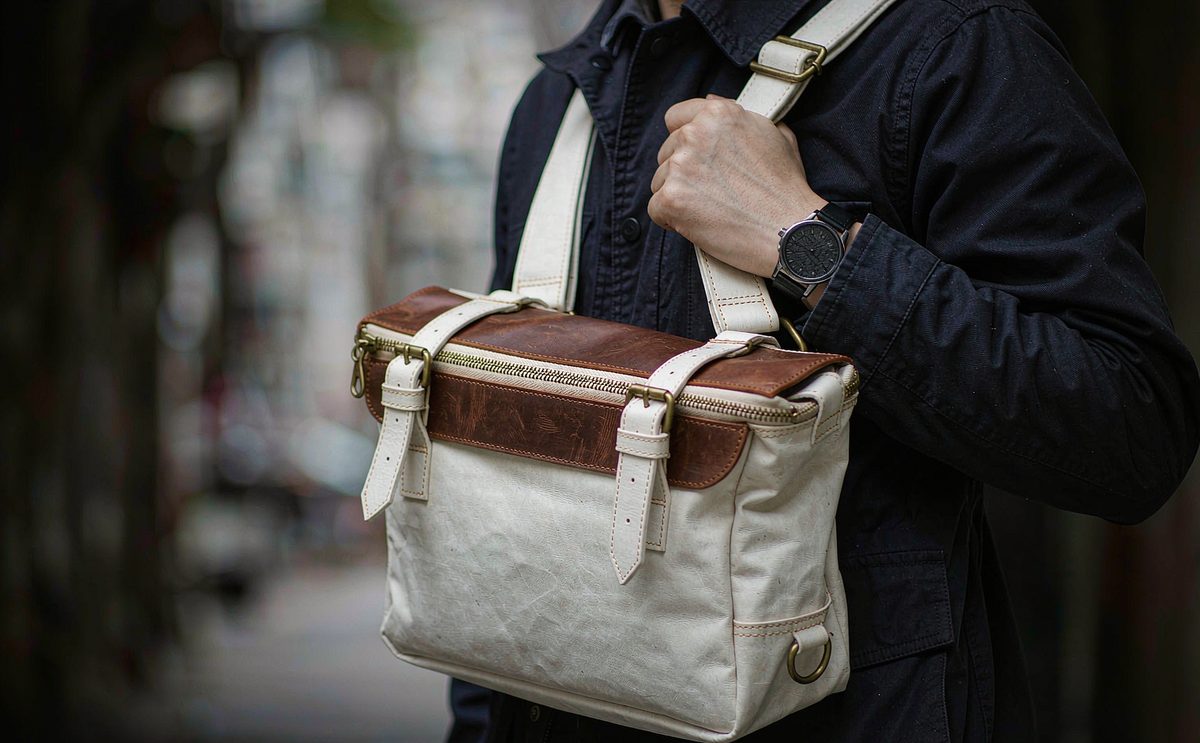
- Minimum order quantity
- 500 pcs per style / colourway
- Sampling
- 6-10 working days (12-15 for complex builds)
- Bulk production
- 35-50 days after deposit + approved pre-production sample
- Inspection
- AQL 2.5 to ISO 2859-1
- Trade term
- FOB Xiamen
- Payment
- T/T 30/70
- Production floor
- 4,950 m² SGS-verified, 137 staff, 7 lines, 149 machines
- Monthly capacity
- 200,000 pcs per month
- Programme contact
- service@junyuanbags.com
Key takeaways before you spec a messenger bag
- Size the body from the intended carry volume, then check it against the largest laptop compartment you promise.
- MOQ is 500 pcs per style and colourway; a two-size range is normally two separate commitments.
- Structure comes from interlining and a base board, not from a heavier face fabric.
- Hardware is the largest single defect class here, so specify the buckle by gauge and cycle rating.
What a messenger bag has to survive in a commute programme
A messenger bag sits in a specific place in a reward line-up: the format a backer chooses when they want more organisation than a tote and faster access than a backpack, which makes it the natural second SKU behind a custom backpack. It carries an asymmetric load on one shoulder, is opened and closed dozens of times a day, and is thrown onto a desk rather than placed. Those behaviours drive every specification decision.
It is also a medium-complexity build: a body, a flap, a lining, an interlining set, a strap assembly and a hardware family. That is more operations than a pouch and fewer than a technical backpack, which puts it in the band where a first-time creator can still recover from a specification error without losing the delivery window. Structure, not fabric weight, is what makes the bag look expensive in photography.
Sizing the body around a real carry load
Sizing starts from volume, not from appearance. A day-carry messenger that holds a tablet, a notebook and a charger needs roughly 8-12 litres. Adding a 14-inch laptop and a lunch box takes it to 13-16 litres. A 15 to 16 inch laptop plus documents and a water bottle lands at 17-22 litres. Beyond 23 litres the format stops being a messenger and starts competing with a courier bag, which is a heavier, more structured and more expensive product to build.
Translate volume into a body pattern by fixing two of the three dimensions and solving the third. A body of 40 x 30 x 12 cm gives 14.4 litres and is the everyday default; 42 x 32 x 14 cm gives 18.8 litres and suits a 16-inch device. Depth matters more than height here, because a bag that is too shallow will not close once loaded, while one 2 cm too tall simply looks generous.
| Use case | Body size (cm) | Volume | Unit weight |
|---|---|---|---|
| Tablet and notebook day carry | 36 x 26 x 9 | 8 - 9 L | 480 - 620 g |
| 13 to 14 inch laptop, everyday | 40 x 30 x 12 | 14 - 15 L | 620 - 780 g |
| 15 to 16 inch laptop plus documents | 42 x 32 x 14 | 18 - 19 L | 760 - 950 g |
| Courier format, bulky load | 45 x 34 x 16 | 24 - 25 L | 980 - 1,250 g |
- Fix the largest device compartment first, then size the body around it plus 15-20 mm of padding.
- State external dimensions with a +/- 8 mm tolerance; fabric patterns do not hold to the millimetre.
- Check the rolled-flap height against the body so the closure lands where the pattern says it will.
- Keep depth above 9 cm or the flap will not close over a loaded front pocket.
Shell, lining and interlining: where structure comes from
The most expensive mistake on this format is trying to buy structure with a heavier face fabric. A 1680D ballistic shell feels stiff in the hand and still slumps on the shoulder, because shape is held by what sits behind the shell. Structure comes from an interlining package: 3-5 mm EPE or EVA on the back panel, a polyethylene board in the base, and a lighter interlining on the front panel.
The lining carries the second half of the specification. A 210D polyester lining in a light colour is standard and improves internal visibility, while a ripstop lining resists punctures from keys and umbrella tips. Take the shell and lining from one material customisation shortlist so a single shade approval covers the whole run.
The flap, the closure and the hardware specification
The flap is the visual signature of the product and the largest single defect surface on it. It is a shaped panel, usually extending 60-90 mm below the closure line, and it has to sit flat against the body with no gap when the bag is loaded. That behaviour is controlled by a stiffener inside the flap and by the position of the closure relative to the flap edge. Specify the stiffener as a component with its own thickness, because an unstiffened flap curls at the corners within weeks.
| Closure | Cost index | Defect risk | Perceived value | Best for |
|---|---|---|---|---|
| Hook and loop under flap | 1.00 | Low | Low to medium | Value tiers, quiet access |
| Side-release buckle, 25 mm | 1.15 | Medium | Medium | Standard everyday messenger |
| Side-release buckle, 38 mm | 1.25 | Medium | Medium-high | Larger and courier formats |
| Magnetic snap plus zip under flap | 1.45 | Medium | High | Premium commute tiers |
| Cam buckle with webbing tail | 1.20 | Low | Medium-high | Adjustable, heritage styling |
Hardware deserves its own line in the RFQ because it is where the defect list concentrates. Specify the buckle by gauge and by material, either POM or a zinc alloy, and ask for a cycle rating and a pull figure rather than accepting a generic description. A 25 mm buckle that survives 500 open-close cycles and holds a 25 kg static pull will cost marginally more than one with no rating, and it removes the single most common cause of a mid-campaign replacement request.
- Specify every buckle, D-ring and tri-glide by gauge, material, finish and colour reference.
- Ask for a cycle rating and a static pull figure on load-bearing hardware, not a catalogue description.
- Require a bar-tack at every webbing-to-body attachment; that is where straps detach.
- Keep hardware finishes consistent across the programme so replacement units match earlier shipments.
Strap, harness and load comfort
A messenger bag is carried on one shoulder, which means the strap does more work than on any two-strap format. The default is 38 mm webbing, moving to 50 mm on courier sizes, adjustable across a 0.8-1.4 m range so the bag sits at the hip rather than bouncing against it. The shoulder pad is the part backers notice: 200-250 mm long, 80-100 mm wide, with 6-8 mm of foam and a non-slip backing that stops the pad migrating forward under load.
One addition materially changes the carrying experience at very little cost. A detachable stabiliser strap running under the opposite arm stops the bag swinging when the wearer walks quickly or cycles, and it is a single webbing assembly with one buckle. Give it its own attachment reinforcement, because a strap that tears out at the anchor is worse than none at all.
Ask for a static pull test on the strap-to-body attachment at 25 kg held for 60 seconds, and repeat it after a 500-cycle load test. The failure point on a messenger bag is almost never the webbing; it is the stitching that anchors the webbing to the body. A box-X stitch plus a bar-tack at the anchor removes most of that risk.
Interior organisation and the laptop compartment
The laptop compartment is the specification backers read first and complain about most. Two rules cover it. First, the divider should be suspended, meaning the bottom of the sleeve sits 15-25 mm above the base of the bag, so a drop does not drive the device corner into the ground through the base. Second, the compartment should be sized to the device plus 10-15 mm of padding, not to the nominal diagonal, using the same logic as a custom laptop bag.
Everything else in the interior should be justified by the campaign story rather than by a feature list. Two slip pockets, a pen slot pair and a key leash cover most everyday needs, and a zip pocket under the flap is the only secure interior storage on the format.
Branding placement on a messenger flap
The flap is the largest uninterrupted branding surface on the product, which makes it the natural home for a logo and the worst place to put a large print. A flap bends along a fold line every time the bag is opened, and a print block that crosses that line cracks. Keep the mark inside the flat centre of the flap, clear of the fold by at least 20 mm, and cap the block at roughly 25% of the visible flap area.
The alternative that outperforms print here is a woven label or a debossed PU patch on the flap edge or front pocket, because both survive abrasion from a desk surface. Where embroidery is the brand requirement, it needs a stable panel behind it, so the pocket or flap needs interlining it would not otherwise require. The method comparison sits on our print and embroidery page.
The body, the flap and the strap webbing are frequently cut from different dye lots. Require a shade-band approval covering all three and make it an inspection criterion at AQL 2.5. A flap that is visibly a different black from the body is the defect most often photographed in a campaign comment thread.
Packing, carton yield and freight behaviour
Messenger bags do not fold flat, which makes them more expensive to ship per unit than a pouch or a sleeve. Packed with the flap folded over and the strap coiled, a 14-litre messenger occupies roughly 0.004 m3 per unit. Twenty units fill a 60 x 40 x 40 cm carton at 0.096 m3, or 16.0 kg of volumetric weight at the 6,000 divisor, against an actual gross mass near 17 kg. Weight governs, but only just.
- Pack 18-25 units per export carton, flap folded over and strap coiled into the body.
- Use a double-wall carton; messenger cartons are bulky and get stacked high in a container.
- Individual polybagging adds roughly 0.06-0.10 USD per unit and protects the hardware finish.
- Our rewards fulfilment page covers the packing specification format we ask for.
QC gates specific to messenger bags
Pre-shipment inspection runs at AQL 2.5 to ISO 2859-1, general inspection level II, single sampling plan. Critical is a strap attachment that fails a pull test or a buckle that will not latch. Major is flap misalignment over 5 mm, an out-of-tolerance laptop compartment, a hardware finish defect or a visible shade mismatch. Minor is a loose thread or a crease that relaxes out.
- Confirm carton count, packing list and shipping marks before any carton is opened.
- Measure external dimensions on three units per drawn carton against the stated tolerance.
- Cycle every buckle and magnetic snap a minimum of 20 times and record any failure to latch.
- Pull-test the strap attachment on two units per carton and record the result against the spec figure.
- Check flap-to-body alignment loaded and unloaded, and record any gap over 5 mm.
- Verify the branding coordinate and shade against the approved shade band under standard lighting.
Fabric and seam strength should be verified against a named test rather than by feel. A grab test to ASTM D5034 gives a tensile figure for the shell, and a seam-strength figure on the strap anchor tells you whether the construction will hold. The defect taxonomy we log is set out on the QA and QC page.
Cost breakdown and volume pricing
On a 500 pcs run a structured 600D polyester messenger bag with an interlined back panel, a padded laptop divider, a 25 mm buckle and a coated webbing strap typically quotes in the 6.80 to 14.50 USD ex-works band. The bottom of the band is a hook-and-loop closure on a lighter shell; the top is a waxed canvas or recycled shell with a magnetic closure and branded hardware.
| Quantity | Ex-works unit cost (USD) | What changes |
|---|---|---|
| 500 pcs | 6.80 - 14.50 | Baseline, setup spread over the minimum |
| 1,000 pcs | 6.20 - 13.20 | Better marker yield, setup across 2x units |
| 3,000 pcs | 5.65 - 12.10 | Dedicated line, hardware bought in bulk |
| 5,000 pcs | 5.30 - 11.40 | Material at roll-lot pricing |
| 10,000 pcs | 4.95 - 10.70 | Full-line booking, tooling amortised |
Sampling, compliance and the RFQ checklist
Sampling runs 6-10 working days per round from a released tech pack, extending to 12-15 working days where a custom hardware finish or a waxed canvas shell is involved. Because the format has more operations than a pouch, round one returns a longer revision list, so budget two rounds. production 35-50 days after the 30% deposit under T/T 30/70 has landed and the pre-production sample has been approved in writing.
A messenger bag approved empty on a table tells you almost nothing. Load it with the laptop and the rest of the intended carry, wear it for 30 minutes, and open and close the flap 50 times. Most strap, flap-alignment and closure complaints trace back to a sample that was only ever assessed flat, and a second sampling round costs far less than a re-order.
Compliance follows the destination market rather than the product category. United States shipments fall under California Prop 65 where a listed substance is present above threshold, and CPSIA where the product is intended for children. European Union shipments fall under REACH Annex XVII and the EU GPSR, with OEKO-TEX Standard 100 covering textiles. State the destination in the RFQ so the right shell and hardware finish are quoted. Country-of-origin marking must be applied at the point of manufacture, so it belongs in the tech pack before carton marking is printed.
- External dimensions in centimetres with a tolerance, plus the largest laptop the compartment must hold.
- Shell by denier, weave and coating; lining by denier and finish; interlining by thickness and panel.
- Closure type, hardware by gauge, material, finish and colour reference, with a cycle and pull rating.
- Strap specification: webbing width, adjustment range, pad dimensions and foam thickness.
- Packing specification: pieces per polybag, per inner and per carton, with carton dimensions.
- Quantity per size and colourway against the 500 pcs minimum, and the target delivery month.
- Inspection standard, trade term, destination market and required compliance documentation.
- Custom bags for Kickstarter campaigns
- Custom laptop bags for Kickstarter
- Custom backpacks for Kickstarter
- Material customisation for Kickstarter bags
- Print and embroidery options for custom bags
- Bag manufacturing for campaign creators
- QA, QC and inspection on campaign bag runs
- Request a quotation
Spec a messenger bag that keeps its shape
Send us the carry volume, the laptop compartment size and the hardware direction. As your production partner we will return a unit cost, a sampling estimate and a carton specification. Write to service@junyuanbags.com.
Frequently Asked Questions
What is the MOQ for custom messenger bags on a Kickstarter campaign?
The minimum is 500 pcs per style and per colourway. A two-size range, for example a 14-litre everyday bag and a 19-litre laptop bag, counts as two separate 500 pcs commitments unless both are booked as colourway splits inside one production run.
How large should a messenger bag be for a 16-inch laptop?
A 16-inch laptop measures roughly 35.6 x 24.8 cm, so the compartment needs an internal clear size near 37.5 x 26.5 cm with 10-15 mm of padding. The surrounding body typically lands at 42 x 32 x 14 cm, which is about 18-19 litres and weighs 760-950 g.
How much does a custom messenger bag cost to produce?
On a 500 pcs run a structured 600D polyester messenger with an interlined back panel, a padded laptop divider and a 25 mm buckle typically quotes between 6.80 and 14.50 USD ex-works. At 3,000 pcs the same build usually drops to 5.65 - 12.10 USD.
Which closure is most reliable on a messenger bag flap?
A 25 mm side-release buckle is the everyday default at a cost index of 1.15 and holds up well if a cycle rating is specified. Hook and loop is the quietest and cheapest at 1.00. A magnetic snap with a concealed zip underneath reads premium at 1.45 and adds a second closure if the primary fails.
How do I stop a messenger bag flap from curling at the corners?
Specify a stiffener inside the flap as a separate component with its own thickness, usually 1.5-2.5 mm, and keep the print clear of the fold line by at least 20 mm. An unstiffened flap curls within weeks, and a print crossing the fold line cracks along it.
How long does sampling take for a custom messenger bag?
Sampling runs 6-10 working days per round from a released tech pack, extending to 12-15 working days for a custom hardware finish or a waxed canvas shell. Because the format has more operations than a pouch, budget two rounds, or 12-20 working days of calendar.
What webbing width should the shoulder strap use?
Use 38 mm webbing as the default and move to 50 mm on courier sizes above 23 litres. Pair it with a shoulder pad 200-250 mm long and 80-100 mm wide carrying 6-8 mm of foam, and a non-slip backing, so the pad does not migrate forward under load.
How heavy is a custom messenger bag for freight planning?
A 14-litre messenger typically weighs 620-780 g and a 19-litre version 760-950 g. Packed flat with the strap coiled, about 20 units fill a 60 x 40 x 40 cm carton at 0.096 m3, which is 16.0 kg volumetric against roughly 17 kg actual.
What inspection standard applies to a messenger bag order?
AQL 2.5 to ISO 2859-1 at general inspection level II, single sampling plan. Critical is a strap attachment that fails a pull test or a buckle that will not latch. Major is flap misalignment over 5 mm or a visible shade mismatch. Name the standard in the purchase order.
Can a messenger bag share a production run with a backpack?
Yes, and it is usually the cheapest way to add the SKU. Sharing shell, lining, hardware family and branding means one material purchase order, one shade approval and one consolidated container. Book both inside the same 35-50 day production window rather than as two separate orders.
What compliance applies to messenger bags shipped into the US and EU?
United States shipments fall under California Prop 65 where a listed substance is present above threshold, and CPSIA where the product is intended for children. European Union shipments fall under REACH Annex XVII and the EU GPSR. OEKO-TEX Standard 100 covers textile components.
When does bulk production actually start on a messenger bag order?
production 35-50 days after two conditions are met together: the 30% deposit under T/T 30/70 has landed, and the pre-production sample has been approved in writing. Neither condition alone starts the clock. Get the slot confirmed in writing with a start, completion and inspection date.
People Also Ask
Are messenger bags still a good reward in 2026 campaigns?
Yes, in commute, camera, cycling and EDC programmes where one-shoulder access is part of the story. They underperform in travel campaigns where a backpack or duffel answers the use case more directly for the same pledge level.
What fabric is best for a custom messenger bag?
A PU-coated 600D polyester is the practical default, offering abrasion resistance at a sensible weight. 900D and 1680D add toughness but not structure. Waxed canvas and recycled rPET shells cost roughly 20-40% more and lengthen sampling by a few days.
Should the laptop compartment be suspended inside the bag?
Yes. Suspending the divider so its base sits 15-25 mm above the bag floor means a drop is absorbed by padding rather than driving the device corner into the ground. It adds one operation and prevents the most common damage claim.
Can I use the same hardware across a bag and pouch set?
Yes, and it is worth doing. Specifying one buckle family, one zip family and one finish across the range means a single hardware purchase order, consistent colour matching and a lower risk of a shade mismatch between SKUs.
Do messenger bags count as their own MOQ?
Yes. Each size and colourway is counted separately against the 500 pcs minimum, so a two-size range is normally two commitments. Both can still be produced inside one booked window if they are quoted together at the start.