Custom Bags for Creators: From Idea to Backer Doorstep in 9 Steps
A custom bag reward travels through nine stages between a concept sketch and a parcel on a backer's doorstep. Two of them consume most of the calendar: sampling at 6-10 working days per round, and production 35-50 days after the deposit and the approved pre-production sample. The minimum is 500 pcs per style and colourway, inspection runs at AQL 2.5 to ISO 2859-1, and the handover is FOB Xiamen on T/T 30/70. This is the full route, stage by stage, with the gate you must clear at each one.
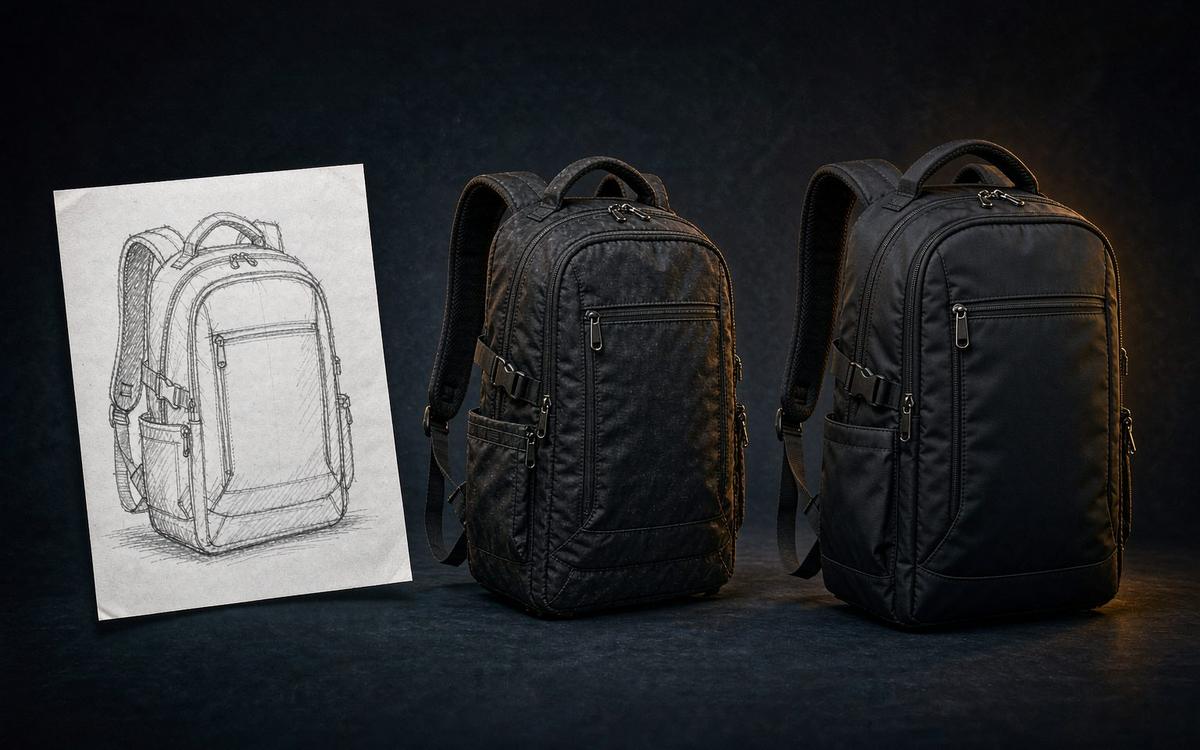
- The nine stages, and where campaigns stall
- Step 1: Define the reward and the number it must hit
- Step 2: Write a tech pack rather than a mood board
- Step 3: Issue the RFQ to a shortlist
- Step 4: Compare quotations on total cost
- Step 5: Sample, revise and re-sample
- Step 6: Approve the pre-production sample
- Step 7: Pay the deposit and run bulk
- Step 8: Inspect, release and ship
- Step 9: Hand over to fulfilment and close the loop
- The owner's calendar: who does what, and when
- Failure points in the gaps between stages
The nine stages, and where campaigns stall
A campaign bag programme is a sequence of nine handovers, and each one has a gate: a document, an approval or a payment that has to exist before the next stage can start. Campaigns rarely fail inside a stage. They fail in the gaps, when a creator assumes a stage has completed because it feels finished, when in fact the gate document was never issued.
The two gates that cause most slippage are the tech pack and the pre-production sample approval. Without a written tech pack, sampling is guesswork and the first quotation is a range. Without a countersigned pre-production sample, the production clock has not started, no matter how much money has been raised. Both gates are cheap to satisfy and expensive to skip.
| Stage | What happens | Indicative duration | Gate to clear |
|---|---|---|---|
| 1. Reward definition | Bag type, dimensions, target quantity, pledge price modelled | 6-10 working days | Written brief with a target landed cost |
| 2. Tech pack | Dimensions, materials, hardware, stitch, branding, packaging specified | 6-10 working days | Countersigned specification |
| 3. RFQ | Brief sent to a shortlist, fabric and hardware options returned | 2-5 days | Option list and unit cost band |
| 4. Quotation | Unit cost at 500, 1,000 and 2,000 pcs with fixed lines identified | 1-5 days | Three-tier cost accepted in principle |
| 5. Sampling | Prototype built, reviewed, marked up and rebuilt | 6-10 working days per round | Fit, function and branding approved |
| 6. Pre-production approval | Gold sample locks construction and materials | 1-3 days | Signed approval, spec frozen |
| 7. Bulk production | Cutting, printing, sewing, assembly, finishing, packing | 35-50 days | Deposit received and sample approved |
| 8. Inspection and release | Pre-shipment inspection, documentation, port handover | 6-10 working days | AQL 2.5 report issued and cartons released |
| 9. Fulfilment | Transit, customs, warehouse, pick and pack, outbound parcel | 30-60 days | Delivery confirmation and reserve stock held |
Read the duration column as a total, not as a promise. Stage five is quoted per round and most campaigns need two. Stage seven starts only when both of its gate conditions are met. Stage nine is outside the production side entirely and depends on the mode and destination the creator chooses. Add the stages and a realistic programme runs 120-190 days from brief to delivered parcel.
- Minimum order quantity
- 500 pcs per style / colourway
- Sampling
- 6-10 working days (12-15 for complex builds)
- Bulk production
- 35-50 days after deposit + approved pre-production sample
- Inspection
- AQL 2.5 to ISO 2859-1
- Trade term
- FOB Xiamen
- Payment
- T/T 30/70
- Facility
- 4,950 m² SGS-verified floor, 137 staff, 7 lines, 149 machines
- Capacity
- 200,000 pcs per month
- Experience
- 20+ crowdfunding campaigns supported
Step 1: Define the reward and the number it must hit
The first stage is not design. It is arithmetic dressed as design: choose a bag type and a size, then decide the landed cost the pledge has to defend. Without that number, every later decision becomes an aesthetic argument with no way to resolve it, and campaigns resolve those arguments by spending money.
Write down five things at this stage. Bag category and rough capacity. The pledge tier it sits in. The landed cost ceiling. The launch month. And the destination markets, because compliance and freight both follow from that. Five lines on one page is enough to start a serious conversation with a production partner, and it is more than most campaigns have when they first make contact.
The destination market question is worth more attention than it gets. A reward shipping into the European Union needs EU GPSR documentation; one shipping to California needs a Prop 65 position; one aimed at students or children needs CPSIA awareness. Those are not afterthoughts to be handled at the port, they are specification constraints that affect material selection at stage two.
Step 2: Write a tech pack rather than a mood board
A tech pack converts an intention into a specification. It is the document every later stage refers back to, and it is the reference against which the sample is checked and the inspection is judged. A mood board does none of those things, which is why campaigns that skip this stage end up arguing about whether the delivered product matches what was promised.
- External dimensions in centimetres, plus the internal clear dimension of any device compartment.
- Shell fabric with denier and coating, for example 600D polyester with PU backing, and the lining specification.
- Hardware by type and size: zip chain gauge and brand tier, buckle break strength, webbing width, hardware finish.
- Construction notes: panel count, seam type, reinforcement and bar-tack positions, binding or taping.
- Branding method and placement, with artwork format and colour count, because screens are charged per colour per placement.
- Packaging format: polybag, hangtag, carton specification, and whether the unit ships flat or assembled.
- Labelling and compliance markings required by the destination market.
Where a property matters, state it as a measurable figure rather than an adjective. Hydrostatic head instead of waterproof. Break strength instead of strong. Internal clear dimensions instead of fits a 16-inch laptop. Adjectives cannot be inspected; figures can, and the inspection at stage eight will rely on whatever this document says. Our sampling and prototyping page sets out the revision loop this document drives.
Key takeaways for the early stages
- Stage one is arithmetic: pick the bag type, then the landed cost the pledge must defend.
- A tech pack states measurable properties, not adjectives, because adjectives cannot be inspected.
- Destination market decided at stage one determines compliance and material choices at stage two.
- Five lines start an RFQ: category, pledge tier, cost ceiling, launch month, destination.
Step 3: Issue the RFQ to a shortlist
Send the brief to two or three parties rather than ten. A shortlist of two or three produces comparable quotations inside a week; a list of ten produces ten rounds of clarification and a slower decision. The purpose of the RFQ is not to run an auction. It is to establish which party can answer the operational questions and which is guessing.
Ask the same five operational questions of each. What is the minimum per style and per colourway? How many working days to a physical sample, and does that count from approved artwork? Which inspection standard applies, and is a report issued? What Incoterm and what deposit structure? And what is the verifiable capacity behind the promise? A party that answers all five with specifics is measurably easier to hold to a date.
Attach the pledge ladder. A quotation that can be tested against a published price is worth substantially more than one that cannot, because it lets the production side tell you at stage four whether the concept is viable rather than at stage seven when the fabric is already cut.
Step 4: Compare quotations on total cost
Two quotations can show the same unit price and completely different total cost, because the unit price excludes one-off charges. Compare on total programme cost at the committed volume, with fixed lines listed separately from volume-sensitive ones. Ask each party to identify which lines will not be charged again on a re-order.
| Comparison item | Why it distorts a unit-price comparison | What to request |
|---|---|---|
| Minimum basis | A price quoted at 1,000 pcs is not comparable to one at 500 | Quote at 500, 1,000 and 2,000 pcs from every party |
| Tooling included or excluded | Custom hardware tooling can add USD 300-2,500 | One-off lines listed separately from unit price |
| Sampling charges | Priced per round; most campaigns need two | Cost per round including courier |
| Branding set-up | Charged per colour per placement | Number of placements and colours confirmed in writing |
| Inspection included | Some quotes exclude inspection entirely | State AQL 2.5 to ISO 2859-1 with a report |
| Trade term | FOB and DDP numbers are not comparable | Normalise to FOB Xiamen before comparing |
| Payment structure | Deposit size affects cash, not unit cost | Confirm T/T 30/70 and the deposit month |
Once the numbers are normalised, the decision usually stops being close. The remaining differentiators are the ones that do not appear in a price at all: whether the sampling window is stated in working days, whether capacity is verifiable, and whether the party has supported crowdfunding programmes before and understands what a published delivery date means. We have supported 20+ campaigns, and the pattern is consistent — the cheapest quotation is rarely the one that delivers on the published date.
Step 5: Sample, revise and re-sample
Sampling runs 6-10 working days for standard constructions and 12-15 working days for complex builds with custom hardware, welded seams or multi-panel print. The count starts from approved artwork and a settled tech pack, and it excludes courier transit in both directions. Budget two rounds: the first settles structure and panel layout, the second settles colour and branding placement.
- Material and hardware confirmation. Fabric lot, zip chain, webbing and labels confirmed available, or substituted with a documented equivalent.
- Pattern and first build. Cut and sewn on the line that will run bulk, not in a sample room that never touches the order again.
- Internal check and photography. Dimensions checked against the tech pack and photographed under neutral light before dispatch.
- Creator review. Fit, function, hand-feel and print placement assessed against the written specification.
- Mark-up as a revision. Changes documented as a written revision, not as a phone call or a chat message.
- Second build if needed. Most campaigns need it; the first round rarely lands colour and branding together.
- Photography for the campaign page. Shoot the approved sample in use, then shoot the packed carton for expectation-setting.
Use the sample for more than approval. It is the object the campaign page is photographed from, it is the reference the pre-shipment inspection will be judged against, and it is the physical proof that converts a sceptical backer. A sample that exists before the page is written is the single highest-return investment in the pre-launch calendar.
Step 6: Approve the pre-production sample
The pre-production sample, sometimes called the gold sample, is the unit that locks construction, materials and branding. Once it is countersigned, the specification is frozen and any subsequent change carries both a cost and a calendar impact. This is the gate that most campaigns treat casually and later regret.
Approve it against the tech pack line by line, not against your impression of it. Check external dimensions, internal compartment dimensions, fabric hand and colour under daylight, zip action under load, bar-tack density at every strap attachment, print registration, and the packed carton. Photograph the approved unit and keep the photographs, because they become the reference if there is a dispute at inspection.
Approval freezes the specification. A change requested afterwards arrives after fabric has been bought or cut, which is the most expensive moment in the whole programme to change anything. Decide colour, branding placement and hardware finish during the sampling rounds, and treat the approval signature as the point of no return.
Step 7: Pay the deposit and run bulk
production 35-50 days, and the window opens on two conditions being met together: the 30% deposit has been received and the pre-production sample has been approved. Payment terms are T/T 30/70, with the balance due against shipping documents. Funding alone does not open the window, and this is the misunderstanding behind a large share of late crowdfunding deliveries.
Inside the window sit fabric and trim procurement, cutting, printing or embroidery, sewing, assembly, in-line checks, finishing and packing. Complex constructions with welded seams, moulded components or multi-colour print sit at the top of the range; a flat-pack tote with a single print sits near the bottom. Transit to port and onward freight sit outside it entirely and must not be folded into the date you publish.
Ask for a milestone update schedule at the start of the run: cutting complete, first units off the line, mid-run check, finishing and packing. Four dated checkpoints turn a 35-50 day silence into four opportunities to correct course, and they give you something factual to put in a campaign update instead of reassurance.
Step 8: Inspect, release and ship
Pre-shipment inspection runs at AQL 2.5 under ISO 2859-1. An inspector draws a statistically determined sample from finished cartons, classifies defects as critical, major or minor against tolerances agreed before the run, and the shipment either passes or is reworked before release. The deliverable is not the pass result; it is the written report.
- Defect classification agreed in advance, so critical, major and minor mean the same thing to both sides.
- Carton count and packing check, including any per-unit numbering on a limited edition.
- Functional checks: zip action, buckle release, strap attachment, compartment dimensions.
- Appearance checks under consistent light: print registration, colour consistency, seam alignment.
- Documentation check: labelling, compliance markings, hangtag and carton marking.
That report is what you quote in a campaign update. Naming the standard, the sample size and the defect count is far more persuasive than promising quality, and it is the difference between a backer who trusts the next update and one who does not. Full detail on how the checks are evidenced sits in kickstarter campaign bag QA and QC.
Release then happens on FOB Xiamen terms: goods delivered export-cleared to the port, from which your nominated forwarder takes responsibility. The 70% balance is paid against shipping documents at this point, so the cash forecast has to place that payment in the right month.
Step 9: Hand over to fulfilment and close the loop
The final stage is freight, customs, warehouse receipt, pick and pack, and the outbound parcel. Ocean transit typically runs 30-45 days; air runs 7-12 at three to five times the cost per kilogram. Decide the mode before the campaign launches, because it determines the delivery date that appears on the page.
Hold back the replacement reserve at this stage rather than shipping everything out. A reserve of 3-5% of units, retained at the fulfilment warehouse, covers transit damage and backer-reported faults without turning every complaint into a refund. It is much cheaper to hold units than to re-run a 500-piece minimum later.
Then close the loop with the production side. Confirm what the re-order price would be on the approved spec, which lines would not be charged again, and how quickly a repeat run could be scheduled. A campaign that ends with a documented re-order position has converted a one-off reward into a repeatable product line. Coordinate the whole of this stage with your rewards fulfilment partner before the pre-production sample is signed.
The owner's calendar: who does what, and when
Every stage has an owner, and the owner is not always the creator. Confusion about ownership is what turns a two-week stage into a five-week one, usually because both sides assumed the other had issued the gate document. Assign ownership explicitly at the start of the programme.
| Stage | Creator owns | Production side owns | Closing document |
|---|---|---|---|
| 1. Reward definition | Category, pledge, cost ceiling | Feasibility feedback on the concept | Written brief |
| 2. Tech pack | Design intent and artwork | Construction and material input | Countersigned specification |
| 3. RFQ | Shortlist and brief distribution | Operational answers and options | Option list |
| 4. Quotation | Acceptance decision | Three-tier cost with fixed lines | Accepted cost band |
| 5. Sampling | Review and mark-up | Build, photography, dispatch | Revision notes |
| 6. Approval | Signature on the gold sample | Freeze of specification | Approved sample record |
| 7. Bulk run | Deposit payment and milestone review | Production and in-line checks | Milestone updates |
| 8. Inspection | Acceptance of the report | Inspection and carton release | AQL 2.5 report |
| 9. Fulfilment | Forwarder and warehouse appointment | Export documentation to FOB Xiamen | Delivery confirmations |
Failure points in the gaps between stages
The stages themselves are well understood. The failures happen between them, in the handovers where a document should exist and does not. Six gaps account for most programme slippage.
- Brief to tech pack. Design intent never becomes a written specification, so sampling begins on assumptions and needs a third round.
- Tech pack to RFQ. The brief goes out without the pledge ladder, so the cost cannot be tested against the price that will be published.
- Quotation to sampling. One-off lines were never itemised, so tooling cost appears as a surprise after artwork is finished.
- Sampling to approval. Only one round was budgeted, so the second round compresses the pre-launch calendar by two to three weeks.
- Approval to bulk. The deposit was not inside the funding target, so the production window opens weeks after the campaign closes.
- Bulk to fulfilment. No forwarder was appointed, so finished cartons wait at port while transit time that was never budgeted is added to the delivery promise.
A seventh gap deserves mention because it stays invisible until the last stage: no re-order position was agreed. Without a documented unit price at 1,000 and 2,000 pcs on the approved specification, the campaign ends with a delivered product and no repeat economics, and the second run has to be quoted from scratch. Every one of those gaps is closed by a document or a decision, not by more money. Write the tech pack, send the pledge ladder, itemise the one-off lines, budget two sampling rounds, fund the deposit, and appoint the forwarder before launch. Do those six things and the nine stages run close to their stated durations.
To start the sequence, send the stage-one brief through the quote request form. If the concept is still at the category stage, begin with custom bag categories to see which formats are already proven, and read the crowdfunding bag guide for how reward claims map to documentation.
Two decisions compress the calendar more than anything else: fund the deposit inside the funding target, and appoint a freight forwarder before launch. Together they remove the two gaps that most commonly turn a 35-50 day production window into a 120-day delivery.
- Custom Bags for Kickstarter — campaign sourcing hub
- Custom bag categories and reward formats
- Sampling and prototyping programme
- Kickstarter campaign bag QA and QC
- Crowdfunding rewards fulfilment planning
- Low MOQ bag production for creators
- Request a campaign bag quotation
- More campaign sourcing articles
Start stage one today
Send bag type, target quantity, launch month and the pledge you intend to publish. You receive feasibility feedback, fabric options and a three-tier cost band within one business day.
Frequently Asked Questions
How long does a custom bag programme take from idea to delivery?
Realistically 120-190 days. Nine stages sit inside that: about 6-10 working days on reward definition, 7-14 on the tech pack, 2-5 on the RFQ, 6-10 working days per sampling round with two rounds typical, 35-50 days of production 35-50 days on inspection and release, and 30-60 days of transit and fulfilment.
What is the minimum order for a first campaign bag run?
500 pcs per style and per colourway. That figure is where fabric, hardware and print set-up stop dominating unit cost, and it produces a spec that can be re-ordered later without repeating tooling or sampling charges. Accessory items sharing the same fabric lot can often be folded into the same run.
How many sampling rounds should a campaign budget for?
Two. The first settles structure and panel layout; the second settles colour and branding placement. Each round runs 6-10 working days for standard builds and 12-15 for complex ones, counted from approved artwork and excluding courier transit. Budgeting one round is the most common scheduling error in campaign bag work.
What starts the bulk production clock?
Two conditions together: the 30% deposit has been received under T/T 30/70 terms, and the pre-production sample has been approved in writing. Funding alone does not start it. Campaigns that treat campaign close as the start date publish delivery dates their own production schedule cannot support.
Which document matters most in the whole programme?
The tech pack. It is the reference the sample is checked against, the basis of the quotation, and the standard the pre-shipment inspection is judged by. State properties as measurable figures such as denier, hydrostatic head and break strength rather than adjectives, because adjectives cannot be inspected.
How should a creator compare two bag quotations?
Normalise them first. Request unit cost at 500, 1,000 and 2,000 pcs from every party, list tooling, sampling and branding set-up separately, confirm inspection is included, and convert everything to FOB Xiamen before comparing. Two identical unit prices can hide very different total programme costs.
What happens at the pre-production sample approval?
The specification is frozen. Construction, materials and branding are locked, and any later change arrives after fabric has been bought or cut, which is the most expensive moment in the programme to alter anything. Photograph the approved unit and keep the images as the inspection reference.
What does an AQL 2.5 inspection actually check?
A statistically determined sample is drawn from finished cartons under ISO 2859-1 and defects are classified as critical, major or minor against tolerances agreed before the run. Carton count, packing, zip action, strap attachment, compartment dimensions, print registration and labelling are all checked, and a written report is issued.
Who is responsible for freight after production?
On FOB Xiamen terms the goods are delivered export-cleared to the port and the creator's nominated forwarder takes over from there. Appointing that forwarder before launch removes one of the six common gaps that delay crowdfunding deliveries.
How much stock should be held back for replacements?
Around 3-5% of units, retained at the fulfilment warehouse rather than shipped out. It covers transit damage and backer-reported faults without converting every complaint into a refund. Holding units is far cheaper than re-running a 500-pcs minimum later.
Can a campaign re-order after the first run?
Yes, and it is where campaign margin is usually recovered. A re-order on an approved spec needs no second sampling cycle and no repeat charge on tooling, print screens or embroidery digitisation, which is typically worth 8-15% of unit cost before any volume discount.
What causes the biggest delays between stages?
Six gaps: no written tech pack, no pledge ladder in the RFQ, un-itemised one-off costs, one sampling round budgeted instead of two, a deposit not funded inside the target, and no forwarder appointed before launch. All six are closed by a document or a decision rather than by spending more.
Should compliance testing happen during sampling?
Yes. Testing is priced per material per standard and takes calendar time, so a report requested in the final production week is a risk with no mitigation. Book CPSIA, REACH, Prop 65, OEKO-TEX Standard 100 or GRS as the destination market requires, while the first sample is being reviewed.
How many parties should be on the RFQ shortlist?
Two or three. That produces comparable quotations within a week and keeps clarification manageable. A list of ten slows the decision without improving it. Ask each the same five operational questions about minimum, sampling window, inspection standard, trade terms and verifiable capacity.
People Also Ask
What is the process for making a custom bag for a crowdfunding campaign?
Nine stages: define the reward and its cost ceiling, write a tech pack, issue an RFQ, compare quotations on total cost, sample twice, approve the gold sample, pay the deposit and run bulk, inspect at AQL 2.5, then hand over to fulfilment.
How long does bulk production take for campaign bags?
35-50 days, and only from the moment the 30% deposit has cleared and the pre-production sample has been approved. Transit and fulfilment are additional, so a realistic delivery promise adds 30-60 days on top.
Do I need a technical drawing before requesting a quote?
Not a CAD drawing, but you do need a written specification: dimensions, fabric denier, hardware sizes, branding placement and packaging. Without it the first quotation is a range rather than a cost you can plan with.
What is a pre-production or gold sample?
The approved unit that freezes construction, materials and branding. Signing it starts the production clock and marks the point after which specification changes become expensive, because fabric has usually been bought or cut by then.
Who arranges shipping for backer rewards?
On FOB Xiamen terms the creator's nominated forwarder takes over at the port. Appoint that forwarder before launch, because finished cartons waiting at port is one of the most common causes of late crowdfunding delivery.