Custom Bags for Crowdfunding Campaigns: Timeline From Mockup to Mass Production
How long does a custom bag take to move from mockup to mass production on a crowdfunding campaign? The working answer is 12-16 weeks end to end: 6-10 working days for sampling, 12-15 working days for complex builds, then 35-50 days of bulk production after the deposit and the approved pre-production sample. Add inspection at AQL 2.5 to ISO 2859-1, FOB Xiamen loading and ocean or air transit, and the calendar fills quickly. This article maps every stage to numbers you can plan a campaign around.
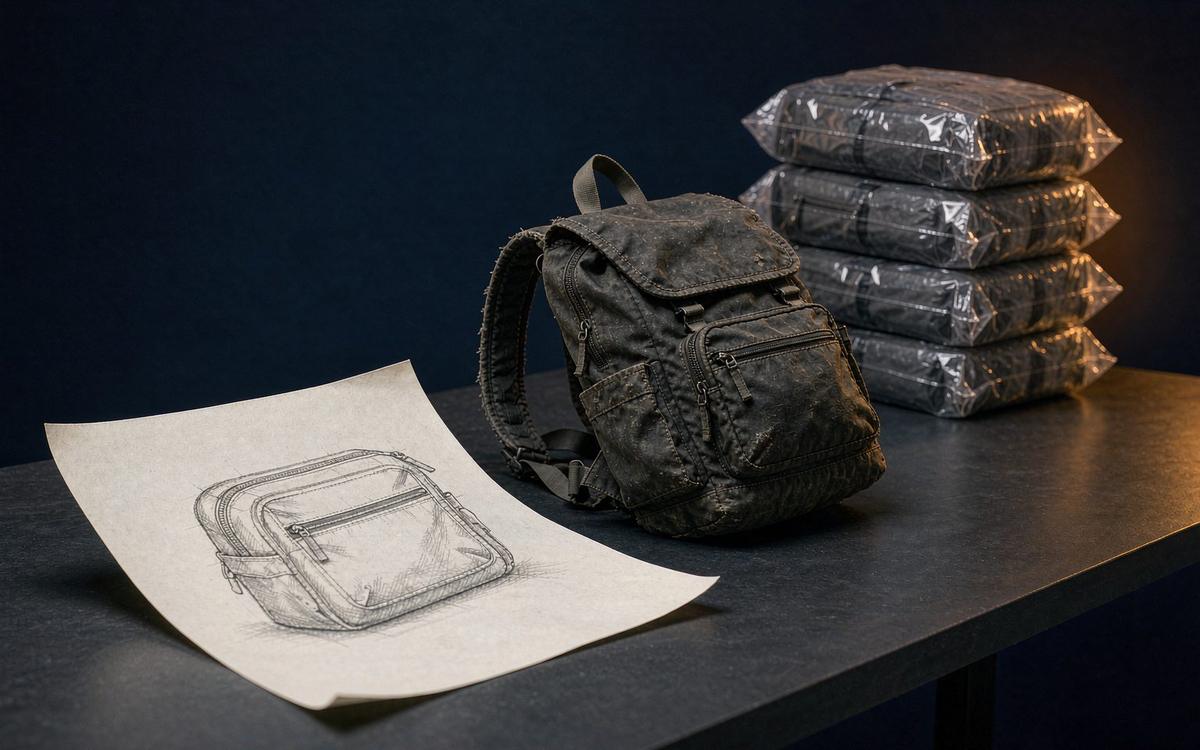
- Why the mockup-to-mass clock starts before the campaign page
- Turning a render into a quote-ready specification
- Inside the 6-10 working days of sampling window
- When sampling stretches to 12-15 working days
- Pre-production approval is what starts the bulk clock
- Anatomy of the 35-50 day bulk production window
- A 120-day reference calendar from artwork to delivery
- Inspection at AQL 2.5 and the release decision
- Freight, trade terms and what FOB Xiamen does to your date
- Payment milestones: how T/T 30/70 maps to the calendar
- Compressing the schedule without breaking the build
- Backwards planning from a published delivery month
- The RFQ pack that starts the clock
Why the mockup-to-mass clock starts before the campaign page
Most creators treat production as something that begins after the campaign funds. It does not. The clock starts the moment a specification is complete enough to be quoted, and everything that happens before that point — material selection, panel count, hardware references, branding method — determines how many days the later stages will consume. A creator who locks a specification eight weeks before launch enters the funding period with a known production window. A creator who locks it after funding discovers the window in public, in campaign updates, while backers count the days.
The practical consequence is that the timeline is a pre-launch asset, not a post-launch chore. Two working rounds of sampling can be completed while the campaign page is still being written, which means the reward photography shows a real unit rather than a render, and the published delivery month rests on a schedule that has already been tested once. Backers fund campaigns that look operationally credible, and an approved sample in hand is the single cheapest credibility signal available.
Below is the full path expressed as a calendar, using the numbers our production team works to on campaign programmes: a 500 pcs minimum per style and colourway, sampling at 6-10 working days, production 35-50 days, inspection at AQL 2.5 to ISO 2859-1, FOB Xiamen, and T/T 30/70 payment terms. The crowdfunding bag guide covers the same path from the design side; this article stays on the calendar.
- Minimum order quantity
- 500 pcs per style / colourway
- Sampling
- 6-10 working days (12-15 for complex builds)
- Bulk production
- 35-50 days after deposit + approved pre-production sample
- Inspection
- AQL 2.5 to ISO 2859-1
- Trade term
- FOB Xiamen
- Payment
- T/T 30/70
- Production floor
- 4,950 m² SGS-verified, 137 staff, 7 lines, 149 machines
- Monthly capacity
- 200,000 pcs per month
- Programme contact
- service@junyuanbags.com
Key takeaways on the production calendar
- Budget 12-16 weeks from a locked specification to backer doorstep on a first run.
- Sampling is 6-10 working days per round; plan two rounds, not one.
- The bulk clock starts on deposit plus approved pre-production sample, not on campaign close.
- Inspection at AQL 2.5 and cargo loading add days after the last unit is sewn.
- Only material readiness and decision speed are compressible; sewing days are not.
Turning a render into a quote-ready specification
A mockup answers what the bag should look like. A tech pack answers what it must be made of, and only the second question produces a quotation and a schedule. The conversion is unglamorous but it is where days are won or lost: every element left undefined in the pack becomes a decision taken later, on the line, by someone who has no authority to change your delivery date. Panels, denier, coating, stitch density, hardware finish, webbing width, zip reference, branding coordinates and carton specification all need to be written down before a sampling slot can be booked.
The specification also fixes the cost drivers that a quotation is built from, and therefore the volume pricing you can plan reward tiers against. A programme coordinator will read a pack and return a unit cost, a sampling estimate and a production window; they cannot return any of the three from a mood board. If you have not written a pack before, the crowdfunding bag sample prototyping page sets out the document section by section.
| Element | What it fixes on the line | Effect on the calendar |
|---|---|---|
| Panel layout and count | Cutting markers, sewing sequence, labour time | High panel counts add 2-4 sampling days |
| Face fabric and denier | Material purchase order and lot reservation | Stock fabric saves 6-10 working days; custom dye adds 15-25 |
| Lining and interlining grade | Structure, hand feel, shape retention | Grade changes mid-sample reset the round |
| Hardware references | Plating, puller tooling, load rating | Custom hardware adds 15-20 days before sewing |
| Branding method and coordinates | Embroidery tape, screen films, heat-transfer dies | Each method adds 3-5 days to round one |
| Carton and packing spec | Packing list, volumetric weight, freight quote | Errors here surface at loading, not in sampling |
- State external and internal dimensions in centimetres, with tolerances, not as a capacity claim alone.
- Name every fabric by denier, weave and coating, and give a reference swatch or supplier code where one exists.
- Pin branding placement to a measured coordinate from a stated seam, not to a photograph.
- Specify stitch type and density for load-bearing seams; this is where warranty claims originate.
- Define the packing unit: pieces per carton, carton dimensions, and whether retail packaging is inserted.
- Write the inspection standard into the pack so it can be quoted, not negotiated later.
Days -34 to -24: the sampling block, day by day
Sampling is not a waiting period, it is a sequence of gates, and knowing which day each gate falls on is what makes the calendar predictable. Below, day 0 is the day bulk production starts, so sampling sits in negative days.
| Day | What happens | Who is waiting on whom |
|---|---|---|
| Day -34 | Brief received, cost band issued, specification drafted | Production team waiting on the creator for the five-line brief |
| Day -33 to -32 | Pattern made, fabric and trim reserved | Pattern room waiting on final fabric GSM and hardware choice |
| Day -31 to -27 | First sample sewn, printed and assembled | Line waiting on approved artwork |
| Day -26 | Photos and measurements sent for review | Creator reviewing; this is the cheapest day to change anything |
| Day -25 to -24 | One revision round, then the reference is frozen | Production team waiting on a single consolidated change list |
The pattern worth noticing is that four of the six rows are waiting on the creator, not on production. Campaigns that lose days inside the sampling window almost always lose them in review, not in sewing — which is why a consolidated change list beats three rounds of incremental comments.
Days -34 to -18: what pushes the sampling block wider
Three things widen the block from six to ten working days to twelve to fifteen, and all three are visible in the brief before a needle moves. Recognising them on day -34 is free; recognising them on day -20 costs the campaign its published date.
- Bonded or welded construction. Every bonded seam needs its own tooling and its own test, which adds days and cannot be compressed by working longer.
- Custom hardware. A moulded pull, a bespoke buckle or a coated zip has a component lead time that sits outside the sewing schedule entirely.
- Multi-material panels. Each additional fabric is another material approval and another cutting marker before assembly can start.
If the brief contains none of those, plan six to ten working days. If it contains two of them, plan twelve to fifteen and put the difference into the published date now rather than into an update later.
Day 0: the gate that starts everything
Nothing in the bulk schedule begins until the pre-production sample is approved in writing and the specification is frozen. That approval is day 0, and every date in this article is counted from it.
| Gate | Evidence required | What happens if it is missing |
|---|---|---|
| Specification frozen | Signed spec sheet with dimensions, tolerances and placement | Bulk cannot be cut; the slot may be lost |
| Pre-production sample approved | A named unit held as the reference, plus written approval | No baseline for the inspection to measure against |
| Artwork released to print | Print-ready files with colour references | Screens cannot be cut, delaying the first printing pass |
| Deposit cleared | Thirty per cent received | Fabric and trim are not released, regardless of approval |
Four gates, all of them administrative, and all of them in the creator’s hands. That is the argument for finishing the paperwork before the campaign closes rather than during the week after.
Days 1 to 45: the bulk window, week by week
Thirty-five to fifty days is a range, not a promise, and the width of the range is decided by how much of the run is standard. Here is what each week inside the window actually contains.
| Week | Activity | What a delay here costs |
|---|---|---|
| Week 1 | Fabric arriving, cutting markers made, first panels cut | A day here is a day off the end, with no recovery |
| Week 2 | Panel preparation, printing and embroidery passes | Print queues are shared; a missed slot waits for the next |
| Week 3 | Assembly begins, sub-assemblies built | Recoverable with overtime, at a cost |
| Week 4-5 | Main assembly, hardware, lining and closing | Partially recoverable |
| Week 6 | Finishing, trimming, cleaning and packing | Not recoverable — packing is the last production operation |
The useful reading of that table is that delays are cheap in the middle and expensive at either end. Protect week 1 and the end of week 6; the middle weeks can absorb more than creators expect.
Days 46 to 50: inspection and the release decision
Inspection happens after packing, which is why it is the last point at which anything can still be changed. The standard is AQL 2.5 under ISO 2859-1: a sample drawn to the lot size, defects classified as critical, major or minor, and accept or reject thresholds that follow the standard rather than anybody’s opinion.
- The inspector draws the sample and classifies what is found.
- A pass releases the shipment and the seventy per cent balance falls due.
- A marginal result goes to rework and re-inspection, which costs three to seven days and is the single most common cause of a missed vessel.
- A fail goes back to the line, and the schedule is renegotiated from day 0 arithmetic rather than patched.
Ask for the report template at quotation stage. A creator reading an AQL report for the first time while a vessel waits is making the expensive decision at the worst possible moment.
Days 51 onward: the leg nobody in the building controls
FOB Xiamen means the goods are yours from the point they are loaded, and the leg that follows is not a production problem. It is also the part of the calendar most campaigns model worst, because they use a transit figure copied from a freight index rather than one quoted for their lane and their season.
- Sea is the default for a 500-pcs run and the slowest to correct.
- Air buys five to ten days door to door and is priced on chargeable weight, which punishes bulky goods.
- Rail, where the lane exists, sits between the two.
- Clearance, duty and the inland leg come after the vessel or flight and are the part creators forget to add.
Add the destination-side days to the production days before you publish anything. The published date is the sum, not the production figure.
Where the money falls on the same calendar
Payment terms are a schedule, not just a price. Thirty per cent on order releases fabric, trim and print screens; seventy per cent falls due against the inspection report and packing record, before the goods are handed to the carrier.
| Day | Event | Money |
|---|---|---|
| Day -34 to -18 | Sampling block | Sampling and courier charges |
| Day 0 | Specification frozen, deposit cleared | Thirty per cent |
| Day 1-7 | Fabric and trim released, screens cut | — |
| Day 8-45 | Cutting, printing, assembly, packing | — |
| Day 46-50 | AQL 2.5 inspection and report | Seventy per cent against the report |
| Day 51+ | Handover to the carrier | Freight, duty and inland leg |
The cash-flow consequence is that the largest single payment falls due roughly when production finishes, not when it starts. A campaign that spent its pledge money on pre-launch marketing without holding the balance back discovers this at the worst possible moment.
A 120-day reference calendar from artwork to delivery
Put the pieces together and one full run — brief to backer — looks like this. Treat it as a reference shape, then substitute your own mode and destination for the last two rows.
| Block | Days | Cumulative |
|---|---|---|
| Brief, quotation and specification | 2 | 2 |
| Sampling, including courier both ways | 14 | 16 |
| Approval gates and deposit | 3 | 19 |
| Bulk production | 45 | 64 |
| Inspection and release | 5 | 69 |
| Sea leg | 30 | 99 |
| Clearance and inland delivery | 10 | 109 |
| Buffer you did not publish | 11 | 120 |
The last row is not padding. Every campaign that publishes a date without a buffer ends up spending it anyway, in the form of an update.
Compressing the schedule without breaking the build
There are exactly four levers that shorten this calendar, and only two of them are free. Everything else is a trade that shows up later as quality, cost or risk.
| Lever | Days saved | What it costs |
|---|---|---|
| Finalising the brief before the campaign closes | 5-10 | Nothing |
| Sending one consolidated change list per review | 3-6 | Nothing but discipline |
| Switching the international leg from sea to air | 15-25 | Air freight on chargeable weight |
| Splitting the run: early-bird tiers by air, balance by sea | 10-20 | Two shipments, two clearances, higher handling |
| Skipping the pre-production sample | 10-14 | The inspection baseline disappears — never worth it |
| Cutting the inspection | 3-5 | You lose the only evidence you have before paying the balance |
The two free levers are both administrative, and between them they are worth more than the freight upgrade most campaigns reach for first. Finish the paperwork early and send one change list per review.
Building the calendar backwards from the month you published
The only reliable way to set a delivery date is to start from the date and work backwards, because the forward version of the plan always assumes everything goes right. Take the published month, subtract the legs in reverse order, and whatever is left is the last day the brief can be finalised.
| Working backwards | Days to subtract | Running total |
|---|---|---|
| Published delivery month | — | Day of delivery |
| Inland delivery and fulfilment | 5-10 | Minus 5-10 |
| Customs clearance and duty handling | 3-7 | Minus 8-17 |
| International leg, sea | 25-40 | Minus 33-57 |
| Inspection and release | 3-7 | Minus 36-64 |
| Bulk production | 35-50 | Minus 71-114 |
| Sampling, complex build | 12-15 | Minus 83-129 |
| Brief and quotation | 1-2 | Minus 84-131 |
Read the bottom row as the real deadline: the brief has to be final roughly three to four months before backers receive anything, and every day of slippage inside the campaign eats into that, not into the end date. That is why the specification is a pre-launch deliverable rather than a post-campaign one.
Where campaigns actually lose the week they did not budget for
Every delayed campaign has a story about a single dramatic event. In practice the week is lost in five unglamorous places, none of which appear in a production schedule because none of them are production events.
- The brief that was never finalised. A specification that is 90 per cent agreed still generates questions, and each question costs a day of sampling.
- Artwork approved in pieces. Print screens cannot be cut until the file is final, so a logo approved after the sample is a sample that waits.
- The colourway added at stretch-goal stage. A second colourway is a second fabric buy, a second print set-up and a second trim order, and none of them were in the original calendar.
- The courier leg on the sample. Three to five days each way, plus customs handling, and it is routinely omitted from the plan.
- The deposit that cleared late. Fabric is released on the deposit, not on the approval, so an unpaid invoice is a stopped calendar.
Four of those five are administrative and free to fix. That is the consistent finding across campaign calendars: the time is not lost in making the bag, it is lost in deciding what the bag is.
Two calendars compared: a standard build and a complex one
The same factory, the same team and the same destination produce two very different calendars depending on how much of the build is standard. This is the comparison to run before publishing a date.
| Block | Standard build | Complex build |
|---|---|---|
| Brief and quotation | 1-2 days | 1-2 days |
| Sampling | 6-10 working days | 12-15 working days |
| Sample courier | 3-5 days each way | 3-5 days each way |
| Approval gates | 2-3 days | 3-5 days, because there is more to approve |
| Bulk production | 35-40 days | 45-50 days |
| Inspection and release | 3-5 days | 5-7 days, rework is more likely |
| Sea leg and clearance | 35-45 days | 35-45 days |
| Total to a backer’s door | About 90-115 days | About 105-135 days |
The difference is roughly three to four weeks, and it is visible in the brief on day one. Decide which column you are in before the campaign page goes live, because the published date cannot be changed cheaply afterwards.
What to publish, and what to keep unpublished
The delivery date on a campaign page is a promise with a legal and reputational edge, and the way to keep it is to publish the month rather than the day and to hold a buffer you never mention.
- Publish the month. "Ships in November" survives a six-day slip; "ships 14 November" does not.
- Hold 10-15 days of buffer inside your own plan and never put it on the page.
- Say what you are waiting on. Backers tolerate a named dependency far better than silence.
- Update early, not late. The update that lands two weeks before the date is read as competence; the one that lands on the date is read as failure.
- Do not promise a date you have not modelled backwards. The bottom row of the backwards table is the earliest honest date, not the earliest hopeful one.
Under-promise on the page and over-deliver in the pledge manager. The reverse is the single fastest way to turn a funded campaign into a refund request.
Where campaigns actually lose the week they did not budget for
Every delayed campaign has a story about a single dramatic event. In practice the week is lost in five unglamorous places, none of which appear in a production schedule because none of them are production events.
- The brief that was never finalised. A specification that is 90 per cent agreed still generates questions, and each question costs a day of sampling.
- Artwork approved in pieces. Print screens cannot be cut until the file is final, so a logo approved after the sample is a sample that waits.
- The colourway added at stretch-goal stage. A second colourway is a second fabric buy, a second print set-up and a second trim order, and none of them were in the original calendar.
- The courier leg on the sample. Three to five days each way, plus customs handling, and it is routinely omitted from the plan.
- The deposit that cleared late. Fabric is released on the deposit, not on the approval, so an unpaid invoice is a stopped calendar.
Four of those five are administrative and free to fix. That is the consistent finding across campaign calendars: the time is not lost in making the bag, it is lost in deciding what the bag is.
Two calendars compared: a standard build and a complex one
The same production team and the same destination produce two very different calendars depending on how much of the build is standard. This is the comparison to run before publishing a date.
| Block | Standard build | Complex build |
|---|---|---|
| Brief and quotation | 1-2 days | 1-2 days |
| Sampling | 6-10 working days | 12-15 working days |
| Sample courier | 3-5 days each way | 3-5 days each way |
| Approval gates | 2-3 days | 3-5 days, because there is more to approve |
| Bulk production | 35-40 days | 45-50 days |
| Inspection and release | 3-5 days | 5-7 days, rework is more likely |
| Sea leg and clearance | 35-45 days | 35-45 days |
| Total to a backer’s door | About 90-115 days | About 105-135 days |
The difference is roughly three to four weeks, and it is visible in the brief on day one. Decide which column you are in before the campaign page goes live, because the published date cannot be changed cheaply afterwards.
What to publish, and what to keep unpublished
The delivery date on a campaign page is a promise with a reputational and, in several markets, a legal edge. The way to keep it is to publish the month rather than the day, and to hold a buffer you never mention.
- Publish the month. A month survives a six-day slip; an exact date does not.
- Hold 10-15 days of buffer inside your own plan and never put it on the page.
- Say what you are waiting on. Backers tolerate a named dependency far better than silence.
- Update early, not late. The update that lands two weeks before the date is read as competence; the one that lands on the date is read as failure.
- Do not promise a date you have not modelled backwards. The bottom row of the backwards table is the earliest honest date, not the earliest hopeful one.
Under-promise on the page and over-deliver in the pledge manager. The reverse is the fastest way to turn a funded campaign into a refund request.
The RFQ pack that starts the clock
The clock in this article starts on day -34, and what starts it is a complete request. Five pieces of information are enough for a cost band, and two more turn a cost band into a schedule.
- Bag type and the features you cannot drop — pockets, size, closures, laptop sleeve, ventilation.
- Quantity per colourway, not just a total, because the 500-pcs minimum applies per style and per colourway.
- Material direction — canvas, nylon, recycled PET, coated polyester, vegan leather.
- Logo method — screen print, heat transfer, embroidery, woven label, metal hardware.
- Dates — campaign close, and the delivery month you intend to publish.
- Destination and fulfilment model, so the freight and clearance days are real rather than assumed.
- Reference images, ideally three: the shape you want, the detail you like, and the colour you are aiming at.
Send those to service@junyuanbags.com or message WhatsApp +86 177 5002 0688 and the reply carries a three-tier unit cost band, the fixed lines identified separately, and the sampling window expressed as dates rather than as a range.
Frequently Asked Questions
How long does it take to go from a bag mockup to mass production?
Plan 12-16 weeks from a locked specification to goods arriving at your fulfilment point. That breaks down as 6-10 working days per sampling round, usually two rounds, 35-50 days of bulk production after deposit and approved pre-production 35-50 days for inspection and packing, then 18-38 days of ocean transit from FOB Xiamen depending on destination.
What is the minimum order quantity for a custom campaign bag?
The minimum is 500 pcs per style and per colourway. That means a backpack offered in black, navy and olive counts as three separate 500 pcs commitments unless it is treated as one colourway split across a single production run. Most creators launch a single hero colourway at 500 pcs and add variants on re-order.
How many sampling rounds should a crowdfunding bag budget for?
Budget two rounds at 6-10 working days each, so 12-20 working days of calendar before the pre-production sample exists. Round one finds construction and proportion issues; round two confirms corrections and becomes the reference unit. A third round is common on structured builds and should be treated as contingency rather than as the plan.
When does the 35-50 day bulk production window actually begin?
It begins when two conditions are met together: the 30% deposit under T/T 30/70 has landed and the pre-production sample has been approved in writing. Neither alone starts the clock. Creators who assume production began on campaign close typically lose two to four weeks to this misunderstanding.
What inspection standard should a bag campaign specify?
AQL 2.5 to ISO 2859-1 at general inspection level II is the standard for reward-grade bag runs. Retail-facing programmes sometimes tighten to AQL 1.5 and simple promotional pouches may accept AQL 4.0, but 2.5 is the default. Name the standard, the level and the defect classes in the purchase order before production starts.
Can the production timeline be shortened for a tight campaign deadline?
Partly. Stock fabrics instead of custom-dyed saves 15-25 days, catalogue hardware instead of custom tooling saves 15-20 days, and answering technical queries within 24 hours keeps the sampling clock moving. Sewing days and inspection cannot be compressed; a build needing 40 days on the line needs 40 days.
What does FOB Xiamen mean for a crowdfunding bag order?
FOB Xiamen means goods are delivered on board the vessel at Xiamen and risk transfers there. Packing, port delivery and loading are handled on our side; ocean freight, insurance, customs clearance and inland delivery to your fulfilment warehouse are yours. Budget 18-30 days transit to the US West Coast and 28-38 days to Northern Europe by sea.
How much is the deposit and when is the balance due?
Payment is T/T 30/70. The 30% deposit falls due when the pre-production sample is approved and releases materials and the production slot. The 70% balance falls due after a passed pre-shipment inspection and before cargo is released for loading. The deposit must sit inside your funding target because it is payable weeks before all pledges settle.
Why does sampling take 12-15 working days on some builds?
Complex builds add steps outside the standard sequence: custom moulded hardware adds 15-20 days before sewing, custom-dyed or laminated fabric adds 15-25 days before cutting, bonded or welded construction adds 4-6 days, and integrated electronics or cable routing adds 5-8 days for assembly and safety checking.
How much production capacity is available for a campaign order?
A 4,950 m² SGS-verified production floor with 137 staff, 7 production lines and 149 machines running at 200,000 pcs per month has ample headroom for a 500 pcs campaign order. That headroom is why a modest order can still be scheduled inside 35-50 days while a much larger booking placed in the same week cannot.
Should sampling be finished before the campaign page goes live?
Yes. Completing two sampling rounds before launch means reward photography shows a real unit rather than a render, the published delivery month rests on a tested schedule, and the pre-production sample exists to approve the moment funding closes. It typically removes four to six weeks from the post-campaign calendar.
What happens if a pre-shipment inspection fails?
A failed inspection at AQL 2.5 triggers rework or re-sorting of the finished run and a second inspection, adding roughly 10-15 days. Agree in advance who pays for re-inspection, and mitigate the risk with an in-line check during the sewing window, when a defect trend is still correctable rather than finished.
People Also Ask
How early should I contact a bag production partner before launching?
Ideally 12-16 weeks before launch. That allows two sampling rounds at 6-10 working days each, a quotation cycle, and a reserved production slot. Contacting at 4-6 weeks still works but usually forces a single sampling round and a render-based campaign page.
Is 500 pcs enough for a first crowdfunding bag run?
For most first campaigns, yes. Five hundred pieces per style and colourway is where unit cost stabilises on a sewn bag, and it typically covers a core reward tier of 300-400 backers plus replacements, press units and retail samples.
Can I add a second colourway after the campaign overfunds?
Yes, but it is a new 500 pcs commitment unless negotiated as a split within one production run. Price the variant during the original RFQ so the re-order is a confirmation rather than a fresh negotiation, and expect it to add days to the window.
Do air freight and sea freight change the inspection timing?
No. Inspection at AQL 2.5 still happens before cargo is released, whichever mode follows. Air freight only compresses the transit leg, typically from 18-30 days by sea to 3-8 days by air, which is why it is used for partial shipments ahead of an event date.
What should I include in a bag RFQ to get an accurate lead time?
Include the tech pack, quantity per style and colourway, target delivery month, destination market, inspection standard, trade term and any stretch-goal variants. Missing material or hardware detail is the most common reason a quoted lead time turns out to be optimistic.