Custom Cosmetic Bag MOQ: What a Beauty Creator Can Order at 500 Pcs
A 500 pcs minimum on a custom cosmetic bag means 500 units of one silhouette in one approved colourway, not 500 units spread across colours. Sampling runs 6 to 10 working days, bulk production 35 to 50 days, and inspection is set at AQL 2.5 to ISO 2859-1. At 500 pcs a wipe-clean pouch typically lands between USD 3.20 and USD 6.80 per unit FOB Xiamen, and a second colourway is a second 500. This guide shows how a beauty creator turns that single number into a reward plan, a budget and a production slot.
- What 500 pcs per style and per colourway actually means
- How far 500 units go across a reward ladder
- Where the 500 floor comes from: fabric, trim and setup
- One colourway or two: the decision that shapes the run
- What you can genuinely customise at 500 pcs
- Unit cost at 500, 1,000 and 2,000 pcs
- Stretch goals and the second production slot
- Sampling before you commit the 500
- Allocating the run: backers, press and buffer
- Writing the RFQ so 500 pcs works in your favour
Most beauty creators arrive at their first sourcing conversation with one number in their head: 500. It is the figure that appears on every kickstarter bag page, and it is the figure that makes a custom reward feel reachable when a campaign is still a pitch video and a prototype. The trouble is that 500 is not one constraint. It is three constraints folded into a single sentence, and the difference between understanding them and assuming them is usually the difference between a reward that ships on schedule and one that gets redesigned in month three. This article unpacks the number from the inside, using the way a custom cosmetic bag programme is actually costed and scheduled.
What 500 pcs per style and per colourway actually means
Read the phrase slowly. 500 pcs per style and per colourway carries two independent multipliers. A style is one silhouette: the panel count, the dimensions, the pocket layout, the closure. A colourway is one approved combination of face fabric colour, lining colour, zip tape colour and hardware finish. If you want the same brush pouch in black and in sand, that is two colourways of one style, and the minimum becomes 1,000 units. If you want a flat pouch and a standing case in the same black fabric, that is two styles, and again the minimum becomes 1,000. Creators rarely budget for this, and it is the single most common reason a first quote comes back roughly double the number they expected.
There is a narrow exception worth knowing about. When two colourways share an identical base fabric and differ only in a trim element, such as zip tape or puller colour, some programmes will accept a split within a combined total, because the fabric purchase is a single lot. That is a negotiated arrangement rather than a published rule, and it depends on the mill lot size, the dye house schedule and how busy the line is. If your campaign genuinely needs two looks, ask about it explicitly rather than assuming. Our sourcing partner will tell you within one exchange whether the split is available for your construction, and what the combined total has to be.
The practical habit is to treat 500 as the price of admission for one fully specified product. Everything else multiplies. A beauty campaign that wants a pouch, a brush roll and a train case across two colour families is looking at six purchase blocks, not one, and should be modelled that way from the first spreadsheet. This is also why the low MOQ bag production route is worth understanding before the reward ladder is locked: the ladder and the minimum are the same decision made twice. The full construction and costing picture for beauty rewards sits in our custom cosmetic bags for Kickstarter guide, and both should be read before a single quote is requested.
One style in one colourway costs you 500 units. Add a colourway or a silhouette and you add another 500, unless the split is negotiated on shared fabric.
How far 500 units go across a reward ladder
The next question is whether 500 is even enough. A beauty campaign with 1,200 backers where the bag appears on two of four tiers will often need 700 to 900 units once the pledge mix settles. Because the survey goes out after the campaign closes, nobody knows the true mix at the point the order has to be placed, which is why the allocation model matters more than the headline backer count. Build the model from three inputs: the number of backers on each tier, the historical rate at which backers upgrade when a physical perk is attached, and the percentage you intend to hold back for replacements and press.
A working example. Suppose 1,000 backers, with a bag on the mid tier at 45 percent uptake and on the top tier at 15 percent uptake, and a bundle tier that adds a second bag at 8 percent. That is 450 plus 150 plus 80, or 680 units, before any buffer. Add a 6 percent replacement and damage allowance and you are at roughly 721. Order 500 and you will be running a second production slot in the middle of fulfilment, at a worse unit price and with a 35 to 50 day lead time sitting between an angry backer and their reward.
| Backer count | Bag tier uptake | Units needed | Buffer at 6% | Order decision |
|---|---|---|---|---|
| 600 backers | 55% single tier | 330 | 350 | 500 pcs run covers it with press stock left over |
| 1,000 backers | 45% + 15% tiers | 600 | 636 | Order 700 if a split is available, otherwise 1,000 |
| 1,800 backers | 40% + 20% + 10% | 1,260 | 1,336 | Order 1,500 across up to three colourways |
| 3,000 backers | 35% across four tiers | 2,100 | 2,226 | Two slots of 1,100 booked together |
The pattern in that table is not really about arithmetic. It is about the shape of the decision. Below roughly 650 units of demand, a 500 pcs run plus a small press allocation is comfortable, and the leftover stock becomes website inventory after fulfilment. Between 650 and 1,000 you are in the awkward band where one run is slightly too small and two colourways are slightly too many, and this is exactly where a negotiated split or a trim-only second colourway earns its keep. Above 1,000 the maths becomes easy again, because two full colourways of 500 plus a third partial one maps cleanly onto a tier ladder.
Where the 500 floor comes from: fabric, trim and setup
Creators often assume a minimum order quantity is an arbitrary policy. It is not. It is the point at which the fixed costs of setting up a run stop dominating the unit price, and those fixed costs are concrete. Start with fabric. A cosmetic pouch consumes roughly 0.25 to 0.40 metres of face fabric plus a similar amount of lining, depending on panel layout and whether the base is gusseted. Mills sell by the lot, and a colour or finish typically carries a lot minimum in the 300 to 500 metre band. Five hundred pouches uses roughly 150 to 200 metres, so the purchase has to be rounded up to the lot and the surplus carried. Below about 400 units that surplus becomes a visible cost per bag.
Trim is the second floor, and it is usually the tighter one. Zip tape is bought by the roll, commonly 200 to 300 metres per colour, and a single pouch might use 0.5 metres of it. Woven labels and printed care labels carry their own minimums, generally 500 to 1,000 pieces per artwork. Elastic brush loops, webbing binding and drawcord come in similar bands. If a design uses a custom metal puller, the plating bath and the polishing setup behave in the same way as the fabric lot: they cost the same whether the bath processes 300 pieces or 3,000.
The third floor is machine and line setup. A pouch line has to be threaded, the pattern laid, the needle gauge and thread changed, and the first articles inspected and signed off. That setup consumes two to four hours of skilled time before a single saleable unit exists. Spread across 300 units it is a meaningful chunk of labour cost. Spread across 500 it becomes tolerable, and across 2,000 it disappears. Our production team runs 7 lines with 149 machines and a monthly capacity of 200,000 pcs, so the constraint is never the building; it is the economics of changeover, and 500 is where that economics turns in your favour.
One colourway or two: the decision that shapes the run
The colourway question is the most consequential decision a beauty creator makes after choosing the silhouette, because it quietly sets the size of the order. Two colourways of 500 each is 1,000 units, and if the campaign only needs 700, the second colourway is 300 units of dead stock sitting in a warehouse after fulfilment. That stock is not worthless, since it can sell on the website afterwards, but it is cash converted into inventory at exactly the moment a campaign needs cash for freight and duty.
There is a smarter version of the same idea. Keep the body fabric in a single colour and vary the elements that carry the visual identity: zip tape, puller, binding, lining and print colour. A black pouch with a gold zip tape and a gold puller reads as a different product from the same black pouch with a rose tape and a rose puller, yet the fabric purchase stays one lot and the run stays at 500. The trim suppliers have lower minimums than the fabric mill, so the variation is cheap. This is the single most useful trick available to a creator working at the 500 pcs entry point.
If you do go to two full colourways, choose them for reasons that will survive contact with backers. Neutral plus accent usually beats two neutrals, because the accent photographs well in campaign updates and gives the upgrade tier something visibly different. Ask your backers before you commit: a two-question poll in a campaign update will typically return 300 to 800 responses on a mid-sized beauty campaign, and it costs nothing. The alternative is making the decision in a vacuum and discovering in month six that 40 percent of backers wanted the colour you did not make.
What you can genuinely customise at 500 pcs
The honest answer is: more than most creators expect, and less than a full custom programme. At 500 units the door is wide open on construction, dimensions, materials chosen from existing colour cards, hardware selected from standard catalogues, and every branding method that does not require a new tool. The door is closed, or at least expensive, on anything that requires a mill or a toolmaker to make something new. The list below separates the two, and it is the fastest way to sanity-check a reward spec before it goes into a quotation request.
- Available at 500 pcs: any silhouette drawn to your dimensions, face fabric from the existing colour card, lining in a contrast or wipe-clean finish, interior pocket layout, elastic brush loops, zip tape colour, standard puller shapes, woven or printed labels, screen print, heat transfer, foil logo, embroidery with a digitising fee of roughly USD 25 to 60 per artwork, hangtags and printed polybags.
- Available with a tooling fee: a custom shaped metal or silicone zipper puller, typically USD 300 to 900 for a mould plus unit cost; a custom debossed or embossed logo patch; a bespoke hangtag die-cut.
- Usually out of reach at 500 pcs: fabric dyed to a specific Pantone reference, which generally needs 1,000 to 3,000 metres; a fully bespoke injection-moulded hardware part, where tooling runs USD 1,500 to 6,000; a custom woven jacquard or a sublimation print developed from scratch, both of which carry artwork and strike-off costs better spread over 2,000 units.
- Worth asking about: splitting the run across two trim-driven colourways, using a stocked fabric in a colour very close to your brand Pantone, and running the branding in two placements rather than one to lift perceived value without changing the minimum.
One caution on branding. A small pouch has a small printable area, and the temptation is to fill it. Foil and embroidery both have minimum letter heights below which the artwork degrades: roughly 3 mm for foil stroke width and 4 mm for embroidery letter height on a woven face. Logos designed for a 1,200 px website banner frequently fail at pouch scale, and the fix is a simplified lockup rather than a smaller version of the same file. Ask for a scale proof on the actual fabric before approving, because a degraded logo on 500 bags is 500 bags you cannot ship.
Unit cost at 500, 1,000 and 2,000 pcs
Price behaviour on a pouch is not linear and it is not dramatic. The fixed costs described above amortise, so the unit price falls as quantity rises, but the fall is modest: typically 8 to 15 percent per doubling of quantity on a simple construction, and closer to 12 to 20 percent on a structured one where setup dominates. That means moving from 500 to 1,000 might take a USD 4.60 pouch to around USD 4.05, and moving to 2,000 to around USD 3.65. The saving is real, but it is rarely large enough to justify ordering 1,000 when demand is 600, because the extra cash is tied up for months.
| Cost element | 500 pcs | 1,000 pcs | 2,000 pcs |
|---|---|---|---|
| Face fabric + lining | USD 1.05 | USD 0.98 | USD 0.92 |
| Trim, zip and hardware | USD 0.85 | USD 0.79 | USD 0.74 |
| Cut and sew labour | USD 1.10 | USD 1.02 | USD 0.96 |
| Branding (foil + label) | USD 0.55 | USD 0.42 | USD 0.34 |
| QC, packing, overhead | USD 0.45 | USD 0.33 | USD 0.27 |
| Indicative FOB unit | USD 4.00 | USD 3.54 | USD 3.23 |
Treat those figures as a shape, not a quote. A pouch in recycled polyester with a standard zip and a single foil logo sits at the bottom of the band; a vegan leather case with a structured base, a wipe-clean lining and a custom puller sits at the top, commonly USD 6.20 to 7.80 at 500 pcs. What matters more than the unit price is the landed cost. Add ocean or air freight, duty at your destination, and per-unit fulfilment, and a USD 4.00 FOB bag becomes roughly USD 6.50 to 8.50 landed in the US or EU at these volumes. Reward pricing has to clear that number, not the FOB number.
There is also a cash-flow point that catches first-time creators. Payment terms are T/T 30/70: 30 percent deposit to release materials and book the slot, 70 percent against the balance before shipment. On a 500 pcs run at USD 4.00 that is USD 600 down and USD 1,400 roughly six weeks later, which is manageable. On a 2,000 pcs run at USD 3.23 it is USD 1,938 down and USD 4,522 later, and that second figure lands before a single backer has paid for their reward. Size the order to the cash you will actually hold, not to the unit price you would like.
Stretch goals and the second production slot
Beauty campaigns love stretch goals, and bag stretch goals are among the most effective because they are visible and photographic. The two that cause trouble are a new colourway and an upgraded silhouette. Both add a purchase block. A new colourway of an existing style adds 500 units of commitment; an upgraded silhouette such as moving from a flat pouch to a structured train case adds a new style at 500 plus a new sampling round of 6 to 10 working days, or 12 to 15 for a complex case. Neither is impossible, but both have to be priced into the campaign before they are announced.
The safer stretch goals are additive rather than multiplicative: an extra interior pocket, a mirror, a detachable wrist strap, a second branded label, a dust bag. Each is a trim or an accessory line on the same bill of materials, and the unit cost impact is usually USD 0.20 to 0.90 rather than a new minimum. A detachable strap is a good example. It is a separate small assembly, it can be made from stocked webbing in the brand colour, and it photographs as a genuine upgrade while leaving the pouch minimum untouched.
If the campaign does unlock a second colourway mid-flight, the scheduling rule is simple and unforgiving: the second slot must be booked while capacity still exists. Bulk production runs 35 to 50 days after deposit and approved pre-production sample, and a line allocated to a different customer in the same window is a line you cannot recover. Our programme coordinator will hold adjacent slots when a creator flags a likely stretch goal at the quotation stage, which costs nothing and removes the risk entirely. Tell us the stretch goal before the campaign launches, not after it funds.
Sampling before you commit the 500
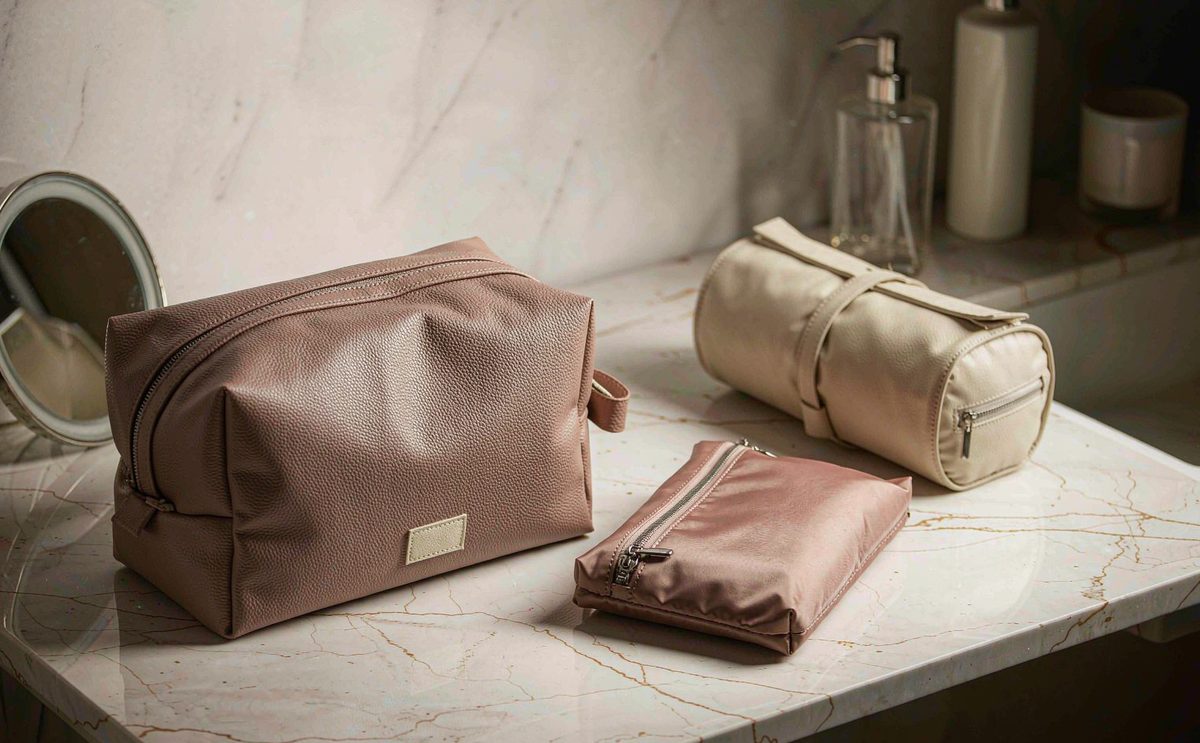
No creator should release a deposit on a 500-unit cosmetic bag run without an approved pre-production sample in their hand. Sampling takes 6 to 10 working days for a standard pouch and 12 to 15 working days for a complex case with structured panels or moulded parts. That clock starts when artwork, dimensions and material direction are agreed, not when the first email arrives. Budget two rounds rather than one: the first round verifies construction and proportion, the second verifies fabric, colour and branding on the actual bulk materials.
Colour is where beauty campaigns most often lose time. A screen renders differently from a dyed woven fabric, and a Pantone reference matched on polyester will not look identical on a coated vegan leather. The workable method is physical: ask for a fabric swatch card or a lab dip in the actual bulk base, approve it under daylight and under the lighting you shoot campaign photography in, and only then approve the sample. Where a brand colour is non-negotiable, build an extra 5 to 7 working days into the plan for a second dip. Our sourcing partner handles dip submission and approval as a tracked step, and the sampling and colour matching process sets out the sequence in detail.
Sample cost is small relative to the risk it removes. Expect a sample fee in the USD 40 to 120 band per round for a pouch, plus courier, and expect the fee to be credited against the bulk order in most programmes. What you are buying is not the bag. It is the right to change the specification before 500 units of the wrong thing are cut, and on a programme where the bulk commitment is USD 2,000 to USD 3,900, spending USD 150 to protect it is not a difficult decision.
Allocating the run: backers, press and buffer
Once the 500 are made, they have to be divided. A clean allocation starts with confirmed backer units from the survey, then adds a replacement and damage buffer of 4 to 6 percent, then adds press and influencer units, then leaves whatever remains as post-campaign inventory. On a 500-unit run serving 420 backers, that is roughly 25 units of buffer, 20 units for press and creators, and 35 units of website stock. Those 35 units are useful: they are the only stock you hold that can be sold at full margin, and they are what turns a reward into a product line.
The buffer percentage is not arbitrary. Inspection at AQL 2.5 to ISO 2859-1 sets an acceptance threshold rather than a perfection guarantee, and a lot that passes can still contain a small number of units with a skipped stitch, a misaligned label or a zip that pulls roughly. Transit adds its own attrition, particularly on structured cases that can be crushed at the corners. A 6 percent allowance covers both. If the run passes with fewer defects than expected, the surplus simply becomes sellable inventory rather than waste.
Plan the reorder before you need it. Repeat runs carry the same 500 pcs minimum, and the unit price will not improve much on a reorder of the same size, but the lead time can improve significantly because the pattern, the tooling and the approved sample already exist. Keep the approved specification frozen and filed with the same partner that ran the first lot. Reordering through a different route means repeating the sampling round and, in practice, accepting a slightly different product. If you expect a website restock within six months, say so at quotation stage and the pattern file will be kept live.
Writing the RFQ so 500 pcs works in your favour
A quotation request that produces a usable number in one exchange is short, specific and honest about quantity. Include a reference image or sketch of the silhouette, target dimensions in centimetres or inches, the face fabric direction and whether it must be wipe-clean, the lining requirement, the colour direction with any Pantone references, the quantity per colourway, the branding method and its placement, the target FOB unit price if you have one, the shipping destination, and the date the bags must be in your fulfilment warehouse. That is ten lines. It removes almost all of the back-and-forth.
Then ask for five specific things back: the unit price at 500, 1,000 and 2,000 pcs; the sample lead time and fee; any tooling charges; the carton dimensions and units per carton so you can pre-calculate freight; and confirmation that inspection will be run to AQL 2.5. A partner who will not state the inspection standard in writing is telling you something. Our team returns all five as standard, together with a costed list of what changes if the quantity moves, which is the information you actually need when a campaign doubles overnight.
Send us a brief with your silhouette, quantity per colourway and target ship date, and our campaign bag specialist will return a 500 / 1,000 / 2,000 pcs costed quotation within one working day.
Key takeaways
- 5
- 0
- 0
- p
- c
- s
- b
- u
- y
- s
- o
- n
- e
- s
- i
- l
- h
- o
- u
- e
- t
- t
- e
- i
- n
- o
- n
- e
- c
- o
- l
- o
- u
- r
- w
- a
- y
- .
- M
- o
- d
- e
- l
- y
- o
- u
- r
- t
- i
- e
- r
- m
- i
- x
- b
- e
- f
- o
- r
- e
- y
- o
- u
- o
- r
- d
- e
- r
- ,
- v
- a
- r
- y
- t
- r
- i
- m
- s
- i
- n
- s
- t
- e
- a
- d
- o
- f
- f
- a
- b
- r
- i
- c
- s
- w
- h
- e
- n
- y
- o
- u
- w
- a
- n
- t
- t
- w
- o
- l
- o
- o
- k
- s
- ,
- a
- n
- d
- r
- e
- s
- e
- r
- v
- e
- t
- h
- e
- s
- e
- c
- o
- n
- d
- s
- l
- o
- t
- b
- e
- f
- o
- r
- e
- t
- h
- e
- c
- a
- m
- p
- a
- i
- g
- n
- l
- a
- u
- n
- c
- h
- e
- s
- .
Frequently Asked Questions
What does a 500 pcs cosmetic bag MOQ actually cover?
It covers 500 units of one style in one approved colourway. A style is the silhouette and construction; a colourway is one combination of face fabric, lining, zip tape and hardware finish. Two colourways of the same pouch means 1,000 units. Two different silhouettes also means 1,000 units. A split across two trim-driven colourways inside one 500-unit run is sometimes possible when the base fabric is identical, but it has to be requested and confirmed rather than assumed.
Can I order 250 pcs of each of two colours at a 500 pcs minimum?
Usually not as a published rule, because the fabric mill lot minimum applies per colour rather than per order. The workable alternative is to keep one body colour and vary the trim: zip tape, puller, binding, lining and print colour. Those suppliers carry lower minimums, so you get two visibly different products out of one fabric lot and one 500-unit run. Ask for a trim-driven split at quotation stage and you will get a clear yes or no within one exchange.
How much does a custom cosmetic bag cost per unit at 500 pcs?
A wipe-clean pouch with a stocked fabric, standard zip and one foil logo typically lands between USD 3.20 and USD 6.80 FOB Xiamen at 500 pcs, with a simple recycled polyester build near the bottom and a structured vegan leather case near the top. Doubling to 1,000 pcs usually cuts 8 to 15 percent per unit, and doubling again to 2,000 cuts a further 8 to 12 percent. Landed cost in the US or EU is typically USD 2.50 to 4.50 per unit above FOB once freight, duty and fulfilment are added.
How long does sampling and bulk production take at 500 pcs?
Sampling runs 6 to 10 working days for a standard pouch and 12 to 15 working days for a complex case with structured panels. Bulk production runs 35 to 50 days after the deposit clears and the pre-production sample is approved. Add 3 to 7 working days for a lab dip if a brand colour has to be matched exactly, and add transit time on top. A realistic plan from brief to warehouse is 10 to 13 weeks, and 14 if a second colourway is involved.
What payment terms apply to a 500 pcs cosmetic bag order?
Terms are T/T 30/70 on FOB Xiamen: 30 percent deposit to release materials and book the production slot, and 70 percent balance before shipment. On a 500 pcs run at USD 4.00 per unit that is roughly USD 600 up front and USD 1,400 about five to seven weeks later. Sample fees, typically USD 40 to 120 plus courier, are usually credited against the bulk order. Tooling for a custom puller, where it applies, is invoiced separately and is a one-off charge.
Can I get my exact brand Pantone colour on 500 cosmetic bags?
An exact Pantone match on the face fabric usually needs a custom dye lot, and dye lots generally start at 1,000 to 3,000 metres, which is far more than 500 pouches consume. At 500 pcs the practical route is to choose the nearest colour from the existing fabric card and carry the exact brand colour on the elements that can be matched cheaply, such as zip tape, puller, print and labels. Where a match is essential, a lab dip can be submitted, but expect an extra 5 to 7 working days and a lot minimum charge.
What branding methods work at a 500 pcs minimum?
Screen print, heat transfer, foil stamping, embroidery and woven or printed labels all work at 500 pcs. Embroidery carries a digitising fee of roughly USD 25 to 60 per artwork, and foil needs stroke widths above about 3 mm to hold on a woven face. A custom shaped metal or silicone zipper puller is possible with a mould fee of roughly USD 300 to 900. Fully bespoke injection-moulded hardware and custom-woven jacquard fabric usually need 1,000 to 2,000 units to make economic sense.
How many of my 500 bags should I hold back for replacements?
Hold 4 to 6 percent. Inspection at AQL 2.5 to ISO 2859-1 sets an acceptance threshold rather than a zero-defect guarantee, so a passing lot can still contain a small number of units with cosmetic faults, and transit adds its own attrition, especially on structured cases. On a 500-unit run covering 420 backers, that works out at roughly 25 units for replacements, 20 for press and influencer seeding, and about 35 units left as post-campaign website inventory.
Do stretch goals change the 500 pcs minimum?
Additive stretch goals do not: an extra pocket, a mirror, a detachable strap or a dust bag are trim and accessory lines on the same bill of materials and typically add USD 0.20 to 0.90 per unit. Multiplicative stretch goals do: a new colourway adds another 500 units of commitment and an upgraded silhouette adds a new style at 500 plus a fresh 6 to 10 working day sampling round. Price the stretch goal into the campaign before you announce it, and reserve the slot before launch.
What should I include in a cosmetic bag RFQ to get a fast quote?
Ten lines: a reference image or sketch, target dimensions, face fabric direction and whether it must be wipe-clean, lining requirement, colour direction with Pantone references if you have them, quantity per colourway, branding method and placement, target FOB unit price, destination port or warehouse, and the date the bags must arrive. Then ask for unit prices at 500, 1,000 and 2,000 pcs, sample lead time and fee, tooling charges, carton dimensions and units per carton, and written confirmation of AQL 2.5 inspection.
Is 500 pcs enough for a campaign with 1,500 backers?
Almost certainly not. If the bag sits on two tiers and uptake runs 40 percent and 15 percent across 1,500 backers, demand is around 825 units before buffer, and roughly 875 with a 6 percent allowance. That sits in the awkward band between one run and two, so the options are a negotiated trim-driven split inside a larger single run, or two full colourways of 500 booked together. Model the mix from the post-campaign survey rather than guessing, and keep the second slot reserved.
Can I reorder the same cosmetic bag later at the same 500 pcs minimum?
Yes. Repeat runs carry the same 500 pcs minimum per style and colourway, and the unit price will be similar because the amortisation is the same. What improves is the lead time: with the pattern, any tooling and the approved sample already on file, the sampling round is largely removed and bulk can start sooner. Tell your partner at quotation stage if a website restock is likely within six months so the specification is kept frozen and the pattern file stays live.
People Also Ask
What is the MOQ for custom cosmetic bags?
500 pcs per style and per colourway. That means one silhouette in one approved combination of fabric, lining, zip tape and hardware. A second colourway or a second silhouette adds another 500 units, unless a trim-driven split inside one fabric lot is negotiated.
Can I split 500 bags across two colours?
Only when both colours share the same base fabric and differ in trim. Otherwise each colourway carries its own 500-unit minimum because the mill lot and trim rolls are purchased per colour. Ask at quotation stage and you will get a definitive answer.
How much does a 500 pcs cosmetic bag order cost in total?
At a USD 4.00 indicative FOB unit, 500 pcs is USD 2,000 plus tooling, samples and freight. Landed in the US or EU, budget USD 3,250 to 4,250 for the run once duty, freight and per-unit fulfilment are included.
How long does a 500 pcs cosmetic bag run take?
Roughly 10 to 13 weeks end to end: 6 to 10 working days for sampling, 35 to 50 days for bulk production after deposit and sample approval, plus transit. Add 5 to 7 working days if a lab dip is needed for an exact brand colour.
What can I customise on a cosmetic bag at 500 pcs?
Dimensions, silhouette, fabric from the stock colour card, lining, pockets, brush loops, zip tape colour, puller, woven labels, screen print, heat transfer, foil and embroidery. Custom-dyed fabric and bespoke moulded hardware usually need 1,000 to 2,000 units.
Should I order 1,000 bags to get a better unit price?
Only if demand supports it. Doubling from 500 to 1,000 typically saves 8 to 15 percent per unit, but the extra cash is tied up for months. If the campaign needs 700 units, a negotiated split beats 300 units of unsold inventory.
How many spare bags should a campaign keep?
A 4 to 6 percent allowance on top of confirmed backer units. That covers defects that pass AQL 2.5 inspection plus transit damage, and any surplus becomes website inventory sold at full margin after fulfilment.