Custom Fulfillment Bags: Packaging Options That Protect Bags in Transit
What packaging actually protects custom fulfilment bags on their way to backers? The answer is a four-layer system rather than a single box: a vented polybag, internal void fill to hold the shape, a carton specified by grade rather than price, and a pallet pattern that survives freight. Budget 1.20-3.40 USD per unit for it on a 500 pcs run, specify an ISTA 3A drop test on cartons before you release them, and write the carton spec into the same RFQ as the bag itself.
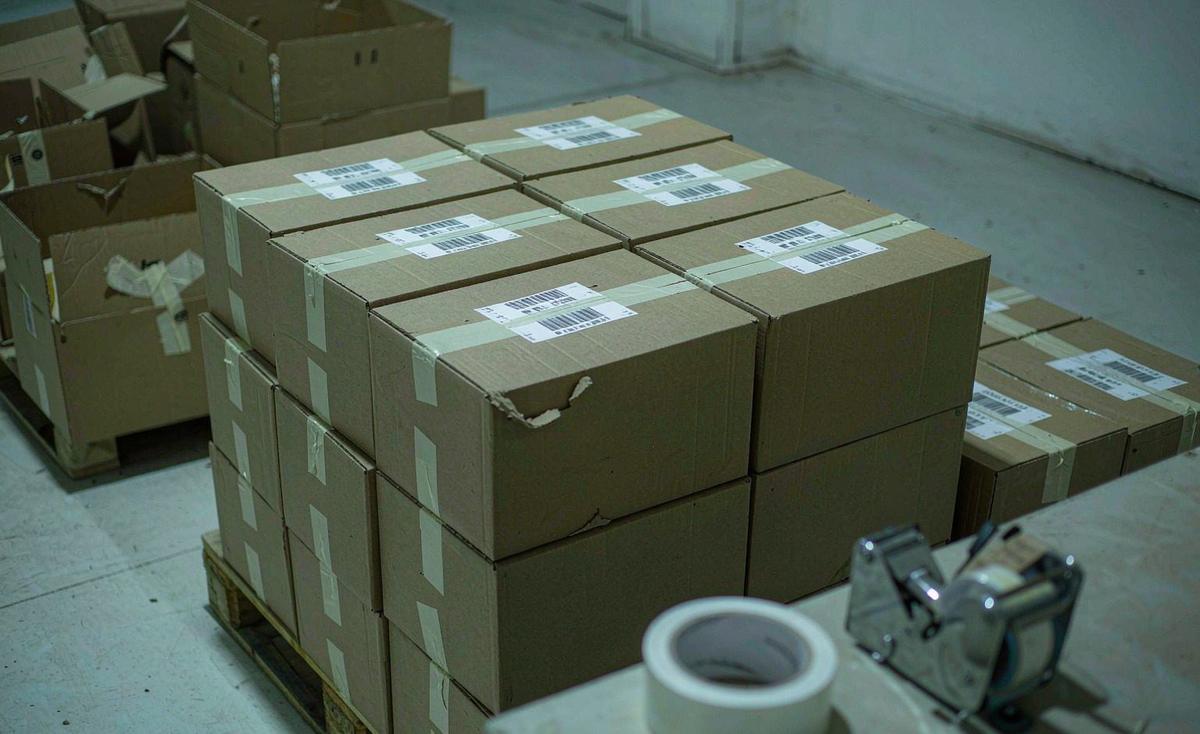
- What actually damages a bag between the line and the backer's door
- The four packaging layers and what each one costs per unit
- Polybag gauge, venting and the moisture mistake
- Carton grade, burst strength and stack height
- Protecting structured backpacks with inserts and void fill
- Closure geometry, webbing and hardware under a box drop
- Palletisation and the freight consequence of packaging
- ISTA 3A and drop testing before you commit 500 units
- Labels, barcodes and the fulfilment warehouse handover
- What you can honestly claim about recyclable packaging
- A packaging specification to attach to the RFQ
- Budgeting packaging as a stand-alone line item
What actually damages a bag between the line and the backer's door
Transit damage on a sewn bag is almost never a torn panel. It is four failure modes that repeat across campaign shipments: creasing that will not relax out of a structured shell, abrasion on corners and webbing ends, hardware impressions pressed into adjacent panels, and moisture staining that appears after a container has sat through a humidity cycle. Each one has a specific packaging cause and a specific packaging fix, and none of them is solved by buying a thicker box.
Creasing comes from compression. A backpack packed flat and then stacked under cartons above it takes the load through its own shell, and a laminated or foam-backed panel will hold that crease permanently. Hardware impressions come from the same mechanism working at a point rather than an area: a buckle pressed against another bag under load leaves a mark that survives steaming. Both are fixed by distributing load through void fill and separators rather than by upgrading the carton wall.
Abrasion travels through the polybag, not around it. A bag loose inside a smooth polybag rubs against itself at every contact point, and after a multi-week voyage the webbing ends, binding tape edges and coated fabric can show scuffing. The countermeasure is a polybag sized to the product with the webbing folded in, plus enough internal tension that the unit moves as one mass rather than shifting.
Moisture is the one that surprises creators who ship their first container in a humid season. Cartons absorb humidity, polybags trap whatever moisture was sealed inside them, and the result appears as spotting, odour and, in the worst cases, mildew on natural-fibre trims. Understanding these four modes is what lets you spend packaging money where it works. The rewards fulfilment side of the programme is where the consequence of getting it wrong is finally counted.
- Minimum order quantity
- 500 pcs per style / colourway
- Sampling
- 6-10 working days (12-15 for complex builds)
- Bulk production
- 35-50 days after deposit + approved pre-production sample
- Inspection
- AQL 2.5 to ISO 2859-1
- Trade term
- FOB Xiamen
- Payment
- T/T 30/70
- Production floor
- 4,950 m² SGS-verified, 137 staff, 7 lines, 149 machines
- Monthly capacity
- 200,000 pcs
- Foundation
- 2014, trade roots since 2004
The four packaging layers and what each one costs per unit
Treat packaging as four layers rather than one purchase. Layer one is the primary bag: the polybag around the unit. Layer two is internal protection: void fill, inserts, moulded pads or tissue that stops movement and holds shape. Layer three is the carton: the export box that carries stack load and the addressing. Layer four is the pallet: the stretch wrap, corner boards and stacking pattern that decide what happens to the whole consignment in transit.
Costing each layer separately is important because they trade off against each other. Cheapening layer one and paying for layer two is often the better value: a thinner polybag plus a moulded pulp insert protects a structured pack better than an expensive polybag alone, because the failure mechanism is movement, not puncture. Cheapening layer three is rarely worth it, because the carton failure cost is not per unit, it is per pallet, and a single crushed stack can destroy twenty units at once.
| Layer | Economy option | Recommended option | Delta per unit |
|---|---|---|---|
| Primary polybag | LDPE 0.04 mm, no vent, 0.11 USD | LDPE 0.06 mm, vented, printed warning, 0.19 USD | 0.08 USD |
| Internal protection | Tissue sheets, 0.14 USD | Moulded pulp insert plus tissue, 0.46 USD | 0.32 USD |
| Export carton | Single-wall B flute, 32 ECT, 0.95 USD | Double-wall BC flute, 48 ECT, printed, 1.55 USD | 0.60 USD |
| Pallet and wrap | Stretch wrap only, 0.06 USD | Wrap plus corner board plus slip sheet, 0.20 USD | 0.14 USD |
| Total packaging per unit | 1.26 USD | 2.40 USD | 1.14 USD |
Read that bottom row as an insurance premium rather than a specification upgrade. Spending 1.14 USD more per unit to move from economy to recommended packaging costs 570 USD on a 500 pcs run. A single incidence of eight creased units returned for replacement costs more than that once return freight, replacement units and the backer communication overhead are counted, and it costs more than money in the week it happens.
Key takeaways on transit protection
- The four layers are polybag, internal protection, export carton and pallet; cheapening them is not interchangeable.
- Recommended packaging typically costs 2.40 USD per unit against 1.26 USD for economy, a delta of 1.14 USD.
- Specify cartons by ECT or burst strength, never by price; the failure cost of the carton is per pallet, not per unit.
- Vented polybags are mandatory when a coated fabric or a natural-fibre trim is involved.
- Packaging belongs in the RFQ alongside the bag, so the carton is costed before the reward price is published.
Polybag gauge, venting and the moisture mistake
The primary polybag does three jobs: contain the unit, resist scuffing during handling, and manage moisture. Gauge is the obvious variable and the least important one above a threshold. Going from 0.04 mm LDPE to 0.06 mm LDPE raises puncture resistance noticeably and costs roughly 0.08 USD per unit, but going further to 0.08 mm buys almost nothing extra in transit terms, because the failure mode has already moved to the carton.
Venting is the variable creators overlook and the one that causes the most expensive complaints. A sealed polybag around a bag that was packed in a humid environment traps that moisture for the whole journey and concentrates it against coated or laminated surfaces. Perforated polybags, typically six to twelve holes distributed across the face, allow exchange without letting dust in. They cost almost nothing extra and should be standard on any coated fabric, PU-backed fabric, or cotton canvas trim.
- Specify gauge in millimetres rather than microns-per-supplier and require a tolerance of plus or minus 0.005 mm.
- Require vent holes on any bag containing coated fabric, laminated panels or natural-fibre trims.
- Print the suffocation warning in the destination market language and check whether the market requires it at that film thickness.
- Set the polybag size so webbing and straps fold inward rather than splaying against the film.
- Ask for a bag thickness test report so the quoted gauge can be verified at inspection rather than assumed.
There is one more decision in layer one that is easy to get wrong: whether to pack units individually at all. For items that ship direct to a fulfilment warehouse rather than to backers, bulk packing in interleaved sheets saves the polybag cost entirely, and the warehouse polybags at pick time. That route only works if the warehouse agrees in writing to handle the units in that condition, so agree it before the carton specification is frozen rather than discovering it at the handover.
Carton grade, burst strength and stack height
Cartons are sold three ways: by flute profile, by burst strength or by edge crush test value. Of the three, edge crush test, expressed as ECT, is the most useful predictor of stacked performance, because it measures the vertical compression strength that actually determines how a carton behaves in a container or on a pallet. Burst strength, expressed in kilopascals or pounds per square inch, measures puncture resistance better and is the right metric when cartons are handled individually.
For a bag programme, double-wall BC flute at 48 ECT is typically the right default for a structured pack shipping FOB Xiamen into both Europe and North America. Single-wall C flute at 32 ECT is adequate for flat-packed totes and soft duffles where the units themselves carry some load, and inadequate for structured backpacks that arrive as air and nothing else. Upgrading to 48 ECT typically adds 0.60 USD per unit on the carton line, less if carton print runs are consolidated across colourways.
| Product type | Recommended board | ECT target | Units per carton |
|---|---|---|---|
| Flat-packed tote, 12 oz canvas | Single-wall C flute | 32 ECT | 25-40 |
| Soft duffle, unstructured, 40L | Single-wall B flute | 32-40 ECT | 10-16 |
| Structured daypack, 20-25L | Double-wall BC flute | 44-48 ECT | 8-12 |
| Technical travel pack, 35-45L | Double-wall BC flute | 48 ECT | 5-8 |
| Wheeled or framed pack | Double-wall BC flute plus corner board | 51 ECT | 4-6 |
Stack height is the thing the ECT number is protecting. A container holds cartons stacked several metres high, and a pallet in a bonded warehouse may sit under another pallet for weeks. Ask your production partner to state the maximum stack height the carton is specified for, not merely its ECT value, and set carton weight below the manual handling limit in the destination market. Heavy cartons get dropped. Our QA and QC page lists the packing checks that belong alongside the product inspection.
When the carton is priced as an afterthought it is always the first line to be cut, and it is the only packaging line whose failure damages twenty units at once. Write board grade, ECT value, carton dimensions and units per carton into the purchase order, not into an email.
Protecting structured backpacks with inserts and void fill
A structured backpack is the hardest bag to ship well because it is mostly air with a shape to keep. Without internal support the shell carries all stack load through whatever points happen to contact first, usually the harness and the base corners. The fix is internal rather than external: give the cavity something to push against so load transfers through volume rather than through points.
Three options exist in common use. Tissue or kraft paper stuffing is the cheapest at around 0.14 USD per unit and works acceptably for soft packs, but it settles under load and offers little support by week three of a voyage. Moulded pulp inserts hold shape properly and typically cost 0.35-0.55 USD per unit plus a tooling charge in the range of 250-600 USD for the mould, which amortises well over 500 units and better over a re-order. Inflatable air pillows work well but puncture, and a punctured pillow protects nothing.
For a first campaign run we generally recommend tissue plus a single moulded pulp insert at the base, which addresses the two highest-risk areas: the harness volume and the base panel. It costs roughly 0.46 USD per unit and removes most of the crease and impression complaints that otherwise arrive with the first hundred deliveries. Ask during sample prototyping whether an insert mould can be developed inside the 6-10 working days of sampling window, because on complex builds the answer is sometimes 12-15 days.
Closure geometry, webbing and hardware under a box drop
Some damage is created by the bag's own design interacting with packaging, and it is cheapest to fix at design stage rather than at packing stage. Long exposed webbing ends, protruding ladderlock buckles, unpadded grab handles and rigid frames all create pressure points that press into whatever is next to them. During transit under compression, those points act like a stamp.
- Fold straps inward and secure them before polybagging rather than letting them splay.
- Wrap hardware contact points in tissue even when the overall solution relies on void fill.
- Pad or reposition grab handles that sit proud of the shell profile.
- Round internal frame ends so they cannot concentrate load against an adjacent unit.
- Specify a minimum radius on any rigid component that will contact another unit in a full carton.
Carton fill ratio matters here as much as the individual protections. A carton that is 15% under-filled allows its contents to move, and movement is what turns a pressure point into an abrasion site. A carton that is over-filled bulges, loses most of its compression strength, and fails at the corners in a stack. Target 85-95% fill with void fill taking up the remainder, and require the packing team to work to a fill standard rather than to a carton count.
Palletisation and the freight consequence of packaging
Layer four is the one that quietly decides freight cost, because packaging volume sets volumetric weight and volumetric weight often sets the freight bill. A structured backpack is charged largely on air: at typical carton dimensions, a 500 pcs shipment will burn noticeably more chargeable weight on volume than on scale weight. Every centimetre of unnecessary carton height therefore has a direct cost that runs through the whole shipment rather than stopping at the packaging line.
This creates a genuine tension worth stating plainly. Better protection usually means more volume, which means higher freight, and the optimal answer is not maximum protection but the protection that removes the most damage per cubic centimetre. In practice that means spending on layer two, internal support, which costs almost no volume, before spending on layer three, carton size, which costs volume on every carton in the shipment.
| Packaging route | Cartons | Chargeable weight | Freight line |
|---|---|---|---|
| Economy, minimum void fill | 62 cartons | 930 kg | 2,110 USD |
| Recommended, internal inserts | 66 cartons | 990 kg | 2,245 USD |
| Oversized carton, heavy void fill | 78 cartons | 1,170 kg | 2,655 USD |
| Flat-packed where applicable | 48 cartons | 720 kg | 1,632 USD |
Read the table before choosing, and note that the difference between the first two routes is around 135 USD in freight, or roughly 0.27 USD per unit, which is smaller than the damage saving it buys. The fourth row is the interesting one and only applies to soft goods: if the product category tolerates flat packing, the freight reduction can exceed the entire recommended packaging budget. That trade-off depends entirely on the bag category, so raise it during RFQ rather than assuming either answer. Our custom bags pillar page maps which categories tolerate compression.
ISTA 3A and drop testing before you commit 500 units
Packaging can be verified, and doing so costs a fraction of one replacement round. ISTA 3A is the standard most relevant here: a general simulation performance test for individual packaged products shipped through a parcel delivery system, which is exactly the route most backer shipments take after leaving a fulfilment warehouse. It subjects packaged units to atmospheric preconditioning, random vibration and drop impacts from specified heights and orientations.
A practical testing budget for a first bag campaign looks like this: 150-400 USD for a laboratory ISTA 3A run on three packaged units, or effectively nothing beyond shipping cost if you conduct your own drop-and-inspect protocol on six units. Run either before cartons are bulk-ordered, because carton tooling and print plates are one-off charges you do not want to re-pay. Record carton deformation, not merely product condition, since a carton that absorbed impact well enough to save the bag once may fail on its second cycle.
- Test three units minimum and include one carton corner drop, which is statistically the most damaging orientation.
- Precondition units at high humidity for 24 hours if any natural fibre or coating is involved.
- Inspect immediately after unpacking and again after 24 hours, since creases can either relax or set.
- Photograph every carton face before opening so the failure mode is documented rather than guessed.
- Re-run the test whenever carton board, unit count per carton or void fill changes materially.
Where ISTA 3A is overkill, borrow its logic rather than skipping verification. Six drops from 45 cm covering top, edge and corner orientations will surface the majority of packaging weaknesses on a sewn bag, and the whole exercise costs one working day. Doing it during the sampling window rather than after production means the fix lands in the specification rather than in a repacking operation at the warehouse.
Labels, barcodes and the fulfilment warehouse handover
Packaging is also a data problem. Every fulfilment warehouse receives against a scan, and cartons that arrive without scannable labelling cost receiving time that is billed back to the campaign. Agree the labelling format with the warehouse before cartons are printed, because printing is a one-off cost and relabelling 500 units at destination is not.
The minimum label set is a carton sequence label such as carton 7 of 66, an SSCC or equivalent serial shipping container code where the warehouse requires it, and a contents line that lets a picker verify without opening. Unit-level barcodes are a separate decision: if the bag ships to backers directly from the fulfilment centre rather than being kitted, the warehouse will usually apply its own label, and asking your production partner to apply one adds cost for no benefit.
Alignment across rewards fulfilment matters most on the units-per-carton number. If the warehouse expects to receive inner packs of ten and production cartons arrive holding twelve, receiving reconciliation breaks on day one. Put the exact carton contents on both the carton label and the packing list, and require the packing list to match the carton sequence labels exactly. Our production window guidance covers how carton specifications are locked alongside the bulk slot.
What you can honestly claim about recyclable packaging
Backers increasingly ask about packaging waste, and the campaign page often makes claims that the packing specification cannot support. This is a compliance question as much as a marketing one: a recyclable claim must be substantiated in the destination market, and packaging claims fall inside the same enforcement perimeter as product claims under regimes such as the EU General Product Safety Regulation and national advertising standards.
Three claims are usually safe to make when they are true and documented. Recyclable LDPE polybags are widely recyclable in store-drop-off streams, though rarely in kerbside streams, and the campaign wording should say which. Recycled content in corrugated board is standard and should be stated as a percentage with mill documentation behind it. Plastic-free packaging is achievable only when every layer including tape, labels and void fill is genuinely plastic-free, which usually means paper tape and paper void fill.
Decide what the campaign page will say about packaging once the carton, film and void fill are specified and the supplier documentation is in hand. A claim written first forces the specification later, and the gap between them is exactly where complaints and enforcement originate.
Ask for documentation rather than assurances: a mill certificate for recycled content, a film specification sheet for the polybag, and confirmation that any printed ink is compatible with the recycling stream claimed. These documents usually cost nothing and are available on request, and their absence within a week of asking is itself a useful signal about how the rest of the order will be handled.
A packaging specification to attach to the RFQ
Packaging is quoted accurately only when it is specified. A request for quotation that describes the bag in detail and the packaging in one adjective will produce exactly one outcome: the cheapest carton available, and a change request later. Attach a short packaging sheet to the same RFQ as the bag and require your shortlist to price against it so quotations are comparable.
- State polybag material, gauge with tolerance, whether it is vented, and whether it is printed.
- State internal protection by type and quantity per unit, including whether tooling is required.
- State carton board grade, ECT target, internal dimensions, closure method and print colour count.
- State units per carton, carton weight limit and maximum stated stack height.
- State pallet pattern, wrap layers and whether corner boards or slip sheets are required.
Two closing clauses belong at the end of that sheet. First, require a packed-goods sample before tooling: one unit packed exactly as bulk will be packed, shipped to you, which reveals creasing and fit issues while they are still free to fix. Second, require packing to be included in the pre-shipment inspection at AQL 2.5, so polybag quality, carton print and carton count are checked before the 70% balance is released. Full details of the sourcing route are on our crowdfunding bag guide.
Budgeting packaging as a stand-alone line item
Packaging should be its own line in the campaign budget rather than a rounding inside unit cost, because it behaves differently from everything else in the cost breakdown. It does not fall with volume as steeply as the unit cost does, it interacts directly with freight, and it is one of the few items where spending more is measurably cheaper than spending less. Treating it as a line item rather than as overhead is what lets you make that comparison.
| Quantity | Packaging per unit | Packaging total | Share of landed cost |
|---|---|---|---|
| 500 pcs | 2.40 USD | 1,200 USD | 9-11% |
| 1,000 pcs | 2.15 USD | 2,150 USD | 8-10% |
| 2,000 pcs | 1.95 USD | 3,900 USD | 7-9% |
| Tooling and print plates | 250-700 USD one-off | Amortised per run | About 0.50 USD at 500 pcs |
Note that tooling is the reason the small run carries a higher per-unit packaging cost, exactly as it does for the bag itself. Print plates for a branded carton are typically 120-350 USD per colour and are reusable across re-orders, so a campaign planning a second run should ask whether plates are being held rather than remade. Ask explicitly, because it is a question worth 0.50 USD per unit on the re-order.
- Crowdfunding rewards fulfilment
- Kickstarter campaign bag QA and QC
- Crowdfunding bag sample prototyping
- Bag manufacturing for campaign creators
- Custom bags for Kickstarter campaigns
- Crowdfunding bag guide
- Request a quotation
Specify the carton alongside the bag
Send us your bag specification and we will return an itemised quotation covering polybag gauge, internal protection, carton board and ECT target, units per carton and one-off tooling, costed as a separate line at 500, 1,000 and 2,000 pcs. Write to service@junyuanbags.com or request a quote through the site.
Frequently Asked Questions
What does packaging add to the unit cost of a custom fulfilment bag?
Recommended packaging typically runs 2.40 USD per unit at 500 pcs, against roughly 1.26 USD for the economy option and up to 3.40 USD for a framed or wheeled pack needing corner boards. That represents roughly 9-11% of landed cost on a first run, falling to 7-9% at 2,000 pcs as tooling amortises.
Which single packaging layer prevents the most transit damage?
Internal protection, because it addresses movement and load concentration rather than puncture. Moving from tissue to a moulded pulp insert plus tissue costs about 0.32 USD per unit and removes the majority of crease and hardware-impression complaints, which are the two most common failures on structured backpacks.
What carton grade should be specified for a structured backpack?
Double-wall BC flute at 48 ECT is the standard recommendation for a structured daypack or travel pack, with 5-12 units per carton depending on size. Flat-packed totes and soft duffles are adequately served by single-wall 32-40 ECT, since their contents carry part of the stack load themselves.
Should polybags be vented for shipping bags by sea freight?
Yes, whenever the bag contains coated fabric, laminated panels or natural-fibre trims. 6-12 vent holes distributed across the film allow moisture exchange for almost no added cost, and they prevent the staining, odour and mildew that appear after a container has been through a humidity cycle.
How much does ISTA 3A testing cost for a 500 pcs bag order?
A laboratory ISTA 3A run on three packaged units typically costs 150-400 USD. An in-house drop protocol on six units costs effectively nothing beyond shipping. Either should be run before cartons are bulk-ordered, because carton print plates are a one-off charge of 120-350 USD per colour.
How many units should go in one export carton?
Roughly 25-40 for flat-packed totes, 10-16 for soft duffles, 8-12 for a structured daypack and 5-8 for a 35-45L travel pack. Target 85-95% fill: under-filled cartons let contents move and abrade, while over-filled cartons bulge and lose most of their compression strength.
Does better packaging increase freight cost?
Slightly. In a worked comparison, moving from economy to recommended packaging raised a 500 pcs shipment from 62 cartons and 930 kg chargeable to 66 cartons and 990 kg, roughly 135 USD in freight. That is about 0.27 USD per unit, well below the damage and replacement cost it avoids.
Is packing covered by a standard pre-shipment inspection?
Only if you specify it. Require the AQL 2.5 inspection to ISO 2859-1 to include polybag quality, carton print, carton count and pallet condition, and require the report to be issued to you before the 70% balance is released. Packing defects found at the warehouse instead cost far more to correct.
Can bags ship flat-packed to reduce freight?
Soft categories can: flat packing a 500 pcs tote run took a worked example from 62 cartons to 48 and cut the freight line from 2,110 USD to 1,632 USD. Structured packs with moulded shells or frames generally cannot, since the crease cannot be relaxed out later.
What labelling should export cartons carry for a fulfilment warehouse?
A carton sequence label such as carton 7 of 66, an SSCC or equivalent serial shipping container code where required, and a contents line for picker verification. Agree formats with the warehouse before print plates are cut, since relabelling 500 units at destination is expensive.
How do I substantiate a recyclable packaging claim on the campaign page?
Document each layer separately. LDPE polybags are widely recyclable in store drop-off streams but rarely kerbside, so state which. Ask for a mill certificate stating recycled board content as a percentage, plus a specification sheet stating film gauge at 0.06 mm, and confirmation that inks and tape are compatible with the recycling stream claimed.
When should packaging be specified in the sourcing process?
At RFQ stage, attached to the same document as the bag specification. Sampling then takes 6-10 working days, 12-15 for complex builds, and production 35-50 days after the deposit and approved pre-production sample. Specifying later means a repacking operation at destination instead of a line item.
Is a moulded pulp insert worth its tooling cost at 500 units?
Usually yes for structured packs. Tooling runs 250-600 USD, which is roughly 0.50-1.20 USD per unit amortised over 500 pcs, and the mould is reusable on re-order so amortisation improves on the second run. On the most budget-sensitive entry tiers, tissue plus a base insert is the cheaper compromise.
What causes musty odour complaints after sea freight?
Moisture trapped inside a sealed polybag around a bag packed in humid conditions. The remedy is vented film plus a desiccant sachet for cartons exceeding roughly 12 units, and preconditioning units at high humidity for 24 hours during drop testing so the failure appears in testing rather than in backer feedback.
People Also Ask
How do you stop backpacks getting crushed during shipping?
Support the interior rather than thickening the box. A moulded pulp insert plus tissue holds the shell so stack load passes through volume instead of through the harness and base corners. On a 500 pcs first run that costs about 0.46 USD per unit and removes most crease complaints.
Is a thicker polybag worth the extra cost?
Up to a point. Moving from 0.04 mm to 0.06 mm LDPE adds useful puncture resistance for roughly 0.08 USD per unit, but 0.08 mm buys little extra because failure has already shifted to the carton. Venting matters more than gauge on coated or laminated fabrics.
What is the difference between ECT and burst strength in cartons?
ECT measures vertical compression strength and predicts stacked performance, making it the right metric for containerised or palletised freight. Burst strength measures puncture resistance and suits cartons handled individually. For structured bags in a stack, specify the ECT target.
Should fulfilment packaging printed with my brand be costed separately?
Yes. Print plates typically cost 120-350 USD per colour as a one-off, adding about 0.50 USD per unit at 500 pcs. Ask whether plates are held for reuse, because remaking them on a re-order is a pure avoidable cost.
Can I test my own mailer instead of paying for ISTA certification?
Yes for internal decisions. Six drops from 45 cm covering top, edge and corner orientations surfaces most weaknesses on a sewn bag in one working day. Use a formal ISTA 3A laboratory run only when a retail or fulfilment partner requires certification.