Custom Toiletry Kits for Crowdfunding: Bundle 3-5 Items Into One Reward
How do you bundle three to five toiletry items into one crowdfunding reward without wrecking the unit cost? Structure it as a single kit with one bill of materials. The minimum order is 500 pcs per style and colourway, sampling runs 6-10 working days, production 35-50 days after deposit and approved pre-production sample, and pre-shipment inspection runs at AQL 2.5 to ISO 2859-1. Budget kit-out labour separately from sewing or the freight line will eat the margin the bundle created.
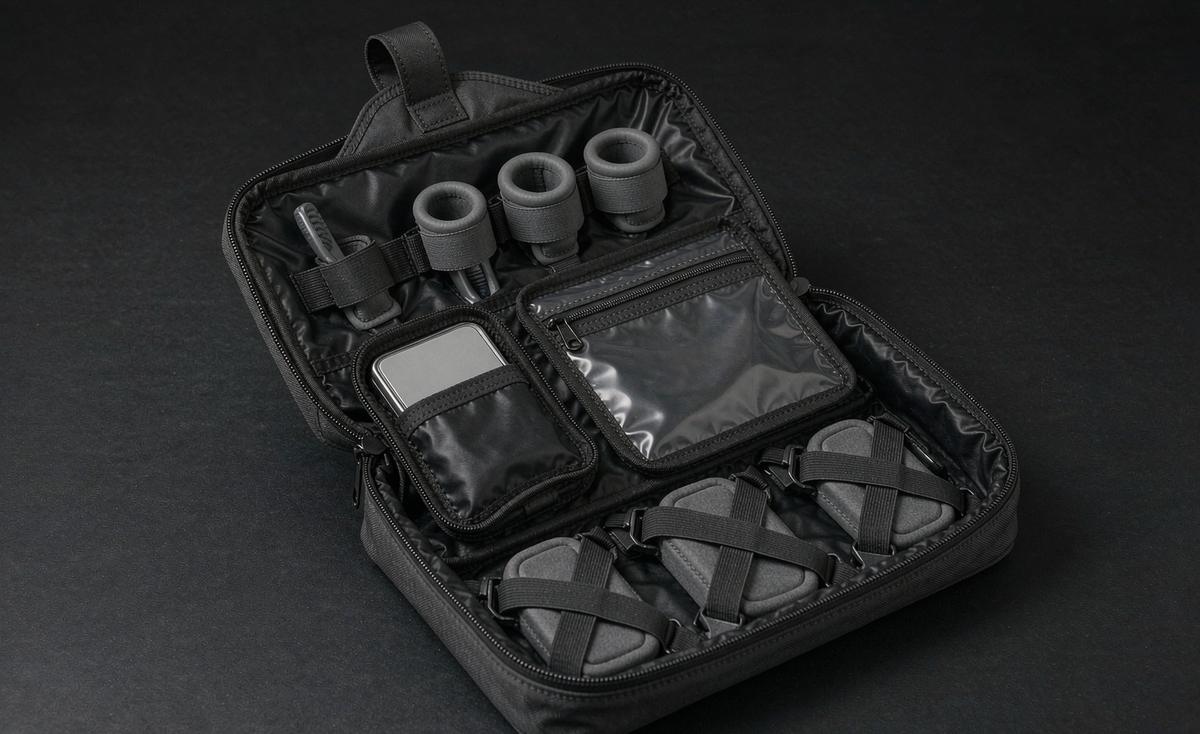
- Why a bundled toiletry kit beats a single pouch in reward-tier economics
- Defining the kit: which 3-5 items belong in the bundle
- Building one bill of materials for a multi-item kit
- How bundling changes unit cost and what it does to your margin
- Sizing and nesting: making 3-5 items pack into one carton
- Material consistency across a kit and why it protects QC
- Branding five items without multiplying tooling cost
- Assembly, packing and the kit-out operation nobody budgets for
- Volumetric weight: the hidden freight cost of a bundled reward
- QC on a multi-component kit: a defect in one unit fails the whole reward
- Compliance for toiletry and wash-bag kits shipping into the US and EU
- The kit RFQ: what to send to get one price for five items
Why a bundled toiletry kit beats a single pouch in reward-tier economics
A single cosmetic pouch is the simplest reward to source and the hardest to price. Backers compare it against retail pouches they can already buy for a fraction of a pledge, and perceived value collapses the moment that comparison lands. A bundled toiletry kit resists it, because a coordinated set of three to five items is not something a backer can find on a shelf and price against. It reads as a system with a purpose, and the pledge tier supports a materially higher number without a matching rise in cost of goods.
The sourcing logic points the same way. One kit means one bill of materials, one sampling round, one inspection and one carton, even though the reward physically contains several pieces. The alternative, raising three separate purchase orders for a wash bag, a brush pouch and a flat pouch, triples the administrative surface of the programme and, far more expensively, triples exposure to minimums. Each style and colourway carries a 500 pcs commitment, so three unrelated items mean 1,500 units of inventory risk where one kit means 500.
For a first campaign that difference decides whether the programme is fundable at all. Campaigns we support that bundle typically reach their target on fewer backers, because the average pledge rises faster than the cost of goods does. They also carry less inventory risk, because a kit is one SKU to forecast rather than three. The trade-off sits in three places that creators routinely under-budget: kit-out labour, carton nesting and inspection scope. The rest of this article works through each with numbers.
- Minimum order quantity
- 500 pcs per style / colourway
- Sampling
- 6-10 working days (12-15 for complex builds)
- Bulk production
- 35-50 days after deposit + approved pre-production sample
- Inspection
- AQL 2.5 to ISO 2859-1
- Trade term
- FOB Xiamen
- Payment
- T/T 30/70
- Production floor
- 4,950 m² SGS-verified, 137 staff, 7 lines, 149 machines
- Monthly capacity
- 200,000 pcs per month
- Campaigns supported
- 20+ crowdfunding campaigns, trade roots since 2004
- Programme contact
- service@junyuanbags.com / WhatsApp +86 177 5002 0688
| Factor | Single pouch reward | Bundled 3-5 item kit |
|---|---|---|
| Retail price comparison | Backer compares against high-street pouches | No direct comparable on shelf |
| Minimum commitment | 500 pcs | 500 pcs for the kit as one style |
| SKUs to forecast | One pouch | One kit SKU holding 3-5 components |
| Tooling and setup | One decoration setup | One setup covering all components |
| Kit-out labour per reward | Zero | 0.04-0.12 USD depending on piece count |
| Carton volume per reward | Baseline | 1.8-2.6x a single pouch |
| Typical pledge uplift | Baseline | 25-60% above a single pouch tier |
Key takeaways on bundling a toiletry kit
- Treat the bundle as one style with one 500 pcs minimum, not five separate purchase orders.
- Every component still needs its own material, hardware and packing line in the bill of materials.
- Kit-out labour of 0.04-0.12 USD per kit is real money across 500 units and is rarely quoted unless asked for.
- Design the components to nest; a kit that packs flat ships for roughly half the freight of one that does not.
- QC must classify defects per component, because a single failed pouch fails the reward the backer receives.
Defining the kit: which 3-5 items belong in the bundle
Not every item deserves a place in the bundle, and the test for inclusion is commercial rather than aesthetic. Each component has to perform a job the others cannot, and it has to add more pledge value than it costs to make, pack and ship. A wash bag that swallows full-size bottles, a flat pouch for brushes, a leak-resistant pouch for anything wet, and a compact hanging hook or laundry pouch covers most travel use cases in four items. A fifth is defensible only when it answers a problem backers have actually stated in a survey or a pre-launch comment thread.
- Anchor item: the largest component, normally a wash bag or vanity case, which sets the visual identity for the whole kit.
- Wet item: a leak-resistant pouch with welded or taped seams, sized for the messiest thing a backer will carry.
- Organiser item: a flat or standing pouch with elastic loops, dividers or slip pockets for small items.
- Micro item: a small pouch, coin purse or brush roll that costs little to make and photographs well in the reward grid.
- Optional fifth: a laundry bag, a mirror panel or a detachable strap, added only against a stated backer need.
Sizing relationships matter as much as the item count. A useful rule on a four-item kit is that the two smaller components should nest inside the organiser, and the organiser should nest inside the anchor item, leaving no more than 15% wasted volume in the assembled pack. Where that nesting ratio cannot be reached, the realistic alternative is to shrink the anchor item by 2-3 cm in one dimension rather than to accept the freight penalty, because the anchor is the component with the most slack in its specification.
Five items is the practical ceiling. Beyond that, kit-out labour, carton volume and inspection surface all begin to grow faster than perceived value does, and the reward starts to read as a grab bag rather than a designed system. Where a sixth item is genuinely wanted, the cleaner commercial move is to hold it back as a stretch goal and have it priced inside the original request for quotation. Unlocking it later then becomes a confirmation rather than a fresh negotiation, which protects the production window you have already published.
Building one bill of materials for a multi-item kit
A kit needs one bill of materials, not five. The BOM is the document that turns a reward concept into a quotation, and on a kit it has to list every component with its own material, hardware, decoration and packing line before rolling them up into a single unit cost. Programme coordinators price kits this way because it exposes the true cost of each piece and makes it obvious where a substitution saves money and where it costs more than it saves. A pack that says three pouches, assorted sizes produces an estimate; a pack that specifies each one produces a quotation.
| Line | Component | Fields that must be written down |
|---|---|---|
| 01 | Face fabric, all items | Denier, weave, coating, colourway reference and supplier code |
| 02 | Lining, wet pouch only | Film type and thickness, seam sealing method, wipe-clean finish |
| 03 | Interlining and structure | Grade, weight, and whether it is fused or sewn in |
| 04 | Zippers and sliders | Chain gauge, tape width, slider reference, puller style and plating |
| 05 | Webbing, binding and trim | Width, material, colourway, and where binding replaces a turned seam |
| 06 | Branding on each item | Method, coordinates from a stated seam, size in millimetres, thread or Pantone reference |
| 07 | Kit-out and packing | Pieces per kit, polybag spec, insert count, carton size and pieces per carton |
Two mistakes recur in kit BOMs. The first is listing components without a packing line, which effectively prices the kit-out operation at zero; inserting, folding, bagging and sealing three to five pieces typically lands between 0.04 and 0.12 USD per kit. The second is naming a decoration method without confirming it adheres to the specified coating, which is the most common reason a first-off approval comes back rejected and a sampling round is lost.
How bundling changes unit cost and what it does to your margin
Bundling does not make the components cheaper. It changes what the same money buys. Five items raised as one kit share a single tooling setup, a single sampling round and a single inspection, and their assembly is pooled into one kit-out operation instead of three packing lines. In programmes we coordinate, the saving consistently appears in pooled overhead rather than in the fabric or trim, which is why creators who expect a dramatic drop in unit cost on a bundle are usually disappointed by the first quotation.
The margin arithmetic is where bundling earns its place. Consider a single pouch supporting a 35 USD pledge at a 9 USD unit cost. Adding three more components might take the unit cost to 22 USD, but if the reward supports a 65 USD pledge the gross contribution per backer rises materially rather than falling. The reward also becomes defensible against the comment every cosmetic campaign receives, the one asking why it costs more than a pouch from a department store.
Model the bundle on landed cost rather than on unit cost. Unit cost is the sewn piece plus kit-out and packing; landed cost adds ocean or air freight, duty, and inland delivery to the fulfilment warehouse. A bundle that looks comfortable on unit cost can turn marginal once volumetric freight is applied, particularly on an air-shipped partial order sent ahead to cover an event or a press moment. Run the calculation both ways before the tier price is published.
- Pool the tooling: one screen, plate or embroidery tape amortised across the kit rather than per component.
- Pool the sampling: one 6-10 working day round covering all items, not one round per piece.
- Pool the inspection: one AQL 2.5 inspection with defect classes defined per component.
- Pool the freight: one carton per reward instead of one parcel per item, which is usually the largest single saving.
- Watch the grams: every additional gram multiplies across 500 units and again through the volumetric calculation.
- Price stretch-goal variants now so a re-order is a confirmation and not a renegotiation of the production window.
Sizing and nesting: making 3-5 items pack into one carton
Nesting is a design decision taken at the pattern stage, not a packing instruction issued at the end. The question to put to your production partner is simple: what is the largest component, and what fits inside it? A wash bag that opens flat and accepts two pouches and a rolled brush mat inside it turns four shipping volumes into one. A kit of five rigid boxes does the opposite, and the difference shows up on the freight invoice rather than in the unit cost.
| Kit configuration | Flat-packed kit dimensions (cm) | Kits per export carton | Freight index |
|---|---|---|---|
| 3 items, all soft flat pouches | 26 x 18 x 4 | 80-100 | 1.00 |
| 4 items, one lightly structured wash bag | 28 x 20 x 7 | 50-64 | 1.52 |
| 4 items, wash bag with pouches nested inside | 28 x 20 x 6 | 60-72 | 1.24 |
| 5 items including a hanging wash bag with hook | 30 x 22 x 8 | 40-52 | 1.97 |
| 5 items, hanging bag folded flat, hook packed separately | 30 x 22 x 6 | 52-64 | 1.43 |
The freight index column is the one to read. Moving a four-item kit from an un-nested configuration to a nested one cuts roughly a fifth of the chargeable volume without changing a single component. That saving is permanent: it recurs on the re-order, on the second colourway and on every pallet shipped to a fulfilment partner. It is also the rare cost reduction that does not degrade the product, because the backer receives exactly the same items.
Material consistency across a kit and why it protects QC
Standardising material across a kit is the cheapest quality decision available to a creator. When all components come from the same fabric lot and the same hardware lot, an inspector is checking one set of references instead of five, shade variation between pieces is structurally impossible, and the reward photographs as a coordinated set. When each component carries its own fabric, its own plating and its own thread reference, every additional reference is another opportunity for a mismatch that only becomes visible when the items are placed side by side in the finished kit.
- Specify one face fabric across every component so a single dye lot covers the whole kit.
- Standardise on one zipper chain gauge and one plating finish so hardware is purchased in one lot.
- Keep the interlining grade consistent so items sit together visually in reward photography.
- Match thread and binding colourways to the shell unless contrast is an intentional part of the design.
- Order lining in a single lot; two lots of coated fabric from separate runs rarely match exactly under retail lighting.
There is a lead-time dividend too. Fewer material references means fewer purchase orders to place, fewer lots to receive and fewer shade checks to run during the first seven days of the bulk window. That is the stage where a 35-day production window either holds or slips, and a kit built from one fabric lot and one hardware lot moves through it faster than a kit assembled from six separate supplier confirmations.
Branding five items without multiplying tooling cost
Decoration is where a bundle can quietly destroy its own economics. Five items each carrying a separate logo application means five setups, five approvals and five chances for a first-off to fail. The usual fix is a branding hierarchy: one prominent application on the anchor item, a secondary mark on the organiser, and either a woven label or nothing at all on the smallest pieces. Backers read a hierarchy as intentional design; they read five identical logos as oversized branding.
The second lever is method selection by substrate. A coated polyester shell takes screen printing and heat transfer well but can reject a hot-foil application depending on the coating; an uncoated canvas takes embroidery cleanly but shows a heat-transfer edge over time. Choosing one method that works across the whole kit is usually cheaper than choosing the ideal method for each component, and the difference in unit cost is small next to the tooling you avoid. Our cosmetic bag sourcing page sets out which methods suit which face fabrics.
Assembly, packing and the kit-out operation nobody budgets for
Kit-out is the operation of gathering finished components, folding or nesting them, inserting any printed matter, bagging and sealing the kit, then packing kits into an export carton. It is labour, it is quoted by the piece, and it is almost never volunteered in a first quotation because it sits between the sewing line and the freight forwarder. Ask for it explicitly and price it per kit, not as a percentage, so you can see what a sixth item would actually cost to add.
- Components arrive at the kit-out station from the finishing line, counted and sorted by colourway.
- Each component is checked for visible defects; rejects return to finishing before they enter a kit.
- Printed matter, care cards or instruction inserts are folded and placed in the stated position.
- Components are nested or folded to the stated packing configuration and placed in the polybag.
- The bag is sealed, the barcode or SKU label applied, and the kit placed into the export carton.
- Cartons are filled to the stated count, weighed, measured and marked before palletisation.
Kit-out labour scales with piece count, not with order value. Adding a fifth item that costs 0.40 USD to make can add 0.04 USD of kit-out labour and 0.30 USD of freight per unit once the carton volume changes. Price the whole chain, not just the component.
Volumetric weight: the hidden freight cost of a bundled reward
Carriers charge on whichever is greater, actual weight or volumetric weight, and a bundle of soft pouches is almost always charged on volume. Volumetric weight is calculated by dividing the packed volume in cubic centimetres by a divisor, commonly 5000 for air freight and 6000 for some express services. A kit that packs 2 cm thicker than planned can therefore cost more to ship than the fabric in it, which is exactly why nesting has to be designed in rather than discovered at the packing station.
| Packed thickness per kit | Carton volume (m3) | Chargeable weight, divisor 5000 | Freight index |
|---|---|---|---|
| 4 cm | 0.034 | 6.8 kg | 1.00 |
| 6 cm | 0.050 | 10.1 kg | 1.48 |
| 8 cm | 0.067 | 13.4 kg | 1.97 |
| 10 cm | 0.084 | 16.8 kg | 2.47 |
| 12 cm | 0.101 | 20.2 kg | 2.96 |
Read across 500 units, the difference between the first and last row is not a rounding error; it is a material change in the landed cost per reward and, at the top end, enough to move a pledge tier from profitable to marginal. This is also the number that decides whether fulfilment ships from a single warehouse or from regional nodes, because volumetric cost multiplies again once you split a run across destinations.
QC on a multi-component kit: a defect in one unit fails the whole reward
The defining characteristic of kit inspection is that the backer judges the reward, not the component. A wash bag that is perfect and a pouch with a crooked seam still produce one disappointed backer and one replacement shipment. Inspection on a kit therefore has to classify defects per component while scoring the outcome per kit, and the sampling plan has to be large enough that a defect affecting only one of five pieces has a realistic chance of being drawn.
- Define defect classes for each component before inspection day, including cosmetic and functional categories.
- Inspect kit-out as well as sewing: wrong insert, missing care card and wrong colourway mix are kit-level defects.
- Require the count check at kit level, not only at carton level, because a short kit is the most common backer complaint.
- Keep the approved pre-production kit sealed as the reference the inspector measures against.
- Decide in advance who funds rework and re-inspection when a first inspection fails.
- Ask for photographic evidence of each defect class so a corrective action can be written against it.
One practical adjustment helps: treat the defect limit per component as if it applied to the run as a whole. If a pouch defect would fail a single-pouch order at AQL 2.5, it should also fail a kit containing that pouch, even though the pouch is one of four items. Scoring it that way costs a little more in rework during the first run and saves considerably more in replacements and backer goodwill after delivery.
A single-bag inspection covers construction, decoration and packing. A kit inspection covers all of that for every component, plus the kit-out operation itself: correct piece count, correct colourway mix, correct insert, and correct seal. Scope it in writing or it will be quoted as a single-bag inspection.
Compliance for toiletry and wash-bag kits shipping into the US and EU
A toiletry kit is a soft good, but it is a soft good that will hold cosmetics and be handled by children, which pulls it into several regimes. In the United States, CPSIA applies to products marketed to children and sets limits on lead and phthalates in accessible components. California Prop 65 requires a warning where a listed substance is present above a threshold. In the European Union, REACH Annex XVII restricts certain substances in articles, and the EU General Product Safety Regulation requires traceability documentation and a responsible economic operator.
- Name the destination market in the RFQ so the correct substance restrictions are applied to materials and hardware.
- Request OEKO-TEX Standard 100 certification for fabrics and linings where the reward touches skin or holds cosmetics.
- Confirm coating and film specifications in writing, since phthalate restrictions most often bite on PVC and printed films.
- Ask for a documented material traceability record tied to the production lot, not a generic certificate.
- Confirm labelling requirements: fibre content, country of origin and any required warnings for the destination.
- Where the kit is marketed to children, confirm CPSIA testing scope covers coatings, hardware and printed areas.
None of this is exotic, and almost all of it can be resolved during sampling. What it cannot be is resolved after cargo has been loaded, because a failed substance test at destination leaves you holding inventory you cannot legally distribute. Our QA and QC page lists the documentation set we recommend requesting alongside the pre-production sample.
The kit RFQ: what to send to get one price for five items
A kit RFQ is only as good as its completeness. Send the full pack with every component specified, the quantity per style and colourway, the target delivery month, the inspection standard, the trade term, the destination market and any stretch-goal variants, and you will receive a unit cost, a sampling estimate and a production window in a single exchange. Send a mood board and a total quantity and you will receive three rounds of clarifying questions before anyone can quote.
The one addition most creators forget is the stretch-goal list. A kit that unlocks a fifth item at 150% of target needs that component costed, sampled and material-planned before the bulk window opens, not after. Pricing it inside the original RFQ costs nothing and removes the most common cause of a mid-campaign schedule change.
- Tech pack listing every kit component with dimensions, materials, hardware references and branding coordinates.
- Quantity per style and per colourway, with the 500 pcs minimum per style and colourway understood.
- Packing specification: pieces per kit, insert count, polybag, carton size and kits per carton.
- Target delivery month and destination country, so freight, duty and compliance can be quoted accurately.
- Inspection standard stated as AQL 2.5 to ISO 2859-1 at general inspection level II unless there is a reason to vary it.
- Confirmation of FOB Xiamen and T/T 30/70, or a stated alternative with the reason for it.
- Stretch-goal components priced now, so unlocking them later does not reopen the production window.
Backers are more forgiving of a delay they were told about than of a reward that disappoints on arrival; the specification is where you choose which risk you are carrying.
Kickstarter Creator Handbook
- Custom bags for Kickstarter campaigns
- Custom cosmetic bags for Kickstarter
- Crowdfunding bag sample prototyping
- QA, QC and inspection on campaign bag runs
- Crowdfunding rewards fulfilment
- Low minimum bag production for creators
- More guides on the blog
Price your kit as one purchase order
Send us the component list, target quantity and delivery month. As your production partner we will return a unit cost covering all items, a sampling estimate and a booked production window. Write to service@junyuanbags.com or request a quotation.
Frequently Asked Questions
What is the minimum order for a bundled toiletry kit?
The minimum is 500 pcs per style and per colourway, applied to the kit as a single style. That means four coordinated components produced as one kit count as one 500 pcs commitment, whereas four unrelated items raised as separate purchase orders would commit you to 2,000 units across four lines.
How many items should a crowdfunding toiletry kit contain?
Three to five items is the workable range. Below three the bundle does not read as a kit; above five the kit-out labour and carton volume grow faster than perceived value. A four-item kit of wash bag, flat pouch, leak-resistant pouch and micro pouch covers most travel use cases.
Does bundling five items mean five sampling rounds?
No. When the kit is raised as one purchase order with one bill of materials, sampling runs as a single round of 6-10 working days covering all components. Complex builds with custom hardware or bonded seams move to 12-15 working days, but that is driven by construction, not by piece count.
How much does kit-out labour add to the unit cost?
Budget 0.04 to 0.12 USD per kit depending on how many pieces must be folded, nested, inserted and bagged. Across a 500 pcs run that is 20 to 60 USD in total. It is small per unit but it is rarely quoted unless the packing specification in the tech pack makes it explicit.
How does a bundled kit change volumetric freight cost?
A bundled kit typically occupies 1.8 to 2.6 times the packed volume of a single pouch. Because carriers charge on volume when it exceeds actual weight, designing components to nest can cut roughly 20% of chargeable volume, which recurs on every re-order and every destination.
Can I add a stretch-goal item to the kit after funding closes?
Yes, and it is cheaper if you priced it inside the original RFQ. An unpriced addition means a new quotation, a possible new sampling round of 6-10 working days, and material reordering that can add 10-15 days to a production window you have already published to backers.
Should every item in the kit carry the same logo treatment?
Usually not. A branding hierarchy works better: a full application on the anchor item, a secondary mark on the organiser, and a woven label or plain face on the smallest pieces. Five identical logo applications mean five tooling setups and five first-off approvals, which lengthens sampling for no perceived gain.
What inspection standard applies to a multi-item kit?
AQL 2.5 to ISO 2859-1 at general inspection level II, with defect classes defined for each component and additional kit-level checks for piece count, colourway mix, inserts and seal integrity. The inspector measures against the approved pre-production kit rather than against a written description.
Which compliance documents should I request for a toiletry kit?
Request OEKO-TEX Standard 100 for fabrics and linings, a REACH Annex XVII statement for the EU, CPSIA test reports where the product is marketed to children in the US, and a Prop 65 assessment for California. Tie all of them to the production lot, because a generic certificate carries no weight at customs.
How long does a first kit run take from specification to delivery?
Plan 12-16 weeks. Two sampling rounds at 6-10 working days each, 35-50 days of bulk production after deposit and approved pre-production 35-50 days for inspection and packing, kit-out within the packing window, then 18-38 days of ocean transit from FOB Xiamen.
Does one fabric across all kit components really matter?
It matters on three counts. A single dye lot removes shade variation between components, one hardware lot means one plating reference to inspect, and fewer purchase orders compress the material receipt stage that occupies days 1-7 of the bulk window.
What are the payment terms on a bundled kit order?
T/T 30/70. The 30% deposit falls due when the pre-production kit is approved in writing and releases materials plus the production slot. The 70% balance falls due after a passed AQL 2.5 inspection and before cargo is released for loading at FOB Xiamen.
How should a kit be specified so freight can be quoted accurately?
Give the packed dimensions of the assembled kit, the kits per export carton, the carton dimensions and the gross weight. Without those four numbers a freight quote is an estimate, and volumetric weight on a soft bundle is the single most common cause of a freight overrun on a first run.
People Also Ask
Is a bundled reward harder to fulfil than a single pouch?
Slightly, because kit-out adds a station between finishing and packing. In programmes we coordinate the added handling is 0.04-0.12 USD per kit, and it is more than repaid by the 25-60% pledge uplift a coordinated set supports over a single pouch.
Can different items in one kit use different colourways?
Yes, but each colourway combination counts against the 500 pcs minimum per style and colourway. Most first campaigns launch a single coordinated colourway and introduce a second on re-order once pledge volume justifies the additional commitment.
What is the biggest hidden cost in a toiletry kit reward?
Volumetric freight. A soft bundle is charged on volume rather than weight, and a kit that packs 4 cm thicker than planned can raise the freight index by roughly 60% across a 500 pcs run.
Do I need a separate QC inspection for each kit component?
No, but you do need defect classes written for each component inside one inspection. Add kit-level checks for piece count, colourway mix and insert placement, because a short or mismatched kit is the most common backer complaint on bundled rewards.
How early should a kit be specified before a campaign launch?
Lock the component list 12-16 weeks before the delivery month you intend to publish. That covers two sampling rounds at 6-10 working days each, material ordering for custom fabrics, and the 35-50 day bulk window.