Kickstarter Period-Pouch Bags: The Conscious Consumer Niche
What does it take to source a reusable period pouch for a crowdfunding campaign? A leak-resistant lining specified by film type and thickness, a sealed seam construction, and certification evidence in hand before sampling closes. The minimum is 500 pcs per style and colourway, sampling runs 6-10 working days, production 35-50 days after deposit and approved pre-production sample, and pre-shipment inspection runs at AQL 2.5 to ISO 2859-1.
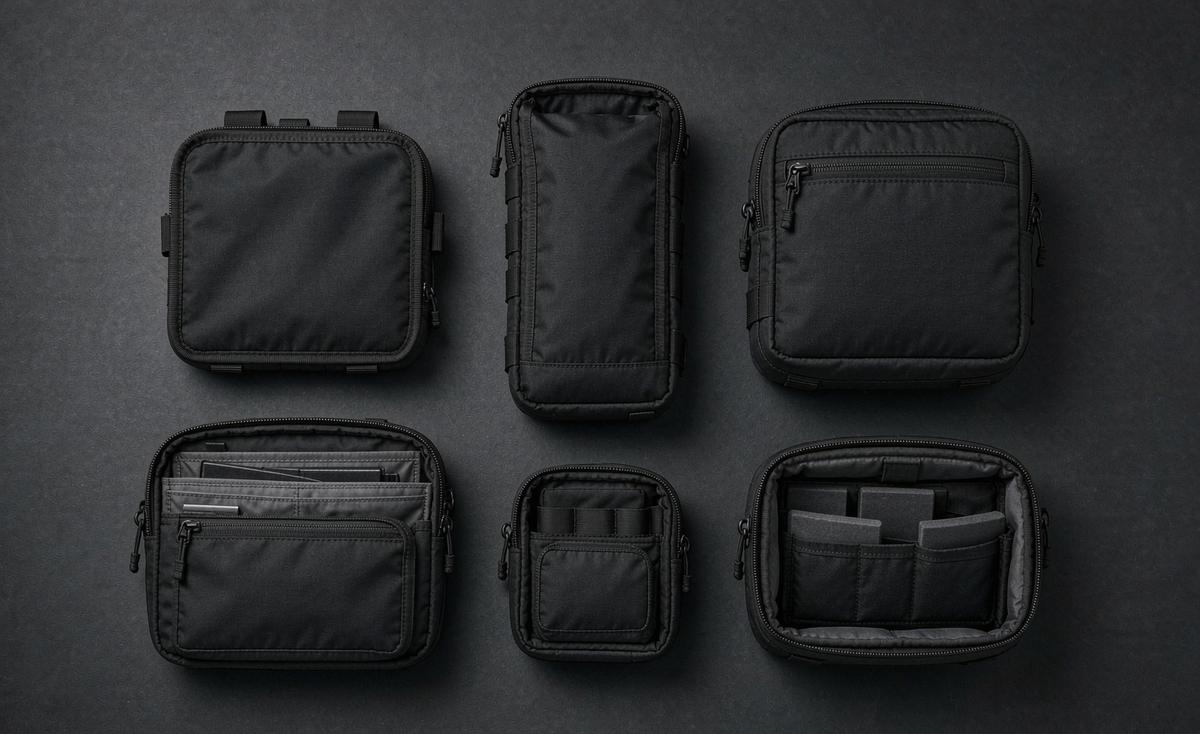
- Where the period-pouch category sits in the crowdfunding rewards landscape
- What a period pouch actually has to do: function before fabric
- Leak-resistant lining grades and how they are specified
- Odour control, washability and the test methods buyers ask for
- Discretion as a design specification, not a marketing adjective
- Certifying the claim: OEKO-TEX, REACH, CPSIA and Prop 65 in practice
- Recycled content, GRS and the evidence behind a sustainability claim
- Cost drivers on a small-format pouch and where the unit price moves
- Planning a first run when the niche is narrow and the minimum is 500
- Packaging and instruction inserts for a category that needs them
- QC checkpoints specific to leak-resistant pouch construction
- Building the RFQ for a compliance-led product category
Where the period-pouch category sits in the crowdfunding rewards landscape
Period pouches occupy a narrow but unusually committed corner of the rewards market. The buyer is not comparing your reward against a generic pouch; they are comparing it against a product category they have strong, specific opinions about. That changes the sourcing brief. Where a general cosmetic pouch can compete on print quality and price, a period pouch has to clear a functional threshold first — leak resistance, cleanability and discretion — before any aesthetic argument is even heard.
For a creator, the practical implication is that the specification carries more of the marketing load than usual. Backers in this niche ask detailed questions in the comments about lining material, seam construction and whether the pouch survives a wash cycle. A campaign page that cannot answer those questions in material terms will lose the segment that was most likely to pledge at the top tier, and that segment is the one most likely to re-order.
It also changes the risk profile. A pouch that leaks is not a disappointing product; it is a product that has failed at its only job, and it will be said so publicly. Our campaign bag specialists treat leak-resistant categories as inspection-led programmes, where the test method is agreed before sampling rather than negotiated after a complaint. The rest of this article sets out how to specify that.
- Minimum order quantity
- 500 pcs per style / colourway
- Sampling
- 6-10 working days (12-15 for complex builds)
- Bulk production
- 35-50 days after deposit + approved pre-production sample
- Inspection
- AQL 2.5 to ISO 2859-1
- Trade term
- FOB Xiamen
- Payment
- T/T 30/70
- Production floor
- 4,950 m² SGS-verified, 137 staff, 7 lines, 149 machines
- Monthly capacity
- 200,000 pcs per month
- Programme contact
- service@junyuanbags.com / WhatsApp +86 177 5002 0688
| Brief element | General cosmetic pouch | Period pouch |
|---|---|---|
| Primary acceptance test | Appearance and print quality | Leak resistance and cleanability |
| Lining specification | Often unspecified or generic | Film type and thickness named in the pack |
| Seam construction | Turned or bound seam is acceptable | Sealed, welded or taped seam required |
| Compliance evidence | Requested at shipment | Requested before sample approval |
| Backer questioning | Mostly aesthetic | Materially technical and specific |
| Failure consequence | Disappointment | Product has failed its core function |
Key takeaways on sourcing a period pouch
- Specify the lining by film type and thickness, not by a trade name or a look.
- Require a sealed, welded or taped seam; a turned seam on a leak-resistant claim will fail in the field.
- Request OEKO-TEX Standard 100 and REACH evidence before sample approval, not at shipment.
- Design discretion as measurable criteria: opacity, closure noise, external branding and silhouette.
- Agree the leak test method and acceptance threshold in writing before the pre-production sample.
What a period pouch actually has to do: function before fabric
Strip the category back and a period pouch has four jobs. It must contain a leak without wetting the bag it sits inside. It must clean completely and repeatedly without retaining odour. It must be openable and closable one-handed, quietly, in a public place. And it must not identify itself to anyone standing nearby. Every one of those is a specification line rather than a marketing line, and each maps to a decision about material, construction or hardware.
- Containment: a lining film with no pinholes, and a seam path that does not perforate it.
- Cleanability: a surface that wipes clean at room temperature and survives a 30°C wash cycle.
- One-handed access: a slider that tracks cleanly and a puller large enough to find without looking.
- Discretion: an opaque shell, a quiet closure, and no external branding that names the category.
- Longevity: coating adhesion that survives repeated wiping without cracking or delaminating.
- Carry compatibility: external dimensions that fit the bag the backer already uses.
Ranking these matters because they conflict. A heavier film contains better but folds less cleanly and adds grams. A covered zipper is quieter but slower to open one-handed. A fully opaque shell is more discreet but hides the contents from the user as well as from everyone else. Writing the ranking into the brief before the first sampling round means the production partner resolves those conflicts the way you would, rather than the way the pattern room finds easiest.
Leak-resistant lining grades and how they are specified
Lining is the component that determines whether the product works, and it is the component most often specified badly. A brief that says waterproof lining invites a substitute; a brief that says 0.15 mm TPU film laminated to 190T polyester, hydrostatic head above 1000 mm, wipe-clean to a defined method does not. Name the film chemistry, the thickness in millimetres, the substrate it is bonded to, and the performance threshold it has to clear, and you have removed the single largest source of disappointment in this category.
| Lining | Typical build | Strengths | Watch points |
|---|---|---|---|
| TPU film laminate | 0.10-0.20 mm TPU on polyester | Flexible, durable, low odour | Higher material cost, needs controlled lamination |
| PUL knit laminate | Polyurethane on knit backer | Soft hand, widely available | Coating quality varies by lot; check adhesion |
| PEVA film | 0.12-0.20 mm PEVA | Low cost, PVC-free | Stiffer hand, can crease permanently |
| PVC film | 0.15-0.30 mm PVC | Excellent containment, cheap | Phthalate restrictions under REACH and Prop 65 |
| Coated polyester | PU-coated 210D-420D | Light, packs flat | Needs sealed seams to be genuinely leak resistant |
The compliance column is the one that decides the shortlist. PVC is the cheapest route to a genuinely impermeable lining and is also the material most exposed to phthalate restrictions in both the EU and California, which is why many programmes in this category specify TPU or PEVA despite the higher material cost. If you do specify PVC, request a full plasticiser declaration tied to the production lot rather than a generic statement, and confirm it against the current REACH Annex XVII entry with your own compliance adviser.
Odour control, washability and the test methods buyers ask for
Odour retention is the complaint that ends repeat purchases, and it is a function of surface chemistry and seam design rather than of any additive. A smooth, non-porous film with no stitched perforations in the wet zone wipes clean and dries without holding anything. A lining that is stitched through in the wet zone, or a coating that has begun to craze, will retain odour no matter what care instructions the insert carries.
- Colour fastness to washing, referenced to ISO 105 C06, with a stated grey scale rating.
- Abrasion resistance on the face fabric, commonly referenced to ASTM D4966 or a Martindale rub count.
- Coating adhesion after repeated wiping, with a defined number of cycles and inspection criteria.
- Water resistance of the shell, expressed as a hydrostatic head in millimetres rather than as a claim.
- Odour assessment after a defined soiling and cleaning cycle, judged against an agreed reference.
Ask which of these are run in-house and which go to an external laboratory, and get the turnaround time in writing before sampling starts. External laboratory testing typically adds one to three weeks to a programme, and on a category where you have promised a performance claim in the campaign copy, that testing is not optional. Build it into the calendar at the same time as you book sampling, not after the pre-production sample is approved.
Discretion as a design specification, not a marketing adjective
Discretion is measurable, and treating it as measurable is what separates a credible product from a pouch with a nice name. Opacity can be tested by placing a high-contrast card behind the shell under a defined light level. Closure noise can be assessed by covering the chain, choosing a finer gauge, and specifying a slide that does not rattle against a metal stop. External branding can be reduced to a woven tab in a matching colourway. None of these are expensive; all of them need to be written down.
The silhouette matters as much as the surface. A pouch shaped like a flat cosmetic case does not attract the second glance that a structured, obviously compartmentalised one does. Where the brief allows it, keeping the pocket architecture internal and the exterior quiet is the single highest-value discretion decision available, and it costs nothing in unit terms. Our cosmetic bag sourcing page includes examples of flat, quiet-shell formats that have worked on campaign rewards.
Certifying the claim: OEKO-TEX, REACH, CPSIA and Prop 65 in practice
Four regimes come up repeatedly on soft goods in this category, and the distinction between them is worth being precise about. OEKO-TEX Standard 100 is a certification scheme applied to textile materials and components against a limit-value catalogue; it is requested more often than any other document in cosmetic-adjacent programmes. REACH Annex XVII is the EU restriction list that applies to substances in articles. CPSIA applies to products marketed to children in the US. Prop 65 is a California warning obligation triggered by listed substances above a threshold.
- Request OEKO-TEX Standard 100 certificates for shell, lining and thread, and check the product class covers your use.
- Ask for a REACH Annex XVII statement from the material supplier, dated and tied to the production lot.
- Confirm CPSIA testing scope where the reward is marketed to children, including coatings, hardware and prints.
- Obtain a Prop 65 assessment for California distribution rather than applying a warning by default.
- Keep certificates with the inspection report so the compliance file travels with the shipment.
- Verify certificate validity dates; expired certificates are a common finding in document checks.
The commercial point is timing. Certificates requested at shipment arrive late, and late certificates delay customs clearance at exactly the moment your backers are waiting. Request them alongside the pre-production sample, verify the scope covers the materials you actually specified, and hold them in the same file as the inspection report. Our QA and QC process page lists the documents we recommend collecting at that gate.
Recycled content, GRS and the evidence behind a sustainability claim
Conscious-consumer categories attract sustainability claims, and sustainability claims attract scrutiny, including from backers. The Global Recycled Standard provides a chain-of-custody framework for recycled content, and a transaction certificate tied to your specific purchase is the document that substantiates a percentage claim. A marketing statement about recycled bottles with no transaction certificate behind it is a liability in a category where the audience reads labels and asks questions in public.
| Claim | Document that substantiates it | Weak substitute to avoid |
|---|---|---|
| Recycled polyester shell | GRS transaction certificate for the lot | A supplier letter with no certificate number |
| Recycled lining film | Chain-of-custody record to the film producer | A generic recycled logo on a spec sheet |
| PVC-free construction | Material declaration listing all films and coatings | An unqualified PVC-free statement |
| Low-impact dyeing | Dye house declaration with process detail | A colour name implying environmental benefit |
| Recyclable packaging | Material identification plus local facility note | The resin code alone |
There is a cost and lead-time dimension too. Certified recycled shell fabrics are typically ordered in specific lots and can carry a material premium and a longer purchase lead time than a stock equivalent. If the campaign page states a recycled content figure, confirm fabric availability at quotation stage rather than at sampling, because discovering a certified lot is unavailable after you have published the claim is a problem that costs both weeks and credibility.
Cost drivers on a small-format pouch and where the unit price moves
Small pouches are deceptive. Because the material area is modest, buyers assume the unit cost will be low, and then find that labour and hardware dominate. On a pouch of roughly 22 x 15 cm, the face fabric is a small part of the cost; the zipper, the lining with sealed seams, the binding, the decoration setup and the finishing labour are where the money sits. This is why a request to upgrade the zipper can move unit cost more than a request to upgrade the shell fabric.
- Lining film grade and thickness: the largest single material variable in a leak-resistant build.
- Zipper chain gauge, slider quality and puller style: dominated by hardware, not by length.
- Seam sealing method: taped, welded or high-frequency, each with different labour and tooling.
- Panel count: every additional panel adds cutting, alignment and sewing operations.
- Decoration method and colour count: screens, foils and thread changes each carry setup cost.
- Packing specification: polybag, insert, barcode and carton count add a small but real amount per unit.
The volume pricing conversation then follows the usual pattern. At 500 pcs per style and colourway the unit cost sits at the entry point of the curve; a re-order at 2,000 pcs typically improves it, mostly through setup amortisation and line efficiency rather than through material savings. Ask for the quotation at two or three quantity breaks so the re-order economics are known before the campaign closes, not discovered afterwards.
Planning a first run when the niche is narrow and the minimum is 500
The most common objection from creators in a niche category is that 500 pcs feels like too many. It rarely is, if the colourway structure is planned properly. The minimum applies per style and colourway, so a single pouch style offered in three colourways is three commitments of 500 unless it is negotiated as a split within one production run. For a first campaign, the cleaner structure is one style, one colourway, 500 pcs, with the palette expansion held for the re-order.
- Model the pledge volume you realistically expect at the tier that carries the pouch, then subtract replacements, press units and retail samples.
- Decide whether a second colourway is worth a second 500 pcs commitment or should wait for the re-order.
- Confirm whether your production partner will accept a colourway split within a single 500 pcs run and at what unit cost impact.
- Price the re-order at quotation stage so the second run is a confirmation rather than a negotiation.
- Build the deposit into the funding target; the 30% payment falls due weeks before all pledges have settled.
A focused category does not change the 500 pcs minimum per style and colourway; it changes how you structure the range. Launch one colourway, prove the pledge volume, and expand the palette on the re-order when demand justifies a second commitment.
Packaging and instruction inserts for a category that needs them
Most pouch rewards ship with a polybag and nothing else. This category should not. A care card covering washing temperature, drying and what to avoid is the difference between a product that performs for years and one that is discarded after a coating failure the user caused without knowing it. A one-page insert is cheap, it is inserted during kit-out, and it materially reduces the complaint rate on a product whose failure mode is visible and embarrassing.
- Care card stating wash temperature, drying method and any cleaning agents to avoid.
- Material identification for the shell and lining, so a user with a sensitivity can check.
- A short statement of what the leak-resistant construction does and does not cover.
- Recycling or end-of-life information appropriate to the destination market.
- Barcode or SKU labelling if the reward will be fulfilled alongside retail inventory.
QC checkpoints specific to leak-resistant pouch construction
Standard bag inspection checks construction, decoration and packing. A leak-resistant pouch needs three additional gates, and all three should be defined before the pre-production sample is approved so the inspector is scoring against an agreed method rather than improvising on inspection day. The first is coating integrity, the second is seam path, and the third is closure performance under load.
| Gate | Method | Failure signal |
|---|---|---|
| Coating integrity | Visual check under defined light for pinholes and thin spots | Any pinhole in the wet zone is a critical defect |
| Seam path | Confirm sealed, welded or taped seam; no needle perforation in wet zone | Stitched-through seam where sealing was specified |
| Closure performance | Fill test with water, invert for a stated duration | Any moisture transfer beyond the lining |
| Slider tracking | Open and close for a stated number of cycles | Catch, skip or separation of the chain |
| Adhesion after wiping | Wipe for a stated number of cycles with a defined cloth | Crazing, cracking or delamination of the film |
Classification matters as much as method. A pinhole in the wet zone is a critical defect because the product has failed its core function; a cosmetic mark on a non-visible interior panel is a minor. Agreeing those classes in writing before inspection means the AQL 2.5 result is interpretable, and it removes the argument about whether a marginal finding is a pass or a fail. More on this sits in our QA and QC guidance.
Building the RFQ for a compliance-led product category
A request for quotation on a compliance-led category has to carry more documentation than a standard pouch RFQ, because the certification scope changes both the material cost and the purchase lead time. Send the pack, the quantity structure, the delivery month, the inspection standard, the trade term and the list of certificates you will require for the destination market, and the quotation you receive back will be usable rather than indicative.
- Tech pack naming the lining film type, thickness and substrate, and the seam sealing method.
- Quantity per style and per colourway against the 500 pcs minimum, with any split proposal stated.
- Target delivery month and destination market, so compliance scope can be priced and scheduled.
- Certificate list: OEKO-TEX Standard 100, REACH Annex XVII, CPSIA where applicable, Prop 65 assessment.
- Inspection standard as AQL 2.5 to ISO 2859-1, with defect classes agreed per component.
- Confirmation of FOB Xiamen and T/T 30/70, or a stated alternative with the reason.
A performance claim belongs in the specification before it appears in the campaign copy, because the specification is what can be tested and the copy is what will be challenged.
Kickstarter Creator Handbook
- Custom cosmetic bags for Kickstarter
- Custom bags for Kickstarter campaigns
- Crowdfunding bag sample prototyping
- QA, QC and inspection on campaign runs
- Low minimum bag production for creators
- Crowdfunding bag guide
- Request a quotation
Specify a pouch that passes its own claims
Send us the tech pack, quantity structure and destination market. As your sourcing partner we will return a unit cost, a sampling estimate, the certificate set required, and a booked production window. Write to service@junyuanbags.com or request a quotation.
Frequently Asked Questions
What is the minimum order for custom period pouches?
The minimum is 500 pcs per style and per colourway. For a niche category this argues for launching one style in one colourway and holding the palette expansion for the re-order, rather than committing to three colours at 500 pcs each on a first run.
Which lining should a leak-resistant pouch specify?
TPU film laminate at 0.10-0.20 mm on a polyester substrate is the usual specification, offering flexibility, durability and low odour. PEVA is a lower-cost PVC-free alternative with a stiffer hand. PVC performs well but carries phthalate exposure under REACH Annex XVII and California Prop 65.
Why is a sealed seam necessary rather than a stitched one?
A needle perforates the film at every stitch, creating a leak path along the seam. A sealed, welded or taped seam closes the panel joint without piercing the barrier. Specifying a leak-resistant lining while allowing a stitched wet-zone seam is the most common cause of field failure in this product type.
How long does sampling take on a period-pouch build?
Standard builds sample in 6-10 working days from a released specification. Builds using high-frequency welding, custom-moulded pullers or certified recycled fabrics move to 12-15 working days, largely because tooling or material lots sit outside the sample line.
What inspection standard should be written into the purchase order?
AQL 2.5 to ISO 2859-1 at general inspection level II, with defect classes agreed per component and additional gates for coating integrity, seam path and closure performance. Naming the standard, the level and the classes together is what makes the inspection result interpretable.
Which certificates should be requested before sample approval?
Request OEKO-TEX Standard 100 for shell, lining and thread, a REACH Annex XVII statement tied to the production lot, CPSIA test reports where the product is marketed to children, and a Prop 65 assessment for California distribution. Requesting these at shipment delays customs clearance.
How is discretion turned into something measurable?
Four criteria cover it: shell opacity tested against a high-contrast card under defined light, closure noise addressed by covering the chain and choosing a finer gauge, external branding reduced to a woven tab in a matching colourway, and a flat silhouette rather than an obviously compartmentalised one.
Does recycled content change the lead time or unit cost?
Usually both. Certified recycled shell fabric is ordered in specific lots and can carry a material premium and a longer purchase lead time than a stock equivalent. Confirm availability at quotation stage if the campaign page states a recycled content figure.
What does a GRS transaction certificate prove?
It substantiates a recycled content claim by tracing the material through the supply chain to your specific purchase. A supplier letter with no certificate number, or a recycled logo on a spec sheet, does not substantiate a percentage claim and should not be relied on in campaign copy.
Should a period pouch ship with a care insert?
Yes. A care card covering wash temperature, drying method and cleaning agents to avoid reduces coating failures caused by the user. It is inserted during kit-out, costs very little per unit, and lowers complaint rates on a product whose failure mode is both visible and embarrassing.
How are the payment terms structured on a first run?
T/T 30/70. The 30% deposit is triggered by written approval of the pre-production sample and releases materials and the production slot. The 70% balance falls due after a passed AQL 2.5 inspection and before cargo is released for loading at FOB Xiamen.
What is the total calendar from specification to delivery?
Plan 12-16 weeks. Two sampling rounds at 6-10 working days each, 35-50 days of bulk production after deposit and approved pre-production 35-50 days for inspection and packing, then 18-38 days of ocean transit from FOB Xiamen depending on destination.
Can a niche pouch share a colourway split within one 500 pcs run?
Sometimes, and it is worth asking. A split within a single production run keeps the total commitment at 500 pcs while offering two or three colourways, though it usually carries a modest unit cost impact and needs agreeing before the sampling round is released.
People Also Ask
Why do period pouches need a different specification from makeup bags?
Because containment is the core function rather than a nice-to-have. A leak-resistant lining named by film type and thickness, plus a sealed seam in the wet zone, are what separate a working product from a pouch that fails publicly.
Is 500 pcs too many for a niche crowdfunding category?
Rarely, if the range is structured as one style in one colourway at 500 pcs. The risk comes from splitting the same style across three colourways, which multiplies the commitment to 1,500 units before demand is proven.
Can I claim recycled content without a certificate?
You should not. A recycled content claim needs a GRS transaction certificate tied to your purchase lot. A supplier letter with no certificate number will not survive a backer asking for evidence.
What makes a pouch closure discreet?
A covered chain, a finer gauge, and a puller that does not rattle against a metal stop. Combined with an opaque shell and no external category branding, the pouch stops announcing itself in public.
How do I test leak resistance before approving a sample?
Agree a fill-and-invert method with a stated volume and duration, then apply it to the pre-production sample. Record the result so the inspector can repeat the same method at AQL 2.5 on the finished run.