Kickstarter Rolltop Backpack: Market Fit and Production Reality
Rolltop backpacks photograph beautifully and convert well, but the closure itself is the expensive part. Plan three full rolls, 25 or 38 mm webbing with a tested buckle, and extra pattern length for the roll panel. Minimum order is 500 pcs per style and colourway, sampling takes 6-10 working days and reaches 12-15 for complex builds, with production 35-50 days after deposit and approved pre-production sample.
- Why the rolltop format converts so consistently
- Choosing 18, 24 or 30 litres for a roll closure
- Roll geometry and how much extra fabric it needs
- Closure hardware options and how they fail
- Fabric behaviour in a panel that folds repeatedly
- Water performance expectations from a rolled top
- Where tooling and pattern cost actually sits
- Line operations unique to a rolltop build
- Defect patterns inspectors should look for
- Unit cost structure of a rolltop construction
- Sampling and lead time reality for rolltops
- Pricing and positioning the rolltop reward
Key takeaways
- A rolltop sells adaptability: one silhouette covering a commute load and a weekend load, which is easier to price than two separate products.
- Budget three full rolls in the pattern, since two reads as improvised and four consumes fabric nobody wants to pay for.
- Webbing width and buckle quality decide whether the closure survives two years of daily use, and they are the first things to fail in field reports.
- The roll panel flexes more than any other part of the bag, so coating creasing and delamination must be assessed during sampling.
- Expect additional cutting and finishing operations versus a zip-top design, reflected in the labour line rather than in any single component.
- Minimum order remains 500 pcs per style and colourway, with inspection at AQL 2.5 to ISO 2859-1 before shipment on FOB Xiamen terms.
Why the rolltop format converts so consistently
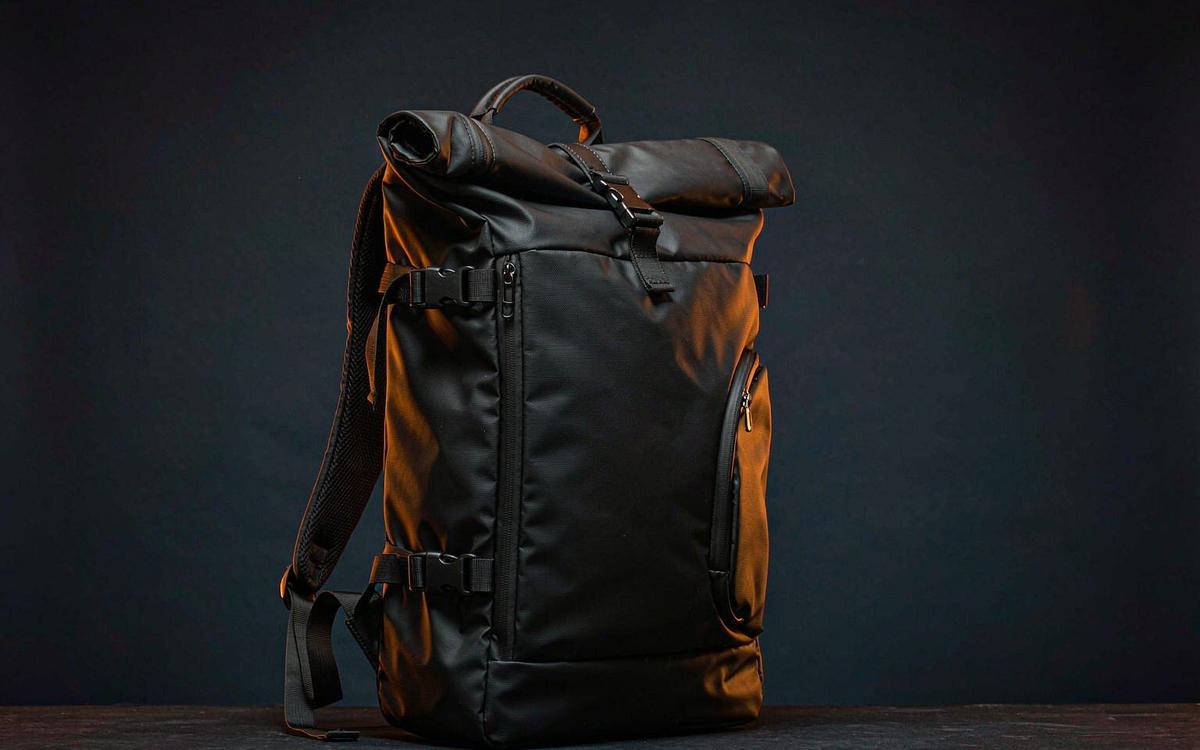
Creators notice that rolltop designs appear disproportionately among funded bag campaigns, and there is a straightforward reason. The closure communicates capacity range visually in a single photograph. Rolled down, the pack looks compact and urban. Rolled up, the same bag looks ready for a weekend. One product therefore serves two purchase motivations, which is a genuinely valuable thing to be able to promise in a reward description.
There is also a search behaviour element. Buyers looking for something between a slim commuter pack and a travel pack use language that maps naturally onto roll closures, so the format benefits from being recognisable rather than novel. Novelty campaigns in this category often struggle to communicate their advantage within the few seconds a pledge decision takes.
Translate that advantage into an audience check before committing. Review the campaigns you admire and record three things: how many reward tiers they offer, whether the roll closure is described in volume terms or only aesthetically, and what the reward prices are once shipping is added. That exercise quickly reveals whether buyers are paying for adaptability or for a look. Where they pay for adaptability, your campaign copy should lead with measured litre ranges; where they pay for the look, photography and fabric selection deserve the larger share of effort.
Before committing, however, distinguish market fit from production reality. Rolltops are pleasant to design and comparatively demanding to build well. The closure section carries more operations than a zippered top, the panel flexes repeatedly in service, and any imprecision in the roll line becomes visible as soon as the pack is closed. Teams that plan for those characteristics ship on time; teams that assume a rolltop is a simple bag with a funny top discover otherwise during week two of sampling.
Choosing 18, 24 or 30 litres for a roll closure
Volume behaves differently here than it does with a fixed-top pack, because the closure adds usable range. Published figures usually describe the rolled-down state, and the expanded figure sits above that by whatever the additional roll height contributes, commonly 20-35% depending on how many rolls you release. Publish both numbers, since that range is precisely what buyers are paying for.
| Rolled-down volume | Typical expanded range | Best fit |
|---|---|---|
| 18 L | 22-24 L | Daily commuter with laptop and charger |
| 22 L | 27-30 L | Mixed office and gym use |
| 26 L | 32-35 L | Weekend trips; overlaps with travel pack positioning |
| 30 L | 36-40 L | Approaches carry-on territory; consider the travel route |
| 34 L and above | Above 42 L | Usually better executed as a dedicated travel pack |
Above roughly 30 litres the design starts competing with purpose-built travel luggage, where a full clamshell opening beats a roll closure for packing and retrieval. If your concept sits in that territory, compare against the analysis in our travel backpack 30L versus 40L comparison before committing to a roll top purely for aesthetic reasons.
Whichever band you select, verify it by measurement rather than by drawing. Fill the pack rolled down with measured litre beads, record the figure, then unroll one or two folds and measure again. Waist published figures on what you measured, and note explicitly whether quoted volumes describe closed or expanded states, because ambiguity on this point generates avoidable complaints after delivery.
Roll geometry and how much extra fabric it needs
The single most consequential specification decision is how many rolls the pattern provides. Three is the working standard. Two leaves the closure feeling insecure under a full load and tends to spring open when the pack is compressed. Four consumes substantially more fabric and adds weight without improving security, which is why it appears mainly in specialist applications rather than everyday carry.
- Decide roll depth, typically 70-110 mm per roll, since this sets how much additional panel length is required.
- Add the corresponding fabric length to the body pattern, remembering that it is cut as one continuous panel with the lining.
- Specify whether the inside face of the roll panel uses a contrasting colour, a common and cheap way to add visual interest.
- Confirm the top edge finishing method, since this is the most handled part of the entire product.
- Mark the first roll position on the panel, either stitched or printed, so users close consistently every time.
Additional panel length has an obvious cost consequence, and it is larger than most founders expect. Extending the body by 250 mm across the full width adds material to every unit, but it also increases cutting waste because that extension is rarely a clean fit within the marker. Ask your production partner to quote the panel extension separately where possible, so the relationship between roll count and cost stays visible rather than buried.
One further geometry question deserves an early decision: whether the roll section tapers. A panel slightly narrower at the top than at the base rolls more neatly and sits flatter once closed, because successive folds of decreasing width stack without bunching at the sides. The trade-off is that tapering complicates the marker and makes lining alignment harder, adding labour minutes to a construction that already carries more handling than average. Make the choice deliberately during round one rather than adjusting it after operators have learned the straight version.
Closure hardware options and how they fail
Hardware is the second distinctive decision and the source of nearly every long-term rolltop failure reported by users. The common options are side-release buckles, ladderlock adjusters, G-hooks with webbing loops, and metal or acetal hooks attaching to a daisy chain of loops down the body. Each has a different feel, a different price, and a different failure signature.
| Hardware | Feel and user experience | Failure signature |
|---|---|---|
| 25 mm side-release buckle | Familiar, fast, quiet | Female housing cracking after cold exposure |
| 38 mm side-release buckle | Confident, more substantial | Higher cost; leverage exposes weak mouldings |
| Acetal or metal G-hook | Premium tactile signature | Webbing loop abrasion where the hook seats |
| Hook plus daisy chain loops | Highly adjustable and rugged | Loop stitching pulled under heavy compression |
| Magnetic folding closure | Neat appearance | Weak retention under load; rarely suitable alone |
| Velcro plus hook backup | Simple and quiet | Hook accumulation of lint over two seasons |
Specifying the brand matters as much as specifying the type. Recognised hardware suppliers publish load data and maintain consistent moulding tolerances, whereas unbranded alternatives vary between batches and frequently crack where a chrome-plated surface meets an internal stress point. Ask named brands to be written into your tech pack, then verify on the pre-production unit that what arrived matches what was specified.
Webbing width interacts with all of this. A 38 mm strap paired with a 25 mm buckle is impossible, obviously, but a 38 mm webbing through a nominally 38 mm buckle that only accepts it when perfectly flat is also a problem, since users will force the fit and progressively fray the edges. Verify threading ease on a physical sample rather than trusting a datasheet, and consider slightly chamfering webbing ends during finishing.
Many buckle failures cluster in winter, because acetal becomes noticeably less impact resistant at low temperature. Before approval, chill two sample units to roughly minus 10 degrees Celsius for four hours and fasten them twenty times. Creaking or whitening at stress points predicts exactly the field failures that otherwise appear in reviews months after dispatch.
Fabric behaviour in a panel that folds repeatedly
The roll section flexes more than any other part of the bag, potentially several hundred times per year of ownership. That repeated creasing is a demanding service condition, and it is where the failure differences between coating methods become obvious. A PU-coated shell used in this position often develops visible crease lines within one season; a TPU-laminated construction generally resists far longer.
- Assess creasing by rolling and unrolling a sample panel fifty times, then inspecting under raking light.
- Avoid very stiff coatings on the roll panel specifically, even where the rest of the body benefits from structure.
- Consider a slightly lighter denier on the roll panel than the body, which rolls more cleanly and reduces bulk at the fold.
- Ask whether the coating is specified for flex resistance, and request evidence rather than accepting a general assurance.
- Inspect for coating adhesion loss after creasing, since delamination begins invisibly before it appears as whitening.
Where the design uses a contrasting interior, remember that this becomes the visible face whenever the bag is open. It is exposed to whatever spills inside, so specify a lining with reasonable cleaning characteristics and check that its coating does not transfer onto the outer shell when folded wet. The material reference in our custom backpacks for Kickstarter notes covers denier and coating combinations suited to repeated folding loads.
Water performance expectations from a rolled top
Buyers assume a rolltop sheds rain, and the assumption is reasonable for a properly executed three-roll closure with adequate overlap. It is not equivalent to a welded seam-sealed chamber, and campaign copy should not imply that it is. Describe the performance honestly: three rolls with taped seams resist sustained rain, while the same closure immersed will eventually admit water at the fold.
Two design details control most of the outcome. The first is roll overlap: each fold should cover the previous fold by a healthy margin, typically 35-60 mm, so that wind-driven water has to travel upward against gravity to enter. The second is whether the side seams above the roll line are sealed, because water running down the body can enter through those perforations above the closure itself.
Where genuinely submerged performance is required, the correct answer is usually RF welded seams plus a purpose-built closure rather than thicker fabric. Those methods bring their own tooling and a longer sampling window, discussed further below, so raise the requirement at RFQ stage rather than after three rounds are complete.
Specification language protects you here. Rather than promising weatherproof performance in general terms, record a measurable target such as a 3,000 mm hydrostatic head tested to ISO 811 on the body fabric, all seams taped, and three rolls with stated overlap distance. That combination can be quoted, sampled and inspected, whereas an adjective cannot. Our waterproof construction notes covering TPU, coated nylon and seams set out the same framework in greater detail for teams going further down this route.
Where tooling and pattern cost actually sits
Rolltop designs rarely need expensive mould tooling unless you specify custom hardware. Most programmes use standard buckles, meaning your development cost concentrates in pattern development instead: getting the roll geometry, panel extension and top edge finishing to produce a clean closed shape.
| Charge type | Applies when | Budget guidance |
|---|---|---|
| Pattern development | Every new design | Usually modest, sometimes credited against bulk |
| Custom hardware tooling | Bespoke buckles or hooks | Four figures; favours larger runs |
| Cutting templates for complex panels | Curved or asymmetric bodies | Small; worth paying for accuracy |
| Logo plates or embossing tooling | Branded hardware | Separate line, sometimes refundable |
| RF welding electrodes | Welded roll construction | Significant; amortise across larger quantities |
The practical advice is to defer custom until after the first successful run. Standard hardware with a woven label achieves most of the branding effect at a fraction of the development risk, and a second campaign can justify bespoke components once volumes are proven. Where custom tooling genuinely matters to the concept, negotiate it during quotation rather than discovering the figure after the design has been costed.
Pattern files themselves are worth retaining properly. Ask that graded patterns for your roll construction are archived against your order reference, so a repeat run does not restart development from the original drawings. Teams that skip this often re-develop geometry on their second campaign, paying twice for work already completed and losing consistency between product generations. The consolidated checklist in our crowdfunding bag guide includes prompts covering exactly this kind of documentation.
Line operations unique to a rolltop build
Compared with a zip-top pack of similar volume, a rolltop involves noticeably more handling. The extended panel has to be aligned with its lining, the top edge has to be finished cleanly because it is both the most visible and most handled area, and any alignment error is displayed permanently every time the bag is closed.
- Panel-to-lining alignment across a long extension, which requires careful laying rather than speed.
- Top edge finishing, usually a bound or turned-and-topstitched method specified by width tolerance.
- Webbing anchoring into the roll structure, where the load path crosses a folding area rather than a static seam.
- Any daisy chain or loop column attaching down the body, each requiring consistent spacing.
- Final shaping and pressing of the roll section before packing, so units photograph cleanly on arrival.
Those operations translate directly into labour minutes, which is why rolltops typically sit above comparable zip-top builds on the conversion line of any cost breakdown. Plan for it. The flip side is that once operators are trained on your specific closure, repeat runs benefit from retained pattern files and muscle memory, so the second order usually behaves considerably better than the first.
Defect patterns inspectors should look for
Pre-shipment inspection runs at AQL 2.5 under ISO 2859-1, which defines sample size and thresholds but not what counts as a defect for your product. That classification is yours to write, and rolltops have a distinctive failure set worth naming explicitly before bulk begins.
| Observation | Proposed class | Reason |
|---|---|---|
| Roll panel creasing along the fold line after packing | Major | Predictable visible ageing on arrival |
| Buckle cracking during cold or repeated cycling test | Critical | Field failure waiting to happen |
| Top edge binding width varying by more than 2 mm | Major | Most visible area of the whole product |
| Webbing loop spacing inconsistent by over 3 mm | Major | Reads as poor workmanship immediately |
| Roll panel misaligned with lining at the sides | Critical | Cannot be corrected by the user |
| Minor dust mark removable in normal handling | Minor | Cosmetic and self-resolving |
Provide that table to inspectors alongside your sealed pre-production reference unit. The combinations matter: they let a third party make defensible judgements rather than negotiate with whoever is present on the day. Our Kickstarter campaign bag QA and QC reference sets out how to attach consequences to each class so remediation follows automatically from a failed check.
Unit cost structure of a rolltop construction
Cost follows lines familiar across bag categories, but the balance shifts. Material rises because of the extended panel, labour rises because of additional handling, and hardware sits above average because the closure is both visible and structural.
| Cost line | Indicative share | Note for rolltops |
|---|---|---|
| Shell fabric | 24-36% | Higher than average because of the roll panel extension |
| Lining and internal fabric | 7-12% | Contrasting roll lining raises this within the band |
| Hardware and trims | 10-18% | Closure quality is visible and load-bearing |
| Zippers | 3-7% | Fewer external zips than a comparable zip-top design |
| Foam and reinforcement | 6-11% | Usually a simpler back panel than technical packs |
| Cut, make and trim labour | 20-30% | Additional handling versus zip-top equivalents |
| Finishing and packing | 4-8% | Rolled shaping and protective interleaving before packing |
Model the total honestly against both directions of comparison. A rolltop usually costs slightly more than a zip-top pack of equivalent size and material, and noticeably less than a technical pack with welded construction. Positioned correctly, the extra cost buys a design that photographs better and serves a wider range of loads, which supports a higher reward tier rather than eroding margin.
Sampling and lead time reality for rolltops
Sampling follows the standard structure of three rounds: a construction prototype in stock fabric, a true-material specification unit, and a pre-production unit built on the bulk line. Standard builds take 6-10 working days per round. Introduce RF welded seams, custom tooling or unusual internal structure and the complex band of 12-15 working days applies, which cascades directly into your campaign calendar.
- Round one: judge whether three rolls close cleanly and whether the top edge finishing plan is practical.
- Round two: assess fabric behaviour in the roll panel, including creasing after repeated folding.
- Round three: confirm batch hardware threads smoothly and that operators can reproduce the alignment.
- Throughout: measure rolled-down and expanded volume by bead fill rather than by estimation.
- Before bulk: cold-cycle two units and inspect every buckle for stress whitening.
production 35-50 days after deposit and approved pre-production sample, followed by inspection and ocean freight on FOB Xiamen terms against T/T 30/70 payment. Creators planning around this should also review our crowdfunding bag sample prototyping notes, which describe how change notes are handled between rounds to prevent avoidable delay.
Pricing and positioning the rolltop reward
Rolltops reward honest communication more than elaborate feature lists. Campaign pages perform best when they show the pack in both states, explain precisely what the volume range means, and demonstrate closure operation on video rather than through edited stills. Buyers want to see the mechanism, because the mechanism is the reason they are choosing this design over alternatives.
- Show both rolled-down and expanded states side by side with the same laptop load inside each.
- Quote both volumes explicitly and state which figure corresponds to which configuration.
- Name the hardware brand and explain why that choice supports daily use over several years.
- Demonstrate fifty cycles of rolling and closing in a single unedited clip.
- State what the closure resists and what it does not, using tested language rather than adjectives.
Pricing should be built from landed cost rather than from competitor pages. Add freight, duty and platform fees to the FOB Xiamen unit cost before choosing a tier figure, because those layers frequently account for 30-45% of what a backer pays. Our crowdfunding rewards fulfilment guide covers the packing and shipping elements in detail, including why bulky rolled units benefit from particular carton strategies.
Programme terms remain constant across all of this: 500 pcs minimum per style and colourway, 6-10 working days of sampling at 12-15 for complex builds, 35-50 days bulk after deposit and approved pre-production sample, AQL 2.5 inspection to ISO 2859-1, and shipment from Xiamen on T/T 30/70 payment. Send drawings and target volumes to service@junyuanbags.com for a costed rolltop quotation.
- Custom backpacks for Kickstarter creators
- Kickstarter campaign bag QA and QC
- Crowdfunding bag sample prototyping
- Crowdfunding rewards fulfilment
- Travel backpack 30L versus 40L comparison
- Request a quotation
- Minimum order quantity
- 500 pcs per style / colourway
- Recommended roll count
- 3 full rolls, 70-110 mm per roll
- Webbing and hardware
- 25 or 38 mm webbing with branded tested buckles
- Roll panel fabric
- Flex-resistant TPU laminated preferred
- Sampling lead time
- 6-10 working days (12-15 days for complex builds)
- Bulk production
- 35-50 days after deposit and approved pre-production sample
- Inspection standard
- AQL 2.5 to ISO 2859-1
- Trade term and payment
- FOB Xiamen; T/T 30/70
- Production capacity
- 4,950 m2 SGS-verified floor, 137 staff, 7 lines, 149 machines, 200,000 pcs monthly
- Company foundation
- 2014, trade roots since 2004
- Contact
- service@junyuanbags.com
Get your rolltop closure costed properly
Send drawings, target volume and preferred hardware. Our production team returns a component-level quotation showing the cost impact of each roll, plus a sampling calendar built around the closure testing this construction needs.
Frequently Asked Questions
Why do rolltop backpacks perform so well on crowdfunding platforms?
The format communicates capacity range in a single frame: rolled down it reads compact, rolled up it suggests weekend capacity, so one product covers 2 purchase motivations and supports a higher reward tier. Campaigns offering 3 or fewer tiers benefit most, since buyers choosing this format are comparing adaptability rather than counting features.
How many rolls should a rolltop backpack pattern include?
Three is the working standard. Two tends to spring open under compression and feels insecure, while four consumes noticeably more fabric and adds weight without improving retention. Specify roll depth of roughly 70-110 mm per fold, and mark the first roll position so users close consistently every time.
Which closure hardware lasts longest on a rolltop?
Branded acetal side-release buckles in 25 or 38 mm are the dependable default, with G-hooks and webbing loop systems offering a more premium tactile signature. Whatever you choose, chill two samples to around minus 10 degrees Celsius and fasten them twenty times, since buckle fractures cluster in cold weather.
How much extra fabric does the roll section require?
Roughly 250 mm of additional panel length beyond a comparable zip-top body for three standard rolls, though the figure varies with roll depth. That extension raises both material cost and cutting waste, since the added length rarely fits cleanly into the marker, so ask for it to be quoted separately.
Is a rolltop backpack waterproof?
A three-roll closure with 35-60 mm overlap and taped seams resists sustained rain well, but it is not a sealed chamber and will admit water if immersed. Describe performance honestly using tested standards rather than adjectives, and note that side seams above the roll line also need sealing.
Does the roll panel fabric need special specification?
Yes. The roll section flexes several hundred times per year, which is the most demanding condition on the bag. Roll and unroll a sample panel 50 times, then inspect under raking light for permanent crease marks and whitening. TPU laminated construction generally resists creasing longer than PU coating, which can show lines within one season.
Why does a rolltop cost more than a zip-top pack of similar size?
Two lines move: material rises because the extended roll panel adds roughly 250 mm of length, and labour rises because aligning long panels, finishing the handled top edge and shaping during packing all add minutes. Expect shell fabric at 24-36% and labour at 20-30% of unit cost.
How long does sampling take for a rolltop design?
Standard builds take 6-10 working days per round across three rounds. Introducing RF welded seams, custom hardware or unusual internal structure moves into the 12-15 working day band, then production 35-50 days after deposit and pre-production approval before inspection and freight.
Do rolltops need custom tooling?
Usually not, unless you want bespoke buckles or hooks. Development cost concentrates in pattern work: roll geometry, panel extension and top edge finishing. Custom hardware tooling typically runs 1,000-3,000 dollars per profile and favours larger runs, so many first campaigns defer it until volumes support amortising the charge.
What defects are most common in rolltop production?
The distinctive set is roll panel creasing from packing, buckle cracking under cold cycling, inconsistent top edge binding width above 2 mm, uneven webbing loop spacing, and roll-to-lining misalignment. Supply a written defect classification alongside your sealed reference unit before inspection begins.
Should I publish rolled or expanded volume?
Publish both and label them clearly. Rolled-down figures typically sit 20-35% below expanded capacity depending on how many folds are released. Measure by litre bead fill rather than trusting a drawing, since lining and structure routinely reduce real capacity below the nominal design figure.
What should the campaign video show about the closure?
Show 50 unedited cycles of rolling and closing, plus both volume states carrying the same laptop load. Buyers choose this format for the mechanism, so honest demonstration outperforms edited montages. Name the hardware brand and state the tested figures, such as 3 rolls at 70-110 mm each and the resulting litre range.
People Also Ask
Are rolltop backpacks practical for daily commuting?
Yes, provided the closure is quick to operate. Three rolls with a 25 or 38 mm branded buckle takes a few seconds, and the format copes with varying daily loads better than a fixed-volume body. Test the mechanism repeatedly during sampling to confirm it stays convenient.
What size rolltop sells best as a reward tier?
A 22-26 litre rolled-down capacity tends to be the sweet spot, expanding to roughly 28-34 litres. Below 18 litres the roll looks decorative, while above 30 litres the design starts competing with travel packs that open more usefully.
Can I use a contrasting lining inside the roll panel?
Yes, and it photographs well when the bag is open. Specify a lining that cleans reasonably and check that its coating does not transfer onto the shell when folded while damp, which otherwise shows as permanent marks along the fold.
Why does the roll on my sample spring open?
Usually because only two rolls were specified, or because the buckle sits too low to compress the fold properly. Increasing to three standard rolls and raising the anchor point typically resolves it without changing hardware.
Is magnetic closure hardware a good idea for rolltops?
Rarely as the primary closure. Magnets give a neat appearance but retain poorly under load, so they work best as a secondary aid alongside a buckle or hook rather than carrying the closing force themselves.