Kickstarter Tech Backpack: USB Ports, RFID Pockets and Backer Expectations
What does a tech backpack reward have to deliver to satisfy backers in 2026? A USB pass-through port that is wired correctly, internal cable routing that survives a year of use, a power bank pocket sized to real banks, and RFID pockets described honestly. Sampling runs 6-10 working days, 12-15 for complex builds, production 35-50 days, inspection AQL 2.5 to ISO 2859-1. Minimum order is 500 pcs per style and colourway on FOB Xiamen terms.
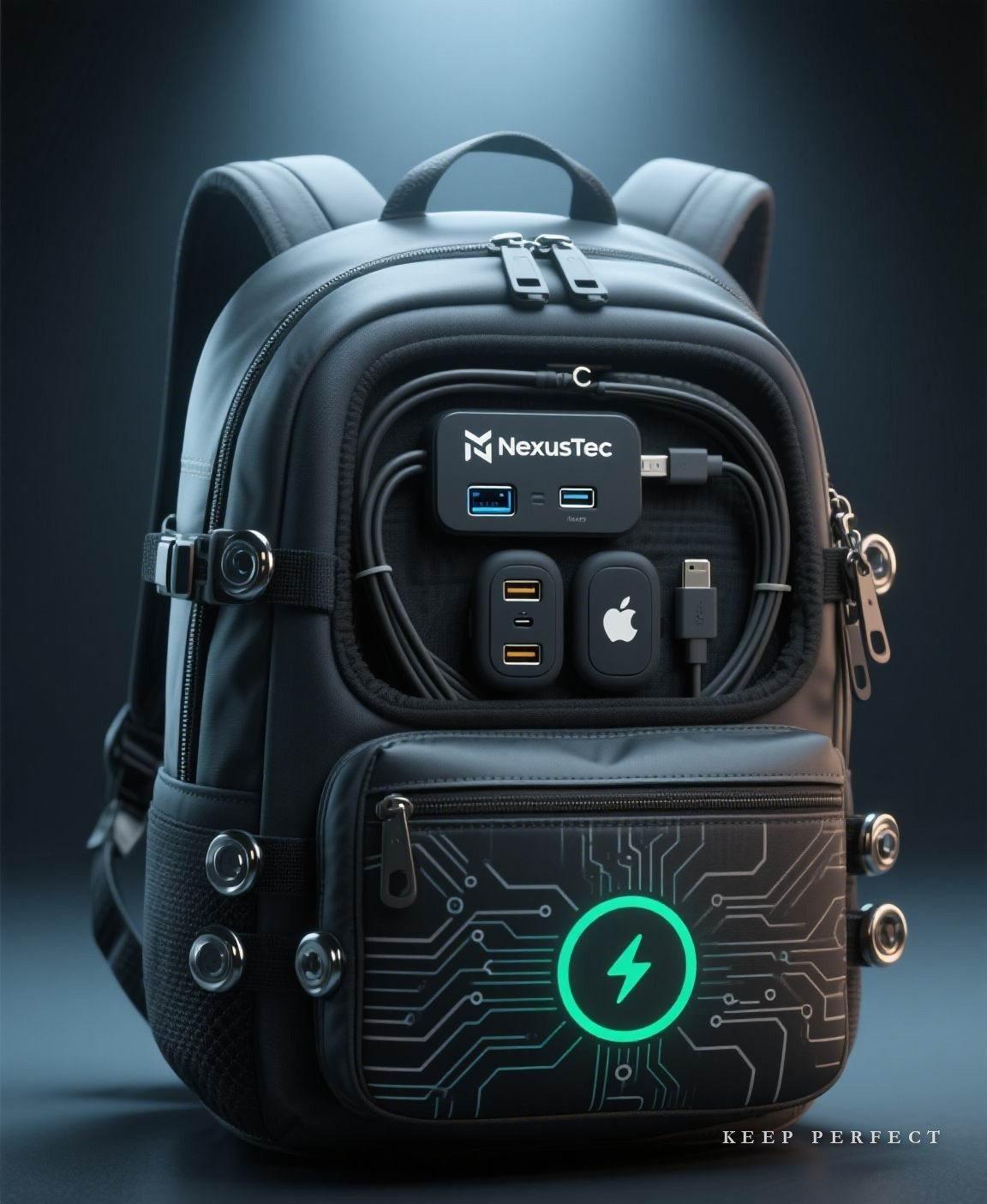
- What backers expect from a tech backpack
- How a USB pass-through port is built
- Cable routing and internal channel design
- Power bank pockets: sizing and safety
- What you may not ship inside the bag
- RFID pockets: placement and honest claims
- Charging specifications backers check
- Failure modes of built-in ports and cables
- Cost breakdown for a connected build
- Compliance and certification for components
- Sampling, testing and the approval checklist
- Reward positioning for a tech carry campaign
What backers expect from a tech backpack
Tech carry has a specific failure pattern on crowdfunding platforms: the campaign promises connectivity and delivers a bag with a hole in the side. Backers who back a tech backpack expect the port to work on day one, the cable to be routed so it does not snag, the power bank pocket to fit the bank they already own, and the device compartment to hold a 16 inch laptop with a charger. None of those expectations are unreasonable, and all of them are specification decisions rather than marketing ones. Getting them right is mostly a matter of writing them down before sampling.
The expectations are also comparative. A tech backpack backed at 129 to 179 USD is measured against retail products in the same band, and the comment section will name them. That means the specification has to be defensible in public: name the port type, name the cable rating, state the maximum device size and state what is included. A bag described as having a charging port without any of that detail reads as unfinished, and it attracts the exact question a creator cannot answer well in a comment thread.
Key takeaways
- A USB pass-through port is a passive coupler, not electronics; it adds roughly 1.80 to 4.20 USD depending on whether the cable is included.
- Internal cable routing must be accessible for repair, or a broken cable turns the whole bag into a return.
- Power banks are almost never shipped inside the bag, because lithium cells are regulated as dangerous goods in air freight.
- RFID pockets should be described by construction and tested band, not by an absolute blocking claim.
- Charging performance depends on the backer's own bank and cable, so state that clearly on the page.
How a USB pass-through port is built
The external port on a tech backpack is a pass-through coupler: a panel-mounted female connector on the outside of the bag, joined by a short internal cable to a matching female connector inside, with the backer's own cable and power bank completing the circuit. There is no circuitry, no voltage regulation and no battery inside the bag. Understanding that is important for two reasons: it keeps the unit cost low, and it keeps the product out of most electrical safety regimes that would otherwise apply to a product containing electronics.
| Option | Added unit cost | Pros | Watch out for |
|---|---|---|---|
| Moulded port housing with USB-A female | 1.80 to 3.00 USD | Familiar, cheap, widely compatible | USB-A is being displaced by USB-C |
| USB-C female pass-through | 2.80 to 4.20 USD | Matches current devices | Connector cost and moulding precision |
| Dual port, USB-A plus USB-C | 4.20 to 6.50 USD | Broadest compatibility | Two internal cables, more assembly |
| Port with a hinged cover | + 0.40 to 0.90 USD | Keeps water and dust out | Cover hinge is a wear point |
| Port with an internal cable included | + 0.80 to 1.60 USD | Ready to use out of the box | Cable rating must be specified |
The port housing is the part that needs engineering attention. It is a rigid component set into a soft panel, and it is subject to the same pull and twist forces as any handle. Specify a moulded housing with a flange that is trapped between the shell and a reinforcement patch, add a backing plate or a washer inside, and ask for a pull test on the assembled panel. A port glued into a fabric panel will work on the sample and fail in month three, which is exactly the timeline that produces reviews after a campaign has closed and the creator has moved on.
Ingress protection is worth specifying too. A port on the outside of a bag gets rained on, and a covered or downward-facing port with a hinged or tethered cover costs well under a dollar extra. Describe the bag as water resistant with a covered port rather than making a rating claim you have not tested. If you want a formal ingress rating, the component has to be tested to a defined standard and the result kept in the technical file, which is a decision to make at quotation stage rather than after funding.
Cable routing and internal channel design
Routing is where a connected bag is either a product or a frustration. The internal cable has to run from the external port to the power bank pocket without crossing a compartment the user opens daily, without creating a loop that catches on a laptop, and without being trapped under a lining panel that cannot be opened. The clean solution is a dedicated channel: a fabric sleeve or a webbing tunnel sewn into the lining, with an access opening at each end so the cable can be replaced.
- Route the cable along a side or back panel, never across the main compartment opening.
- Sew a dedicated sleeve with an opening at both ends so the cable can be withdrawn and replaced.
- Leave 30 to 50 mm of slack at each end so the cable is not under tension when the bag is loaded.
- Secure the cable with a hook-and-loop tab at the mid point so it cannot migrate inside the sleeve.
- Mark the internal connector position on the lining so backers find it without searching.
Design for repair, because cables fail. A bag with a permanently trapped cable is a bag with a single point of failure, and a backer with a broken cable will ask for a replacement bag rather than a replacement cable. An accessible sleeve lets you ship a two dollar spare cable instead of processing a forty dollar return. That decision also improves the campaign story: a replaceable cable reads as considered design, and it is the kind of detail that gets mentioned in reviews by the backers who understand how these products fail.
Specify a sleeve with an opening at both ends and 30 to 50 mm of slack, so a spare cable can be threaded through in minutes. A trapped cable turns a two dollar failure into a full product return, and returns are the most expensive line in a campaign budget.
Power bank pockets: sizing and safety
The power bank pocket is a specification most campaigns get wrong by guessing. Common power banks range widely in size, but a pocket dimensioned to roughly 160 by 80 by 25 mm accommodates the majority of 10,000 to 20,000 mAh banks on the market. Dimension the pocket against the two or three banks you name on the campaign page, leave 5 to 10 mm of clearance so the bank can be withdrawn easily, and add a retention strap or an elastic loop so it cannot slide to the bottom of the compartment.
- Pocket lined with a smooth fabric so the bank slides in without snagging.
- A small hook-and-loop or elastic retention strap across the top of the pocket.
- A cable pass-through grommet from the pocket to the sleeve, sized to the connector.
- Ventilation is not required for a bank in normal use, but avoid sealing it inside foam.
- Place the pocket away from the back panel so a hard bank does not press into the wearer's back.
Placement has a comfort dimension that is easy to overlook. A 20,000 mAh bank is a hard, dense object, and if the pocket sits against the back panel it becomes a pressure point within an hour. Put the pocket in the lower side of the main compartment or in a dedicated front pocket, and keep it away from the device sleeve so the bank and the laptop are not stacked against each other. That separation also reduces the chance of a hard object pressing into a screen through the lining.
What you may not ship inside the bag
This is the question that most often derails a tech backpack campaign. Lithium cells are regulated as dangerous goods in air transport, and a power bank shipped inside a bag is a declared lithium shipment with packaging, labelling and documentation requirements, plus UN 38.3 test evidence for the cell. Most campaign creators resolve this by not shipping a power bank at all: the bag ships with the port and the cable, and the backer supplies the bank. That is the default for good reason, and it should be stated plainly on the campaign page.
If you do intend to include a bank, plan it as a separate compliance and logistics project rather than as an accessory decision. The cell needs UN 38.3 test documentation and a supplier who can provide it, the shipment needs the correct dangerous goods declaration and packaging, and some freight forwarders will not carry it at all on certain lanes. The cost of getting this wrong is not a fine alone; it is a container held at the port while the campaign's delivery date passes. Ask your freight partner before you promise it, and read the restriction as a design constraint rather than as paperwork.
Cables and small electronics accessories that ship with the bag are treated differently from cells and are normally straightforward, but they still need documentary compliance. A cable supplied with the product should carry the relevant certification for the markets you sell into, and its materials need to meet the same chemical requirements as the bag. Details on component documentation are covered below, and fulfilment planning is set out on crowdfunding rewards fulfilment.
RFID pockets: placement and honest claims
An RFID pocket is a card slot or a small zipped pocket lined with a metallised shielding fabric. The material attenuates the radio field used by contactless payment cards, so a reader held against the outside of the bag cannot interrogate a card inside the pocket. It is a cheap feature, typically 0.90 to 2.20 USD depending on the area covered, and it is more often misdescribed than misbuilt. Backers who care about it will test it with a phone, so the claim on the page has to match what the production unit does.
- Line only the card pocket, not the whole bag, which keeps weight and cost down.
- Test the sample with a contactless reader at 13.56 MHz, the band used by contactless payment.
- State that the pocket is lined with a shielding fabric rather than claiming the bag blocks all signals.
- Place the pocket in an easily reached position, because an inaccessible pocket does not get used.
- Confirm the shielding fabric has a material declaration covering the chemical requirements of your markets.
Placement is a usability decision more than an engineering one. The most effective position is a slot panel inside the main compartment near the top, or a zipped pocket on the back panel that is reachable without opening the bag. Card slots in the strap are a popular variant and work well, provided the slot is not so tight that it deforms the card. Whichever position you choose, test it in the sample with a real card and a real reader, and keep the result with the approval record.
Charging specifications backers check
The charging performance of a pass-through setup depends on three things, only one of which you control: the power bank's output capability, the cable's current rating and connector quality, and the port's own current handling. The bag contributes the port and, if you supply it, the cable. That means the honest campaign statement is that the bag provides a pass-through connection and that charging speed depends on the bank and cable the backer uses. Overstating this is a common and avoidable source of disputes.
| Item | What to state | Why it matters |
|---|---|---|
| Port type | USB-A and or USB-C female pass-through | Sets accessory compatibility expectations |
| Cable rating | Rated current and length if included | Prevents under-performance complaints |
| Power bank | Not included, backer supplies their own | Lithium shipping rules and cost |
| Max device size | Largest laptop the sleeve fits, in inches and cm | The most checked specification on the page |
| RFID pocket | Lined with shielding fabric, tested at 13.56 MHz | Accurate and testable by the backer |
| Water resistance | Water resistant with covered port, not waterproof | Defensible without a formal rating test |
If you supply a cable, specify it properly: connector type, length, current rating and jacket material. A cable rated for 2 A used with a bank capable of 3 A will charge slowly, and the backer will blame the bag. Supply a cable rated at or above the output of the banks you expect backers to use, or do not supply one and say so. Either approach is defensible; a mismatch is not. Our production team can source a cable to a stated rating and hold the supplier declaration against the order.
Failure modes of built-in ports and cables
Every connected bag has the same four failure modes, and all of them are designable out. The port pulls away from the panel under load. The internal cable fractures at the connector strain relief. The connector loosens and makes intermittent contact. The cover hinge breaks. Each has a specification answer: a flanged housing with a backing plate, a cable with a moulded strain relief, a connector seated and tested rather than pushed in, and a cover hinge specified for a cycle count rather than chosen from a photograph.
- Port pull: flanged moulded housing, reinforcement patch, backing plate, pull test to specification.
- Cable fracture: moulded strain relief at both connectors, plus slack in the sleeve.
- Intermittent contact: connector seated and continuity tested on every unit at inline inspection.
- Cover hinge failure: specify a cycle count, typically 1,000 to 3,000 open and close cycles.
- Water ingress: downward-facing port with a tethered cover and a covered zip above it.
Build the continuity check into production. A pass-through port that is wired incorrectly or seated badly will not be visible in a visual inspection, so specify a continuity test on every unit at the point where the cable is connected, before the lining is closed. That is a few seconds per bag and it converts an invisible defect into a measured one. Add a sample pull test on the port housing at final inspection, and keep the results with the inspection report as evidence that the build matches the approved sample.
Cost breakdown for a connected build
A connected backpack costs more than a conventional commuter pack for three reasons: the port component and its housing, the additional assembly operations, and the extra inspection steps. The table below is a representative 22 L build at 500 pcs quoted FOB Xiamen, including a USB-C pass-through port, an internal cable, a power bank pocket and a lined RFID card panel. Use it as a template and adjust the line items to your own specification.
| Line item | Cost per unit | Notes |
|---|---|---|
| Shell fabric, 600D polyester with coating | 6.60 | Recycled GRS option adds 0.40 to 0.90 |
| Lining and internal panels | 3.20 | Includes sleeve fabric for cable routing |
| Padding: EVA back panel, device sleeve foam | 4.10 | Suspended sleeve with false bottom |
| Zips, number 8 main plus number 5 secondary | 4.40 | Covered runs at the device compartment |
| USB-C pass-through port and moulded housing | 3.60 | Dual port option adds 1.40 to 2.30 |
| Internal cable, rated, with moulded strain relief | 1.20 | Length specified in the tech pack |
| RFID shielding liner for the card panel | 1.60 | Sized to the pocket area |
| Hardware, webbing, binding, elastic | 3.30 | Standard catalogue components |
| Labels, hangtag, polybag | 1.00 | Warning and specification text approved early |
| Cut, make and trim labour | 12.80 | Higher than a commuter pack of same volume |
| Overhead, inline and final inspection | 3.60 | Includes continuity test on every unit |
That build totals roughly 45.40 USD FOB at 500 pcs, easing to about 39 to 42 USD at 2,000 pcs. Landed cost after sea freight of 6 to 11 USD and duty sits near 50 to 64 USD, which supports a pledge in the 139 to 179 USD band with room for fees, processing and a contingency. Pricing below about 119 USD with this specification leaves very little once the platform fee near 5 percent and payment processing of 3 to 5 percent are deducted. Landed cost planning is covered in the crowdfunding bag guide.
Compliance and certification for components
A bag with a port and a cable is a textile product with an accessory, and each part carries its own obligations. The bag itself follows the normal textile route: REACH for substances of very high concern in the European Union, EU GPSR for the general product safety obligations, CPSIA where the product is a children's product in the United States, and Prop 65 in California where a listed substance is present above a threshold. The added components add two more: the cable and the port housing need their own material declarations and, for the cable, the applicable product certification for the markets you sell into.
- Request material declarations for the port housing, the cable jacket and any plated component.
- Confirm the cable carries the certification expected in your destination markets before you commit to it.
- Screen the shielding fabric and the coated shell against the chemical requirements of those markets.
- Keep supplier declarations, test reports and the approved reference sample together as one technical file.
- State clearly on the page that no power bank is included, and why.
Documentation discipline pays off twice. It protects the shipment at import, and it lets you answer the campaign question that always arrives: is this safe to carry and charge from? A creator who can point to material declarations and a cable certification answers that in one comment and gains credibility for the rest of the page. A creator who cannot will spend the campaign defending it. Ask for the documentation pack at quotation stage so it is part of the deliverable rather than a favour requested later.
Sampling, testing and the approval checklist
A connected build with a moulded housing and a routed cable is a complex build, so plan 12-15 working days of sampling rather than the 6-10 needed for a standard construction. The extra time goes into fitting the housing into the panel, resolving the sleeve geometry, and running the fit checks. Plan two rounds as usual: the first for layout and ergonomics, the second as the pre-production sample that bulk is matched against, approved in writing with a retained reference.
- Minimum order quantity
- 500 pcs per style / colourway
- Sampling lead time
- 12-15 working days for connected builds
- Bulk production
- 35-50 days after deposit and approved pre-production sample
- Inspection standard
- AQL 2.5 to ISO 2859-1
- Inline check
- Continuity test on every unit at cable connection
- Trade term
- FOB Xiamen
- Payment terms
- T/T 30/70
- Production floor
- 4,950 m2, SGS-verified
- Team and equipment
- 137 staff / 7 production lines / 149 machines
- Monthly capacity
- 200,000 pcs
Write the approval checklist before the first sample arrives, so the evaluation is objective rather than impressionistic. Require a continuity test on the pass-through path, a pull test on the port housing, a fit test with the named power bank, a contactless read test on the RFID pocket, a cycle test on the port cover, and a loaded wear test to confirm the cable sleeve does not snag. Those six checks take under an hour and they are the whole difference between a connected bag that works and one that generates returns. The process is set out on crowdfunding bag sample prototyping.
On a connected bag, test the connection on every unit, because a fault there is invisible until the backer tries to charge a phone.
Programme coordinator, connected build briefing
Reward positioning for a tech carry campaign
Tech carry converts on specification, so the campaign page should lead with the port type, the device size, the cable rating and the pocket layout, and treat the connectivity as a feature of a good bag rather than as the whole proposition. The strongest positioning is a commuter backpack that happens to be wired, because that product still works if the backer never uses the port. A bag whose entire identity is the port has nothing left when a cable fails.
- Early bird at 119 to 139 USD capped at 150 to 300 units, identical construction to the standard tier.
- Standard reward at 149 to 179 USD, positioned against retail products in the same band.
- Add-on spare cable at 9 to 14 USD, which is cheap to supply and reduces future support load.
- Add-on packing cube or cable organiser at 19 to 29 USD, using the same shell fabric.
- Duo pack at 269 to 329 USD for teams, which lifts average pledge without new engineering.
Plan the re-order with the component supply in mind. Port housings and rated cables are sourced from component suppliers with their own lead times, and a re-order six months later may face a different component availability picture. Ask your sourcing partner to hold the approved component specification and, where the volume justifies it, to reserve the component against a likely re-order. That is a small commitment that protects the second run. Order planning is covered on low MOQ bag production for creators, and inspection method on Kickstarter campaign bag QA and QC. Related reading is indexed on the blog.
Specify the electronics before you promise them
Send your port preference, device sizes and target quantity to service@junyuanbags.com. Our production team will return a cost breakdown at 500 and 2,000 pcs, a component documentation checklist, and a 12-15 working day sampling plan with defined electrical and mechanical checks.
Frequently Asked Questions
What is a USB pass-through port on a backpack?
It is a passive coupler: a panel-mounted female connector on the outside of the bag joined by a short internal cable, typically 25 to 40 cm, to a matching connector inside. There are no electronics and no battery in the bag. The backer supplies the power bank and the device cable, which is why charging speed depends on their equipment.
How much does a USB port add to the unit cost?
A moulded USB-A housing typically adds 1.80 to 3.00 USD, and a USB-C version 2.80 to 4.20 USD. A dual port adds 4.20 to 6.50 USD, and supplying a rated internal cable adds a further 0.80 to 1.60 USD. A hinged cover adds about 0.40 to 0.90 USD.
Can I ship a power bank inside the backpack?
Almost never in practice. Lithium cells are regulated as dangerous goods in air transport, requiring UN 38.3 cell test evidence, specific packaging, labelling and a dangerous goods declaration. Most campaigns ship the bag with the port and cable only and state clearly that the backer supplies the bank.
How should the power bank pocket be sized?
A pocket of roughly 160 by 80 by 25 mm accommodates most 10,000 to 20,000 mAh banks. Leave 5 to 10 mm of clearance so the bank withdraws easily, add a retention strap, and place the pocket away from the back panel so a hard bank does not press into the wearer.
Should the bag use USB-A or USB-C?
USB-C matches current devices and costs 2.80 to 4.20 USD against 1.80 to 3.00 for USB-A. A dual port at 4.20 to 6.50 USD gives the broadest compatibility but needs two internal cables and more assembly time, which raises the defect risk slightly.
How is RFID shielding described accurately?
State that the card pocket is lined with a shielding fabric and, if tested, that it attenuates the 13.56 MHz band used by contactless payment. Avoid absolute claims of blocking all signals, because shielding performance is frequency-specific and backers can test it themselves with a phone.
How much does an RFID pocket add to unit cost?
Lining a card pocket or small zipped pocket typically adds 0.90 to 2.20 USD, scaling with the area covered rather than the number of slots. Lining an entire compartment can exceed 4 USD and adds weight for little practical benefit.
How long does sampling take for a connected backpack?
12-15 working days rather than the standard 6-10, because the port housing has to be fitted into the panel and the cable sleeve geometry resolved. Plan two rounds, with the second approved in writing against a continuity test, a pull test and a fit test with the named power bank.
What is the MOQ for a custom tech backpack?
500 pcs per style and colourway. At that quantity a representative connected 22 L build totals roughly 45.40 USD FOB Xiamen, easing to about 39 to 42 USD at 2,000 pcs, so model both quantities before setting the pledge.
What inspection checks apply to a built-in port?
Specify a continuity test on every unit at the point where the cable is connected, before the lining is closed, plus a pull test on the port housing at final inspection. Inspection overall runs at AQL 2.5 to ISO 2859-1, with defect classes defined in advance.
Do cables supplied with the bag need certification?
Yes. A cable shipped with a product should carry the certification expected in your destination markets and have a material declaration covering the jacket and connectors; budget 0.80 to 1.60 USD for a rated cable. An under-rated cable causes slow charging complaints that backers attribute to the bag.
How should I price a tech backpack reward?
A representative connected build lands at 50 to 64 USD after freight and duty, which supports a pledge in the 139 to 179 USD band. Below about 119 USD the same specification leaves too little once platform fee and payment processing are deducted.
Can the internal cable be replaced if it fails?
It can if you specify a sleeve with an opening at both ends and 30 to 50 mm of slack. That turns a two dollar failure into a spare cable shipment rather than a full product return, and it is the specification detail that reduces campaign returns most.
People Also Ask
Do tech backpacks with USB ports actually work?
They work as a pass-through connection, not as a power source. The port connects your own power bank inside the bag to your own cable outside it, so performance depends on the bank output and cable rating rather than on the bag itself.
Why do tech backpack campaigns not include a power bank?
Lithium cells are regulated as dangerous goods in air freight, needing UN 38.3 test evidence, specific packaging and a dangerous goods declaration. Most creators ship the port and cable only and state clearly that the backer supplies the bank.
What laptop size should a tech backpack fit?
State the largest device the sleeve accommodates in both inches and centimetres, with the sleeve suspended and a false bottom of at least 15 mm of foam. It is the most checked specification on a tech carry campaign page.
Are RFID pockets worth adding to a backpack?
Yes as a cheap, testable feature. Lining a card pocket costs 0.90 to 2.20 USD and blocks a contactless read at 13.56 MHz, but describe it as a lined pocket with a tested band rather than as complete signal blocking.
How do I stop the USB port breaking?
Specify a flanged moulded housing with a reinforcement patch and backing plate, a cable with moulded strain relief, and a pull test at inspection. A port glued into fabric works on the sample and typically fails within a few months of use.