Carton Marking and Master Carton Specs: A Quick Guide
What should a master carton specification for a crowdfunding bag reward contain? Four things: the board construction and strength value, the pack-out and carton dimensions, the weight and stacking limits, and the marking set. Get these right before bulk and the goods survive transit and reconcile at goods-in. Sampling runs 6-10 working days, production 35-50 days, inspection at AQL 2.5.
- What the master carton actually does
- Corrugated board: construction, flute and strength values
- Sizing the carton from pack-out maths
- Weight limits, stacking and compression
- Shipping marks: what goes on the outside
- Side marks and carton numbering
- Barcodes, GS1 and pallet labels
- Palletisation: patterns, heights and container fit
- Damage prevention: void fill, drop and humidity
- Compliance markings by destination market
- Documentation that travels with the cartons
- Writing the carton specification into your RFQ
What the master carton actually does
The master carton is the outer shipping container that holds multiple unit-packed bags, and it does four jobs at once. It protects the units through handling, stacking and transit. It identifies the contents without being opened. It lets a warehouse count and reconcile the shipment. And it carries the markings that let customs classify and clear the goods. A specification written to only one of those four jobs will fail at the other three.
Most campaign programmes under-specify the carton because it feels like a commodity. It is not. Carton volume drives the freight line, carton strength drives the damage rate, and carton marking drives the reconciliation cost at the fulfilment warehouse. All three are priced into the reward margin, and all three are set in a one-page specification that most creators never write.
The remedy is to treat the carton as part of the tech pack rather than as a packing-day decision. Carton board, dimensions, pieces per carton, weight limit, marking set and numbering convention all need to be agreed at sample approval, because that is when cartons are ordered. Our crowdfunding rewards fulfilment page covers how the marking set is used downstream, and the crowdfunding bag guide sets out the full specification sequence.
- Minimum order quantity
- 500 pcs per style / colourway
- Sampling
- 6-10 working days (12-15 for complex builds)
- Bulk production
- 35-50 days after deposit + approved pre-production sample
- Inspection
- AQL 2.5 to ISO 2859-1
- Trade term
- FOB Xiamen
- Payment
- T/T 30/70
- Production floor
- 4,950 m² SGS-verified, 137 staff, 7 lines, 149 machines
- Monthly capacity
- 200,000 pcs per month
- Programme contact
- service@junyuanbags.com
Key takeaways on master carton specs
- Name board construction, flute and a measurable strength value, not a description.
- Size the carton from pack-out maths, then round to a standard palletisable dimension.
- Set a gross weight limit per carton and design the stack height around it.
- Print marks on two adjacent faces and number cartons sequentially.
- Include the marking set in the tech pack so cartons can be ordered at sample approval.
Corrugated board: construction, flute and strength values
Corrugated board is a liner-flute-liner sandwich. Single wall is three plies, one fluted medium between two liners. Double wall is five plies, two mediums and three liners. Triple wall is seven. Each step up roughly doubles the stacking strength and adds meaningful material cost, so the right choice is the lightest construction that survives your actual transit, not the heaviest one available.
| Flute | Approximate height | Characteristics | Typical use |
|---|---|---|---|
| A flute | 4.5-5.0 mm | Best cushioning and stacking | Heavy or fragile cargo |
| C flute | 3.5-4.0 mm | Balance of cushioning and compression | General shipping cartons |
| B flute | 2.5-3.0 mm | Flat surface, good crush resistance | Printed retail cartons |
| E flute | 1.1-1.6 mm | Very flat, good print surface | Retail display cartons |
| BC double wall | 6.0-7.0 mm | High stacking strength | Export cartons, long ocean transit |
Strength has to be stated as a measured value, and there are two conventions. The bursting test measures resistance to rupture and is quoted in kilopascals or pounds per square inch, with 200 lb test a long-standing benchmark for export cartons. The edge crush test measures top-to-bottom compression strength and is quoted in kilonewtons per metre or pounds per inch, with 32 ECT the common standard grade. Name one, with the figure, in the specification.
- State the construction: single wall 3-ply, double wall 5-ply or triple wall 7-ply.
- State the flute: B, C, BC or another profile as appropriate to the cargo.
- State the strength: either a burst value or an ECT value, with units.
- Specify liner weight in grams per square metre where print quality matters.
- Ask for the mill certificate or test report on the first bulk carton order.
- Confirm whether the carton is recyclable or carries recycled content for your market claim.
Sizing the carton from pack-out maths
Carton dimensions should follow from the folded unit, not from a convenient stock size. Measure the folded unit at its thickest point, decide the pieces per carton from the weight limit, work out the internal arrangement, and only then pick a standard dimension that accommodates it. Working in the other direction, picking a stock carton and filling it, is how void space and crushed units both end up in the same shipment.
The arithmetic is simple and worth doing twice. A folded tote at 30 cm by 25 cm by 3 cm with tissue stuffing might pack 12 units per layer and four layers deep, giving 48 units in a carton of roughly 62 cm by 52 cm by 34 cm. Multiply the three dimensions to get cubic metres per carton, divide the order quantity by the pack-out to get the carton count, and multiply the two to get total shipment volume. That is the number your freight quote is built on.
| Input | Value | Derived figure | Result |
|---|---|---|---|
| Folded unit | 30 x 25 x 3 cm | Units per carton | 48 |
| Carton internal | 60 x 50 x 32 cm | Cubic metres per carton | 0.096 |
| Order quantity | 500 pcs | Cartons required | 11 |
| Carton gross weight | About 16 kg | Total gross weight | About 176 kg |
| Shipment volume | 11 cartons | Total cubic metres | About 1.06 |
Rounding matters at the pallet level more than the carton level. A carton dimension that leaves an awkward overhang on a standard pallet wastes cubic metres across every layer, and the waste multiplies across the container. Where two carton sizes are close, prefer the one that tiles the pallet footprint cleanly, even if it carries marginally more void space per carton. That trade is almost always worth making.
- Measure the folded unit at its thickest point, including stuffing and inserts.
- Decide pieces per carton from the weight limit, not from the carton volume.
- Design the internal arrangement, then pick the standard carton that fits it.
- Prefer carton footprints that tile the pallet without an overhang.
- Recalculate cubic metres after any change to fold method or pack-out.
Standard carton sizes exist for a reason: they tile standard pallets and box makers stock them at short lead times. Where the pack-out maths gives an internal dimension close to a standard size, take the standard size and adjust the pack-out rather than ordering a bespoke carton. A bespoke size only pays for itself at volumes where the saved cubic metres exceed the tooling and minimum-quantity cost.
Weight limits, stacking and compression
Every carton specification should carry a gross weight limit, and the limit should come from how the carton will actually be handled. Where cartons are moved by hand at both ends, a working limit around 15-20 kg keeps the operation safe and reduces drop damage. Where cartons are palletised and moved by machine, higher limits are workable, but the stack then has to be designed around compression rather than lifting.
| Gross weight band | Handling method | Board guidance | Marking |
|---|---|---|---|
| Up to 15 kg | Manual handling, one person | Single wall C flute | Standard shipping mark |
| 15-20 kg | Manual handling, may need two people | Single wall high performance | Standard shipping mark |
| 20-25 kg | Team lift or mechanical assist | Double wall BC | Weight marking recommended |
| 25-30 kg | Mechanical handling only | Double wall, high ECT | Weight marking required in several markets |
| Above 30 kg | Palletised, mechanical handling | Double or triple wall | Confirm with the destination warehouse |
Compression is the failure mode most creators have never considered. A carton at the bottom of a container stack carries every carton above it, for weeks, in humidity that softens the board. The practical mitigations are cheap: specify a board with an adequate ECT value, fill the void so the carton cannot settle, keep the stack height within what the board can carry, and add desiccant where the route is humid.
Shipping marks: what goes on the outside
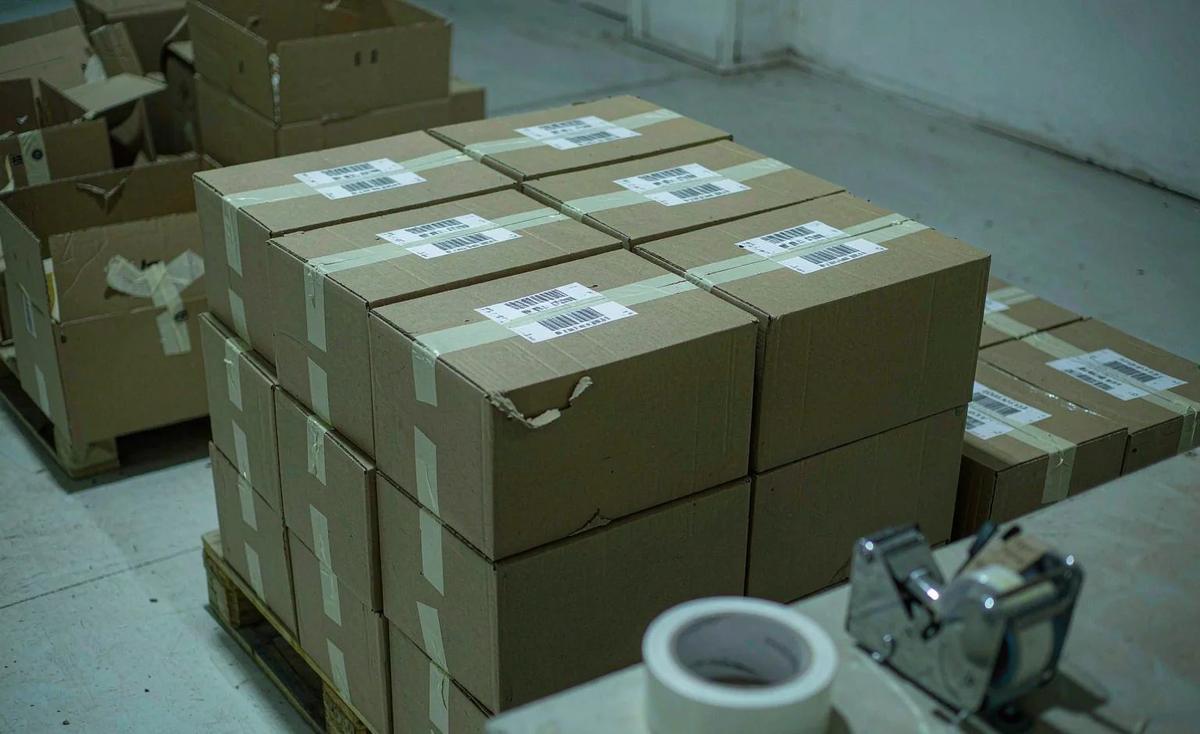
Shipping marks are the printed information on the outside of the carton, and they fall into two groups: the main mark and the side mark. The main mark identifies the shipment. The side mark identifies the contents of that particular carton. Together they let a warehouse move, count and put away a container without opening a single box, which is the whole point.
Consignee or receiving warehouse, destination, purchase order number, and carton number shown as n of N. If any one of these is missing, the warehouse cannot reconcile or route the carton without opening it, and every opened carton is a handling charge and a delay.
| Field | Group | Example | Why it is there |
|---|---|---|---|
| Consignee name | Main mark | Receiving warehouse | Routes the carton at the destination |
| Destination port or city | Main mark | Rotterdam | Confirms the routing |
| Purchase order number | Main mark | PO-2027-0142 | Ties cartons to the order |
| Country of origin | Main mark | Made in China | Required by customs in most markets |
| Carton number | Side mark | 7 of 42 | Enables reconciliation and partial put-away |
| Item or SKU code | Side mark | TOTE-BLK-01 | Enables picking without opening |
| Quantity in carton | Side mark | 48 pcs | Confirms the pack-out |
| Net and gross weight | Side mark | 15.2 / 16.4 kg | Customs and handling |
| Carton dimensions | Side mark | 62 x 52 x 34 cm | Freight and warehouse planning |
Print marks on two adjacent faces rather than on the top. Cartons are stacked, wrapped and turned, and a top-only mark disappears the moment a second carton lands on it. Use a print size that survives handling and stays legible after stretch wrap, and avoid placing a barcode where a pallet strap or a corner post will cross it. These are small specification details that prevent recurring warehouse charges.
Side marks and carton numbering
Carton numbering is the cheapest control in the entire packing specification. Number every carton sequentially as n of N, carry the same numbering into the packing list, and a warehouse can reconcile a container in minutes. It also makes a partial put-away or a damage claim specific rather than general, because a query resolves to a numbered box rather than to the whole shipment.
- Number cartons sequentially and tie each number to the packing list line.
- Print the number large enough to read from a pallet aisle, not just at arm's length.
- Keep one colourway and one SKU per carton wherever the pack-out allows it.
- Record the pack-out per carton at the packing station, not at goods-in.
- Photograph the first sealed carton of each SKU as the packing reference.
- Where cartons are split across containers, number per container and say so.
Handling symbols are the other half of the side mark. The standard pictorial set is defined in ISO 780 and covers keep dry, this way up, fragile and stacking limits. They are cheap to print and they are read in every market without translation, which matters when a container is handled by three parties along the route who do not share a working language.
Barcodes, GS1 and pallet labels
A unit barcode and a case barcode are different identifiers serving different steps. The unit barcode is scanned to pick a single item for a backer. The case barcode is scanned to receive and move cartons without opening them. Where a fulfilment warehouse requires GS1 identifiers, confirm early, because obtaining a GS1 company prefix takes time and the identifiers have to be allocated and printed before packing begins.
Pallet labels close the loop. Each pallet should carry a label on all four faces showing the pallet number, the range of carton numbers it contains, the destination and the total gross weight. That lets a receiving dock confirm a pallet against the packing list without breaking the wrap, and it makes a short-shipment claim specific to one pallet rather than to the whole container.
Palletisation: patterns, heights and container fit
Pallet pattern and carton footprint have to be designed together, because a carton that does not tile the pallet footprint wastes volume on every layer. The two common footprints are 1200 by 800 mm, standard across much of Europe, and 1200 by 1000 mm, common in the UK and used widely for export. Confirm which your destination warehouse expects before fixing carton dimensions.
| Container | Approximate usable volume | Internal height | Typical use |
|---|---|---|---|
| 20 ft standard | About 28-33 cubic metres | About 2.39 m | Dense cargo, smaller orders |
| 40 ft standard | About 58-67 cubic metres | About 2.39 m | Most bag shipments |
| 40 ft high cube | About 68-76 cubic metres | About 2.69 m | Low density, high volume orders |
| 45 ft high cube | About 78-86 cubic metres | About 2.69 m | Large volume, where available |
Stack height is the constraint most often missed. A 40 ft high cube gives about 2.69 m of internal height, but a loaded pallet is typically wrapped to no more than 1.6-1.8 m so it can be double-stacked and handled at the destination. Add a further allowance for the pallet itself, roughly 140-150 mm, and design the carton module so a whole number of layers fits inside the wrapped height.
Pallet weight is the other limit people forget. A wrapped pallet is constrained both by height and by total mass, and the two interact: a dense cargo reaches the weight limit before the height limit, while a low density cargo such as folded bags reaches the height limit first. Confirm the receiving warehouse's limits before booking, and record the pallet count and weights on the packing list. Verify at QA and QC that the physical carton count matches the paperwork.
Damage prevention: void fill, drop and humidity
Damage in transit comes from four mechanisms: compression under stack load, impact from drops and handling, abrasion between units and carton walls, and moisture. Each has a specific mitigation and each costs a different amount. Compression is answered by board strength and void fill, impact by cushioning and weight limits, abrasion by unit polybags and interleaving, and moisture by desiccant and barrier protection.
| Mechanism | Symptom on arrival | Mitigation | Cost level |
|---|---|---|---|
| Compression | Crushed corners, collapsed stacks | Higher ECT board, void fill, lower stack | Low to moderate |
| Impact | Torn cartons, damaged hardware | Cushioning, weight limit, corner protection | Low to moderate |
| Abrasion | Scuffed print, pilling fabric | Unit polybag, tissue interleaving | Very low |
| Moisture | Mould, tarnish, water staining | Desiccant, moisture barrier, container lining | Low to moderate |
| Pest or contamination | Soiled units | Fumigation where required, clean packing area | Low |
For a parcel-shipped reward that goes straight to a backer rather than into a warehouse, the relevant test standard is ISTA 3A, which simulates the drops, vibration and handling a single parcel experiences. Where you are shipping high-value units individually rather than in bulk to a warehouse, ask for the packing to be validated against that standard rather than assuming a bulk carton will survive the parcel network.
Desiccant quantity is calculated from container volume, transit duration and expected humidity exposure, not from a fixed rule of thumb. A programme shipping from Xiamen into Northern Europe or the US West Coast carries more moisture risk during the humid season than in winter, so the specification should reflect the route and the time of year rather than a number copied from a previous order.
Moisture is the damage mechanism most underestimated on a Xiamen to Northern Europe routing. Container rain forms on the underside of the roof as temperature falls, and it lands on the top cartons. The mitigations are a moisture barrier or container liner, sufficient desiccant calculated from container volume and transit duration, and avoiding packing cartons flush against the container walls.
Compliance markings by destination market
Carton marking is not only an operational convenience; some of it is legally required. Country of origin must be marked on the goods or the packaging in most markets, and the rules about where it appears and how prominent it must be differ between the US, the UK and the EU. Getting this wrong produces a customs hold rather than a warehouse inconvenience, and customs holds are measured in weeks, not days.
| Market | Requirement | Where it appears | Note |
|---|---|---|---|
| United States | Country of origin, fibre content, care labelling, CPSIA where applicable | Product label and carton | Textile labelling rules are strictly applied |
| European Union | EU GPSR product information, fibre content, care symbols | Product label and carton | Language must match the destination market |
| United Kingdom | Country of origin, fibre content, care labelling | Product label and carton | Separate from EU rules post-GPSR |
| California | Prop 65 warning where applicable | Product or carton | Requires assessment, not assumption |
| Retail channels | Barcode, case pack quantity, retail labelling | Unit and carton | Confirm the buyer's specification early |
Raise the destination market at RFQ stage rather than at packing. Fibre content declarations, care symbols and origin marking all have to be specified, approved and printed, and each has a lead time. A compliant packing specification is a few extra lines in the pack; a non-compliant one is a container sitting at the port while paperwork is redone and demurrage accrues.
Documentation that travels with the cartons
The cartons are only half the shipment. The other half is the paperwork, and a mismatch between the two is a far more common cause of delay than a damaged box. The packing list and the commercial invoice have to agree with each other and with the physical carton count, weights and dimensions, and the bill of lading has to match both.
- Commercial invoice: values, quantities, HS classification and the trade term, stated as FOB Xiamen where that is the agreed term.
- Packing list: carton numbers, contents, quantities, net and gross weights and dimensions, matched to the physical cartons.
- Bill of lading: issued by the carrier against the booking, with the container and seal numbers recorded.
- Certificate of origin where the destination or the trade agreement requires one.
- Test reports and compliance documentation for the destination market, for example CPSIA, REACH, Prop 65 or EU GPSR.
- Inspection report at AQL 2.5 to ISO 2859-1, issued to you before the 70% balance is released.
The most common customs and goods-in delay is not a damaged carton; it is a packing list that disagrees with the boxes on the pallet. Reconcile carton numbers, weights and dimensions before cargo is released, and keep the packing list alongside the inspection report in your programme file.
Writing the carton specification into your RFQ
A carton quotation follows the same rule as every other quotation: it is only as accurate as the information behind it. Send the folded unit dimensions, the target pieces per carton, the board and strength requirement, the marking set and the destination market, and the carton cost and freight volume can be quoted in the same round as the unit price. Send a quantity alone and you will receive a stock carton that does not fit.
It also helps to price the carton at two volumes. A 500 pcs first run and a 2,000 pcs re-order can justify different board and print choices, and the print minimum on a marked carton is often the deciding factor. Ask for both, then request a quotation with the packing specification attached. The custom bag categories page shows which formats pack flat and which need a taller carton module, and our bag manufacturing page covers where the carton decision sits in the wider programme.
Keep one complete documentation set per shipment in your programme file: the invoice, the packing list, the bill of lading, the inspection report and any compliance test reports. When the re-order happens, that file is what lets the second run be quoted and scheduled quickly, with a shorter sampling estimate than the original 6-10 working days because the specification already exists.
- Crowdfunding rewards fulfilment
- Custom bags for Kickstarter campaigns
- Kickstarter campaign bag QA and QC
- Bag manufacturing for campaign creators
- Custom bag categories
- Request a quotation
Specify the carton before bulk starts
Send us your folded unit dimensions, target pack-out, board requirement, marking set and destination market. As your production partner we will return a carton specification, a packing cost and a freight volume you can budget. Write to service@junyuanbags.com or use the quotation form.
Frequently Asked Questions
What board should I specify for an export master carton?
For a long ocean transit, specify double wall 5-ply with a BC flute and a named strength value, either a burst figure or an ECT value such as 32 ECT. Single wall is adequate for light units on short routes, but bottom-of-stack cartons carry the load for weeks in humidity.
How many pieces should go in one master carton?
Set it from the gross weight limit, not the volume. Where cartons are handled manually, a working limit around 15-20 kg applies, so a 400 g folded tote might pack 30-40 units while a 1.2 kg structured backpack packs 10-15.
What is the difference between a main mark and a side mark?
The main mark identifies the shipment: consignee, destination port, purchase order number and country of origin. The side mark identifies the individual carton: carton number such as 7 of 42, SKU, quantity and weights. Together they let a warehouse receive stock without opening boxes.
Should carton marks be printed on the top of the box?
No. Print them on two adjacent vertical faces at a minimum print height of around 5-8 mm, so they stay legible through handling and under stretch wrap. A top-only mark disappears as soon as another carton is stacked on it, which is exactly when the warehouse needs it.
What does ECT mean on a carton specification?
ECT is the edge crush test, a measure of top-to-bottom compression strength quoted in kilonewtons per metre or pounds per inch. 32 ECT is the common standard export grade. It is the better figure to specify where cartons will be stacked, because stacking failure is a compression failure.
How do I calculate shipment volume for a freight quote?
Multiply the carton length, width and height in centimetres, then divide by 1,000,000 to get cubic metres per carton. Divide 500 units by 48 pieces per carton to get 11 cartons, then multiply the two. That figure, not unit weight, drives most freight quotes.
Is country of origin marking required on the carton?
In most markets, yes. Origin must appear on the goods or the packaging in a form customs accepts, under rules such as 19 CFR 134 in the US. The prominence and placement requirements differ between the US, UK and EU, so confirm each destination before carton print approval.
What handling symbols should a master carton carry?
Use the standard pictorial set defined in ISO 780: keep dry, this way up, fragile and any stacking limit. They cost almost nothing to print, they need no translation, and they are read by every party handling the container along the route.
How should pallet labels be applied?
Apply 1 label per face, repeated on all 4 sides, showing the pallet number, the range of carton numbers it contains, the destination and the total gross weight. Four labels per pallet let a receiving dock verify stock against the packing list without breaking the wrap.
Does carton size affect my freight cost more than weight?
Usually yes on a bag programme. Bags are low density cargo, and freight is billed on the greater of actual and volumetric weight. Cutting 2 cm from a carton dimension changes cubic metres directly, which moves the freight line more than most unit-weight savings.
What is a standard pallet footprint for export?
The two common footprints are 1200 by 800 mm, standard across much of Europe, and 1200 by 1000 mm, common in the UK and widely used for export. Confirm which your destination warehouse expects before fixing carton dimensions, because the choice changes how cartons tile.
Should the carton specification be approved before bulk starts?
Yes, approve it at sample approval, which typically falls around day 30 of the programme. Cartons, polybags, inserts and labels are ordered alongside bulk materials at that point, so a later change means either a delay while printed material is redone, or shipping goods in a pack you did not choose.
People Also Ask
How do I work out how many cartons my bag order needs?
Divide the order quantity by the pieces per carton, then round up. Set pieces per carton from your gross weight limit rather than carton volume. A 500 pcs run at 48 pieces per carton needs 11 cartons.
Do I need barcodes on every carton?
A case barcode speeds goods-in considerably and most fulfilment warehouses expect one. Confirm whether they need GS1 identifiers, because allocating a company prefix takes time and must be done before the carton print is approved.
What causes crushed cartons in a container?
Usually compression under stack load combined with humidity softening the board. Specify an adequate ECT value such as 32 ECT, fill voids so cartons cannot settle, and keep the wrapped pallet height within what the board can carry for a four-week transit.
Is double wall board always worth the extra cost?
Not always. On a short transit with light units, single wall is adequate. On a long ocean route, or where cartons sit at the bottom of a tall stack, double wall pays for itself in avoided damage and returns.
Should I put the packing list inside the carton as well as outside?
Yes. A copy inside the first carton helps if outer documents are separated from the shipment, and it lets a warehouse confirm contents at the point of opening without a system lookup. Mark which carton holds it.