What Is the MOQ for Custom Bags on a Kickstarter Campaign? A Data-Backed Answer
The MOQ for custom bags on a Kickstarter campaign is 500 pcs per style and per colourway. That single number drives the funding target, the deposit and the reward tier structure. Sampling runs 6-10 working days, production 35-50 days, inspection at AQL 2.5 to ISO 2859-1, and payment is T/T 30/70 on FOB Xiamen terms. This article explains why 500 is the threshold, what colourway splits do to it, and how re-order economics work when a campaign overfunds.
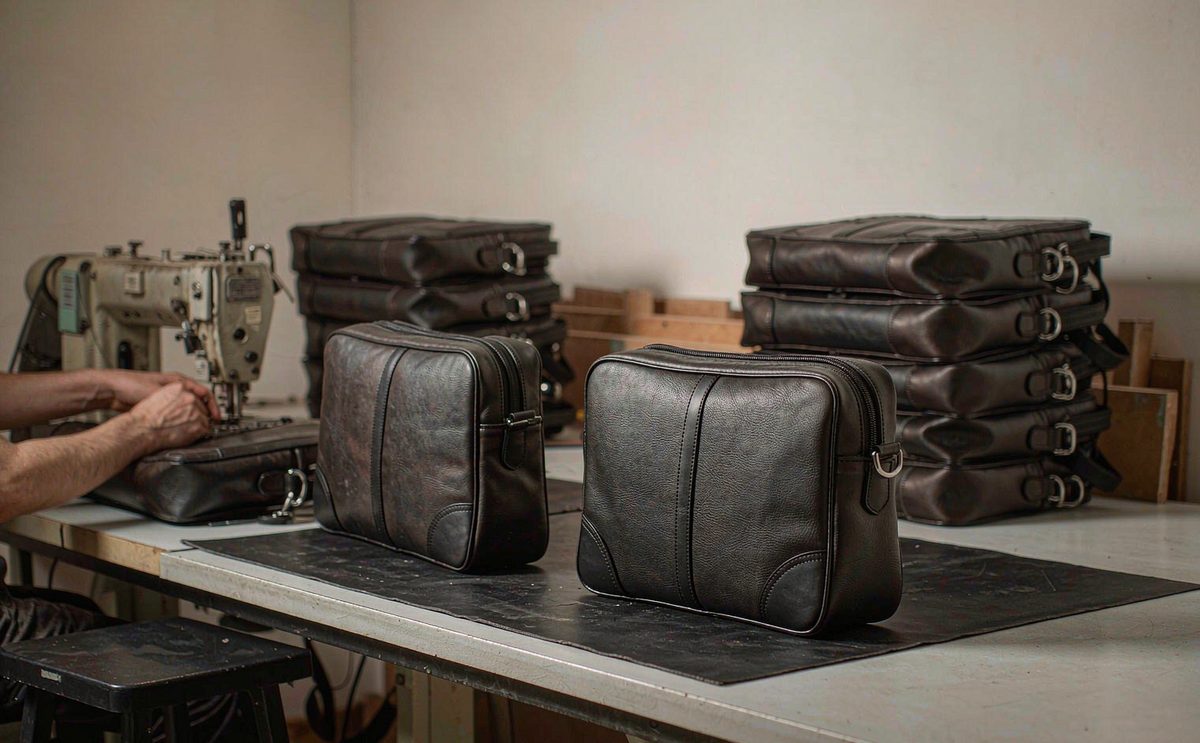
- The straight answer on minimum order quantity
- Why 500 pcs is where unit cost stabilises
- What a colourway does to your minimum
- Minimum versus monthly capacity: reading the headroom
- Minimums across different sourcing routes
- Financing the first run: deposit, terms and cash flow
- Reading a quotation: what the minimum hides
- When 500 pcs is the wrong target volume
- Re-order economics after an overfund
- Reducing effective minimum without weakening the spec
- Converting MOQ into a reward tier structure
- Minimum-order questions for every RFQ
The straight answer on minimum order quantity
If you are building a funding target today, use 500 pcs per style and per colourway as the planning figure. It is not a negotiating opening position; it is the volume at which the fixed costs of a custom bag run — fabric dye lot, hardware mould and plating, print screens, pattern and set-up — spread thinly enough that the unit price becomes defensible against a published reward tier.
The distinction between style and colourway is where most first-time creators misread the number. A style is a distinct construction: a 22-litre backpack and a 40-litre duffle are two styles. A colourway is a colour variant of the same construction. The 500-pcs minimum applies to each, so a backpack in three colours is three commitments of 500 pcs, not one commitment of 500 split three ways.
- Minimum order quantity
- 500 pcs per style / colourway
- Sampling
- 6-10 working days (12-15 for complex builds)
- Bulk production
- 35-50 days after deposit + approved pre-production sample
- Inspection
- AQL 2.5 to ISO 2859-1
- Trade term
- FOB Xiamen
- Payment
- T/T 30/70
- Monthly capacity
- 200,000 pcs per month
- Production floor
- 4,950 m² SGS-verified, 137 staff, 7 lines, 149 machines
Key takeaways on the 500 pcs minimum
- 500 pcs applies per style and per colourway — three colours of one bag is three minimums, not one.
- The number exists because of fixed set-up costs: fabric dye lots, hardware tooling, print screens and pattern making.
- Budget the 30% deposit on 500 pcs into the funding target, not as a post-campaign expense.
- Re-orders on an approved spec skip the sampling cycle, so the second run is materially cheaper per unit.
Why 500 pcs is where unit cost stabilises
A bag run carries costs that do not scale with quantity and costs that do. Fabric is purchased in dye lots with a minimum yardage; zips, buckles and webbing come in production batches; print screens and embroidery digitising are one-off charges; the pattern and the sample-room time are fixed. At 100 pcs those charges might add USD 9-14 per unit. At 500 pcs the same charges spread to roughly USD 2-4 per unit. Beyond about 2,000 pcs the curve flattens, because by then fabric and hardware are being bought at their own supplier minimums anyway.
| Run size | Fixed set-up per unit | Indicative effect on unit cost | Comment for campaign planning |
|---|---|---|---|
| 100 pcs | USD 9-14 | Highest unit cost | Usually unavailable as a custom build; only viable on stock blanks |
| 250 pcs | USD 4-7 | Materially above target | Workable only for a simple flat-pack tote with generic hardware |
| 500 pcs | USD 2-4 | Defensible against a reward tier | The standard campaign entry point across all bag categories |
| 1,000 pcs | USD 1-2 | Best value on the curve | Typical stretch-goal volume; improves margin rather than just adding units |
| 2,000 pcs and above | Under USD 1 | Curve flattens | Savings come from material sourcing rather than set-up amortisation |
The practical consequence is that the gap between 500 and 1,000 pcs is far more valuable than the gap between 1,000 and 2,000 pcs. If your campaign has any chance of reaching a stretch goal, price the reward at the 1,000-pcs band and treat the 500-pcs price as the conservative floor. Publishing a reward price built on the 2,000-pcs band is how campaigns end up funding successfully and losing money on every unit shipped.
What a colourway does to your minimum
Colourway is the single most expensive aesthetic decision in a campaign bag programme. Each colourway means a separate fabric dye lot, separate webbing and thread, and in most cases a separate zip tape order. Fabric mills impose their own minimums per colour, typically several hundred metres, which is precisely why the production-side minimum is expressed per colourway rather than per order.
- One colourway, 500 pcs. One dye lot, one hardware batch, one print set-up. The lowest-risk structure for a first campaign.
- Two colourways, 1,000 pcs total. Two dye lots and a second hardware batch. Roughly 8-14% higher unit cost than a single 1,000-pcs run in one colour.
- Three colourways, 1,500 pcs total. Three commitments and three QC checkpoints. Rarely justified at launch; better held as a stretch-goal unlock.
- Colourway as a stretch goal. Announce a second colour only once funding clears the volume that supports it, then re-order on the approved construction.
There is also a quality argument. Dye lots vary. Two colourways ordered in the same production window from the same fabric supplier will usually match, but a colourway added as a re-order eight weeks later may sit outside the original lot tolerance. If colour accuracy is central to the campaign promise, either commit to all colourways in the first run or accept a documented tolerance in the tech pack.
Fund the hero colourway at 500 pcs and treat additional colours as stretch goals with their own re-order. This keeps the deposit small, keeps the dye lot consistent, and gives the campaign a visible unlock to announce mid-flight without changing the construction or the delivery date.
Minimum versus monthly capacity: reading the headroom
A minimum tells you the smallest order that works. Capacity tells you the largest change you can absorb. The programme behind this site runs a 4,950 m² SGS-verified production floor with 137 staff across 7 production lines and 149 machines, producing 200,000 pcs per month. For a campaign creator that headroom matters more than the minimum does, because the risk is rarely that 500 pcs cannot be made — it is that a stretch goal doubles the order and there is no line time left in the window.
Read those figures together. A 500-pcs first run against 200,000 pcs of monthly capacity is a rounding error, which means a funded campaign plus an overfund top-up can normally be scheduled inside the same production window. What consumes capacity is not unit count but line changes: each new style, colourway or print set-up costs changeover time. Minimising variants is therefore both a cost decision and a scheduling decision.
Minimums across different sourcing routes
Not every route to a finished bag carries the same minimum, and the differences are structural rather than negotiable. Understanding them saves a creator from spending weeks trying to talk a number down when the correct move is to change the specification. The table below sets out what each route can realistically deliver at campaign volumes.
| Route | Realistic minimum | Customisation depth | Fit for a crowdfunding reward |
|---|---|---|---|
| Blank stock bag with decoration | 50-100 pcs | Print or embroidery only | Fast and cheap, but the bag is not yours and the campaign looks generic |
| Semi-custom build on an existing pattern | 300-500 pcs | Fabric, colour, branding, some hardware | Good middle path when the launch date is tight |
| Fully custom build from a tech pack | 500 pcs per style / colourway | Full control of dimensions, materials, hardware | The standard route for a hero campaign reward |
| Complex build with custom tooling | 500 pcs plus tooling charge | Moulded pulls, welded seams, bespoke frames | Justified only when the mechanism is the campaign story |
| Re-order on an approved spec | 500 pcs, no new set-up | Identical to the approved sample | Cheapest per-unit route; use it for stretch goals |
The semi-custom route deserves attention from campaigns with a fixed launch date. Working from an existing pattern removes pattern development and part of the sampling cycle, which can pull the sampling window towards the 6-day end of the 6-10 working day range. The trade-off is dimension control: you get the bag's proportions as designed, with fabric, colour and branding as your variables. Our page on low MOQ bag production for creators explains where that trade-off makes commercial sense.
Financing the first run: deposit, terms and cash flow
Payment terms are T/T 30/70: a 30% deposit to start production and 70% against shipping documents. On a 500-pcs order at a USD 26 unit cost, that is roughly USD 3,900 up front and USD 9,100 at shipment. Both figures need to exist inside the campaign's cash plan before the page goes live, because neither can be deferred without delaying the run.
- Model the deposit at 500 pcs, not at the target. The deposit is owed on the committed minimum regardless of how many backers pledge.
- Net off platform fees. Kickstarter and payment processing take roughly 8-10% of gross funds, which reduces the cash actually available for the deposit.
- Reserve for the balance. The 70% payment falls months later, after freight and duty; hold it rather than redeploying it into marketing.
- Budget a replacement allowance. Plan 3-5% of units for damage, defect and lost-parcel replacement.
- Fund the stretch goal separately. An overfund triggers a larger order with a larger deposit; pre-cost it so the cash exists when it unlocks.
The most common cash failure is not underfunding — it is a campaign that funds at 400% and then cannot finance the larger deposit. The unit cost improves at higher volume, but the absolute cash requirement rises. Pre-cost the stretch-goal volume at the quotation stage and confirm that the deposit for the larger run is financeable before you announce the unlock.
Reading a quotation: what the minimum hides
A quotation built on a minimum is only useful if it states what the number includes. Two quotations can both read 500 pcs and differ by 20% on landed cost, because one includes print screens, hardware tooling, polybagging and pre-shipment inspection as separate line items while the other folds them into the unit price and recovers them later. Always ask for the set-up charges to be itemised separately from the unit cost, and then ask which of them repeat on a re-order.
The second thing a minimum hides is the packing specification. Units per carton, carton dimensions and gross weight determine freight cost, and freight is frequently 25-40% of landed unit cost on a first run. A quotation without a carton specification is not comparable to one with it, which is why a three-tier quote should always carry the packing data alongside each volume band rather than after it.
The third is the validity window. Fabric and hardware prices move, and a quotation issued in one quarter is not automatically honoured two quarters later when the campaign actually funds. Ask how long the quoted band holds and what triggers a re-quote. For campaigns with a long pre-launch runway this matters more than the unit price itself, because a re-quote at funding close reopens the reward economics at the worst possible moment.
- Itemised set-up. Print screens, hardware tooling, pattern and sampling charges listed separately from unit cost.
- Packing data. Units per carton, carton dimensions in centimetres and gross weight, quoted per volume band.
- Validity window. How long the band holds, and what triggers a re-quote before the campaign funds.
- Re-order terms. Which set-up charges repeat and which are already amortised on the first run.
- Incoterm clarity. FOB Xiamen confirmed, so freight, duty and fulfilment are costed on your side rather than assumed.
Two quotes at the same FOB Xiamen unit price can differ materially once freight, duty and fulfilment handling are added, because packing volume and carton weight differ between them. Build the comparison on landed cost per unit at 500 pcs and the ranking frequently changes.
When 500 pcs is the wrong target volume
There are campaigns where 500 is genuinely too many, and pretending otherwise wastes a launch cycle. If the addressable backer base is small, the reward is a niche technical product, or the pledged price cannot carry the landed unit cost at 500 pcs, then the honest options are to restructure the reward or to move to a semi-custom build rather than to push for a lower minimum on a full custom spec.
- Restructure the reward. Bundle the bag with a low-cost accessory so the tier price supports the unit cost at 500 pcs.
- Move to semi-custom. An existing pattern with custom fabric and branding reduces set-up cost and can make a smaller run viable.
- Reduce construction complexity. Fewer panels, generic hardware and a single print placement all lower the fixed cost floor.
- Run a pilot. Produce 500 pcs as the hero reward, sell through, then re-order on the approved spec rather than discounting into a second style.
- Delay rather than discount. A campaign launched three months later with correct economics beats one launched now at a loss per unit.
A minimum can almost always be reduced by downgrading fabric denier, dropping branded hardware or removing reinforcement. Those savings reappear as backer complaints, replacement costs and refund requests. Reduce scope — fewer panels, fewer colourways — before you reduce material grade.
Re-order economics after an overfund
The second run is the cheapest unit a campaign will ever buy. Pattern, print screens, hardware tooling and the pre-production sample are all paid for, and the approved spec removes the 6-10 working days of sampling cycle from the critical path. A re-order therefore compresses to the 35-50 day bulk window plus inspection and export, with no sampling risk and no spec ambiguity.
| Element | First run at 500 pcs | Re-order on approved spec |
|---|---|---|
| Sampling | 6-10 working days, usually two rounds | None required; spec already approved |
| Set-up charges | Fabric lot, hardware batch, print screens, pattern | Already amortised; no repeat charge |
| Bulk production | 35-50 days | 35-50 days |
| Inspection | AQL 2.5 to ISO 2859-1 | AQL 2.5 to ISO 2859-1 |
| Deposit | T/T 30% of the first order value | T/T 30% of the re-order value |
| Risk | Spec and colour settled during sampling | Colour lot tolerance; confirm fabric availability early |
One caution on re-orders: fabric availability. A dye lot ordered eight or twelve weeks after the first run may need to be re-made, and small repeat lots sometimes carry a surcharge. Confirm fabric and hardware availability at the moment the stretch goal looks likely, not after it unlocks. Capacity of 200,000 pcs per month across 7 lines means line time is rarely the constraint; material lead time is.
Reducing effective minimum without weakening the spec
Effective minimum and stated minimum are different things. You will not change a 500-pcs floor on a fully custom build, but you can change what that 500 pcs has to cover. Four levers do most of the work, and none of them requires a quality concession: consolidate colourways, share material buys across SKUs, use add-ons instead of variants, and design packaging that shares a print set-up with the bag.
- Consolidate colourways. One colourway at launch removes an entire dye lot and hardware batch from the cost base.
- Share the material buy. A pouch, organiser or strap pad made from the same fabric lot adds a reward line without a new minimum.
- Use add-ons, not variants. Add-ons inherit the hero run's set-up, so their incremental unit cost is frequently 30-50% lower than a standalone equivalent.
- Standardise packaging. One carton size and one print set-up across the reward matrix removes a packaging minimum and a freight penalty.
Branding method is the fourth lever in practice. Screen print carries a per-colour screen charge; heat transfer removes it but changes durability and hand-feel; a woven label is cheap per unit but has its own minimum, often 1,000 pcs. Choose the method against the volume you will actually run, not against the look in the render. Our crowdfunding bag guide compares the methods against typical campaign volumes.
Converting MOQ into a reward tier structure
Once the minimum is fixed at 500 pcs, the reward structure follows from it. Work out how many units each tier consumes at a plausible backer split, then check that the total lands at or above 500 with room for a stretch goal. A common structure is one hero tier consuming roughly 65-75% of units, one early-bird tier at a lower price with a capped count, and one multi-unit tier for small resellers or teams.
The early-bird tier is where economics get tightest. If the early-bird price is 20% below the standard reward, the unit cost still has to sit inside it, which usually means the early-bird count must be capped and the difference carried by the standard tier. Cap the count explicitly on the campaign page; an uncapped early-bird tier quietly converts the whole campaign to the lower price and compresses margin below the level the 500-pcs quotation assumed.
For category-specific minimum behaviour — how a structured backpack differs from a flat-pack tote in material usage and packing volume — see the custom bag categories overview and the dedicated custom backpacks for Kickstarter page, which break the cost drivers down by construction type.
Minimum-order questions for every RFQ
Put these questions in writing whenever you request a quotation. Ambiguity about the minimum is the most common cause of a surprise cost change after a campaign funds, and it is entirely avoidable at the RFQ stage. A production partner who answers all six crisply is one whose numbers will hold through the run.
- Is the minimum 500 pcs per style, per colourway, or per order?
- Does the minimum change for a semi-custom build on an existing pattern?
- What is the unit cost at 500, 1,000 and 2,000 pcs, quoted as three separate lines?
- Which set-up charges are one-off, and which repeat on a re-order?
- What deposit is required, and is it calculated on the minimum or on the final quantity?
- If the campaign overfunds, how quickly can a re-order be scheduled into the same window?
Two further questions are worth asking even though they are not strictly about volume. Ask what the quotation assumes about packing, because units per carton and carton dimensions drive freight and therefore landed cost. And ask how long the quoted band remains valid, because a campaign with a long pre-launch runway can otherwise be re-quoted at funding close, which reopens the reward economics at the worst possible moment.
Send those questions with your brief through the quote request form and you will receive quotable numbers rather than a range. For the full sourcing sequence behind this article, read Custom Bags for Kickstarter: The Complete 2026 Sourcing Guide; for the pre-launch scheduling side, see how to plan production before you launch. Additional volume questions are answered in the sourcing FAQ.
Set your funding goal based on the number of units you need to produce, not the number you hope to sell.
Kickstarter Creator Handbook
- Custom Bags for Kickstarter — campaign sourcing hub
- Low MOQ bag production for creators
- Crowdfunding bag guide: cost and reward planning
- Bag manufacturing options for campaign creators
- Rewards fulfilment planning
- Sourcing FAQs
- More campaign sourcing articles
Get the minimum confirmed for your specification
Send bag type, target quantity and colourway count. You get the applicable minimum, a three-tier unit cost band and the sampling window back within one business day.
Frequently Asked Questions
What is the MOQ for custom bags on a Kickstarter campaign?
The minimum order quantity is 500 pcs per style and per colourway. A style is a distinct construction and a colourway is a colour variant of it, so one backpack in three colours represents three separate 500-pcs commitments rather than a single 500-pcs order split across the colours.
Does the minimum apply per colourway or per order?
Per colourway. Each colour needs its own fabric dye lot, webbing, thread and usually its own zip tape order, which is why fabric mills impose their own per-colour minimums. Launch on one colourway and treat additional colours as stretch goals with their own re-order.
Why is 500 pcs the threshold rather than 250 pcs?
Because fixed set-up costs dominate below it. At 100 pcs, dye lots, hardware batches, print screens and pattern work add roughly USD 9-14 per unit; at 500 pcs the same charges spread to about USD 2-4 per unit, which is where a reward tier becomes commercially defensible.
How much deposit is required on a 500-pcs bag order?
Terms are T/T 30/70, so 30% is payable to start production and 70% against shipping documents. On a 500-pcs order at USD 26 per unit that is roughly USD 3,900 up front and USD 9,100 at shipment, both of which belong in the funding target.
Can the minimum be reduced for a first-time campaign creator?
The stated minimum on a fully custom build stays at 500 pcs. The effective commitment can be reduced by moving to a semi-custom build on an existing pattern, cutting the colourway count to one, and simplifying the panel structure rather than downgrading material grade.
What is the cheapest volume band for a campaign bag run?
The steepest part of the volume curve sits between 500 and 1,000 pcs, where set-up amortisation still falls sharply. Beyond roughly 2,000 pcs the curve flattens, because fabric and hardware are already being bought at their own supplier minimums and further savings come from material sourcing instead.
How is a re-order priced after a campaign overfunds?
A re-order on an approved spec carries no repeat sampling cycle and no second set-up charge, so its unit cost is materially lower than the first run. Confirm fabric availability early, because a dye lot re-made weeks later can carry a small surcharge.
Does capacity limit a stretch goal more than the minimum does?
Capacity of 200,000 pcs per month across 7 lines and 149 machines rarely limits a campaign run. What consumes line time is changeovers between styles and colourways, so minimising variants protects both the schedule and the unit cost at the same time.
How should reward tiers be built around a 500-pcs minimum?
Allocate roughly 65-75% of units to the hero tier, cap the early-bird tier explicitly, and add a multi-unit tier for teams or small resellers. An uncapped early-bird tier converts the whole campaign to the lowest price and breaks the margin the quotation assumed.
Which branding method carries its own separate minimum?
Woven labels usually carry their own minimum, often 1,000 pcs, and screen print carries a per-colour screen charge. Heat transfer removes the screen charge but changes durability and hand-feel, so choose the method against the volume you will actually run.
What happens if a campaign cannot finance 500 pcs?
Restructure rather than downgrade. Bundle the bag with a low-cost accessory to lift the tier price, move to a semi-custom pattern, or delay launch by a quarter. Cutting fabric denier or dropping branded hardware saves money now and costs more in replacements later.
How long does sampling take once the quantity is agreed?
Sampling runs 6-10 working days for standard builds and 12-15 working days for complex constructions, counted from approved artwork and a settled tech pack. Budget two rounds before reward photography, and add courier transit on both legs of the sample shipment.
Do add-on rewards count towards the minimum order quantity?
Add-ons made from the same fabric lot and print set-up as the hero run do not trigger a new minimum, and their incremental unit cost is frequently 30-50% lower than a standalone equivalent. That makes them the most efficient way to add reward value without increasing commitment.
Which questions should an RFQ ask about the minimum?
Ask six: whether the minimum is per style, per colourway or per order; whether it changes for semi-custom builds; unit cost at 500, 1,000 and 2,000 pcs; which set-up charges repeat on re-order; how the deposit is calculated; and how fast a re-order can be scheduled.
People Also Ask
Is 500 pieces a lot for a small Kickstarter campaign?
It is manageable if it is one style in one colourway and the pledge price carries the landed unit cost. If 500 is out of reach, bundle the bag with an accessory, move to a semi-custom pattern, or delay launch rather than downgrading materials.
Can I order a sample bag before committing to 500 pieces?
Yes, and you should. Sampling runs 6-10 working days for standard builds and 12-15 for complex ones, and most campaigns need two rounds. The sample is what locks the spec before the minimum becomes a financial commitment.
Do different bag types have different minimum order quantities?
The minimum is 500 pcs across all categories, but what that 500 pcs costs varies with construction. A flat-pack tote uses less fabric and fewer panels than a structured backpack, so material usage and packing volume drive the unit price rather than the minimum.
What is a reasonable deposit for a custom bag production order?
T/T 30/70 is standard: 30% to start production and 70% against shipping documents. Budget the deposit into the funding target, because production cannot begin until it clears, regardless of how well the campaign funds.
How do I calculate how many bags to order for my campaign?
Start from the pledged tier structure: hero tier at 65-75% of units, a capped early bird, and a multi-unit tier. Add 3-5% for replacement stock, then round up to the 500-pcs minimum per style and colourway.