Custom Bags for Campaign Backers: Quality vs Price Trade-offs Explained
Every campaign bag reward is a compromise between what the pledge price can carry and what a backer accepts when the parcel opens. The trade-off sits inside four fixed limits: MOQ 500 pcs per style and colourway, sampling in 6-10 working days, production 35-50 days, and inspection at AQL 2.5 to ISO 2859-1. Within those limits you decide where the money goes. This article maps each component of a bag to the cost it adds and the perceived quality it returns.
- Where the quality-versus-price argument actually starts
- What backers evaluate in the first minute
- Component by component: cost added versus quality returned
- Three spec tiers and what each one costs at 500 pcs
- Where extra spend earns nothing
- Where economy quietly becomes expensive
- Defect economics: the real price of a cheap unit
- Writing a specification that can be quoted
- Testing the trade-off during the sampling window
- How the balance shifts across bag categories
- Fitting the spec to the pledge tier
- Locking the decision before the campaign page goes live
Where the quality-versus-price argument actually starts
Most creators open this argument in the wrong place. They compare two quotations for the same drawing and ask which is better value, when the two numbers are almost certainly built on two different specifications. A unit cost is an output, not an input. Until both quotations name the same fabric denier, the same zip chain, the same stitch density and the same packing format, the comparison is meaningless and the lower number is simply the one with more assumptions hidden inside it.
The real question for a crowdfunding reward is narrower and much more useful: which components does a backer evaluate, and which do they never notice? Money spent on the first group raises the perceived value of the reward and protects the campaign's reputation. Money spent on the second group raises the unit cost and nothing else. Sorting a bag's bill of materials into those two groups is the whole exercise, and it takes about an hour with a production partner once the tech pack exists.
There is also a hard boundary that no amount of spec cleverness moves: a reward has to clear its landed cost. Landed unit cost is the FOB Xiamen price plus freight, duty and per-unit fulfilment handling. On a reward pledge of USD 79, backer shipping absorbs roughly USD 16-22 and platform plus payment fees another 8-10%, which leaves around USD 48-56 for landed unit cost, margin and replacement stock. If the spec you want costs USD 39 landed, the trade-off is not a design question any more; it is a pricing question.
- Minimum order quantity
- 500 pcs per style / colourway
- Sampling
- 6-10 working days (12-15 for complex builds)
- Bulk production
- 35-50 days after deposit + approved pre-production sample
- Inspection
- AQL 2.5 to ISO 2859-1
- Trade term
- FOB Xiamen
- Payment
- T/T 30/70
- Production floor
- 4,950 m², SGS-verified
- Team
- 137 staff / 7 production lines / 149 machines
- Capacity
- 200,000 pcs per month
- Campaign experience
- 20+ crowdfunding campaigns supported
Key takeaways on the trade-off
- Never compare two unit costs until both rest on the same written specification; a cheaper quote usually hides a thinner spec.
- Split the bill of materials into components backers evaluate and components they never notice, then spend accordingly.
- Test the spec against landed unit cost, not FOB unit cost, because freight and duty are part of what the pledge must carry.
- Lock the specification at pre-production sample approval; every change after that point costs money and calendar days.
What backers evaluate in the first minute
A crowdfunding backer has a different inspection behaviour from a retail shopper. They pledged months earlier, they have read the campaign page, and they open the parcel with a mental checklist formed from the renders they were shown. That checklist is short, physical and remarkably consistent across campaigns. It is dominated by touch and by hardware, and it is almost never about the things a designer spends the most time on.
| What gets checked | How it is judged | What it costs to get right |
|---|---|---|
| Zip action and chain | Pulled end to end immediately; snagging or grit feel reads as cheap | A branded coil chain in #5 or #8 adds a small but visible amount to unit cost and is the single most noticed upgrade |
| Fabric hand and weight | Held and squeezed; excessive stiffness or a thin, papery shell both register as wrong | 600D polyester with PU backing sits in the acceptable band for most reward categories without premium pricing |
| Strap and webbing feel | Straps are pulled and the shoulder contact is rubbed | Polyester webbing at 25 mm or 38 mm with bar-tacks at load points costs little and prevents the most common field failure |
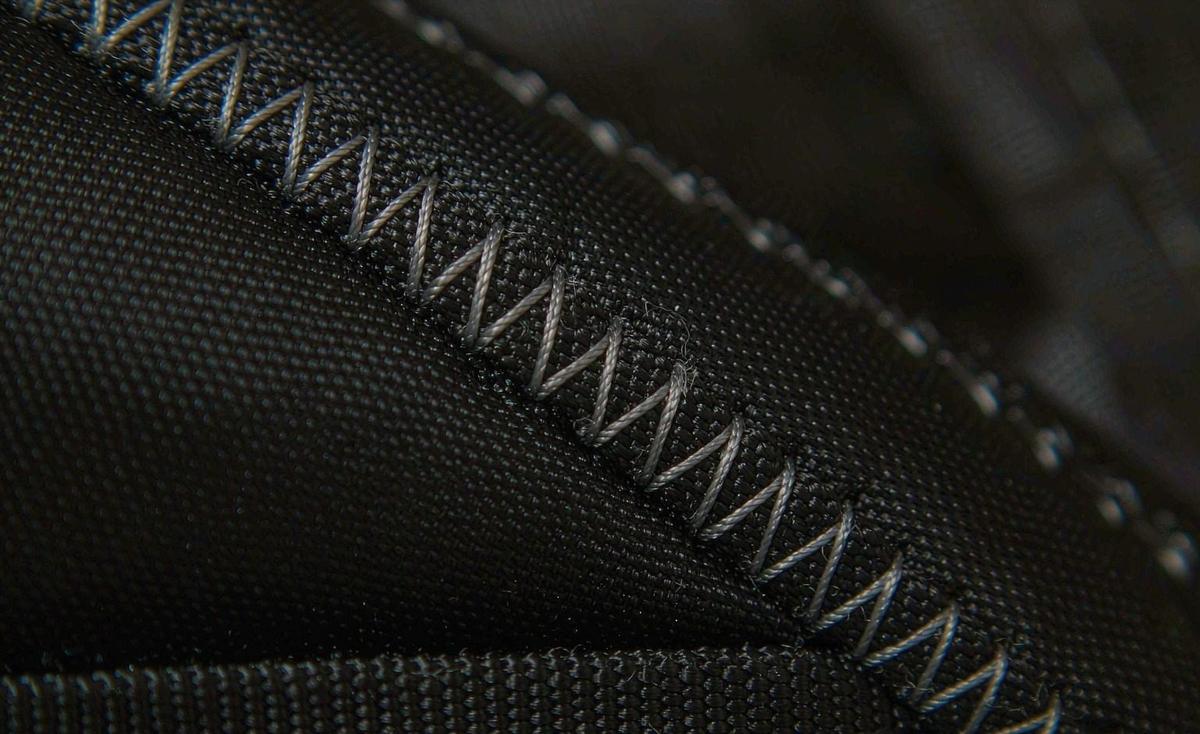
| Stitching at stress points | Panel joins and strap roots are turned over and tugged | Bar-tack reinforcement and consistent stitch density are process decisions, not material upgrades |
| Branding execution | Logo placement, edge definition and colour accuracy against the render | Screen print or woven label placement is cheap to specify and expensive to get wrong across 500 units |
| Interior lining and odour | The bag is opened and smelled before anything is put inside | A 210D or 420D lining with low-odour adhesives avoids the complaint that generates the most returns |
| Packaging condition on arrival | Creased cartons or crushed corners are read as damage regardless of the bag inside | Carton specification and ISTA 3A-aware packing are freight decisions, not bag decisions |
Notice what is absent from that list. Panel count, internal pocket architecture, colour-matching subtleties and almost every element of structural cleverness rank far lower than zip, fabric hand and strap feel. This does not mean structure is unimportant for function; it means that when the budget is tight, structure is where a creator can economise without a backer noticing, while hardware and fabric hand are where economising is immediately visible.
Backers compare the physical reward against the campaign imagery, not against a retail equivalent. Any surface that the render makes prominent — a zip, a pull, a logo panel, a coloured lining — becomes part of the first-minute checklist. Choose the render after the spec is settled, not before, or you will be inspected against a promise the unit cost cannot carry.
Component by component: cost added versus quality returned
The table below is the practical core of this article. It takes the seven components that appear in almost every campaign bag and ranks each upgrade by how much it moves the unit cost against how much perceived quality it returns. The cost column is expressed as a share of unit cost rather than in dollars, because absolute figures move with fabric markets and order volume while the ranking stays stable.
| Component | Standard option | Upgrade option | Cost impact | Perceived return |
|---|---|---|---|---|
| Zip chain | Unbranded #5 coil | Branded coil #5 or #8, reverse coil for weather resistance | Low to moderate | Very high — the first thing a backer operates and the most cited defect source |
| Shell fabric | 300D or 420D polyester | 600D with PU backing, or 900D on load panels | Moderate | High — weight and hand-feel are read as quality before anything else is examined |
| Webbing and bar-tacks | 20 mm webbing, single-pass stitch | 25-38 mm webbing with bar-tacks at every load point | Low | High when inspected, and decisive for warranty exposure eighteen months later |
| Lining | Unlined or 190D | 210D general, 420D in laptop compartments | Low to moderate | Moderate — noticed mainly on opening, and a source of odour complaints when skipped |
| Hardware finish | Standard zinc alloy | Custom-moulded pulls or anodised finish | High, plus tooling charge | Low to moderate — visible but rarely the reason someone pledges or complains |
| Branding method | Single-position screen print | Embroidery, heat transfer or a woven label set | Moderate | Moderate — accuracy against the render matters more than the method itself |
| Packaging | Bulk polybag | Printed mailer or retail-style box | Moderate, plus freight volume | Low for the bag, high for the unboxing moment and for damage rates in transit |
Two rows deserve emphasis because they are counter-intuitive. Custom-moulded hardware carries a tooling charge, adds to the sampling window and is consistently overrated as a differentiator; a campaign almost never gains pledges from a shaped zip pull. Bar-tacked webbing, by contrast, is close to invisible in a render and is the component that determines whether a bag survives its second year of use. Spend on the second, not the first.
Three spec tiers and what each one costs at 500 pcs
Rather than negotiating a single specification up and down, it is faster to price three defined tiers and then choose one. A tier is a complete, quotable specification: fabric, hardware, construction, branding and packaging, all settled. When a production partner quotes three complete tiers, the differences are real and comparable, and the decision becomes a business judgement about the pledge price rather than an argument about individual components.
| Attribute | Tier 1 — pledge-safe | Tier 2 — balanced | Tier 3 — premium |
|---|---|---|---|
| Shell fabric | 420D polyester, light PU backing | 600D polyester with PU backing, DWR finish | 900D or recycled PET with GRS documentation and TPU laminate |
| Zip specification | Unbranded #5 coil, standard pull | Branded #5 coil, rubber-moulded pull | Branded #8 reverse coil with weather flap |
| Webbing and load points | 20 mm webbing, standard stitch | 25 mm webbing, bar-tacked at strap roots | 38 mm webbing, bar-tacked and box-stitched at all load points |
| Lining | 190D polyester, single tone | 210D polyester, two-tone | 420D with TPU-coated wet compartment |
| Branding | One-position screen print | Screen print plus woven label | Embroidery plus woven label plus printed interior |
| Packaging | Bulk polybag, plain carton | Individual polybag, hangtag, printed carton | Printed mailer, tissue wrap, branded carton |
| Sampling window | 6-10 working days | 6-10 working days | 12-15 working days for the laminated or welded elements |
| Best used when | The pledge tier is the main selling point and volume matters most | The reward is the campaign's reputation and reviews will drive the re-order | The campaign story is built on material claims that must be documented |
The balanced tier is where most funded campaigns land, and it is worth understanding why. It puts the money into the three components a backer physically operates — zip, fabric and webbing — and leaves tooling, exotic finishes and elaborate packaging out of the bill. That allocation survives the first-minute inspection while keeping the landed unit cost inside the range a typical mid-tier pledge can carry.
A premium shell with economy webbing is worse than a consistently mid-spec bag, because the strong component raises expectations the weak one then breaks. Backers read a bag as a single object, not as a list of parts. Choose a tier and apply it across every component, then adjust the whole tier up or down until the landed unit cost fits the pledge.
Where extra spend earns nothing
Some upgrades are pure cost from a backer's point of view. They may be justified for other reasons — a brand story, a specific functional claim, a retail channel after the campaign — but they will not move perception at delivery, and they consume budget that would be better placed elsewhere. Knowing this list in advance is what keeps a specification honest when a designer and a founder are both adding features.
- Custom tooling on pulls and buckles. A tooling charge plus additional sampling days for a component that appears in no pledge decision and rarely in any review.
- Exotic shell laminates for a bag that never gets wet. A welded TPU laminate on a tote or a cosmetic pouch adds material and process cost with no scenario in which a backer tests it.
- Very high denier across the whole bag. Going from 600D to 1680D everywhere adds weight and cost; reinforcement panels at load points deliver the same durability for a fraction of the spend.
- Multi-position branding. A second or third logo position multiplies set-up charges and alignment risk while adding very little to perceived value beyond the first well-executed mark.
- Rigid retail packaging for a direct-ship reward. A printed box is opened once and discarded; on a 500-piece run it also increases shipped volume and therefore freight, duty and volumetric charges.
- Over-engineered internal organisation. Pocket count is a spec-sheet feature. It raises panel count and sewing time, and it is one of the least mentioned attributes in backer feedback we see.
None of these are forbidden; they are simply expensive relative to their return. The discipline is to name them explicitly in the brief as nice-to-have, price them separately, and cut them in a defined order if the landed cost model does not close. A specification with a documented cut list is far easier to manage than one where every element is presented as essential.
Where economy quietly becomes expensive
The opposite error is more damaging because it is invisible at quotation stage and expensive after delivery. These are the components where saving a small amount per unit creates a cost that arrives later, in the form of replacements, refunds, negative updates and a damaged re-order pipeline. Each of them looks like a rounding error on a quotation and none of them are.
- Unbranded or undersized zip chain. A few cents saved per unit against the single most frequently reported defect in bag rewards, and the most likely to be photographed.
- Unreinforced strap roots. The classic eighteen-month failure. Bar-tacking costs a small amount per unit; a replacement programme at 3-5% of a run costs far more than the entire reinforcement would have.
- Thin or unlined interiors. Pens, chargers and keys find the weakest seam. An unlined shell also shows abrasion far earlier than a 210D interior.
- Low-grade adhesives. Odour complaints arrive in the first week, travel fast through campaign updates and are effectively impossible to remediate after shipment.
- Unspecified colour tolerance. Without a stated tolerance and an approved reference swatch, a dyed lot can land visibly off the render across all 500 units at once.
- Undefined packing specification. A carton chosen by whoever is packing that day leads to crushed corners and volumetric surprises that no bag specification can compensate for.
A useful way to test a proposed saving is to ask what it costs per affected unit rather than per unit. If a cheaper zip saves USD 0.40 across 500 pcs, that is USD 200 saved against a defect that might touch 4% of the run — twenty bags, each of which costs the landed unit price plus two-way shipping plus the staff time to resolve. The saving does not survive the arithmetic.
Defect economics: the real price of a cheap unit
This is the calculation that reframes the whole trade-off. A 500-piece run is small enough that a handful of failures is a visible percentage, and public enough that each failure is reported in a comments thread. Pre-shipment inspection at AQL 2.5 under ISO 2859-1 catches systematic defects before cartons leave, but it samples the run rather than testing every unit, so the specification still determines the base failure rate.
| Failure mode | Usual cause | Cost per affected unit | Cheaper prevention |
|---|---|---|---|
| Zip separation or snagging | Undersized chain, unbranded slider, poor tape alignment | Full unit replacement plus two-way parcel freight | Branded coil chain, correct gauge, tape alignment specified in the tech pack |
| Strap root tearing | No bar-tack, low stitch density, webbing too narrow for the load | Full replacement, plus loss of confidence in the whole run | Bar-tacks at every load point and 25-38 mm webbing |
| Seam opening under load | Insufficient seam allowance or wrong stitch type for the fabric | Repair or replacement, frequently reported with photographs | Stitch type matched to fabric, seam allowance stated, ASTM D5034 testing on load panels |
| Colour drift against the render | No approved reference swatch, no stated tolerance | Reputation cost across the entire run at once | Approved lab dip or swatch card retained before bulk dyeing begins |
| Odour on opening | Low-grade adhesive or insufficient curing time before packing | Replacement or refund, and the most contagious complaint category | Low-odour adhesive specification and a stated curing window before cartons are closed |
| Transit damage | Carton grade chosen for cost rather than for the parcel journey | Replacement plus reshipment, often attributed to the bag itself | Carton grade specified and ISTA 3A-aware packing for individual backer parcels |
Budget a replacement allowance regardless of how good the specification is. In campaigns we support, holding 3-5% of the run as replacement stock is normal practice, and it should be a line in the cost model rather than an afterthought funded from margin. That allowance is also the reason a landed cost near the top of the acceptable band is risky: there is no room left in it for the replacements the campaign will inevitably need.
Add 3-5% of the run to the order quantity or to the cost model as replacement stock. A campaign that ships 500 rewards and holds no spares has no answer to the first defect report, and the answer it improvises will cost more per unit than the spare would have. Discuss the allowance with your production partner while the quotation is still open.
Writing a specification that can be quoted
A spec that cannot be quoted cannot be compared, and a spec that cannot be compared cannot be traded off. The fix is unglamorous: replace every adjective with a measurable property. Durable fabric becomes 600D polyester with PU backing. Strong zipper becomes a branded #5 coil with a stated tape width. Good stitching becomes a stated stitch type and density plus bar-tacks at named locations. Once that translation is done, three things happen at once: quotations become comparable, samples become testable, and inspection has something to check against.
- Name the shell fabric by denier and coating, and state the hydrostatic head figure if any water resistance is claimed.
- Specify the zip by type, gauge and brand or grade, and state the tape colour and pull finish.
- State webbing width in millimetres and list every location that receives a bar-tack or box stitch.
- Give the lining denier separately from the shell, and name any coated compartments.
- Set branding by method, position, size and colour reference, with artwork supplied in the agreed format.
- State the packing format: individual polybag, hangtag, carton grade and carton quantity.
- Attach an approved colour reference, and state the tolerance you will accept against it.
- List any compliance requirement by name — CPSIA, REACH, Prop 65, OEKO-TEX Standard 100, GRS or EU GPSR.
Our page on kickstarter campaign bag QA and QC sets out how each of these line items becomes a checkable point during inspection. If the immediate problem is volume rather than specification, the analysis in What Is the MOQ for Custom Bags on a Kickstarter Campaign? explains how the 500-pcs minimum interacts with re-order economics.
Testing the trade-off during the sampling window
Sampling is not a formality that produces a nice photograph for the campaign page. It is the only point at which the trade-off can be tested physically, at low cost, before 500 units commit you. Sampling runs 6-10 working days for standard builds and 12-15 working days for complex constructions, and the clock starts from approved artwork rather than from first contact. Use that window as a decision process, not as a waiting period.
- Request the sample built to the tier you intend to buy, not to a best-case version that cannot be produced at the quoted price.
- Operate every zip and buckle twenty times and note any snag, gritty feel or resistance; this is the defect backers report first.
- Load the bag to its realistic working weight and carry it, rather than assessing it empty on a table.
- Check the strap roots and panel joins by tugging them, which is what a backer does within the first minute of opening the parcel.
- Compare the sample against the render under neutral light, because colour drift is assessed visually and never in isolation.
- Photograph everything you intend to change and return the mark-up as a written revision list rather than as a conversation.
- Approve the pre-production sample explicitly, understanding that this is the point after which changes carry both a cost and a schedule impact.
If the budget only allows one sampling round, spend it on structure and hardware and resolve colour at the pre-production sample stage. Most campaigns need two rounds: the first settles construction, the second settles colour and branding. The full revision loop, including what to send back at each stage, is documented on our crowdfunding bag sample prototyping page.
How the balance shifts across bag categories
The trade-off is not identical for every reward format, because the way a backer uses a bag determines which components get stressed and which get ignored. A cosmetic pouch is judged almost entirely on fabric and print, while a travel duffle is judged on zip, strap and seam strength. Applying one allocation rule across a multi-style reward matrix is how campaigns end up overspending on one style and under-specifying another.
| Category | Spend here | Economise here | Consequence if inverted |
|---|---|---|---|
| Backpack | Zip chain, shoulder strap webbing, back panel construction | Internal pocket count, secondary branding positions | Strap and zip failures dominate the replacement allowance and the comments thread |
| Duffle or travel bag | Zip gauge, haul-loop reinforcement, base panel | Decorative trim, rigid structure in an unstructured design | A split base panel or haul loop is a total-function failure, not a cosmetic one |
| Tote | Fabric weight and handle attachment method | Lining specification, closure hardware | Handle attachment is the only load path on the bag and the most common failure we see |
| Laptop bag | Padding density, lining denier, divider construction | External branding, decorative webbing | Backers measure the compartment against a stated device size; tolerance failure is immediate |
| Gym or sports bag | Ventilation, coated compartments, wipe-clean lining | External finish, print complexity | Odour retention generates complaints that no amount of external quality offsets |
| Cosmetic or pouch | Print accuracy, lining cleanability, zip smoothness | Structure, reinforcement, hardware grade | Print drift against the render is the whole perceived-value story for this category |
Category-specific allocation also protects the campaign from a subtle budgeting error: averaging. Averaging one landed unit cost across a reward matrix hides the fact that the duffle needs a heavier spec than the pouch. Price each style against its own category rules, then check whether the pledge tiers still work individually rather than in aggregate. Our custom bag categories page lists the styles with their typical specification starting points.
Fitting the spec to the pledge tier
The specification and the pledge tier are two ends of the same calculation, and they should be solved together rather than sequentially. Start from the pledge you believe the market will accept, subtract backer-facing freight, platform and payment fees, the replacement allowance and the margin you need to survive a cost overrun, and whatever remains is the landed unit cost the spec has to meet. Working in the other direction — specifying the bag first and then pricing it — is how campaigns discover in month two that their reward economics never closed.
When the arithmetic does not close, there are exactly four levers and they are worth listing explicitly. Raise the pledge price. Reduce the landed cost by moving down a tier. Increase quantity to move along the volume curve, remembering that the steepest part of that curve sits between 500 and 2,000 pcs. Or simplify the bag itself by reducing panel count and hardware count. Cutting the inspection allowance or the replacement stock is not on that list; those are the two cuts that convert a tight margin into a failed delivery.
Payment terms matter here too. Standard terms are T/T 30/70, with 30% to start production and 70% against shipping documents. If the deposit is not inside the funding target, production cannot begin when the campaign closes and the 35-50 day window starts late — which then forces an air freight decision that costs more than the deposit question ever saved.
Locking the decision before the campaign page goes live
Once the page is published, the specification is effectively a public promise. Every change after that point is either a visible downgrade or an unbudgeted upgrade, and both are expensive in different currencies. The sequence below puts the decision where it belongs: before the render, before the pledge tiers and before launch.
- Cost the landed unit price at 500, 1,000 and 2,000 pcs and keep the three-tier curve in the campaign file.
- Choose a specification tier and apply it consistently across every component of the bag.
- Build the cost model backwards from the pledge, including freight, fees, replacement stock and margin.
- Run the sampling window as a physical test of the chosen tier, with two rounds planned.
- Approve the pre-production sample and freeze the spec; price any later change before agreeing to it.
- Publish the render and the pledge tier against the frozen spec, so the promise matches the production order.
If you want a second opinion on where your current specification sits, send the tech pack and the target pledge price to a campaign bag specialist. A short review usually identifies one upgrade worth making and two costs worth cutting, which is often the difference between a reward that lands and one that needs an apology update. Start with the quote request form, or read the wider framing in custom bags for Kickstarter before you brief anyone.
Backers fund a promise about an object that does not exist yet; the reward is where that promise becomes physical and where trust is either confirmed or spent.
Kickstarter Creator Handbook
- Custom bags for Kickstarter — sourcing hub
- Custom bag categories and reward formats
- Campaign bag QA and QC
- Sampling and prototyping programme
- Custom backpacks for Kickstarter campaigns
- Request a quotation
- More campaign sourcing articles
Get your specification priced at three tiers
Send the bag type, target quantity and pledge price. You receive a cost per tier, the sampling window and a landed cost check against your reward economics.
Frequently Asked Questions
How much should a campaign bag reward cost to produce?
Work backwards from the pledge. On a USD 79 reward, backer freight takes about USD 16-22 and platform plus payment fees 8-10%, leaving roughly USD 48-56 for landed unit cost, margin and replacement stock. Request three quotations at 500, 1,000 and 2,000 pcs before you fix the price.
Which bag component gives the best return on spend?
The zip chain, consistently. It is the first component a backer operates and the most frequently reported defect source, and upgrading from an unbranded #5 to a branded #5 or #8 coil moves unit cost only modestly while changing first impressions materially at 500 pcs.
Is custom-moulded hardware worth the tooling charge?
Rarely for a first campaign. Tooling adds a charge and pushes sampling from 6-10 working days towards 12-15, while a shaped pull appears in almost no pledge decision. Put that budget into branded zip chain, 25-38 mm webbing and bar-tacks at every load point instead.
What does AQL 2.5 mean for a 500-piece reward run?
AQL 2.5 under ISO 2859-1 sets the sample size drawn from finished cartons and the number of major and minor defects permitted before the run is rejected or reworked. It samples the batch rather than testing every unit, so a strong specification still determines the underlying failure rate.
How much replacement stock should a campaign hold?
Hold 3-5% of the run. On 500 pcs that is 15-25 units, which covers defect reports, transit damage and address failures without forcing a second production run. Budget the allowance as a cost line rather than funding it from margin after the campaign closes.
Can a campaign mix a premium shell with economy hardware?
It can, but it usually backfires. A heavy 900D shell raises expectations that a light, unbranded zip then breaks, and backers judge the bag as one object. Choose a consistent tier across every component, then move the whole tier up or down to fit the pledge.
How long does sampling take when testing two spec tiers?
Each round runs 6-10 working days for standard builds and 12-15 for complex ones, counted from approved artwork. Budget two rounds: the first settles structure and hardware, the second settles colour and branding. Courier transit on both legs is additional.
Does a higher quantity change the quality-versus-price balance?
Yes, because set-up charges for fabric, hardware and print are amortised across the run. The volume curve is steepest between 500 and 2,000 pcs, so a stretch goal that doubles volume often funds a tier upgrade without raising the pledge price.
Which compliance documents affect the cost of a bag reward?
CPSIA for children's products, REACH and Prop 65 for chemical declarations, OEKO-TEX Standard 100 or GRS for material claims, and EU GPSR for European delivery. Book testing during the 6-10 working days of sampling window, not in the final week of a 35-50 day run.
What is the most expensive way to save money on a bag?
Removing bar-tacks at strap roots. It saves a small amount per unit and creates the classic eighteen-month failure, which on 500 pcs means replacement units, two-way freight and staff time far exceeding the original saving, plus the reputational cost in campaign comments.
Should packaging be upgraded for a crowdfunding reward?
Only if the unboxing is part of the campaign story. A printed mailer raises unit cost and shipped volume, which affects freight and duty. For direct-ship rewards, carton grade and ISTA 3A-aware packing usually protect more value than decorative packaging does.
When should the specification be frozen on a campaign bag?
At pre-production sample approval, before the campaign page is published. Every change after that point carries a surcharge and a schedule impact inside the 35-50 day bulk window, and after launch any downgrade is also a public change to a promise backers have already funded.
People Also Ask
Is it better to launch one high-quality bag or two cheaper ones?
One well-specified bag in a single colourway. Two styles mean two 500-pcs minimums, two dye lots and two pre-production samples, which splits the budget precisely when concentration would buy a better tier.
Do backers actually notice fabric denier?
They notice weight and hand-feel rather than the number itself. A 420D shell reads thin next to a 600D one, and that impression forms before any other component is examined, so denier indirectly drives perceived value.
How do I know if my reward price covers the spec I want?
Build the cost model backwards: pledge minus backer freight, platform fees, a 3-5% replacement allowance and margin gives the landed unit cost you can afford. Compare it to quotations at 500, 1,000 and 2,000 pcs.
What should I cut first when the budget is tight?
Cut tooling, exotic laminates, extra branding positions and retail packaging before touching zip grade, webbing or bar-tacks. Those four cuts are invisible to backers; the second group is what they inspect and what generates warranty claims.
Can I upgrade the spec after the campaign funds?
Only at a cost. Changes after pre-production sample approval carry a surcharge and can extend the 35-50 day window, so price any upgrade before promising it in a stretch goal or an update.