Custom Foldable Totes for Campaigns: Flat-Pack Design to Cut Fulfilment Cost
A foldable tote that packs to 2 cm instead of 8 cm cuts chargeable freight volume on a 1,000-unit order by roughly 60 to 75 percent, and it removes one pack-out step in the fulfilment centre. The saving comes from three design decisions made at sampling stage: how the bag folds, how many units nest inside one another, and how the carton is planned against carrier dimensional-weight divisors. This guide works through the dimensional maths, the fold constructions that survive repeated packing, the fabric and hardware choices that keep a packable bag flat, and the carton and labelling specification that makes fulfilment cheaper. Minimum order 500 pcs per style and colourway, sampling 6-10 working days, production 35-50 days.
- Why packed volume beats unit price on a tote reward
- Dimensional weight in plain maths a creator can budget with
- Four fold constructions and how many cycles each one survives
- Nesting ratios and how to set a pieces-per-carton target
- Carton planning: choosing box sizes that fill a pallet cube
- Fabric, interlining and hardware that keep a packable bag flat
- Compression, recovery and crease testing before bulk
- Sea, air and courier: where flat-pack changes the mode you can afford
- Fulfilment pack-out savings that flat-pack design unlocks
- Labelling, polybag and carton marking for a flat-pack run
- QC and inspection points specific to a foldable tote
- The RFQ data that produces an accurate freight and unit-cost quote
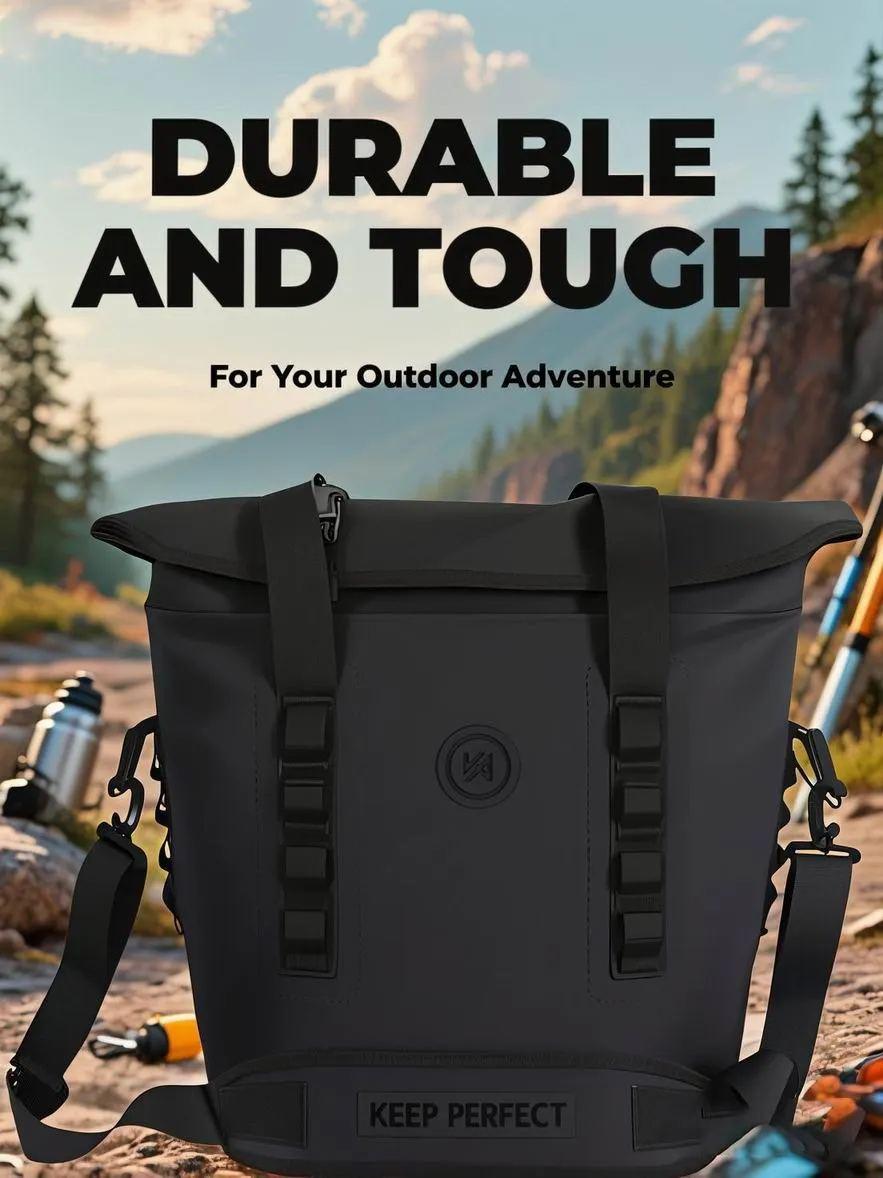
Freight is the line item most campaign budgets get wrong. Creators negotiate the unit price down by twenty cents and then discover that shipping has added more than a dollar per unit, because a tote is the archetypal light-and-bulky product: it weighs almost nothing and takes up a great deal of space. Carriers know this and charge on whichever is greater, actual mass or dimensional mass. Design the bag so it folds genuinely flat, and you are attacking the single largest controllable cost in the entire reward. Start with custom tote bags for Kickstarter and treat packed volume as a specification line rather than an afterthought.
Why packed volume beats unit price on a tote reward
Take a representative campaign tote with a body of 380 mm by 400 mm and a gusset of 100 mm. Folded reasonably flat it might pack to 380 by 400 by 25 mm. Shipped as a stuffed, unstructured bundle it can easily occupy 380 by 400 by 90 mm, because the fabric lofts and the handles and hardware take up space. On a 1,000-unit order, that difference is the difference between roughly 3.8 cubic metres and roughly 13.7 cubic metres of chargeable volume. Nothing else in the reward specification moves the landed cost by that kind of multiple.
The second reason to care is that packed volume compounds through the chain. It determines how many units fit a carton, how many cartons fit a pallet, how many pallets fit a container, and how much the fulfilment centre charges to receive and store the goods. A bag that nests well reduces the receiving count, the storage footprint and the pick-and-pack handling time. Those are separate line items on separate invoices, and they all move in the same direction when the packed volume comes down.
The third reason is that flat-packing changes what you can promise. A tote that folds into its own pocket can be marketed as a packable spare bag, which is a genuine feature rather than a shipping convenience. Backers understand the value immediately: a bag that lives in a backpack or a glovebox and appears when needed. That framing lifts the perceived value of a reward tier without adding cost, which is a rare outcome in reward design and it is available to any campaign willing to specify the fold at sampling stage.
Dimensional weight in plain maths a creator can budget with
Carriers compute dimensional weight by multiplying the three dimensions of a shipment and dividing by a divisor. Air freight commonly uses a divisor of 6,000 when dimensions are in centimetres, giving kilograms; couriers often use 5,000. A carton measuring 60 by 40 by 40 cm has a volume of 96,000 cubic centimetres, which is 16 kg at a 6,000 divisor and 19.2 kg at a 5,000 divisor. If the carton actually contains 8 kg of totes, you pay for 16 or 19.2 kg either way.
The practical implication is that reducing any one dimension reduces chargeable weight proportionally. Cutting packed thickness from 90 mm to 25 mm on the example above cuts the dimensional weight of every carton by roughly 70 percent, and because the divisor is fixed, that saving is purely a function of design. It is the closest thing to free money in reward manufacturing: the decision costs nothing at the drawing stage and pays out on every shipment for the life of the product.
| Packed thickness | Volume per 1,000 units | Dimensional weight at divisor 6,000 | Relative freight cost |
|---|---|---|---|
| 90 mm, loosely bundled | approx. 13.7 cbm | approx. 2,283 kg | Baseline, 100 percent |
| 60 mm, folded once | approx. 9.1 cbm | approx. 1,520 kg | approx. 67 percent |
| 40 mm, folded and rolled | approx. 6.1 cbm | approx. 1,013 kg | approx. 44 percent |
| 25 mm, folded into pocket | approx. 3.8 cbm | approx. 633 kg | approx. 28 percent |
| 15 mm, folded and compressed | approx. 2.3 cbm | approx. 380 kg | approx. 17 percent |
Treat those figures as planning bands rather than quotations. Carton walls, dunnage, pallet overhang and the carrier's rounding rules all move the final number, and a competent freight forwarder will apply their own divisor. What the table demonstrates is the shape of the relationship: the curve is steep at first and then flattens, so the largest single win is getting from a loose bundle to a considered fold. Chasing the last 10 mm is usually not worth the manufacturing complexity; getting the first 50 mm absolutely is.
Four fold constructions and how many cycles each one survives
The first construction is a simple trifold, where the bag is folded into thirds like a letter. It is the cheapest, adds no components, and packs to roughly three times the fabric thickness plus the handle bulk. It survives unlimited cycles because there is nothing to break. Its weakness is that it produces a floppy package that springs open in transit unless it is banded or bagged, and it does not protect the contents of the bag.
The second is a fold-into-own-pocket design, where the whole bag stuffs into an interior slip pocket that then turns inside out or closes with a snap. This is the design used on packable shopping bags and it is the best combination of compactness and marketing value. It packs to roughly 40 to 60 mm depending on fabric weight and it self-contains, so no band or polybag is strictly needed. The cost is one extra pocket, one closure component and a little more sewing time, typically 0.30 to 0.80 USD per unit.
The third is a roll-and-clip design, where the bag is rolled and held by a strap or an elastic loop. It packs tight and looks considered, but the clip or loop is a component that can break, and rolling produces a cylindrical package that wastes carton corners. The fourth is a zipped flat pouch conversion, where a zipper on one panel lets the bag close into a flat envelope. This packs flattest of all, roughly 15 to 25 mm, and it is the most expensive, because the zipper and the panel engineering add both cost and failure modes. Choose it only when the flat pack is a headline feature.
Key takeaways
- T
- h
- e
- l
- a
- r
- g
- e
- s
- t
- f
- r
- e
- i
- g
- h
- t
- w
- i
- n
- c
- o
- m
- e
- s
- f
- r
- o
- m
- g
- e
- t
- t
- i
- n
- g
- a
- l
- o
- o
- s
- e
- b
- u
- n
- d
- l
- e
- d
- o
- w
- n
- t
- o
- a
- c
- o
- n
- s
- i
- d
- e
- r
- e
- d
- f
- o
- l
- d
- .
- C
- h
- a
- s
- i
- n
- g
- t
- h
- e
- f
- i
- n
- a
- l
- 1
- 0
- m
- m
- o
- f
- t
- h
- i
- c
- k
- n
- e
- s
- s
- u
- s
- u
- a
- l
- l
- y
- c
- o
- s
- t
- s
- m
- o
- r
- e
- i
- n
- c
- o
- m
- p
- o
- n
- e
- n
- t
- s
- t
- h
- a
- n
- i
- t
- s
- a
- v
- e
- s
- i
- n
- f
- r
- e
- i
- g
- h
- t
- .
Nesting ratios and how to set a pieces-per-carton target
Nesting is what turns a folded bag into a dense carton. If each folded tote is 25 mm thick and the fabric compresses under stacking pressure, ten units nested may occupy 200 mm rather than 250 mm. That compression factor, typically 0.8 to 0.9 for canvas and 0.75 to 0.85 for polyester, is worth measuring on a physical stack rather than assuming. Ask the sampling team to fold twenty units, stack them, compress under a modest weight for an hour and report the stack height.
From that measurement you can set a pieces-per-carton target and write it into the packing specification. This is a genuinely useful number because it converts directly into freight, receiving and storage cost, and it is measurable at inspection. If the target is 40 units per carton and the production run achieves 32, you know immediately that the fold is inconsistent between units and that the freight invoice will be 25 percent higher than budgeted.
Consistency is the hard part. Hand-folding is variable: one operator folds tight, another leaves the handles proud, and the carton ends up with air pockets. Mitigations are cheap. Specify the fold as a written sequence with a photograph, require a fold jig or template on the packing table, and require the handles to be tucked in a stated way. Our production programme uses a photographed fold card for exactly this reason, and it is the difference between a carton that closes easily and one that has to be forced.
Carton planning: choosing box sizes that fill a pallet cube
Carton sizing is where many flat-pack savings quietly leak away. A bag folded to 25 mm loses most of its advantage if it is packed into a carton sized for the unfolded bag, or into a carton whose dimensions do not relate to the pallet footprint. The discipline is to work backwards: choose the pallet, then the carton footprint that tiles it efficiently, then the carton height that a full container or air pallet allows.
A standard export pallet of 1,200 by 1,000 mm tiles cleanly with cartons of 600 by 400 mm, 400 by 300 mm or 300 by 200 mm, all of which leave little wasted edge. A carton of 550 by 380 mm, chosen because it happens to fit the bag, leaves awkward gaps that multiply over eight layers. Ask for a pallet diagram with the carton count and the total cube, and compare two or three carton footprints before committing. This costs nothing at planning stage and it is routinely worth 5 to 10 percent of the freight bill.
Also specify the carton specification itself. Export cartons should be stated by board grade and by burst strength or edge-crush test rating, not by a generic phrase like strong carton. A carton that collapses in a container destroys more value than the freight it was meant to save. For air freight, where cartons are handled more and stacked less, a lighter board is acceptable; for sea freight with long transit and high humidity, specify a higher grade and consider a moisture barrier.
Fabric, interlining and hardware that keep a packable bag flat
Not every fabric folds flat. A heavy 16 oz canvas with a stiff finish will fight the fold and spring back, producing a bulky package regardless of how carefully it is folded. A lighter 8 oz to 10 oz canvas or a 210D to 420D polyester folds and recovers far better. Ripstop nylon is the classic packable material for good reason: it is light, it compresses and it recovers from creasing. The trade-off is that lighter fabric carries less load and feels less substantial, so the flat-pack design and the heavy-duty design pull in opposite directions.
Interlining and structure are the enemy of flat packing. Any fused panel, any foam base plate, any stiffened hem adds a thickness that cannot be compressed. If you need structure, make it removable: a loose base board that ships flat beside the bag, or a foldable insert that scores along a line. Ask the sampling team to quote both a structured and an unstructured version and compare the packed thickness, because the difference is often larger than expected and it is visible on the freight invoice rather than on the unit cost.
Hardware matters more than it appears to. A metal snap or a magnetic closure adds a hard lump that prevents tight nesting and can damage adjacent units in a carton. A moulded plastic snap, a hook-and-loop tab or a simple elastic loop lies flat and nests. If your design needs hardware, specify it at the edge of the folded package rather than in the centre, so the lump sits where the fold naturally leaves space. These are small decisions that add up to millimetres per unit and centimetres per carton.
Compression, recovery and crease testing before bulk
A foldable tote needs two tests the average tote does not. The first is a compression and recovery test: fold twenty units, stack them, apply a load representative of a full carton at the bottom of a stack, hold for 24 hours, then unpack and measure how long the fabric takes to recover its flat appearance. A bag that recovers in an hour is fine. A bag that retains deep creases after a day will arrive looking second-hand, which is a serious problem for a reward that is meant to feel new.
The second is a crease-cycle test: fold and unfold one unit a stated number of times, commonly 200 to 500 cycles, and inspect for abrasion along the fold lines, cracking of any coating, and loosening of any stitching that crosses a fold. A crease that abrades through after 300 cycles means the bag will show wear lines within a year of normal packable use. If a coating is present, this test is essential, because coatings are the first thing to crack at a fold.
Third, run a packed-dimension verification at inspection. Take ten finished cartons at random, measure the internal packed dimensions at three points, and confirm they meet the packing specification. This is the control that protects the freight budget, and it is measurable in under ten minutes. Our production programme can add it to the standard AQL 2.5 to ISO 2859-1 inspection as a defined check, with the tolerance agreed in writing before bulk begins.
Sea, air and courier: where flat-pack changes the mode you can afford
Freight mode is usually decided by the delivery promise in the campaign rather than by preference, and flat-pack design widens the set of affordable options. On sea freight, which is the default for most campaign rewards, the saving from flat packing is real but moderate, because sea freight is priced per container or per cubic metre and a tote shipment rarely fills a container. Expect meaningful but not dramatic savings, plus lower storage and handling charges at the destination.
On air freight the saving is dramatic, because air is priced on chargeable weight with a dimensional divisor. This is where the design decision changes the plan: a reward that could only afford sea freight at 90 mm packed thickness may comfortably afford air at 25 mm, which can remove three to five weeks from the schedule. If your campaign promised delivery by a fixed date and the production schedule is tight, that optionality is worth more than the freight saving itself.
On courier and postal fulfilment, which is how most individual backer rewards actually ship, flat packing changes the parcel category. A tote that packs under a courier's letter or small-parcel thickness threshold can move into a cheaper rate band, and the saving applies to every single backer shipment. On 2,000 backers that is frequently a four-figure sum. Ask your fulfilment partner for their dimensional thresholds before you finalise the fold design, because those thresholds are specific numbers and designing to them is free.
Ask your fulfilment partner for their parcel thickness thresholds before you design the fold. Designing to those numbers costs nothing and saves money on every backer shipment.
Fulfilment pack-out savings that flat-pack design unlocks
The freight saving is the headline, but the pack-out saving is often just as large and it is easier to overlook. Every manual step in a fulfilment centre is billed: a typical rate is 0.08 to 0.25 USD per unit per step. Folding the bag, inserting a card, attaching a hangtag, applying a sticker and closing the polybag are five steps. A bag that arrives folded flat inside its own pocket, with the care information on a sewn label and the tier printed on the polybag, removes three of those five steps.
On 2,000 units, removing three steps at a mid-range rate is roughly 500 to 1,500 USD saved, and it removes three opportunities to pack the wrong variant into the wrong parcel. That second benefit is underrated: pack-out errors are the most common cause of backer complaints after late delivery, and every step removed is an error opportunity removed. Design the reward so the bag self-identifies and the pack-out becomes a single pick-and-place operation.
There is also a returns benefit. A compact, self-contained folded bag is easy for a backer to return or exchange, and it is cheap for you to send a replacement. Compare that with a bulky unstructured tote, where the return postage can exceed the value of the item. For campaigns that expect any volume of size or colour exchanges, that difference is worth building into the reward economics from the start. Our crowdfunding rewards fulfilment guide covers the wider pack-out planning in more detail.
Labelling, polybag and carton marking for a flat-pack run
Specify the polybag with the same care as the bag. State the material and thickness, whether it is recyclable or compostable if that matters to your campaign, whether it is printed, whether it has a barcode or a tier identifier, and whether it is perforated for safety. A printed polybag removes a sticker step and makes the variant identifiable without opening the bag, which is the cheapest identification method available at volume. Note that printed polybags carry their own minimum order quantity, so confirm it early.
Carton marking should be stated in full: shipping mark, side mark, carton number in a sequence such as 1 of 40, style, colourway, quantity, net and gross weight, and carton dimensions in centimetres. Add a handling instruction such as keep dry or do not stack beyond a stated number of layers if the carton grade requires it. Correct carton marking speeds customs clearance and makes the receiving count at the fulfilment centre straightforward, both of which remove cost and delay at the most stressful point of the campaign.
Finally, decide the barcode question. If the reward will ever be stocked by a retailer, or if your fulfilment centre requires a scannable identifier on the outer pack, the barcode needs a home on the polybag or the carton. Adding it after production means reprinting packs and relabelling cartons by hand, which is expensive and error-prone. Reserve the space at design stage; it costs nothing and it keeps the retail option open.
QC and inspection points specific to a foldable tote
A foldable tote has defect modes that a standard tote inspection will not catch. Add these to your inspection criteria. Fold-line abrasion: any thinning or fuzzing along a permanent fold line. Coating cracks at a fold, visible as a white or silvery line when the fabric is flexed. Closure failure on the pocket or snap that retains the folded bag. Nested-unit count shortfall: a carton containing fewer units than the stated packing specification.
Also inspect the recovery from compression. Unpack a carton at inspection and lay the units flat for one hour; any unit that retains visible creasing beyond an agreed standard is a defect. This is subjective, so agree a reference: a photograph of an acceptable and an unacceptable recovered unit, kept with the golden sample. Subjective criteria with a physical reference are enforceable; subjective criteria without one are not.
Standard checks still apply. Finished totes are inspected to AQL 2.5 to ISO 2859-1 for major and minor defects, with critical functional failures such as handle detachment or closure breakage at zero tolerance. Add a dimensional check on the folded package, with a tolerance of perhaps plus or minus 5 mm on thickness, and require the carton count to be verified. These checks take minutes and they protect the freight budget that the whole design was created to reduce.
The RFQ data that produces an accurate freight and unit-cost quote
A freight quote is only as good as the packed dimensions behind it, and a unit-cost quote is only as good as the technical pack behind it. Send both together. For the bag: dimensions, fabric and weight, lining, handle construction, closure, hardware, branding positions and methods, quantity per colourway, and the target delivery date. For the pack: fold method, target packed dimensions in millimetres, nesting and pieces-per-carton target, polybag specification, carton specification and marking.
- Bag dimensions in mm, with the gusset and handle drop stated separately.
- Fabric and weight, lining, and any coating or finish.
- Fold method: trifold, fold into own pocket, roll and clip, or zipped pouch.
- Target packed dimensions in mm and a compression factor measured on a physical stack.
- Nesting ratio and pieces-per-carton target, with a tolerance.
- Polybag specification: material, thickness, printed or plain, perforated, barcode.
- Carton specification: board grade, burst or edge-crush rating, dimensions and marking.
- Quantity per style and colourway, remembering the 500 pcs minimum per colourway.
- Test requirements: compression recovery, crease cycles and packed-dimension verification.
- Inspection standard: AQL 2.5 to ISO 2859-1 with a critical-defect list.
- Delivery mode: sea, air or courier, and the target delivery date.
- Terms, by default FOB Xiamen with T/T 30/70 payment.
With that information our sourcing partner can return both a unit-cost band and a freight band, so you can compare landed cost rather than ex-works cost. Sampling for a foldable tote typically runs 6-10 working days, extending to 12-15 working days where a pocket closure and a compression test are involved, and bulk runs 35-50 days. If you are weighing a packable design against a structured one, ask for both to be sampled; the packed-thickness difference is far more persuasive in person than in a specification. You can also compare fabric choices in our heavy-duty tote fabric guide, since fabric weight drives both packed thickness and load capacity.
Send us a brief with your tote dimensions, fold idea and target quantity, and our production team will return packed-volume and landed-cost options.
Frequently Asked Questions
How much can flat-pack design really cut tote freight?
On a 1,000-unit order, moving from a loosely bundled 90 mm packed thickness to a considered 25 mm fold cuts chargeable volume from roughly 13.7 to 3.8 cubic metres, a reduction of about 70 percent. The saving is proportionally larger on air freight, which is priced on dimensional weight, and it applies again on every individual backer parcel.
What is the best fold construction for a campaign tote?
Fold-into-own-pocket is the best balance of compactness, cost and marketing value. It packs to roughly 40 to 60 mm, needs no separate band or bag, and lets you market the reward as a packable spare bag. It typically adds 0.30 to 0.80 USD per unit for the pocket, closure and extra sewing time.
What fabric folds flattest?
Ripstop nylon folds flattest and recovers best from creasing, followed by lighter polyester in the 210D to 420D range and lighter canvas around 8 oz to 10 oz. A heavy 16 oz canvas with a stiff finish will fight the fold and spring back, which defeats the purpose regardless of how carefully it is packed.
How do I measure nesting ratio?
Fold twenty units, stack them, apply a modest weight for about an hour, then measure the stack height and divide by twenty. Compare that with the single folded thickness to get the compression factor, typically 0.8 to 0.9 for canvas and 0.75 to 0.85 for polyester. Measure it physically rather than assuming it.
What is dimensional weight?
Dimensional weight is the chargeable weight a carrier calculates from volume rather than mass. Multiply the three dimensions in centimetres and divide by a divisor, commonly 6,000 for air freight and 5,000 for couriers. If that figure exceeds the actual mass, you are billed on it, which is exactly what happens with bulky light tote shipments.
Does flat packing save money in fulfilment as well as freight?
Yes, often as much. A typical fulfilment centre charges 0.08 to 0.25 USD per unit per manual step. A bag that arrives folded into its own pocket, with care information on a sewn label and the tier printed on the polybag, removes around three of five pack-out steps, saving roughly 500 to 1,500 USD on 2,000 units.
What is the MOQ for a foldable tote?
The minimum order is 500 pcs per style and per colourway. Note that printed polybags and custom-printed cartons may carry their own minimum quantities, so confirm those separately. Sampling runs 6-10 working days, extending to 12-15 for a design with a pocket closure and compression testing, and production 35-50 days.
Will folding damage the bag in transit?
It can, which is why compression recovery and crease-cycle testing matter. Fold twenty units, stack them under a representative load for 24 hours, unpack and measure recovery time. A bag that recovers within an hour is fine; one retaining deep creases after a day will arrive looking second-hand. Run 200 to 500 fold cycles and check for crease abrasion and coating cracks.
Should I use a polybag on a folded tote?
Usually yes, for protection and for variant identification. Specify the material, thickness, whether it is printed, whether it is perforated for safety, and whether it carries a barcode. A printed polybag removes a sticker step in pack-out and lets the fulfilment centre identify the variant without opening the pack.
How do I keep packed thickness consistent between units?
Specify the fold as a written sequence with a photograph, require a fold card or jig on the packing table, and state exactly how the handles should be tucked. Hand folding varies between operators, and cartons with air pockets quietly push the freight invoice above budget. Add a packed-dimension check at inspection with a tolerance of around plus or minus 5 mm.
Can a flat-pack tote still be heavy duty?
Not fully. Structure, interlining, foam base plates and stiffened hems all add thickness that cannot be compressed, and they are what make a tote heavy duty. The compromise is removable structure, such as a loose base board that ships flat beside the bag, or a foldable insert scored along a fold line.
How should cartons be sized for a flat-pack run?
Work backwards from the pallet. A 1,200 by 1,000 mm pallet tiles cleanly with cartons of 600 by 400, 400 by 300 or 300 by 200 mm. Ask for a pallet diagram with carton count and total cube, and compare two or three footprints. This routinely saves 5 to 10 percent of the freight bill at no cost at planning stage.
People Also Ask
Why is tote bag shipping so expensive?
Because totes are light and bulky, so carriers bill on dimensional weight rather than actual mass. Reducing packed thickness reduces chargeable weight proportionally, which makes fold design the biggest lever on reward freight cost.
What is a packable tote bag?
A tote that folds into its own interior pocket and closes with a snap or elastic loop, so it can live in a backpack or glovebox. It packs to roughly 40 to 60 mm and doubles as a marketing feature for a campaign.
How do you calculate dimensional weight?
Multiply length, width and height in centimetres and divide by the carrier divisor, commonly 6,000 for air and 5,000 for courier. The greater of dimensional and actual weight is what you pay for.
Does folding a tote bag damage it?
Repeated folding can abrade fold lines and crack coatings. Test with 200 to 500 fold cycles and a 24-hour compression recovery check before approving bulk, and inspect for crease abrasion at inspection.
How many tote bags fit in a shipping carton?
Set a target from a measured nesting test rather than a guess: fold twenty, stack, compress for an hour, measure and divide. Write the resulting pieces-per-carton figure into the packing specification so it can be checked at inspection.
What is the cheapest way to ship tote bags?
Sea freight is cheapest per unit but slowest. Flat packing often makes air freight affordable, which can remove three to five weeks from the schedule, and it can move individual backer parcels into a cheaper courier rate band.
Do I need a polybag for each tote?
Usually yes, for protection and variant identification. A printed polybag removes a labelling step in pack-out, though it carries its own minimum order quantity so confirm it early.
How long does tote sampling and production take?
Sampling is 6-10 working days, or 12-15 for complex builds with closures and compression testing, from a complete technical pack. production 35-50 days before freight, with a 500 pcs minimum per style and colourway.