Custom Pouches for Kickstarter Add-ons: High Margin, Low Weight
Are custom pouches worth a slot on a Kickstarter add-on menu? For most campaigns, yes. A flat pouch typically weighs 40-90 g, packs into a 2-4 cm carton profile and carries a landed unit cost far below a structured bag, yet it sells as a 12-25 USD add-on. Our production team builds them at 500 pcs per style and colourway, sampling in 6-10 working days and running production 35-50 days. This guide covers the formats, the specs and the arithmetic.
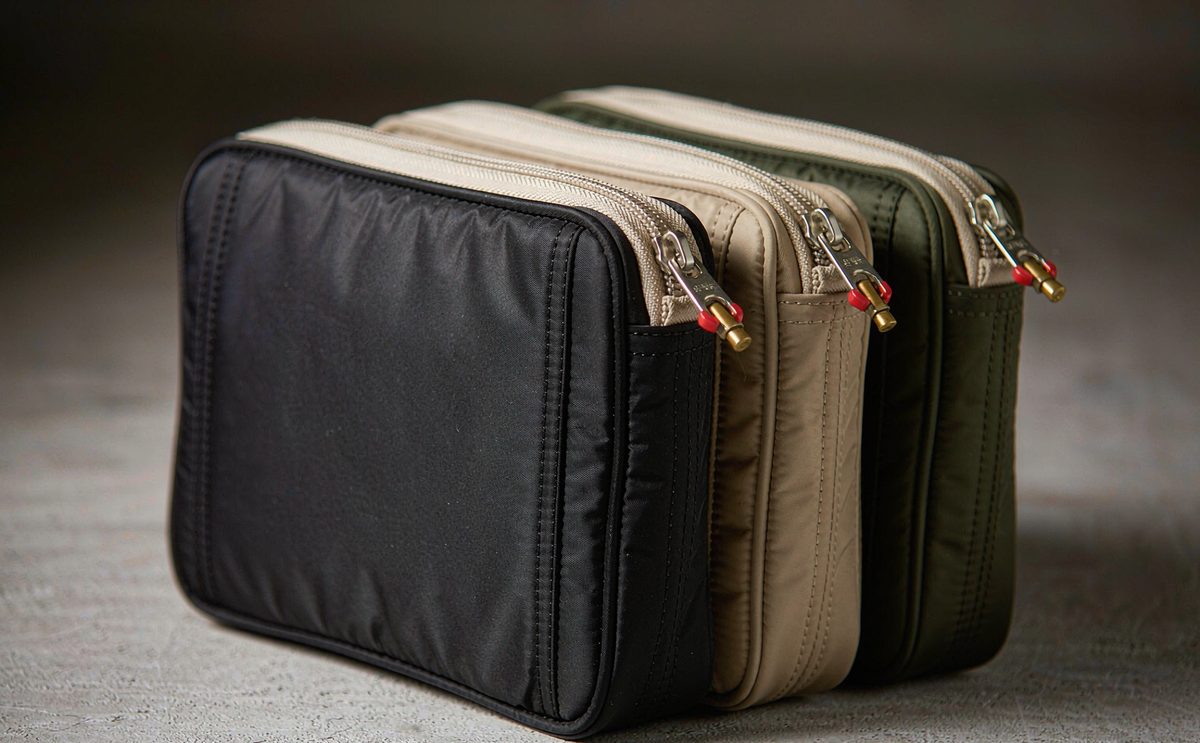
- Why pouches earn their place on an add-on menu
- The unit cost arithmetic behind a pouch add-on
- Pouch formats and what each one costs to build
- Sizing pouches around flat-pack shipping
- Shells, linings and the weight that follows
- Branding methods that hold up on small panels
- Closures, hardware and the failure points to specify
- Sampling a pouch add-on in two rounds
- Packing, cartons and freight maths for add-ons
- QC checks specific to pouches
- Pricing the add-on on your campaign page
- The RFQ checklist for a pouch add-on
Why pouches earn their place on an add-on menu
An add-on has a harder job than a pledge tier. It has to raise average pledge value without adding a new fulfilment workflow, a new carton size or a new QC regime. A flat pouch is the reward format that most reliably does all three. It is cut from the same material families as your hero bag, it sews on the same equipment, and it can travel inside the hero carton rather than as a separate shipment, which is where most of the margin actually comes from.
The economics follow from the geometry. Pouch panels are rectangular and nest efficiently on a marker, so material yield runs high and cutting time per unit runs low. There is no frame sheet, no moulded back panel, no load-bearing harness and usually no structured interlining. On a first run of 500 pcs that difference translates into a unit cost that is typically a fraction of a structured backpack, while the perceived value to a backer sits comfortably in impulse-buy territory.
There is a second, less obvious benefit. Because a pouch is cheap to sample and quick to approve, it is the format to use when you want to test a colourway, a print or a label treatment before committing it to the hero SKU. Our crowdfunding bag sample prototyping programme often runs the pouch variant one round ahead of the main bag for exactly this reason. The pouch becomes a low-risk proving ground rather than just another SKU.
- Minimum order quantity
- 500 pcs per style / colourway
- Sampling
- 6-10 working days (12-15 for complex builds)
- Bulk production
- 35-50 days after deposit + approved pre-production sample
- Inspection
- AQL 2.5 to ISO 2859-1
- Trade term
- FOB Xiamen
- Payment
- T/T 30/70
- Production floor
- 4,950 m² SGS-verified, 137 staff, 7 lines, 149 machines
- Monthly capacity
- 200,000 pcs per month
- Programme contact
- service@junyuanbags.com
Key takeaways before you add a pouch SKU
- A flat pouch typically weighs 40-90 g and adds 2-4 cm to a carton profile, so it can ride inside the hero shipment.
- MOQ is 500 pcs per style and colourway; three sizes in one fabric count as three commitments unless built as one run.
- Sampling takes 6-10 working days per round; budget two rounds before you publish a delivery month.
- One branding method per run keeps the decoration cost, the QC burden and the lead time predictable.
- Price the add-on against landed cost per unit, not against the ex-works unit cost on the quotation.
The unit cost arithmetic behind a pouch add-on
Creators usually price add-ons by looking at the unit cost on the quotation and applying a markup. That works for a pledge tier and it fails for an add-on, because an add-on carries costs the hero reward already absorbed. Four lines matter: the unit cost itself, the incremental packing and handling cost, the volumetric freight share, and the replacement reserve you will need when a percentage of units arrive damaged or defective.
Worked forward rather than backward is clearer. Take a pouch quoted at 1.80 USD ex-works on a 500 pcs run. Add a packing and handling increment of roughly 0.15 USD per unit, a volumetric freight share of roughly 0.35 USD per unit on consolidated ocean freight, and a replacement reserve of 3% of landed cost, which is about 0.07 USD. Landed cost lands near 2.37 USD. At a 14 USD add-on price the gross contribution is roughly 11.60 USD per unit before platform and payment fees of around 8-10%, leaving roughly 10.40 USD of contribution.
The number that surprises creators is how little the unit cost matters at this margin. Moving the pouch from 1.80 USD to 2.10 USD by upgrading the lining costs 0.30 USD of contribution; failing to control carton volume can easily cost more than that in freight alone. This is why the crowdfunding bag guide belongs next to the quotation on your sourcing spreadsheet, not after it.
| Cost line | Per unit (USD) | Note |
|---|---|---|
| Ex-works unit cost | 1.60 - 2.40 | Varies with shell denier, lining and hardware |
| Packing and handling increment | 0.10 - 0.20 | Polybag, folding, carton packing labour |
| Volumetric freight share, ocean | 0.25 - 0.50 | Driven by packed carton volume, not unit mass |
| Duty and clearance allowance | 0.10 - 0.30 | Depends on HS classification and destination |
| Replacement reserve at 3% | 0.06 - 0.10 | Covers defects found after inspection |
| Indicative landed cost | 2.11 - 3.50 | Model your own figures on the same structure |
Pouch formats and what each one costs to build
Format choice drives unit cost more than fabric choice does. A gusseted pouch with a boxed base needs more panels, more sewing operations and more precise corner work than a flat envelope pouch of the same nominal size. A structured cosmetic pouch with a wide-opening frame needs interlining and a stay, plus a longer assembly sequence. Pick the simplest format that delivers the value the backer is paying for.
| Format | Panel count | Best add-on use | Relative unit cost |
|---|---|---|---|
| Flat envelope pouch, zip top | 2-4 | Cable and accessory organiser | 1.00 (baseline) |
| Flat pouch with bound seams | 3-5 | Premium-feel small goods pouch | 1.15 - 1.30 |
| Gusseted pouch, boxed base | 5-7 | Toiletry or cosmetic add-on | 1.30 - 1.55 |
| Structured cosmetic pouch | 6-9 plus interlining | High-perceived-value tier | 1.60 - 2.10 |
| Roll-top or fold-top pouch | 4-6 | Sustainability-led campaigns | 1.25 - 1.50 |
| Pouch with external slip pocket | 6-8 | Upgrade that lifts perceived value | 1.35 - 1.70 |
- Start with the flat envelope format; it is the cheapest to cut, the fastest to sew and the easiest to inspect.
- Add a gusset only where the contents genuinely need depth, because boxed corners are where pouch defects concentrate.
- Treat external slip pockets as a stretch-goal upgrade rather than a launch feature.
- Keep panel count under seven on a first run if you want sampling to finish inside 10 working days.
- Confirm the packed flat profile in writing; it is the number your freight quote depends on.
Sizing pouches around flat-pack shipping
Pouch dimensions should be chosen backwards from the carton, not forwards from a rough idea of what fits inside. A pouch sized to 24 x 16 cm flat will stack in predictable layers inside a standard export carton, while a 26 x 19 cm pouch that looks barely different on screen can change the layer count enough to shift the volumetric weight of the whole shipment. On a 500 pcs add-on run consolidated with your hero bags, that shift is usually larger than any material saving you could negotiate.
The three-size rule works well here. A small pouch around 18 x 12 cm, a medium around 24 x 16 cm and a large around 30 x 20 cm cover the accessory, toiletry and tech-organiser use cases while sharing one zip length family, one webbing width and one label size. Shared components mean fewer purchase orders, fewer shade-matching risks and a shorter material lead time inside the 35-50 day bulk window.
| Size | Flat dimensions | Typical contents | Shared components |
|---|---|---|---|
| Small | 18 x 12 cm | Cables, chargers, cards, coins | #3 zip, 12 mm webbing pull, 30 mm label |
| Medium | 24 x 16 cm | Toiletries, make-up, small tools | #5 zip, 12 mm webbing pull, 30 mm label |
| Large | 30 x 20 cm | Tech organisers, travel documents | #5 zip, 15 mm webbing pull, 40 mm label |
| All sizes | Tolerance +/- 5 mm | As specified on the campaign page | One shell fabric, one lining, one print method |
Reading a volumetric quote before you commit
Freight on a consolidated reward shipment is usually charged on the greater of actual weight and volumetric weight, and pouches sit near the crossover point. A carton of 100 medium pouches might weigh 6 kg but measure 0.024 m³, which at the standard 6,000 divisor computes to a volumetric weight of 4 kg, so actual weight governs. Reduce the packing density and the same carton measures 0.032 m³, computing to 5.3 kg, and the freight line barely moves. Increase the folded height across the whole programme and the crossover flips, and every unit starts paying on volume.
The practical instruction for an RFQ is therefore to ask for the packed carton specification, not the unit weight. Carton dimensions, pieces per carton and gross weight let your forwarder quote accurately, and they let you compare two quotations that have similar unit costs but very different landed costs. Where a programme is shipping to more than one fulfilment region, ask for the carton spec to be modelled against each destination, because the duty classification and the volumetric divisor both move with the market.
If your campaign page states a pouch is 24 x 16 cm, the pack must carry a tolerance, typically +/- 5 mm on a sewn fabric pouch. Without a written tolerance the inspector has nothing to measure against, and a 10 mm shortfall becomes an argument rather than a defect finding.
Shells, linings and the weight that follows
A pouch is roughly 60-70% shell fabric by mass, so the shell choice sets the shipping weight. A 300D polyester shell with a light PU coating produces a medium pouch around 55-70 g. Moving to 600D roughly doubles the shell mass and lands the same pouch near 90-110 g. Multiply that across 500 pcs and the difference is 15-20 kg of actual weight, which matters less than it sounds on ocean freight and considerably more if you air-freight a partial shipment to hit an event date.
Linings matter for a different reason: they drive perceived value and they are the most common source of colour-transfer complaints. An unlined pouch with overlocked internal seams is cheap and light but reads as disposable. A 210D polyester lining in a toning shade adds roughly 10-15 g and lifts the unboxing impression substantially. A wipe-clean TPU or PEVA lining adds 20-35 g and is the right call for cosmetic or toiletry add-ons where leaks are expected.
| Specification | Indicative unit weight | Cost index | Best for |
|---|---|---|---|
| 300D polyester shell, unlined | 45 - 60 g | 1.00 | Lightest, cheapest accessory pouch |
| 300D shell + 210D lining | 55 - 75 g | 1.15 | Default premium-feel pouch |
| 600D polyester shell + lining | 90 - 115 g | 1.35 | Durable everyday pouch |
| Cotton canvas 10 oz + lining | 110 - 140 g | 1.45 | Natural-material brand positioning |
| Recycled rPET shell + rPET lining | 55 - 80 g | 1.25 | Sustainability-led campaigns |
| Shell + wipe-clean TPU lining | 75 - 105 g | 1.40 | Cosmetic and toiletry add-ons |
Branding methods that hold up on small panels
A pouch panel is small, which constrains the branding method more than most creators expect. Embroidery needs a minimum stable area and a minimum letter height; below roughly 5 mm of letter height the stitches lose definition and the logo reads as a blob. Screen printing handles fine detail better on a flat panel but adds a film and a cure step. A woven label is the most robust option on a small format because the design is woven, not applied, and it survives abrasion at the seam.
| Method | Minimum practical size | Cost driver | Watch out for |
|---|---|---|---|
| Woven label, sewn in | 20 x 40 mm | Label tooling plus sewing operation | Placement must clear the zip end |
| Screen print, 1-2 colours | 40 x 40 mm | Film per colour, per size | Cracking on coated shells if under-cured |
| Heat transfer print | 50 x 50 mm | Transfer sheet per unit | Hand feel on soft shells |
| Embroidery, flat | 30 x 60 mm | Stitch count, not logo size | Puckering on lightweight shells |
| Debossed or moulded puller | Tooling production 35-50 days | Tool cost amortised over 500 pcs | Only worth it on premium tiers |
| Woven hang tag on puller | 15 x 60 mm | Tag unit cost plus application | Added packing time per unit |
The decision rule we give creators is simple: one method on the first run, a second method only on a stretch-goal upgrade. Two methods on one small panel means two setup charges, two QC regimes and two ways for a run to fail inspection. If you want embroidery specifically, the print and embroidery options for custom bags page breaks down stitch counts and panel requirements in more detail.
Closures, hardware and the failure points to specify
Pouches fail at the closure, not in the field of the panel. The three recurring defects on a 500 pcs pouch run are zip tape separation at the stop, puller detachment from the slider, and seam slippage at the point where the zip tape is sewn to the shell. All three are specification problems rather than workmanship problems, and all three are preventable by naming the component and the construction in the tech pack.
- Name the zip by gauge and type: #3 coil for small pouches, #5 coil for medium and large, metal only where the aesthetic justifies the weight.
- Specify the stop type: a metal stop at the top of the tape prevents the slider walking off under load.
- Require bar-tack reinforcement at both zip ends; this is a 2-second operation that removes the most common defect.
- Specify puller attachment: a split ring or a webbing loop sewn into the seam beats a clip-on puller for durability.
- Set a slider pull-test requirement and record it in the pack so it can be verified at inspection.
- Define seam allowance at the zip join, typically 8-10 mm, and stitch density for that seam.
Hardware is also where custom components quietly wreck a schedule. A custom moulded puller costs 15-20 days of tooling before the first unit can be sewn, which on a pouch programme can be longer than the sampling itself. Catalogue hardware in a stock finish gets you the same visual result for no tooling lead time, and on a 500 pcs run the amortised tooling cost is rarely recovered anyway.
Sampling a pouch add-on in two rounds
Sampling runs 6-10 working days per round from a released specification, and complex builds stretch to 12-15. Because a pouch is quick to build, it is tempting to treat it as a single-round formality and skip straight to bulk. That is a mistake: the pouch is usually the unit that gets handled most by backers, and it is the unit most likely to be photographed in unboxing posts.
- Round one: confirm format, dimensions and closure function. Load the pouch with the intended contents and photograph it.
- Write the revision list as a numbered document, each item tied to a clause in the tech pack.
- Round two: confirm corrections, the branding application and the packed flat profile inside the carton.
- Approve the pre-production sample in writing; this is the unit the inspector will measure bulk against.
- Pay the 30% deposit under T/T 30/70; the bulk clock starts on deposit plus approval, not on either alone.
- Book the production slot in writing with a start date, a completion date and an inspection date.
A pouch that looks correct empty and fails when loaded is the most common sampling miss on this format. Ship the sample with the actual cables, bottles or tools it is meant to hold, then measure how much the panel distorts. That measurement is what tells you whether the gusset depth is right.
A useful trick on tight calendars is to approve the pouch as a pre-production sample ahead of the hero bag. Because the pouch shares fabric and hardware with the hero SKU, approving it early lets materials be reserved for the full programme while the structured item is still in revision. Our low minimum production programme is structured to allow exactly that split approval across a multi-SKU first run.
Packing, cartons and freight maths for add-ons
Add-ons are where packing specification quietly destroys margin. Pouches are compressible, so the temptation is to pack them at maximum density. That works until the carton fails a drop test or the folded creases will not relax out of a coated shell. A folded pouch that arrives with a permanent crease across the printed logo is a replacement request, and replacements are the most expensive units you will ever ship.
| Packing method | Carton profile | Damage risk | Packing labour |
|---|---|---|---|
| Bulk packed, folded flat, 100 per carton | Lowest | Medium: creasing on coated shells | Lowest |
| Bulk packed, 50 per inner, 2 inners per carton | Low | Low: fewer compression creases | Low |
| Individually polybagged, 50 per carton | Medium | Lowest | Medium |
| Individually polybagged with insert card | Medium | Lowest, best unboxing | Highest |
| Retail-ready, folded with belly band | Highest | Low, but highest freight | Highest |
Carton dimensions belong on the packing list and in the quotation. Standard export cartons around 60 x 40 x 40 cm consolidate predictably; an oversized carton pushes the shipment into a worse volumetric bracket and inflates the freight line on every unit in the container. Where a programme ships add-ons separately, ask for the carton specification before you publish the pledge price, then confirm it again at rewards fulfilment planning.
QC checks specific to pouches
Pre-shipment inspection runs at AQL 2.5 to ISO 2859-1, general inspection level II, single sampling plan. On pouches the defect classes worth defining in advance are: critical — broken zip or detached puller that makes the unit unusable; major — visible print defect on the logo, seam slippage at the zip join, or a dimension outside tolerance; minor — loose thread, slight shade variation between panels, or a crease that relaxes out.
- Measure external dimensions flat, at three units per carton drawn, against the stated tolerance.
- Cycle every zip in the sample draw a minimum of 20 times and record any catch or separation.
- Check branding placement against the coordinate in the pack, measured from a stated seam, not estimated.
- Verify the lining is anchored at both ends; a floating lining is the most common cosmetic pouch complaint.
- Confirm carton count, carton marking and packing list match before the balance payment is released.
- Keep the approved pre-production sample on the inspection table as the reference unit.
A failed inspection costs 10-15 days in rework and re-presentation, which on a pouch add-on is often longer than the original build. The mitigation is an in-line check during the sewing window, when a defect trend is still correctable at the station rather than sortable only at the end. The full defect taxonomy we log on bag programmes is on the QA and QC process page.
Pricing the add-on on your campaign page
Two pricing errors recur. The first is pricing an add-on from ex-works unit cost and discovering after freight and duty that the contribution was thinner than planned. The second is pricing it so low that a backer who adds three pouches costs you more in packing labour than the add-on earns. Both are fixed by modelling landed cost per unit, then checking the contribution at the realistic attach rate rather than at a single unit.
Attach rate matters more than price. If 25% of backers add one pouch and 8% add two, the incremental revenue on a 400-backer campaign is meaningful, but the incremental packing labour is roughly linear in units. Set the add-on price so that the contribution survives a 3% replacement reserve and the platform and payment fee load, then decide whether the upside justifies the SKU at all. Where a pouch is one format in a wider reward range, the custom bag categories page shows how pouch SKUs sit alongside totes, cosmetic bags and organisers in a single programme.
The RFQ checklist for a pouch add-on
A request for quotation returns a usable cost breakdown and production window only when the specification is complete. For a pouch, the six items that most often go missing are the zip gauge, the lining specification, the branding coordinate, the packed flat profile, the carton count and the inspection standard. Send all six and the quotation comes back in one exchange.
- External flat dimensions in centimetres with a stated tolerance, plus gusset depth if the format has one.
- Shell fabric by denier, weave and coating, and lining by denier and finish.
- Zip gauge and type, stop type, puller type and bar-tack reinforcement at the zip ends.
- Branding method, size and a measured placement coordinate from a stated seam.
- Packing specification: pieces per polybag, per inner and per carton, with carton dimensions.
- Quantity per size and per colourway against the 500 pcs minimum.
- Inspection standard, trade term and destination market for freight and compliance.
- Custom bags for Kickstarter campaigns
- Custom cosmetic bags for Kickstarter
- Low minimum bag production for creators
- Sample prototyping for crowdfunding bags
- Print and embroidery options for custom bags
- QA, QC and inspection on campaign bag runs
- Crowdfunding rewards fulfilment
- Request a quotation
Price a pouch add-on against real landed cost
Send us the pouch format, dimensions, fabric and quantity per colourway. As your production partner we will return a unit cost, a sampling estimate and a packed carton specification you can model. Write to service@junyuanbags.com or use the quotation form.
Frequently Asked Questions
What is the MOQ for custom pouches used as Kickstarter add-ons?
The minimum is 500 pcs per style and per colourway. A three-size pouch family in one fabric counts as three separate 500 pcs commitments unless the run is structured as a single production booking with a colourway split. Most creators launch one size at 500 pcs and add the second and third sizes on re-order once the attach rate is known.
How much does a custom pouch add-on cost per unit?
Ex-works unit cost for a flat zip pouch on a 500 pcs run typically sits between 1.60 and 2.40 USD, depending on shell denier, lining and hardware. Add roughly 0.35 USD for packing and a volumetric freight share and 0.10 to 0.30 USD for duty, and landed cost lands near 2.11 to 3.50 USD before any platform fees.
How long does sampling take for a pouch add-on?
Sampling runs 6-10 working days per round from a released tech pack, stretching to 12-15 working days for complex builds such as a structured cosmetic format. Budget two rounds, so 12-20 working days of calendar, and treat a third round on a structured build as planned contingency rather than as a problem.
Can pouches ship inside the same carton as the hero reward bag?
Usually yes, and it is the single biggest margin lever on an add-on programme. A flat pouch adds roughly 2-4 cm to the packed profile, so it can ride inside the hero carton rather than travelling as a separate shipment, which removes an entire pick, pack and freight leg from the cost structure.
Which branding method works best on a small pouch panel?
A woven label sewn into the seam is the most robust option on a small format because the design is woven rather than applied. Embroidery needs roughly 5 mm of letter height and a 30 x 60 mm stable area to hold definition. Screen printing handles finer detail but adds a film and cure step per colour.
How heavy is a typical custom pouch for shipping estimates?
A medium pouch in 300D polyester with a 210D lining typically weighs 55-75 g. An unlined 300D pouch drops to 45-60 g, while 600D with a wipe-clean TPU lining reaches 75-105 g and cotton canvas reaches 110-140 g. Multiply by 500 pcs to get the actual-weight line on your freight estimate.
What inspection standard should a pouch add-on order specify?
AQL 2.5 to ISO 2859-1 at general inspection level II, single sampling plan, is the standard for reward-grade pouches. Name the standard, the level and your defect classes in the purchase order. Simple promotional pouches sometimes accept AQL 4.0, and retail-facing programmes sometimes tighten to AQL 1.5.
What are the most common defects on a bulk pouch run?
The three recurring defects are zip tape separation at the stop, puller detachment from the slider, and seam slippage where the zip tape joins the shell. All three are specification problems rather than workmanship problems, and bar-tack reinforcement at both zip ends removes most of the risk for under 0.02 USD per unit on a 500 pcs run.
Should a pouch add-on use custom moulded hardware?
Rarely on a first run. A custom moulded puller adds 15-20 days of tooling before the first unit can be sewn, which on a pouch programme can exceed the sampling time itself. Catalogue hardware in a stock finish gives the same visual result with no tooling lead time and a lower amortised cost on 500 pcs.
How should I price a pouch add-on on the campaign page?
Price against landed cost per unit, not ex-works. Take the unit cost, add roughly 0.35 USD for packing and freight, allow 0.10 to 0.30 USD for duty, then add a 3% replacement reserve and platform and payment fees of around 8-10%. Check the contribution at your realistic attach rate, not at a single unit.
Can I add a second pouch colourway after the campaign funds?
Yes, but each additional colourway is a new 500 pcs commitment unless it was negotiated as a split within one production run. Price the variant inside the original RFQ so a re-order becomes a confirmation rather than a fresh negotiation, and expect it to add days to the production window.
What does FOB Xiamen mean for a pouch add-on shipment?
FOB Xiamen means goods are delivered on board the vessel at Xiamen and risk transfers there. Packing, port delivery and loading are handled on the production side; ocean freight, insurance, customs clearance and inland delivery to your fulfilment warehouse are yours. Budget 18-30 days transit to the US West Coast and 28-38 days to Northern Europe.
How many pouches should I order for a first campaign run?
Work from forecast attach rate rather than backer count. On a 400-backer campaign with 25% single-unit attach and 8% two-unit attach, roughly 165 units are committed, so 500 pcs covers those plus replacements, press units and retail samples with useful headroom for late pledges and post-campaign add-on sales.
When is the balance payment due on a pouch add-on order?
Payment is T/T 30/70. The 30% deposit falls due when the pre-production sample is approved in writing; the 70% balance falls due after a passed pre-shipment inspection and before cargo is released for loading. The deposit must sit inside your funding target because it is payable weeks before all pledges have settled.
People Also Ask
Are pouches a good first add-on for a bag campaign?
They are usually the best first add-on because they share fabric, hardware and branding with the hero bag, so no new supply chain is required. A typical unit weighs 40-90 g and can ride inside the hero carton, which keeps the incremental fulfilment cost close to zero.
How much margin should a Kickstarter pouch add-on carry?
Aim for a gross contribution of at least 4x landed cost before platform fees. With a landed cost near 2.50 USD, an add-on price of 12-18 USD leaves roughly 8-12 USD of contribution after fees and a 3% replacement reserve.
Can I mix pouch sizes in one production run?
Yes, if you book them as one production slot with a shared fabric and hardware family. Each size is still counted separately against the 500 pcs minimum per style and colourway, so three sizes usually means three commitments rather than one combined 500 pcs order.
What fabric should I use for a cosmetic pouch add-on?
A 300D or 600D polyester shell with a wipe-clean TPU or PEVA lining is the practical default. It resists leaks, cleans easily and adds only 20-35 g versus a standard 210D lining. Confirm any recycled content claim with documentation before you put it on the page.
Do pouches need their own carton specification?
They do. Packed flat profile, pieces per polybag and per carton, and carton dimensions all belong on the packing list. Oversized cartons push a consolidated shipment into a worse volumetric bracket and inflate the freight line on every unit in the container.