Custom Ski and Snowboard Bags for Crowdfunding: Long-Item Logistics
A ski or snowboard bag is a logistics product before it is a design product. At 170 to 200 cm long it attracts oversized freight pricing, it is charged on volumetric weight, and it has to fit airline size and weight limits to be useful at all. Plan on 500 pcs per style and colourway, sampling of 6-10 working days and production 35-50 days, then add a seasonal constraint: units must land before the northern winter starts, so the campaign has to fund in spring or early summer rather than in autumn.
- Long items break the freight maths before they break the design
- Airline and carrier size rules you must design around
- Ski bag versus snowboard bag: two different shapes
- Padding, structure and what a 190 cm bag needs to survive
- Wheels, handles and dragging a 2 m bag through an airport
- Volumetric weight and the cost of empty space
- Carton engineering for an oversized product
- Seasonal timing: the northern winter is a hard window
- Material choices for cold, wet and abrasive use
- Cost structure of a long-item programme
- QC for a long seam and a long zip
- The long-item RFQ
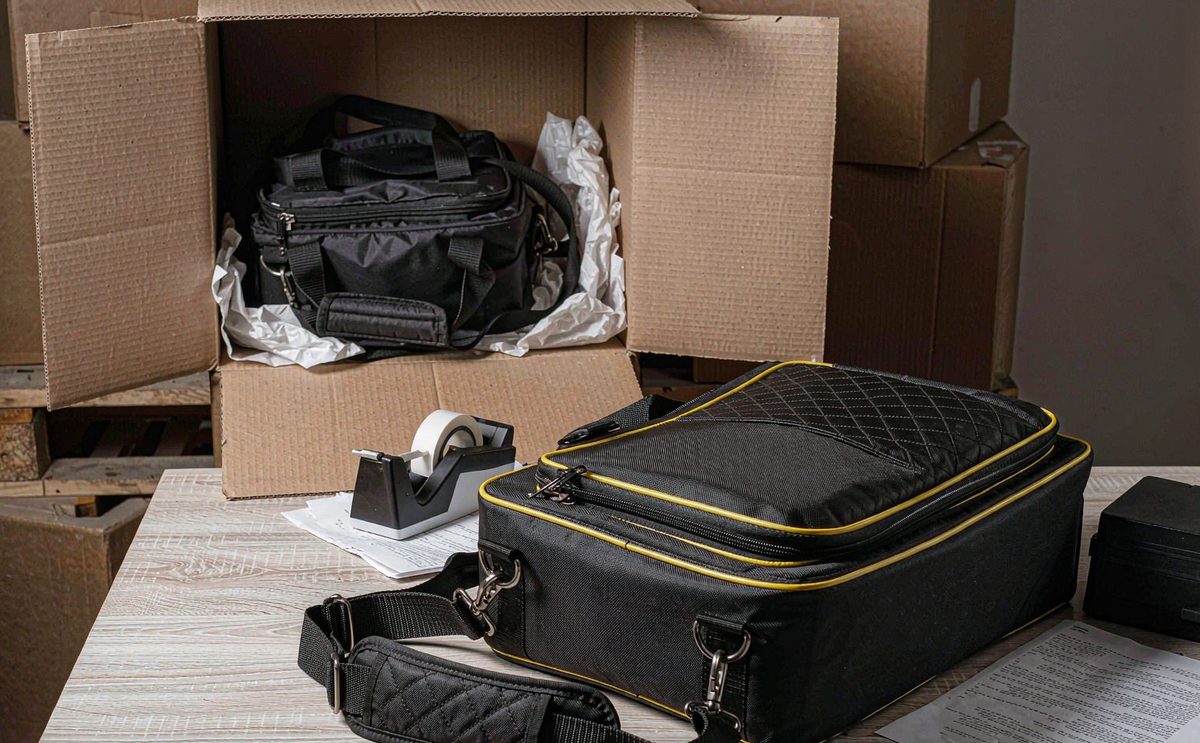
Ski and snowboard bags are the clearest example in this industry of a product whose logistics define its design. Length drives freight class, volumetric weight, carton cost, warehouse handling and the airline rules that decide whether the bag is useful to its owner at all. None of that appears in a campaign render, and all of it appears in the unit cost and the delivery date. This article works through the long-item problems in the order they bite: freight, airline rules, structure, cartons, season and QC.
- Minimum order quantity
- 500 pcs per style / colourway
- Sampling
- 6-10 working days (12-15 for complex builds)
- Bulk production
- 35-50 days after deposit + approved pre-production sample
- Inspection
- AQL 2.5 to ISO 2859-1
- Trade term
- FOB Xiamen
- Payment
- T/T 30/70
- Production floor
- 4,950 m2 SGS-verified, 137 staff, 7 lines, 149 machines
- Monthly capacity
- 200,000 pcs per month
- Campaign experience
- 20+ crowdfunding campaigns supported
Key takeaways on long-item programmes
- Length drives freight class and volumetric weight; model both before you price the tier.
- Design to airline size and weight limits, because a bag that cannot be checked is not a travel product.
- Wheels and a centre carry handle are what make a 190 cm bag usable; specify them by load rating.
- The northern winter is a hard delivery window, so the campaign must fund in spring or early summer.
- Long seams and long zips fail differently; write specific functional checks into the AQL 2.5 plan.
Long items break the freight maths before they break the design
The first thing to understand about a ski bag is that its length changes which freight rules apply. Standard parcel and express networks apply a longest-side limit, commonly around 120 to 150 cm depending on the carrier and service, and a bag of 170 to 200 cm falls outside it. That moves the shipment into an oversized category with different pricing, fewer service options and often an additional handling surcharge.
The second thing is volumetric weight. Air and express carriers charge on the greater of actual and volumetric weight, and volumetric weight scales with the product of the three dimensions. A long, thin bag has relatively modest volume for its length, but the longest dimension alone pushes it into a category where the charge is calculated on a shape that cannot be reduced much. That is the cost of the product and it has to be in the tier price.
The third thing is handling. A 190 cm carton cannot go through a standard parcel sorter, which means it is handled manually or as a freight item, and manual handling costs more and damages more. That raises both the freight line and the damage rate, and the damage rate feeds back into the returns reserve. All three effects are consequences of one dimension, which is why length is the first decision in this category rather than the last. Our custom travel bags for Kickstarter pillar page covers the wider travel framework.
| Dimension | Logistics consequence | Planning response |
|---|---|---|
| Longest side under 120 cm | Standard parcel networks apply | Normal freight modelling |
| Longest side 120-150 cm | Carrier limits begin to bite | Check service availability by destination |
| Longest side 170-200 cm | Oversized category, surcharges | Model oversized rates before pricing |
| Any long item by air | Charged on volumetric weight | Reduce carton cross-section wherever possible |
| Any long item in a warehouse | Manual or freight handling | Budget a higher damage reserve |
Airline and carrier size rules you must design around
The product exists to carry skis or a board onto an aircraft, so the bag has to work inside airline rules. Two sets matter. The checked baggage allowance sets a maximum weight, commonly 23 kg in economy with a 32 kg ceiling on many carriers, and it sets a maximum linear dimension, usually the sum of length, width and height, commonly around 158 cm for standard checked bags. Sports equipment is often carried outside the standard allowance under a specific sports equipment policy, which is the rule a ski bag owner will actually be using.
That policy is where the design constraint lives. Many carriers accept ski or snowboard equipment as one item within a stated maximum weight, and they charge a sports equipment fee when it is within the allowance or an excess fee when it is not. The practical design implication is that the empty weight of the bag matters directly: every kilogram in the bag is a kilogram less of equipment the owner can pack before hitting the allowance.
Publish the empty weight and the external dimensions on the campaign page, and state them as maximum external dimensions rather than as an internal fit claim. Backers in this category check these numbers against their carrier before pledging. A bag that fits a 185 cm ski but exceeds the linear limit is a bag that generates a complaint from the first person who tries to check it in, and that complaint arrives as a review rather than as a question.
- Publish external dimensions and empty weight, not just the ski length the bag fits.
- Design to the common 23 kg allowance: every kilogram of bag is equipment the owner cannot pack.
- Check how major carriers treat sports equipment and design within that rather than within the standard allowance.
- State whether wheels and handles count within the external dimension you publish.
- Avoid rigid structures that make the bag heavier than a comparable soft design.
Ski bag versus snowboard bag: two different shapes
These are not variants of the same product. A ski bag is long and relatively narrow, typically carrying one or two pairs of skis with poles, and its cross-section is shaped by the bindings and the brake arms rather than by the skis themselves. A snowboard bag is shorter and wider, because a board is wide and its bindings protrude substantially. The two shapes produce different cutting patterns, different padding requirements and different carton dimensions.
That matters for the minimum. A ski bag and a snowboard bag are two styles, which means 500 pcs per style and per colourway applies to each. A campaign wanting both is committing to 1,000 pcs unless a shared pattern approach is possible, and it is usually not, because the padding and the binding clearance differ. Pick one for a first run unless the audience is clearly split and large enough to support two.
If you must choose, consider which audience is more reachable. Snowboard audiences skew younger and are more active in online communities, which helps a campaign. Ski audiences are larger and often buy as families, which helps average order value. Both are seasonal and both are concentrated in a small number of markets, which is the factor that matters most for the shipping plan and the one covered below.
| Factor | Ski bag | Snowboard bag |
|---|---|---|
| Typical external length | 175-200 cm | 155-180 cm |
| Cross-section driver | Bindings and brake arms | Board width and binding height |
| Padding priority | Binding contact zones | Board edges and nose or tail |
| Carry configuration | Shoulder strap plus end handle | Shoulder strap plus centre handle |
| Audience profile | Larger, family purchase | Younger, community-active |
| Style count against minimum | One style | One style |
Padding, structure and what a 190 cm bag needs to survive
A long bag is loaded with hard, sharp, heavy objects and then thrown. Skis have metal edges, bindings are dense and angular, and poles add point loads. Baggage handling is not gentle. The specification response is concentrated padding at the contact zones rather than uniform padding throughout, because uniform padding adds weight everywhere and weight is the constraint identified above.
Identify the contact zones and specify them individually. Binding contact areas need the densest protection. Edge contact along the length needs a continuous abrasion-resistant liner rather than foam alone, because a sharp edge cuts foam. The nose and tail need impact protection, since that is where a dropped bag lands. And the base needs a reinforced, wipe-clean panel, because the bag is dragged across snow, gravel and conveyor surfaces.
Structure is a separate decision. A fully rigid shell protects best and is heaviest and most expensive to ship. A soft bag with a semi-rigid base panel and internal compression straps protects adequately, weighs less and packs smaller, which is why most products in this category use it. Specify internal compression straps, because they stop the contents moving inside the bag, and movement is what turns a hard edge into a cut.
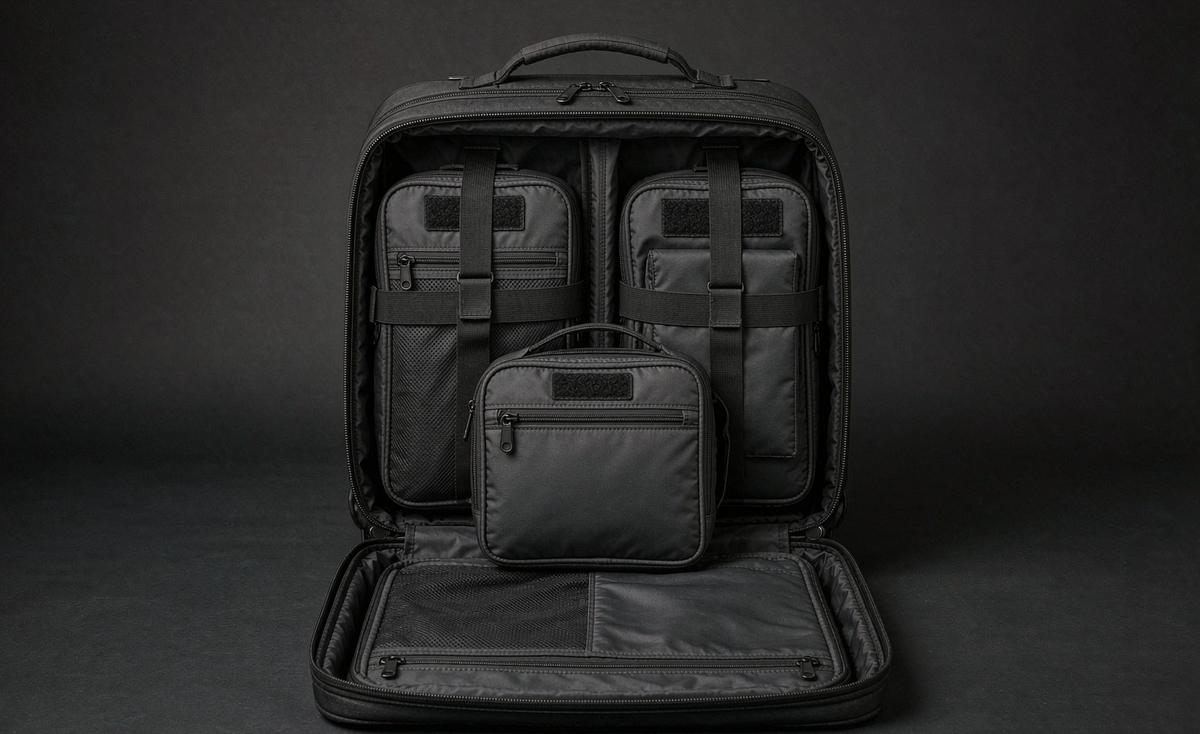
Consider how the bag is packed by its owner, because that determines where the padding is actually needed. A bag loaded with skis, boots, a helmet and clothing puts the heaviest objects in different places than a bag loaded with a single board. Ask the target audience what they pack, then place the padding accordingly. Padding placed where nobody puts anything is weight that costs the owner airline allowance and protects nothing.
Wheels, handles and dragging a 2 m bag through an airport
A bag of this length is not carried; it is dragged, wheeled or carried by two people. That makes the handle and wheel specification the most-used part of the product and the most common source of failure. Wheels on a long bag take an unusual load because the bag flexes along its length, so the wheel housing has to be mounted to a reinforced plate rather than to the fabric alone.
Handles should be specified in three positions, not one. An end handle for pulling it along, a centre carry handle for lifting it onto a conveyor or into a car, and a shoulder strap that is removable and padded. The centre handle is the one most often omitted and the one most often needed, because a 190 cm bag cannot be lifted from an end without dragging the other end on the ground.
Rate all of them. Wheel housings by load and by the reinforcement behind them, handles by pull strength at the attachment, and the shoulder strap by the same standard as any load-bearing strap. Then test them on the sampling unit with the bag loaded to the weight it will actually carry, because a handle that holds an empty bag and fails on a loaded one is a failure that appears in the first week of the season.
- Mount wheels to a reinforced plate, not to the face fabric, because a long bag flexes.
- Specify three carry points: end handle, centre carry handle and a removable padded shoulder strap.
- Rate handles by pull strength at the attachment and wheels by load rating.
- Test the loaded sample, not the empty one, at the weight the bag will actually carry.
- Confirm the wheel housing does not protrude beyond the published external dimensions.
- Consider whether wheels are worth the weight against the airline allowance.
Volumetric weight and the cost of empty space
Because freight is charged on volume and volume is the product of three dimensions, the cross-section of the carton matters as much as the length. A carton that is 5 cm taller and 5 cm wider adds volume across the whole 190 cm length, which is a large absolute increase. That makes the packing method a cost lever: whether the bag is rolled, folded or packed flat, and how much air is left around it.
The design lever is compressibility. A soft bag that can be folded or rolled for shipping occupies materially less volume than a semi-rigid one, and the saving multiplies across every carton. Where the destination mix is air-heavy, that difference can be the single largest controllable freight variable in the programme. Where the mix is sea-heavy it matters less, because sea freight is charged by container space and the bag is bulky either way.
Model it per unit before pricing. Take the packed carton dimensions, apply the volumetric divisor your carrier uses, divide by the pieces per carton, and add duty. Then test the tier price against a 20 per cent freight increase, because long-item freight is volatile and the oversized surcharges change more often than base rates. Campaigns that do this still launch; campaigns that skip it discover their margin after the price is published.
One more item belongs in the carton specification: how the bag is packed inside it. A folded bag needs a fold instruction so every carton is packed the same way, because inconsistent packing produces inconsistent carton volumes and therefore inconsistent freight costs across a shipment. Agree the fold, record it with a photograph, and give the photograph to the packing team. It is a five-minute decision that prevents a freight variance nobody can explain.
Carton engineering for an oversized product
A long carton behaves differently from a standard one. It is more prone to bending in the middle when lifted, it is more likely to be stacked badly, and it needs a board grade and a closure that hold its shape across the full length. Specify the carton by board grade and by dimensions, and consider an internal support or a higher grade than you would use for a bag of half the length.
Palletisation is the second issue. An oversized carton may not fit a standard pallet footprint efficiently, which means wasted pallet space and a higher cost per unit shipped. Work out cartons per pallet and pallets per container before you commit to a carton size, because a 3 cm change in carton width can change how many fit per layer and therefore the whole freight cost.
Labelling is the third. Long cartons are often stacked on their side or stood on end, which hides a label placed for a conventional orientation. Put the shipping mark and the carton number on at least two faces, and state the contents and the orientation on the carton. It is a small specification and it prevents the most common warehouse problem with oversized goods, which is a carton that cannot be identified without being moved.
Consider how the empty carton is stored before packing, because oversized cartons consume warehouse space quickly and that space is charged. Flat-packed cartons delivered close to the packing date cost less in storage than cartons held for weeks, and they arrive undamaged, which matters because a crushed long carton protects nothing. Agree the carton delivery schedule with the packing operation rather than assuming cartons will be available when the run finishes.
Seasonal timing: the northern winter is a hard window
Ski and snowboard bags sell into a season. The northern hemisphere season runs roughly from December to April, which means units have to be with backers before the first trip, and the whole programme has to be scheduled backwards from that. With bulk production at 35-50 days, sampling at 6-10 working days and sea transit of 25-40 days to a major market, a December delivery means production starting in early summer.
That has a direct consequence for campaign timing: the campaign should fund in spring or early summer, not in autumn. A campaign that funds in October has already missed the season for a sea-shipped programme, and the only remaining option is air freight at a cost that the tier price rarely supports. This is the single most common planning failure in the category and it is entirely predictable.
There is a second seasonal effect on capacity. Production slots in the months leading up to a winter season are contested by every winter product in the category, so a slot booked late competes with the whole industry. Reserve the slot early, and consider producing slightly earlier and holding stock rather than producing closer to the season. The holding cost is usually lower than the air freight alternative. Our race bag article covers the same backwards-planning discipline for another date-critical category.
| Step | Indicative duration | Target month |
|---|---|---|
| Backer delivery before first trips | Event | Late November |
| Clearance and inland delivery | 1-2 weeks | November |
| Sea transit to major market | 25-40 days | October |
| Bulk production | 35-50 days | August to September |
| Sampling, two rounds | 12-20 working days | July |
| Campaign funds and slot confirmed | Goes live | May to June |
Material choices for cold, wet and abrasive use
This category has an environment most bags never meet: sub-zero temperatures, wet snow, salt or grit, sharp metal edges and UV at altitude. Materials have to be chosen against all four. Coatings that become brittle when cold are the main trap, because a PVC-coated fabric that is flexible at room temperature can crack when folded at minus fifteen degrees. Ask specifically about low-temperature flexibility for any coated or laminated material.
The second choice is the liner. Snow and meltwater sit inside the bag, and the liner has to be wipe-clean and non-absorbent, which points to a coated polyester or a TPU-laminated fabric rather than an untreated lining. Where the bag is designed to carry a wet board, drainage matters as much as containment, and the same vent-high, drain-low logic applies as in any wet compartment.
The third choice is hardware, and it is the one that fails visibly. Zips on a long bag run the full length and are opened while the bag is lying in snow or on a wet surface. Specify a large-gauge zip with a corrosion-resistant slider and a puller that can be operated with a gloved hand. Buckles and strap adjusters should be rated for low-temperature impact, because plastics that are tough at room temperature can shatter when struck while cold.
- Ask about low-temperature flexibility for every coated or laminated material, not just about denier.
- Choose a wipe-clean, non-absorbent liner for snow and meltwater.
- Specify a large-gauge zip with a corrosion-resistant slider and a glove-friendly puller.
- Rate buckles and adjusters for low-temperature impact, not only for load.
- Use a reinforced, wipe-clean base panel; the bag is dragged across abrasive surfaces.
- Confirm colour fastness to light, because altitude UV is strong.
Cost structure of a long-item programme
A long bag costs more than a same-volume short bag for three reasons: more fabric per unit, more sewing minutes because every seam is longer, and a larger carton. Fabric consumption scales with surface area, and a 190 cm bag has a large surface area even when it is narrow. Sewing time scales with seam length, and the main seam on this product runs most of the length of the bag twice.
Hardware is the fourth line and it is higher than in most categories, because wheels, a reinforced plate, three handles and a long heavy-duty zip are all specified. Those are not optional on a product of this length. Padding is the fifth, and it is concentrated rather than uniform, which partially offsets the other increases.
Freight is the sixth and the one that behaves differently, because it is driven by carton dimensions rather than by product cost. On a long-item programme freight can represent a materially larger share of landed cost than on a compact product, particularly when air is used. Model it as its own line rather than as a percentage of unit cost, because the percentage approach understates it consistently in this category. See crowdfunding rewards fulfilment for how it is modelled.
| Cost line | Indicative share | What moves it |
|---|---|---|
| Face fabric and lining | 24-32% | Surface area, coating grade, cold-flexibility requirement |
| Cutting and sewing labour | 30-40% | Seam length, padding insertion, wheel plate assembly |
| Hardware and wheels | 12-20% | Wheel housing, handle count, zip gauge and length |
| Padding and structure | 8-14% | Foam density, compression straps, base panel |
| Packing and oversized cartons | 6-12% | Carton grade, board area, pallet efficiency |
| Freight, modelled separately | Market dependent | Carton dimensions, mode and destination mix |
QC for a long seam and a long zip
Length changes the failure modes. A long seam is subjected to a bending load along its whole length whenever the bag is lifted or dragged, and a weakness anywhere along it becomes a split. A long zip is subjected to the same bending plus the load of the contents pressing against it from inside, and it is the most common critical defect in this category. Both need functional checks rather than visual ones.
Write the classes into the AQL 2.5 to ISO 2859-1 plan before production. Run every zip end to end along its full length, not just a portion. Load the bag to a stated weight and lift it from the centre handle, then from the end handle, and check the main seam. Check wheel attachment by pulling and by rolling the loaded unit across a hard surface. And check the carton itself, because an oversized carton that fails in transit produces damage that looks like a product defect.
Give the long-item checks a sampling approach that reflects where stress concentrates. A visual inspection of a two-metre seam will not find a weak section; a functional load test on a drawn sample will. Request an in-line check during sewing as well, because a tension problem on a long seam is a machine setting that can be corrected across the run rather than a defect to be found at the end of it.
- Freeze the specification with external dimensions, empty weight target and material grades.
- Complete sampling round one and return one numbered revision list tied to pack clauses.
- Complete sampling round two and load the unit to the weight it will actually carry.
- Lift the loaded sample from the centre handle and the end handle and check the main seam.
- Run every zip end to end along its full length and roll the loaded unit on its wheels.
- Approve the pre-production sample in writing against the sample identification and pack revision.
- Inspect at AQL 2.5 with the long-item functional checks included, then release the 70 per cent balance.
The long-item RFQ
A request for quotation for this category needs the external dimensions stated first, because they drive everything else. Then the format, ski or snowboard, the maximum equipment length to be carried, the padding zones, the hardware including wheels and handle count, the materials by denier and coating with a cold-flexibility requirement, the decoration method and coordinate, the carton specification, the quantity per style and colourway, the inspection standard and the destination mix.
- External dimensions and the empty weight target, stated as maxima.
- Format: ski or snowboard, and the maximum equipment length the bag must carry.
- Padding zones identified individually: binding contact, edge liner, nose and tail, base.
- Hardware: wheel load rating, handle count and positions, zip gauge and slider finish.
- Materials named by denier, weave and coating, with a stated low-temperature flexibility requirement.
- Carton specification: board grade, dimensions, cartons per pallet and labelling on two faces.
- Quantity per style and colourway, with 500 pcs per style and colourway as the minimum.
- Destination mix and delivery window, so the season can be met rather than chased.
Two lines on that list decide more than the rest: the empty weight target and the destination mix. The first determines whether the bag is usable within airline allowances, and the second determines whether the freight is affordable and whether the season can be met at all. Send the request as one document and you will receive a unit cost, a sampling estimate of 6-10 working days and a production window of 35-50 days in a single exchange. Our team works as a campaign bag specialist on long-item programmes and has supported 20+ crowdfunding campaigns. For minimum planning see the MOQ article, and when the specification is ready send us a brief through the quote request page.
Frequently Asked Questions
What is the MOQ for custom ski or snowboard bags?
500 pcs per style and per colourway. A ski bag and a snowboard bag are two different styles with different patterns and padding, so offering both means two minimums. Most first campaigns pick one format and one colourway and use trim variation for visual choice.
How long does a ski bag programme take?
Sampling is 6-10 working days per round, or 12-15 for a complex build, and production 35-50 days after deposit and written sample approval. Sea transit to a major market adds 25-40 days plus clearance. For a northern winter delivery that means production starting in early summer and the campaign funding in May or June.
Why is freight so expensive on long bags?
Three reasons: length moves the shipment into an oversized category with surcharges, air freight charges on volumetric weight which scales with all three dimensions, and a long carton cannot go through standard parcel sorting so it is handled manually. Model freight as its own line rather than as a percentage of unit cost.
What airline rules should a ski bag be designed around?
The sports equipment policy rather than the standard checked allowance. Design to a common 23 kg allowance, because every kilogram of bag is equipment the owner cannot pack. Publish external dimensions and empty weight as maxima, because backers check these numbers against their carrier before pledging.
Should a ski bag have wheels?
Usually yes, because a bag of this length is dragged rather than carried. Mount the wheels to a reinforced plate rather than to the face fabric, since a long bag flexes along its length. Weigh the added weight against the airline allowance and confirm the housing does not push the bag past the published external dimensions.
What handles should a long bag have?
Three: an end handle for pulling, a centre carry handle for lifting onto a conveyor or into a car, and a removable padded shoulder strap. The centre handle is the one most often omitted and most often needed, because a 190 cm bag cannot be lifted from one end without dragging the other.
How much padding does a ski bag need?
Concentrated rather than uniform. Binding contact zones need the densest protection, the full length needs a continuous abrasion-resistant liner because a metal edge cuts foam, and the nose and tail need impact protection. Add internal compression straps so the contents cannot move, because movement turns a hard edge into a cut.
What materials work in cold and wet conditions?
Ask specifically about low-temperature flexibility for any coated or laminated fabric, because coatings that are flexible at room temperature can crack when folded at minus fifteen degrees. Use a wipe-clean non-absorbent liner for meltwater, and rate buckles for low-temperature impact as well as load.
How should an oversized carton be specified?
By board grade and dimensions, with a higher grade than you would use for a bag of half the length, because a long carton bends when lifted. Work out cartons per pallet before fixing the size, and put shipping marks and carton numbers on at least two faces because long cartons are often stacked on end.
When should a snowboard bag campaign launch?
In spring or early summer, so the campaign funds in May or June. That leaves time for sampling, 35-50 days of production 35-50 days of sea transit before a late November delivery. A campaign that funds in October has already missed a sea-shipped winter season.
What QC checks suit a long bag?
Functional ones. Run every zip end to end along its full length, load the bag to a stated weight and lift it from the centre and end handles to check the main seam, roll the loaded unit on its wheels, and check the carton. Request an in-line check during sewing, because a long-seam tension problem is a machine setting.
Can I make a ski bag and a snowboard bag in one run?
Not usually, because they are different styles with different patterns, padding and cartons, so each carries its own 500 pcs minimum. If your audience is split, pick the format with the stronger community for a first run and add the second on re-order once real demand data exists.
People Also Ask
Why are ski bags expensive to ship?
Length moves them into oversized freight with surcharges, volumetric weight scales with all three dimensions, and long cartons need manual handling that costs more and damages more.
What is the MOQ for a snowboard bag?
500 pcs per style and per colourway. A ski bag and a snowboard bag count as two styles, so offering both is two minimums.
When should a ski bag campaign launch?
Spring or early summer. Funding in May or June allows sampling, 35-50 days of production 35-50 days of sea transit before a late November delivery.
How heavy should a ski bag be?
As light as protection allows. Design to a common 23 kg airline allowance, because every kilogram of bag is equipment the owner cannot pack.
Does a ski bag need wheels?
Usually. A bag this length is dragged rather than carried. Mount wheels to a reinforced plate, because a long bag flexes along its length.
What fails first on a long bag?
The long zip and the main seam. Both need functional checks: run every zip end to end and lift the loaded bag from both handles.
Do materials behave differently in cold weather?
Yes. Coatings that are flexible at room temperature can crack when folded at minus fifteen degrees. Ask specifically about low-temperature flexibility.
Can I make ski and snowboard bags together?
Rarely. Different patterns and padding mean separate styles and separate minimums. Pick one for a first run and add the second on re-order.