Custom Wash Bags for Kickstarter: Hanging vs Flat Designs Compared
A hanging wash bag costs roughly USD 1.80 to 4.20 more per unit than a flat one at 500 pcs, mainly in hook hardware, reinforcement and assembly, and it needs a load path engineered rather than assumed. A flat wash bag ships denser, samples faster and fails less often. Both work as campaign rewards, and they suit different audiences. This guide compares structure, hardware, waterproofing, freight and QC for each, and ends with a decision framework a creator can run in ten minutes.
- What a wash bag is and where it sits on a travel ladder
- The hanging design: anatomy, hardware and load paths
- The flat design: why it still outsells in most campaigns
- Hook hardware: types, load ratings and failure modes
- Waterproofing: coatings, welded seams and leak-proof pockets
- Cost comparison at 500 and 1,000 pcs
- Use-case mapping: who actually hangs a wash bag
- Packing, freight and volumetric comparison
- QC checkpoints by design type
- Tier positioning and photography for each design
- A decision framework you can run in ten minutes
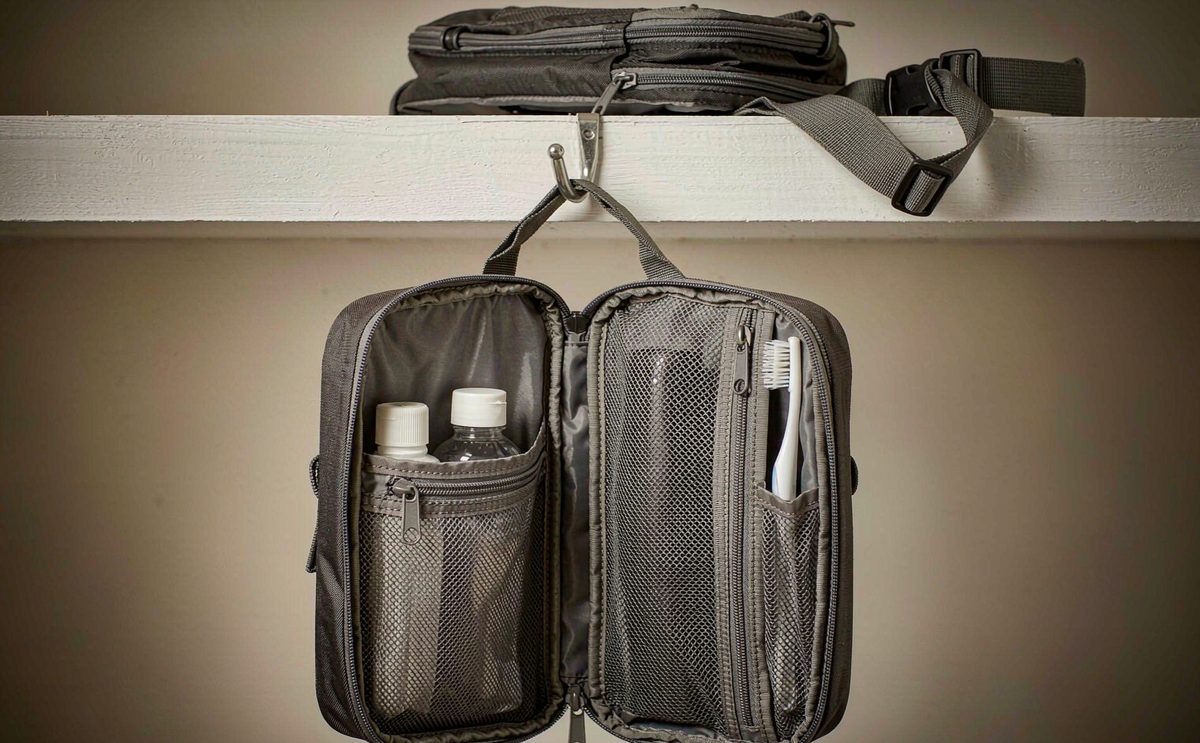
The wash bag, dopp kit or toiletry bag is the most common travel reward on crowdfunding after the backpack itself, and it generates more specification arguments than any other small bag. Almost all of those arguments come down to one question: does it hang? The answer is not a matter of taste. It changes the hardware bill, the reinforcement pattern, the assembly sequence, the packed volume and the failure profile, and it should be decided from what the backer will actually do with the bag rather than from what looks good in a render.
What a wash bag is and where it sits on a travel ladder
A wash bag is a soft or semi-structured case sized to hold travel toiletries, typically 22 to 28 cm wide, 12 to 16 cm tall and 10 to 14 cm deep. It is bigger than a cosmetic pouch and smaller than a train case, and it sits on the ladder as the natural companion to any travel bag programme. Its job is containment: keeping a leaking bottle away from clothing, and keeping a dozen small items findable in a hotel bathroom.
That containment job is why the category performs well as a reward. It solves a problem every traveller has, it is gender-neutral, it bundles naturally with a backpack or a duffel, and it does not need sizing decisions the way apparel does. It also has a long service life, which means the logo stays in circulation for years. For a campaign building a travel range rather than a single perk, the wash bag is usually the second product after the main bag.
Category positioning matters for the hanging decision. A wash bag sold as part of a travel system to backpackers and frequent flyers is a different product from one sold as a bathroom organiser to people who mostly stay at home. The first audience values hanging, because a hook is the only storage in many hostel and cruise bathrooms. The second audience values a flat base that sits on a shelf. Get the audience wrong and the feature that cost USD 3.00 per unit is the feature nobody uses.
The hanging design: anatomy, hardware and load paths
A hanging wash bag adds four things to a flat one. A hook assembly at the top, a reinforced suspension point that transfers the load from the hook into the body, a stiffened top panel so the bag hangs square rather than collapsing, and usually a two or three panel fold-out layout with pockets on the inside faces. Each of those is a specification decision, and the second one is where cheap designs fail.
The load path is the engineering. A loaded wash bag weighs 1.2 to 2.5 kg. If the hook is stitched to the outer fabric, that entire load hangs on a few stitches in a face panel, and the panel will tear within weeks. The correct construction carries the hook on a webbing loop anchored to a structural band that runs down the back panel, or to a stiffener board, so the load spreads across the bag rather than concentrating at one point. Ask how the hook is anchored before approving anything.
The stiffened top panel is the second decision. Without it, a hanging bag folds at the top and contents slide to the bottom. The usual solution is a 1.5 to 2.5 mm board or a stiffened webbing band across the top edge, costing roughly USD 0.40 to 1.10 per unit. The fold-out layout then determines pocket count, and this is where cost creeps: each additional interior pocket adds roughly USD 0.25 to 0.70 in material and labour, and a three-panel layout typically carries six to ten pockets.
The flat design: why it still outsells in most campaigns
A flat wash bag is simpler and, on most campaigns, the better commercial choice. It is a single cavity with a base gusset, one or two interior slip pockets and a zip closure. It has no hardware beyond a zip and a puller, which means fewer failure modes, a faster sampling round of 6 to 10 working days against 10 to 14 for a hanging design, and a unit cost roughly USD 1.80 to 4.20 lower at 500 pcs.
It also packs better. A flat wash bag compresses, so it nests inside a suitcase and ships dense, while a hanging bag carries a hook and a stiffener that fix its shape and inflate its packed volume by roughly 25 to 45 percent. On sea freight at these quantities that difference is meaningful but not decisive; on air freight it is the difference between a viable and a marginal tier.
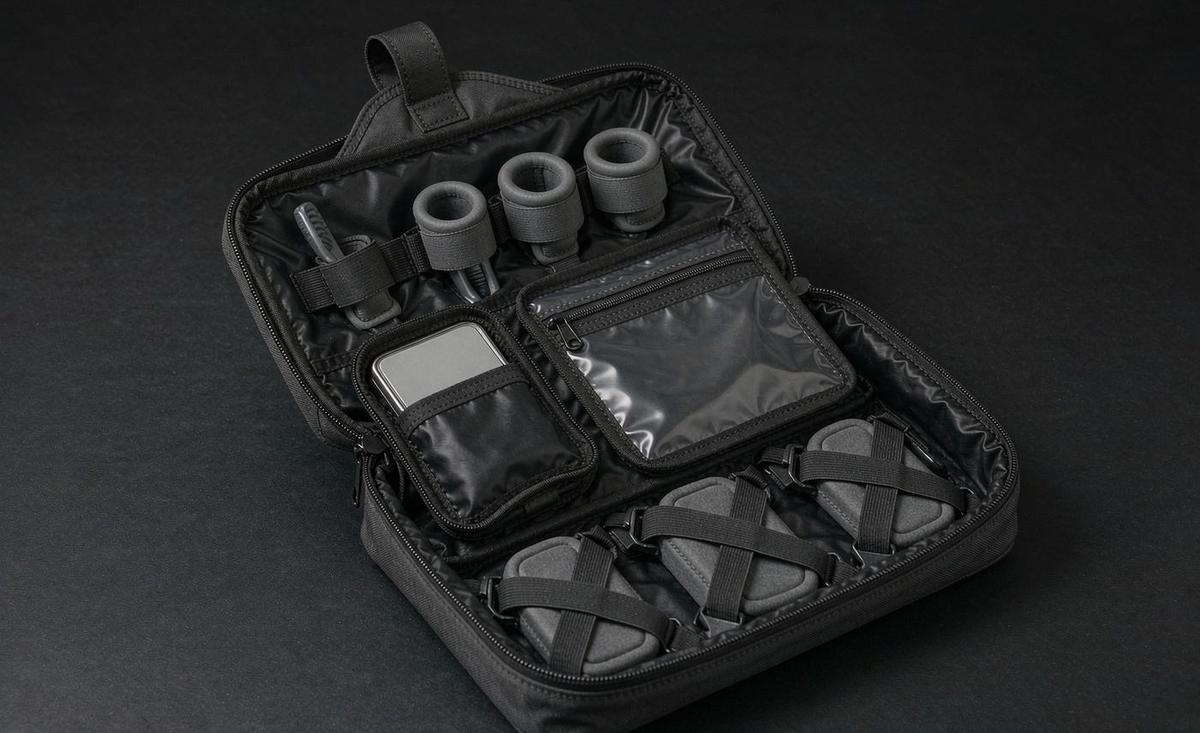
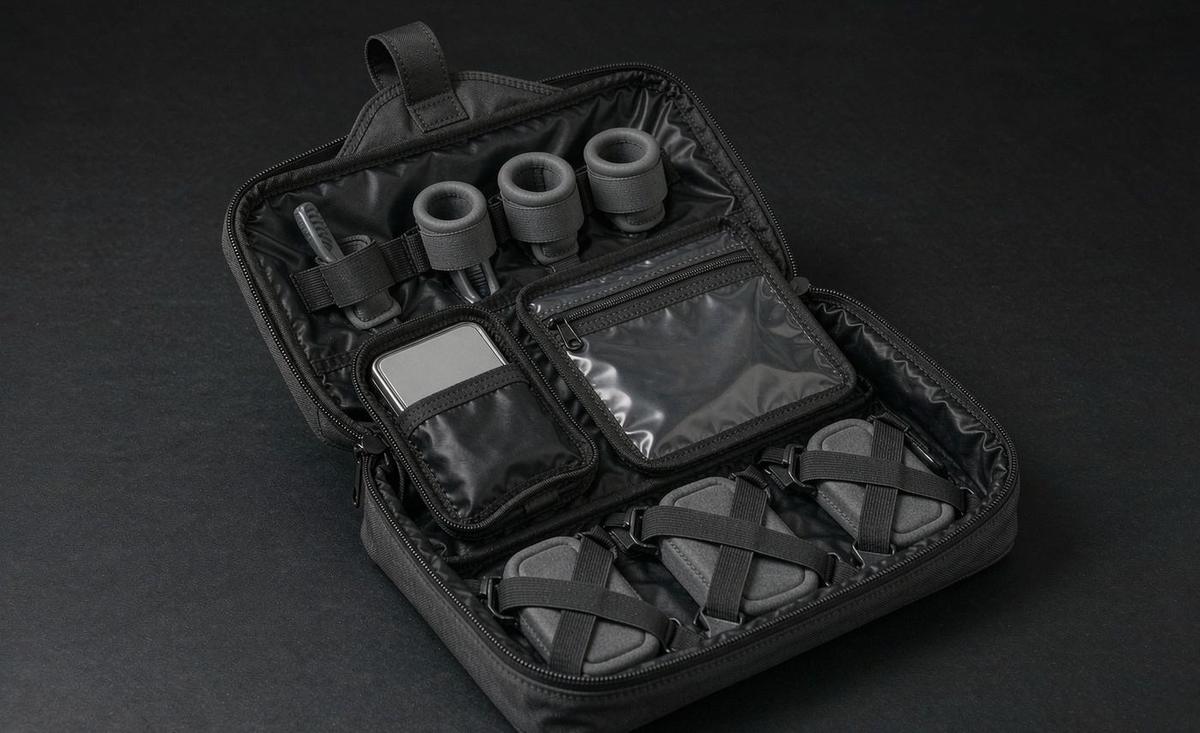
The perception argument usually made against a flat bag, that it looks cheaper, is largely a photography problem rather than a product problem. A flat wash bag shot open with the contents arranged and a visible wipe-clean lining looks considered. Shot closed on a white background it looks like a pouch. Campaigns that photograph the flat design open, in context, on a bathroom counter with a mirror in frame, sell it at the same price point as a hanging one without the hardware cost. There is also a durability argument that rarely gets made. A flat bag has one zip, no swivel, no rivet and no stiffener that can delaminate, which means its field failure rate is structurally lower. On a campaign shipping 500 units to 20 countries, every avoided failure is an avoided replacement shipment at USD 11 to 15 of landed cost plus international postage, and that arithmetic favours the simpler design more often than creators expect.
Hook hardware: types, load ratings and failure modes
Four hook types dominate. A swivel metal hook costs USD 0.55 to 1.40, rotates so the bag hangs square against a door, and is the standard choice. A carabiner-style clip costs USD 0.45 to 1.10, clips to a rail or a strap rather than a door, and suits camping and outdoor positioning. A moulded plastic hook costs USD 0.18 to 0.55, is light and cheap, and is the one most likely to snap under a cold-temperature drop.
The fourth, a webbing hanging loop with a snap, costs USD 0.25 to 0.70 and is the quietest option: no metal, no rattle, and it packs flat because the loop collapses. It is the right choice when the bag will live inside another bag, because a metal hook in a packed suitcase is a scratch risk and an annoyance. Several travel campaigns we have supported switched from a metal hook to a webbing loop after backer feedback, and none of them went back.
Load rating is the specification that gets skipped. A hook should be rated and tested at three times the expected loaded weight, which for a 2.5 kg bag means a test load of 7.5 kg held for 60 seconds. Our production team runs that test on the pre-production sample and photographs it. Failure modes to watch for are the hook opening under load, the swivel rivet pulling out, and the webbing loop tearing at the stitch line, in that order of frequency.
Waterproofing: coatings, welded seams and leak-proof pockets
Waterproofing is the one area where a wash bag genuinely differs from a cosmetic pouch, because a wash bag is expected to contain a leaking bottle. Three levels exist. Level one is a coated fabric with a sewn seam: cheap, and it leaks through the needle holes. Level two is a coated fabric with seam tape applied over the stitching: roughly USD 0.60 to 1.40 per unit, and it holds against a slow leak. Level three is radio-frequency or hot-air welded seams: roughly USD 1.20 to 2.80 per unit plus tooling, and it is genuinely watertight.
Most campaigns should specify level two on the base and level one on the body, which is a good balance of cost and performance. The base is where a leaking bottle pools, so taping the base seam captures most of the benefit at a fraction of the cost. A fully welded bag is worth it only when the campaign is making an explicit waterproof claim, because a claim that is not met is a return and a review.
A leak-proof pocket is the feature that gets the most campaign-page attention, and it is usually a coated compartment with a welded or taped seam and a water-resistant zip. It costs roughly USD 1.20 to 2.60 per unit depending on size and closure, and it is what allows a campaign to say the bag holds a wet toothbrush or a shampoo bottle without ruining anything. Test it by filling it with water, sealing it, laying it on paper for 30 minutes and looking for marks. One further specification detail matters on the closure. A water-resistant zip keeps liquid in but it is not a sealed closure, and a bag with a taped pocket and a standard zip will still leak through the teeth. If the campaign claims leak-proof rather than water-resistant, the closure has to match the seam, which usually means a coated zip at roughly USD 0.35 to 0.90 more per unit. Decide which word the campaign page will use before the specification is frozen, because the two claims carry different bills of materials and different inspection criteria.
Cost comparison at 500 and 1,000 pcs
| Cost element | Flat design | Hanging design |
|---|---|---|
| Face fabric, lining, interlining | USD 2.10 | USD 2.85 |
| Hardware (zip, puller, hook) | USD 0.75 | USD 1.85 |
| Reinforcement and stiffener | USD 0.25 | USD 1.05 |
| Interior pockets and layout | USD 0.80 | USD 2.10 |
| Cut, sew and assembly labour | USD 1.55 | USD 2.60 |
| Branding, QC, packing | USD 0.95 | USD 1.05 |
| Indicative FOB unit | USD 6.40 | USD 11.50 |
The gap of roughly USD 5.10 per unit is real but it is not the whole story, because the tier prices differ too. A flat wash bag supports a tier of about USD 39 to 59; a hanging one with three panels and a leak-proof pocket supports USD 65 to 95. Contribution after landed cost and platform fees is therefore roughly USD 18 to 26 on the flat design and USD 34 to 48 on the hanging one, so the more expensive bag is also the more profitable one if the audience wants it.
At 1,000 pcs the gap narrows to roughly USD 4.40 because the fixed elements amortise. What does not narrow is the sampling and assembly time: a hanging design still needs 10 to 14 working days of sampling against 6 to 10, and still carries more assembly minutes per unit. Plan the calendar on the hanging number even if the order is placed at 1,000, because the schedule is the constraint that catches campaigns out rather than the price. One further cost sits outside both columns: tooling. Neither design needs a mould unless a custom puller or a moulded hook cover is specified, so a first campaign can avoid tooling entirely by choosing stocked hardware and spending the saving on fabric.
Use-case mapping: who actually hangs a wash bag
The honest answer is a minority of users, but a valuable and vocal one. Backpackers, cruise travellers, campers, festival-goers, military and field users, and anyone who has shared a bathroom with three other people will hang a bag and will pay for the feature. Everyone else will put it on a counter. That split is roughly 25 to 40 percent hangers on a general travel audience and 60 to 75 percent on a backpacking or camping audience.
Audience therefore decides the design, and it should be read from the campaign's own positioning rather than from category averages. A campaign selling a travel backpack with a hostel-friendly feature set has an audience that hangs. A campaign selling a weekender or a business-travel bag has an audience that does not. A campaign selling a grooming kit to people who use it at home has an audience that definitely does not, and a hanging hook is wasted cost.
There is a hybrid worth considering when the audience is mixed. A flat bag with a concealed webbing loop that tucks into a pocket costs roughly USD 0.25 to 0.70, adds almost nothing to the packed volume, and gives the 30 percent who want to hang it the ability to do so without imposing the feature on everyone else. It is the option most campaigns should consider first, and it is rarely offered because it is not what a mood board shows. Ask for the loop to be quoted on both designs, and compare the landed cost rather than the unit cost, because the loop changes the freight profile of neither design and therefore favours the flat one even more clearly than the table suggests.
Packing, freight and volumetric comparison
Freight is where the two designs diverge most visibly. A flat wash bag compresses to roughly 3 to 4 cm and packs at 40 to 60 units per export carton. A hanging bag with its stiffener and hook holds 12 to 14 cm of shape and packs at 18 to 28 units per carton. On a 500-unit run that is about 10 cartons against about 22, and by sea the difference is roughly USD 0.90 to 1.80 per unit; by air it is USD 4.00 to 8.00.
The mitigation for a hanging design is to ship it folded and unclipped, with the hook turned inward and protected, which recovers some volume. Insist on corner and hook protection inside the carton, because a metal hook pressed against a neighbouring bag in transit will mark or puncture it. A moulded hook cover or a simple corrugated divider costs USD 0.15 to 0.40 per unit and prevents the most common arrival defect on hanging bags.
Retail packaging is the last packing decision. A flat wash bag can ship in a polybag with a printed card and look fine. A hanging one benefits from a box, because the shape needs support and the hook needs somewhere to sit. A printed retail box costs roughly USD 0.85 to 2.20 per unit and adds carton volume, which compounds the freight gap. Include it in the landed cost calculation before deciding, because the box is often the item that tips a hanging tier from profitable to marginal.
QC checkpoints by design type
Inspection runs to AQL 2.5 to ISO 2859-1 for both, but the checklists differ. For a flat wash bag the four that matter are seam integrity at the base gusset, zip run smoothness over the full length, coating continuity with no pinholes, and interior pocket attachment. For a hanging wash bag, add four more: hook load, hook attachment to the reinforcement, panel alignment when hung, and pocket attachment across all panels.
- Hook load test: hang the loaded bag at 2.5 kg for 60 seconds, then at 7.5 kg for 60 seconds. Any deformation or opening is a critical defect.
- Attachment inspection: examine the webbing loop stitch line on every inspected unit. Skipped stitches here are the leading cause of field failure.
- Hang square test: hang the loaded bag and check that the panels lie flat and aligned within 5 mm. Twisting indicates an undersized stiffener.
- Water test: fill the leak-proof pocket, seal it, lay it on absorbent paper for 30 minutes. Any transfer is a critical defect on a claimed feature.
- Coating pinhole check: hold the lining up to a light source and look for pinholes in the coating, particularly at fold points.
Defect classification should be agreed at the specification freeze. For a hanging bag, treat any hook or suspension fault as critical, because a bag that falls off a door is a failed product rather than a flawed one. For a flat bag, treat coating failure and zip failure as critical. Colour and print faults are major on both, and loose threads and minor creasing are minor. The full framework is set out in the campaign bag QA and QC guide.
Tier positioning and photography for each design
A flat wash bag belongs on a mid tier or as an add-on, priced at USD 39 to 59 against a landed cost of roughly USD 11 to 15, and it bundles naturally with a backpack or a duffel. It should be photographed open, in context, with contents, because closed it is indistinguishable from a large pouch. One technical image showing the wipe-clean lining and the base gusset does more for conversion than three lifestyle shots.
A hanging wash bag belongs on an upper tier, priced at USD 65 to 95, and it should be photographed hanging, loaded, with the panels open and the pockets visibly full. That single image communicates the entire value proposition in a way no copy can, and it is the reason hanging bags can command the higher tier. Include the closed dimensions in the description, because the packed size is the objection a traveller will raise.
Whichever design is chosen, state three numbers in the reward description: closed dimensions in centimetres, empty weight in grams, and the number of pockets. Those are the three facts a backer uses to decide, and campaigns that omit them generate the same three questions in the comments. Adding a hanging weight rating where a hook is fitted is a small detail that signals seriousness and costs nothing. Both designs benefit from one more line in the description: the care instruction. A wash bag with a coated lining and taped seams should say it can be wiped clean and should not be machine washed, because a backer who puts it in a washing machine will delaminate the coating and blame the product. Two short sentences prevent that outcome entirely.
A decision framework you can run in ten minutes
Five questions settle it. First, what share of the audience will realistically hang the bag? Below 40 percent, choose flat or a concealed loop. Second, does the campaign already run a tier above USD 65? If not, the hanging cost will not be recovered. Third, is the launch more than 14 weeks away? A hanging design needs 10 to 14 working days of sampling plus 35 to 50 days of bulk plus transit.
Fourth, is the shipment going by sea or by air? Air freight on a hanging design adds USD 4.00 to 8.00 per unit over a flat one, which can erase the tier margin entirely. Fifth, does the campaign make a waterproof claim? If it does, budget level two seam taping at USD 0.60 to 1.40 or level three welded seams at USD 1.20 to 2.80, because the claim has to be true.
Score it honestly and the answer usually appears quickly. Campaigns serving travellers who sleep in shared or compact accommodation, with a tier above USD 65 and a sea freight schedule, should choose hanging. Everyone else should choose flat, or flat with a concealed loop, and spend the USD 3.00 to 5.00 saved on better fabric or a better lining, which is what the backer will actually feel. Our sourcing partner will quote both versions side by side if you ask, and seeing the two numbers usually ends the debate.
Send us a brief with your audience, target tier and quantity, and our campaign bag specialist will return a costed flat and hanging wash bag comparison in one quotation.
Key takeaways
- C
- h
- o
- o
- s
- e
- t
- h
- e
- d
- e
- s
- i
- g
- n
- f
- r
- o
- m
- t
- h
- e
- a
- u
- d
- i
- e
- n
- c
- e
- a
- n
- d
- t
- h
- e
- f
- r
- e
- i
- g
- h
- t
- m
- o
- d
- e
- ,
- n
- o
- t
- f
- r
- o
- m
- t
- h
- e
- r
- e
- n
- d
- e
- r
- .
- B
- e
- l
- o
- w
- 4
- 0
- p
- e
- r
- c
- e
- n
- t
- h
- a
- n
- g
- e
- r
- s
- ,
- a
- f
- l
- a
- t
- b
- a
- g
- w
- i
- t
- h
- a
- c
- o
- n
- c
- e
- a
- l
- e
- d
- l
- o
- o
- p
- b
- e
- a
- t
- s
- a
- h
- o
- o
- k
- .
Frequently Asked Questions
What is the difference between a hanging and a flat wash bag?
A hanging wash bag adds a hook assembly, a reinforced suspension point, a stiffened top panel and usually a two or three panel fold-out interior with six to ten pockets. A flat wash bag is a single cavity with a base gusset and one or two slip pockets. At 500 pcs the hanging version costs roughly USD 5.10 more per unit and needs 10 to 14 working days of sampling against 6 to 10.
How much more does a hanging wash bag cost?
Roughly USD 1.80 to 4.20 per unit more in hardware, reinforcement and assembly, or about USD 5.10 in a full like-for-like comparison at 500 pcs: USD 11.50 FOB against USD 6.40. The gap narrows to about USD 4.40 at 1,000 pcs. Freight adds another USD 0.90 to 1.80 per unit by sea and USD 4.00 to 8.00 by air, because the stiffener and hook fix the packed shape.
Which hook type is best for a hanging wash bag?
A swivel metal hook at USD 0.55 to 1.40 for door hanging, a carabiner clip at USD 0.45 to 1.10 for rails and outdoor use, a moulded plastic hook at USD 0.18 to 0.55 for light loads, or a webbing loop with a snap at USD 0.25 to 0.70 that packs flat. Specify a load rating and test at three times the loaded weight, which is 7.5 kg for a 2.5 kg bag, held for 60 seconds.
Should the hook be stitched to the fabric?
No. A loaded wash bag weighs 1.2 to 2.5 kg and a hook stitched to the face fabric will tear out within weeks. The hook must load into a webbing loop anchored to a structural band running down the back panel, or into a stiffener board, so the load spreads across the bag. Ask how the hook is anchored and check the stitch line on the pre-production sample.
Can a wash bag be made genuinely waterproof?
Yes, at three levels. A coated fabric with sewn seams leaks through the needle holes. Seam tape over the stitching costs USD 0.60 to 1.40 and holds against a slow leak. Radio-frequency or hot-air welded seams cost USD 1.20 to 2.80 plus tooling and are watertight. Most campaigns should tape the base seam and leave the body, because the base is where a leaking bottle pools.
How much does a leak-proof pocket cost?
Roughly USD 1.20 to 2.60 per unit for a coated compartment with a welded or taped seam and a water-resistant zip, depending on size and closure. It is the feature that lets a campaign claim the bag holds a wet item safely. Test it by filling with water, sealing, laying on absorbent paper for 30 minutes and checking for transfer, because any failure on a claimed feature is a critical defect.
How does packed volume differ between the two designs?
A flat wash bag compresses to 3 to 4 cm and packs 40 to 60 units per export carton. A hanging bag holds 12 to 14 cm of shape and packs 18 to 28 per carton. On 500 units that is roughly 10 cartons against 22, worth USD 0.90 to 1.80 per unit by sea and USD 4.00 to 8.00 by air. Ship the hook turned inward and protected to avoid marking neighbouring units.
What percentage of backers actually hang a wash bag?
Roughly 25 to 40 percent on a general travel audience and 60 to 75 percent on a backpacking, camping or festival audience. Hostels, cruises, campsites and shared bathrooms are the environments that make hanging essential. Below 40 percent expected hangers, the better product is a flat bag with a concealed webbing loop at USD 0.25 to 0.70, which serves the minority without taxing the majority.
Which wash bag design should a first campaign choose?
Flat, or flat with a concealed loop, unless the audience is clearly a hanging one and the ladder already runs above USD 65. The flat design samples in 6 to 10 working days against 10 to 14, costs about USD 5.10 less per unit, packs two to three times denser and has fewer failure modes. Spend the saving on fabric and lining quality, which is what every backer feels.
What QC checks apply to a hanging wash bag?
Four beyond the standard list: hook load at 7.5 kg for 60 seconds, hook attachment stitch line inspection, hang-square alignment within 5 mm when loaded, and pocket attachment across all panels. Add a water test on any leak-proof pocket and a pinhole check on coated linings held to a light. Treat hook and suspension faults as critical defects under AQL 2.5 to ISO 2859-1.
What size should a campaign wash bag be?
Roughly 22 to 28 cm wide, 12 to 16 cm tall and 10 to 14 cm deep. That holds a full-size shampoo bottle upright, which is the practical test, and it fits inside a carry-on without dominating it. Go below 22 cm wide and standard toiletry bottles will not stand up; go above 28 cm and the bag stops fitting inside most personal-item bags.
Does a hanging wash bag need a retail box?
It benefits from one. The shape needs support and the hook needs somewhere to sit, and a hanging bag in a polybag tends to arrive misshapen. A printed retail box costs USD 0.85 to 2.20 per unit and adds carton volume, which compounds the freight gap against a flat bag. Include the box in the landed cost before deciding whether the hanging tier still clears margin.
People Also Ask
Should a campaign wash bag hang or lie flat?
Flat, unless more than 40 percent of the audience will hang it and the ladder already runs above USD 65. A flat bag costs about USD 5.10 less per unit, samples in 6 to 10 working days and packs two to three times denser.
How much more does a hanging wash bag cost?
About USD 1.80 to 4.20 in hardware and reinforcement, or USD 5.10 in a full comparison at 500 pcs. Freight adds USD 0.90 to 1.80 by sea and USD 4.00 to 8.00 by air.
What is the best hook for a wash bag?
A swivel metal hook at USD 0.55 to 1.40 for doors, a carabiner at USD 0.45 to 1.10 for rails, or a webbing loop with a snap at USD 0.25 to 0.70 that packs flat. Test at three times the loaded weight.
Can a wash bag be waterproof?
With welded seams at USD 1.20 to 2.80 per unit, yes. Seam tape at USD 0.60 to 1.40 holds against slow leaks. A coated fabric with sewn seams still leaks through the needle holes.
What size is a standard wash bag?
Roughly 22 to 28 cm wide, 12 to 16 cm tall and 10 to 14 cm deep. That holds a full-size toiletry bottle upright and still fits inside a personal-item bag.
How many pockets should a wash bag have?
One or two slip pockets for a flat design, six to ten across the panels for a hanging fold-out. Each additional pocket adds roughly USD 0.25 to 0.70 in material and labour.
Do hanging wash bags cost more to ship?
Yes. The stiffener and hook fix the shape, so packing drops from 40 to 60 units per carton to 18 to 28. That is about USD 0.90 to 1.80 more per unit by sea and USD 4.00 to 8.00 by air.