Carry-On Bag Features Backers Check: Airline Compliance Guide
What makes a Kickstarter carry-on bag genuinely airline compliant? Design the hard shell or structured body to about 55 x 40 x 23 cm including wheels and handles, because that is the tighter end of the mainstream limits, and keep the empty weight near 2.2 to 3.0 kg. Use a soft-structured front so the bag compresses into a sizer rather than jamming against it. Put the liquids pouch and the laptop sleeve outside the main cavity for security screening. Then test a prototype in a real airport sizer before you make the claim on the campaign page.
- The three dimensions that decide whether a bag flies
- Airline limits compared
- Carry-on versus personal item
- Why handles, wheels and pockets break the sizer
- Soft structure and compression
- Liquids, laptops and the security screening checkpoint
- Weight: the limit airlines enforce without publishing
- Making a compliance claim you can defend
- Testing a prototype in a real sizer
- How compliance features change cost and MOQ
- Presenting compliance so backers believe it
- Materials and abrasion for a bag that flies
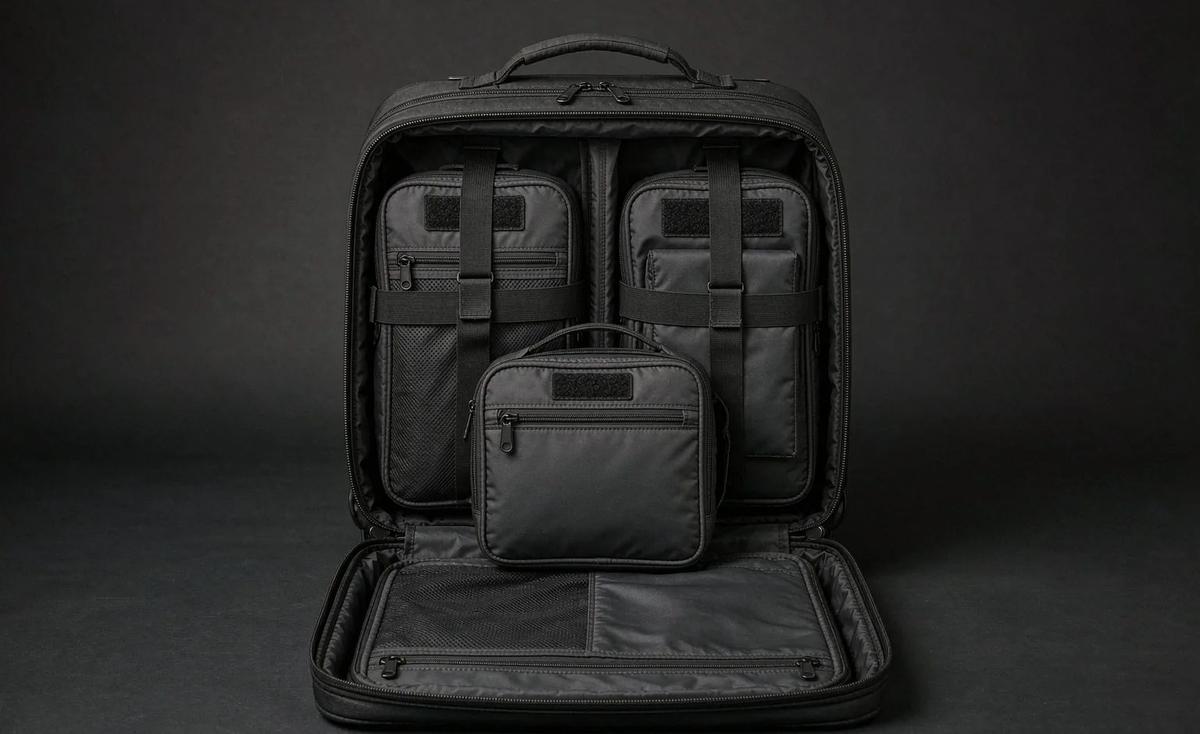
Travel campaigns make a promise that backers can test on their first flight, which makes carry-on compliance one of the few reward features that is either true or false. A bag that jams in a sizer generates a gate-check fee, a bad review and a refund request. This guide is about designing to the real limits, understanding why bags that measure correctly on paper still fail at the gate, and making a claim on the campaign page that survives contact with an airline.
The three dimensions that decide whether a bag flies
A carry-on is assessed on three external dimensions measured at the widest points, including wheels, handles, feet and any external pocket in its loaded state. That last clause is where most designs fail. A bag specified as 55 x 40 x 20 cm on a flat drawing can measure 57 x 43 x 26 cm once a telescoping handle housing, two wheel housings and a gusseted front pocket are added. The housing alone typically adds 15 to 30 mm of depth, and a front pocket that is designed flat but used full adds another 20 to 40 mm.
The working method is to specify from the outside in. Start with the maximum permitted envelope, subtract the fixed protrusions, and whatever is left is the body. On a 23 cm depth limit, a wheel housing of 45 mm and a handle housing of 30 mm leave roughly 155 mm of usable body depth before any front pocket is considered. That is a genuinely tight number and it is why most compliant carry-ons have shallow front pockets or none at all. Creators who design the body first and add the running gear afterwards end up with a bag that measures 27 cm deep and fails at the gate.
- Measured at the widest points, including wheels, handles, feet and external pockets in the loaded state.
- Wheel housings typically add 40 to 50 mm of depth on a two-wheel or four-wheel base.
- Telescoping handle housings add 25 to 35 mm, usually inside the body but sometimes proud of it.
- A gusseted front pocket adds 20 to 40 mm when full, which is why compliant bags keep them shallow.
- Specify from the outside in: start at the limit, subtract the protrusions, and the remainder is the body.
Airline limits compared
Limits vary by carrier and by region, and they change, so a campaign should design to the tightest mainstream limit rather than to the most generous one. The commonly encountered carry-on envelope in North America is about 56 x 36 x 23 cm including wheels and handles. Several major European carriers publish a smaller envelope, around 55 x 40 x 23 cm, and some low-cost carriers publish substantially smaller cabin bag dimensions with a separate paid tier for a larger one. Asian and Australian carriers generally sit in a similar band, with weight limits that are sometimes stricter than the dimensional ones.
The practical consequence is that a bag designed to 55 x 40 x 23 cm including everything will pass the majority of mainstream sizers, and a bag designed to 56 x 36 x 23 cm will pass most North American ones but is a different shape, being taller and narrower. There is no single bag that is compliant everywhere, because the regional envelopes differ in proportion, not just in size. The honest campaign claim is therefore a qualified one: state the envelope the bag is designed to, and name the carriers or regions it suits rather than claiming universal compliance.
| Region or carrier type | Typical carry-on envelope | Typical weight limit | Design implication |
|---|---|---|---|
| North America mainstream | About 56 x 36 x 23 cm | Often no published limit | Taller and narrower body |
| Europe mainstream | About 55 x 40 x 23 cm | Commonly 8 to 12 kg | Wider body, weight matters |
| European low-cost cabin bag | About 40 x 20 x 25 cm | Commonly 8 to 10 kg | Personal item size only |
| Asia and Australia mainstream | About 56 x 36 x 23 cm | Commonly 7 to 10 kg | Weight is the binding constraint |
| Regional and commuter aircraft | Often smaller, gate-checked | Varies widely | Design to compress or fold |
Carry-on versus personal item
Two slots exist on most aircraft and they are different products. The carry-on goes in the overhead bin and uses the full envelope. The personal item goes under the seat and is much smaller, commonly around 40 x 20 x 25 cm on the strictest published limits. A creator choosing between them is choosing between two markets: the carry-on buyer wants maximum packing volume, and the personal item buyer wants to avoid a checked bag fee entirely, often on a low-cost carrier where the cabin bag is a paid extra.
The personal item slot is commercially interesting for a crowdfunding reward because the object is smaller, cheaper and lighter, and it is a genuine solution to a real annoyance. A 40 x 20 x 25 cm soft bag costs materially less than a wheeled carry-on, ships as a lighter parcel, and can be positioned as a fee-avoidance product. The design challenge is volume: that envelope is about 20 litres at best, so the bag has to be a soft structure with a full-perimeter zip and no rigid panels, and it has to compress when it is not full.
- Decide the slot first: overhead bin or under seat. They are different products with different buyers.
- For the under-seat slot, design to about 40 x 20 x 25 cm soft, with no rigid panels.
- For the overhead slot, design to about 55 x 40 x 23 cm including all running gear.
- Check whether your target carriers charge for the overhead slot, which shifts demand to the smaller bag.
- State on the campaign page which slot the bag is designed for, by name.
Why handles, wheels and pockets break the sizer
A sizer is a rigid box with an open top, and a bag fails it in three specific ways. The first is a hard corner: a rigid shell or a stiffened base that cannot deform will not enter a sizer that is nominally the same size, because there is no tolerance in the frame. The second is a protrusion: a side handle, a water bottle pocket or a wheel that sits proud of the body catching on the frame edge. The third is over-stuffing: a bag that measures correctly empty and swells when full, which is the state it will be in at the gate.
Each has a design answer. Hard corners are handled by keeping the shell profile slightly under the limit, by 10 to 15 mm on the two critical dimensions, and by using a soft or semi-structured front panel. Protrusions are handled by recessing side handles flush with the body and by specifying wheel housings that sit inside the footprint rather than outside it. Over-stuffing is handled by compression straps: internal or external straps that pull the bag back to its specified depth when it is loaded, which is a USD 0.35 to USD 0.75 component that prevents the most common gate failure.
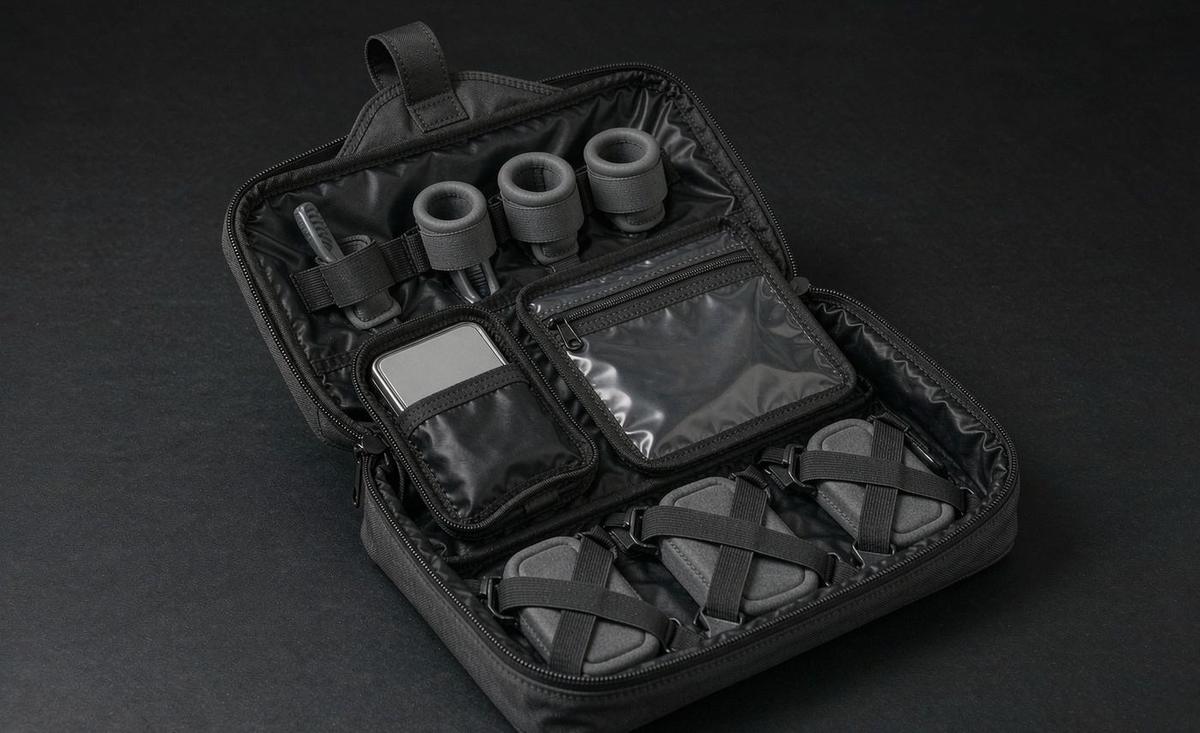
A fourth failure mode belongs on the list: the bag that measures correctly but cannot be lifted into the sizer. A sizer is a frame with an open top and the bag has to be lowered into it, which means the handles have to be usable and the bag has to be liftable with one hand while loaded. A top handle positioned off-centre, or one too short to clear a loaded body, is a usability failure the tape measure will never reveal.
Soft structure and compression
There is a real engineering choice between a hard-shell and a soft-structured carry-on, and compliance favours the soft build. A hard shell protects contents better and looks precise in a photograph, but it has no give: if the shell is 23 cm deep and the sizer is 23 cm deep, it may not enter. A soft build with a semi-structured frame gives 10 to 20 mm under load, which converts a marginal failure into a pass. That forgiveness is why most frequent travellers carry soft bags on carriers with tight sizers.
The middle path, and the one we recommend for a campaign reward, is a hybrid: a structured back panel with a light frame sheet, a semi-rigid base, and soft front and side panels. Contents are protected at the points that matter, the bag holds shape when empty so it photographs well, and the front compresses under the sizer frame. The cost sits between the two builds, typically 8 to 15 percent above an all-soft bag at 500 pcs, and the compliance benefit is worth more than the difference. A hybrid also weighs less than a hard shell, which matters for the next section.
There is a second reason to prefer the hybrid: repairability. A torn panel on a soft or hybrid body can be repaired by any luggage repair service, while a cracked hard shell usually cannot be repaired at all and the whole bag is discarded. For a campaign whose marketing includes a durability or warranty story, that difference is worth more than the marginal protection advantage of the shell.
Liquids, laptops and the security screening checkpoint
Compliance is not only dimensional. A carry-on has to pass security screening, and two design features make that routine rather than annoying. The first is an externally accessible liquids pouch, sized to the standard 1 litre resealable bag used in most screening regimes, positioned in a front or top pocket so it can be produced without opening the main cavity. The second is a laptop sleeve that lies flat against the back panel and unzips independently, so the device can be removed without unpacking.
Both features are cheap and both are heavily used. A dedicated liquids pocket adds 3 to 5 labour minutes and about USD 0.45 to USD 0.90 per unit at 500 pcs. A flat external laptop sleeve sized to a 14 or 16 inch device adds 6 to 9 labour minutes and USD 1.10 to USD 2.20 per unit including the padding. What neither should do is compromise the dimensional envelope: a liquids pocket gusseted on the side adds depth, so specify it on the front face where the depth budget is larger, or make it flat and unlined.
Key takeaways
- P
- u
- t
- t
- h
- e
- l
- i
- q
- u
- i
- d
- s
- p
- o
- u
- c
- h
- a
- n
- d
- t
- h
- e
- l
- a
- p
- t
- o
- p
- s
- l
- e
- e
- v
- e
- o
- n
- t
- h
- e
- f
- r
- o
- n
- t
- a
- n
- d
- b
- a
- c
- k
- f
- a
- c
- e
- s
- ,
- n
- o
- t
- o
- n
- t
- h
- e
- s
- i
- d
- e
- s
- .
- S
- i
- d
- e
- g
- u
- s
- s
- e
- t
- s
- e
- a
- t
- t
- h
- e
- d
- e
- p
- t
- h
- b
- u
- d
- g
- e
- t
- t
- h
- a
- t
- t
- h
- e
- s
- i
- z
- e
- r
- m
- e
- a
- s
- u
- r
- e
- s
- .
Two further checkpoint features cost little and are used constantly. An external pocket sized for a passport and a boarding pass, positioned on the back panel where it stays accessible in a queue, and a key clip inside the front pocket. Neither affects the dimensional envelope and neither is glamorous, but both appear in the reviews that determine whether the next campaign from the same creator funds.
Weight: the limit airlines enforce without publishing
Dimensional limits get the attention and weight limits cause the problems, because weight is enforced at the gate with a scale and it is often not published prominently. Mainstream European carriers commonly apply a carry-on weight limit in the 8 to 12 kg range, and several carriers in Asia and Australia apply 7 to 10 kg. A backer packing for a two-week trip will exceed 10 kg in a 40 litre bag without difficulty, so the bag's own empty weight is a genuine competitive specification.
The empty weight budget for a wheeled hybrid carry-on is roughly 2.2 to 3.0 kg, and every component decision shows up in it. A hard polycarbonate shell adds 0.8 to 1.4 kg over a soft build. Four spinner wheels add 0.25 to 0.45 kg over two inline wheels. An aluminium telescoping handle adds 0.15 to 0.30 kg over a steel one. A heavy decorative hardware package adds 0.10 to 0.25 kg. Our production team will produce a component weight breakdown with the first sample so a campaign can see exactly where the grams go before the specification is frozen.
| Component | Light option | Heavy option | Difference |
|---|---|---|---|
| Shell or body | Soft or semi-structured, 0.9 to 1.3 kg | Hard polycarbonate, 1.7 to 2.7 kg | 0.8 to 1.4 kg |
| Wheel set | Two inline wheels, 0.30 to 0.45 kg | Four spinners, 0.55 to 0.90 kg | 0.25 to 0.45 kg |
| Telescoping handle | Steel, 0.35 to 0.50 kg | Aluminium, 0.50 to 0.80 kg | 0.15 to 0.30 kg |
| Hardware and trim | Minimal, 0.10 to 0.20 kg | Decorative package, 0.25 to 0.45 kg | 0.10 to 0.25 kg |
| Frame and base | Light frame sheet, 0.20 to 0.35 kg | Full perimeter frame, 0.45 to 0.70 kg | 0.25 to 0.35 kg |
Making a compliance claim you can defend
Campaign pages routinely claim that a bag is carry-on compliant everywhere, and that claim is not defensible because the envelopes differ by carrier and change over time. A claim that survives scrutiny is specific: name the envelope the bag is designed to, say that it includes wheels and handles, and name the carriers or regions it suits. Better still, publish the empty weight and the packed volume, because those are the two numbers a travelling backer actually compares.
There is also a platform and consumer-protection dimension. A claim that a bag fits every airline is a performance claim, and a backer who is charged a gate-check fee has a reasonable complaint. The safer construction is comparative and conditional: designed to fit the carry-on sizers used by most mainstream carriers in North America and Europe, with the envelope stated. That is honest, it is checkable, and it is still a strong marketing line. We advise creators to keep the sizer photograph on the campaign page, because a bag photographed inside a sizer frame sells the feature better than any sentence.
There is a second dimension to a defensible claim: the packed state. A bag that is compliant empty and not compliant when full is not compliant, and the campaign should say where the boundary sits. The clean way to express it is to publish the envelope including wheels and handles, the packed volume in litres, and a statement that the bag stays within the envelope with the compression straps engaged.
A bag photographed inside a sizer frame is also the cheapest compliance evidence there is, because it shows the envelope and the handles at the same time. One good frame on the campaign page does more for conversion than a paragraph of text, and it costs an hour of shooting.
Testing a prototype in a real sizer
Paper compliance is not compliance. The test that matters is physical, and it takes one afternoon. Buy or borrow a sizer frame, or use the one at a departure gate before a flight, and test the prototype in three states: empty, half packed and fully packed to the weight the campaign will claim. Enter it top-down, the way a passenger does, and note whether any protrusion catches. Photograph all three, because those photographs are the evidence behind the campaign claim and the reference for the production sample.
Three additional checks belong in the same session. A drop test from 900 mm onto a hard floor with the bag loaded to its stated weight, to check wheel housings and the handle housing. A wheel run of 2 km over a rough surface, which is roughly what a bag sees between a check-in hall and a gate. And a zip cycle test of 300 operations on every compartment, because a failed zip on a carry-on is a failed product. We run all of these on the pre-production sample of a travel programme as standard, alongside inspection at AQL 2.5 to ISO 2859-1 on the bulk run.
A fourth check is a handle cycle test, because the telescoping handle fails more often than any other component on a wheeled bag. Extend and retract the handle 500 times and check for wobble at the top position, then load the bag to its stated weight and wheel it 2 km. A handle that passes both will almost certainly survive the first year of use, and one that fails either will not.
How compliance features change cost and MOQ
Compliance features are not free, and the ones that matter most are in the middle of the cost range. A compression strap set adds USD 0.35 to 0.75. A recessed side handle adds USD 0.45 to 0.90, because recessing requires a reinforced aperture. Inboard wheel housings add USD 1.20 to 2.60 over external ones, because the housing has to be moulded and reinforced inside the body. A flat external laptop sleeve adds USD 1.10 to 2.20. A liquids pocket adds USD 0.45 to 0.90. Together, a full compliance package adds roughly USD 3.55 to 7.35 per unit at 500 pcs.
On quantity, the minimum is 500 pcs per style and per colourway, and this matters more on travel bags than on pouches because the unit cost is higher and the tooling for a moulded wheel housing or a handle assembly is significant. A custom wheel housing tool can run USD 800 to 2,200, which is a large number to amortise over 500 units. The standard recommendation for a first travel campaign is to use proven stock running gear and spend the custom tooling budget on the body, the interior and the branding, where the campaign's differentiation actually lives.
On a first travel campaign, use proven stock wheel and handle assemblies and put the custom tooling budget into the body, interior and branding. Amortising a USD 800 to 2,200 wheel tool over 500 units rarely makes sense.
One cost line moves in the opposite direction. A compliant bag is smaller than a non-compliant one, so it uses less fabric and less lining and it nests more efficiently in the carton. On a carry-on, the fabric saving from designing to a 23 cm depth rather than a 28 cm depth is roughly 4 to 7 percent, which offsets a meaningful share of the cost of the compliance package described above.
Presenting compliance so backers believe it
Backers have been told that every bag fits every airline, and they are sceptical. Three presentation choices overcome that. Show the bag in a sizer, photographed rather than rendered, with the frame visible. State the numbers: the envelope including wheels and handles, the empty weight, and the packed volume in litres. And state the limitation: which carriers or regions it suits, and what happens on the strictest low-cost fares where the overhead slot is a paid extra.
The fourth choice is to show the test. A campaign page frame showing the prototype being drop tested, wheel run and cycled at the zips converts a claim into evidence, and it costs a few hours of filming. It also aligns the campaign with what will actually be delivered, because the same tests are run on the pre-production sample. For the build options behind a compliant travel bag, see custom travel bags for Kickstarter, and for the larger soft-format sibling category see custom duffle bags for Kickstarter. If you are still sizing the reward, the pricing comparison across quantity bands shows how unit cost moves with volume, and the QA and QC guide sets out what to inspect before shipment.
A fifth presentation choice is the one most campaigns skip: state what happens when the bag does not fit. A short line saying the bag is designed for the stated envelope and that some regional and commuter aircraft have smaller bins sets an honest expectation and removes the complaint before it is made. Campaigns that state the limitation are consistently rated higher on trust than campaigns claiming universal compliance.
Materials and abrasion for a bag that flies
A carry-on bag is dragged across airport floors, lifted into bins by a handle, and compressed under other bags in an overhead locker. The material specification has to survive that, and the two properties that matter are abrasion resistance and tear strength. Ballistic nylon in the 840D to 1680D range is the reference standard for a reason: it resists abrasion better than any comparably priced face fabric and it hides scuffing because of its weave structure. Coated polyester in the 600D to 900D range is the value alternative and performs well on abrasion, though it shows scuffs more readily because of its flat surface.
The areas that fail first are predictable and should be specified separately from the body. The base corners take the abrasion of being dragged and set down, and a reinforced corner panel or a coated bottom panel adds USD 0.85 to USD 1.90 per unit and removes the most common warranty claim in the category. The handle attachment points take the full loaded weight repeatedly, and a bar-tacked reinforcement with a backing plate adds USD 0.35 to USD 0.75. The wheel housings take impact, and a moulded housing with a reinforced mounting plate is worth the cost over a sewn-on strap mount.
Two material choices should be avoided regardless of price. A light ripstop under about 210D lacks the tear strength for an overhead bin environment and will puncture rather than scuff. A PVC or vinyl face looks substantial and becomes brittle in the cold temperatures of an aircraft hold, which is exactly where a gate-checked bag goes. Where a creator wants a premium look, a heathered or two-tone woven construction delivers it without the temperature problem, and it hides the scuffs that accumulate over a first year of travel.
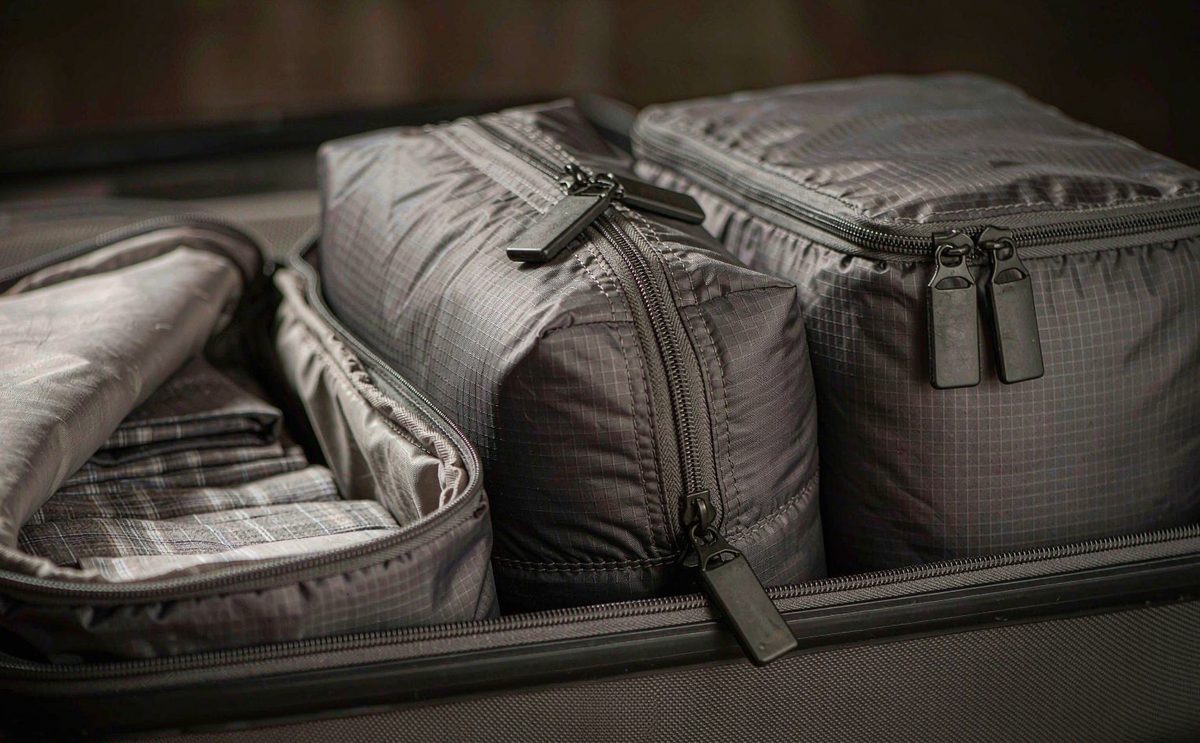
- Face fabric: ballistic nylon 840D to 1680D for abrasion, or coated polyester 600D to 900D as the value alternative.
- Base corners: reinforced or coated bottom panel at USD 0.85 to 1.90 per unit.
- Handle attachments: bar tack with a backing plate at USD 0.35 to 0.75 per unit.
- Wheel housings: moulded with a reinforced mounting plate rather than a sewn strap mount.
- Avoid: ripstop under about 210D, and PVC or vinyl faces that embrittle in a cold aircraft hold.
Send us your target envelope, weight budget and quantity per colourway, and we will return a compliant carry-on specification with costed options.
Frequently Asked Questions
What dimensions make a carry-on bag airline compliant?
Design to about 55 x 40 x 23 cm including wheels, handles and external pockets, which is the tighter end of the mainstream envelopes. A North American envelope of about 56 x 36 x 23 cm is taller and narrower, so no single bag suits every region. A North American envelope of about 56 x 36 x 23 cm is taller and narrower, so no single bag suits every region and the claim should be qualified by market.
Are carry-on limits measured including wheels and handles?
Yes. Limits are assessed at the widest points including wheels, handles, feet and external pockets in the loaded state. That is why a bag measuring correctly on a flat drawing can fail at the gate. A wheel housing adds 40 to 50 mm, a handle housing 25 to 35 mm, and a gusseted front pocket another 20 to 40 mm once it is full.
Why does a bag that measures correctly still fail the sizer?
Three reasons: a rigid corner that cannot deform, a protrusion such as a side handle or wheel housing catching the frame, and over-stuffing that swells the bag beyond its empty measurement. Compression straps at USD 0.35 to 0.75 per unit pull the bag back to its specified depth when loaded, which prevents the most common gate failure. Internal or external compression straps at USD 0.35 to 0.75 per unit pull the bag back to its specified depth when it is loaded.
Should a carry-on bag be hard shell or soft?
A hybrid is usually best: a structured back panel with a light frame sheet, a semi-rigid base and soft front and side panels. It holds shape for photographs and gives 10 to 20 mm under the sizer frame, which converts a marginal failure into a pass. The hybrid typically costs 8 to 15 percent above an all-soft bag at 500 pcs and weighs less than a hard shell, which matters where carriers apply 7 to 12 kg limits.
How much should an empty wheeled carry-on weigh?
Budget 2.2 to 3.0 kg. European carriers commonly apply 8 to 12 kg limits and several Asian and Australian carriers apply 7 to 10 kg, so the bag's own weight is a genuine competitive specification. A hard shell adds 0.8 to 1.4 kg over a soft build, four spinner wheels add 0.25 to 0.45 kg over two inline wheels, and a decorative hardware package adds 0.10 to 0.25 kg.
What is the personal item size limit?
Commonly around 40 x 20 x 25 cm on the strictest published limits, for the under-seat slot. That envelope holds roughly 20 litres, so the bag must be soft-structured with no rigid panels and must compress when part full. That envelope holds about 20 litres at best, so the bag must be soft-structured with a full-perimeter zip and no rigid panels, and must compress when part full.
Where should the liquids pouch and laptop sleeve go?
On the front and back faces, not the sides. A side gusset eats the depth budget the sizer measures. A dedicated liquids pocket costs USD 0.45 to 0.90 and a flat external laptop sleeve USD 1.10 to 2.20. A dedicated liquids pocket adds 3 to 5 labour minutes, and a flat external laptop sleeve sized to a 14 or 16 inch device adds 6 to 9 minutes including padding.
How much do compliance features add to unit cost?
A full package adds roughly USD 3.55 to 7.35 per unit at 500 pcs: compression straps USD 0.35 to 0.75, a recessed handle USD 0.45 to 0.90, inboard wheel housings USD 1.20 to 2.60, a laptop sleeve USD 1.10 to 2.20 and a liquids pocket USD 0.45 to 0.90. Together a full compliance package adds roughly USD 3.55 to 7.35 per unit at 500 pcs, before any custom tooling on the running gear.
Is it worth tooling a custom wheel housing?
Rarely on a first campaign. A wheel housing tool runs USD 800 to 2,200, which is hard to amortise over 500 units. Use proven stock running gear and put the custom tooling into the body, interior and branding. Use proven stock running gear and spend the custom tooling budget on the body, interior and branding, where the campaign's differentiation actually lives. The standard recommendation is proven stock running gear, with the custom tooling budget spent on the body, interior and branding instead.
How should I test a carry-on prototype?
Test it in a real sizer in three states: empty, half packed and fully packed. Then run a 900 mm drop test loaded, a 2 km wheel run over rough surface, and a 300 cycle test on every zip. We run all of these on the pre-production sample as standard, alongside inspection at AQL 2.5 to ISO 2859-1 on the bulk run.
Can I claim my bag fits every airline?
No, and you should not. Limits differ by carrier and change over time. State the envelope including wheels and handles, name the carriers or regions it suits, and publish the empty weight and packed volume. A backer charged a gate-check fee has a reasonable complaint, so the safer construction names the envelope and the regions the bag suits. Keep a sizer photograph on the campaign page, because a bag photographed inside a sizer frame sells the feature better than any sentence.
What are the production and inspection terms?
MOQ is 500 pcs per style and per colourway, sampling runs 6 to 10 working days or 12 to 15 for complex builds, bulk runs 35 to 50 days after the approved pre-production sample, and inspection is at AQL 2.5 to ISO 2859-1. Sampling runs 6 to 10 working days or 12 to 15 for complex builds, and terms are FOB Xiamen with T/T 30/70.
People Also Ask
What size is a compliant carry-on bag?
About 55 x 40 x 23 cm including wheels and handles, which is the tighter end of the mainstream envelopes.
Do airline limits include wheels?
Yes. Everything is measured: wheels, handles, feet and external pockets in the loaded state.
Why does my carry-on not fit the sizer?
Usually a rigid corner, a protruding handle or wheel housing, or over-stuffing that swells the bag beyond its empty measurement.
How heavy should a carry-on be empty?
2.2 to 3.0 kg for a wheeled hybrid. Many carriers apply 7 to 12 kg total limits, so the bag's own weight matters.
What is the personal item size?
About 40 x 20 x 25 cm for the under-seat slot, holding roughly 20 litres. Design it soft and compressible.
Should a carry-on be hard or soft sided?
A hybrid with a structured back and soft front gives protection where it matters and 10 to 20 mm of give at the sizer.
How do I test carry-on compliance?
Use a real sizer in three states, then run a drop test, a 2 km wheel run and a 300 cycle zip test.
Can I say my bag fits all airlines?
No. State the envelope, name the regions it suits and publish the weight and volume. Photograph it in a sizer instead.