Kickstarter Cosmetic Bag Unit Cost at 500, 1,000 and 5,000 pcs
What does a custom cosmetic bag cost at 500, 1,000 and 5,000 pcs? On a mid-specification wipe-clean pouch, plan a FOB Xiamen band of USD 3.60 to 6.80 at 500 pcs, USD 3.10 to 5.90 at 1,000 pcs and USD 2.75 to 5.20 at 5,000 pcs. The steepest drop, typically 15 to 22 percent, happens between 500 and 1,000 pcs where set-up and cutting costs spread over twice the units. From 1,000 to 5,000 the curve flattens to 8 to 12 percent because fabric and labour dominate. This guide breaks the price into its eight component lines so you can model your own number.
- What a unit price actually contains
- Why 500 pcs is priced the way it is
- The 500 to 1,000 step: where the biggest drop happens
- The 1,000 to 5,000 step: why the curve flattens
- Material cost drivers ranked by impact
- Labour minutes: the hidden driver on structured bags
- Tooling, moulds and one-off charges
- What sits outside the unit price
- Building a landed cost model for one reward tier
- Quantity planning before the campaign closes
- How to compare two quotes that look different
- Re-order economics: why the second run costs more
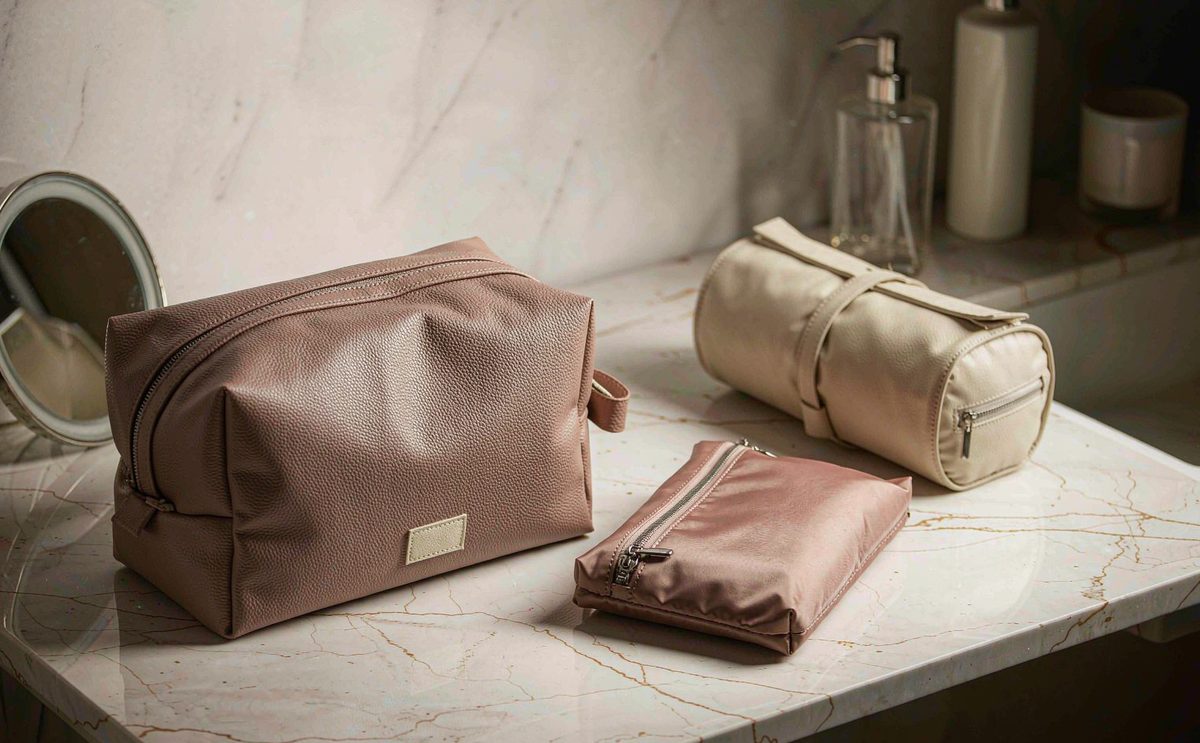
Cosmetic bag pricing confuses creators because the same bag can be quoted at three quite different numbers by three different programmes, and all three can be honest. The reason is that a unit price is a bundle of eight separate costs, and each programme weights them differently depending on its fabric sourcing, its line allocation and how it treats tooling. This article takes the price apart. It is written for creators who need to model a tier before the campaign launches, not for those comparing suppliers on a headline number.
What a unit price actually contains
A cosmetic bag quote is built from eight lines. Face fabric, lining fabric, interlining and structure, hardware, trim and thread, direct labour, factory overhead and margin, and allocated set-up. Two of those scale with quantity, five scale with units, and one is fixed. Understanding which is which tells you exactly what happens to the price when the order doubles. Fabric and trim scale with units and improve in price at mill breaks. Labour scales with units and improves slightly with line efficiency. Set-up is fixed and is the reason the 500 pcs price looks high.
On a typical mid-specification cosmetic bag, the split at 500 pcs looks roughly like this: face fabric 18 to 24 percent, lining and structure 14 to 19 percent, hardware 9 to 14 percent, trim and thread 4 to 6 percent, direct labour 22 to 30 percent, overhead and margin 12 to 18 percent, and allocated set-up 6 to 11 percent. Those bands move with specification. A bag with a moulded silicone patch shifts hardware up and set-up up. A bag with a welded liner shifts labour up and lining up. Knowing your own split is the first step in value engineering, because you cannot cut a line you cannot see.
| Cost line | Share of unit price | Scales with quantity? | Typical reduction at 5,000 pcs |
|---|---|---|---|
| Face fabric | 18 to 24 percent | Yes, at mill breaks | 10 to 18 percent |
| Lining and structure | 14 to 19 percent | Yes, at mill breaks | 10 to 16 percent |
| Hardware and zips | 9 to 14 percent | Yes, at supplier breaks | 12 to 20 percent |
| Trim and thread | 4 to 6 percent | Yes | 8 to 12 percent |
| Direct labour | 22 to 30 percent | Partly, via line efficiency | 5 to 9 percent |
| Overhead and margin | 12 to 18 percent | No | 0 to 3 percent |
| Allocated set-up | 6 to 11 percent | No, fixed | 80 to 90 percent |
Why 500 pcs is priced the way it is
The 500 pcs price is high relative to the 5,000 pcs price for one structural reason: the fixed costs of starting a production run do not shrink. Cutting dies or digital nesting files, machine set-up, thread and needle changes, a colour-matching dyelot, the first-article inspection, and the line changeover all cost roughly the same whether the run is 500 or 5,000 units. Spread over 500 units that is a visible charge per bag. Spread over 5,000 units it rounds to almost nothing. This is why the minimum matters: below 500 pcs per style and colourway, the set-up charge becomes a large enough share of the unit price that the bag stops being commercially viable as a reward.
There is a second, less obvious driver: fabric minimums. Mills sell coated polyester and TPU-laminated nylon in lot quantities, and a 500 pcs run of a cosmetic bag consumes perhaps 400 to 700 linear metres depending on the shell size and nesting efficiency. That is below the dyelot minimum for a custom colour, which means the programme either buys a stock colour at a standard price or pays a surcharge for a short custom lot. Most cosmetic bag programmes run into this on the first order. Choosing a stock colourway from the mill card removes a surcharge worth 4 to 9 percent of the unit price, and few backers can tell the difference between a stock navy and a custom navy in a photograph.
- Fixed set-up: cutting files, machine set-up, thread change, first-article check and line changeover cost the same at 500 and at 5,000 units.
- Fabric minimums: a 500 pcs run consumes roughly 400 to 700 linear metres, often below a custom dyelot minimum.
- Colour surcharge: a short custom lot adds 4 to 9 percent to the unit price; a stock mill colour removes it.
- Hardware breaks: zip and pull suppliers price at 1,000 unit breaks, so a 500 pcs run buys at the small-lot rate.
- Inspection cost: a fixed inspection day is allocated across the run, so it is five times heavier per unit at 500 pcs.
The 500 to 1,000 step: where the biggest drop happens
Doubling from 500 to 1,000 pcs typically removes 15 to 22 percent from the unit price, and it is the single best value move available on a cosmetic bag programme. Three things happen at once. Set-up halves per unit. Fabric crosses a mill break, because 800 to 1,400 linear metres is usually enough to qualify for the next price tier on a stock colour and sometimes enough for a custom lot without surcharge. Hardware crosses a supplier break, since zip and pull pricing commonly steps at 1,000 units.
For a creator modelling a tier, this has a practical consequence. If the campaign is realistically going to land between 700 and 1,100 backers on this reward, it is usually cheaper to commit to 1,000 units and hold inventory than to order 700 and re-order 300 later. A re-order of 300 pcs carries a second full set-up charge, a second fabric lot that may not shade-match the first, and a second inspection, and it re-prices in the 500 pcs band. The total cost of 1,000 plus 300 ordered separately is frequently higher than 1,300 ordered once, even after carrying the excess stock.
There is a second-order effect that is easy to miss. At 1,000 units the programme can usually justify a dedicated cutting nest rather than a shared one, which improves fabric utilisation by 4 to 8 percent independently of the mill price break. That utilisation gain is a real cost reduction that never appears as a line item on the quote, and it is one reason the observed drop is often at the upper end of the 15 to 22 percent band.
The 1,000 to 5,000 step: why the curve flattens
Between 1,000 and 5,000 pcs the unit price typically falls only 8 to 12 percent, and creators who expect a second halving are disappointed. The reason is that by 1,000 units the fixed costs have already been spread thin, so what remains is variable cost: fabric per bag, hardware per bag and labour minutes per bag. Fabric improves a little at larger mill lots. Hardware improves a little at larger supplier breaks. Labour improves only through line efficiency, and on a structured bag with a lining and dividers the labour minutes are largely irreducible.
This flattening has a strategic implication for stretch goals. A campaign that funds at 1,000 units and stretches to 3,000 should not promise a better bag on the basis of volume savings, because the savings are around 6 to 9 percent of the unit price. That is not enough to upgrade a face fabric or add a moulded patch. What volume does buy is negotiating room on tooling: at 3,000 units a mould fee in the USD 200 to USD 450 range can often be absorbed into the unit price rather than billed separately, which is a real saving the campaign can bank.
What does improve at 5,000 units is scheduling certainty. A run of that size is booked as a dedicated block on a line rather than fitted into a gap, which means the start date is firmer and the risk of being displaced by a larger order is lower. For a campaign with a published delivery date, that certainty has real value even when the unit price barely moves.
Material cost drivers ranked by impact
When a cosmetic bag quote comes back too high, the instinct is to downgrade the face fabric. That is usually the wrong lever, because the face fabric is 18 to 24 percent of the price and downgrading it visibly cheapens the reward. Ranked by impact per dollar saved, the effective levers are different. Simplifying the interior is first: removing one divider panel and one slip pocket saves 2 to 4 labour minutes and 6 to 11 percent of unit cost, with far less visible impact than a fabric downgrade. Changing the branding method is second. Reducing shell size by 10 percent is third.
Hardware is a surprisingly good lever because it is 9 to 14 percent of the price and largely invisible in a photograph. Moving from a custom moulded pull to a stock pull with a printed or laser mark removes a tooling charge and 3 to 6 percent of unit cost. Moving from a #8 to a #5 zip on a pouch saves weight and cost with no functional loss at this scale. Our production team routinely runs a value-engineering pass on a first quote and returns two alternatives: one that holds the design and cuts cost by 8 to 12 percent, and one that holds the cost and adds a feature the campaign can market.
- Simplify the interior first: each divider or pocket removed saves 2 to 4 labour minutes and 6 to 11 percent.
- Change the branding method second: heat transfer instead of a moulded patch removes tooling and 3 to 6 percent.
- Reduce shell dimensions by about 10 percent: less fabric, less lining, lower freight volume.
- Downgrade hardware to a stock pull with a laser or printed mark: 3 to 6 percent with no visible change.
- Downgrade the face fabric last: it is the first thing a backer sees and the hardest thing to defend.
Labour minutes: the hidden driver on structured bags
Labour is 22 to 30 percent of a cosmetic bag unit price and is the line most creators never see quoted. It is measured in standard minutes: the sum of every operation from cutting through closing, turning, topstitching, hardware setting, branding, trimming and packing. A simple flat pouch with a single zip might total 6 to 9 standard minutes. A structured cosmetic bag with a lining, a base board, two dividers and a slip pocket runs 18 to 26 standard minutes. A clamshell with a welded liner and a moulded pull can reach 30 to 38 minutes.
Each additional standard minute is a real cost, and the operations that add minutes are not the ones creators expect. Turning a lined bag after closing adds 2 to 3 minutes. Binding an internal seam rather than leaving it raw adds 3 to 5 minutes. Setting a divider panel adds 4 to 6 minutes. A slip pocket adds 3 to 4 minutes. By contrast, adding a printed logo adds under 1 minute. This is why a bag that looks simple in a render can cost more than one that looks complex: the render shows the exterior and the cost lives in the interior operations.
Ask for the standard minute count on your quote. Two bags quoted at the same price with minute counts of 12 and 24 are not the same commercial proposition once a re-order or a spec change arrives.
The practical way to control this line is to ask for a minute breakdown with the quote. A programme that can state which operations consume the minutes is a programme that can tell you what a design change will cost before you make it, rather than after. That transparency is worth more than a small difference in the headline number, and it is the fastest way to spot a quote that has quietly downgraded the specification.
Tooling, moulds and one-off charges
One-off charges are quoted separately and are the most common source of a budget overrun, because they appear after the creator has already committed to a unit price. The typical list for a cosmetic bag programme includes a silicone patch mould at USD 120 to USD 260, a moulded zip pull tool at USD 200 to USD 450, a deboss or emboss die at USD 90 to USD 180, a foil die at USD 90 to USD 180, a heat transfer plate at USD 60 to USD 140, and cutting dies at USD 80 to USD 200 for a complex nest. Compliance testing is separate again at USD 180 to USD 420 per material.
Amortisation is the question that matters. A USD 240 silicone mould spread over 500 units is USD 0.48 per bag; over 5,000 units it is USD 0.05. A moulded pull tool at USD 400 over 500 units is USD 0.80 per bag, which is why we rarely recommend a custom pull below about 3,000 units. The practical rule is to treat any one-off charge above USD 300 as justifiable only above 2,000 units, and to use heat transfer or a woven label below that. Where a campaign wants the premium look at a low quantity, a silicone patch is the better value than a moulded pull, because it reads as premium and its tooling is cheaper.
| Charge | Typical cost | Per unit at 500 pcs | Per unit at 5,000 pcs |
|---|---|---|---|
| Heat transfer plate | USD 60 to 140 | USD 0.12 to 0.28 | USD 0.01 to 0.03 |
| Foil or deboss die | USD 90 to 180 | USD 0.18 to 0.36 | USD 0.02 to 0.04 |
| Silicone patch mould | USD 120 to 260 | USD 0.24 to 0.52 | USD 0.02 to 0.05 |
| Cutting die for complex nest | USD 80 to 200 | USD 0.16 to 0.40 | USD 0.02 to 0.04 |
| Moulded zip pull tool | USD 200 to 450 | USD 0.40 to 0.90 | USD 0.04 to 0.09 |
| REACH or Prop 65 test per material | USD 180 to 420 | USD 0.36 to 0.84 | USD 0.04 to 0.08 |
What sits outside the unit price
A FOB Xiamen unit price covers the bag in a carton at port. Everything after that is separate and, on a cosmetic bag reward, the post-FOB costs commonly add 25 to 60 percent to the landed figure. Ocean freight is quoted on volumetric weight and a nested cosmetic bag is efficient, but a boxed or rigid-format bag is not. Duty depends on classification and destination: cosmetic bags entering the US under a textile classification carry a different rate than a travel set, and getting the HS code right before shipping is worth more than any freight negotiation. Port charges, customs entry fees and inland drayage are flat per shipment.
Then there are the costs creators forget. Payment processing on a T/T transfer runs USD 25 to USD 60 per transaction in bank fees. Currency movement over a 35 to 50 day production window plus a 30 to 45 day transit can move the effective price by 2 to 5 percent if the campaign funds in a currency that is not the settlement currency. Storage at the fulfilment centre is charged per pallet per month, and excess inventory from an optimistic quantity commitment accrues that charge indefinitely. A realistic landed model adds all of these, because a campaign that budgets only the FOB price will run short of cash at the fulfilment stage.
One more item belongs on this list: the cost of a decision made late. A change to the specification after bulk has started is charged at the full cost of the affected components plus the labour already spent, and it usually adds 5 to 10 days to the schedule. Campaigns that freeze the specification at sample approval rarely pay this charge; campaigns that keep refining pay it repeatedly.
Building a landed cost model for one reward tier
A usable model has five lines and a buffer. Line one is the FOB unit price at the committed quantity. Line two is tooling amortised across that quantity. Line three is freight plus duty plus port and entry charges, divided by unit count. Line four is fulfilment: pick, pack, mailer and postage per backer. Line five is a loss and returns allowance. On top of that, add a contingency buffer of 6 to 10 percent. Campaigns that skip the buffer are the ones that cannot fund a re-order when a defect batch appears.
Worked example for a mid-specification cosmetic bag reward at 1,000 units: FOB unit price USD 4.60, tooling USD 240 amortised at USD 0.24, freight and duty USD 1.35 per unit, fulfilment pack and postage USD 5.80, loss allowance at 2 percent of goods cost USD 0.12, subtotal USD 12.11, plus a 8 percent buffer USD 0.97, for a landed cost of roughly USD 13.10 per backer. If the tier is priced at USD 39, the goods cost sits at about 34 percent of pledge, which is inside the healthy band for a physical reward. Below about 45 percent goods cost most campaigns are viable; above 60 percent the margin disappears once platform fees and taxes are applied.
The model should also be run at the pessimistic case, not only the expected one. Take the quantity at the lower end of the forecast, the freight rate at the upper end of the recent range, and the defect allowance at 3 percent rather than 2. If the tier still clears a 45 percent goods cost at that setting, the reward is robust. If it does not, the price or the specification needs to change before launch rather than after.
Quantity planning before the campaign closes
The hardest pricing decision a creator faces is committing to a quantity before the backer count is known. Three approaches are workable. The first is to quote at three bands in advance, get written prices for 500, 1,000 and 2,000 pcs before launch, and place the order the day the campaign closes at whichever band the final count falls into. This costs nothing and removes the guesswork. The second is to commit to the lower band and accept a re-order, which as noted costs a second set-up and risks a shade mismatch.
The third is to commit to the higher band and carry stock, which is the right call when the campaign has a retail or post-campaign sales plan, because the excess becomes inventory rather than dead weight. Whichever route is chosen, the deposit structure matters. Payment terms are T/T 30/70, so a 30 percent deposit commits real cash before the campaign closes if the order is placed early. Our production programme allows a provisional specification to be booked with a deposit and revised once before the cutting date, which lets a creator hold capacity without locking the final quantity.
A fourth approach suits campaigns with a retail plan: commit to the higher band and treat the excess as the first retail order rather than as surplus. This works when the product has a post-campaign sales channel and fails when it does not, because unsold pouches and unsold cosmetic bags both end up in the same place, which is a storage invoice that arrives monthly. Decide which case applies before committing.
How to compare two quotes that look different
Two quotes for the same bag can differ by 20 percent and both be correct, because they are not quoting the same inputs. The right way to compare is to normalise on six variables before looking at the price: face fabric specification with denier and coating named, lining construction, hardware grade, branding method and whether tooling is included, quantity per colourway rather than total, and whether the price is FOB or DDP. A quote that looks 12 percent cheaper because it uses a #3 zip instead of a #5 is not cheaper; it is a different bag.
The second filter is the terms. A quote with a 50 percent deposit and no inspection clause is not comparable to one at T/T 30/70 with inspection at AQL 2.5 to ISO 2859-1 and a re-inspection right. The third is the timeline: a 35 to 50 day bulk window quoted without the sampling window included is not the same as one that states 6 to 10 working days of sampling plus 35 to 50 days of bulk. Ask every programme to quote on the same worksheet, and check the campaign bag QA and QC guide for what the inspection clause should say before accepting a price without one. Our cosmetic bag programme page lists the standard build options we price from, and the low MOQ production guide explains how the 500 pcs minimum interacts with colourway splits and re-order economics. For the sampling stage that precedes any firm price, see crowdfunding bag sample and prototyping.
Re-order economics: why the second run costs more
Every campaign that re-orders discovers the same thing: the second run is quoted higher per unit than the tail of the first, even when the total quantity across both runs would have qualified for a better band. The reason is that price bands apply per production order, not cumulatively. A first run of 1,000 at the 1,000 pcs price followed by a second run of 400 at the 500 pcs price costs more than a single run of 1,400 at the 1,000 pcs price, because the 400 unit run carries its own set-up, its own inspection and its own fabric lot.
Three additional costs sit inside a re-order and are rarely budgeted. The first is shade matching: a second fabric lot, even from the same mill and the same colour reference, can shift by a measurable amount, and if the two runs will be visible side by side in the same backer community that shift is a complaint generator. The second is tooling re-validation, because a heat transfer plate or a silicone mould held for several months may need a test strike before the run. The third is scheduling, because a re-order joins the production queue as a new booking rather than continuing an existing one, so the 35 to 50 day window starts again from a new sample approval.
The practical guidance is to treat the first run as the only run and to size it accordingly, using the three-band quote taken before launch. Where a re-order is unavoidable, minimise its cost by keeping it on the same material lot if the mill still holds stock, by reusing the existing tooling without modification, and by accepting the specification exactly as previously approved rather than improving it. Every improvement on a re-order converts a booking decision back into a development project, which is what turns a four-week re-order into a ten-week one.
- Bands apply per order, not cumulatively: 1,000 plus 400 costs more than 1,400 in one run.
- Shade shift: a second fabric lot can differ visibly from the first even at the same mill reference.
- Tooling re-validation: hold and test strike the existing plate or mould before the second run.
- Queue position: a re-order is a new booking, so the 35 to 50 day window restarts.
- Do not improve: any specification change turns the re-order back into a development project.
Key takeaways
- P
- r
- i
- c
- e
- b
- a
- n
- d
- s
- a
- p
- p
- l
- y
- p
- e
- r
- p
- r
- o
- d
- u
- c
- t
- i
- o
- n
- o
- r
- d
- e
- r
- ,
- n
- o
- t
- c
- u
- m
- u
- l
- a
- t
- i
- v
- e
- l
- y
- .
- S
- i
- z
- e
- t
- h
- e
- f
- i
- r
- s
- t
- r
- u
- n
- a
- s
- t
- h
- o
- u
- g
- h
- t
- h
- e
- r
- e
- w
- i
- l
- l
- n
- o
- t
- b
- e
- a
- s
- e
- c
- o
- n
- d
- .
Send us your target quantity band and specification, and we will return written prices at 500, 1,000 and 2,000 pcs so you can launch with the numbers already known.
Frequently Asked Questions
What is the unit cost of a custom cosmetic bag at 500 pcs?
On a mid-specification wipe-clean pouch, plan a FOB Xiamen band of USD 3.60 to 6.80 at 500 pcs. Entry specifications with a printed logo sit at the bottom of that range; premium builds with a TPU face and foam structure sit at the top. Entry specifications with a printed logo sit at the bottom of that band, and premium builds with a TPU face and foam structure sit at the top.
How much cheaper is 1,000 pcs than 500 pcs?
Typically 15 to 22 percent cheaper. Three effects compound: set-up halves per unit, fabric crosses a mill price break, and hardware crosses a supplier break at 1,000 units. It is the best value move available on a cosmetic bag programme. The saving usually exceeds the cost of carrying excess stock, and a re-order of 300 pcs re-prices in the 500 pcs band with a second full set-up charge.
Why does the price barely change between 1,000 and 5,000 pcs?
By 1,000 units the fixed costs are already spread thin, so what remains is variable cost per bag: fabric, hardware and labour minutes. Fabric and hardware improve slightly at larger breaks, and labour improves only through line efficiency, giving 8 to 12 percent total. Labour minutes are largely irreducible on a structured bag with a lining and dividers, which is why the curve flattens rather than continuing to fall.
Is it cheaper to order 700 now and 300 later?
Usually not. The 300 pcs re-order carries a second full set-up charge, a second fabric lot that may not shade-match the first, and a second inspection, and it re-prices in the 500 pcs band. Ordering 1,000 once is often cheaper than 700 plus 300. The re-order also risks a shade mismatch, because a second fabric lot from the same mill and the same colour reference can still shift by a measurable amount.
What one-off tooling charges should I budget for?
A heat transfer plate USD 60 to 140, a foil or deboss die USD 90 to 180, a silicone patch mould USD 120 to 260, a cutting die USD 80 to 200, and a moulded pull tool USD 200 to 450. Compliance testing is separate at USD 180 to 420 per material. Cutting dies for a complex nest run USD 80 to 200, and compliance testing is separate again at USD 180 to 420 per material for REACH or CA Prop 65 screening.
When is a moulded zip pull worth the tooling cost?
Above roughly 3,000 units. At 500 units a USD 400 tool adds USD 0.80 per bag, which is hard to justify. A silicone patch reads as premium at lower quantity because its tooling is cheaper, at USD 120 to 260. Below about 2,000 units a heat transfer plate at USD 60 to 140 or a woven label at USD 0.05 to 0.12 delivers the same visual result for far less.
What does FOB Xiamen mean for my landed cost?
FOB covers the bagged carton at the port of loading. Everything after is yours: ocean freight on volumetric weight, duty by classification, port charges, customs entry, inland drayage and bank fees. Post-FOB costs commonly add 25 to 60 percent to the landed figure. Currency movement over a 65 to 95 day cycle can move the effective price by 2 to 5 percent, and storage at the fulfilment centre accrues per pallet per month.
How much of a reward tier price should the goods cost represent?
Aim for goods cost at 30 to 45 percent of the pledge. Below about 45 percent most campaigns are viable once platform fees, taxes and payment processing are applied. Above 60 percent the margin disappears. Above 60 percent the margin disappears once platform fees of about 5 percent, payment processing and taxes are applied to the pledge. The landed model should carry five lines: FOB unit price, amortised tooling, freight and duty, fulfilment pack and postage, and a loss allowance, plus a 6 to 10 percent contingency buffer.
How does the 500 pcs MOQ apply across colourways?
The minimum is 500 pcs per style and per colourway, not 500 across all colours. Three colourways of the same bag is three production runs, each priced in the 500 pcs band. Two colourways at 750 each moves two thirds of the order down a band. Two colourways at 750 pcs each moves two thirds of the order down one price band, which is the cheapest structural decision available on most programmes.
What payment terms apply to a cosmetic bag order?
T/T 30/70: a 30 percent deposit releases materials and books production capacity, and 70 percent falls due against the passed inspection report before shipment. Bank fees run USD 25 to 60 per transaction and are your cost. Budget USD 25 to 60 per transaction in bank fees, and note that a 30 percent deposit commits real cash before the campaign closes if the order is placed early.
How long does production take and when does the clock start?
Sampling runs 6 to 10 working days, or 12 to 15 for complex builds. Bulk runs 35 to 50 days counted from written approval of the pre-production sample and clearance of the deposit, not from the purchase order date. A quote with a 50 percent deposit and no inspection clause is not comparable to one at T/T 30/70 with inspection at AQL 2.5 to ISO 2859-1 and a re-inspection right.
How do I compare two quotes that differ by 20 percent?
Normalise on six variables first: face fabric with denier and coating named, lining construction, hardware grade, branding method and whether tooling is included, quantity per colourway, and whether the price is FOB or DDP. Often the cheaper quote is a different bag. A quote that looks 12 percent cheaper because it uses a #3 zip instead of a #5 is not cheaper at all; it is a different bag with a different specification.
People Also Ask
How much do custom cosmetic bags cost per unit?
USD 3.60 to 6.80 at 500 pcs, USD 3.10 to 5.90 at 1,000 pcs and USD 2.75 to 5.20 at 5,000 pcs for a mid-specification wipe-clean pouch, FOB Xiamen.
What is the MOQ for custom cosmetic bags?
500 pcs per style and per colourway. Each colourway counts as its own production run and is priced in its own band.
Why is 500 pcs so much more expensive per unit?
Fixed set-up, fabric dyelot minimums and hardware lot breaks do not shrink with the run. At 500 units those fixed costs are visible in every bag.
Is it worth ordering 1,000 instead of 500?
Yes if you expect 700 or more backers. The 15 to 22 percent saving usually exceeds the cost of carrying the excess inventory.
What is the biggest hidden cost in bag pricing?
Post-FOB costs: freight on volumetric weight, duty, port charges, customs entry and bank fees, which commonly add 25 to 60 percent to the landed figure.
How much does tooling add per unit?
A USD 240 silicone mould is USD 0.48 per bag at 500 pcs and USD 0.05 at 5,000 pcs. Treat any one-off above USD 300 as justifiable only above 2,000 units.
What should goods cost as a share of the pledge?
Target 30 to 45 percent of the tier price. Above 60 percent the campaign margin disappears after platform fees and taxes.
Can I get prices at three quantity bands before launching?
Yes, and you should. Written prices at 500, 1,000 and 2,000 pcs cost nothing and remove the guesswork at campaign close.