Skincare Kit Bags for Kickstarter: B2B Sourcing for Beauty Brands
How should a beauty brand source a skincare kit bag for a Kickstarter reward? Work to a 500 pcs minimum per style and per colourway, budget 6-10 working days for sampling and 35-50 days for bulk production after the deposit and approved pre-production sample, and inspect at AQL 2.5 to ISO 2859-1. Expect a leak-resistant lined kit bag to land between USD 4.10 and USD 8.90 per unit at 500 pcs, falling to roughly USD 3.20 to USD 6.40 at 5,000 pcs. The rest of this guide covers the specifications that move that number.
- What a skincare kit bag must do that a generic pouch does not
- Sizing the bag around the actual regimen
- Face fabrics and coatings for formulas that leak and stain
- Linings, interiors and spill containment
- Closures, zips and hardware for liquid payloads
- Branding a skincare bag on a small panel
- Unit cost at 500, 1,000 and 5,000 pcs
- Sampling rounds and the approval gates that start the clock
- Compliance and labelling for cosmetics-adjacent goods
- Cartons, freight and flat-pack economics
- The RFQ brief that returns a quotable number
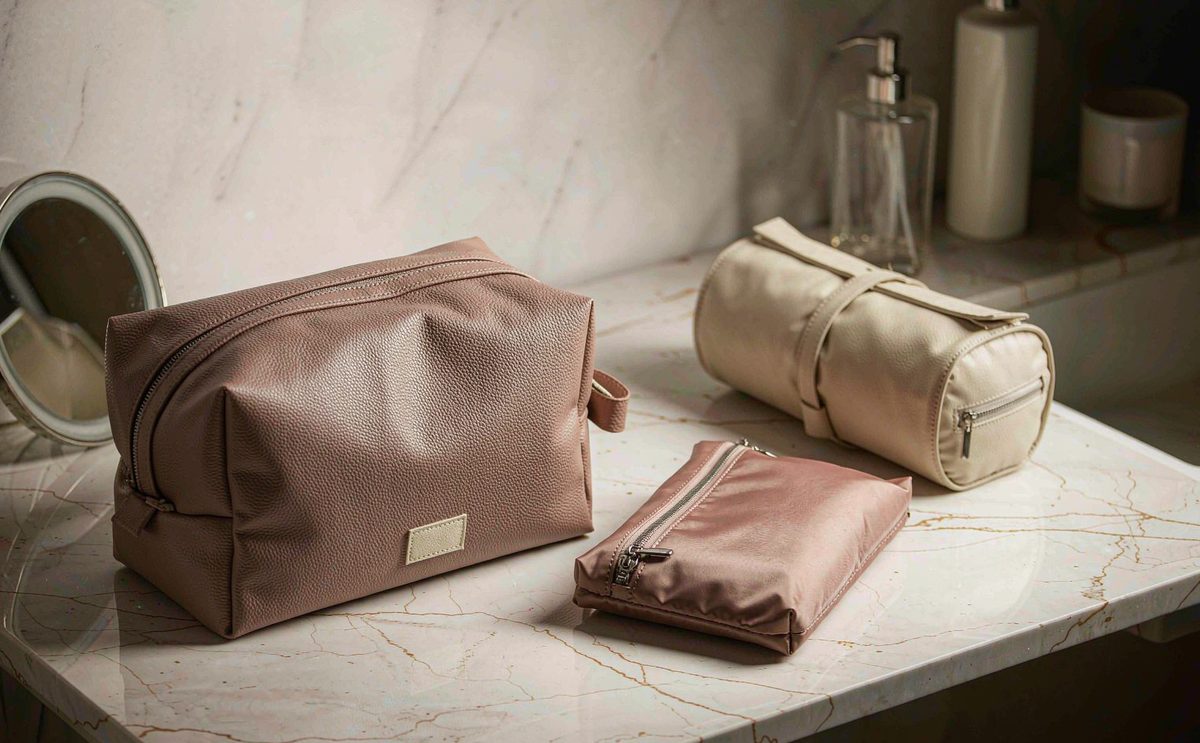
Beauty campaigns are among the fastest-growing categories on Kickstarter, and the reward that carries the formula is almost always a bag. What most creators discover too late is that a bag built for a lipstick behaves badly when it carries a 30 ml serum dropper. This guide is written for skincare and beauty brand teams sourcing the kit bag as a B2B component of their reward, not as an afterthought. It covers containment, materials, closures, unit cost at three quantity bands, sampling, compliance and freight. Every figure below is a working band from live campaign programmes, not a quote.
What a skincare kit bag must do that a generic pouch does not
A generic cosmetic pouch is built to carry dry, rigid objects: a lipstick, a compact, a brush handle. A skincare kit bag carries liquids, gels and creams in bottles that leak, stain, separate and off-gas when a carton sits in a hot container for several weeks. That single difference changes almost every line on the tech pack, from the coating on the face fabric to the way the base seam is constructed. Creators who reuse a makeup-pouch specification for a serum kit usually find the problem after the campaign funds, when the first pre-production sample arrives with a liner that wicks escaped product into the outer shell.
Our production team treats a skincare kit bag as part of the product system rather than as merchandise. Before we quote, we ask for the actual filled bottles: the 30 ml dropper, the 50 ml pump, the 15 ml jar, the sheet-mask sachet. Physical dimensions and filled weight drive the internal divider layout, the base board and the lining gauge. A kit holding four 30 ml glass droppers weighs roughly 380 g and needs a rigid base; the same count in 30 ml PET bottles weighs about 210 g and can run on a soft base with a 0.8 mm PP board. That difference alone moves unit cost by 8 to 14 percent and changes the carton count.
- Spill containment: a welded or high-frequency sewn liner that holds at least 30 ml of escaped product without reaching the face fabric.
- Wipe-clean interior: TPU or PVC lining in the 0.15 to 0.25 mm range, specified for stain resistance rather than hand feel.
- Odour control: low-VOC coatings and adhesives, plus a 48 to 72 hour airing cycle before carton packing.
- Drop protection: 3 to 5 mm foam or EVA in the base and along divider walls whenever the primary packaging is glass.
- Fit tolerance: 1.5 to 2.0 mm clearance per bottle diameter so the kit closes without force and without rattle.
Sizing the bag around the actual regimen
Skincare is sold as a regimen, and the regimen dictates the bag. A three-step routine (cleanser, toner, moisturiser) fits a single-compartment bag roughly 210 x 130 x 80 mm. A five-step routine with an eye cream and a serum usually needs two compartments and moves to 250 x 160 x 90 mm. A seven-step routine with sheet masks needs a third flat sleeve and a clamshell format around 270 x 190 x 100 mm. Each step up adds fabric, lining, divider panels and labour minutes, and each step up also raises the volumetric weight of the shipped carton.
The commercial trap is over-sizing. A bag that looks generous in a campaign render is a bag that lets bottles travel, and bottles that travel arrive chipped or cracked. Our campaign bag specialist will normally recommend sizing to the tightest workable envelope and spending the saved fabric cost on internal structure instead. In one recent programme, dropping the shell from 260 x 170 x 95 mm to 240 x 150 x 85 mm cut face fabric consumption by 19 percent while base foam and divider thickness went up by 40 percent. Unit cost was flat, damage rates in transit fell, and the reward photographed as a denser, more premium kit.
- List every item in the reward with filled weight and external dimensions, including caps and pumps.
- Group items by fragility: glass, then rigid plastic, then flexible sachets.
- Draft the layout at 1:1 on paper and confirm the lid closes over the tallest item with 5 mm to spare.
- Add 1.5 mm clearance per bottle to every divider aperture.
- Confirm the flat packed footprint, because that number drives freight more than the finished volume does.
Face fabrics and coatings for formulas that leak and stain
The face fabric of a skincare kit bag is chosen for cleanability first and aesthetics second. Coated fabrics dominate the category for good reason. PU-coated polyester in the 300D to 600D range is the default: it wipes clean, takes a printed logo well, and runs at a predictable price. TPU-laminated nylon costs more per metre but resists hydrolysis, which matters if the bag will be shipped through humid ports and stored for months before fulfilment. Reclaimed RPET with a PU backing satisfies a sustainability claim without losing the wipe-clean surface, and it has become the most requested face fabric for beauty campaigns in the last two years.
Uncoated woven fabrics look better in a lifestyle photograph and worse in month three. A cotton canvas or a woven jacquard absorbs a serum spill and holds the stain permanently, and no amount of spot cleaning recovers it. Where a creator insists on a woven face for brand reasons, we specify a two-layer build: woven outer, bonded TPU membrane, wipe-clean liner. That build adds roughly USD 0.55 to USD 0.95 per unit at 500 pcs and about 2 working days to the sampling window, but it survives the spill test. Anyone weighing this trade-off should read the material comparison in custom backpack material options for creators, because the same hydrolysis and abrasion logic applies at pouch scale.
| Face fabric | Cleanability | Typical unit cost impact at 500 pcs | Best for |
|---|---|---|---|
| PU-coated 300D polyester | High, wipes clean | Baseline | Mass-market three-step kits |
| PU-coated 600D polyester | High, wipes clean | +USD 0.30 to 0.55 | Five-step kits needing structure |
| TPU-laminated 420D nylon | Very high, hydrolysis resistant | +USD 0.70 to 1.20 | Humid shipping lanes, long storage |
| RPET 600D with PU backing | High, wipes clean | +USD 0.25 to 0.45 | Sustainability-led beauty brands |
| Woven cotton canvas with bonded membrane | Moderate, membrane dependent | +USD 0.55 to 0.95 | Premium positioning, low spill risk |
Linings, interiors and spill containment
The lining is where a skincare kit bag succeeds or fails, and it is the line item most often cut during a value-engineering conversation. Three constructions are in common use. A loose drop-in liner is cheapest and least reliable: it shifts, it bunches, and product escapes past it into the shell. A sewn-in liner with bound seams costs about USD 0.22 more per unit and holds position permanently. A high-frequency welded liner with no needle holes at all is the specification we push for glass-primary kits, because needle holes are the path a leak takes to reach the face fabric.
Interior organisation matters just as much. Elastic loops sized to the bottle diameter at 60 to 70 percent stretch hold items without being hard to load. Fixed divider panels made from lined foam keep shape when the bag is empty, which matters because an empty kit bag looks collapsed in a backer unboxing video. A slip pocket sized for sheet masks or a regimen card costs little and adds perceived value. Mesh zip pockets are popular in renders and problematic in production: mesh snags on pump actuators, so we normally specify a solid lined pocket with a mesh window instead. Every interior feature is a labour-minute decision, and labour minutes are what separate a USD 4.10 unit from a USD 6.80 unit.
One specification detail decides whether a liner is worth its cost: the seam at the base. A liner that stops at the base seam leaves the corners as the leak path, and corners are exactly where a bottle rests. We specify the liner to turn up 15 to 20 mm at every corner and to be welded rather than stitched at that turn, which adds about USD 0.18 per unit and removes the failure mode behind most leak complaints on a kit bag.
Closures, zips and hardware for liquid payloads
A zip is the most common failure point on any bag reward, and skincare kits punish weak zips harder than most. The reasons are physical: a kit bag is packed full, the contents press outward against the tape, and any lateral force on the slider translates into tooth separation. For this category we specify a #5 nylon coil zip with a metal-look pull as the entry grade, and a #5 or #8 reversed coil with a water-resistant tape where the creator wants a wipe-clean claim on the exterior as well. Metal teeth look premium and add 40 to 70 g to the unit, which is weight a small kit cannot spare.
Hardware should be matched to the transit profile. A six-week ocean leg with a 45 °C container peak will haze cheap electroplated pulls and stain adjacent lining. We specify sealed or lacquered finishes on pulls for any campaign shipping outside the domestic market, and we run a 48 hour salt mist check on the hardware batch before bulk assembly. Magnetic closures are a frequent request from beauty brands because they feel premium on camera; they are also unreliable under load and add freight weight, so we reserve them for the outer flap of a clamshell and never for the primary containment compartment.
- Zip grade: #5 nylon coil minimum, reversed coil where a wipe-clean exterior is claimed.
- Pull finish: lacquered or sealed electroplate, salt mist checked for 48 hours before assembly.
- Load test: pack the kit to maximum and cycle the zip 300 times before the pre-production sample is approved.
- Magnetic closure: acceptable on an outer flap, never on the containment compartment.
- Spare tolerance: order 1 percent additional pulls as service stock for post-campaign warranty claims.
Branding a skincare bag on a small panel
A skincare kit bag offers a smaller branding panel than a backpack, and the panel is usually curved or boxed, which rules out some methods. Heat transfer prints handle small type and gradients well on PU-coated faces and cost roughly USD 0.18 to USD 0.35 per unit at 500 pcs, but they sit on the surface and can scuff. Silicone patches give a raised, soft-touch mark that reads as premium and survives abrasion, at USD 0.45 to USD 0.90 per unit plus a one-off mould in the USD 120 to USD 260 range. Woven labels are the cheapest durable option at USD 0.06 to USD 0.15 and work well when the brand mark is simple.
Embroidery is the most requested method and the least suitable for coated faces. Needle perforations through a PU or TPU coating create leak paths, which directly contradicts the containment specification. Where a creator wants the embroidered look, we embroider onto a separate twill patch and then stitch or heat-seal the patch onto the shell, keeping the perforations away from the containment zone. Registration matters more than method: a mark placed over a base seam or a divider panel will read as a defect in every backer photograph, so we require a placement drawing with tolerances of plus or minus 2 mm before the first sample is cut.
Key takeaways
- O
- n
- a
- s
- k
- i
- n
- c
- a
- r
- e
- k
- i
- t
- b
- a
- g
- ,
- b
- r
- a
- n
- d
- i
- n
- g
- m
- e
- t
- h
- o
- d
- i
- s
- a
- c
- o
- n
- t
- a
- i
- n
- m
- e
- n
- t
- d
- e
- c
- i
- s
- i
- o
- n
- a
- s
- m
- u
- c
- h
- a
- s
- a
- d
- e
- s
- i
- g
- n
- d
- e
- c
- i
- s
- i
- o
- n
- :
- a
- n
- y
- t
- h
- i
- n
- g
- t
- h
- a
- t
- p
- e
- r
- f
- o
- r
- a
- t
- e
- s
- t
- h
- e
- c
- o
- a
- t
- e
- d
- f
- a
- c
- e
- c
- r
- e
- a
- t
- e
- s
- a
- l
- e
- a
- k
- p
- a
- t
- h
- .
Colour choice on a skincare bag is a branding decision in its own right. A dark face fabric hides spill marks and looks clean longer, but it shows every scuff from transit and every fingerprint in a photograph. A mid-tone face with a darker lining is usually the most forgiving combination, and it is worth testing both under the lighting the campaign will shoot in before the second sample round is booked.
Unit cost at 500, 1,000 and 5,000 pcs
Unit cost on a skincare kit bag falls with quantity, but not linearly and not for the reasons most creators assume. The steep drop happens between 500 and 1,000 pcs, where cutting and set-up costs are spread over twice the units and the fabric mill releases a better price break. Between 1,000 and 5,000 pcs the curve flattens, because by then material and labour dominate and neither scales. A realistic landed FOB Xiamen band for a mid-specification three-step kit bag with welded liner, divider panel and printed logo looks like the table below. Treat these as planning bands; a firm number requires a tech pack.
| Quantity | Entry spec (sewn liner, printed logo) | Mid spec (welded liner, divider, silicone patch) | Premium spec (TPU face, foam base, custom pull) |
|---|---|---|---|
| 500 pcs | USD 4.10 to 5.60 | USD 5.40 to 7.20 | USD 6.90 to 8.90 |
| 1,000 pcs | USD 3.60 to 4.90 | USD 4.80 to 6.40 | USD 6.10 to 7.90 |
| 2,000 pcs | USD 3.35 to 4.55 | USD 4.50 to 6.00 | USD 5.75 to 7.40 |
| 5,000 pcs | USD 3.20 to 4.30 | USD 4.25 to 5.70 | USD 5.40 to 6.90 |
Three items sit outside those bands and are quoted separately: tooling, freight and compliance testing. Silicone patch moulds run USD 120 to USD 260 one-off. Custom zip pulls with a moulded logo carry a tool charge of USD 200 to USD 450 above roughly 3,000 pcs and are usually not worth it below that. Fabric compliance testing for REACH or CA Prop 65 is billed per material, typically USD 180 to USD 420 per SKU, and is worth doing once rather than per colourway. Freight is quoted on volumetric weight, and a flat-packed kit bag is the friendliest format in the category: expect 60 to 90 units per export carton depending on shell size.
Payment terms on these programmes are T/T 30/70: 30 percent deposit to release materials and book production capacity, 70 percent against the passed inspection report before shipment. For a first-time creator that means about 30 percent of the bag budget is committed before a single unit exists, which is a real cash-flow consideration when the campaign has not closed yet. Our production programme allows a deposit to be placed against a provisional specification and revised once the final backer count is known, provided the revision lands before the cutting date.
Sampling rounds and the approval gates that start the clock
Sampling for a skincare kit bag runs 6 to 10 working days for a standard construction and 12 to 15 working days when the build includes a welded liner, a custom pull or a moulded patch. That clock starts when the tech pack and artwork are complete, not when the enquiry arrives. Most campaigns need two rounds: a first round to confirm silhouette, layout and fit against the real bottles, and a second round to confirm fabric, colour, branding placement and finishing. Creators who plan for one round and get three are the ones whose launch date slips.
The approval gate that matters commercially is the pre-production sample. Bulk production of 35 to 50 days is counted from the date that sample is signed off and the deposit clears, not from the date of the purchase order. Every day spent arguing about shade matching after sign-off is a day the calendar does not give back. We recommend creators build a 10 working day buffer between pre-production approval and the date fulfilment must begin, because that buffer absorbs the two events that most often occur: a fabric mill delay on a custom dyelot, and a re-inspection after a first-pass AQL failure.
- Week 0: send the filled bottles and the tech pack together, never separately.
- Round one sample: assess fit, layout and closure only. Do not judge colour yet.
- Round two sample: assess fabric, colour, branding and finishing under the lighting you will shoot the campaign in.
- Pre-production sample: sign off in writing, with the shade reference physically attached to the approval sheet.
- Bulk window: 35 to 50 days from sign-off and deposit, plus 10 working days of buffer.
Compliance and labelling for cosmetics-adjacent goods
A bag is not a cosmetic, but it ships alongside one and it is sold by a beauty brand, so the compliance file still matters. For the US market the relevant items are CA Prop 65 on the face fabric and hardware, and the general product safety expectations applied to children's products, which do not apply here unless the kit is marketed to minors. For the EU, REACH SVHC screening on the coated fabric and any metal hardware is the standard request, and a responsible importer will ask for it. Testing is billed per material and takes 5 to 8 working days, so it must be scheduled inside the sampling window and not after bulk.
Labelling is the second half of the file. Country of origin marking, fibre content where the face fabric is a textile, and any care instruction should be printed as a permanent label inside the bag rather than on a hangtag that backers discard. If the bag is claimed as recycled or vegan, the claim should be supportable: an RPET face fabric needs a transaction certificate from the mill, and a PU face fabric is not automatically vegan unless the adhesive system is also declared. Our sourcing partner keeps these documents on file per programme so a marketplace or a retail buyer can request them later without a new round of testing.
Schedule compliance testing inside the 6 to 10 day sampling window. Testing booked after bulk production has started is the single most common cause of a missed fulfilment date.
Cartons, freight and flat-pack economics
Skincare kit bags are the most freight-friendly reward in the beauty category because they nest. A 240 x 150 x 85 mm kit compresses to about 35 mm when nested empty, which means 60 to 90 units fit a standard export carton and the volumetric penalty is small relative to a boxed rigid gift set. That matters because freight on a reward shipped from Xiamen to a US or EU fulfilment centre is usually quoted on volumetric weight, and a 20 percent reduction in packed height is a 20 percent reduction in the freight line.
Carton specification should be written into the tech pack rather than left to the packing line. We specify a 5-ply export carton with a burst strength appropriate to a stacked container load, unit packing in a single PP bag with a silica sachet for any programme shipping through humid lanes, and a carton weight ceiling of 15 kg so warehouse staff can handle it without equipment. Master carton marks should carry the campaign name, the SKU, the colourway and a carton sequence number, because that sequence number is what allows a fulfilment centre to reconcile a partial container without opening every box.
One more number belongs in the freight conversation: container utilisation. A flat-packed kit bag typically fills a high-cube container by volume long before it reaches the weight limit, so the freight cost is set by how efficiently the cartons stack rather than by how much the goods weigh. Improving carton dimensions to stack without void space can cut the carton count by 6 to 10 percent and the freight line with it.
The RFQ brief that returns a quotable number
The difference between an enquiry that gets a firm price in 48 hours and one that generates two weeks of questions is the brief. A quotable brief contains the finished dimensions, the face fabric and coating, the lining construction, a list of every internal feature, the closure and hardware grade, the branding method and placement, the quantity per colourway, the target ship date, and the destination. Photographs of the filled bottles are more useful than a render. Missing any one of those items does not stop a programme, but each missing item adds a round trip.
One more item deserves its own line: the quantity per colourway, not just the total. The minimum is 500 pcs per style and per colourway, not 500 pcs across three colours. A campaign planning 1,500 bags in three colourways is really three production runs of 500, and it will be quoted at the 500 pcs price band three times. Creators who consolidate to two colourways at 750 pcs each move one full price band down on two thirds of the order. That is usually the cheapest structural decision available on a skincare kit bag programme, and it costs nothing but a colour vote in the backer survey.
Before you send the brief, the campaign bag QA and QC guide sets out what a pre-shipment inspection should cover. If you are at the brief stage now, the fastest path is to send the bottle list, the target dimensions and the quantity per colourway. Our campaign bag specialist will return a specification proposal with the cost drivers marked, and our cosmetic bag programme page sets out the standard build options we quote from. Where the campaign needs a bag that doubles as the primary packaging, the bag manufacturing overview for campaign creators explains how capacity, line allocation and the 35 to 50 day window are scheduled.
Send us a brief with your bottle list, target dimensions and quantity per colourway, and we will return a costed specification within two working days.
Frequently Asked Questions
What is the minimum order quantity for a custom skincare kit bag?
The minimum is 500 pcs per style and per colourway. If you plan three colourways of the same bag, that is three separate production runs of 500 pcs each and each is priced in the 500 pcs band. Consolidating to two colourways at 750 pcs each moves two thirds of the order down one price band. Consolidating two colourways at 750 pcs each moves two thirds of the order down one band, which is usually the cheapest structural change available on a skincare kit programme.
How long does sampling take for a skincare kit bag?
Standard constructions sample in 6 to 10 working days once the tech pack and artwork are complete. Builds with a welded liner, a moulded silicone patch or a custom zip pull need 12 to 15 working days. Two rounds are normal: one for fit and layout, one for fabric, colour and branding. The clock starts when the tech pack and artwork are complete, not when the enquiry arrives, so sending the filled bottles with the brief is the fastest way to protect the date.
What does a skincare kit bag cost per unit at 500 pcs?
At 500 pcs a realistic FOB Xiamen band is USD 4.10 to 5.60 for an entry spec with a sewn liner and printed logo, USD 5.40 to 7.20 for a mid spec with a welded liner and divider, and USD 6.90 to 8.90 for a premium build with a TPU face and foam base. The band is driven by three things: whether the liner is sewn or welded, whether the interior has divider panels, and whether the face fabric is a standard PU coating or a TPU laminate.
How much does the unit price drop from 500 to 5,000 pcs?
Expect roughly 20 to 25 percent between 500 and 1,000 pcs, where cutting and set-up costs spread over twice the units. From 1,000 to 5,000 pcs the drop is usually only 8 to 12 percent, because by then fabric and labour dominate the cost and neither scales further. Beyond 5,000 pcs the curve flattens further still, because material and labour dominate the cost and neither improves materially with volume at that point.
Why does my kit bag need a welded liner instead of a sewn one?
Needle perforations are the path a leak takes to reach the face fabric. A sewn liner with bound seams holds position and costs about USD 0.22 less, but a high-frequency welded liner has no needle holes at all. For glass primary packaging we specify welded liners as standard. A sewn liner with bound seams holds position and costs about USD 0.22 less, but for glass primary packaging the welded construction is the specification we recommend as standard.
Can I use an embroidered logo on a PU-coated skincare bag?
Not directly. Embroidery perforates the coating and creates leak paths that contradict the containment specification. The workable route is to embroider onto a separate twill patch and then heat-seal or stitch that patch onto the shell, keeping perforations away from the containment zone. Registration matters more than method: a mark placed over a base seam or a divider panel reads as a defect in every backer photograph, so require a placement drawing with plus or minus 2 mm tolerance.
What zip grade should a skincare kit bag use?
A #5 nylon coil zip is the minimum sensible grade, with a reversed coil and water-resistant tape where a wipe-clean exterior is claimed. Metal teeth look premium but add 40 to 70 g, which a small kit cannot spare. We cycle the zip 300 times on a fully packed kit before approving the pre-production sample. We cycle the zip 300 times on a fully packed kit before approving the pre-production sample, and we specify a lacquered or sealed pull finish for any campaign shipping outside its home market.
How long is bulk production after sample approval?
Bulk production runs 35 to 50 days, counted from the date the pre-production sample is signed off in writing and the deposit clears, not from the purchase order date. We recommend a 10 working day buffer before the date fulfilment must begin, to absorb fabric delays or a re-inspection. We recommend a 10 working day buffer before the date fulfilment must begin, which absorbs the two events that occur most often: a fabric mill delay and a re-inspection after a first-pass failure.
What inspection standard applies to skincare kit bags?
Inspection is run at AQL 2.5 to ISO 2859-1. That covers cosmetic defects, construction faults, hardware function and packing. A waterproof or spill claim adds a functional test on a sample pulled from the same batch rather than from the sample room. A spill claim adds a functional test on a sample pulled from the bulk batch rather than from the sample room, because a sample-room unit does not prove what the run will do.
What are the payment and shipping terms?
Standard terms are FOB Xiamen with T/T 30/70: a 30 percent deposit releases materials and books production capacity, and 70 percent falls due against the passed inspection report before shipment. DDP to a US or EU fulfilment centre can be quoted on request. A deposit can be placed against a provisional specification and revised once before the cutting date, which lets a creator hold capacity without locking the final backer count.
Do I need compliance testing for a bag sold with skincare products?
For the US, CA Prop 65 screening on the face fabric and hardware is the usual request. For the EU, REACH SVHC screening on the coated fabric and metal hardware is standard. Testing is billed per material at roughly USD 180 to USD 420 and takes 5 to 8 working days, so schedule it inside the sampling window. Where the bag is claimed as recycled or vegan, the claim needs supporting documentation: a mill transaction certificate for RPET, and an adhesive declaration for a vegan claim.
How many kit bags fit in one export carton?
A mid-size kit of about 240 x 150 x 85 mm nests to roughly 35 mm empty, giving 60 to 90 units per standard export carton. We hold carton weight to a 15 kg ceiling and mark each carton with campaign name, SKU, colourway and a sequence number for reconciliation. We hold carton weight to a 15 kg ceiling and mark each carton with campaign name, SKU, colourway and a sequence number so a fulfilment centre can reconcile a partial container.
People Also Ask
What is the MOQ for custom skincare kit bags?
500 pcs per style and per colourway. Three colourways means three runs, each priced in the 500 pcs band.
How much does a custom skincare bag cost?
Plan USD 4.10 to 8.90 per unit at 500 pcs depending on specification, dropping about 20 to 25 percent at 1,000 pcs.
Can a kit bag hold glass dropper bottles safely?
Yes, with a 3 to 5 mm foam or EVA base, divider walls and a welded liner. Fit tolerance should be 1.5 to 2.0 mm per bottle diameter.
Which lining is best for a skincare bag?
A high-frequency welded TPU or PVC liner in the 0.15 to 0.25 mm range. It has no needle perforations, so a leak cannot reach the face fabric.
How long does it take to make custom skincare bags?
6 to 10 working days for sampling, then 35 to 50 days for bulk after pre-production sample approval and deposit.
Do skincare kit bags need REACH or Prop 65 testing?
For the EU, REACH SVHC screening on fabric and hardware; for the US, CA Prop 65. Budget USD 180 to USD 420 per material.
What is the best branding method on a coated pouch?
Heat transfer or a silicone patch. Embroidery perforates the coating, so use an applied twill patch if you want the embroidered look.