Low MOQ Bag Production for Creators: How 500-Piece Minimums Work
Low-MOQ bag production means a crowd-funded creator can place a real production order at 500 pcs per style and per colourway instead of a retail-scale quantity. The floor exists because a run absorbs fixed work before the first usable unit: pattern confirmation, markers, material lot preparation, colour coordination, decoration setup, line changeover, quality documentation and carton planning. It changes inventory risk and deposit size, but it does not change sampling at 6-10 working days, production 35-50 days, inspection at AQL 2.5 to ISO 2859-1, FOB Xiamen terms or T/T 30/70 payment. This article explains the mechanics so the quantity can be planned instead of negotiated.
- What low MOQ actually means in bag production
- Where the 500-piece floor comes from
- Why 500 is a planning tool and not a penalty
- How a 500-piece run is scheduled
- What low MOQ does for cash and inventory
- What low MOQ does not change
- Working inside the floor
- When 1,000 beats 500 and when it does not
- The planning sequence for a 500-piece order
- The RFQ that gets a usable low-MOQ quote
What low MOQ actually means in bag production
MOQ stands for minimum order quantity. In a low-MOQ bag programme the number is 500 pcs per style and per colourway, and that four-word tail is the part creators most often miss. One bag in one construction and one colour can start at 500 pieces. Two colours of the same bag are normally two commitments. Two capacities are normally two styles even if they share a shell fabric. Treating 500 as a mixed pool for the whole campaign is the single most common planning error we see in enquiries.
The term low is relative. In cut-and-sew soft goods, retail and promotional programmes often begin at 1,000, 3,000 or 5,000 units per colour. A 500-piece entry point is what lets a crowdfunding creator order a genuine custom product with its own patterns, materials, hardware and branding, rather than buying a stock item and adding a logo. It is the difference between a reward that looks like the campaign and a reward that looks like a merchandise afterthought.
Low MOQ is also a production-structure idea, not a discount. It describes how a small order is handled: grouped preparation, a shared line sequence, defined material lots and a documented packing plan. A creator who understands the structure can use it deliberately, for example by keeping the construction identical across future re-orders so the same markers, jigs and component references stay valid. A creator who only hears the number tends to treat it as a hurdle to argue with.
Our team works as the sourcing partner on these programmes, which means we translate a campaign plan into a production file and then coordinate it. The quantity is only one line in that file. The low-MOQ bag production guide covers the wider framework; this article looks at the mechanics behind the number so a creator can predict what happens after the purchase order is signed.
Where the 500-piece floor comes from
Every bag order carries work that happens once regardless of quantity. Patterns must be confirmed against the approved sample. Cutting markers must be laid to minimise waste. Material lots must be prepared and shade-checked. Webbing, zip tape, binding and lining must be matched to the approved colour standard. Logo application requires a setup, whether that is a screen, a mould, an embroidery file or a heat-transfer film. Then the line changes over, quality documents are prepared, and cartons are planned.
None of those tasks scale with the number of units. They cost roughly the same at 300 pieces as at 5,000. If they are spread over 300 pieces, the fixed share of unit cost is heavy; spread over 500, the line also gains enough repetition for operators to settle into the sequence and hold a consistent stitch and assembly standard. That repetition matters for quality as much as for price, because the first units off any new setup are the ones most likely to drift.
| Preparation task | Scales with quantity? | Why 500 helps | What the creator should confirm |
|---|---|---|---|
| Pattern and marker confirmation | No | One confirmed geometry per style | Revision number on the file |
| Material lot preparation | Partly | Enough fabric for one lot and one shade | Shade standard and lot identity |
| Colour and trim matching | No | One coordinated colourway | Physical trim card signed |
| Logo and decoration setup | No | Setup spread over the run | Whether the setup is reusable |
| Line changeover | No | Operators settle into the sequence | In-line check timing |
| Quality documentation | No | One checklist per lot | AQL 2.5 sampling plan |
| Carton and packing planning | Partly | One carton specification | Pieces per carton and gross weight |
Material minimums sit underneath the product minimum. A custom dyed fabric, a special webbing weave or a bespoke moulded puller can carry its own mill or tooling minimum, sometimes above 500 units and sometimes expressed in metres or kilograms. This is why two quotations for the same bag can differ sharply: one assumed stock materials and the other priced a custom development. Ask the question explicitly in the RFQ rather than discovering it when the material is ordered.
The practical reading is that 500 pcs is not an arbitrary barrier. It is the point at which the fixed preparation of a custom bag is economically and technically sensible. Our production team uses the same preparation sequence on every order; the quantity determines how widely its cost is spread and how much buffer exists for retained references, inspection handling and service stock.
Why 500 is a planning tool and not a penalty
Most creators meet the minimum as bad news. It is more useful to treat it as a demand discipline. A 500-piece commitment forces three questions before launch: how many reward units can genuinely be sold, which single style and colour carries that demand, and what happens to the units that are not pledged. Campaigns that answer those three early tend to have fewer public surprises later, because their reward cap, funding target and production order were built from the same numbers.
The floor also protects quality. Very small runs tempt everyone to compress: fewer approvals, shorter in-line checks, a sample that doubles as the reference and the production unit. At 500 pieces there is enough material and time in the schedule for a pre-production sample, an in-line check after the first 50-100 units, and a formal pre-shipment inspection. Those three gates are where most defects are found, and none of them requires the order to be large.
Finally, a known minimum simplifies internal maths. The deposit under T/T 30/70 is 30% of the product order, so a creator can compute it before launch: quoted unit cost multiplied by 500, plus packing and any one-time charges, then 30%. The 70% balance follows at the inspection gate. When the quantity is fixed, the cash calendar can be written with dates rather than ranges, and the funding target can be set against an actual obligation.
The reverse risk is over-reading the number. Some creators treat 500 as a sales target and shape the reward tiers to hit it exactly, leaving no allocation for media units, retained references, replacements or late pledges. The MOQ terminology article separates the units that count toward the minimum from the units that have to exist afterwards, which is a distinction worth understanding before the tiers are published.
How a 500-piece run is scheduled
A small custom run is not pushed through the gap between larger orders. It follows the same sequence: material arrival and shade review, cutting, decoration, sewing, in-line control, finishing, packing and pre-shipment inspection. What changes is not the sequence but the reservation. Material lots must be ordered and held; the line sequence must be booked; the inspection must be scheduled. Without a reservation, a small order waits.
The production 35-50 days, and it begins when the deposit has been received and the pre-production sample has been approved. That window reflects the whole chain, not only sewing. Material lead time can be a significant share when fabric, webbing or hardware is not a stock item. Decoration adds its own days. The inspection booking is itself a scheduled event with a queue, and rework after a failed inspection adds time that cannot be recovered by asking the sewing line to work faster.
Programme context helps explain why a small order still needs a slot. The production programme behind our work operates a 4,950 m² SGS-verified floor with 7 production lines, 149 machines and 137 staff, with capacity stated at 200,000 pcs per month. Capacity means a 500-piece campaign order can be absorbed, but it does not mean the order can be inserted at will; every programme on the floor has materials, markers, operators and inspection dates attached to it.
- Reserve the slot when the sample is released for approval, not after approval arrives.
- Confirm material availability for every trim, not only the shell fabric.
- Book the in-line check at a defined output, for example after 50-100 pieces.
- Schedule the pre-shipment inspection before the target completion date.
- Name the FOB Xiamen cargo handover date and the document set needed for it.
- Keep one dated revision of the tech pack as the reference for the whole run.
Creators who publish a delivery month should derive it from this chain rather than from the production number alone. Sampling takes 6-10 working days per round, or 12-15 for complex builds, and sits before the bulk window. Transit, clearance, inland delivery and warehouse receiving sit after it. A conservative public date survives early approvals; a tight one does not survive a single rework loop.
What low MOQ does for cash and inventory
The clearest benefit is committed cash. A 500-piece order requires a 30% deposit that is half the deposit of a 1,000-piece order at the same unit price, and a 70% balance that is similarly smaller. For a creator whose funding is still arriving, that difference can decide whether the production slot is taken or missed. It also reduces the worst-case inventory position: if demand disappoints, the unsold quantity is capped at a level that a post-campaign channel can plausibly absorb.
The second benefit is optionality. A 500-piece first run can be followed by a measured re-order using the same specification, rather than by a single large bet placed before demand is known. For a new product with no sales history, two decisions beat one. That structure does require the first run to be documented properly, because a re-order is only cheap when the file is complete.
The third benefit is the reward structure itself. At 500 units, a creator can offer a genuine custom reward instead of a stock bag with a print, and can price the tier from a real quotation rather than a hope. That improves the perceived value of the reward, which is the part backers actually evaluate. Physical rewards are central to many bag campaigns, and the custom bags programme sits behind most of the enquiries we handle.
| Cash event | 500-piece order | 1,000-piece order | Planning consequence |
|---|---|---|---|
| Deposit at 30% | Smaller absolute commitment | Roughly double | Deposit date met more easily at 500 |
| Balance at 70% | Smaller financing need | Roughly double | Inspection gate is less exposed |
| Freight volume | Fewer cartons | More cartons per booking | Cube still drives the rate |
| Unsold inventory risk | Capped at the smaller run | Doubled exposure | Post-campaign channel must be ready |
| Re-order flexibility | Second decision available | Capital already committed | Two-step planning is possible |
The discipline is to compare total exposure, not the unit-price column. At 1,000 pieces the unit cost will often fall through material and line efficiency. If the campaign cannot name the buyers for the second 500, that saving is a cost, because inventory and storage are paid for in cash even when they are not paid for in the unit price.
What low MOQ does not change
A smaller minimum changes the quantity on the purchase order, not the rest of the programme. Sampling time is unchanged: 6-10 working days per round, or 12-15 working days for complex builds. A 500-piece order still needs a physical pre-production sample, a measurement sheet and a component list, because the sample is the reference the bulk lot is judged against. There is no express version of approval available purely because the order is small.
The bulk window is unchanged: 35-50 days, from deposit plus approved sample. Inspection is unchanged: AQL 2.5 to ISO 2859-1, with a named sampling plan and defect classification. The trade term is unchanged: FOB Xiamen, so main freight, insurance, import clearance, duty and inland delivery remain the buyer's planning. Payment is unchanged: T/T 30/70. Low MOQ reduces quantity and total cash but not the calendar or the controls.
This matters because creators sometimes expect a small order to behave like a sample purchase: quick, informal, and forgiving. It does not. A 500-piece run has materials to reserve, a line to book and an inspection to pass. The documents that protect a 3,000-piece order are the same documents that protect a 500-piece one: tech pack, approved sample, purchase order, inspection report and packing list.
Low MOQ lowers the quantity and the deposit. It does not lower the standard of approval, the length of the calendar or the need for an inspection record.
Understanding this prevents a specific failure: a creator accepts the low minimum, then pressures the schedule because the order feels small. The pressure usually lands on the two stages that cannot be shortened without risk, sampling and inspection. For the development side of that trade-off, the sample prototyping guide sets out what belongs in a sample round and why the calendar resists compression.
Working inside the floor
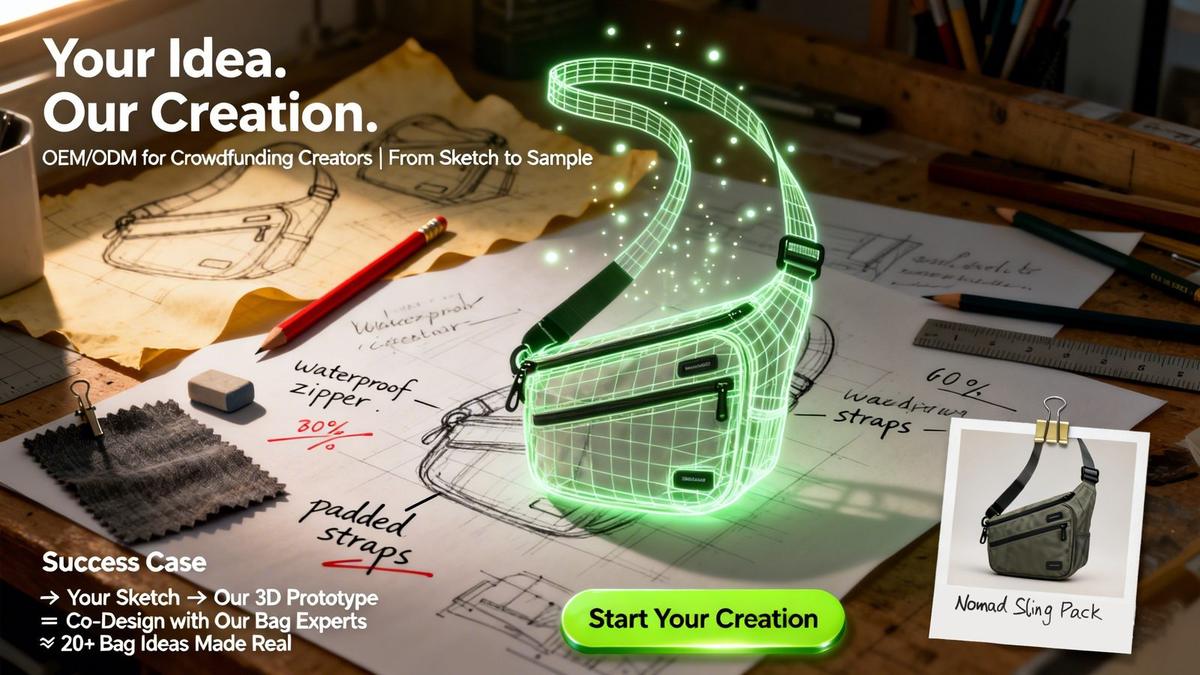
The quantity is fixed at 500 pcs per style and colourway, so the variables a creator controls are style count, colourway count, construction stability and decoration. Each has a different cost consequence. A single hero style in a single colour is the cheapest structure and the easiest to inspect. Every additional variant multiplies coordination without necessarily multiplying demand.
Decoration sits between those extremes. A different logo on the same shell may keep one construction while creating a separate setup and approval. A contrast lining can be a material coordination item inside the same style. A removable accessory, such as a pouch or a strap, may carry its own minimum. The useful habit is to classify each proposed variant in the RFQ and ask for its minimum in writing, rather than assuming a shared run.
- List every variant the campaign intends to publish, including stretch goals.
- Ask for a classification: same style, new colourway, or new style.
- Request the minimum that applies to each classified variant.
- Keep the base construction identical across all approved variants.
- Price decoration setups separately from the base bag.
- Decide a re-order option for any variant not funded in the first run.
There is also a marketing use for the floor. Because 500 units is a genuine production quantity, a creator can publish a limited first run with honest scarcity, supported by a real allocation model. That framing is credible only if the tiers reflect the physical output: a tier promising 900 units from a 500-piece order is a promise the production file cannot keep, and the shortfall will appear in the update thread rather than in the plan.
Our programme coordinator role is largely this classification work. When a creator sends a page with four colour options and two sizes, we return a table showing which are shared-construction variants and which are separate commitments, with the deposit impact of each. The 500-piece scope article continues that discussion from the other side: what a 500-piece order includes and what it excludes.
When 1,000 beats 500 and when it does not
Volume pricing is real. Materials are bought in larger lots, markers spread over more units, the line changeover is amortised further, and cartons are planned more densely. The question is never whether the unit price falls; it is whether the lower price is worth the cash and inventory it requires. Four conditions make a 1,000-piece order defensible: demand evidenced beyond the campaign, deposit and balance funded without the marketing reserve, a post-campaign channel for the surplus, and a specification stable enough that a correction will not strand a large lot.
Three conditions argue for staying at 500. The product is new with no sales history. The cash position depends on platform payout timing that has not yet happened. Or the campaign intends to offer several variants, in which case the safer move is one hero run now and a measured re-order later, because splitting demand across variants at 1,000 pieces multiplies the inventory of each.
| Situation | Better quantity | Reason | Risk if the other choice is made |
|---|---|---|---|
| First campaign, unproven demand | 500 | Caps exposure and keeps a re-order decision | Doubled unsold inventory |
| Strong pre-launch waitlist converted | 1,000 | Lower unit cost, known buyers | Stock-out and a rushed re-order |
| Two or more colourways wanted | 500 per colour, if funded | Each colour is its own commitment | Two large unsold positions |
| Complex structure with long sampling | 500 | Easier to correct before scaling | A large lot built on an unproven pattern |
| Cash depends on platform payout | 500 | Smaller deposit and balance | Missed slot while funds clear |
The intermediate option is a staged programme: 500 pieces in the first run with a pre-agreed re-order price, material assumption and validity period recorded before the first shipment. That preserves the option to scale without committing the cash up front. It only works if the re-order file is complete, which is a documentation task during the first run rather than after it.
The planning sequence for a 500-piece order
A low-MOQ order goes smoothly when the sequence is respected. Start with a technical file: dimensions with tolerances, materials with references, trim and hardware, construction notes, branding artwork, packing rules and acceptance criteria. Then sample. Then approve physically. Then confirm quantity, price, lead time, inspection and trade terms in one purchase order. Then pay the deposit. Then let the 35-50 day window run. Then inspect, release and book freight.
Two steps in that list are routinely compressed and later regretted. The first is the technical file, which some creators treat as paperwork belonging to the production side. It is the creator's own specification and the basis for every comparison. The second is the deposit timing: releasing 30% before the sample is approved removes the creator's main lever for getting corrections made. Approve first, then pay.
After inspection, the sequence continues with freight and fulfilment, which are the buyer's responsibilities under FOB Xiamen. Book with the approved carton data, not an estimate. Clear customs with the correct classification. Receive into a warehouse whose system already contains the SKUs, carton quantities and bundle rules. Budget the final mile separately, because 500 parcels across several zones is a real line item.
For creators building a pilot before a wider launch, the startups pilot-run guide shows how a 500-piece run doubles as a market test, and how the records from it support a later re-order. The same logic applies in reverse: a campaign run can become the pilot for a later direct or wholesale channel, provided the records were kept.
The RFQ that gets a usable low-MOQ quote
A request for quotation that says 500 custom backpacks will produce a wide range of numbers, because each recipient fills the gaps differently. A usable RFQ states the quantity per style and per colourway, attaches the technical file, and asks for a defined set of returns: unit cost, one-time charges, sample fee and lead time, bulk lead time, volume pricing at named tiers, packed carton data, payment terms, inspection assumption and exclusions.
- Quantity by style and colourway, never as a mixed total.
- Dimensioned drawings and a material reference list.
- Trim, hardware and branding method with artwork coordinates.
- Destination, trade term and packing requirement.
- Requested sampling rounds and target delivery month.
- A named inspection level: AQL 2.5 to ISO 2859-1.
- A request for exclusions to be listed, not omitted.
Then compare the responses on their assumptions, not only their totals. A lower number that excludes inspection, assumes a thinner lining or packs 12 pieces where another packs 20 is not cheaper; it is different. Our team normalises quotations against the same technical file before presenting them, which is the least glamorous and most useful part of the sourcing partner role.
Finally, treat the sample as the test of the quotation. A bid that looked excellent on paper has to produce a unit that meets the measurements, materials, functions and finish in the file. The 6-10 working days that sampling takes, or 12-15 for complex builds, is where a 500-piece commitment is either confirmed or corrected cheaply.
Planning a 500-piece bag order? Send the technical file, the colourway plan, the target quantity and the delivery month through the contact quotation form or to service@junyuanbags.com, and we will return a structured quotation with the sampling path, the production window and the inspection plan.
Frequently Asked Questions
What does low MOQ mean for custom bags?
Low MOQ means a genuine custom bag order can be placed at 500 pcs per style and per colourway instead of a retail-scale quantity. It covers custom patterns, materials, hardware and branding, not just a logo on a stock item. The minimum applies to each style and each colourway, so two colours of the same bag are normally two 500-piece commitments.
Why is the minimum 500 pieces rather than 100?
A bag order absorbs fixed work before the first usable unit: pattern and marker confirmation, material lot preparation, colour and trim matching, decoration setup, line changeover, quality documentation and carton planning. Spread over 100 pieces that overhead distorts the unit cost; at 500 it can be distributed and the line gains enough repetition to hold a consistent construction standard. At 500 pcs the fixed share of unit cost also becomes predictable enough to quote, which is what makes a 30% deposit calculable before launch.
Does a 500-piece order get made faster than a large one?
No. Sampling still takes 6-10 working days per round, or 12-15 for complex builds, and production 35-50 days from deposit and approved sample. A small order needs the same materials, the same line reservation and the same AQL 2.5 to ISO 2859-1 inspection. What changes is the total cash, not the calendar. Material reservations, the line booking and the inspection queue are scheduled the same way at 500 as at 3,000, so the calendar does not shorten.
Can 500 pieces be split across several colours?
Not by default. Each colourway carries its own 500-pcs minimum because shell, lining, webbing, zip tape, thread, trim and labels need separate material coordination. If a mixed split is offered for a specific programme, it must be quoted and confirmed in writing. Do not build a campaign page around an assumed split. Shade, dye lot and trim matching are prepared per colourway, and a mixed 500-piece pool cannot be produced as one material lot.
What are the payment terms on a 500-piece bag order?
T/T 30/70. The 30% deposit is due when the pre-production sample is approved and the purchase conditions are confirmed; the 70% balance falls at the agreed inspection gate before cargo release. Map platform payout timing so cleared funds exist in the deposit week, and keep the marketing budget separate from the production reserve. On a 500-pcs order both figures are known in advance: quoted unit cost times 500, plus packing and one-time charges, then the 30/70 split.
What does FOB Xiamen mean for a small order?
FOB Xiamen covers the agreed origin-side responsibilities up to the on-board point. Main freight, insurance, import clearance, duty and inland delivery are arranged by the buyer. For 500 pieces, freight is usually charged on volume, so request a packed trial carton with pieces per carton, exterior dimensions, gross weight and net weight before booking. Reserve destination storage as well, because a delay in receiving after arrival is a daily cost the buyer carries.
Is 1,000 pieces better value than 500?
The unit price usually falls at 1,000 through material lots, markers and amortised setup, but total committed cash, freight and inventory exposure roughly double. Choose 1,000 only with evidenced demand, funded deposit and balance money, a post-campaign channel for the surplus, and a specification stable enough that a correction will not strand a large lot. If two of the three tests fail, stay at 500 and use a staged re-order instead of a larger first commitment.
How many units should be offered to backers from a 500-piece run?
Fewer than 500. Allocate deliberately: an illustrative split might be 410 for core rewards, 25 for late pledges, 12 for media, 8 for retained references, 30 for replacement stock and 15 for reserve. Adjust the six lines to your warranty promise, route and post-campaign plans rather than copying a template. Cap the reward tier below the physical output: a tier promising 500 rewards from a 500-piece order leaves nothing for media, replacements or late pledges.
What should a low-MOQ RFQ include?
Quantity by style and colourway, dimensioned drawings, a material and trim reference list, branding method and artwork coordinates, packing requirements, destination and trade term, target delivery month, requested sampling rounds, and a named inspection level. Ask for unit cost, one-time charges, sample fee and lead time, bulk lead time, volume tiers, carton data, payment terms and listed exclusions. Attach the packing requirement and the destination, since both change the carton specification and therefore the freight and receiving costs.
Do material minimums apply separately from the product minimum?
Often yes. A custom dyed fabric, a special weave of webbing or a bespoke moulded puller can carry its own mill or tooling minimum, sometimes expressed in metres or kilograms and sometimes above 500 units. That is why two quotations for the same bag can differ sharply: one assumed stock materials, the other priced a development. Ask whether each reference is stock or custom before the RFQ is sent, because the answer changes both the price and the calendar.
Can a 500-piece run be re-ordered later at the same price?
Not automatically. A re-order depends on the same 500-pcs minimum, material availability and current costs. Ask for re-order price validity conditions in the original quotation: the period, the material assumption, the minimum quantity and whether sampling is needed after a component change. Keep the signed sample and tech pack so the re-order is a quotation exercise. Material availability and current costs move, so a recorded validity period is the most a quotation can promise.
What documents protect a 500-piece bag order?
The tech pack with revision history, the signed pre-production sample, the measurement sheet, the component list, the purchase order with inspection and trade terms, the AQL 2.5 to ISO 2859-1 inspection report, the packing list and the carton specification. Retaining these makes a later re-order, a warranty discussion or a freight claim far easier to resolve. Keep them together in one file, because a dispersed archive is the usual reason a re-order restarts development.
People Also Ask
What is a low MOQ for custom bags?
500 pcs per style and per colourway. It covers a genuine custom construction with its own patterns, materials, hardware and branding, not a stock item with a logo added.
Is 500 pieces a lot for a first crowdfunding run?
It is the practical entry point for a custom bag and a useful demand discipline. Fewer than 500 units of a custom construction is rarely economic, and more than 500 doubles the deposit and the unsold-inventory exposure.
Does a small order still need inspection?
Yes. The standard is AQL 2.5 to ISO 2859-1, and the inspection report is the document that authorises the 70% balance before cargo release at FOB Xiamen.
How is a 500-piece run scheduled?
Material arrival and shade review, cutting, decoration, sewing, in-line control, finishing, packing and pre-shipment inspection, within a 35-50 day window that begins at deposit plus approved sample.
Can I start with 500 and scale later?
Yes, and it is often the better structure. Keep the signed sample, tech pack and inspection report so a later 500-piece re-order can be quoted from evidence instead of restarting development.
What is the deposit on a 500-piece order?
30% under T/T 30/70, calculated on the product order after the sample is approved. Multiply the quoted unit cost by 500, add packing and any one-time charges, then apply 30%.
How do I compare two low-MOQ quotations?
Normalise them against one technical file, then compare material references, packing density, sampling discipline, inspection inclusion and exclusions. The cheapest number is frequently the one that assumed the least.