Sourcing Partner Questions to Ask Before Ordering Bags
What should you ask a bag supplier before placing a campaign order? Forty-eight questions across ten areas: capability, MOQ, pricing, sampling, materials, compliance, capacity, QC, shipping and re-order terms. The answers that matter most are the ones that come back in writing with numbers: 500 pcs minimum, 6-10 working days of sampling, 35-50 days bulk, AQL 2.5 to ISO 2859-1, FOB Xiamen and T/T 30/70.
- Why the questions matter more than the price
- Capability and scope questions
- MOQ, pricing and payment questions
- Sampling and prototyping questions
- Material and traceability questions
- Compliance and testing questions
- Capacity and scheduling questions
- Quality control and inspection questions
- Shipping and responsibility questions
- Communication, change control and re-order questions
- How to read the answers
- Send it as one RFQ
Why the questions matter more than the price
Every creator sourcing a campaign bag starts by comparing unit prices, and almost every sourcing problem that follows is caused by something the price did not include. A low unit cost can hide a higher minimum, a tooling charge that appears later, a sampling window that does not exist, an inspection standard that was never agreed, or a production slot that has not actually been booked. The price is the output of a set of terms; the terms are the thing to compare.
The second reason to ask is that the answers are themselves information about how the programme will be run. A production partner who returns a complete answer within two working days, with numbers, dates and named standards, is telling you something about how they will handle a technical query in week four of bulk. A response that answers three of ten questions and ignores the rest is telling you the same thing, less pleasantly.
This article is written as a questionnaire you can send. It covers ten areas and forty-eight questions, and the useful ones are the ones that require a number rather than an assurance. Where a question below has a standard answer on the programmes we support, that answer is given, so you can tell the difference between a considered response and a deflection. The crowdfunding bag guide covers the same ground from the planning side.
- Minimum order quantity
- 500 pcs per style / colourway
- Sampling
- 6-10 working days (12-15 for complex builds)
- Bulk production
- 35-50 days after deposit + approved pre-production sample
- Inspection
- AQL 2.5 to ISO 2859-1
- Trade term
- FOB Xiamen
- Payment
- T/T 30/70
- Production floor
- 4,950 m² SGS-verified, 137 staff, 7 lines, 149 machines
- Monthly capacity
- 200,000 pcs per month
- Programme contact
- service@junyuanbags.com
Key takeaways on supplier questions
- Ask for numbers, dates and named standards; an assurance without a number is not an answer.
- Confirm the minimum is per style and per colourway, and what a second colourway commits you to.
- Ask what exactly starts the bulk clock; it should be deposit plus written pre-production sample approval.
- Ask who owns the tooling, what happens to the screens, and what a re-order costs without them.
- Ask how a defect discovered at inspection is handled, and who pays for re-inspection.
Capability and scope questions
Start with scope, because a partner who cannot build your construction will still quote for it and then discover the problem in sampling. These questions establish whether the bag you have designed is within the range they actually run, and they are cheap to ask and expensive to skip.
| Question | Weak answer | Strong answer |
|---|---|---|
| Have you built this construction before? | Yes, many bags | Yes, with a named example and the panel count |
| What is the highest panel count you run regularly? | Any | A number, with a note on tooling needs |
| Do you run bonded or welded construction in-house? | We can arrange it | Yes or no, with the sub-process named |
| Which decoration methods are in-house? | All of them | A specific list, with which are subcontracted |
| What is your monthly capacity? | Large | 200,000 pcs per month across 7 lines |
| How many production lines and staff? | Enough | 7 lines, 137 staff, 149 machines |
The last two rows of that table matter for a specific reason. A campaign order of 500 pcs is small in production terms, and the question is whether it will be treated as small. A production floor of 4,950 m² with 137 staff across 7 lines running at 200,000 pcs per month has the headroom to schedule a 500 pcs order inside 35-50 days without displacing other bookings, which is exactly the answer a creator wants to hear and can verify. Our bag manufacturing page sets out how the capacity figures map to a schedule.
MOQ, pricing and payment questions
Minimum order quantity is the term most often misread. A minimum stated per style is not the same as a minimum stated per style and colourway, and the difference is a multiple of the number of colourways in the campaign. Ask the question in the form that exposes that distinction, and ask it before the tier structure on the campaign page is designed around an assumption.
| Question | Answer to expect | Why it matters |
|---|---|---|
| What is the MOQ? | 500 pcs per style and colourway | Three colourways is three commitments |
| Is tooling charged separately? | Yes, itemised | Otherwise it is hidden in the unit cost |
| What are the payment terms? | T/T 30/70 | Deposit timing affects campaign cash |
| When is the deposit due? | On written PPS approval | It gates the production slot |
| Is there a price break at higher quantity? | Yes, typically 8-20% | Prices the stretch goal in advance |
| Is the quotation valid for a stated period? | Usually 30 days | Protects against material cost moves |
Ask for the quotation to be itemised, because an itemised quotation is the only one you can negotiate and the only one you can compare against another. A single unit price hides the tooling, the set-up and the packing, and it makes a like-for-like comparison impossible. If two quotations differ by 8%, the itemisation will usually explain why, and the explanation is more useful than the difference.
Sampling and prototyping questions
Sampling is where a specification becomes an object, and it is also the stage most likely to slip. The questions below establish what a round includes, how long it takes, what happens if the sample is wrong, and what you will receive at the end of it. Ask all of them before the sampling slot is booked rather than during the round.
- How many working days does a standard sampling round take? The answer should be 6-10 working days.
- What extends it to 12-15 working days? The answer should name custom hardware, non-stock fabric or complex construction.
- How many rounds are included in the quoted price, and what does a third round cost?
- Are sample units charged, and is the charge credited against the bulk order?
- Who pays sample courier, and how many sample units will I receive?
- Will I receive a photographed measurement record with the sample, or only the unit?
- What exactly must be approved to release bulk? Deposit plus written pre-production sample approval.
- If I change the specification after approval, what is the cost and the calendar effect?
Request two units from each sampling round: one to keep untouched as the reference and one to test destructively. A single sample forces a choice between keeping it pristine and finding out whether the handle, the print or the closure actually survives use.
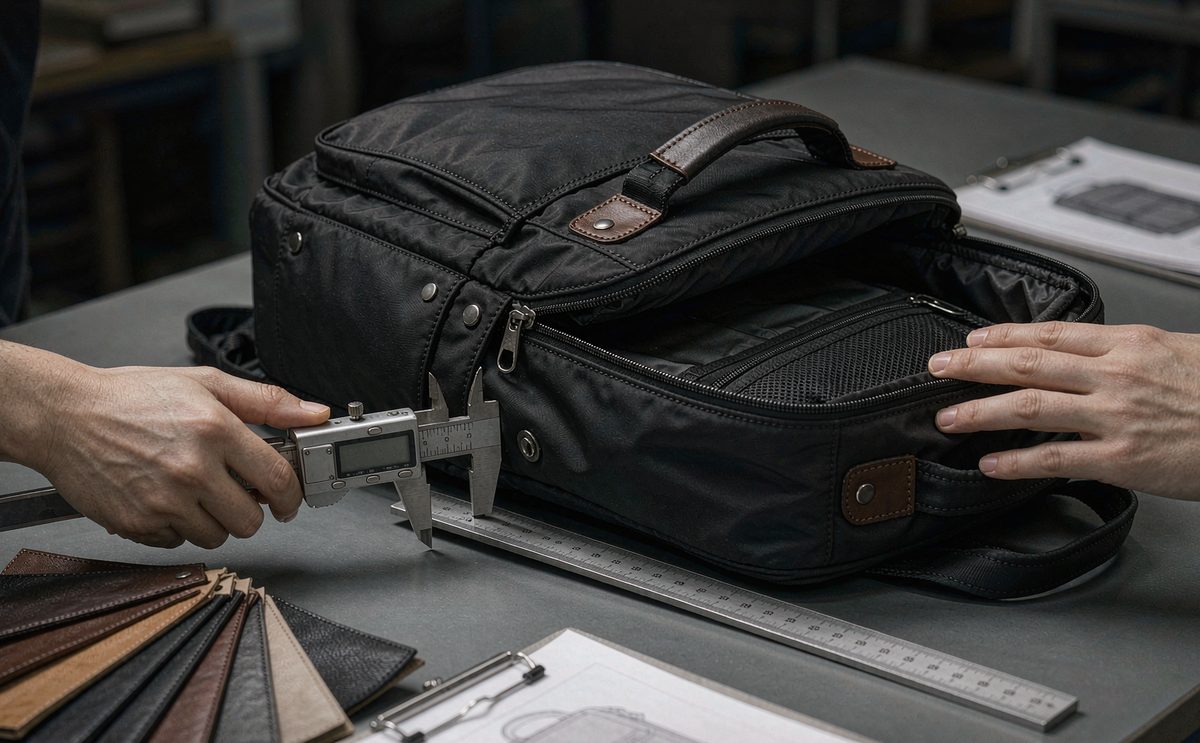
The measurement record in question six is worth insisting on. A sample that arrives with a completed measurement sheet, photographed against a scale reference at the stated points, gives you something to approve rather than an impression to form. Our sample prototyping page sets out what the record should contain.
Material and traceability questions
Materials are where most of the unit cost sits and where most of the surprises live. A fabric named loosely in a quotation can be substituted for something cheaper without technically breaching the agreement, and the substitution is only visible when five hundred units arrive with a slightly different hand feel. These questions close that gap.
- Will the fabric be named by denier, weave, finish and coating, with a supplier reference or swatch code?
- Is the fabric stock or dyed to order, and how many days does a custom dye add?
- Will the bulk run use the same fabric lot as the approved sample, and how is that recorded?
- Are hardware components named by reference, and are they catalogue or custom?
- What happens if a named material becomes unavailable after approval?
- Will I receive a material lot record and shade photographs at goods receipt?
- Are lining, interlining and webbing named with the same specificity as the face fabric?
- Is there a documented substitution policy, and does it require my written approval?
Compliance and testing questions
Compliance is not optional and it is not uniform: obligations differ by destination market and by product claim. A campaign shipping to backers in the US, the EU and the UK is subject to three overlapping sets of requirements, and the documentation has to exist before the goods ship rather than after a marketplace or a customs authority asks for it.
| Question | US market | EU and UK market |
|---|---|---|
| Is fibre composition declared? | Required on the label | Required under EU GPSR |
| Is there a children's product exposure? | CPSIA applies | EN 71 may apply |
| Are restricted substances controlled? | Prop 65 assessment | REACH obligations |
| Is there a substance safety certificate? | Common buyer requirement | OEKO-TEX Standard 100 widely used |
| Is a recycled content claim documented? | Substantiation required | GRS documentation expected |
| Is importer identification on the product? | Required for many categories | Responsible economic operator required |
Ask for the documentation to be listed in the quotation rather than promised verbally, and ask what happens if a test is required and fails. The answer you want is a named test, a named laboratory or certificate scheme, and a stated position on who pays for a re-test. Where the campaign makes an environmental claim, the material customisation page covers what can be substantiated.
Capacity and scheduling questions
A production window that has not been booked is not a production window. This is the single most common gap between what a creator believes has been agreed and what has actually been agreed, and it is worth being blunt about it in the RFQ. Ask for dates, in writing, tied to the conditions that trigger them.
- What starts the bulk production clock? The answer should be deposit plus written pre-production sample approval.
- What are the start and completion dates for my slot, once those conditions are met?
- How long is bulk production 35-50 days.
- Is the slot reserved now, or only when the deposit lands?
- What is the monthly capacity, and where does a 500 pcs order sit relative to it?
- What happens to my slot if my approval slips by two weeks?
- Will I receive weekly production status reports during the run?
- What is the position on a partial air shipment if part of the run is needed early?
Question six is the one creators forget and the one that hurts. A slot booked for a campaign that then slips its sample approval by three weeks does not simply move three weeks; the production partner has other bookings, and the slot may no longer be available. Ask whether the slot is held, for how long, and under what conditions.
Quality control and inspection questions
Quality control is a set of decisions made before production, not an activity performed at the end. The questions below establish what standard applies, who performs it, what report you receive, and what happens when the result is a fail. Ask for the defect classes to be defined jointly before the run starts.
| Question | Answer to expect | Warning sign |
|---|---|---|
| What inspection standard applies? | AQL 2.5 to ISO 2859-1, level II | A vague reference to checking |
| Is there an in-line check during sewing? | Yes, with a defect log | Inspection only at the end |
| Who receives the inspection report? | You, before balance payment | Only the production side |
| How are critical, major and minor defined? | Written classes per product | A generic checklist |
| What happens if inspection fails? | Rework and re-presentation | No stated position |
| Who pays for re-inspection? | Stated in advance | Silence |
Ask what happens when a pre-shipment inspection fails, and who pays for the re-inspection. A partner with a controlled process has an answer ready, because it has happened and been handled. Silence on this question usually means the cost will be negotiated at the worst possible moment, with your delivery date as leverage.
Ask also for the in-line defect log to be shared during the run rather than only at the end. An in-line check catches a defect trend while it is still correctable on the line, whereas a single gate at the end leaves sorting finished goods as the only remedy. Our QA and QC page shows how the classes are structured.
Shipping and responsibility questions
Trade terms allocate cost and risk, and they are frequently misunderstood at exactly the point where the misunderstanding costs money. FOB Xiamen means the goods are delivered on board the vessel at Xiamen with cost and risk transferring there; everything after that is the buyer's arrangement. Confirm it explicitly, and confirm what is included on each side of the line.
- What trade term applies? The answer should be FOB Xiamen, or a stated alternative.
- What is included on the seller side up to loading, and what becomes mine at that point?
- Who arranges ocean freight, insurance, clearance and inland delivery?
- Will I receive carton dimensions and a packing list before the freight booking?
- What is the position if goods are damaged in transit, and whose insurance responds?
- Can you ship directly to my fulfilment warehouse, or only to the port?
- Will I receive loading photographs and a container or carton count at dispatch?
- What documentation accompanies the shipment: packing list, commercial invoice, certificate references?
Communication, change control and re-order questions
The last group covers what happens after the order is placed: who you talk to, how changes are handled, and what a second run costs. These are the questions that determine whether a re-order is a confirmation or a fresh negotiation, and they are worth asking during the first RFQ rather than after the campaign overfunds.
| Question | Answer to look for | Why it matters |
|---|---|---|
| Who is my single point of contact? | A named programme coordinator | Escalation needs a name |
| What is the response time on technical queries? | Within one working day | Unanswered days add to the calendar |
| How are specification changes documented? | Written revision, re-quoted | Prevents scope drift |
| Who owns the tooling and screens? | Stated, usually retained for re-order | Affects switching cost |
| What does a re-order cost? | Unit cost without tooling | Removes one sampling round |
| How long are screens, dies and markers kept? | A stated period, often 12-24 months | Sets the re-order window |
| Is a re-order a confirmation or a new negotiation? | Confirmation if priced in the first RFQ | Protects the stretch-goal margin |
Ask the re-order question at the first quotation, with the likely variants named. Pricing a second quantity band and any stretch-goal colourway during the original RFQ costs nothing, and it means that when the campaign overfunds the re-order is a confirmation rather than a negotiation conducted under time pressure.
How to read the answers
Three signals separate a considered response from a deflection, and none of them is the price. The first is specificity: a number, a date and a named standard rather than an adjective. The second is completeness: all ten areas answered rather than the three that were easy. The third is whether the answer distinguishes between what is included and what is not, which is the mark of a quotation that will still be accurate in week six.
| Signal | What it looks like | What it predicts |
|---|---|---|
| Numbers instead of adjectives | 35-50 days rather than fast | The schedule is likely to hold |
| Named standards | AQL 2.5 to ISO 2859-1 | Inspection will be measurable |
| Exclusions stated | Tooling and courier itemised separately | Fewer change orders later |
| Conditions stated | Clock starts on deposit plus PPS approval | No surprise about when bulk begins |
| Fail positions stated | Rework, re-present, who pays | Problems handled rather than negotiated |
| Re-order terms offered | Second quantity band priced now | Scale-up will be cheap |
One further signal is worth noting because it is easy to miss: whether the response asks you questions back. A partner who returns three queries about your tech pack has read it. A partner who returns a price without a single query has either understood everything immediately, which is possible, or has not read it closely, which is more common and more expensive later.
There is a fourth signal that only appears once you have two responses in front of you: consistency of structure. Two quotations that both itemise tooling, state the sampling window as a range of working days, name an inspection standard and define when the bulk clock starts can be compared line by line. Two quotations that differ in structure cannot be compared at all, and in that situation the lower number is not the better offer, it is simply the less complete one.
Finally, treat the response time itself as data. A considered reply to a ten-section questionnaire within two working days tells you the enquiry is being handled by someone with authority to answer. A reply that arrives a week later, answers four sections and asks you to call, tells you how a technical query will be handled in week four of bulk, which is when it will actually matter.
Send it as one RFQ
The most efficient way to use this list is to send it as a single document with your tech pack attached. Ten sections, forty-eight questions, and a request for the answers in writing. You will receive either a complete response that lets you compare two partners properly, or a partial one that tells you what you need to know without spending a sampling round finding out.
- Attach the complete tech pack: dimensions, materials, hardware, branding method, packing specification.
- State quantity per style and colourway, with the 500 pcs minimum understood.
- State the target delivery month and destination market, so freight and compliance can be quoted.
- State the inspection standard you expect: AQL 2.5 to ISO 2859-1 unless there is a reason otherwise.
- Confirm trade terms and payment: FOB Xiamen and T/T 30/70, or a stated alternative.
- Name any stretch-goal or re-order variants and ask for them to be priced in this RFQ.
- Ask for the response in writing, with the ten sections answered in order, within a stated number of days.
That request takes an hour to assemble and it is the highest-return hour in the whole sourcing process. It is also the point at which a campaign stops hoping its reward will arrive and starts knowing it will, on dated terms, at a cost that has been modelled. If you are comparing formats before you send it, the custom bag categories page and the Indiegogo page cover the range and the platform differences.
- Bag manufacturing for campaign creators
- Crowdfunding bag sample prototyping
- Kickstarter campaign bag QA and QC
- Low minimum bag production for creators
- Material customisation for Kickstarter bags
- Custom bag categories
- Custom bags for Kickstarter campaigns
- Request a quotation
Send the questionnaire with your tech pack
Send us your specification, quantity and target delivery month. As your production partner we will answer all ten sections in writing, with a unit cost, an itemised tooling list and a booked production window. Write to service@junyuanbags.com or use the quotation form.
Frequently Asked Questions
What is the minimum order quantity for custom campaign bags?
The minimum is 500 pcs per style and per colourway. Confirm the wording, because a minimum stated per style only is a different commitment. A backpack in black, navy and olive is three separate 500 pcs commitments unless it is treated as one colourway split inside a single run.
When does bulk production actually start?
production 35-50 days after two conditions are met together: the 30% deposit under T/T 30/70 has landed, and the pre-production sample has been approved in writing. Neither alone starts the clock, and assuming production began on campaign close typically costs two to four weeks.
How long should a sampling round take?
Six to ten working days for a standard build and 12-15 working days for a complex one. Budget two rounds, so 12-20 working days of calendar, and ask in the RFQ what a third round costs before you actually need one.
What inspection standard should be specified in the order?
AQL 2.5 to ISO 2859-1 at general inspection level II, with critical, major and minor defect classes defined for your specific product. Ask also whether an in-line check runs during sewing, and who receives the report before the balance is released.
Should tooling be charged separately from unit cost?
Yes. An itemised quotation lets you see what is one-off and what recurs on re-order, and it makes two quotations genuinely comparable. Ask who owns the screens and dies, and how long they are retained, because that sets the cost of switching later.
What does FOB Xiamen include and exclude?
FOB Xiamen means goods are delivered on board the vessel at Xiamen with cost and risk transferring there. Packing, port delivery and loading are handled on the production side; ocean freight, insurance, customs clearance and inland delivery to your warehouse are yours to arrange.
What happens if a pre-shipment inspection fails?
A failed inspection triggers rework or re-sorting of the finished run plus a second inspection, typically adding 10-15 days to the calendar. Ask in advance who pays for the re-inspection, and mitigate the risk with an in-line check during the sewing window.
How is a specification change handled after sample approval?
A change after written approval resets the sampling stage rather than just the queue position, because it means new markers, reissued material orders and a fresh sample. Ask for the cost and calendar effect to be quoted in writing before agreeing to any change.
Is the production slot reserved before the deposit is paid?
Usually not, and this is worth asking about directly. Ask whether the slot is held, for how long, and under what conditions, because a campaign that slips its sample approval by three weeks may find the slot allocated elsewhere in the meantime.
What compliance documents should a bag supplier provide?
Ask for a material declaration, fibre composition, and certificate references for the destination market: CPSIA and Prop 65 for the US, REACH and EU GPSR for Europe, plus OEKO-TEX Standard 100 or GRS where a safety or recycled claim is made.
How much does a re-order cost compared with the first run?
Unit cost typically falls 8-20% at a higher quantity, and the effective saving is larger than that figure because tooling, sampling and set-up are already paid for. A re-order also removes one whole sampling round of 6-10 working days from the production calendar.
How quickly should technical queries be answered?
Within one working day is a reasonable expectation and worth stating in the RFQ. Every unanswered day during sampling is a day added to the calendar, and slow answers during bulk are the usual cause of a slipped delivery month.
People Also Ask
How do I choose a bag supplier for a crowdfunding campaign?
Compare terms rather than unit prices. Ask forty-eight questions across capability, MOQ, pricing, sampling, materials, compliance, capacity, QC, shipping and re-order terms, and judge the answers on specificity rather than reassurance.
What should I send a bag supplier to get an accurate quote?
A complete tech pack, quantity per style and colourway, target delivery month, destination market, inspection standard and trade terms. Missing material or hardware detail is the most common reason a quoted price later moves.
Is a low unit price a red flag?
Not always, but an unexplained one is. Ask what the price excludes: tooling, sampling, packing, inspection or a higher minimum. An itemised quotation shows whether a low price is efficiency or an omission.
Can I switch suppliers between sampling and bulk?
Technically yes, but it usually costs more than it saves. You lose the approved sample as a reference, pay tooling again, and restart a sampling round of 6-10 working days, which is often longer than resolving the original problem.
What is a reasonable response time from a bag supplier?
One working day for technical queries during sampling and bulk. Slow answers are the most common hidden cause of a slipped delivery date, so state the expectation in the RFQ and hold the partner to it.