Custom Dry Bags for Kickstarter
The MOQ for custom dry bags on a Kickstarter campaign is 500 pcs per style and colourway. Sampling takes 6-10 working days, or 12-15 where RF welded seams or moulded closures are specified, and production 35-50 days after deposit and approved pre-production sample. Inspection is set at AQL 2.5 to ISO 2859-1, cargo ships FOB Xiamen and payment is T/T 30/70. A dry bag carries the most binary claim in the entire bag category: either it keeps water out or it does not, and a backer can prove which in a bathtub. This page covers the coating, seam, closure and testing decisions that decide the outcome.
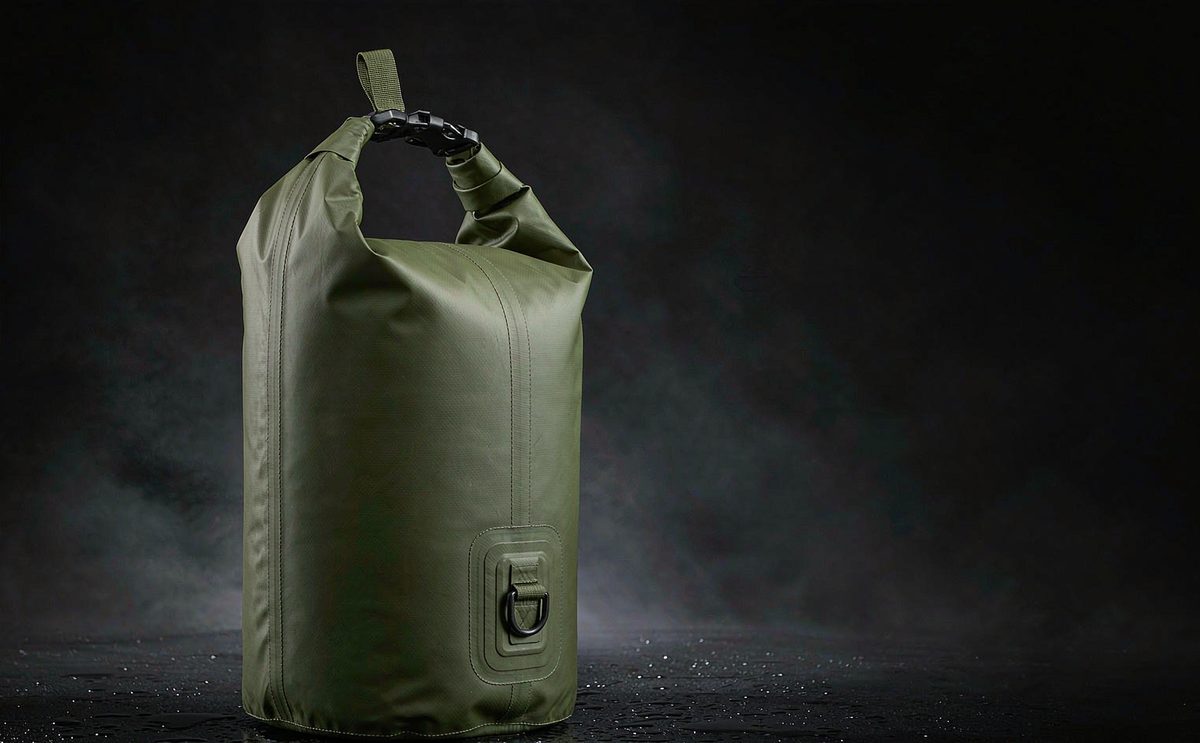
Key takeaways
- MOQ is 500 pcs per style and colourway, with each size and colourway carrying its own minimum.
- Sampling takes 6-10 working days, extending to 12-15 for RF welded seams or moulded closures.
- production 35-50 days after deposit and approved pre-production sample.
- Inspection is AQL 2.5 to ISO 2859-1, with a photographic report before the 70% balance payment.
- Cargo ships FOB Xiamen under T/T 30/70 terms.
- Waterproofing is built by welded seams, not by a coating; a needle hole is a leak path.
Waterproof is a construction method, not a coating
The most expensive mistake in this category is buying a coated fabric and calling the result waterproof. A coating makes fabric water resistant; it does not make a bag waterproof, because every seam is stitched through the coating and every stitch is a hole. Genuine waterproofing comes from construction: radio-frequency welded seams that fuse two coated faces into a continuous bond, and a closure that seals without a needle path.
Our production team therefore splits the RFQ into three specification layers. The first is the material system: base fabric, coating or laminate, and the film gauge. The second is the seam method: RF welded, heat welded, or stitched and taped, with the last of those only appropriate where a water-resistant claim is enough. The third is the closure: roll-top, zipper or a hybrid. A dry bag that fails does so almost always at layer two or layer three, not at layer one.
The commercial consequence is that waterproofing has to be decided at RFQ stage rather than added later. Moving a design from stitched-and-taped to welded after sampling means re-costing the bag, re-cutting the pattern and re-running the sampling window. Programme-level planning context is on the custom bags for Kickstarter page.
Coating, film and fabric construction for dry bags
Base fabric, coating and film gauge work as a system. A heavier base fabric gives tear and abrasion resistance; the coating or laminate gives the waterproof barrier and the weldability. TPU laminates weld well and stay flexible in cold water, which matters for paddling and mountain use. PVC laminates weld easily and cost less, but stiffen in the cold and carry a heavier environmental and compliance load.
| System | Base fabric | Weldability | Cold flexibility | Cost index |
|---|---|---|---|---|
| PU-coated 210D nylon | 210D nylon | Moderate | Good | 1.0 |
| TPU-laminated 420D nylon | 420D nylon | Very good | Very good | 1.9 |
| TPU-laminated 840D nylon | 840D nylon | Very good | Good | 2.6 |
| PVC-laminated 500D polyester | 500D polyester | Excellent | Poor | 1.5 |
| TPU-laminated 70D ripstop | 70D ripstop nylon | Good | Very good | 1.7 |
| Recycled rPET with TPU film | 600D rPET, GRS | Good | Good | 2.1 |
Film gauge matters as much as base fabric. Too thin and the weld has little material to fuse, so the seam becomes the weak point; too thick and the bag becomes stiff and hard to roll closed, which pushes backers towards leaving the closure partly undone. Specify the gauge in the tech pack, verify it on incoming material, and confirm it is consistent across the batch. Material and coating options are set out on the material customization for Kickstarter bags page.
Seam construction: RF welding versus stitch and tape
There are three seam routes and they produce three genuinely different products. RF welding fuses thermoplastic faces under radio-frequency energy and produces a continuous bond with no needle holes. Heat welding achieves a similar result where the material allows it, at lower tooling cost but with a narrower process window. Stitch and tape sews the seam and covers it with a waterproof tape, which is cheaper and faster to sample but relies on tape adhesion for the life of the product.
- RF welded: continuous bond, no needle path, the specification for genuine waterproof claims; highest tooling cost.
- Heat welded: good bond where the material permits, lower tooling, narrower process window to control.
- Stitched and taped: cheapest and fastest, appropriate only where a water-resistant claim is published.
- Weld width: specify in millimetres with a tolerance, because a narrow weld is a slow failure waiting to happen.
- Weld parameters: record energy, pressure and dwell time in the process sheet so bulk matches the approved sample.
- Corner construction: corners are where welds fail; specify a radiused or gusseted corner rather than a hard fold.
Water resistant, splash proof and waterproof are three different products with three different cost bases. If the campaign page says waterproof or submersible, the construction has to be welded and the test protocol has to be a submersion test. Upgrading a water-resistant sample after the campaign has funded means re-cutting the pattern, re-running sampling and re-quoting the entire order.
Closure systems and the roll-top specification
The roll-top is the standard dry-bag closure and the most commonly mis-specified. The seal depends on the number of rolls, and a backer who rolls twice instead of three times gets a bag that leaks. That is not a manufacturing defect, it is an instruction failure. The fix is simple and cheap: print the required roll count on the bag, either as a printed marker line or as a small instruction panel near the closure.
| Closure | Seal quality | Access speed | Unit cost impact | Best for |
|---|---|---|---|---|
| Roll-top with side buckle | Excellent when rolled as instructed | Slow | Baseline | Paddling, expedition, general dry storage |
| Roll-top with top clip | Excellent | Medium | +6% to +14% | Everyday and commuter dry bags |
| Water-resistant zipper | Good, not submersible | Fast | +22% to +55% | Organiser-style dry bags |
| Submersible zipper | Very good | Fast | +90% to +180% | Photography and technical use |
| Roll-top plus zipper hybrid | Excellent plus fast access | Fast | +45% to +95% | Premium multi-compartment builds |
| Drawcord with stiffener | Moderate | Fast | -10% to -18% | Lightweight stuff sacks |
Buckle specification is the other half of the closure. A side-release buckle on a roll-top takes repeated loading as the bag is compressed, and a brittle plastic will crack in cold water. Specify the buckle material, the operating temperature range and the breaking strength, then test it on the pre-production sample in cold conditions if the reward is aimed at paddling or winter use.
Sampling a dry bag: approvals and submersion testing
Sampling runs 6-10 working days from approved artwork and confirmed materials, extending to 12-15 where RF welded seams or moulded closures are specified, because weld tooling has to be set and parameters tested before the first unit can be assembled. Dry bags reward a two-round sequence with the submersion test in the middle, because the test result is what the campaign claim will rest on.
- Round one: assess the material hand feel, the roll behaviour and how many rolls the closure comfortably allows.
- Round one testing: run the submersion test under the conditions the campaign will claim, weighted as instructed.
- Round two: confirm weld width, corner construction and closure alignment on a revised pre-production sample.
- Cold check: where the reward targets cold-water use, flex and roll the sample after refrigeration.
- Approval: sign the pre-production sample built from bulk materials, which becomes the AQL 2.5 reference.
Define the submersion test first: depth, duration, whether the bag is weighted, and the pass criterion stated as water ingress in millilitres or as a dry-contents check. Copy that protocol into the tech pack so it can be inspected against. production 35-50 days after deposit and approved pre-production sample, so the clock starts only once that reference passes the test. The full gate sequence is on the crowdfunding bag sample prototyping page.
MOQ and unit cost for a waterproof build
The minimum order is 500 pcs per style and colourway, and for dry bags it applies per size as well, because each size is a separate pattern and a separate weld tooling set. A three-size family is three production runs. That is the single most important planning fact in this category, and it is why we advise launching with one or two sizes and expanding the family on the re-order once the weld parameters are proven.
| Cost driver | What changes | Effect on unit cost |
|---|---|---|
| Material system | PU-coated 210D to TPU-laminated 840D | +25% to +160% |
| Seam method | Stitched and taped to RF welded | +24% to +65% |
| Closure | Roll-top to submersible zipper | +6% to +180% |
| Hardware | Standard plastic to cold-rated buckle | +7% to +26% |
| Testing regime | Visual to 100% submersion testing | +$0.20 to +$1.10 per unit |
| Order volume | 500 pcs to 3,000 pcs | -9% to -21% |
The testing line is the one most often omitted from a competing quote, and it is the difference between a waterproof claim that can be defended and one that cannot. Ask whether the quotation includes submersion testing on a statistical sample or on every unit, because those are materially different costs and materially different risk positions. On a product where failure is binary, testing is not an optional extra.
A reward claim is only as strong as the test that sits behind it, and only as safe as the sample size that test is run on.
Kickstarter Creator Handbook
Production scheduling for an outdoor-season launch
Dry bags are seasonal in most markets, which compresses the calendar. Sampling is 6-10 working days per round, production 35-50 days after deposit and approved pre-production sample, inspection and packing add 3-5 days, and transit adds 12-38 days. A campaign promising delivery ahead of a paddling or hiking season has to close, sample, produce and ship inside a window that leaves little room for a failed submersion test.
| Stage | Working days | Owner |
|---|---|---|
| RFQ, tech pack review and weld tooling plan | 3-5 | Creator and production partner |
| Material sourcing and weld parameter trials | 6-10 | Production team |
| Sampling round one | 6-10 | Production team |
| Submersion test and closure correction | 3-7 | Creator |
| Pre-production sample and approval | 6-15 | Both |
| Bulk production | 35-50 | Production team |
| AQL 2.5 inspection and waterproof verification | 3-6 | QC team |
| Freight, customs and fulfilment | 12-38 | Freight and fulfilment partners |
Where the reward ships as a set — three dry bags in nested sizes, for instance — the kitting operation needs its own specification, cost and inspection step. The crowdfunding rewards fulfilment page covers kitting, address capture and the DDP route for international backers.
Inspection and waterproof verification at AQL 2.5
Pre-shipment inspection is set at AQL 2.5 to ISO 2859-1, which fixes the sample size, the accept and reject counts and the defect classification. Critical defects — a leaking weld, a split seam, a closure that will not seal — are zero tolerance at any level. Major defects such as weld discoloration or a misaligned panel are capped by the AQL 2.5 table. Minor defects such as a stray mark carry a higher allowance but must still be logged.
- Incoming check: film gauge, coating weight and base fabric weight verified against the specification.
- Inline check: weld width, weld consistency and corner construction on the first 50 units of each size.
- Parameter check: confirm weld energy, pressure and dwell time match the approved process sheet.
- Submersion test: the protocol from the tech pack applied to a defined sample, with results logged per batch.
- Final AQL 2.5 inspection: random carton selection, defect logging and a photographic report before release.
- Compliance file: REACH, CPSIA or Prop 65 documentation assembled for each destination market.
Welding is a parameter-driven process, and parameters drift across a long run. Log energy, pressure and dwell time at the start and end of each shift, and apply the submersion test to units drawn from early, middle and late production. A sample-room piece made under ideal conditions tells you what is possible; only the bulk sample tells you what you are shipping.
The staged inspection model, defect classification and the reporting pack are explained on the Kickstarter campaign bag QA/QC page, including the decision path when a batch lands marginally under the accept threshold.
Compliance, care labelling and carton planning
PVC laminates carry a heavier compliance load than TPU in several markets, and that is a specification decision rather than a paperwork detail. Confirm destination markets in the RFQ, because switching laminate after the compliance file has been assembled means starting the documentation again. Care labelling matters more here than in most categories, because a dry bag's performance depends on how the backer closes and stores it.
- Chemical: REACH declaration for the EU, CPSIA or Prop 65 documentation for the United States.
- Laminate: confirm TPU or PVC compliance status for each destination before material is booked.
- Care card: roll count, maximum fill, and a warning against prolonged storage tightly rolled.
- Product information: EU GPSR information where the reward ships to European backers.
- Carton: five-ply export carton, with units rolled loosely rather than folded, to avoid creasing the film.
Programmes of this kind run from a 4,950 m² SGS-verified production floor with 137 staff across 7 production lines and 149 machines, giving 200,000 pcs of monthly capacity. Established in 2014 with trade roots going back to 2004, the team has supported more than 20 crowdfunding campaigns. That capacity allows a size family to scale from one size to three without losing a seasonal delivery window.
How to choose a production partner for waterproof products
How to choose between bidders on a waterproof build is a question about process evidence. Will the bidder name the weld method, the weld width and the parameters in writing? Will they log those parameters per shift? Will they run the submersion test on a defined sample from the bulk batch, or only on a sample-room piece? A supplier shortlist assembled on material descriptions alone tends to produce a bag that welds beautifully once and inconsistently thereafter.
- Request a quotation that names the material system, seam method and weld width separately.
- Confirm the submersion test protocol, sample size and pass criterion before sampling starts.
- Ask how weld parameters are logged and how often they are verified during a run.
- Ask what testing is included in the quote, and whether it is statistical or per-unit.
- Ask for the re-order price band in writing while the first purchase order is still open.
Creators whose reward overlaps with outdoor carry should compare against the custom sports bags for Kickstarter and custom backpacks for Kickstarter pages, and travel-adjacent rewards against custom travel bags for Kickstarter. Entry-tier planning is on the low MOQ bag production for creators page.
Re-order, size families and volume pricing
The size family is the main commercial lever in this category. Because each size carries its own 500 pc minimum and its own weld tooling, the first order should be narrow and the family should expand on the re-order once weld parameters are proven and tooling exists. Raising volume from 500 to 3,000 pcs typically reduces unit cost by 9% to 21%, and a second size introduced on the re-order costs less than it would have on the first.
- Minimum order quantity
- 500 pcs per style / colourway
- Sampling lead time
- 6-10 working days (12-15 for welded builds)
- Bulk production
- 35-50 days after deposit and approved pre-production sample
- Inspection standard
- AQL 2.5 to ISO 2859-1
- Trade term
- FOB Xiamen
- Payment terms
- T/T 30/70
- Production capacity
- 200,000 pcs per month, 7 lines, 149 machines
- Facility
- 4,950 m² SGS-verified floor, 137 staff
- Programme experience
- 20+ crowdfunding campaigns supported since 2014
Request a dry bag quotation
Send the size range, intended waterproof claim, closure preference, quantity per size and colourway, destination markets and target reward price. The team will return a structured quotation, a material and seam specification proposal, a submersion test protocol and a sampling schedule.
- Custom bags for Kickstarter programmes
- Custom sports bags for Kickstarter
- Custom travel bags for Kickstarter
- Custom backpacks for Kickstarter
- Low MOQ bag production for creators
- Sample prototyping for crowdfunding bags
- QA and QC for campaign bags
- Request a quotation
Request a dry-bag quotation
Email service@junyuanbags.com with your tech pack, size range, intended waterproof claim, quantity per size and target delivery month. A campaign bag specialist will return a cost breakdown and sampling schedule within two working days.
Frequently Asked Questions
What is the MOQ for custom dry bags on a crowdfunding order?
The minimum order is 500 pcs per style and colourway, and for dry bags it applies per size as well, because each size needs its own pattern and weld tooling set. A three-size family is three production runs. Most first campaigns launch with one or two sizes and expand the family on the re-order.
How long does sampling take for a welded dry bag?
Standard sampling is 6-10 working days from approved artwork and confirmed materials. RF welded seams or moulded closures extend that to 12-15 working days, because weld tooling has to be set and parameters tested. Budget 20-30 working days for two rounds plus the submersion test.
How much does a custom dry bag cost per unit?
Unit cost turns on material system, seam method and closure. Moving from PU-coated 210D to TPU-laminated 840D adds 25% to 160%; moving from stitched and taped to RF welded adds 24% to 65%. A submersible zipper can add 90% to 180%. Raising volume from 500 to 3,000 pcs typically reduces unit cost by 9% to 21%.
What is the difference between water resistant and waterproof in a dry bag?
Water resistant means a coated shell with stitched and taped seams that survives rain and spray. Waterproof means RF welded seams with no needle path, verified by a submersion test, and it typically costs 24-65% more. The two are different products, and the claim has to match the construction in the tech pack.
How many rolls should a roll-top closure require?
3 rolls is the standard, and the requirement has to be printed on the bag as a marker line or instruction panel. A backer who rolls only 2 times gets a bag that leaks, which is an instruction failure rather than a manufacturing defect. Confirm the roll count the pattern comfortably allows during sampling.
What inspection standard governs a dry-bag shipment?
Pre-shipment inspection runs at AQL 2.5 to ISO 2859-1, fixing sample size, accept and reject counts and defect classification. Critical defects such as a leaking weld or a closure that will not seal are zero tolerance. You receive a photographic report before releasing the 70% balance payment.
How is waterproofing verified during bulk production?
Log weld energy, pressure and dwell time at the start and end of each shift, then apply the submersion test to units drawn from early, middle and late production. A sample-room piece shows what is possible; only the bulk sample shows what is actually shipping. Statistical testing adds $0.20 to $1.10 per unit.
Should a dry bag use TPU or PVC laminate?
TPU welds very well, stays flexible in cold water and carries a lighter compliance load, at roughly 25% to 70% more than PVC. PVC welds easily and costs less but stiffens in the cold and carries a heavier environmental and compliance burden. Confirm destination markets before booking material.
When should a dry-bag order be placed for a seasonal launch?
Finish sampling during the campaign so production starts when funds clear. production 35-50 days after deposit and approved pre-production sample, inspection and waterproof verification add 3-6 days, and transit adds 12-38 days. A failed submersion test inside that window removes the seasonal delivery date.
Do dry bags need compliance documentation for backers?
Yes. Assemble a REACH declaration, CPSIA or Prop 65 documentation and EU GPSR product information for the destination markets. PVC laminates carry a heavier compliance load than TPU in several markets, so confirm destinations in the RFQ before material is booked, or the file has to be rebuilt.
How should dry bags be packed for container freight?
Roll units loosely rather than folding them, because a hard crease can damage the film and compromise the weld. Use a 5-ply export carton rated for container stacking height and confirm units per carton in the tech pack. Avoid over-filling cartons by more than 5%, since compression can crease laminated material.
What happens to the unit price on a post-campaign re-order?
Raising volume from 500 to 3,000 pcs typically reduces unit cost by 9% to 21%. A second size introduced on the re-order also costs less than it would have on the first order, because weld parameters are proven and only tooling and setup change. Negotiate the band before the campaign closes.
People Also Ask
Are dry bags a good Kickstarter reward?
Dry bags suit outdoor, paddling and travel campaigns because the value proposition is immediate. The risk is the claim: waterproof is binary and a backer can test it in a bathtub. Specify welded seams and a submersion test, and print the required roll count on the bag.
Why does my dry bag leak even though the fabric is waterproof?
Because waterproof fabric does not make a waterproof bag. Stitched seams put a needle hole through the coating, and the closure is the other common path. Welded seams and a correctly rolled roll-top are what make the claim true.
Should I offer multiple sizes in the first order?
Usually not. Each size carries its own 500 pc minimum and its own weld tooling set, so a three-size family is three production runs. Launch with one or two sizes, prove the weld parameters, then expand the family on the re-order.
What is a submersion test and how long should it run?
It is a defined protocol: depth, duration, whether the bag is weighted, and a pass criterion stated as water ingress in millilitres or a dry-contents check. Write it into the tech pack before writing campaign copy, so the claim and the test match.
How long does a dry bag order take from approval to delivery?
Allow 35-50 days for bulk production after deposit and approved pre-production 35-50 days for inspection and waterproof verification, and 12-38 days for freight. Sampling of 6-10 working days per round, or 12-15 for welded builds, comes first.