Bag Pilot Production Planning: The 3-Stage Ramp From Sample to Scale
A three-stage ramp is the safest way to take a bag from a funded campaign to a real product line. Stage one is a 500-pcs validation run that proves the construction and the demand. Stage two is a 1,000 to 2,000 pcs run that absorbs stretch goals and the first re-order. Stage three consolidates at 5,000 pcs, where tooling is amortised, colourways are cut back and the unit cost falls. Plan it as one sequence before you launch, and each stage can be booked and costed instead of improvised after the campaign closes.
- Why a Ramp Beats One Big Order
- Stage 1: The 500-Pcs Validation Run
- What Stage One Is Meant to Tell You
- Stage 2: The 1,000 to 2,000 Pcs Stretch Run
- Stage 3: Consolidation at 5,000 Pcs and Beyond
- What Changes Between Stages: Tooling, Patterns, Materials
- Reserving Capacity Across Three Stages
- Cash Flow Through the Ramp
- The Timeline a Three-Stage Ramp Actually Needs
- How to Know You Are Ready for the Next Stage
Why a Ramp Beats One Big Order
The instinct of most first-time creators is to place one order that covers everything: the campaign backers, the stretch goals, and some stock for later. It feels efficient, and the unit price on the quote looks attractive. It is also the structure that produces the two classic crowdfunding failures, which are unsold inventory and a product that needed a fix nobody discovered until the last carton.
A ramp works differently. You commit to the smallest quantity that clears the 500 pcs per style and per colourway minimum, you ship it, you learn from the returns and the reviews, and you let what you learned shape the next order. The unit price is higher in stage one and lower by stage three, but the total cash at risk in the early months is a fraction of the single-big-order plan, and the product that reaches scale is a better one.
There is a second reason that is specific to bags. A bag is made of many materials, cut in many pieces and sewn by many hands, and the first run of any construction reveals things that no sample can: which seam is awkward to sew at speed, which fabric slips under the needle, which trim colour the machines dislike. A 500-piece run is long enough to surface those problems and short enough that you can fix them before you have made 5,000 of them.
The ramp also matches how a campaign actually behaves. Funding arrives in one surge, then softens into a long tail of late pledges, add-ons and post-campaign store sales. A single big order forces you to guess the tail before you have seen it. A ramp lets stage one fill the surge and stage two and three respond to the tail with data, which is the difference between holding 3,000 units of a colour nobody wanted and holding none of the one everybody did.
None of this argues for timidity. Some products genuinely have demand you can forecast with confidence, and a creator with a proven audience and a previous campaign behind them may be right to start at 1,000 or 2,000 pcs. The argument is for a sequence with decision points in it, and for booking the sequence in advance rather than discovering each stage when the previous one has already run out. Our page on Low MOQ Bag Production for Creators sets out how the entry stage works in practice.
Stage 1: The 500-Pcs Validation Run
Stage one has one job, which is to prove two things at once: that the construction holds up at production speed, and that people want the product. Everything else about this stage is subordinate to those two questions, and every temptation to optimise it for something else should be resisted.
The quantity is 500 pcs, which is the minimum per style and per colourway. If your campaign closed with 800 backers, the temptation is to order 800 immediately. The better move in most cases is to order 500 as the validation run, ship to the earliest 500 backers in the order they pledged, and let the remaining 300 travel into stage two alongside the re-order, if there is one. You gain a decision point and you lose very little, because the 300 units are not going anywhere.
The specification in stage one should be deliberately narrow. One style, one or two colourways, one decoration method, and no exotic materials. Every additional variable in a validation run makes the results harder to read, because you cannot tell whether the five complaints you received were about the fabric, the colour or the zipper. Narrow runs produce clean data, and clean data is what makes stage two cheap.
The commercial logic of stage one is that it is the cheapest place to be wrong. A construction flaw discovered in a 500-piece run costs a rework or, at worst, a remake of 500 units. The same flaw discovered at the end of a 5,000-piece run costs ten times as much and probably ends the campaign. Our Pilot Runs: Test 3 Bag Designs Before You Commit guide covers the design-testing version of the same idea, where several constructions are compared before one is chosen.
One practical instruction for stage one that saves creators real money: do not buy the premium options yet. Custom moulded pullers, custom-dyed webbing, printed linings and bespoke packaging all carry their own minimums, and none of them change whether the bag works. Spend that money in stage three, when you know the product is a keeper and the volumes justify the setup.
What Stage One Is Meant to Tell You
A validation run is only useful if somebody reads the results. Before the cartons ship, decide what you are going to measure, and write it down, because the signals are easy to miss when you are busy shipping 500 parcels.
| Signal | Where it comes from | What a bad result tells you |
|---|---|---|
| Return and complaint rate | Backer emails and support tickets in the first 60 days | A construction or specification problem to fix before stage two |
| Which colourways actually sold | Post-campaign store and add-on sales | Which colours to cut and which to promote in stage two |
| Damage in transit | Backer photographs on arrival | Carton specification or packing method to change |
| Assembly and finishing time on the line | Production report from the run | Which operations to re-engineer before they are repeated 10 times |
| Unit cost at 500 versus the quote | Final invoice | How much of the stage three saving is real |
The first row is the one that decides the schedule. A return rate in the low single digits is normal for a first run of a sewn product and is not cause for alarm. A rate climbing into the high single digits or above usually points at one identifiable thing, and it is nearly always one of four: a closure that fails, an attachment that pulls, a dimension that does not fit the object it was designed for, or a colour that arrived different from the photographs. All four are fixable, and all four are much cheaper to fix at stage two than to have discovered earlier.
The second row is where the money is. Campaign votes and sales are different signals, and the second is worth more. A colour that won the vote by a narrow margin and then converted poorly in the store is a colour to retire, while a colour that nobody voted for but which sells steadily in the store is a colour to promote. Thirty days of post-campaign store data will change your stage two allocation, sometimes substantially.
The fourth row is the one creators never ask for and should. If the production report shows that one operation, such as attaching a lining pocket or binding a curved edge, took materially longer than planned, that operation will dominate the cost of every later run until it is re-engineered. Asking for this information costs nothing and it is the single most useful thing to carry into a stage two negotiation.
Finally, treat the feedback as product development rather than as criticism. A creator who reads 40 backer emails in week three and changes two specifications before stage two will have a noticeably better product by stage three than one who did the same volume and changed nothing.
Stage 2: The 1,000 to 2,000 Pcs Stretch Run
Stage two is where a campaign product becomes a small product line. The quantity typically lands between 1,000 and 2,000 pcs, and it exists to absorb three things at once: the stretch goals unlocked during the campaign, the late pledges and store sales after it, and the first genuine wholesale or retail conversation.
The decisions that matter in this stage are about variety. You can now afford a second or third colourway, because each clears 500 pcs within a 1,500-piece total. You can afford one custom trim item that was uneconomic at 500. You can add a size, if the size is a genuine second style and clears the minimum in its own right. What you should not do is add all three at once, because the stage two run is still small enough that a mistake in any of them is expensive.
There is a sequencing discipline worth following. Add the change you are most confident about first. If you are confident about the colour and unsure about the size, run the new colour in stage two and the new size in stage three. Every variable you add to a production run adds a chance that something in that run goes wrong, and the cost of a problem rises with the quantity.
Unit cost typically improves in this band, and it is worth understanding why so you can judge whether a quote is reasonable. The fixed costs of the run, such as pattern making, sample making, tooling and the first-piece approval, were already paid in stage one and do not repeat. What improves further is material purchasing, because fabric and trim bought for 1,500 units costs less per metre than the same material bought for 500. Labour improves only modestly, because the bag still takes roughly the same minutes to sew.
That is why the cost curve flattens. The drop from 500 to 1,500 pcs is usually the largest single step you will see, and it comes mostly from materials and absorbed setup rather than from sewing. Our Low MOQ vs Wholesale Pricing: The Unit Cost Curve for Bags page sets the whole curve out with the reasons behind each segment.
The stretch-goal mechanics of this stage have their own traps, and the commonest is announcing a stretch reward that requires a separate style to reach 500 pcs on its own. A packing cube set, a shoe pouch or a tech pouch is a distinct construction with its own minimum, and a stretch goal that promises it to 400 backers is a promise that cannot be met inside the structure. Our Bag Re-orders: How Stretch Goals Change Your MOQ article works through the arithmetic before you publish the tier.
Stage 3: Consolidation at 5,000 Pcs and Beyond
Stage three is not simply more of stage two. It is a different kind of order, planned on different principles, and the brands that treat it that way get a materially better result from it. The quantity at this stage is typically 5,000 pcs and upward, spread across colourways, and its purpose is to lower the unit cost and to stabilise supply.
The first principle of stage three is consolidation. By this point you have sales data across two stages, and some colourways have clearly outperformed others. The right move is usually to cut the poor performers and concentrate volume in the winners, because every colourway you retire removes a changeover, a fabric purchase and an approval from the run. A 5,000-piece order spread across three colourways is cheaper per unit than the same total spread across six.
The second principle is that the bespoke items become affordable. Custom moulded hardware, custom-dyed webbing in a brand colour, printed linings, and retail packaging with barcodes all carry minimums that were out of reach at 500 pcs and are reasonable at 5,000. This is the stage where a product stops looking like a campaign reward and starts looking like a brand, and it is also the stage where those decisions become hard to reverse, so they should be made from data rather than enthusiasm.
The third principle is planning the run as a schedule rather than an event. At 5,000 pcs you are consuming real capacity for a sustained period, and the run needs to be booked. Our production programme operates at 200,000 pcs per month across a 4,950 m² SGS-verified facility with 137 staff, 7 lines and 149 machines, and a run of this size is scheduled into that capacity rather than fitted around it. Booking it early is what protects the delivery date.
There is a fourth principle that is easy to skip and expensive to skip: lock the specification. By stage three the temptation to improve five small things at once is strong, and each improvement is a change that has to be sampled, approved and communicated to the line. Improvements are good, but they belong in the gap between stages, not in the middle of the largest run you have placed. Freeze the specification before the run starts and bank the improvements for the next one.
Brands that reach this stage often find the conversation changes with their own customers too. A 5,000-unit order usually means a wholesale or retail channel has appeared, and those channels ask for barcodes, carton specifications, compliance documentation and consistent lead times. It is worth asking for those things at the point you book the run rather than after it ships.
What Changes Between Stages: Tooling, Patterns, Materials
Understanding which costs are fixed and which are variable is what makes a ramp plan a financial plan rather than a hope. The split is consistent across bag types, and it explains most of the behaviour of the cost curve.
| Cost item | Behaviour across stages | Practical implication |
|---|---|---|
| Pattern and marker making | One-off, paid in stage one | Do not change the construction casually; a new pattern is a new cost |
| Sample making | Paid per sample round, 6-10 working days each | Consolidate revisions into as few rounds as possible |
| Moulded hardware tooling | One-off, usually 1,000 to 3,000 pcs minimum per design | Defer to stage three unless the design depends on it |
| Custom dyed fabric and trim | Per lot, with a lot minimum per colour | Defer to stage two or three, use stock materials in stage one |
| Shell and lining fabric | Variable, falls per metre with volume | The largest single saving between stage one and two |
| Cutting and sewing labour | Variable, improves only modestly with volume | Do not expect labour to halve at 5,000 pcs |
| Inspection and packing | Per lot, under AQL 2.5 to ISO 2859-1 | Cost per unit falls as lots get larger |
Read the first two rows together and the discipline of stage one becomes obvious. Pattern making and sampling are the two costs you pay once and cannot recover, and they are also the two costs that a change of mind in stage two re-triggers. A creator who changes the construction between stages pays for the pattern and the sample round twice, which is usually several hundred dollars and two to three weeks.
The hardware row is the one that most often surprises people. A custom moulded zipper puller or a bespoke buckle is a tooling investment with a quantity commitment attached, frequently in the 1,000 to 3,000 pcs range for a single design. That is why a distinctive piece of hardware is a stage three decision. In stages one and two, the equivalent brand signal is a woven label, a printed patch or contrast thread, all of which carry a small setup instead of a mould.
The labour row is worth internalising before you negotiate. Sewing a bag takes the minutes it takes. Volume buys you better material prices and absorbed setup, and it buys you a line that is not stopping and starting, but it does not buy you a bag that takes half the time to make. Any quote that promises a dramatic labour saving at 5,000 pcs should be examined closely.
Reserving Capacity Across Three Stages
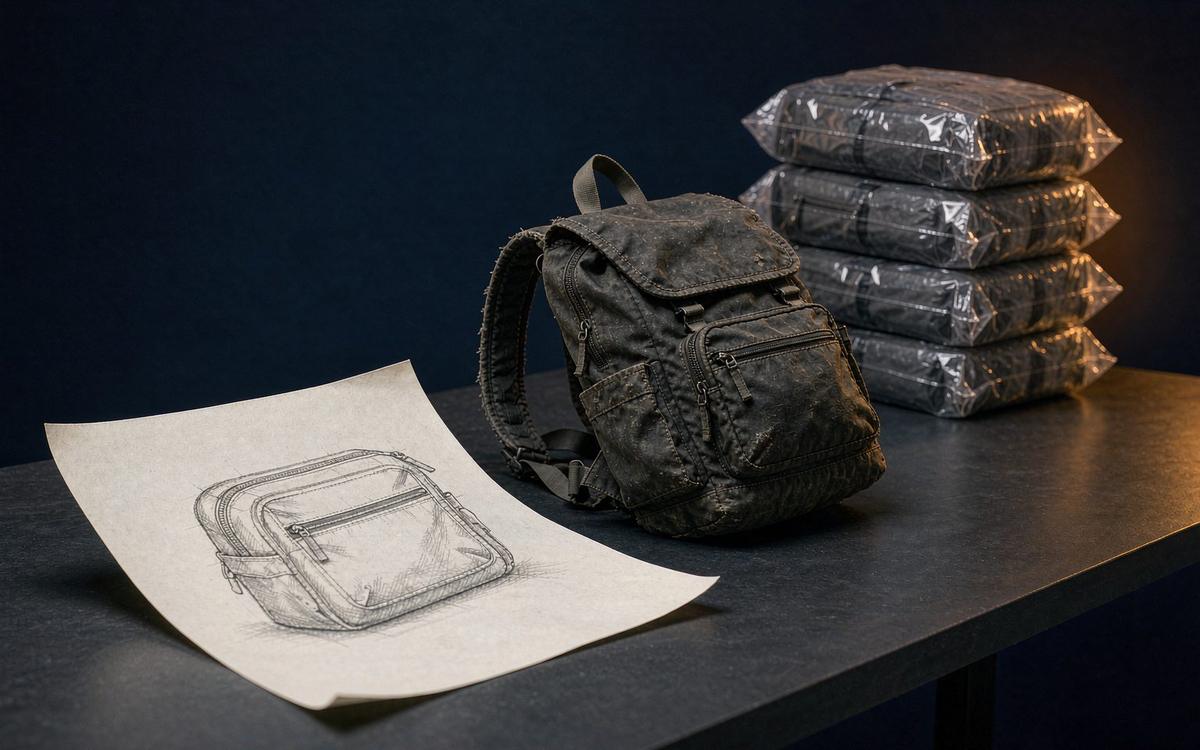
A ramp plan that is not booked is a wish. Production capacity in a real facility is a schedule, and a three-stage ramp is best treated as three bookings made at the same time, with quantities and windows agreed up front and confirmed as each stage is triggered.
The reason is simple. When a campaign closes and the creator decides to order the second run, they are not the only person asking that month. Other programmes are running, the schedule for the next two months is largely committed, and a request arriving unannounced either waits or displaces something. A standing booking with a trigger date avoids both, and it is the single highest-value thing a creator can ask for after the first order.
A workable booking arrangement has four parts. It names the quantity band for each stage rather than an exact number, because you will not know the exact number until nearer the time. It names the window, meaning the month or months in which each run will be scheduled. It names the trigger, meaning the event that confirms the stage, such as a re-order request received by a particular date. And it names the fallback, meaning what happens if the trigger does not fire, which is usually that the slot is released.
Booking also protects the sample position. Sampling takes 6 to 10 working days for a standard build and 12 to 15 working days for a complex one, and those days are spent by people as well as machines. If a stage two revision needs a sample round, that round has to be scheduled too. Creators who book the run but not the sample round often find the run waiting on an approval that nobody had planned for.
This is one place where the scale of the operation matters to a small brand. A programme running 7 lines and 149 machines can hold a slot for a 500-piece run without it being disruptive, because a 500-piece run occupies a fraction of the week. A single-line operation cannot, which is part of why small orders are often quoted with long or vague lead times elsewhere.
Cash Flow Through the Ramp
A ramp is as much a financing structure as a production one, and it is worth pricing the whole sequence before you commit to stage one rather than after. The payment structure we work to is T/T 30/70, meaning 30% deposit to start and 70% before shipment, and the shipment terms are FOB Xiamen.
Map that across three stages and the shape of the cash requirement appears. Stage one at 500 pcs requires the deposit when the run is booked and the balance before it ships. Stage two at 1,500 pcs requires roughly three times the deposit and three times the balance, but by then the campaign funds and the post-campaign sales from stage one are partly available to fund it. Stage three at 5,000 pcs is a genuinely different scale of commitment, and it is normally funded from the revenue of the first two stages plus whatever wholesale or retail channel has opened.
The useful discipline is to compare the ramp against the alternative for the same total volume. Suppose the product will need 7,000 units across its first year. Ordered as one 7,000-unit run, that is one large deposit, one long wait, one specification you cannot change, and 7,000 units of inventory arriving at once. Ordered as 500 plus 1,500 plus 5,000, it is three deposits spread across a year, three opportunities to correct the product, and inventory arriving in step with demand.
The ramp costs more per unit in total, and that is the honest trade. You are paying a premium for optionality and for lower risk. What the ramp usually saves you is the cost of the mistakes you did not make, which is invisible on a spreadsheet and very visible in a bank account when a single big order goes wrong.
One cash note that creators miss. The deposit is not the only early payment. Freight, duties and fulfilment are all payable around shipment, and for a campaign shipping to backers in several countries, the post-production costs can rival the production costs. Our How to Budget Bag Production for a Kickstarter Campaign guide puts the full landed cost together.
The Timeline a Three-Stage Ramp Actually Needs
The most common planning error in a ramp is assuming the three stages sit end to end with nothing between them. They do not, and the gaps are where the learning happens.
| Phase | Duration | What is happening |
|---|---|---|
| Stage 1 sampling and approval | 6-10 working days, or 12-15 for complex builds | Pre-production sample, revisions, approval |
| Stage 1 bulk | 35-50 days | Cutting, sewing, inspection to AQL 2.5, packing |
| Shipping and fulfilment | Varies by mode and destination | FOB Xiamen handover, freight, duties, delivery to backers |
| Learning window | 30-60 days after delivery | Returns, reviews, store sales data, colourway performance |
| Stage 2 sampling if the spec changed | 6-10 working days | Any revision from the learning window |
| Stage 2 bulk | 35-50 days | Production at 1,000 to 2,000 pcs |
| Stage 3 planning and booking | Overlaps stage 2 | Specification freeze, capacity booking, material commitment |
| Stage 3 bulk | 35-50 days at 5,000 pcs | Consolidated run with bespoke items |
Add that up and a full three-stage ramp is comfortably a year of calendar, even before you allow for the shipping modes and the customs clearances in each destination. That is not a reason to avoid it, it is a reason to plan the campaign delivery promise around it. A campaign that promises delivery six weeks after it closes has no room for a ramp, and it has no room for a rework either.
The intervals are ours and they are stated as ranges deliberately. Sampling is 6 to 10 working days because a simple tote and a structured travel bag are not the same job. Bulk is 35 to 50 days because material availability and the size of the run both move it. Anyone quoting you a single fixed number for either is quoting you a number they will miss.
The learning window is the phase most plans omit, and it is the one that makes the ramp work. Thirty days of real use by real backers tells you things that no sample period can, particularly about how a bag ages, how a coating wears and whether the dimensions were right. Skipping it to save a month means carrying an unexamined problem into a run ten times the size.
How to Know You Are Ready for the Next Stage
The trigger for moving up a stage should be a decision made against criteria, not a feeling that things are going well. Four tests cover most cases, and a brand that clears all four is ready.
- The current run is nearly allocated. When you can see the stage one units spoken for, whether by backers, store sales or a wholesale conversation, the next run is justified by demand rather than by optimism.
- The return rate is understood and acceptable. You know what the complaints were, you know which of them you have fixed, and the rate is low enough that repeating it at three times the volume is tolerable.
- You have a colourway and size ranking. Thirty days or more of sales data has told you which variants to promote and which to retire, so the next run is allocated from evidence.
- The cash for the deposit and the balance is identified. The 30% deposit and the 70% balance are funded from known money, not from sales that have not happened yet.
If a brand clears three of the four, the usual answer is to wait on the fourth rather than to press ahead. The most common failure is the third test, where a creator moves to a larger run before knowing which colours to make, and ends up with 1,000 units of the colour nobody wanted sitting beside 200 units of the one that sold out.
There is also a case for staying at a stage deliberately. Some products are best as a steady 500 or 1,000 pcs every quarter rather than a leap to 5,000, particularly premium items where scarcity supports the price, and seasonal items where demand is concentrated in a few months. A ramp is a structure, not an obligation to grow.
If you are planning the first two stages now, our Planning Bag Production Before Your Crowdfunding Launch page covers what to settle before the campaign goes live, and Small Batch Bag Manufacturing: What 500 Pcs Includes sets out exactly what the entry order contains.
Tell us your campaign size and we will map the three stages, with the sampling windows and the capacity slots held. Start the conversation at /contact-quote/.
Frequently Asked Questions
What is a three-stage bag production ramp?
It is a planned sequence of three orders. Stage one is 500 pcs to validate the construction and the demand, stage two is 1,000 to 2,000 pcs to absorb stretch goals and re-orders, and stage three consolidates at 5,000 pcs where bespoke tooling becomes economic and the unit cost falls.
Why not place one order for the whole first year?
One big order gives a better unit price but locks the specification, commits all the cash at once and discovers construction problems after 5,000 units are made. A ramp keeps the cash staged, keeps the product improvable, and matches inventory to demand you have actually seen.
Should stage one be 500 pcs even if I have 800 backers?
Usually yes. Order 500 as the validation run, ship to the earliest backers, and let the remaining 300 travel into the stage two order. You gain a decision point and a chance to fix problems before the larger run, at the cost of a second shipment schedule to manage.
How much does the unit cost fall between stages?
The largest single step is normally from 500 to 1,500 pcs, because the pattern and sampling costs were already paid and fabric is bought at a better price per metre. Labour improves only modestly, since the bag takes roughly the same minutes to sew at any volume.
When should I add a second colourway?
In stage two, when a 1,000 to 2,000-piece total lets each colour clear its own 500-pcs minimum. In stage one the specification should stay narrow so that any feedback you receive points at one variable rather than three.
When is custom moulded hardware worth it?
Usually at stage three. Moulded pullers and bespoke buckles carry a tooling cost and often a 1,000 to 3,000 pcs minimum per design, which is uneconomic at 500. Woven labels, printed patches and contrast thread give the same brand signal in the early stages.
How do I reserve capacity for stage two and three?
Book all three stages at the same time with a quantity band, a scheduling window, a trigger event and a fallback if the trigger does not fire. Production capacity is a schedule, and a request that arrives unannounced either waits or displaces other work.
How long does a full three-stage ramp take?
Comfortably a year. Each stage needs 6 to 10 working days of sampling, 35 to 50 days of bulk, a shipping leg, and a 30 to 60 day learning window before the next stage is specified. Planning the campaign delivery promise around that is essential.
What should I measure in the first 500-pcs run?
Return and complaint rate, which colourways actually sold, transit damage, which operations took longest on the line, and the final unit cost against the quote. Those five things tell you what to change in stage two.
What is a normal return rate for a first bag run?
A rate in the low single digits is normal for a first production run of a sewn product and is not cause for alarm. A rate into the high single digits or above usually points at one identifiable thing, such as a closure, an attachment, a dimension or a colour mismatch.
Can I stay at 500 pcs permanently?
Yes. Some products are best as a steady 500 or 1,000 pcs every quarter, particularly premium items where scarcity supports the price, and seasonal items with concentrated demand. A ramp is a structure, not an obligation to grow.
What are the payment terms across the stages?
T/T 30/70, meaning 30% deposit to start and 70% before shipment, on FOB Xiamen terms. Each stage carries its own deposit and balance, which is what spreads the cash requirement across the year.
People Also Ask
What is a pilot production run?
A small first order that validates a construction before it is repeated at scale. For bags that usually means 500 pcs.
How many units should a first bag order be?
500 pcs per style and per colourway. It is the minimum, and it is also the right size for a validation run.
When should I re-order bags?
When the first run is nearly allocated, the return rate is understood, and you have 30 days or more of sales data by colourway.
Does unit cost drop at 5,000 pcs?
Yes, but the saving comes mainly from materials and absorbed setup. Labour per bag falls only modestly.
Can I book production capacity in advance?
Yes, and you should. Book with a quantity band, a window, a trigger and a fallback if the trigger does not fire.
How long is bulk bag production?
35 to 50 days per run, on top of 6 to 10 working days of sampling, or 12 to 15 for complex builds.
Should my first run use custom hardware?
Usually not. Moulded hardware needs tooling and often a 1,000 to 3,000 pcs minimum, so it belongs at a later stage.
What is T/T 30/70?
30% deposit to start production and 70% before shipment. It is the payment structure used on each stage of a ramp.