Bag QC for Kickstarter Campaigns: AQL 2.5 Inspection Explained
AQL 2.5 is the worst defect rate a sampling plan will accept, not a promise that 97.5 percent of bags are perfect. Under ISO 2859-1 general level II, a lot of 500 pcs draws a sample of 50 and accepts 3 major defects, rejecting on 4. Critical defects run at AQL 0, major at 2.5 and minor at 4.0. Inspection covers appearance, construction, function, measurement and packing, but not durability or compliance. This page explains the sampling plan, the switching rules and how to write the specification into your order.
- What AQL actually means, and what it does not
- ISO 2859-1 and the anatomy of a sampling plan
- Lot size, code letter and sample size: the lookup
- Reading the accept and reject numbers
- Critical, major and minor: classifying bag defects
- Why AQL 2.5 is the campaign default
- Switching rules: normal, tightened and reduced
- Single, double and multiple sampling
- What an AQL 2.5 inspection does not cover
- How to read an inspection report
- Specifying AQL 2.5 in your order documents
What AQL actually means, and what it does not
AQL stands for acceptance quality limit. It is the worst defect rate a sampling plan will still accept, expressed as a percentage, and it is the number that governs whether a production lot is released. When a specification says inspection to AQL 2.5 to ISO 2859-1, it means a statistically sized sample is drawn from the lot, defects are counted and classified, and the lot passes if the count falls at or below the acceptance number for that sample size.
The first thing to understand is what AQL is not. It is not a guarantee that 97.5 percent of your bags are perfect. It is not a statement about the defect rate in the whole lot. It is a decision rule for accepting or rejecting a shipment, and it is deliberately designed with a built-in asymmetry: it protects the buyer against bad lots more strongly than it protects the producer against false rejection.
That asymmetry has a name worth knowing. The plan's operating characteristic curve shows the probability of acceptance at each true defect rate. At the AQL itself, a lot has a high but not certain chance of being accepted, typically around 89 to 98 percent depending on the plan. Far above the AQL, acceptance probability collapses. Far below it, the lot is almost always accepted.
So the honest reading of AQL 2.5 is this: a lot with a genuine defect rate of 2.5 percent has a good chance of passing, a lot at 8 percent will almost certainly fail, and a lot at 0.5 percent will virtually always pass. If you need a defect rate below 1 percent in the delivered goods, specifying AQL 2.5 is not sufficient on its own, and this is the single most common misunderstanding we encounter.
ISO 2859-1 and the anatomy of a sampling plan
ISO 2859-1 is the international standard for attribute sampling by lot. It is the same document as ANSI/ASQ Z1.4 and as the older MIL-STD-105E, so a report citing any of the three is describing the same arithmetic. The standard is built on attribute inspection, meaning each sampled unit is judged as conforming or non-conforming against a list of checks, rather than measured on a continuous scale.
A plan is defined by four inputs. The lot size decides the code letter. The inspection level decides which of the general levels applies, normally level II. The AQL decides which column of the accept and reject table is used. And the sampling scheme, single, double or multiple, decides how many draws are permitted before a decision is reached.
Everything else follows mechanically from those four. This is genuinely useful for a creator, because it means an inspection specification is not a matter of opinion. If you and your production partner agree on lot size, level II, AQL 2.5 and single sampling, you have agreed on the exact sample size and the exact accept and reject numbers, and there is nothing left to negotiate at the moment of inspection.
The standard also assumes random sampling. Units must be drawn from across the lot, not from the easiest carton to reach, and not from a pre-prepared display set. This sounds obvious and it is the most frequently violated requirement in practice. Ask explicitly for cartons to be selected at random across the stack, and ask the report to note how many cartons were opened.
Lot size, code letter and sample size: the lookup

The chain runs lot size to code letter to sample size. Under general inspection level II, a lot of 500 units takes code letter H and a sample of 50. A lot of 1,200 takes code letter J and a sample of 80. A lot of 3,200 takes code letter K and a sample of 125. The sample grows with the lot, but far more slowly, which is the entire economic point of sampling.
This is where the 500 pcs per style and per colourway minimum becomes relevant to quality. A first campaign order of 500 units is a lot of 500, giving code letter H and sample size 50. That is a small sample in absolute terms, and it is one reason why inspection alone is not a complete quality strategy at low volumes. At 500 units, the sampling plan can reliably detect a serious problem and cannot reliably certify a very good lot.
Note also that lot size means the quantity presented for inspection as one lot, not the total campaign order. If a run of 1,500 units is split into three colourways of 500 each, and each colourway is inspected separately, you have three lots of 500 and three samples of 50, for 150 units examined. If they are combined into one lot of 1,500, you have one sample of 80. Fewer units examined for the same total.
This is a real decision, not a technicality. Inspecting per colourway is more thorough and costs more inspector time. For a first campaign where the colourway differences are trim-only, combining is usually defensible. Where each colourway has a different fabric lot or a different hardware finish, inspect them separately, because the failure modes differ by lot.
Reading the accept and reject numbers
For every combination of sample size and AQL there is a pair of numbers: Ac for accept and Re for reject. Count the defects in the sample. If the count is at or below Ac, the lot passes. If it is at or above Re, the lot fails. There is no middle ground and no judgement call, which is precisely the value of using a published standard.
Under AQL 2.5 with single sampling and general level II, the pairs you will meet on bag campaigns are these. Sample 20 gives Ac 1, Re 2. Sample 32 gives Ac 2, Re 3. Sample 50 gives Ac 3, Re 4. Sample 80 gives Ac 5, Re 6. Sample 125 gives Ac 7, Re 8. Sample 200 gives Ac 10, Re 11.
| Lot size | Code letter | Sample size | Accept | Reject |
|---|---|---|---|---|
| 91 to 150 | F | 20 | 1 | 2 |
| 151 to 280 | G | 32 | 2 | 3 |
| 281 to 500 | H | 50 | 3 | 4 |
| 501 to 1200 | J | 80 | 5 | 6 |
| 1201 to 3200 | K | 125 | 7 | 8 |
| 3201 to 10000 | L | 200 | 10 | 11 |
| 10001 to 35000 | M | 315 | 14 | 15 |
Read the 500-unit row carefully, because it is the one most campaigns live in. Three defects allowed, four rejected. That means a run of 500 bags where the inspector finds four loose threads classified as major defects in a sample of 50 will fail, and the whole lot goes back for rework. It feels harsh on small numbers, and it is, which is why defect classification matters as much as the number.
There is one asymmetry in those tables that surprises people. The reject number is always exactly one above the accept number. There is no band. This is deliberate: the standard is designed so that every sample outcome produces a decision, and it removes the temptation to argue about borderline results at the bench.
Critical, major and minor: classifying bag defects
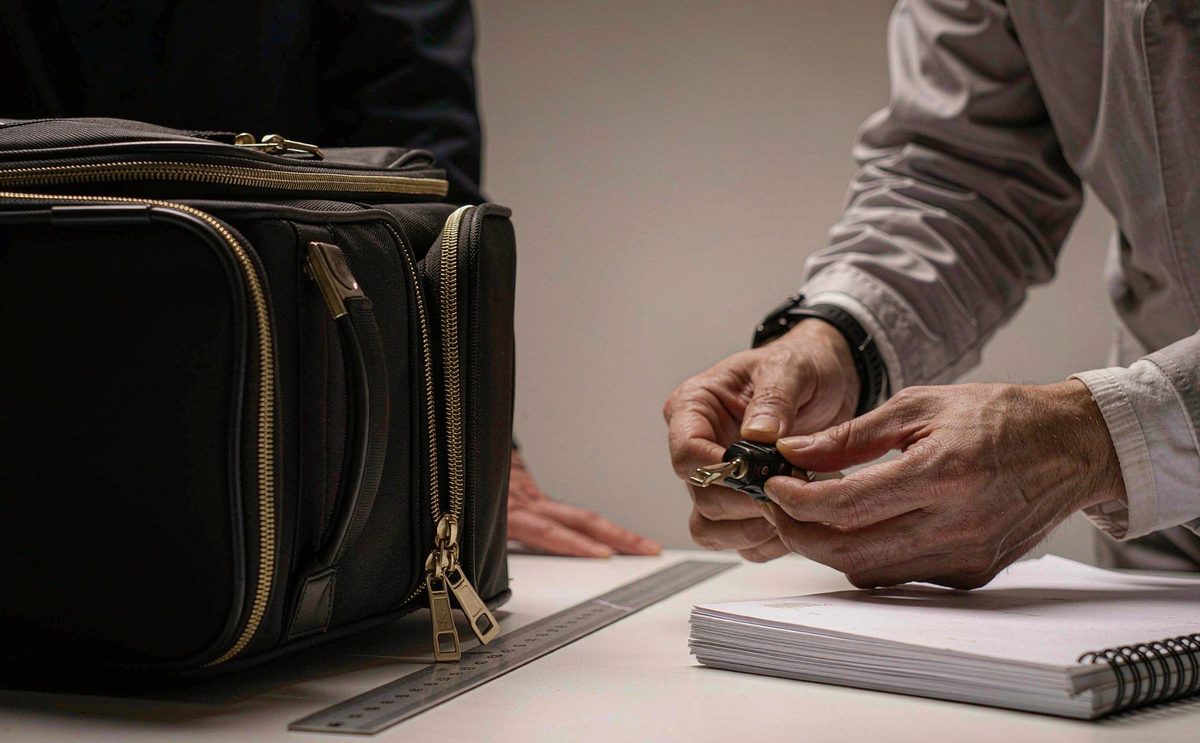
Defects are not counted as one undifferentiated pile. They are classified into three severities, and each severity carries its own AQL. The convention used across most bag programmes is critical at AQL 0, major at AQL 2.5, and minor at AQL 4.0. For brevity people say AQL 2.5, but a complete specification names all three.
A critical defect is one that makes the product unsafe or illegal: a needle fragment left in the lining, a sharp exposed metal edge, a broken buckle on a child's bag, a missing compliance label where one is required. Critical defects accept zero tolerance. One critical defect in the sample rejects the lot, regardless of the other counts.
A major defect is one a backer would notice and would consider a fault: a skipped stitch at a stress point, a strap attached off-centre by more than the agreed tolerance, a zip that separates, a visible colour mismatch between panels, a logo applied crooked. These are the defects that generate support tickets, and AQL 2.5 is set on this class.
A minor defect is one a careful observer would notice but most users would not: a thread tail under 3 mm in a non-structural position, slight waviness in topstitching, a small mark that wipes off, a measurement 2 mm outside nominal on a non-critical dimension. Minor defects run at AQL 4.0, and a lot can pass with them present.
Write the classification into the specification before inspection, with examples. This is not pedantry. Whether a 4 mm thread tail is major or minor can be the difference between a pass and a fail on a 500-unit lot, and deciding that question while the inspector is standing at the bench is the worst possible moment to decide it.
Why AQL 2.5 is the campaign default
AQL 2.5 is the conventional level for consumer soft goods, and it sits at a sensible point on the cost curve. Tighter levels such as 1.0 require larger samples and produce more rejections of acceptable lots, which costs schedule. Looser levels such as 4.0 pass too many lots with visible faults, and for a crowdfunding campaign the cost of a visible fault is not just a replacement but a public comment.
The calculation that makes 2.5 the right default for campaigns is the downstream cost of a defect. A bag that fails in a backer's hands costs 18 to 34 USD to replace, plus support time, plus a risk to campaign reputation. A bag caught at inspection costs a fraction of that, typically 0.40 to 1.80 USD per unit of rework. The ratio strongly favours catching defects at the gate.
There is one case where we recommend tightening below 2.5: when the reward is a premium tier above roughly 120 USD, where backer expectations are closer to retail luxury than to campaign merchandise. In that case specify major at AQL 1.5 and accept the larger sample and the higher rejection risk, because the reputational cost of a fault at that price point is disproportionate.
And one case where 2.5 is unnecessarily strict: low-cost giveaway items such as drawstring bags or sticker-adjacent perks, where a visible minor flaw generates no complaint. Specifying 2.5 across every item in a campaign wastes inspection budget that would be better spent on the hero product.
Switching rules: normal, tightened and reduced
ISO 2859-1 is not a single plan but a system of plans that move between three states based on recent history. You start at normal inspection. The rules then say when to tighten and when to relax, and they exist so that a producer with a good record is rewarded and a producer with a bad record is examined harder.
The tightened rule: if 2 out of 5 consecutive lots are rejected, move to tightened inspection. Tightened means a larger sample for the same lot size with the same accept number, which makes rejection more likely. Stay there until 5 consecutive lots are accepted, then return to normal. This is the mechanism that protects a campaign placing repeat orders.
The reduced rule: after 10 consecutive lots are accepted under normal inspection, and if production is at a steady rate and the authority responsible considers it desirable, you may move to reduced inspection, which uses a smaller sample. Reduced inspection is rarely worth it for a single campaign, because a campaign rarely places 10 consecutive lots with one partner.
For a first-time creator the practical takeaway is simple: you are at normal inspection, and each lot is judged on its own. Do not assume a good first run entitles you to lighter checks on the re-order, and equally do not panic if one lot fails. What matters is the pattern, and the switching rules exist to make the pattern formal rather than argumentative.
One practical implication deserves emphasis for creators placing a re-order. The switching rules are usually applied per product and per production line rather than per campaign. If you re-order the same bag eight months later, ask what the inspection history has been in between, because a line that has been running tightened inspection on someone else's product will start your lot under tighter rules than you might expect.
Single, double and multiple sampling
A single sampling plan draws one sample and decides. It is the simplest to understand, the easiest to administer and the right choice for almost every campaign. A double sampling plan draws a first smaller sample, and if the result is borderline draws a second before deciding. Multiple sampling extends that to up to seven draws.
Double and multiple sampling exist to reduce the average number of units inspected when lots are either very good or very bad. They achieve that, but at the cost of administrative complexity and of a decision process that is harder to explain to a creator who wants to know whether their lot passed. For campaign volumes the saving is small and the confusion is large.
Specify single sampling unless you have a specific reason not to. It gives a fixed inspector-day cost, which means inspection can be quoted in advance, and it produces a report that any stakeholder can read without a reference table. The economics that favour double sampling apply to continuous high-volume programmes, not to a 500-unit first run.
One related option is worth knowing: 100 percent inspection, sometimes proposed after a lot fails. It means every unit is checked. On a bag run it costs roughly 0.60 to 1.80 USD per unit in labour and it does find most defects, but it is tiring work with a high false-accept rate after the first few hundred units. It is a remedy of last resort, not a substitute for a working plan.
What an AQL 2.5 inspection does not cover
This is the part most specifications omit and the part that causes the most disappointment. An attribute inspection against AQL 2.5 checks appearance, construction, function, measurement and packing on a sample. It does not test durability, it does not verify chemical compliance, and it does not assess whether the design is any good.
Durability is a laboratory question. A strap pull test, a zip cycle test, a colour fastness rub test, a drop test on a packed carton: none of these are attribute counts and none belong in an AQL plan. If you need them, commission them separately and specify the method, such as 20,000 flex cycles on a handle or a stated number of zip open and close cycles.
Compliance is a documentation question. Restricted substance requirements, fibre content labelling, country of origin marking and any child-safety rules are verified through certificates and test reports, not through a sample count. Ask for the certificates with the quotation rather than after the goods are made, because a failed compliance test cannot be reworked.
And design quality is not a quality control question at all. A bag that is made exactly to specification and is still unpleasant to carry has no defect for an inspector to find. That is a sampling and prototyping problem, and it is why the approved reference sample matters more than any inspection number. Pair this gate with a proper pre-shipment check scope rather than treating one as a substitute for the other.
There is a fourth gap that catches campaigns out: statistical confidence at small sample sizes. With a sample of 50 and an accept number of 3, the plan is good at detecting a bad lot and weak at certifying a good one. If your campaign genuinely needs a defect rate below 1 percent, the answer is not a tighter AQL but a different approach, such as a defined process control at the operation that produces the defect.
How to read an inspection report
A usable inspection report has six sections, and if any are missing the report is not telling you enough to make a release decision. They are: the plan actually used, the sample drawn and from how many cartons, the defect list by classification, the result per severity, the photographs, and the conclusion stating pass, fail or pass with conditions.
Check the plan section first and confirm it matches what you specified: lot size, level II, AQL values for each severity, single sampling. Reports that omit this are often using a different plan from the one you asked for, and the difference can be substantial at small lot sizes.
Read the defect list rather than the conclusion. A lot that passes with three major defects is not the same as a lot that passes with zero, even though both are passes. If all three majors are the same fault in the same position, that is a systematic problem that will appear again in the re-order, and it is worth fixing regardless of the result.
Look at the photographs with the approved reference sample next to you. Photographs are the only part of the report that shows what the inspector actually saw, and they are where a discrepancy between your expectation and the inspector's classification becomes visible. Ask for at least eight: full front, full back, interior, base, harness detail, hardware close-up, branding close-up and packing.
Ask for the report to state the number of cartons opened as well as the number of units drawn. A sample of 50 drawn from two cartons is not the same evidence as a sample of 50 drawn from twelve, because defects cluster by carton, by production hour and by operator. This single line on a report tells you more about the quality of the inspection than any other figure on it.
Specifying AQL 2.5 in your order documents
The specification belongs in the purchase order and the request for quotation, not in an email the week before dispatch. One paragraph is enough, provided it names the six variables: standard, inspection level, sampling scheme, AQL per severity, what happens on failure, and who pays for re-inspection.
- Standard
- ISO 2859-1, equivalent to ANSI/ASQ Z1.4
- Inspection level
- General level II, single sampling
- Critical defects
- AQL 0, zero acceptance
- Major defects
- AQL 2.5, sample 50 at lot size 500, accept 3 reject 4
- Minor defects
- AQL 4.0
- On failure
- Rework and re-inspect; re-inspection cost as agreed in writing
- Trigger
- Before release of goods for shipment, FOB Xiamen
- Programme context
- Sampling 6 to 10 working days, bulk 35 to 50 days
Add two sentences that most specifications leave out and that prevent the two most common disputes. First, state that inspection takes place before goods are released for shipment, so a failed lot is found while it is still in the workshop rather than on a vessel. Second, state who bears the cost of re-inspection after a rework, typically split, because that clause changes behaviour on both sides.
Finally, treat the inspection as one gate in a wider programme rather than as the programme itself. It sits between an approved reference sample and a packing and dispatch plan, and its value depends on both neighbours being defined. An inspection against no approved sample is an inspection against opinion, and it sits inside the wider campaign bag QA and QC programme rather than standing alone.
Send us your order quantity and product description, and our campaign bag specialist will return the inspection plan with sample size, accept and reject numbers and the defect classification list.
Frequently Asked Questions
What does AQL 2.5 actually mean in plain terms?
It is the worst defect rate a sampling plan will still accept. Under ISO 2859-1 general level II, a lot of 500 units draws a sample of 50 and accepts up to 3 major defects, rejecting on 4. It is a decision rule for releasing a lot, not a guarantee that 97.5 percent of units are perfect. Ask the report to state how many cartons were opened, because defects cluster by carton, production hour and operator.
What sample size will my inspection use?
It depends on lot size under general level II. Lot 281 to 500 gives sample 50, lot 501 to 1200 gives 80, lot 1201 to 3200 gives 125, lot 3201 to 10000 gives 200. A first campaign order of 500 pcs, which is our per style and colourway minimum, therefore draws 50 units. Remember that lot size means the quantity presented as one lot, so three colourways inspected separately draw three separate samples.
What is the difference between critical, major and minor defects?
Critical defects make a product unsafe or illegal and accept zero tolerance, such as a needle fragment or a broken buckle. Major defects are what a backer would call a fault, such as a skipped stitch at a stress point, and run at AQL 2.5. Minor defects are cosmetic and run at AQL 4.0. Write the classification with worked examples into the specification before inspection rather than deciding it at the bench.
Why is critical set at AQL 0 rather than 2.5?
Because one critical defect in the sample rejects the lot regardless of other counts. Critical covers safety and legality, where a percentage tolerance has no meaning. A complete specification therefore names three AQL values, not one, even though people refer to it simply as AQL 2.5. One critical defect rejects the lot regardless of the other counts, which is why safety findings are never averaged with cosmetic ones.
Should I inspect each colourway separately?
Separately when colourways use different fabric lots or hardware finishes, because the failure modes differ. Combined when the difference is trim only. Note that three lots of 500 draw three samples of 50, or 150 units examined, against one sample of 80 for a combined lot of 1,500. Inspect separately where hardware finish or fabric lot differs, since the failure modes differ even when the style is identical.
Is AQL 2.5 strict enough for a premium reward tier?
Usually not. Above roughly 120 USD where expectations approach retail luxury, specify major at AQL 1.5 and accept the larger sample and higher rejection risk. Conversely, on low-cost giveaway perks, AQL 2.5 is stricter than needed and wastes inspection budget better spent on the hero product. On low-cost giveaway perks, AQL 2.5 is stricter than necessary and the inspection budget is better spent on the hero product.
Does an AQL inspection test durability?
No. Attribute inspection covers appearance, construction, function, measurement and packing on a sample. Durability needs laboratory methods commissioned separately, such as a stated number of zip cycles or a strap pull test. Chemical and labelling compliance is verified through certificates, not sample counts. Ask for certificates and test reports with the quotation rather than after production, because a failed compliance result cannot be reworked.
What are the switching rules and do they apply to me?
They move inspection between normal, tightened and reduced based on recent lot history: tighten after 2 of 5 consecutive lots are rejected, return to normal after 5 consecutive accepted. For a first campaign you are at normal inspection and each lot is judged on its own, so do not assume a good first run earns lighter checks later. On a re-order, ask what the inspection history has been, because rules are applied per product and line rather than per campaign.
What should I do if a lot fails inspection?
Rework and re-inspect. Specify in advance who pays for re-inspection, typically split, because that clause changes behaviour on both sides. Also read the defect list: if all major defects are the same fault in the same position, it is systematic and will recur on the re-order unless the process changes. Specify full re-inspection, partial re-inspection or 100 percent sorting on the single fault, and agree who pays before production.
Why does the reject number sit one above the accept number?
Because the standard is designed so every sample outcome produces a decision, with no borderline band to argue about. Sample 50 at AQL 2.5 accepts 3 and rejects 4, so a fourth major defect fails the lot. This removes judgement calls at the bench, which is the main value of using a published standard. The same structure applies at every sample size, from 20 units accepting 1 to 315 units accepting 14, with no borderline band.
How many photographs should an inspection report include?
At least eight: full front, full back, interior, base, harness detail, hardware close-up, branding close-up and packing. Photographs are the only part of a report showing what the inspector actually saw, and reviewing them next to the approved reference sample reveals classification disagreements quickly. Confirm the report also states the plan used, since reports omitting it often apply a different plan from the one specified.
When should inspection happen?
Before goods are released for shipment, so a failed lot is found in the workshop rather than on a vessel. Our programme runs sampling in 6 to 10 working days, bulk production in 35 to 50 days, and release on FOB Xiamen terms, so inspection sits between bulk completion and carton loading. Add incoming material checks before cutting, because a wrong zip tape found at goods-in is a phone call rather than a rejected lot.
People Also Ask
What is an acceptable AQL level for bags?
AQL 2.5 for major defects is the convention for consumer soft goods, with critical at 0 and minor at 4.0. Tighten to 1.5 on premium tiers above about 120 USD and relax on low-cost giveaway items.
How many units get inspected in a 500 piece order?
Fifty. A lot of 281 to 500 takes code letter H and sample size 50 under general level II, accepting 3 major defects and rejecting on 4.
What is the difference between AQL and ISO 2859-1?
AQL is the quality limit, expressed as a percentage. ISO 2859-1 is the standard that turns that limit into a sample size and an accept and reject number. The same arithmetic appears in ANSI/ASQ Z1.4 and the older MIL-STD-105E.
Can an AQL inspection guarantee zero defects?
No. It is a statistical decision rule for accepting or rejecting a lot. A lot with a true defect rate of 2.5 percent has a good chance of passing, so if you need under 1 percent delivered, AQL 2.5 alone is not sufficient.
What is a critical defect on a bag?
One that makes the product unsafe or illegal: a needle fragment left in lining, a sharp exposed metal edge, a broken buckle on a child's bag, or a missing required compliance label. Critical defects carry zero tolerance.
Does inspection cover zip and strap strength?
Not within an attribute plan. Functional checks confirm a zip runs and a strap is attached; durability requires laboratory tests with a stated method and cycle count, commissioned separately.
Should I use single or double sampling?
Single. It gives a fixed cost, a report anyone can read and a decision in one draw. Double and multiple sampling reduce average inspection volume on continuous programmes, which is not the situation for a 500-unit first run.
What happens after a failed lot is reworked?
It is re-inspected. Agree in writing before production who bears the re-inspection cost, and treat repeated identical defects as a process problem rather than a one-off, because they will recur on the re-order.