Custom Makeup Train Cases: Premium Perks With Higher Margins
A structured makeup train case is the highest-margin bag perk available to a beauty campaign, and the highest-risk one. At 500 pcs per style and colourway it typically costs USD 9.80 to 22.00 per unit FOB Xiamen, supports a reward tier of USD 129 to 199, and carries contribution of USD 60 to 95 after fees and freight. It also needs 12 to 15 working days of sampling, a rigid-structure QC regime and serious carton engineering. This guide covers structures, interiors, hardware, cost, volumetric freight and the campaigns that should skip it.
- What qualifies as a train case and why it is a different category
- Where the margin actually comes from on a premium case
- Structure: boards, moulded trays and frame options
- Exteriors: PU leather, EVA shell, aluminium frame and fabric over board
- Interiors: dividers, trays, mirrors and wipe-clean floors
- Hardware: handles, locks, feet and corner protection
- Cost build-up at 500, 1,000 and 2,000 pcs
- Freight and carton reality: volumetric weight on a rigid case
- QC and transit damage on rigid goods
- Sampling a structured case: 12 to 15 working days, two rounds
- Tier design: who should order a train case and who should not
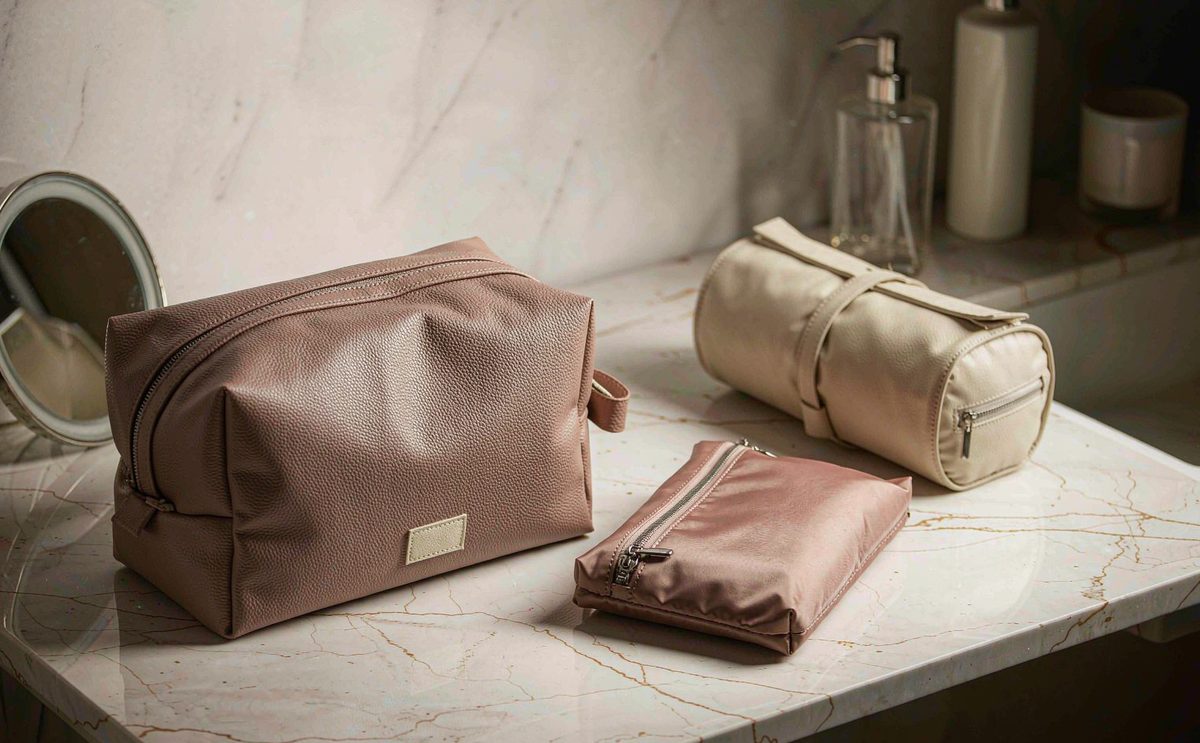
Every beauty campaign eventually has the same conversation. The pouch tier is working, the mid tier is healthy, and somebody asks whether a big case would unlock the backers who want the whole kit. It usually would. A structured train case is the one bag format that reliably supports a three-figure reward tier with a healthy contribution, because backers compare it against professional cases retailing at USD 150 to 400 rather than against a pouch at USD 20. It is also the format that most often goes wrong, for reasons that have nothing to do with sewing.
What qualifies as a train case and why it is a different category
A train case is a rigid or semi-rigid case with a structured shell, a top handle, a closure that locks or latches, and an interior that holds product in dividers or trays. That definition separates it from a cosmetic pouch on four axes at once: the bill of materials includes boards or moulded shells rather than just fabric, the assembly sequence includes gluing and riveting rather than only stitching, the inspection regime has to cover structure and hardware rather than seams alone, and the packed volume is fixed rather than compressible.
Those four differences compound. A pouch can be squeezed into a carton and it recovers. A case cannot, so freight is charged on air. A pouch with a weak seam is a minor defect. A case with a delaminated panel is a return. A pouch can be sampled in 6 to 10 working days because it is a cutting and sewing problem. A case needs 12 to 15 working days because the shell, the interior fit-out and the hardware setting all have to be resolved and then assembled in the right order.
The category also carries a different expectation from backers. Someone paying USD 149 for a case expects it to survive being stood on, to open smoothly after a year, and to look good on a shelf. Those expectations are reasonable and they are achievable, but they require specification decisions that a pouch never forces you to make: board thickness, corner reinforcement, hinge cycle life and drop performance. Skipping them is how a premium perk becomes the campaign's worst review cluster.
Where the margin actually comes from on a premium case
The margin story is simple and it is worth stating in numbers. A case landing at roughly USD 14.50 per unit, plus USD 30 of bundled product and USD 9 of fulfilment, sits comfortably behind a USD 149 reward tier. Platform and payment fees take roughly 8 to 10 percent, or about USD 15, leaving contribution in the USD 80 to 90 band. Compare that with a pouch tier where contribution is typically USD 20 to 30, and the argument for offering one premium case tier becomes obvious even if only 6 to 10 percent of backers take it.
The second margin source is the halo effect. A premium case at the top of the ladder makes the mid tier look reasonably priced, and campaigns that add one consistently see a shift in the pledge distribution upward rather than a simple additive sale. On a campaign we supported, introducing a case tier at USD 169 moved roughly 9 percent of backers off lower tiers and added about USD 11 to the average pledge across the whole campaign, which is a larger effect than the case tier's own revenue.
The third source is post-campaign. A train case is the format most likely to sell at full retail price after fulfilment, because it is the one item in a beauty reward set that a customer would buy on its own. Holding 8 to 12 percent of the run as website inventory is genuinely viable here in a way that it is not for a branded pouch. That inventory is sold at retail rather than at reward pricing, which means the effective margin on those units is two to three times the campaign contribution.
A train case tier is not mainly a revenue line. It is a pricing anchor that lifts the whole ladder, and it is the one perk with a real afterlife as retail stock.
Structure: boards, moulded trays and frame options
Structure is the first decision and it sets the cost floor. There are four workable routes at campaign volumes. Fabric over board is the cheapest: a 1.5 to 2.5 mm greyboard or PP board wrapped in the face fabric, giving a firm but not rigid case at roughly USD 1.20 to 2.80 of structural cost per unit. EVA shell is a moulded or vacuum-formed ethylene vinyl acetate body, semi-rigid and impact tolerant, at roughly USD 3.50 to 7.00. ABS or PP moulded shell is fully rigid and durable but needs tooling, typically USD 2,500 to 8,000, which only makes sense above about 2,000 units or when the case is the hero product.
The fourth route, an aluminium frame case, is the classic professional makeup case: extruded aluminium edging, metal corner pieces, a reinforced panel core and a lock. It looks and performs like the professional standard, and it costs roughly USD 9 to 16 in structural materials alone at 500 pcs. It is the right choice for a pro-artist positioning and the wrong choice for a lifestyle beauty campaign, where the weight and the industrial look work against the brand.
| Structure | Structural cost | Rigidity | Tooling | Sampling days | Best for |
|---|---|---|---|---|---|
| Fabric over board | USD 1.20-2.80 | Firm | None | 10-12 | Lifestyle beauty, light kits |
| EVA semi-rigid shell | USD 3.50-7.00 | Semi-rigid | Vacuum form USD 400-1,200 | 12-15 | Travel kits, mid-premium tiers |
| ABS or PP moulded | USD 5.00-9.00 | Rigid | USD 2,500-8,000 | 15-20 | Hero product above 2,000 pcs |
| Aluminium frame | USD 9.00-16.00 | Rigid | Extrusion dies USD 800-2,500 | 15-20 | Professional artist positioning |
Whichever route is chosen, the corners decide the product's life. A rigid case dropped on a corner concentrates the entire impact into a few square millimetres, and an unprotected corner will crush, split or delaminate in a single incident. Specify corner protection on every rigid case: metal corners on an aluminium frame, moulded corner caps on an EVA shell, or at minimum a double-wrapped and riveted corner on a board case. The cost is USD 0.40 to 1.60 per unit and it is the cheapest insurance available in this category.
Exteriors: PU leather, EVA shell, aluminium frame and fabric over board
Exterior material carries the visual positioning and it is where most of the perceived value is created. PU leather is the default premium face: available in hundreds of stocked colours, embossable with a grain pattern, easy to wipe clean, and typically USD 2.20 to 4.50 per unit of material on a mid-sized case. It accepts foil stamping beautifully, which is why it pairs so well with a gold or rose logo. Its weakness is that cheap grades crack at fold points after 12 to 18 months, so specify a grade with a stated hydrolysis resistance rather than the cheapest option on the card.
Woven polyester or nylon over board is the practical choice when the brand identity is sporty, travel-oriented or understated. It costs less than PU, roughly USD 1.60 to 3.00 per unit of material, it resists scuffing better, and it takes embroidery cleanly. EVA with a printed or textured surface is the modern option: the shell itself is the exterior, so there is no fabric to scuff, and it gives a distinctive moulded look that reads as designed rather than assembled. Its limitation is colour range, because the shell is usually produced from stocked tool colours.
One specification that separates a premium case from an average one is edge finishing. Raw cut edges on PU are acceptable; bound or painted edges look intentional. Ask for edge paint or binding on all visible edges of a board case, because an unfinished edge is the detail a backer notices when they are deciding whether USD 149 was worth it. The cost is roughly USD 0.50 to 1.20 per unit and it is visible in every product photograph, which makes it one of the highest-return line items in the whole bill of materials.
Interiors: dividers, trays, mirrors and wipe-clean floors
The interior is where a train case earns its price, and it is also where cost creeps unnoticed. A divided interior is built either from fixed stitched dividers in the lining fabric, or from removable padded dividers on hook-and-loop backing. Fixed dividers are cheaper, roughly USD 1.20 to 2.50, and hold their shape. Removable dividers cost roughly USD 3.00 to 6.00 but let the backer configure the case, which is a genuine feature worth describing on the campaign page and worth the money on a pro-tier product.
A moulded or fitted tray is the other interior option, and it is the one that reads most clearly as premium. A vacuum-formed tray with shaped recesses for palettes and bottles costs roughly USD 0.80 to 2.00 in unit terms plus a forming tool of about USD 400 to 1,200, and it makes the unboxing look deliberate. The risk is that it only fits what it was designed for. If the campaign ships a fixed product set, a tray is excellent. If backers will fill the case themselves, dividers are safer.
Two interior items deserve specific attention. A mirror adds roughly USD 1.20 to 3.50 depending on size and whether it is glass or acrylic, and acrylic should be specified for any case that will be shipped internationally, because glass mirrors break in transit and generate exactly the kind of review a premium tier cannot afford. A wipe-clean floor and walls is non-negotiable: makeup spills, and a case with an absorbent lining is ruined by the first foundation bottle that leaks. Specify coated polyester or TPU on every interior surface.
Hardware: handles, locks, feet and corner protection
Hardware is a small share of the bill of materials and a disproportionate share of failures. A top handle on a loaded case carrying 3 to 6 kg of product is under real tension, and a handle stitched directly to a fabric face without reinforcement will tear out. Specify a handle with an internal webbing core anchored to the structural board rather than to the fabric, and ask for a load test. Our production team tests handles at 1.5 times the expected loaded weight for 60 seconds as a standard pre-production check.
Locks come in three families. A turn-key cam lock costs roughly USD 1.20 to 2.60 and gives the professional feel, but it needs key management, and losing a key is a support ticket. A combination lock costs roughly USD 2.50 to 5.00 and removes the key problem entirely, which is usually the better campaign choice. A snap latch costs USD 0.60 to 1.40 and is adequate for a lifestyle case. Whichever is specified, insist on a cycle test: 200 open-close cycles on the sample will reveal whether the latch alignment drifts.
Feet are the most overlooked hardware item on a case and they matter more than they cost. Four or five metal or moulded feet at roughly USD 0.30 to 0.90 per set keep the case off damp surfaces, protect the base from scuffing, and stop the case from sliding on a table when it is opened. A case without feet picks up every mark it sits on, and the base is the second most photographed surface after the lid. Add feet, and add corner protection as described earlier, on every rigid design.
Cost build-up at 500, 1,000 and 2,000 pcs
A structured case has a very different cost shape from a pouch. Materials dominate rather than labour, and the material cost does not fall as steeply with volume, because boards, shells and hardware are bought in fixed increments. That means the saving from 500 to 2,000 pcs on a case is usually 10 to 18 percent rather than the 20 to 30 percent a creator might expect from simpler categories. Plan the tier price on the 500-pcs number and treat any volume improvement as upside rather than as a pricing assumption.
| Cost element | 500 pcs | 1,000 pcs | 2,000 pcs |
|---|---|---|---|
| EVA shell and exterior | USD 5.40 | USD 5.05 | USD 4.80 |
| Interior lining and dividers | USD 2.60 | USD 2.40 | USD 2.25 |
| Hardware (handle, lock, feet) | USD 3.20 | USD 2.95 | USD 2.75 |
| Assembly labour | USD 2.90 | USD 2.70 | USD 2.55 |
| Branding, QC, packing | USD 1.30 | USD 1.05 | USD 0.90 |
| Indicative FOB unit | USD 15.40 | USD 14.15 | USD 13.25 |
Add landed cost before judging that number. Freight on a rigid case is charged on volume rather than weight, and a case of this size runs roughly USD 3.50 to 6.50 per unit by sea at 500 pcs and USD 9 to 16 by air. Duty on cases varies by market and classification, commonly 3 to 12 percent of declared value. Fulfilment on a bulky item runs USD 6 to 10 per unit. A USD 15.40 FOB case therefore lands at roughly USD 26 to 33 all-in, which is the number the tier price has to clear with margin on top.
Cash flow deserves a specific warning here. On T/T 30/70 terms, a 500-unit case order at USD 15.40 is USD 2,310 on deposit and USD 5,390 at balance, and that balance is due before shipment while the campaign may still be collecting pledge payments. Add a tooling charge of USD 400 to 1,200 for a forming tool if a tray is specified. Creators running a case tier should either fund it from a healthy cash position or price the tier to collect early, because a case tier is the one perk where the payment schedule can bite.
Freight and carton reality: volumetric weight on a rigid case
Volumetric weight is the hidden tax on rigid goods. Carriers charge on the greater of actual weight and dimensional weight, calculated as length times width times height divided by a divisor, commonly 5,000 or 6,000 for air freight. A case measuring 28 x 20 x 18 cm has a dimensional weight of about 2.0 kg at a 5,000 divisor against an actual weight of perhaps 1.3 kg, so the shipper pays for 2.0 kg. On 500 units that difference is 350 kg of chargeable weight, and it is the reason a case can cost more to move than a heavier, softer bag.
Carton design is where that is managed. Three levers exist. First, nest: if the case has a removable lid or a tray, ship them nested rather than assembled, which can cut packed volume by 20 to 35 percent. Second, carton fit: an export carton sized to hold the case with less than 15 mm of slack saves volume across every unit, and a custom carton costs little at these quantities. Third, export carton strength: a double-wall carton with a burst strength appropriate to the stack height prevents the crushing that generates transit claims.
Sea freight is the sensible default for cases, because the volume is fixed and the schedule is predictable. Plan on 25 to 40 days of ocean transit plus port and onward handling, against 5 to 10 days for air at three to five times the cost. If the fulfilment date is tight, split the shipment: send 10 to 15 percent of the run by air to start the first fulfilment wave, and the remainder by sea. Our programme coordinator routinely builds split shipments for case runs, and the crowdfunding bag sourcing guide sets out how to plan the calendar around them.
QC and transit damage on rigid goods
Inspection on a case has to be extended beyond the general AQL 2.5 to ISO 2859-1 list, because most of the defects that matter are structural rather than cosmetic. Six checks should be added in writing: panel delamination, corner integrity, hinge and latch alignment over 20 cycles, handle load, interior divider attachment, and closure security when the case is inverted and shaken. Each takes under a minute per unit and each catches a failure mode that general inspection would pass.
Transit damage is the larger risk and it is managed at the carton level. A rigid case survives a drop better than a soft bag but transmits the shock to its own corners, and corner crush is the most common arrival defect. The controls are a corner protection test, a carton drop test from 80 cm on each face and one corner before the carton specification is frozen, and internal protection such as moulded end caps or corrugated dividers between units. Budget roughly USD 0.60 to 1.50 per unit for internal protection on a case of this value.
Then plan the damage allowance honestly. On a soft pouch, 4 to 6 percent covers defects and transit attrition. On a rigid case shipped internationally, 6 to 9 percent is the realistic band, because a damaged case cannot be repaired and has to be replaced in full. That allowance on a 500-unit run is 30 to 45 units, and at a landed cost of USD 30 each it is USD 900 to 1,350 of exposure. Hold the allowance in the order quantity rather than hoping the freight goes better than expected.
Sampling a structured case: 12 to 15 working days, two rounds
Sampling a case is slower and should be planned as two rounds rather than one. The first round resolves the shell, the exterior, the interior layout and the hardware selection, and takes 12 to 15 working days. The second round resolves what the first one cannot: how the case behaves when loaded, whether the lid aligns under load, whether dividers hold product in place when the case is carried, and whether the branding reads at the intended distance. Budget 6 to 8 further working days for that round.
The most valuable thing a creator can do with a case sample is abuse it. Load it with the actual product set, carry it by the handle for ten minutes, drop it once from knee height onto a hard floor, invert it and shake it, and leave it closed in a warm room for 48 hours. Every one of those tests replicates something a backer will do within the first month, and every one of them is cheaper to fix at sample stage than at 500 units. Our team runs a version of this script and photographs the results.
Sample cost on a case is higher than on a pouch, typically USD 120 to 320 per round plus courier, because the shell and hardware have to be produced. It is still a small fraction of the bulk commitment, which on a case run is USD 7,700 or more at 500 pcs. Approve the sample in writing with the dimensions, materials and hardware recorded, because that record is the reference against which the bulk lot is inspected, and without it there is nothing to hold the production run to.
Tier design: who should order a train case and who should not
A train case tier is right for a campaign with a defined product set, an audience of enthusiasts or professionals, a reward ladder that already runs above USD 100, and the cash to fund a USD 8,000 to 12,000 purchase before pledges clear. It is right for campaigns that intend to keep selling after fulfilment, because a case is the one perk with genuine retail life. It is also right when the hero product is itself bulky, since the case solves the storage problem the product creates.
It is wrong for a first campaign with no fulfilment experience, for a campaign whose audience is price-sensitive, for a ladder topping out below USD 90, and for any campaign that cannot fund the balance payment before shipment. It is also wrong when the launch date is inside 12 weeks, because sampling at 12 to 15 working days plus bulk at 35 to 50 days plus sea transit of 25 to 40 days simply does not fit, and air freight on 500 rigid cases is expensive enough to erase the margin that justified the tier.
For campaigns in the second group, the better move is a two-step ladder: launch with a pouch or a brush roll, then offer the case as a post-campaign add-on or as the hero product of the second campaign, by which point the audience and the cash position both exist. Several of the 20+ crowdfunding campaigns our team has supported have taken exactly that route, and none of them regretted sequencing it that way. A case is a reward you grow into rather than one you start with.
Send us a brief with your case dimensions, structure direction and quantity, and our campaign bag specialist will return a costed train case quotation with a sampling plan and carton proposal.
Key takeaways
- A
- t
- r
- a
- i
- n
- c
- a
- s
- e
- a
- n
- c
- h
- o
- r
- s
- t
- h
- e
- l
- a
- d
- d
- e
- r
- a
- n
- d
- o
- u
- t
- l
- i
- v
- e
- s
- t
- h
- e
- c
- a
- m
- p
- a
- i
- g
- n
- ,
- b
- u
- t
- o
- n
- l
- y
- i
- f
- c
- o
- r
- n
- e
- r
- s
- ,
- h
- a
- n
- d
- l
- e
- s
- a
- n
- d
- c
- a
- r
- t
- o
- n
- s
- a
- r
- e
- e
- n
- g
- i
- n
- e
- e
- r
- e
- d
- f
- o
- r
- i
- t
- a
- n
- d
- t
- h
- e
- c
- a
- l
- e
- n
- d
- a
- r
- a
- l
- l
- o
- w
- s
- 1
- 2
- w
- e
- e
- k
- s
- o
- r
- m
- o
- r
- e
- .
Frequently Asked Questions
What is the minimum order for a custom makeup train case?
500 pcs per style and per colourway, the same as other categories. The difference is what sits behind that number: a case run at 500 pcs represents roughly USD 7,700 to 11,000 of commitment at USD 15.40 to 22.00 per unit, plus any tooling. If a moulded tray or a bespoke shell is specified, tooling of USD 400 to 8,000 applies depending on route, and it only amortises sensibly at higher volumes.
How much does a custom train case cost per unit?
Expect USD 9.80 to 22.00 FOB Xiamen at 500 pcs. A fabric-over-board case with simple dividers sits near the bottom, an EVA shell with dividers, a top handle and a combination lock sits around USD 14 to 16, and an aluminium frame professional case sits at the top. Landed cost adds roughly USD 10 to 17 per unit for freight, duty and fulfilment, so a USD 15.40 case is around USD 26 to 33 all-in.
How long does it take to sample and produce a train case?
Sampling runs 12 to 15 working days for a structured case, versus 6 to 10 for a pouch, because the shell, interior and hardware have to be resolved and assembled in sequence. A second round to test loaded behaviour adds 6 to 8 working days. Bulk production runs 35 to 50 days after deposit and approved sample. With sea transit of 25 to 40 days, plan 14 to 18 weeks from brief to warehouse.
Which structure should a first-time campaign choose?
Fabric over board or an EVA semi-rigid shell. Fabric over board costs USD 1.20 to 2.80 in structural materials, needs no tooling and samples in 10 to 12 days. EVA gives better impact resistance at USD 3.50 to 7.00 plus a forming tool of USD 400 to 1,200. Avoid fully moulded ABS or aluminium frame cases for a first campaign, because the tooling and the lead time both work against an untested ladder.
Should the interior use fixed or removable dividers?
Fixed dividers cost roughly USD 1.20 to 2.50, hold their shape and suit a defined product set. Removable padded dividers on hook-and-loop backing cost USD 3.00 to 6.00 and let the backer reconfigure, which is worth it on a professional tier. A moulded tray costs USD 0.80 to 2.00 plus tooling and looks the most premium, but it only fits what it was designed for, so use it only when the shipped set is fixed.
How much does freight cost on a rigid makeup case?
Freight is charged on volumetric weight, which for a 28 x 20 x 18 cm case is about 2.0 kg against an actual weight near 1.3 kg. By sea, budget USD 3.50 to 6.50 per unit at these volumes with 25 to 40 days of transit. By air, budget USD 9 to 16 per unit with 5 to 10 days of transit. Nesting lids or trays and tightening the carton fit typically removes 20 to 35 percent of packed volume.
What damage allowance should a case campaign hold?
Six to nine percent, against 4 to 6 percent for a soft pouch. A damaged rigid case cannot be repaired and has to be replaced in full, and corner crush is the most common arrival defect. On a 500-unit run that is 30 to 45 units, or roughly USD 900 to 1,350 of exposure at a landed cost of USD 30. Hold it in the order quantity rather than hoping freight goes better than planned.
What hardware failures are most common on train cases?
Handle tear-out, latch misalignment and lock failure. A handle stitched to fabric rather than anchored to the structural board will tear under a loaded case of 3 to 6 kg. Latches drift out of alignment after repeated cycling, which is why a 200-cycle open-close test on the sample matters. Specify a webbing-cored handle anchored to the board, and test every closure over at least 20 cycles during inspection.
Can a case be shipped with the lid nested to save volume?
Yes, when the design allows it. Shipping lids or trays nested rather than assembled typically cuts packed volume by 20 to 35 percent, which on volumetric freight is a direct saving. The trade-off is assembly at the fulfilment warehouse, which costs labour. On a 500-unit run the freight saving usually exceeds the assembly cost several times over, so ask for the option to be quoted both ways.
Is a glass or acrylic mirror better for a campaign case?
Acrylic, for any case shipped internationally. Glass gives a marginally better reflection but breaks in transit, and a shattered mirror inside a premium case is a return plus a poor review. Acrylic mirrors cost roughly USD 1.20 to 3.50 depending on size versus a similar band for glass, survive drops, and are lighter. If glass is essential for positioning, it must be shipped in a protective sleeve with a warning label on the carton.
What QC checks should be added for a structured case?
Six beyond the standard AQL 2.5 list: panel delamination, corner integrity, hinge and latch alignment over 20 cycles, handle load at 1.5 times expected weight for 60 seconds, divider attachment, and closure security when inverted and shaken. Treat structural and hardware failures as critical defects. Add a carton drop test from 80 cm on each face and one corner before the carton specification is frozen.
When should a campaign avoid a train case tier entirely?
Avoid it on a first campaign with no fulfilment experience, when the ladder tops out below USD 90, when the audience is price-sensitive, when the balance payment cannot be funded before shipment, or when launch is inside 12 weeks. Sampling at 12 to 15 working days, bulk at 35 to 50 days and sea transit of 25 to 40 days do not fit a short calendar, and air freighting 500 rigid cases erases the margin the tier was created for.
People Also Ask
What is a makeup train case?
A rigid or semi-rigid case with a structured shell, top handle, locking closure and an interior of dividers or trays. It is the bag format that supports a three-figure reward tier because backers compare it against professional cases retailing at USD 150 to 400.
Why does a train case have higher margins?
Perceived value scales faster than cost. A case landing at USD 26 to 33 supports a USD 149 tier and leaves USD 80 to 90 of contribution after fees, versus USD 20 to 30 on a pouch tier. It also lifts lower tiers by anchoring the ladder and sells at retail after fulfilment.
What is the MOQ for a custom train case?
500 pcs per style and per colourway. Structure tooling may apply on top: USD 400 to 1,200 for a vacuum form tray, USD 2,500 to 8,000 for a moulded shell, USD 800 to 2,500 for aluminium extrusion dies.
How long does a train case take to produce?
Twelve to 15 working days for sampling, 35 to 50 days for bulk after deposit and approved sample, and 25 to 40 days for sea transit. Plan 14 to 18 weeks from brief to warehouse, and use a split air and sea shipment if the date is tight.
Are rigid cases expensive to ship?
Yes, because freight is charged on volumetric weight. A 28 x 20 x 18 cm case bills at about 2.0 kg against an actual weight near 1.3 kg. Sea freight runs USD 3.50 to 6.50 per unit; air runs USD 9 to 16. Nesting and tight carton fit cut volume 20 to 35 percent.
Can I get a train case sample before launching?
Yes, and you should test it hard. Sampling takes 12 to 15 working days at USD 120 to 320 per round. Load it with the real product set, carry it, drop it from knee height, invert it and leave it closed in warmth for 48 hours.
Should a case use fixed dividers or a moulded tray?
A moulded tray looks most premium and suits a fixed shipped product set. Fixed dividers are cheaper and hold shape. Removable padded dividers cost the most but let backers configure the case, which is the better answer when they fill it themselves.