Custom Toiletry Bags: Travel Kits That Sell at Any Tier
A toiletry kit is the most tier-flexible reward in the travel category, because the same component platform scales from a USD 29 dopp kit to a USD 149 hanging organiser. The design decisions that make that possible are the liquids-rule compartment, the hang hook, and the wet-dry split. This guide sets out how to build a three-tier ladder from one specification, how the bundle economics work across formats, how the 500 pcs per colourway minimum applies across a range, and what to test on a sample before you commit.
- Why toiletry kits sell across every tier
- The liquids rule and what it means for compartment design
- A three-tier ladder from one component platform
- The hang hook that defines the category
- Waterproof zones and the wet-dry split
- Material and coating choices for a travel kit
- Sizing against airline and pack constraints
- Bundling: what to add and what to leave out
- MOQ maths across a multi-format range
- The loaded test protocol at sampling
- QC and defect classes
- Compliance and labelling for travel products
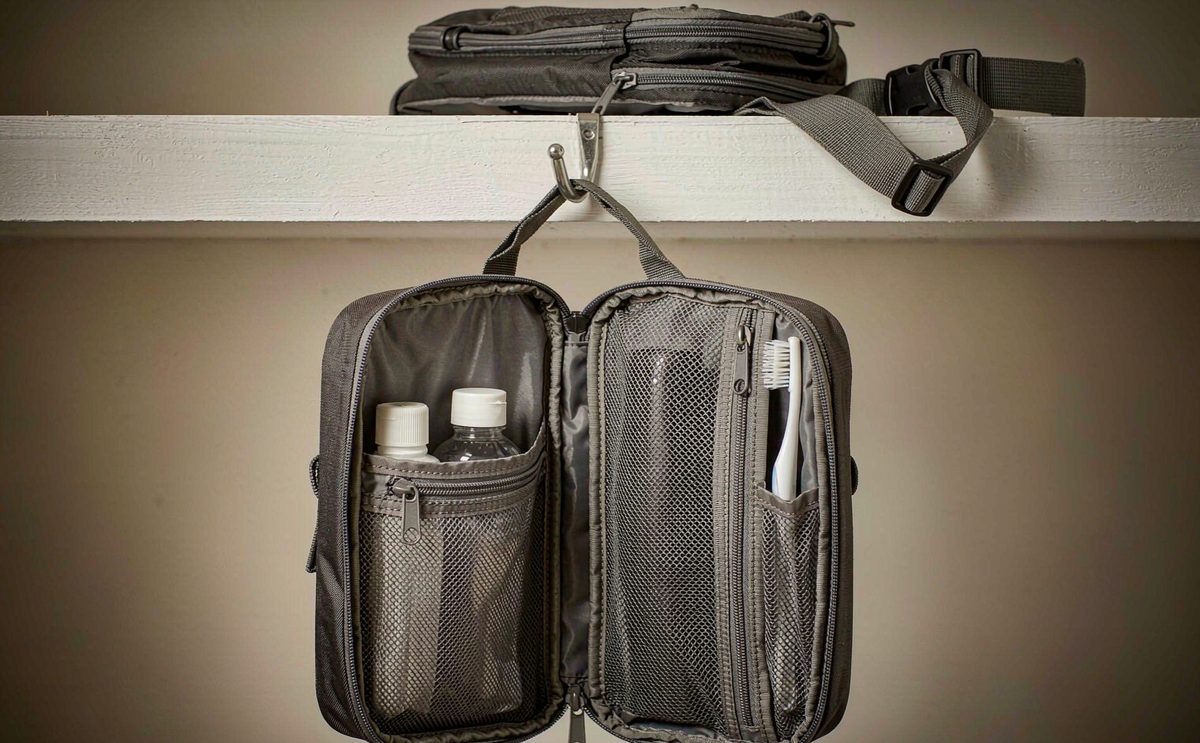
Few rewards work at as many price points as a toiletry kit. A backpack has a floor below which quality becomes visible and a ceiling above which it competes with established brands. A toiletry kit has neither: a flat pouch at USD 29 and a structured hanging organiser at USD 149 are the same product category to a backer, and both are credible. That flexibility is useful because it lets a campaign build a full ladder without inventing three different products, and it is the main reason this format appears in so many travel campaigns. The custom cosmetic bags pillar covers how the category-specific brief is built.
- Minimum order quantity
- 500 pcs per style / colourway
- Sampling
- 6-10 working days (12-15 for complex builds)
- Bulk production
- 35-50 days after deposit + approved pre-production sample
- Inspection
- AQL 2.5 to ISO 2859-1
- Trade term
- FOB Xiamen
- Payment
- T/T 30/70
- Production floor
- 4,950 m2 SGS-verified, 137 staff, 7 lines, 149 machines
- Monthly capacity
- 200,000 pcs per month
- Programme contact
- service@junyuanbags.com
Why toiletry kits sell across every tier
Three properties explain the tier flexibility. The first is that the product has a clear functional job and a visible quality gradient. A backer can tell a good kit from a bad one by looking at the hook, the zip and the internal organisation, which means a premium version has something to show for its price. That is not true of every travel product, and it is what makes a four-tier ladder credible here.
The second property is replacement demand. Toiletry kits wear out. They get wet, they get stained, the lining degrades, and they are replaced every two to four years by most travellers. That is a re-order cycle a campaign can plan around, and it is a materially better one than a backpack, which is typically replaced every five to seven years. For a creator building a programme rather than a one-off, that cycle matters.
The third property is gifting. A toiletry kit is a standard gift item for travellers, graduates, groomsmen and frequent flyers, which means a meaningful share of units are bought for someone else. Gift buyers behave differently from self-buyers: they are less price-sensitive, more influenced by presentation, and more likely to buy at a higher tier. Design the packaging and the unboxing for that buyer, not only for the backer, because a share of your units will be handed to somebody who never saw the campaign.
The practical consequence for the ladder is that the tiers should differ in visible structure rather than in fabric grade. A backer comparing two tiers wants to see a different hook, a different compartment count and a different closure, not a marginally heavier polyester. Spend the difference between tiers on components and organisation. Our custom travel bags pillar sets out how this logic applies across the wider travel range.
The liquids rule and what it means for compartment design
Airline security rules on liquids are the single most under-used design constraint in this category. Under the standard international rule, liquids in carry-on baggage must be in containers of 100 ml or less, carried in a single transparent resealable bag of roughly one litre capacity, presented separately at screening. That rule has been in place in most major markets for close to two decades, and it dictates a compartment that most kits either omit or get wrong.
| Element | Specification | Why it matters |
|---|---|---|
| Clear compartment | Transparent PVC or TPU, fully see-through | Security staff need to see contents without opening |
| Compartment volume | Roughly 1 litre internal | Matches the standard bag capacity limit |
| Access | Separate from the main body, outer face | Must be removable for screening without unpacking |
| Closure | Zip on the clear compartment | Resealable is part of the requirement |
| Container allowance | Sized to eight to ten 100 ml bottles | Drives the internal footprint |
The access row is the one that determines whether the feature works. A clear compartment buried inside the main body is useless, because the traveller would have to unpack the entire kit at the security tray. It needs to be on an outer face, detach or unzip fully, and be removable in one motion. Some programmes use a snap-out panel or a strap-and-snap arrangement; the simplest working version is a clear zip compartment on the front face that unzips completely so it can be lifted away.
Be careful with the claim. The rule varies by market and it has been relaxed at some airports with advanced scanning equipment, so do not state on the campaign page that the compartment is approved or compliant. State what it is: a transparent, resealable, one-litre compartment sized to the standard carry-on allowance. That is accurate, it is verifiable, and it lets the traveller decide. A compliance claim you cannot support is a liability on a travel product.
There is also a material point worth naming. PVC is clear and cheap and it stiffens and yellows over time, particularly with exposure to heat in a vehicle or a suitcase in the sun. TPU is clearer, stays flexible, and resists yellowing better, at a higher material cost. On a product whose selling point is that the compartment is transparent, yellowing is a defect the customer will notice, so the choice belongs in the specification rather than in the costing exercise.
A three-tier ladder from one component platform
The efficiency available here is that all three tiers can share a fabric platform, a zip reference, a lining route and a branding method, while differing in structure, compartment count and hardware. That means one technical pack family, one sampling round per format, and one colourway commitment per format, rather than three unrelated products. The table below sets out a working three-tier structure.
| Tier | Format | Key features | Indicative reward price |
|---|---|---|---|
| Entry | Flat dopp kit, 24 x 14 x 10 cm | Single cavity, one slip pocket, wipe-clean lining | USD 29-45 |
| Mid | Hanging wash bag, 24 x 20 x 12 cm | Metal hang hook, three compartments, clear liquids panel | USD 59-89 |
| Premium | Hanging organiser, 26 x 24 x 14 cm | Five compartments, removable liquids panel, wet-dry split, padded structure | USD 99-149 |
| Bundle | Kit plus silicone travel bottles | Accessories packed at origin; one carton | USD 79-119 |
The important structural point is that the jump from entry to mid is the hook, and the jump from mid to premium is the wet-dry split and the compartment count. Those are the two differences a backer can see in a photograph, which is what a tier comparison needs. Changing only the fabric between tiers produces a ladder where the premium option looks like the cheap one with a higher price, which is the most common tier-architecture failure in this category.
The other decision in that table is whether each tier is a separate 500 pcs commitment. It is, because the minimum applies per style and per colourway, and three formats in one colourway is 1,500 pcs. That is a substantial commitment for a first programme, and the realistic structure is one format at launch with the other two quoted and released against pledge data. We return to this in the MOQ section, because how you sequence the three formats determines whether the range is affordable at all.
The hang hook that defines the category
The hook is the component that separates a toiletry kit from a pouch, and it is the component most likely to fail. It carries the full loaded weight of the kit, it is cycled open and closed constantly, and it is usually anchored into a panel that was not designed to carry that load. Three decisions determine whether it works: the material, the geometry, and the anchoring.
| Hook type | Strength | Weight | Relative cost |
|---|---|---|---|
| Moulded plastic hook | Low-medium | Lowest | Lowest |
| Metal wire hook, coated | High | Low-medium | Low-medium |
| Cast metal hook | Highest | High | High |
| Swivel carabiner clip | High; versatile | Medium | Medium-high |
| Webbing loop, no hook | Medium; needs an anchor point | Lowest | Lowest |
Anchoring is the specification that matters most and the one most often left to the sample maker. A hook riveted or stitched into a single layer of shell fabric will tear out under a loaded kit, and it will do so in a hotel bathroom rather than on a packing line. The response is a reinforced panel behind the anchor, typically a webbing or a coated board insert, with the hook anchored through it rather than through the shell alone. Specify the insert material and its dimensions, then test it by hanging the loaded kit and checking for deformation.
Geometry is the second one. A hook that stows flush is better for packing, and a hook with a deep throat is better for hanging on a towel rail or a shower rail, which are thicker than a door hook. Decide which matters more for your audience, because the two pull in opposite directions. A swivel carabiner resolves the conflict at a higher unit cost and gives the traveller more options, which is why it appears on premium tiers rather than entry ones.
Test it properly at sampling. The protocol is simple: load the kit to its stated capacity, hang it from a rail of a stated diameter, leave it for twenty-four hours, and check for hook deformation, anchor distortion and stitching movement. Then cycle the hook open and closed fifty times and check for loosening at the anchor. It costs an inspector half an hour and it catches the failure that generates the most complaints in this category. Our sample prototyping route covers the record to keep.
Waterproof zones and the wet-dry split
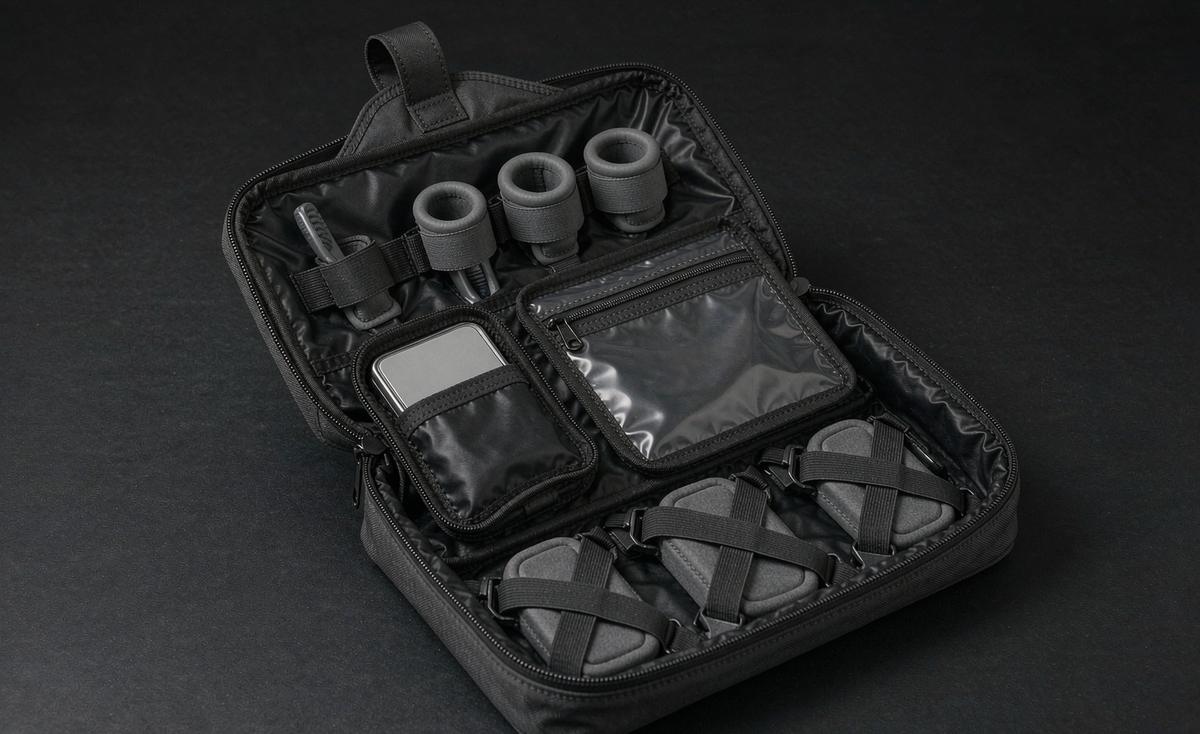
A toiletry kit lives in a bathroom, gets set down on a wet surface, and carries containers that leak. That is a harsher moisture environment than almost any other bag product, and the specification response is a wet-dry split: at least one fully waterproof zone that can hold a wet razor, a damp toothbrush or a leaking bottle without contaminating the rest of the kit. Whether that zone is a welded compartment or a removable liner is the main cost decision in the product.
- Decide first whether the wet zone needs to be welded or merely wipe-clean. Welded is genuinely waterproof and costs more; wipe-clean handles splashes only.
- Give the wet zone a drain route or make it removable. A sealed wet compartment that cannot dry will smell within weeks.
- Keep the wet zone at the base. Gravity means a leak at the top of the kit reaches everything below it.
- Test the weld seam, not just the material. Welded seams fail at the corners and at the closure junction.
- Confirm the closure on the wet zone is as waterproof as the compartment; a waterproof bag with a sewn zip is not waterproof.
The zip point in the last item is the one that catches programmes out. A welded TPU compartment closed with a standard sewn coil zip is not waterproof, because the zip tape and the stitch line are both leak paths. A genuinely waterproof closure needs a welded or laminated zip with a coated tape, which costs more and feels different in use. Decide whether you need waterproof or water-resistant, say which one on the campaign page, and specify the closure to match.
There is a communication discipline here that is worth stating because it prevents most of the complaints. The word waterproof has a specific meaning to a buyer, and a product that is water-resistant and described as waterproof will generate returns that no refund policy will fully satisfy. Use the accurate term, describe what it means in practice, and if the test is a splash test rather than a submersion test, say so. The cosmetic bag sizing guide covers the same discipline on lining claims.
Material and coating choices for a travel kit
Travel kit materials have to satisfy three requirements that pull in different directions: they must wipe clean, they must survive repeated folding, and they must not become brittle in cold or sticky in heat. The first points toward a coated fabric, the second points against a thick coating, and the third eliminates some coating chemistries entirely. Understanding that tension is most of the material decision.
| Material | Wipe-clean | Fold behaviour | Cold and heat behaviour |
|---|---|---|---|
| PU-coated polyester | Good | Good; coating stays flexible | Good across a wide range |
| PVC-coated polyester | Very good | Poor; crazes at repeated creases | Stiffens in cold; can plasticise in heat |
| TPU-coated nylon | Very good | Very good | Best across the range; highest cost |
| Recycled polyester, PU face | Good | Good | Good; supports a GRS claim |
| Uncoated canvas or twill | Poor | Excellent | Good; stains permanently |
The cold-performance row is the one most often ignored and it matters for a travel product specifically. A kit left in a vehicle overnight in a cold climate, then unzipped, will crack at the fold if the coating has stiffened. TPU-coated nylon is the most robust across the temperature range and it is the most expensive; PU-coated polyester is the sensible default for most programmes. PVC is the cheapest and it is the one we would steer a travel programme away from, for the same reason it fails a fold-flex test on a sports bag.
Sustainability claims interact with this and they need the same rigour as any other spec. A recycled-content claim is defensible with GRS certification for the specific material, and a textile-safety claim with OEKO-TEX Standard 100. Both are increasingly requested by retail and by institutional buyers rather than only by end customers. Where a travel kit is sold into a hotel, airline or corporate channel, expect the certificate reference to be requested during procurement, so decide during sampling whether the claim will be made and get the documentation in place then.
Sizing against airline and pack constraints
Travel kit sizing is governed by two external constraints rather than by the contents alone. The first is the carry-on liquids allowance, which sets the clear compartment at roughly one litre. The second is the space available in the bag the traveller is carrying, which for most people is either a carry-on suitcase or a 40-55 litre travel backpack. A kit that fits comfortably in a 40 litre pack will sell into a different audience from one that does not, and the difference is entirely about the closed external dimensions.
| Format | Closed external | Suits | Note |
|---|---|---|---|
| Flat dopp kit | 24 x 14 x 10 cm | Any carry-on; 30 litre packs and up | Flattest pack; best for minimal travellers |
| Hanging wash bag | 24 x 20 x 12 cm | 40 litre packs and carry-on cases | The volume default |
| Hanging organiser | 26 x 24 x 14 cm | 55 litre packs and larger cases | Premium; needs real space |
| Compact roll kit | 22 x 12 cm rolled | Daypacks and 25 litre packs | Smallest; limited organisation |
| Family or shared kit | 32 x 26 x 16 cm | Checked luggage only | Niche; check the freight impact |
Publish the closed external dimensions and say which pack size the kit is designed to sit inside. That is the piece of information a traveller actually uses to decide, and its absence is the most common pre-pledge question in this category. It also protects you: a buyer who knows the kit is 26 x 24 x 14 cm and buys it for a 30 litre pack has made an informed choice, and one who guesses has not.
The freight consequence of that table is worth naming. The formats at the bottom are materially larger in volume, and because a travel kit is a bulky light product it bills closer to its dimensional weight than its actual weight. A family kit can cost two to three times as much to ship per unit as a flat dopp kit. If the range includes both, the smaller format subsidises the larger one in a bundle, which is one of the stronger arguments for bundling here.
Bundling: what to add and what to leave out
Toiletry kits bundle unusually well, because the contents are small, cheap and immediately useful. That is also why bundling is the most common way for a travel campaign to destroy its own margin: four accessory items mean four suppliers, four lead times, four packing specifications and a repacking charge at the fulfilment warehouse. The discipline is to bundle only items that pack into the kit at origin.
| Item | Packs inside the kit? | Risk | Verdict |
|---|---|---|---|
| Silicone travel bottles | Yes; nests in the liquids compartment | Low | Best bundle item in the category |
| Toothbrush case | Yes | Low | Good; confirms the wet zone sizing |
| Nail kit or grooming tools | Yes | Medium; sharp-object rules vary | Check destination regulations |
| Microfibre towel | Yes; compresses | Low | Good; adds perceived bulk value |
| Razor | Yes | Higher; blade regulations vary by market | Usually leave out |
| Liquids or creams | Yes | High; cosmetic regulation and shelf life | Leave out entirely |
The last row is the important one. Putting actual liquids or cosmetics into a bundle moves the product into a regulated category with ingredient labelling, shelf-life and, in several markets, a responsible-person requirement. The regulatory burden is disproportionate to the perceived value, and a travel kit does not need it. Bundle the empty silicone bottles and let the traveller fill them: that is the version of this bundle that works.
The packing-origin principle is the other half. If the accessory items can be placed inside the kit at the packing line, the bundle costs a few minutes of labour per unit and one carton. If they have to be assembled at the destination warehouse, the bundle costs a repacking charge per unit, which on 500 pcs is several thousand dollars. Ask the question in the request for quotation: can the accessories be packed at origin, and does the carton specification support it. The crowdfunding rewards fulfilment route covers the downstream side of that decision.
MOQ maths across a multi-format range
The minimum is 500 pcs per style and per colourway, and this is where a multi-format range gets expensive quickly. Three formats in one colourway is 1,500 pcs. Three formats in two colourways is 3,000 pcs. For a first programme that is usually the wrong shape, and the sequencing matters more than the total: which format launches first determines what you learn and what you can afford to learn it with.
| Structure | Total commitment | Suits | Risk |
|---|---|---|---|
| One format, one colourway | 500 pcs | First programme | Lowest capital; limited ladder |
| Two formats, one colourway | 1,000 pcs | Strong pre-launch signal | Moderate; two inventory lines |
| Three formats, one colourway | 1,500 pcs | Established brand | High; inventory concentration |
| One format, two colourways | 1,000 pcs | Colour-led audience | Moderate; splits demand |
| Launch one, release two on data | 500 + 500 | Most first programmes | Lowest risk with a ladder |
The last row is the structure to aim for. Launch the mid-tier hanging wash bag at 500 pcs, because it is the format most likely to be the standard reward and the one with the clearest upgrade and downgrade paths. Quote the entry and premium formats in the same request for quotation so they are ready to release, then release the one the pledge data points to. That gives you a two or three tier ladder without committing to three production runs before you know which sells.
There is a second lever worth asking about. Where two formats share a fabric, a lining and a trim package, and differ only in structure, there is sometimes scope to combine them within a single production commitment. It depends on the line schedule and on how much of the bill of materials is shared, it is not always available, and it costs one line in the request for quotation to find out. For a range-based programme that line is worth asking.
Decoration interacts with this too, because each format needs its own logo placement and possibly its own set-up. State the number of formats, the number of placements and the total quantity in one request so the set-up is amortised once against the programme rather than charged per format. Where a logo is embroidered, the stitch count and the set-up are the two figures to confirm, and both are cheaper when quoted against the total run. Our low minimum bag production page covers how this works at the entry point of a range.
The loaded test protocol at sampling
The sampling protocol for a travel kit has to test three things a visual inspection cannot: whether the kit holds its stated contents, whether the hook carries the loaded weight, and whether the wet zone is actually waterproof. All three are cheap to test and all three produce complaints if they are not. Write them as numbered protocols in the technical pack so they can be referenced by clause and repeated at inspection.
- Contents test: insert the stated contents in the order a traveller would, close the kit, and confirm the closure meets without pressure and the shell is not distorted.
- Hook test: hang the loaded kit from a rail of a stated diameter for twenty-four hours, then check the hook for deformation and the anchor for distortion or stitch movement.
- Hook cycle: open and close the hook fifty times and re-check the anchor.
- Wet zone test: fill the wet compartment with a defined volume of water, leave it for thirty minutes, and check the outer shell and the adjacent compartment for moisture.
- Weld seam test: fold the wet compartment along its weld line twenty times, then repeat the wet zone test.
- Close and pack test: fold or roll the kit as designed, pack it into a stated pack volume, and confirm it fits without force.
The weld seam test in the fifth item is the one most often omitted and the one that catches the defect that matters. A welded seam is strong in tension and weaker in peel, and the failure mode is a corner of the wet compartment opening after the kit has been folded and unfolded through a few trips. Twenty folds followed by a leak test simulates that in a few minutes at sampling rather than in a hotel bathroom three months after delivery.
Record the results with measurements rather than with impressions. The hook deflection in millimetres, the volume of water that escaped, the external dimension when loaded. Those figures become the acceptance criteria at inspection, and an inspector can check them. A note saying the hook seems fine cannot be checked by anyone and it is the reason a second batch drifts from the first.
QC and defect classes
Pre-shipment inspection runs to AQL 2.5 under ISO 2859-1, drawing a statistically determined number of units and measuring them against defect classes you define. On a 500 pcs lot at general inspection level II that is fifty units, with acceptance at three defects and rejection at four. The classes below are the ones that matter for a travel kit, and the critical ones all require a functional check.
| Defect | Class | Check method |
|---|---|---|
| Wet compartment leakage | Critical | Leak test with a defined volume on drawn units |
| Hook anchor stitch movement or distortion | Critical | Loaded hang test on drawn units |
| Hook deformation | Critical | Visual and measurement check after hanging |
| Zip separation on the main closure | Critical | Run every zip end to end under light load |
| Internal dimension out of tolerance | Major | Measure all three internal axes |
| Clear panel haze or yellowing | Major | Compare with the approved sample under standard light |
| Odour above an agreed level | Major | Sensory check against the approved sample |
The odour row is worth including on every coated-product programme. A kit is packed in a carton for four to six weeks after production, and a coating, an ink or an adhesive that has not fully cured produces an odour that the customer notices on first opening and attributes to a quality problem. Agree an acceptable level against the approved sample at quotation stage and require a sensory check on drawn units, because an odour complaint cannot be resolved after delivery.
- Name the standard, the inspection level and the defect classes in the purchase order before production starts.
- Require the inspection report to be issued before the 70% balance under T/T 30/70 is released.
- Agree in advance who pays for re-inspection; rework typically adds 10-15 days.
- Keep the approved pre-production sample as the physical reference for shade, dimension and odour checks.
- Request an in-line check during the sewing window, when a defect trend can still be corrected.
One note on batch consistency for a range programme, because it is the failure that appears latest. If the entry, mid and premium formats are produced in separate runs, the shell fabric shade has to match across all three, because a customer who buys the mid tier and later the premium one will compare them. Record the fabric lot used on the first run and require the subsequent runs to be matched against it deliberately rather than hopefully. Our Kickstarter campaign bag QA and QC pillar covers the record structure.
Compliance and labelling for travel products
Compliance for a travel kit follows the destination market rather than the product, and the requirement should be booked during sampling rather than discovered after production. The list below covers the markets most travel campaigns sell into, and the practical point is the same in every case: state the destination in the request for quotation so the testing is quoted and scheduled in parallel with the 6-10 working days of sampling window.
- European Union: REACH governs restricted substances, and the EU GPSR sets general safety and traceability obligations including a responsible economic operator.
- United Kingdom: UK REACH applies separately, with its own substance list and obligations.
- United States: CPSIA applies where a product is marketed to children; California Prop 65 warnings apply where a listed substance is present.
- Canada and Australia: general product safety obligations apply, with textile labelling rules in both markets.
- Recycled-content claims: substantiate with GRS certification for the specific material.
- Textile-safety claims: substantiate with OEKO-TEX Standard 100 for the specific article.
The GPSR traceability obligation deserves specific attention for a travel range, because it requires product identification and a responsible economic operator in the EU, and that information has to appear on the product or its packaging. Decide during sampling how it will be applied: a sewn-in label, a printed carton marking or a hangtag. Retro-fitting it after production is a repacking exercise at the destination warehouse and it is far more expensive than adding a label at origin.
Where the bundle includes grooming tools, check the destination regulations on sharp objects and on any item that could be classified differently in transit. A nail kit is unremarkable in checked luggage and treated differently in some carry-on regimes, and a razor blade is regulated in several markets. It is not a reason to avoid the bundle, but it is a reason to confirm before the page copy promises it. Where a programme wants the wider context on the material choices behind the category, the beauty bag material comparison covers the coating and vegan-leather options in detail.
- Custom cosmetic bags for Kickstarter campaigns
- Custom travel bags for Kickstarter campaigns
- Crowdfunding bag sample prototyping
- Kickstarter campaign bag QA and QC
- Crowdfunding rewards fulfilment
- Kickstarter Makeup Bags: 6 Sizes Backers Use
- Kickstarter Beauty Bag: Vegan Leather vs TPU
- Request a quotation
Build a travel kit ladder that sells at every tier
Send us the formats, the closed dimensions you need, the wet-zone requirement and your target quantity. As your production partner we will return a unit cost, a sampling estimate at 6-10 working days and a booked 35-50 day production window. Write to service@junyuanbags.com.
Frequently Asked Questions
What is the MOQ for custom toiletry bags on a crowdfunding campaign?
500 pcs per style and per colourway. Three formats in one colourway is a 1,500 pcs commitment, so most first programmes launch one format at 500 pcs with the other two quoted and released against pledge data. Ask whether formats sharing a fabric can be combined. Ask whether formats sharing a fabric and a trim package can be combined within one commitment.
How much does a custom toiletry kit cost per unit at 500 pcs?
Indicative FOB Xiamen ranges at 500 pcs are roughly USD 4.50-7.00 for a flat dopp kit, USD 7.00-10.50 for a hanging wash bag with a metal hook, and USD 10.00-14.00 for a structured hanging organiser with a welded wet zone. Hook grade and wet-zone construction move it most. Hook grade and wet-zone construction move the figure more than the shell fabric does.
How should the carry-on liquids compartment be designed?
A transparent, resealable compartment of roughly one litre on an outer face, fully detachable so it can be presented at screening without unpacking the kit. Do not state that it is approved or compliant; describe what it is and let the traveller decide, because rules vary by market and by airport. Use TPU rather than PVC for the panel, because PVC stiffens and yellows with heat exposure.
Should the wet compartment be PVC or TPU?
TPU. PVC is clear and cheap but it stiffens and yellows with heat exposure, which matters on a product whose selling point is transparency. TPU stays clearer and more flexible across a wider temperature range at a higher material cost, and it can be welded into a watertight seam. TPU can also be welded into a genuinely watertight seam, which PVC generally cannot.
Is a welded compartment actually waterproof?
Only if the closure is too. A welded TPU compartment closed with a standard sewn coil zip is water-resistant rather than waterproof, because the zip tape and the stitch line are both leak paths. Specify a welded or laminated zip with a coated tape if you need the claim. Specify a welded or laminated zip with a coated tape if the waterproof claim is going on the page.
What hook should a hanging toiletry kit use?
A coated metal wire hook for mid tiers and a cast or swivel hook for premium. The important specification is the anchor: reinforce it with a webbing or coated board insert behind the shell, because a hook anchored into a single fabric layer tears out under a loaded kit. The usual failure is the anchor tearing out of the shell rather than the hook itself breaking.
How do I test whether a hang hook will hold?
Load the kit to its stated capacity, hang it from a rail of a stated diameter for twenty-four hours, and check the hook for deformation and the anchor for distortion or stitch movement. Then cycle the hook open and closed fifty times and re-check the anchor. Record the hook deflection in millimetres so an inspector can check it again at pre-shipment.
Should I bundle liquids or cosmetics with a travel kit?
No. Including actual liquids moves the product into a regulated category with ingredient labelling, shelf-life and responsible-person requirements that are disproportionate to the perceived value. Bundle empty silicone travel bottles instead, which gives the same perceived value without the regulatory burden. Bundle the empty bottles instead, and pack the accessories into the kit at origin. Where a bundle is planned, pack the accessories into the kit at origin rather than at the warehouse.
How long does a toiletry kit programme take?
Sampling runs 6-10 working days per round for an unstructured build and 12-15 for a structured one. production 35-50 days after the deposit and written sample approval. Add 2-4 weeks for the technical pack and 25-40 days of ocean transit to the destination market. Finish sampling before the page goes live to remove four to six weeks from the post-campaign path.
Which format should a first travel campaign launch with?
The mid-tier hanging wash bag. It is the format most likely to be the standard reward, and it has the clearest upgrade and downgrade paths, so you can release the entry or premium version against real pledge data rather than committing to three runs at once. Quote the entry and premium formats in the same request so they are ready to release.
What compliance documentation applies to travel kits?
REACH and EU GPSR for the EU, UK REACH separately for Britain, CPSIA and California Prop 65 where youth marketing applies in the US, plus general product safety and textile labelling for Canada and Australia. Book the testing during sampling rather than after production. Book the testing during sampling so it runs in parallel rather than adding days after production.
How do I keep three formats matching in shade?
Record the fabric lot used on the first run and require subsequent runs to be matched against it deliberately rather than hopefully. A customer who buys the mid tier and later the premium one will compare them, and dye lots vary between production runs even from the same mill. Keep the retained reference unit so the comparison is possible at the next production release.
People Also Ask
Are toiletry bags a good crowdfunding reward?
Yes, because they work at every tier. A flat pouch and a structured hanging organiser read as the same category to a backer, which lets one campaign build a full ladder without inventing three products.
What size should a travel toiletry bag be?
A flat dopp kit runs about 24 x 14 x 10 cm closed, a hanging wash bag about 24 x 20 x 12 cm, and a hanging organiser about 26 x 24 x 14 cm. Publish the closed external dimensions and the pack size it suits.
Do I need a clear liquids compartment?
It is the most useful feature in the category. Size it to roughly one litre, put it on an outer face, and make it fully detachable so it can be presented at screening without unpacking the kit.
What is a wet-dry split?
A fully waterproof zone at the base of the kit that holds a wet razor or a leaking bottle without contaminating the rest. Make it welded rather than wipe-clean, and give it a drain route or make it removable.
How many formats should a first range include?
One. Launch the mid-tier hanging wash bag at 500 pcs, quote the entry and premium formats in the same request, and release the one the pledge data points to. Three formats is a 1,500 pcs commitment.
What should I bundle with a toiletry kit?
Items that pack inside it at origin: silicone travel bottles, a toothbrush case, a microfibre towel. Avoid actual liquids and cosmetics, which move the product into a regulated category.
How strong does the hang hook need to be?
Strong enough to carry the loaded kit for twenty-four hours without deforming, with an anchor reinforced by a webbing or board insert. The usual failure is the anchor tearing out of the shell, not the hook breaking.