Kickstarter Makeup Bags: Six Dimensions Backers Actually Use
Makeup bag sizing fails when it is expressed as capacity and succeeds when it is driven by the objects inside. Six formats cover almost every realistic use: a brush roll, a flat palette pouch, a slim daily case, a medium train case, a hanging organiser and a full-size travel kit. This guide gives the internal dimension for each, the object that governs it, the lining and closure specification each one needs, and the fit-test protocol to verify it on a sample before you commit to 500 pcs per style and per colourway.
- Why makeup bag sizing fails
- The six dimensions and the object that governs each
- Format one: the brush roll
- Format two: the flat palette pouch
- Format three: the slim daily case
- Format four: the medium train case
- Format five: the hanging organiser
- Format six: the full-size travel kit
- Lining, cleanability and the leak test
- Closure types compared
- MOQ and colourway strategy for a beauty campaign
- Sampling fit-test protocol and defect classes
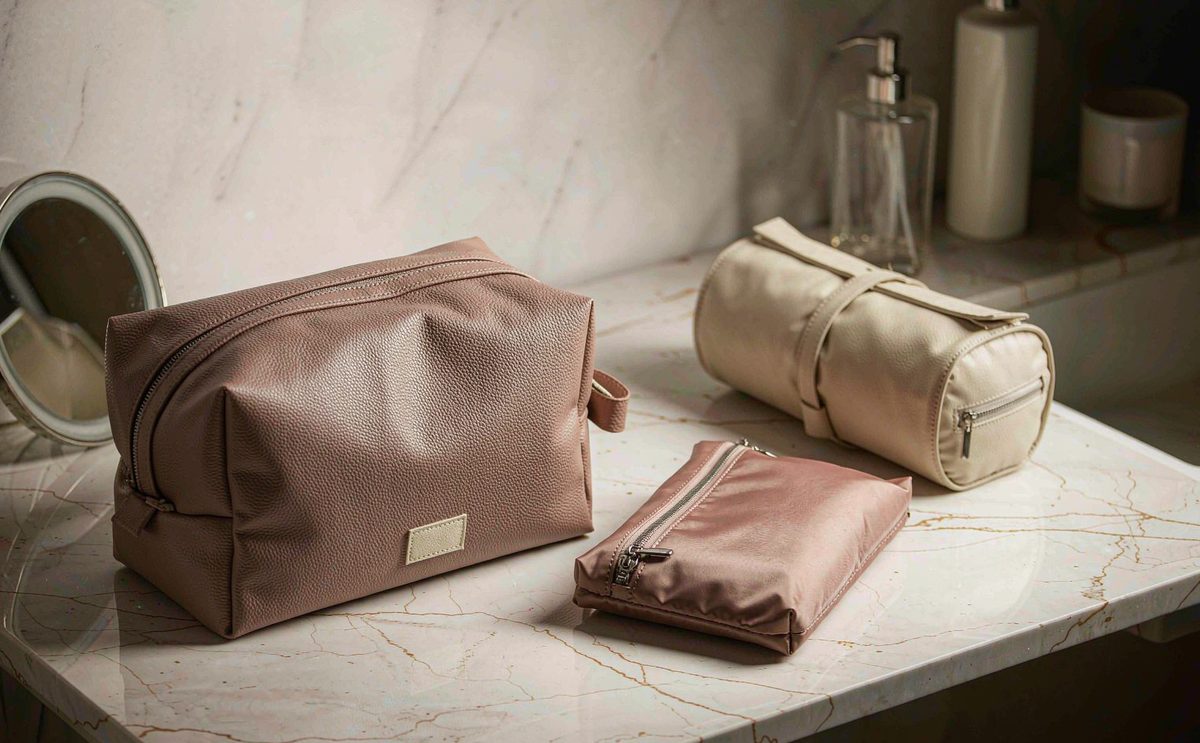
A cosmetic bag is the product in the bag category where a dimension error is most immediately obvious to the buyer, because the buyer knows exactly what they intend to put in it. A backpack that is 2 cm narrower than described is an inconvenience. A makeup bag that will not close around a specific palette is a return, and it is a return that will be mentioned in a review with a photograph. That is why sizing on this product has to be driven from the objects outward and verified on a physical sample with those objects in place. The custom bags for Kickstarter overview sets out where that verification sits in the wider sourcing process.
- Minimum order quantity
- 500 pcs per style / colourway
- Sampling
- 6-10 working days (12-15 for complex builds)
- Bulk production
- 35-50 days after deposit + approved pre-production sample
- Inspection
- AQL 2.5 to ISO 2859-1
- Trade term
- FOB Xiamen
- Payment
- T/T 30/70
- Production floor
- 4,950 m2 SGS-verified, 137 staff, 7 lines, 149 machines
- Monthly capacity
- 200,000 pcs per month
- Programme contact
- service@junyuanbags.com
Why makeup bag sizing fails
Three failure modes account for most of the sizing complaints in this category, and none of them is about the bag being too small in general terms. The first is that capacity figures do not describe shape. A 1.5 litre pouch will hold a surprising amount of loose items and will not hold a single rigid palette, because the governing dimension is the flat internal face rather than the volume.
The second is the zip radius problem. A pouch sized correctly on paper will not accept a rigid object if the opening does not extend far enough down the sides. The governing measurement is not the internal dimension but the usable aperture: how wide the opening is, and how far the zip travels around the gusset. This is the single most common cause of a bag that measures right and does not work.
The third is the tolerance problem. A dimension stated as 22 cm with no tolerance is not a specification, because pattern cutting, seam allowance and fill all introduce variation. State internal dimensions with a tolerance, typically plus or minus 3-5 mm on a soft pouch, and state whether the figure is internal or external. A bag described externally as 22 cm may have an internal dimension of 20 cm once seam allowance and lining are accounted for, and that difference is exactly the size of the complaint.
The fix for all three is the same and it takes twenty minutes: build the specification from a physical list of objects, state internal dimensions with a tolerance, and then verify on a sample by inserting those objects and closing the bag. Our custom cosmetic bags pillar covers how that list becomes a technical pack, and the crowdfunding bag guide sets out the wider path from sketch to repeat order.
The six dimensions and the object that governs each
Six formats cover almost every realistic use case, and each one is governed by a different object. The table below gives the internal dimension for each, the object that sets that dimension, and the reward tier each format typically suits. Treat the figures as starting allowances to verify on a sample rather than as finished specifications, because the objects themselves vary by brand and by market.
| Format | Internal dimension (W x H x D) | Governing object | Typical tier |
|---|---|---|---|
| Brush roll | 38 x 24 cm flat, 20-24 slots | Longest handle brush, typically 20-22 cm | Add-on or entry |
| Flat palette pouch | 26 x 18 x 2 cm | Standard pressed powder palette | Add-on or entry |
| Slim daily case | 22 x 14 x 7 cm | Full-size mascara and a foundation bottle | Standard reward |
| Medium train case | 26 x 18 x 14 cm | Tall bottle standing upright | Standard or bundle |
| Hanging organiser | 24 x 60 cm open, 4-5 tiers | Full kit laid out vertically | Premium tier |
| Full-size travel kit | 30 x 22 x 16 cm | Full-size bottles plus brushes | Premium or anchor |
Notice that the brush roll is the only format where the governing dimension is a length rather than a volume, and the flat palette pouch is the only one where depth is almost irrelevant. Those two are the most frequently mis-specified, because a creator who thinks in capacity will design both as small pouches and discover at sampling that a brush does not bend and a palette does not fold.
The other pattern worth naming is that the two premium formats are the ones with the most internal structure. A hanging organiser and a full-size travel kit both need dividers, elastic loops and probably a removable element, and both therefore carry more labour minutes and more defect classes than the three simpler formats. If this is a first programme and the calendar is tight, the slim daily case is the format that carries the least risk at the highest perceived value.
Format one: the brush roll
The brush roll is governed by one object: the longest brush handle the owner intends to carry. That is typically 20-22 cm for a standard face brush set, and it can reach 25 cm or more for a professional powder or kabuki brush. Add clearance at both ends and the flat panel needs to be roughly 24 cm tall, with a width driven by the number of slots rather than by the brushes themselves.
| Element | Typical figure | Why it matters |
|---|---|---|
| Flat panel height | 24-27 cm | Longest brush handle plus clearance at both ends |
| Slot count | 12, 18 or 24 | Drives the flat width and the elastic length |
| Slot width | 20-35 mm, graded | Handles vary; uniform slots waste space |
| Flap coverage | 30-40 mm above the slot tops | Bristles protrude; a short flap does not cover them |
| Closure | Wrap tie, snap or elastic loop | A roll that unrolls in a suitcase defeats the purpose |
Graded slot widths are the detail that separates a considered brush roll from a generic one. A set contains brushes with handles of very different diameters, and uniform slots either crush the thick ones or let the thin ones fall out. Grade the slots across the panel, with the widest at the end where the largest brushes sit, and confirm the grading against the actual set the target customer owns rather than against an average.
The flap coverage figure is the second commonly missed item. Bristles protrude above the handle, and a flap that only covers the handles leaves the brush heads exposed, which is both unhygienic and the reason a brush roll gets replaced. Thirty to forty millimetres of coverage above the slot tops solves it, and it is a pattern decision rather than a cost decision, so it should be made at sampling rather than discovered later.
Format two: the flat palette pouch
The palette pouch exists to protect a rigid, fragile, flat object, and it is the format where the zip radius problem bites hardest. A pressed powder palette is typically around 20 x 13 x 1.5 cm, but a compact, a mirror or a larger palette can run to 24 x 16 cm. The pouch therefore needs an internal face of roughly 26 x 18 cm with a tolerance, and critically it needs an opening that lets a rigid object slide in rather than be folded in.
- Specify the usable aperture, not just the width: how far the zip travels around the gusset determines whether a rigid object enters.
- Use a three-sided zip, sometimes called a horseshoe opening, so the pouch opens like a book rather than like a letter.
- Add a thin foam laminate on at least one face; a palette in an unpadded pouch will crack.
- Keep the depth at 2-3 cm. Deeper is not better here, because the object is flat and extra depth lets it rattle.
- Consider a divider if two palettes are carried; two rigid objects rubbing together is the main damage mechanism.
The foam laminate point is worth emphasising because it is the difference between a protective pouch and a decorative one. A pressed powder palette dropped in a bag will crack, and the crack appears in the product the customer cares about rather than in the pouch they bought from you. A 2-3 mm foam laminate bonded to one or both faces costs little, adds almost no bulk, and is the reason the pouch justifies its price.
There is a commercial point here too. The palette pouch is the most giftable format in the range and the most likely to be bought as an add-on or a stretch goal, because it is inexpensive, flat to ship and immediately useful. That makes it the best format to test a colourway or a print on, since the 500 pcs minimum is being spent on the cheapest unit in the range. Where a programme wants to test demand before committing to a larger case, this is the format to do it with.
Format three: the slim daily case
The slim daily case is the workhorse of the range and the one most likely to be the standard reward. It is governed by two objects: a full-size mascara tube, which sets the minimum height, and a foundation bottle, which sets the minimum depth and is the item most likely to leak. A typical internal dimension is 22 x 14 x 7 cm, which is enough for a daily kit of eight to twelve items without becoming a bag that has to be searched.
| Item | Governs | Allowance |
|---|---|---|
| Full-size mascara, 12-14 cm | Minimum internal height | 15 cm plus clearance to close |
| Foundation bottle, 30-50 ml | Minimum internal depth | 7 cm; wider if the bottle is squat |
| Lipstick tubes, 5-8 | Elastic loop or slip pocket count | Graded loop widths |
| Compact or small palette | Flat internal face | Keep one face flat and unpocketed |
| Brushes, 3-5 | Internal loop panel | Short brushes only at this size |
| Cotton pads or wipes | Remaining volume | Sized after the items above |
The foundation bottle is the item that drives the lining specification, because it is the item most likely to leak and the one whose contents are hardest to remove. That is the reason a cosmetic bag lining should be wipe-clean rather than absorbent, and why the seam between the lining and the shell should be tested rather than assumed. We return to that in the lining section, but it belongs in the sizing conversation because it determines whether the depth allowance works.
One design decision settles most of the rest: does the case have internal organisation or is it a single cavity? At this size a single cavity with one flat slip pocket usually beats a heavily divided interior, because the items vary enormously between users and a divided interior that does not match the user's kit is worse than no division. If you add organisation, use elastic loops graded by width on one face and leave the other face flat.
Format four: the medium train case
The medium train case is the first format in the range where bottles stand upright, and that single change drives most of the specification. A train case is governed by the tallest bottle the owner carries, typically a toner, a setting spray or a shampoo at 18-22 cm, plus the clearance needed to close the lid. A typical internal dimension is 26 x 18 x 14 cm, with the height figure being the one to verify first.
- Measure the tallest bottle with its cap on, then add 15-20 mm of clearance for the lid to close without pressure.
- Decide whether the lid is structured. A soft lid sags onto tall bottles; a padded or framed lid protects them.
- Add a base reinforcement; a loaded train case is heavy and is set down repeatedly on hard surfaces.
- Include a carry handle rated to the loaded weight, which at this size is typically 2-4 kg.
- Keep the internal walls wipe-clean at least to the height of the tallest bottle, not just at the base.
The lid question is the most consequential and the most often resolved by cost rather than by function. A soft lid on a train case means the top of the bag rests directly on the caps of the tallest bottles, and repeated pressure can crack a cap or force a seal. A padded lid or a framed top costs more and is the reason a train case can be sold at a premium tier. If you have to take cost out of this format, take it from the decoration rather than from the lid.
There is also a freight point specific to this format. A structured train case does not pack flat, which means it ships at a higher volume than the pouches in the range, and on a 500 pcs run that difference is material. If the range includes both a train case and a flat pouch, the pouch subsidises the freight of the case in a bundle, which is one of the better arguments for bundling in this category.
Format five: the hanging organiser
The hanging organiser is the highest-value format in the range and the one with the most specification risk, because it combines a hanging mechanism, multiple compartments and a fold. It is governed by the full kit laid out vertically: typically four or five tiers, each holding a category, folding to roughly 24 x 24 cm and opening to 24 x 60 cm. The three risk areas are the hook, the fold and the compartment closures.
| Risk area | Failure mode | Specification response |
|---|---|---|
| Hook | Bends or detaches under loaded weight | Metal hook rated above the loaded weight; reinforced anchor |
| Fold line | Cracks or delaminates after repeated folding | Reinforced tape or a fabric hinge rather than a coated crease |
| Compartment closure | Contents fall out when the organiser is rolled | Zip or covered elastic on at least the lower tiers |
| Hanging loop | Tears away from the body | Webbing loop anchored into the frame, not into the lining |
| Weight distribution | Organiser leans or tips when hung loaded | Balance the tier volumes; keep the heaviest tier lowest |
The hook is the item to specify hardest, because it carries the entire loaded weight of the kit and it is the failure most likely to be reported as a defect rather than as wear. Use a metal hook rather than a moulded plastic one at this size, specify the material and finish, and anchor it into the frame or a reinforced panel rather than into the lining. Test it by hanging the loaded organiser for a defined period and checking for deformation at the anchor.
The fold line is the second one. A hanging organiser is folded and unfolded constantly, and a coated fabric creased repeatedly at the same line will craze and then crack. The response is either a fabric hinge that is designed to fold, or a reinforced tape on the inside of the crease. Both are pattern decisions and both are cheap; discovering the need for one after production is not. Our sample prototyping route covers the fold-cycle check to run at sampling.
Format six: the full-size travel kit
The full-size travel kit is the anchor format: it carries a complete kit including full-size bottles, brushes and palettes, and it sits at the top of the reward ladder. Typical internal dimensions are 30 x 22 x 16 cm. The governing objects are the full-size bottles, which set the height and the leak requirement, and the brushes, which need a protected flat zone that does not conflict with the bottle zone.
- Separate the bottle zone from the brush zone. A rigid brush handle pressed against a bottle cap will open it.
- Make the bottle zone fully wipe-clean and give it a drain route or a removable liner.
- Add a palette sleeve on the lid or on one flat face, so the fragile item travels flat.
- Confirm the packed weight; a full kit of full-size bottles is heavy and changes the strap or handle requirement.
- Check the closed dimensions against airline personal-item limits if the travel positioning is part of the pitch.
The separation point is the one that most affects user satisfaction and the one most often omitted. A travel kit is packed quickly and carried through an airport, and the failure mode is a bottle cap working loose against a rigid brush handle and leaking into the brush zone. A simple structural divider between the two zones, or a separate zip compartment for brushes, removes it. That is a pattern cost rather than a material cost and it should be in the first sample.
The airline check in the last item is a page-copy decision rather than a production one, but it has a consequence worth stating. If the reward description says the kit fits under an aircraft seat or meets a personal-item limit, that is a dimension claim and it should be verified against the closed external dimensions with the bag loaded. Carriers differ and limits change, so phrase it as a comparison against a typical limit with the measured figure published, rather than as a guarantee.
Lining, cleanability and the leak test
A cosmetic bag lining has one job that no other bag lining has: it has to be cleanable after contact with oil, pigment and alcohol, repeatedly, without degrading. That rules out a lot of otherwise sensible materials and it makes the lining the most specified component in the product. The two routes are a coated polyester or nylon wipe-clean lining, or a TPE or TPU film lining, and the choice is mostly about how the lining meets the seam.
| Lining | Cleanability | Seam behaviour | Relative cost |
|---|---|---|---|
| Coated polyester, PU face | Good; wipes clean with a damp cloth | Sewn seams leak at the stitch holes | Low |
| Coated nylon, TPU face | Very good; resists oil and alcohol | Sewn seams leak; weldable at higher cost | Medium |
| TPE film lining | Excellent; impermeable | Weldable; strong and genuinely watertight seams | Medium-high |
| Removable coated liner | Best; the liner can be washed or replaced | Depends on the liner construction | High; adds a component |
| Uncoated polyester lining | Poor; stains permanently | Sewn seams; absorbs spills | Lowest; not recommended |
The seam behaviour column is where most specifications go wrong. A wipe-clean lining with sewn seams is not watertight, because the needle holes are a leak path. Whether that matters depends on the format: for a palette pouch it does not, for a travel kit carrying full-size bottles it does. Where watertight matters, the options are a welded seam, which requires a weldable film, or a removable coated liner, which adds a component and a second specification.
Whichever route you choose, test it. The leak test is simple and it should be written into the sampling protocol: place the bag with the lining uppermost, pour a defined volume of water into the compartment, leave it for a defined period, and check for moisture at the outer shell and at the seams. Thirty minutes with 100 ml tells you more than any material data sheet. Repeat it on drawn units at inspection, because it is the defect most likely to reach a customer.
Closure types compared
Closure choice on a cosmetic bag is usually made on appearance and it should be made on three functional questions: does the closure keep the bag shut when it is packed loosely in a suitcase, does it keep its shape after repeated opening, and is it cleanable if product gets on it. The five common routes differ sharply on all three, and the right answer varies by format.
| Closure | Security | Durability | Best format |
|---|---|---|---|
| Coil zip, three-sided | High; closes fully around the aperture | High; the default for a reason | Slim case, train case, travel kit |
| Metal zip | High | Medium-high; can snag on lining | Premium train case |
| Magnetic snap | Low-medium; can pop open under pressure | High; no moving parts to fail | Palette pouch |
| Drawstring | Low; does not seal | High | Brush roll, soft pouch |
| Fold-over with snap or Velcro | Medium | Medium; Velcro collects debris | Brush roll |
The three-sided coil zip is the default for good reason and it should be the default in your specification unless there is a specific argument against it. It gives the widest usable aperture, which is what solves the zip radius problem on rigid contents, and it is the closure most likely to survive being overpacked. Specify it by reference rather than by gauge, and specify the pull, because a cosmetic bag pull is handled with product on the user's hands.
Velcro deserves a specific note. It is tempting on a brush roll because it is fast and quiet, and it collects powder, bristles and lint, which degrades it steadily and makes it visibly dirty within months. If the closure is on a product that will be used near loose pigment, choose a snap or a tie instead. That is a small decision that shows up directly in long-term reviews, which is where the re-order comes from.
MOQ and colourway strategy for a beauty campaign
The minimum is 500 pcs per style and per colourway, and beauty campaigns feel that constraint more than most, because colour is the product. The instinct is to offer four or five shades, and that is a 2,000 to 2,500 pcs commitment on a first programme with unproven demand. The structure that works is one hero colourway plus one print, with additional shades released on a re-order against real pledge data.
| Structure | Total commitment | Suits | Risk |
|---|---|---|---|
| Single hero colourway | 500 pcs | First programme | Lowest capital |
| Hero plus one print | 1,000 pcs | Strong pre-launch signal | Moderate; print and plain split demand |
| Three shades at launch | 1,500 pcs | Established brand | High; concentrates inventory |
| Shade swap within one run | 500 pcs total | Testing two shades | Depends on shared materials |
| Hero plus a limited second drop | 500 + 500 | Colour-led audience | Second drop needs its own window |
The shade swap row is the question to ask at quotation stage. Where two shades share a base material and can be produced in the same run, you get variant data for a single minimum. It is not always feasible, it depends on the fabric and the line schedule, and it costs one line in the request for quotation to find out. For a colour-led category that line is worth more than almost anything else in the document.
Decoration is the other place where a beauty range differs. Cosmetic bags are usually decorated with a woven label, a heat-transfer print, an embroidered mark or a debossed patch on a synthetic leather panel, and the choice interacts with the shell material. A print on a coated fabric needs a compatible ink and a cure test; an embroidery on a thin lining will pucker. Decide the method before the shell is finalised rather than after, because the shell choice can foreclose the decoration route. The custom cosmetic bags pillar sets out the combinations that work.
Sampling fit-test protocol and defect classes
The fit test is the sampling activity that matters most on this product, and it is the one most often replaced by looking at the sample. Write it as a numbered protocol: list the objects the bag must hold, insert them in the order a user would, close the bag, and record whether it closes without pressure and whether any item is deformed. Then invert the bag, shake it twice, reopen it and check whether anything moved or fell out.
- Build the object list from the reward description. If the page says it holds a full-size foundation bottle, that bottle is in the test.
- Insert in user order, not in the most convenient order: the largest rigid item first, then bottles upright, then brushes.
- Close and inspect: does the closure meet without pressure, and is the shell distorted anywhere?
- Invert and shake twice, then reopen and check whether items migrated or escaped.
- Repeat with the bag at its maximum stated contents, not at a comfortable level.
- Record internal dimensions against the specification with the bag loaded, not empty.
That last item is the one that catches the tolerance errors. A soft pouch measured empty and a soft pouch measured loaded differ, because the contents push the panels apart and the seam allowance behaves differently under tension. Measuring loaded tells you whether the published dimension is honest, and it is the figure your inspector should be checking against at pre-shipment.
| Defect | Class | Check method |
|---|---|---|
| Internal dimension out of tolerance | Critical | Measure all three internal axes on every unit drawn |
| Lining seam leakage | Critical | Leak test with a defined volume on drawn units |
| Zip separation or slider failure | Critical | Run every zip end to end under light load |
| Elastic loop detached | Major | Pull check on each loop |
| Shade variation within a colourway | Major | Compare with the approved sample under standard light |
| Print or embroidery misregistration | Major | Measure against the stated coordinate |
| Ink or adhesive odour above an agreed level | Major | Sensory check against the approved sample |
The odour row is specific to this category and it is a real one. Cosmetic bags are packed in a carton for four to six weeks, and a print ink or a laminating adhesive that was not fully cured will produce an odour that the customer notices on opening and attributes to the product. Agree an acceptable level against the approved sample at quotation stage and require a sensory check on drawn units, because a smell complaint is almost impossible to resolve after delivery.
- Name the standard, the inspection level and the defect classes in the purchase order before production starts.
- Require the inspection report to be issued before the 70% balance under T/T 30/70 is released.
- Agree in advance who pays for re-inspection; rework typically adds 10-15 days.
- Keep the approved pre-production sample as the physical reference for shade, dimension and odour checks.
- Request an in-line check during the sewing window, when a defect trend can still be corrected.
Compliance for this category follows the destination market rather than the product. Bags sold into the EU need REACH substance compliance and EU GPSR safety and traceability obligations. Where a product is marketed to children in the US, CPSIA applies to components and materials, and California Prop 65 warnings apply where a listed substance is present. A recycled-content claim is defensible with GRS certification for the specific material, and a textile-safety claim with OEKO-TEX Standard 100. State the destination market in the request for quotation so the testing is booked during sampling rather than after production. Where a travel kit is part of the range, the toiletry and travel kit guide covers the bundle and compliance angle in more depth.
- Custom cosmetic bags for Kickstarter campaigns
- Custom bags for Kickstarter: programme overview
- Crowdfunding bag sample prototyping
- Kickstarter campaign bag QA and QC
- Custom Toiletry Bags for Crowdfunding
- Kickstarter Beauty Bag: Vegan Leather vs TPU
- Low MOQ bag production for creators
- Request a quotation
Size a makeup bag range from the objects, not from a capacity figure
Send us the item list, the internal dimensions you need, the lining route and your target quantity. As your production partner we will return a unit cost, a sampling estimate at 6-10 working days and a booked 35-50 day production window. Write to service@junyuanbags.com.
Frequently Asked Questions
What sizes do makeup bags actually need to be?
Six formats cover almost every use: a brush roll at 38 x 24 cm flat, a flat palette pouch at 26 x 18 x 2 cm, a slim daily case at 22 x 14 x 7 cm, a medium train case at 26 x 18 x 14 cm, a hanging organiser opening to 24 x 60 cm, and a full-size travel kit at 30 x 22 x 16 cm, all internal. Verify each figure on a physical sample with the actual objects inside rather than trusting a drawing.
Why does a makeup bag measure correctly but not fit its contents?
Usually the zip radius. The usable aperture, meaning how far the zip travels around the gusset, determines whether a rigid object enters. Use a three-sided zip so a pouch opens like a book rather than like a letter, and verify the fit with the actual object on a physical sample. The three-sided zip is the pattern change that solves it, and it costs very little at sampling stage.
What is the MOQ for custom makeup bags?
500 pcs per style and per colourway. Four shades means four separate commitments, so most first beauty programmes open with one hero colourway plus one print, and add shades on a re-order against real pledge data. Ask whether two shades can share a single production run. Ask whether two shades can share one production run, which costs one line in the request for quotation.
How much does a custom makeup bag cost per unit at 500 pcs?
Indicative FOB Xiamen ranges at 500 pcs are roughly USD 3.20-6.00 for a flat pouch or brush roll, USD 5.00-9.00 for a slim daily case, and USD 8.00-12.00 for a train case or travel kit. The lining route and the closure grade move the figure more than the shell fabric does. Lining route and closure grade move the figure more than the shell fabric does.
Should the lining be welded or sewn?
Sewn is fine where a leak does not matter, such as a palette pouch. Where the bag carries full-size bottles, a sewn seam leaks through the needle holes, so specify a weldable TPE film lining with welded seams or a removable coated liner. Test it rather than assuming. Where the kit carries full-size bottles, test the seam rather than relying on the material data sheet.
How do I test whether a cosmetic bag lining leaks?
Place the bag lining uppermost, pour a defined volume such as 100 ml into the compartment, leave it for a defined period such as 30 minutes, and check the outer shell and the seams for moisture. Repeat the same test on drawn units at pre-shipment inspection, because coating batches vary. Coating batches vary between runs, which is why the test belongs at inspection as well as at sampling.
How long does a makeup bag programme take?
Sampling runs 6-10 working days per round for an unstructured build and 12-15 for a structured one such as a framed train case. production 35-50 days after deposit and written sample approval. Add 2-4 weeks for the technical pack and 25-40 days of ocean transit. Finish sampling before the page goes live to remove four to six weeks from the post-campaign path.
Which makeup bag format should a first campaign choose?
The slim daily case. It carries the least specification risk at the highest perceived value, it packs efficiently, and it is the format most likely to be used daily rather than stored. Add a flat palette pouch as a lower-priced add-on or as a stretch goal for the campaign. Add a flat palette pouch as an add-on, because it is the cheapest format in the whole range.
Can two shades share one 500 pcs production run?
Sometimes, where both shades share a base material and the line schedule allows it. It is not always feasible, but it costs one line in the request for quotation to find out, and in a colour-led category that line is worth more than most of the rest of the document. Feasibility depends on shared materials and the line schedule, so ask in writing before committing.
What closure is best for a cosmetic bag?
A three-sided coil zip, because it gives the widest usable aperture for rigid contents and is the closure most likely to survive being overpacked. Specify it by reference rather than by gauge, and avoid Velcro on anything that will be used near loose pigment, because it collects debris. Specify the zip by reference rather than by gauge, because gauges are not comparable between makers.
Why does my cosmetic bag have an odour on opening?
Usually an incompletely cured print ink or laminating adhesive, concentrated by four to six weeks in a sealed carton. Agree an acceptable level against the approved sample at quotation stage and require a sensory check on drawn units at inspection, because it cannot be fixed after delivery. An odour complaint cannot be resolved after delivery, which is why the check belongs at inspection.
What compliance documentation applies to cosmetic bags?
REACH and EU GPSR for the European Union, and CPSIA plus California Prop 65 where youth marketing applies in the United States. Substantiate recycled-content claims with GRS certification for the specific material and textile-safety claims with OEKO-TEX Standard 100. Book the testing during sampling so it runs in parallel instead of adding days after production. Book it during sampling so it runs in parallel rather than adding days to a schedule that has no slack.
People Also Ask
What size should a makeup bag be?
It depends entirely on the contents. A slim daily case runs about 22 x 14 x 7 cm internally, a train case about 26 x 18 x 14 cm, and a brush roll about 38 x 24 cm flat. Work from the objects, not from a capacity figure.
Why won't my palette fit in the pouch?
Almost always the zip radius rather than the width. The opening has to travel far enough around the gusset for a rigid object to slide in. Specify a three-sided zip and test with the actual palette.
Should a cosmetic bag lining be waterproof?
Where it carries full-size bottles, yes. A sewn seam leaks through the needle holes, so specify a weldable film lining with welded seams or a removable coated liner for any bottle-carrying format.
How many brush slots should a brush roll have?
Twelve, eighteen or twenty-four, with graded slot widths rather than uniform ones. Brush handle diameters vary widely, and uniform slots either crush the thick handles or let the thin ones fall out.
What is the best makeup bag format for a first campaign?
The slim daily case. It has the lowest specification risk, packs efficiently, gets used daily, and supports a realistic reward price. Add a flat palette pouch as a lower-priced add-on.
How tall should a train case be inside?
Measure the tallest bottle with its cap on, then add 15-20 mm of clearance so the lid closes without pressure. That usually lands around 18 cm of internal height for a full-size toner or setting spray.
Do cosmetic bags need compliance testing?
They need the documentation for their destination market: REACH and EU GPSR for the EU, CPSIA and Prop 65 where youth marketing applies in the US. Book it during sampling rather than after production.