Kickstarter Beauty Bag: Vegan Leather vs TPU vs Woven Fabric
Material choice decides most of what a beauty bag feels like, cleans like and costs. PU vegan leather gives structure and a premium read but risks hydrolysis and creasing. TPU gives the best cleanability and cold-flex behaviour at a higher material cost. Woven fabric gives print freedom, low weight and the lowest unit cost, with weaker stain resistance. This guide compares all three on cleanability, structure, decoration, durability and unit cost, and sets out the side-by-side test to run at sampling before you commit to 500 pcs.
- The three material families and what each one actually is
- Vegan leather: PU, and the grades that matter
- TPU: film, coating and laminate are three different things
- Woven fabric: polyester, nylon, rPET and canvas
- Cleanability compared: pigment, oil and alcohol
- Structure and shape retention
- Decoration compatibility by material
- Weight, packability and the freight impact
- Cost comparison and where the money goes
- Durability expectations and the failure mode of each
- The side-by-side sampling test
- Choosing by campaign type, not by preference
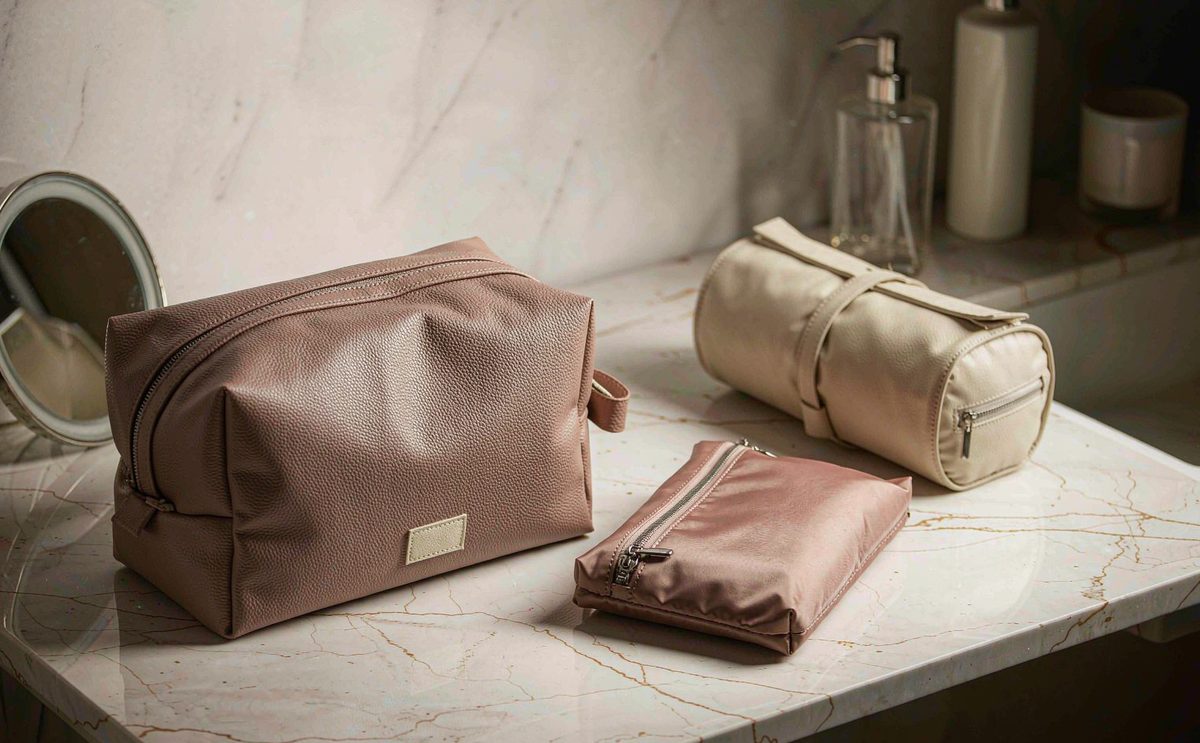
Material is the decision that a backer feels first and the one creators most often leave until the quotation comes back too high. That is backwards, because material determines the cleanability, the structure, the decoration route, the packing volume and roughly a quarter of the unit cost. Changing it later means a re-sample, and a re-sample on a beauty programme means another 6-10 working days. Decide it first, from the tests in this guide rather than from a swatch board.
- Minimum order quantity
- 500 pcs per style / colourway
- Sampling
- 6-10 working days (12-15 for complex builds)
- Bulk production
- 35-50 days after deposit + approved pre-production sample
- Inspection
- AQL 2.5 to ISO 2859-1
- Trade term
- FOB Xiamen
- Payment
- T/T 30/70
- Production floor
- 4,950 m2 SGS-verified, 137 staff, 7 lines, 149 machines
- Monthly capacity
- 200,000 pcs per month
- Programme contact
- service@junyuanbags.com
The three material families and what each one actually is
The naming in this category is loose enough to cause real specification errors, so it is worth being precise at the start. Vegan leather in this context almost always means polyurethane, or PU: a polymer coating applied to a fabric backing, embossed with a grain pattern. It contains no animal product, which is the basis of the claim, and its behaviour is governed by the grade of the polyurethane and by the backing it is applied to.
TPU is thermoplastic polyurethane, a different polymer with different properties: clearer, more elastic, more resistant to hydrolysis and more expensive. It appears in three forms on a beauty bag, and they are not interchangeable. A TPU film is a solid sheet, used for clear panels and for welding. A TPU coating is applied to a woven base to make it wipe-clean. A TPU laminate is a film bonded to a fabric, which behaves differently from either.
Woven fabric is the third family and the broadest: polyester, nylon, recycled polyester and canvas, in a range of deniers and weaves, usually with some coating. It is the cheapest, the lightest, the most printable and the least stain-resistant of the three. Recycled polyester has become the default in this group because it supports a GRS-certified claim without a large cost premium.
Two naming traps sit inside those definitions. First, vegan leather is a claim about content, not about performance, and a low-grade PU will behave worse than a good coated woven fabric on almost every measure except structure. Second, PU leather and TPU are both polyurethanes and they are frequently quoted as if they were the same thing. They are not, and the difference shows up in cleanability and in how the material behaves after two years. Our custom cosmetic bags pillar sets out how each enters a sourcing brief.
Vegan leather: PU, and the grades that matter
PU is the default premium choice for a beauty bag because it reads as expensive, holds a shape and wipes clean. It is also the material most likely to be substituted, because two PU fabrics that look identical on a swatch card can differ substantially in coating weight, in backing and in hydrolysis resistance. Three specification lines separate a good PU from a bad one, and all three belong in the technical pack.
| Specification line | Typical figure | What it controls |
|---|---|---|
| Coating weight | 0.6-1.2 mm total thickness | Structure, crease resistance and hand feel |
| Backing fabric | Knit, woven or non-woven | Tear strength and how the seam behaves |
| Hydrolysis resistance | Stated test result or grade | Whether the surface flakes after 2-4 years |
| Grain pattern | Embossed; specify the reference | Appearance and scratch visibility |
| Colour fastness | To rubbing, wet and dry | Whether dye transfers onto other items |
Hydrolysis resistance is the one that matters most and the one least often specified. Polyurethane degrades in the presence of moisture and warmth, and the failure mode is a surface that becomes tacky and then flakes, typically appearing two to four years after manufacture. The rate depends heavily on the grade. A standard-grade PU in a humid bathroom environment will fail materially sooner than a hydrolysis-resistant grade, and the difference is invisible at sampling.
The mitigation is to specify the grade and to ask for the test result rather than for a description. Where a beauty bag will live in a bathroom, which most do, a hydrolysis-resistant PU is a justified cost, and it is the difference between a product that generates a re-order and one that generates a complaint in year three. If the budget will not stretch to it across the whole bag, use it on the outer shell and a coated woven lining inside.
Colour fastness to rubbing deserves a note because it is specific to this product. A beauty bag sits in a handbag or a suitcase next to light-coloured items, and dye transfer from a dark PU shell is a complaint that is difficult to resolve after delivery. Specify a fastness grade to wet and dry rubbing, confirm the test method, and check it at inspection by rubbing a white cloth against the surface of drawn units under a defined pressure.
TPU: film, coating and laminate are three different things
TPU is the most technically capable of the three materials and the most frequently mis-specified, because film, coating and laminate are quoted as if they were one product. They are not. A TPU film is a solid sheet with no fabric substrate; it is the material used for clear panels and for radio-frequency or heat welding, and it has no tear strength of its own in the way a coated fabric does.
| Form | Construction | Used for | Key property |
|---|---|---|---|
| TPU film | Solid sheet, no substrate | Clear panels, welded compartments | Weldable; genuinely watertight seams |
| TPU coating | Applied to a woven base | Wipe-clean shell or lining | Cleanability with fabric tear strength |
| TPU laminate | Film bonded to a fabric | Structured panels, wipe-clean faces | Structure plus cleanability |
| Clear TPU panel | Film, usually 0.2-0.5 mm | Liquids compartments, ID windows | Transparency; check yellowing |
The practical consequence is that the form determines the seam. A TPU film can be welded, which produces a genuinely watertight seam and is the correct choice for a wet compartment or a liquids panel. A TPU-coated woven fabric cannot be welded in the same way and has to be sewn, which means the needle holes are a leak path. Specify the form by what the seam needs to do, not by the material name.
Yellowing is the second specification point for clear TPU. A clear panel used for a liquids compartment is the selling feature of the product, and a panel that yellows in service undermines it. TPU resists yellowing considerably better than PVC, but grades differ, and exposure to heat and to some cosmetics accelerates it. Ask for the grade, ask what test supports the claim, and keep an approved sample stored under the same conditions for comparison at the next run.
Cost is the constraint. TPU is the most expensive of the three material families, typically 20-45 per cent above a standard PU of equivalent thickness, and clear film grades more again. The usual resolution is a hybrid: a TPU-coated or laminated face where cleanability matters, a PU or woven shell elsewhere, and a TPU film only where a welded seam or transparency is genuinely needed. That hybrid is where most well-specified beauty bags land.
Woven fabric: polyester, nylon, rPET and canvas
Woven fabric is the cheapest, the lightest and the most design-flexible of the three, and it is the right answer more often than creators expect. Its weakness is stain resistance: an uncoated woven lining will absorb foundation and pigment permanently. The specification response is almost always a coating, and once a woven fabric is coated, the decision becomes about the coating chemistry rather than about the base cloth.
| Base fabric | Typical denier | Usual coating | Best for |
|---|---|---|---|
| Polyester | 300D, 420D, 600D | PU | Default; best cost to performance |
| Nylon | 210D, 420D, 500D | PU or TPU | Higher abrasion resistance; softer hand |
| Recycled polyester | 300D, 600D | PU | GRS-certifiable recycled claim |
| Cotton canvas | 10 oz, 12 oz, 16 oz | Usually none or a light finish | Natural aesthetic; stains readily |
| Ripstop nylon | 70D, 210D | PU or silicone | Ultralight; packs smallest |
Recycled polyester is the default in this group for a specific reason: it carries a GRS-certifiable claim at a modest cost premium, and that claim is increasingly requested by retail buyers and by backers in the beauty category, where sustainability claims are scrutinised more closely than in most bag categories. If you plan to make the claim, certify the specific material and keep the certificate reference with the technical pack.
Canvas deserves a caution. It looks good in photography, it takes print well and it has a natural aesthetic that suits beauty branding, and it stains permanently. A canvas makeup bag will show foundation marks within weeks and cannot be wiped clean. If the aesthetic is worth that trade-off, specify a light finish for resistance and say on the campaign page that the bag is spot-clean only. Do not describe a canvas bag as wipe-clean.
The coating is where the specification work sits. A PU-coated woven gives wipe-clean performance at the lowest cost. A TPU-coated woven gives better cleanability and better cold-flex behaviour at a premium. A PVC-coated woven is the cheapest and it crazes at repeated creases, which matters on any bag that folds. Specify the coating by type and by weight, and require a fold-flex check at sampling on whichever you choose.
Cleanability compared: pigment, oil and alcohol
Cleanability is the performance measure that matters most on a beauty bag and the one most often assumed rather than tested. Three contaminant classes behave differently: pigment from pressed powder and eyeshadow, oil from foundation and primers, and alcohol from setting sprays and some removers. A material that handles one well may handle another badly, and the test protocol should cover all three separately.
| Material | Pigment | Oil | Alcohol |
|---|---|---|---|
| PU vegan leather | Very good; wipes clean | Good; may need a mild cleaner | Fair; can dull the surface over time |
| TPU film or laminate | Excellent | Excellent | Very good; most resistant of the three |
| Woven, PU-coated | Good | Fair; oil can mark if left | Fair; can affect the coating |
| Woven, uncoated | Poor; absorbs | Poor; permanent | Poor; spreads the stain |
| Canvas | Poor; absorbs | Poor; permanent | Poor |
The test protocol that turns that table into something you can rely on is simple and it takes one afternoon. Apply a defined quantity of each contaminant to a sample swatch, leave it for a defined period, wipe with a defined cloth and a defined cleaner, and then grade the residue against a reference photograph. Do it on the production material with the production coating, not on a generic swatch from a different run.
- Cut three swatches of the production material, at least 10 x 10 cm, and mark a control area on each.
- Apply a measured amount of pressed powder, a liquid foundation and an alcohol-based setting spray to separate zones.
- Leave for four hours at room temperature, which is close to a realistic exposure in a handbag.
- Wipe once with a dry cloth, once with a damp cloth, and photograph the result against the control area.
- Grade the residue on a three-point scale and record the photographs with the technical pack revision number.
- Repeat the test on drawn units at inspection, because coating batches vary.
The last item matters more than the first five. A coating batch that differs slightly from the sampling batch will produce a different cleanability result, and the difference will not appear in any visual inspection. Including a cleanability spot check on drawn units at pre-shipment costs the inspector two minutes and catches the drift that otherwise surfaces as a review three months after delivery.
Structure and shape retention
Structure is the second performance measure, and it is the one that most determines whether a beauty bag reads as premium. A bag that holds its shape empty looks considered; a bag that collapses looks cheap, and it photographs badly, which on a crowdfunding page is a serious problem. The three materials differ sharply here and the difference is not fully correctable with interlining.
| Material | Natural structure | Typical interlining | Result |
|---|---|---|---|
| PU vegan leather | Good; holds a shape well | Light or none | Structured with minimal build-up |
| TPU film | Poor; floppy on its own | Laminate to a fabric or a board | Structured once laminated |
| Woven, 600D | Low-moderate | Foam or board on the base and faces | Structured with build-up |
| Woven, 300D | Low | Foam on all faces | Structured but heavier than it looks |
| Ripstop nylon | Very low | Minimal; the point is packability | Deliberately unstructured |
The cost consequence is worth stating plainly. A woven bag can be made to hold a shape, but it needs foam laminate or board on the faces and the base, which adds material, adds labour minutes and narrows the cost advantage over PU. By the time a 300D woven shell has enough interlining to hold a shape like a PU shell, the unit cost difference has largely closed and the woven version is heavier. That is the point at which PU becomes the better value.
There is a photography consequence too, and it is specific to a crowdfunding campaign. Reward photography on a Kickstarter or Indiegogo page is usually shot with the bag standing, and a bag that slumps reads as poor quality regardless of its actual construction. If your photography plan depends on the bag standing unaided, structure is a page-design requirement rather than a nice-to-have, and it should push you toward PU or a laminated TPU.
Decoration compatibility by material
Decoration and material interact more than most creators expect, and the wrong pairing is usually discovered at sampling when the aesthetic has already been fixed. The three constraints are: heat transfer requires a surface that tolerates the press temperature, embroidery requires a substrate with enough tear strength to hold the stitch, and sublimation requires a polyester base. Each material family rules something out.
| Route | PU vegan leather | TPU | Woven fabric |
|---|---|---|---|
| Embroidery | Good; use a ballpoint needle and a backing | Possible; perforation risk on film | Excellent; the default |
| Heat transfer | Limited; heat can damage the surface | Limited; check the melt point | Excellent on polyester |
| Screen print | Good with the right ink | Fair; adhesion varies | Excellent |
| Sublimation | Not applicable | Not applicable | Excellent; needs a polyester base |
| Debossed or embossed logo | Excellent; heat or pressure | Excellent with heat | Poor; no definition |
| Woven label | Good | Good | Excellent |
Debossing is the route most creators overlook and it is the one that produces the most premium result on PU. A heat-pressed or high-frequency deboss leaves a permanent impression in the surface with no ink and no thread, and it reads as expensive in a way that printing does not. It requires a tooling charge, which is amortised across the run, and it should be quoted in the original request rather than added later, because the tooling has a lead time of its own.
The perforation risk on TPU film is the second point worth isolating. Embroidery punches holes, and on a film used for a waterproof compartment those holes are leak paths. If a logo has to sit on a welded TPU panel, use a heat-applied patch or a separate label tab sewn into the seam rather than embroidering through the panel. That is a small design adjustment that preserves the waterproofing the panel was specified for.
Whichever combination you choose, approve decoration on the production material rather than on a swatch card, under standard lighting, and against a physical reference for the brand colour. This matters more in beauty than in most categories, because the audience compares the logo against the brand colour they see on screen daily, and a shade drift is read as a quality problem. Our sample prototyping route sets out the approval record to keep.
Weight, packability and the freight impact
Material weight sounds like a detail and it compounds across a 500 pcs run through two channels: the product weight itself and the packing volume. A PU beauty bag is typically 25-45 per cent heavier than an equivalent woven bag, which affects perceived quality positively and shipping cost negatively. A structured bag of any material packs larger than an unstructured one, and because a beauty bag is a light bulky product it bills closer to its dimensional weight than its actual weight.
| Specification | Unit weight | Packs flat? | Freight note |
|---|---|---|---|
| Woven, unstructured | 90-150 g | Yes | Lowest volume; best freight |
| Woven, foam-lined | 180-280 g | Partly | Moderate volume |
| PU vegan leather, unstructured | 160-240 g | Yes | Low volume; heavier per unit |
| PU vegan leather, structured | 280-450 g | No | Highest volume and weight |
| TPU laminate, structured | 300-480 g | No | Highest volume; premium tier only |
Read that table together with the reward price. On a premium tier the freight penalty is absorbable, because a structured PU bag supports a higher price and the freight is a smaller share of it. On an entry tier or an add-on, the unstructured woven version is almost always right, because it packs flat, weighs less and keeps the landed cost inside a margin that a USD 29 reward can sustain.
There is a packing specification lever that applies to all three: pieces per carton. A bag that nests or folds flat may allow three to five units per carton rather than one or two, and the volumetric freight saving across a 500 pcs run is substantial. Confirm the pieces per carton at quotation stage with the actual folded dimensions, because it is the cheapest freight lever available and it is decided by the pattern rather than by the carrier.
Cost comparison and where the money goes
Material is typically 18-30 per cent of the unit cost on a beauty bag, which makes it the second largest line after labour. That means a material change has a real but bounded effect: switching from a premium PU to a coated woven might reduce the unit cost by 8-14 per cent, which is meaningful but rarely transformative. The larger cost levers are construction complexity and decoration, which is why material should be chosen for performance and then cost-managed elsewhere.
| Cost line | Indicative share | What moves it |
|---|---|---|
| Shell and lining material | 18-30% | Material family, coating, denier, recycled content |
| Interlining and structure | 6-14% | Foam, board, laminate, panel count |
| Cutting and sewing labour | 28-38% | Panel count, compartment count, binding |
| Decoration | 8-18% | Method, tooling, placements, set-up amortisation |
| Hardware and trims | 8-14% | Zip reference, puller, label type |
| Packing and cartons | 4-8% | Pieces per carton, polybag, inserts |
| Overhead, QC and margin | 8-16% | Inspection level, defect allowance, testing |
The levers, in the order that usually works: reduce compartment count before changing material, because each internal division is a panel, a seam and labour minutes. Simplify the binding and the trim package. Reduce decoration placements from three to two. Then, if the figure is still above target, look at material grade within the same family rather than at a different family, because a change of family usually means a re-sample.
One cost note specific to tooling. A debossed logo on PU, a custom zip puller and a custom moulded component all carry tooling charges, amortised across the run. At 500 pcs those charges are a visible per-unit figure; at 2,000 pcs they largely disappear. If a premium component is central to the design, quote it across the likely re-order quantity as well as the launch quantity, because the per-unit tooling figure on the second run is what makes the economics work. The crowdfunding bag guide covers the re-order mechanics.
Durability expectations and the failure mode of each
Every material in this category has a characteristic failure mode, and knowing them in advance is what makes a defect class list useful. They are worth stating plainly because they determine what your inspection plan should look for, and because two of the three appear well after the campaign has closed.
| Material | Failure mode | When it appears | Prevention |
|---|---|---|---|
| PU vegan leather | Surface becomes tacky then flakes | 2-4 years; faster in humidity | Specify a hydrolysis-resistant grade |
| PU vegan leather | Crease whitening at folds | Months | Test fold-flex; choose a softer grade |
| TPU film | Yellowing under heat and UV | 1-3 years | Specify the grade; store an approval reference |
| TPU coating | Delamination from the base fabric | 6-18 months | Specify the bond and check adhesion |
| Woven, coated | Coating crazing at folds | 6-18 months | Avoid PVC; test fold-flex |
| Woven, uncoated | Permanent staining | First use | Use a coating; never claim wipe-clean |
The two that appear late, PU hydrolysis and TPU yellowing, are the reason a retained approval sample matters. Keep the approved pre-production unit stored under known conditions, and compare a unit from each subsequent run against it. A drift in surface feel or in clarity is visible in a side-by-side comparison years later even when it was invisible at inspection, and without the reference unit there is nothing to compare against.
The crease-whitening failure on PU is the one most relevant to a first run, because it can appear within months and it will be photographed. It happens where the material is folded sharply in use or in packing, and it is a function of the grade and of the coating weight. The prevention is a fold-flex check at sampling: fold a swatch through 180 degrees twenty times and inspect the crease for whitening under standard light.
- Specify the material by grade and reference, not by a generic name such as PU leather.
- Ask for the test result that supports a hydrolysis or yellowing claim rather than for a description.
- Run a fold-flex check at sampling on any coated or laminated material.
- Keep the approved pre-production unit as a stored reference for future run comparisons.
- Include a cleanability spot check and a surface-feel check on drawn units at inspection.
Inspection runs to AQL 2.5 under ISO 2859-1, drawing fifty units on a 500 pcs lot with acceptance at three defects and rejection at four. The material-specific defect classes to add are surface tackiness or flaking, shade variation within a colourway, coating crazing at a fold, clarity or haze in a transparent panel, and odour above an agreed level. The last one matters on coated materials in particular, because a coating or adhesive that has not fully cured will concentrate in a sealed carton over four to six weeks. Our Kickstarter campaign bag QA and QC pillar covers how to write these classes into a plan.
The side-by-side sampling test
The most useful thing you can do at sampling is ask for the same bag in two or three materials. It costs an extra sampling round, it typically adds 6-10 working days, and it answers in an afternoon the questions that a month of discussion will not. The protocol below is what to do with the three units once they arrive, and it is designed to be executed with things you already have.
- Photograph all three standing empty, from the same angle and in the same light. This is the shape-retention test and the page-photography test at once.
- Weigh each one and record the figure. This is the freight proxy.
- Load each with the same kit, close it, and record whether the closure meets without pressure.
- Run the three-contaminant cleanability test on a hidden area of each unit.
- Fold each one as it would be packed, twenty times, and inspect the crease for whitening or crazing.
- Leave all three in a warm humid room for a week and re-check the surface feel and the clarity.
- Handle each for two minutes with product on your hands, then clean it and photograph the result.
The fifth and sixth items are the ones that predict the late failures, and they are the reason to run the side-by-side at all. A grade difference that is invisible on day one becomes obvious after twenty folds or a week of humidity, and discovering it during sampling costs a material change. Discovering it after production costs the campaign.
Record everything with the technical pack revision number and keep the three units. They become the approval reference, the comparison standard for the next run, and the physical evidence for the campaign page. Most creators discard samples once the page is built, which is why the second batch so often differs from the first. Keeping them costs a shelf.
Choosing by campaign type, not by preference
The decision is rarely about which material is best, because all three are good at something. It is about which material matches the tier, the audience and the price. The table below is the shortcut we would give a creator at the start of a brief, and it is arranged by the situation rather than by the material.
| Situation | Recommended material | Why |
|---|---|---|
| Entry tier or add-on under USD 35 | Coated woven, unstructured | Lowest cost, packs flat, lowest freight |
| Standard reward at USD 49-89 | PU vegan leather, light structure | Premium read, holds shape for photography |
| Premium tier above USD 99 | PU with a TPU wet zone | Structure plus genuine waterproofing |
| Clear liquids compartment needed | TPU film panel, welded | Only genuinely watertight option |
| Sustainability-led brand | GRS-certified rPET, PU-coated | Certifiable claim at modest premium |
| Print-led or pattern-led design | Woven polyester, sublimated | Only route to all-over print |
| Bathroom-humidity market | Hydrolysis-resistant PU or TPU | Avoids the tacky-then-flaking failure |
Two of those rows are worth pulling out. The print-led row: if the design is an all-over pattern, woven polyester with sublimation is the only route, and no amount of preference for a leather look will change that. The sustainability-led row: if a recycled claim is central to the brand, rPET with a GRS certificate is the only defensible version, and the certificate has to cover the specific material rather than the factory generally.
When the choice is genuinely close, break the tie on photography, because that is the constraint a crowdfunding page imposes and no other selling channel does. A bag that stands unaided, photographs cleanly and shows its internal organisation in a flat-lay will outperform a better-feeling bag that slumps in a picture. That usually means light structure, which usually means PU or a laminate, and it is the reason PU dominates the standard reward tier in this category.
Whatever you choose, state it accurately on the campaign page. Vegan leather is an accurate description of PU. Waterproof means something specific and should only be used where a welded seam supports it. Wipe-clean is the honest term for a coated woven. A travel kit with a welded compartment and a makeup pouch with a coated lining are not the same claim, and the audience in this category checks. Where a programme is planning the formats around the material, the makeup bag sizing guide and the toiletry kit ladder cover the dimension and tier decisions that follow.
- Custom cosmetic bags for Kickstarter campaigns
- Crowdfunding bag sample prototyping
- Kickstarter campaign bag QA and QC
- Kickstarter Makeup Bags: 6 Sizes Backers Use
- Custom Toiletry Bags for Crowdfunding
- Crowdfunding bag guide
- Request a quotation
Compare the materials before you commit the run
Send us the format, the tier, the cleanability requirement and your target quantity. As your production partner we will quote two material routes, sample them side by side at 6-10 working days, and book a 35-50 day production window. Write to service@junyuanbags.com.
Frequently Asked Questions
What is the best material for a Kickstarter beauty bag?
It depends on the tier. Coated woven for an entry tier under USD 35 because it packs flat and costs least; PU vegan leather for a standard reward at USD 49-89 because it holds shape for photography; and PU with a TPU wet zone above USD 99 where genuine waterproofing is required. Confirm the choice with a side-by-side sampling round before the production run is committed.
What is the MOQ for a custom beauty bag?
500 pcs per style and per colourway. If you want to compare two materials, that is two commitments unless both are sampled and one is selected, which is why a side-by-side sampling round at 6-10 working days is worth the extra calendar time before the run starts. Ask whether two materials can be sampled from one pack before the colourway is fixed.
Is vegan leather the same as PU?
In this category almost always yes: a polyurethane coating on a fabric backing, embossed with a grain pattern. Vegan leather is a content claim rather than a performance claim, and two PU grades that look identical on a swatch card can differ substantially in hydrolysis resistance. Specify the coating weight, the backing and the hydrolysis grade rather than the generic name.
What is the difference between PU and TPU?
Both are polyurethanes with different properties. TPU is clearer, more elastic, more hydrolysis-resistant and more cold-flexible, typically costing 20-45 per cent more. TPU also welds, which produces genuinely watertight seams, whereas PU generally has to be sewn, leaving needle holes as a leak path. Choose TPU where the seam has to be watertight and PU where structure matters more.
How do I avoid PU flaking after a few years?
Specify a hydrolysis-resistant grade and ask for the test result rather than for a description. Polyurethane degrades with moisture and warmth, and in a bathroom environment a standard grade can become tacky and then flake within two to four years, well after the campaign has closed. A hydrolysis-resistant grade is a justified cost on a bag that will live in a bathroom.
Which material cleans best?
TPU, across pigment, oil and alcohol. PU vegan leather is very good on pigment and good on oil. A PU-coated woven is good on pigment and only fair on oil, because oil can mark if it is left. Uncoated woven and canvas perform poorly on all three and should never be described as wipe-clean. Test all three contaminant classes separately, because a material can handle one and fail another.
How much of the unit cost is material?
Typically 18-30 per cent, making it the second largest line after labour. Switching material family might reduce unit cost by 8-14 per cent, so reduce compartment count and decoration placements first and change the material last, because a change of family usually means a re-sample. Reduce compartment count first, because each internal division is a panel, a seam and labour minutes.
Should I sample the bag in two materials?
Yes, if the choice is close. It adds 6-10 working days and answers in an afternoon what a month of discussion will not. Fold-test, humidity-test, clean-test and weigh all three, then keep them as the approval reference for the next production run. Keep the three units as the approval reference and the comparison standard for the next run.
How do I test cleanability before committing?
Apply pressed powder, liquid foundation and an alcohol-based setting spray to separate zones of a production swatch, leave four hours, wipe with a dry cloth then a damp one, and grade the residue against a control area. Repeat the same test on drawn units at inspection. Run it on the production material with the production coating, not on a generic swatch.
Does material choice affect freight?
Yes. A structured PU bag is typically 25-45 per cent heavier than an equivalent woven one and does not pack flat, and a beauty bag bills closer to its dimensional weight than its actual weight. Confirm pieces per carton at quotation stage using the actual folded dimensions. Confirm pieces per carton at quotation stage using the actual folded dimensions of the bag.
Can a woven fabric hold its shape like PU?
With enough interlining, yes, but the cost advantage largely disappears and the bag gets heavier. By the time a 300D woven shell is stiff enough to match a PU shell, PU is usually the better value, which is why it dominates the standard reward tier. The gap narrows once interlining is added, which is why PU dominates the standard reward tier.
Is a recycled claim defensible on a beauty bag?
Yes, with GRS certification covering the specific material rather than the facility generally. Recycled polyester with a PU coating carries the claim at a modest premium, and retail buyers increasingly request the certificate reference during procurement rather than after it. Expect the certificate reference to be requested during procurement rather than after the order. Keep the certificate reference with the technical pack so it can be supplied on request.
People Also Ask
What is vegan leather made of?
In bag manufacturing it is almost always polyurethane, a polymer coating on a fabric backing embossed with a grain. It is a content claim rather than a performance claim, so grades vary widely in durability.
Is TPU better than PU for a makeup bag?
For cleanability and longevity, yes: TPU resists oil and alcohol better, welds into watertight seams, and resists hydrolysis. It costs 20-45 per cent more, so most programmes use it only where those properties are needed.
How long does PU vegan leather last?
A standard grade in a humid environment can become tacky and flake within two to four years. A hydrolysis-resistant grade lasts substantially longer, which is why the grade belongs in the specification rather than in the costing exercise.
Can I print a pattern on vegan leather?
All-over printing needs sublimation, which requires a polyester base. On PU you can screen print or deboss, but an all-over pattern means a woven polyester shell instead.
Which material is cheapest?
Coated woven polyester, typically 20-40 per cent below PU of equivalent structure. The gap narrows once you add interlining, because a woven shell needs more build-up to hold the same shape.
Do I need a waterproof or a wipe-clean bag?
Wipe-clean is enough for most makeup bags. Waterproof requires welded seams and a coated zip, which only TPU supports, and it is only needed where the bag carries full-size liquid containers.
How do I compare materials before ordering?
Sample the same bag in two or three materials, then fold-test, humidity-test, clean-test and weigh each one. It adds 6-10 working days and prevents the material mistakes that only appear months later.