Custom Wet-Dry Gym Bags for Crowdfunding: The Shoe Pocket Question
The shoe pocket is the feature that decides whether a wet-dry gym bag works, and it fails in a predictable way: it is sealed, it stays damp, and it smells by week three. A compartment that works needs both ventilation and a drainage route, a welded or coated liner rather than a stitched one, and a position that does not let wet weight pull the bag out of shape. Budget 6-10 working days for sampling and 35-50 days for bulk production at 500 pcs per style and per colourway, and specify the liner, the vent aperture and the drain route as measurable lines rather than as a feature name.
- What backers mean when they ask for a wet compartment
- Ventilation, drainage and the sealed-compartment trap
- Liner materials: TPU, PEVA and coated polyester compared
- Where the shoe pocket goes and why position changes everything
- Waterproof versus water-resistant: writing a claim you can defend
- Odour, cleaning and the second-month review
- Hardware in a wet zone: zips, mesh and corrosion
- Testing the compartment before you approve the sample
- Cost impact of a wet-dry build
- Photography: showing separation without a cutaway
- The inspection plan for a wet compartment
- Spec sheet lines for a wet-dry gym bag
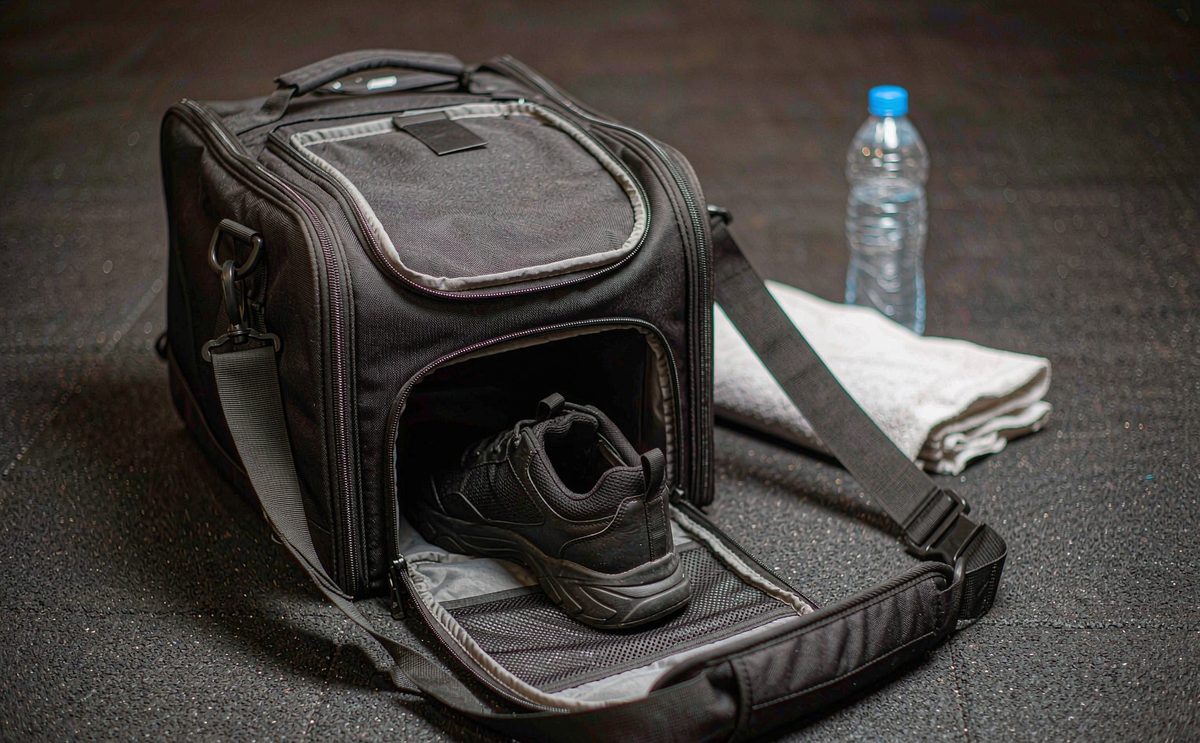
Ask any gym audience what they want in a bag and a separating compartment for wet kit appears in the first three answers. Ask the same audience what went wrong with the last bag they bought and damp smells appear in the first three complaints. Those two facts describe the same design problem, and it is the problem this article is about. A wet-dry gym bag is not a bag with an extra pocket; it is a bag with a moisture management system, and the difference shows up in the specification, in the unit cost and in the reviews that arrive two months after delivery.
- Minimum order quantity
- 500 pcs per style / colourway
- Sampling
- 6-10 working days (12-15 for complex builds)
- Bulk production
- 35-50 days after deposit + approved pre-production sample
- Inspection
- AQL 2.5 to ISO 2859-1
- Trade term
- FOB Xiamen
- Payment
- T/T 30/70
- Production floor
- 4,950 m2 SGS-verified, 137 staff, 7 lines, 149 machines
- Monthly capacity
- 200,000 pcs per month
- Campaign experience
- 20+ crowdfunding campaigns supported
Key takeaways on wet-dry specification
- Ventilation alone is not enough; a sealed compartment with a vent still stays damp without a drainage route.
- Specify the liner as welded or high-frequency sealed rather than stitched, because needle holes leak.
- Put the shoe compartment low and near the base so wet weight does not pull the bag out of shape.
- Write water-resistant rather than waterproof unless you have a hydrostatic head test result to support the stronger claim.
- Test the compartment on the sampling unit with genuinely wet kit, not with a dry shoe.
What backers mean when they ask for a wet compartment
The request is almost always phrased as a feature and is almost always a complaint in disguise. A backer who asks for a wet compartment has previously carried a wet towel, a sweaty training top or a pair of muddy shoes in the same space as a clean change of clothes, a phone and a laptop, and has arrived at work with all of it damp. What they want is not a pocket; it is the certainty that the wet thing cannot touch the dry things.
That certainty has three components, and campaigns that deliver only one of them get mediocre reviews. The first is physical separation, which is the pocket itself. The second is containment, meaning moisture cannot migrate through the liner into the main compartment. The third is drying, meaning the compartment returns to a neutral state between uses rather than staying permanently damp. Most budget gym bags deliver the first and fail the third, which is why the complaint is about smell rather than about leakage.
The audience also splits on what goes in the compartment, and the split matters for the design. Shoe carriers want a rigid, wipe-clean, ventilated space sized to a stated shoe length. Towel and costume carriers want a soft, fully lined, sealable space that can hold a genuinely wet item without dripping. Those are different constructions. Decide which one your reward is for and say so on the campaign page, because a bag that does both adequately usually does neither well. Our custom gym bags for Kickstarter pillar page sets out how the format choice is made.
Ventilation, drainage and the sealed-compartment trap
The most common design error in this category is a compartment that is sealed for containment but has no way to shed water. A welded liner with a single small vent panel will keep the main compartment dry and will keep the shoe compartment wet for days. Damp plus darkness plus organic material is the exact recipe for odour, and odour is the complaint that appears in month two rather than on the packing line.
The specification answer is to treat ventilation and drainage as separate requirements. Ventilation moves air, which requires an aperture high on the compartment, because warm moist air rises. Drainage removes liquid, which requires an aperture at the lowest point of the compartment, plus a route for that liquid to leave the bag rather than pool in a seam. A mesh panel does the first job. A grommet, a drain channel or a removable liner does the second.
There is a third element that gets overlooked: the compartment has to be dryable by the user. If the compartment cannot be opened wide, turned partly inside out or wiped, the user will not dry it and the smell returns regardless of the engineering. Design the opening to at least 180 degrees of access, specify a liner surface that wipes rather than absorbs, and state the cleaning instruction on the care label. These are cheap decisions and they are the ones that show up in five-star reviews.
| Element | Job it does | Specification line |
|---|---|---|
| Welded or sealed liner | Contains liquid | Seam type: welded or high-frequency, not stitched |
| High vent aperture | Moves moist air out | Mesh panel area and position on the compartment |
| Low drain aperture | Removes liquid | Grommet or channel at the lowest point, with a route out |
| Wide opening | Lets the user dry it | Opening angle or zip span stated in the spec |
| Wipe-clean liner surface | Prevents absorption | Liner material and finish named |
| Care instruction | Sets user behaviour | Wipe and air-dry instruction on the label |
Liner materials: TPU, PEVA and coated polyester compared
The liner is where wet-dry bags succeed or fail, and the choice is between three families of material. TPU film or TPU-coated fabric gives the best balance of flexibility, abrasion resistance and sealability, welds cleanly by high frequency, and stays flexible in cold conditions. It is the most expensive of the three and it is the one most often specified on products that are expected to last several years.
PEVA and EVA films are cheaper and weld acceptably, but they are more prone to cracking at fold points over time and they stiffen in cold conditions. For a reward that will be used in a cold climate, or folded for storage, that is a real limitation. Coated polyester is the cheapest route and the most familiar to sew, but a coated fabric still has stitched seams unless it is seam-sealed afterwards, and needle holes are the most common leak path in this category.
The decision that matters more than the material is the seam. A stitched seam in a wet compartment leaks at the needle holes, which is why welded or high-frequency sealed seams are specified on the compartment even when the rest of the bag is sewn. That hybrid construction, sewn shell with a welded compartment, costs more than an all-sewn build and less than a fully welded one, and it is the structure most gym rewards in this category end up using. Confirm which seams are welded in the specification, not just that the bag has a wet pocket.
| Material | Relative cost | Sealing method | Service behaviour |
|---|---|---|---|
| TPU film or TPU-coated fabric | Highest | High-frequency or hot-air weld | Flexible in cold; best abrasion resistance |
| PEVA or EVA film | Low to mid | High-frequency weld | Cheaper; can crack at folds and stiffen when cold |
| Coated polyester | Lowest | Sewn, then seam-sealed | Familiar to sew; needle holes are a leak path unless sealed |
| Nylon with PU coating | Mid | Sewn plus seam tape | Good strength; coating can hydrolyse over years |
| Removable TPU liner bag | Mid to high | Welded, loose component | Best drying behaviour; adds a loose part to pack |
Where the shoe pocket goes and why position changes everything
Position is the least discussed and most consequential decision in a wet-dry design. A shoe compartment at the base keeps weight low and stable, which is what you want when the contents are heavy and damp. A compartment at one end is easier to access and easier to photograph, but it puts asymmetric weight at one end of a bag that is designed to be carried from the middle, and a full shoe compartment at one end makes a duffel sit badly on the shoulder.
There is also a contamination question. A compartment that shares a wall with the main compartment transfers moisture and odour through that wall over time, especially if the shared wall is the bag base and the bag is set down on a wet floor. The better structure gives the wet compartment its own outer wall, so the barrier between wet and dry is a single dedicated panel rather than a shared structural one. That adds a panel and therefore cost, and it is worth it.
Sizing follows the largest shoe in the target range rather than an average. State the largest size the compartment accepts, then add 2 to 3 cm of clearance, and publish that number on the campaign page. Shoe length varies substantially across a size range, and a compartment that fits a size 9 but not a size 12 generates the same complaint as no compartment at all from the person who wears a 12. Our custom sports bags for Kickstarter pillar page covers kit-driven dimension planning.

Waterproof versus water-resistant: writing a claim you can defend
Waterproof and water-resistant are different claims with different evidence requirements, and using the stronger word without the test to support it is the fastest route to a complaint and, in some markets, to a regulatory problem. Water-resistant usually means the fabric and construction shed light moisture for a defined period. Waterproof implies a tested barrier, normally expressed as a hydrostatic head figure in millimetres, measured to a stated standard.
For a gym bag, the honest and defensible claim is almost always water-resistant, and it can be made specific: the wet compartment liner is welded and seam-sealed to contain moisture from damp kit, and the shell fabric is treated to shed light rain. That is accurate, it is testable, and it sets the right expectation. A hydrostatic head figure for the shell, if you want one, should come from a test report on the actual fabric rather than from a general claim about the material family.
There is a related claim to be careful with: antimicrobial or anti-odour treatments. These are regulated differently by market, and in the United States an antimicrobial claim on a treated article can fall under pesticide registration rules administered by the EPA, while in the European Union biocidal product rules apply. If you want that claim, raise it at quotation stage so the right documentation is quoted and obtained, rather than adding it to the campaign page after production. Our production team flags this at specification stage for exactly that reason.
Odour, cleaning and the second-month review
Odour is a design outcome, not a user error. It develops where moisture, organic material and limited airflow coincide, and once it has developed in a lining it is very difficult to remove. The specification levers are the ones already covered: a welded liner that does not absorb, a vent at the top, a drain at the bottom, and an opening wide enough to dry. A fourth lever is material choice for the liner surface, where a smooth finish resists both absorption and bacterial retention better than a textured one.
Cleaning behaviour deserves a line in the specification and a line on the care label. A compartment designed to be wiped needs a surface that wipes, which rules out some textured linings and some open-cell foams. A compartment designed to be rinsed needs a drain route that actually exits the bag rather than a channel that ends in a seam. State the intended cleaning method in the spec so the material can be chosen against it, and repeat it on the label so the user follows it.
Then test it on the timescale that matters. A bag that smells fine after one wet use and unpleasant after ten has failed, and the only way to find that out before committing to 500 pcs is to run a damp-cycle test on the sampling unit: introduce genuinely wet kit, close the compartment, leave it for the period a real user would, and repeat. Our sample prototyping page sets out the measurement record to capture at this gate, including odour assessment by more than one person.
- Specify a smooth liner surface if the compartment is meant to be wiped clean.
- Confirm the drainage route exits the bag rather than ending in a seam.
- Run a ten-cycle damp test on the sampling unit before you approve the pre-production sample.
- Have two people assess odour; one nose is not a test method.
- State the cleaning method on the care label, not only in the campaign copy.
- Avoid antimicrobial claims unless the documentation has been quoted and obtained.
Hardware in a wet zone: zips, mesh and corrosion
A wet compartment is a hostile environment for hardware, and hardware failure here is more annoying than almost anywhere else on the bag because it is the failure that lets water out. Zips come first. A standard coil zip with a painted slider will corrode and stiffen in a damp compartment, and a stiff slider is a zip that gets forced and then fails. Specify a corrosion-resistant slider and puller, name the zip reference rather than the size, and consider a reverse-coil construction with a covered tape for the compartment opening.
Mesh is the second item. Vent panels are usually mesh, and mesh has two failure modes in this position: it frays at a raw edge, and it abrades through at the point where a shoe sole rests against it. Both are specification problems with cheap answers. Bind or weld the mesh edge rather than leaving it raw, and choose a mesh denier and aperture that resists abrasion from a hard sole rather than the cheapest open mesh available.
Grommets and drain hardware are the third item. A drain grommet set into a coated fabric needs a washer or reinforcement behind it, because the fabric around a hole in a damp, loaded compartment will tear out over time. Specify the reinforcement, and include a pull test on the grommet in the inspection plan. These are small components and they are the ones that generate the support tickets, which is why our inspection plans for this category weight them as critical rather than as minor.
| Component | Failure mode | Specification response |
|---|---|---|
| Zip slider and puller | Corrosion and stiffening | Corrosion-resistant finish; named zip reference |
| Zip tape | Wicking moisture along the seam | Reverse coil with covered tape or a sealed tape option |
| Vent mesh | Fraying at raw edges | Bound or welded edge; no raw mesh edge |
| Vent mesh | Abrasion from a hard sole | Higher denier mesh with a stated aperture |
| Drain grommet | Tear-out under load | Reinforcement washer behind the grommet |
| Liner seam | Leak at needle holes | Welded or high-frequency sealed seam, not stitched |
Testing the compartment before you approve the sample
Most sampling approvals are visual. A wet-dry bag cannot be approved that way, because every failure in this category is functional and time-dependent. Build a short test protocol into the sampling gate and run it on the actual sampling unit. It takes an afternoon and it is the cheapest insurance available before a 35-50 day bulk window starts.
The protocol has five steps. Load the compartment with genuinely wet kit and stand the bag upright for the period a user would leave it. Check the main compartment for moisture transfer with a dry tissue pressed against the shared wall. Open the compartment and assess odour after one cycle and again after ten. Run the zip fifty times under a light load. Pour a measured volume of water into the compartment and confirm it exits through the intended route rather than pooling.
- Load the compartment with genuinely wet kit, not with a dry shoe or a folded towel.
- Stand the bag as a user would and leave it for a realistic period between sessions.
- Press a dry tissue against the wall shared with the main compartment and check for transfer.
- Assess odour after cycle one and again after cycle ten, with more than one person checking.
- Run the compartment zip fifty times under light load and check for smoothness and alignment.
- Pour a measured volume of water in and confirm it exits through the stated drain route.
- Record results against the sample identification and attach them to the approval.
Record the results and attach them to the written sample approval. That record becomes the reference for the pre-shipment inspection, because an inspector can repeat a functional test on a drawn sample far more reliably than they can judge whether a bag looks as it should. Our QA and QC page shows how functional checks are written into an AQL 2.5 plan.
Cost impact of a wet-dry build
A wet-dry gym bag costs more than the same bag without the compartment, and the increase is concentrated in three places. The liner material is more expensive than a standard lining, particularly in TPU. The welded seam operation requires equipment and operator time that a sewn seam does not, and it is usually a separate station in the production sequence. And the additional panel needed to give the compartment its own outer wall adds cut pieces, sewing minutes and material.
In broad terms, expect the wet compartment to add a meaningful but survivable amount to unit cost, most commonly in the range of 10 to 20 per cent depending on liner choice and seam method. That is a directional range rather than a quote, because the actual figure depends heavily on whether the compartment is welded or sewn-and-taped, and on whether it shares a wall with the main compartment. Welded plus a dedicated outer wall is the expensive end of the range and the best-performing.
The question is whether the audience pays for it, and in the gym category they generally do. A separating compartment is one of the few bag features that backers will name unprompted in a review and one of the few that justifies a tier price increase on its own. Spend the money on the liner and the seam, and save it elsewhere: an elaborate internal organiser panel is less likely to be mentioned than a compartment that kept a clean shirt dry. See kickstarter fitness merchandise for how feature spend maps to perceived value.
Photography: showing separation without a cutaway
A wet-dry bag has a marketing problem that a backpack does not: the feature that sells it is invisible in a closed product shot. Campaigns respond with a cutaway render, which backers have learned to distrust, or with a paragraph of copy, which converts poorly. The better answer is a sequence of photographs that show the feature being used, because a compartment with a shoe in it is self-explanatory in a way that a diagram is not.
Shoot four images minimum. The compartment open and empty, showing the liner and the vent. The compartment loaded with the largest shoe size you claim to fit, which answers the sizing question before it is asked. The compartment open alongside the main compartment, showing dry kit on one side and wet kit on the other. And a close-up of the drain or vent detail, because it is the image that signals the bag was engineered rather than assembled.
Shoot them on the approved pre-production sample, not on a render or on an earlier prototype. Backers compare the delivered product against the campaign photography, and a vent position that moved between prototype and production is a discrepancy that will be noticed. Keep the sample you photographed as the physical reference for inspection, so the reference used by the inspector and the reference used in the campaign are the same object.

Add a short video if the budget allows, because it answers the question photography cannot: whether the compartment is genuinely separate when the bag is closed and carried. Ten seconds of the bag being loaded wet on one side and dry on the other, then zipped and picked up, does more than any still. Where video is not possible, a single frame of the closed bag with the wet compartment outlined in the caption is an acceptable substitute, provided the caption is honest about what is being shown.
The inspection plan for a wet compartment
Pre-shipment inspection to AQL 2.5 to ISO 2859-1 draws a statistically determined number of units and checks them against defect classes you define. For a wet-dry bag the classes that matter are functional, because the failure modes are functional. A visual inspection of a welded seam will not find a channel that leaks; a water test on a drawn sample will.
Write the classes before production starts, in the purchase order, and require the report to be issued before the 70 per cent balance is released under T/T 30/70. Agree in advance who pays for re-inspection, because a rework cycle typically adds 10-15 days to a calendar that has no slack at this stage. Request an in-line check during the sewing window as well, because a defect trend found at that point can still be corrected.
| Defect | Class | Check method |
|---|---|---|
| Liner seam leak | Critical | Water test on a defined number of drawn units |
| Drain route blocked or absent | Critical | Pour test through the stated route |
| Zip corrosion or stiff operation | Critical | Run every zip end to end under light load |
| Vent mesh raw or frayed edge | Critical | Visual and pull check on every exposed mesh edge |
| Grommet tear-out | Critical | Pull test on reinforcement behind the grommet |
| Odour present on delivery | Major | Odour assessment against the approved sample |
| Shade variation within the run | Major | Compare with the approved sample under standard light |
| Carton quantity error | Major | Count check against the packing list |
Spec sheet lines for a wet-dry gym bag
The specification is where a wet-dry reward is won or lost, because the difference between a compartment that works and one that smells is five lines of detail. Write these lines as measurable statements with tolerances, not as feature names. A line that says waterproof lining cannot be verified and therefore cannot be inspected; a line that says welded TPU liner, seam sealed, 500 mm hydrostatic head can be both quoted and checked.
- Liner material named by type and thickness, with the seam method stated as welded or high-frequency sealed.
- Vent aperture: panel area, position on the compartment and mesh denier and aperture.
- Drain route: aperture type, position at the lowest point and the exit path out of the bag.
- Shoe compartment internal dimensions, derived from the largest shoe size you will claim to fit.
- Zip reference for the compartment opening, with a corrosion-resistant slider and puller.
- Opening angle or zip span, to confirm the compartment can be opened wide enough to dry.
- Care instruction text, stating wipe and air-dry, for the sewn-in label.
- Inspection standard and defect classes, including the water test and the odour assessment.
Send those lines as one document with the quantity, the trade term and the destination market, and you will receive a unit cost, a sampling estimate of 6-10 working days and a production window of 35-50 days in one exchange. If you are weighing a wet compartment against other feature spend, our gym bag pillar page sets out the full decision framework, and the MOQ article covers what a small campaign can commit to. When the specification is ready, send us a brief through the quote request page.
Frequently Asked Questions
What makes a shoe compartment actually work in a gym bag?
Three elements together: a welded or sealed liner that contains liquid, a vent aperture high on the compartment to move moist air, and a drain route at the lowest point that exits the bag. Most budget bags have the liner but not the drain, which is why the complaint is about smell rather than leakage. Add a wide opening so the user can dry it.
Should the wet compartment be ventilated or sealed?
It needs both, doing different jobs. Ventilation at the top moves warm moist air out. A sealed welded liner contains liquid so nothing reaches the main compartment. The mistake is a sealed compartment with a small vent and no drainage route: it keeps the main compartment dry and stays damp itself for days.
Which liner material is best for a wet compartment?
TPU film or TPU-coated fabric is the best-performing option: it welds cleanly by high frequency, resists abrasion and stays flexible in cold conditions. PEVA is cheaper but can crack at folds and stiffen when cold. Coated polyester is cheapest but leaks at needle holes unless the seams are taped after sewing.
Can I call my gym bag waterproof?
Only with a test result to support it. Waterproof implies a measured barrier, normally a hydrostatic head figure in millimetres tested to a stated standard. Water-resistant is the honest and defensible claim for most gym bags, and it can be made specific by describing the welded liner and the treated shell separately.
How much does a wet compartment add to unit cost?
Indicatively 10 to 20 per cent, depending on the liner and seam method. The increase comes from three places: the liner material, the welded seam operation which needs its own equipment and station, and the extra panel needed to give the compartment its own outer wall. Welded plus a dedicated wall is the expensive end and the best-performing.
Where should the shoe compartment be positioned?
Low, near the base, and ideally with its own outer wall. A low position keeps heavy damp weight stable. A dedicated outer wall means the barrier between wet and dry is one panel rather than a shared structural one, which reduces moisture transfer over time. An end-position compartment is easier to photograph but makes a duffel sit badly on the shoulder.
How do I size a shoe compartment?
Size it to the largest shoe in your target range, not to an average, then add 2 to 3 cm of clearance. Publish the largest size the compartment accepts on the campaign page. A compartment that fits a size 9 but not a size 12 generates the same complaint as no compartment from the person who wears a 12.
How do I stop a wet compartment from smelling?
Design it out rather than treating it. A smooth welded liner that does not absorb, a vent at the top, a drain at the bottom and an opening wide enough to dry will prevent most odour. Then test it: run a ten-cycle damp test on the sampling unit before you approve it, because one wet use tells you nothing.
What hardware fails first in a wet compartment?
Zips and grommets. A painted slider corrodes and stiffens in a damp compartment, and a stiff slider gets forced and then fails. A drain grommet set into coated fabric tears out unless there is a reinforcement washer behind it. Name the zip reference, specify a corrosion-resistant finish and pull-test the grommet at inspection.
How should I test the compartment on the sampling unit?
Run five checks: load it with genuinely wet kit and leave it upright; press a dry tissue against the shared wall to check for transfer; assess odour after one cycle and after ten; run the zip fifty times under load; pour a measured volume of water in and confirm it exits the stated route. Record results against the sample identification.
What inspection standard suits a wet-dry gym bag?
AQL 2.5 to ISO 2859-1, with functional defect classes defined before production starts: liner seam leak by water test, blocked drain route by pour test, zip operation under load, mesh edge condition and grommet pull strength. Require the report before releasing the 70 per cent balance under T/T 30/70.
Are antimicrobial or anti-odour claims safe to use?
Be careful. Antimicrobial claims on treated articles are regulated by market; in the United States they can fall under EPA pesticide registration rules and in the European Union under biocidal product rules. Raise the claim at quotation stage so the right documentation is quoted and obtained rather than added to the campaign page after production.
People Also Ask
Why does my gym bag shoe pocket smell?
Because it is sealed and has no drainage route. Damp plus darkness plus organic material produces odour. The fix is a vent at the top, a drain at the bottom and a welded liner that does not absorb.
Is TPU better than PEVA for a wet compartment?
Generally yes. TPU welds cleanly, resists abrasion and stays flexible in cold conditions. PEVA is cheaper but can crack at fold points and stiffen when cold.
Can a wet compartment be stitched?
It can be sewn and then seam-sealed with tape, but needle holes are the most common leak path. A welded or high-frequency sealed seam is the safer specification for the compartment itself.
What size shoe should a gym bag shoe pocket fit?
The largest in your target range, plus 2 to 3 cm of clearance. Publish that number, because sizing is one of the most common pre-pledge questions.
Is a wet-dry bag waterproof?
Usually water-resistant, which is the defensible claim. Waterproof needs a hydrostatic head test result on the actual fabric, not a general statement about the material family.
How much extra does a wet compartment cost?
Indicatively 10 to 20 per cent of unit cost, from the liner material, the welded seam operation and the extra panel for a dedicated outer wall.
How do I photograph a wet compartment?
Four shots on the approved sample: open and empty, loaded with the largest shoe, side by side with dry kit, and a vent or drain detail. Avoid cutaway renders.