International Backer Shipping: Currency, Zones and Cost Tables
International bag shipping is not priced by the freight quote. Landed cost per backer adds duty, tax, handling, packaging and failed deliveries, and typically runs 40 to 90 percent above freight alone. Bags are billed on volumetric weight with a divisor of 5,000, so packing method drives cost more than product weight. Use DDP into high-refusal markets and DDU where backers expect to pay, model currency at a 5 percent adverse assumption across the T/T 30/70 payment events, and add 6 to 10 percent contingency. This page gives the zone structure, the mode comparison and an indicative cost table.
- Start with the landed cost model, not the freight quote
- Shipping zones: how carriers slice the world for parcels
- Dimensional weight and why bags are penalised
- Freight modes: postal, courier, air freight and sea freight compared
- DDP versus DDU: who owns the duty bill
- Duty and VAT on bags: HS codes and de minimis thresholds
- Currency exposure between pledge and payment
- A cost table by zone for a 1.2 kg bag parcel
- Consolidation, hubs and the regional injection trick
- Customs paperwork that actually gets parcels released
- Building the shipping line into the reward price
- What to put in the shipping section of the campaign page
Start with the landed cost model, not the freight quote
The most common budgeting error in international bag fulfilment is treating the freight quote as the shipping cost. It is not. A freight quote covers movement from one point to another. The number that decides whether your campaign is profitable is landed cost per backer, which is freight plus duty plus tax plus handling plus packaging plus the share of any failed delivery, and it is one line of the wider rewards fulfilment plan rather than a standalone number. and it is typically 40 to 90 percent higher than the freight line alone.
Build the model as a single sheet with one row per destination country or zone and columns for each cost element. It takes an afternoon and it is the artefact that lets you answer the two questions that actually decide reward pricing: can I offer free shipping to this country, and what happens to margin if the currency moves 8 percent before I pay the freight bill.
The model also exposes a structural fact that surprises first-time creators: the cheapest country to ship to is usually not the cheapest country to serve. A destination with low freight but a 25 percent import VAT and a 150 EUR de minimis threshold can be more expensive per backer than a destination with higher freight and no threshold, once duty is included. Only a landed model shows this.
Work the model in one currency and convert at the end. Mixing currencies inside a landed cost sheet is the fastest route to a wrong answer, because each line converts at a different date and the errors compound silently. Pick the currency you collect pledges in as the base, and treat every foreign cost as a converted input with a noted rate and date.
Shipping zones: how carriers slice the world for parcels
Carriers do not price by distance. They price by zone, and zones are commercial constructs that group destinations by the carrier's own cost to serve. Two countries 400 km apart can sit in different zones; two countries 9,000 km apart can sit in the same one. Understanding this is what stops creators from assuming that a cheap rate to Germany implies a cheap rate to Poland.
For parcel work out of Asia, the groupings most creators meet are broadly: domestic origin, Greater China and nearby Asian markets, other Asia-Pacific, Western Europe, North America, Eastern Europe and Nordics, Latin America, Middle East and Africa, and remote or extended-area surcharge destinations. The exact numbering differs by carrier, so always work from the specific rate card rather than a generic table.
Two surcharges deserve particular attention because they are routinely missed in budgeting. The remote area surcharge applies to postcodes the carrier considers expensive to reach, and it can add 18 to 40 USD to a single parcel. The extended dimension surcharge applies above certain length or girth thresholds and hits duffels and travel bags especially hard. Ask for both lists up front and check your backer postcodes against them.
Zone is also the input that decides whether regional consolidation is worth it. If 70 percent of your backers fall into two zones, injecting parcels into a hub inside each zone almost always beats shipping 1,000 individual parcels from origin. The break-even usually sits around 250 parcels into a single zone, below which the fixed cost of the consolidation move dominates.
Dimensional weight and why bags are penalised
Bags are the worst-shaped product in e-commerce. They are light, bulky and compressible, which means carriers bill them on volumetric weight rather than actual weight in most cases. The standard divisor is 5,000 for volumetric weight in centimetres, so a parcel measuring 40 x 30 x 25 cm bills as 6 kg of volumetric weight even if the physical weight is 1.1 kg.
The implication for bag campaigns is direct: how you pack the bag matters more than what the bag weighs. A backpack packed flat and folded rather than stuffed to shape can reduce the billed weight by 30 to 50 percent, which on an international parcel is worth several dollars per unit. This is why packaging design and freight cost must be decided together rather than by two different people.
| Packing method | Parcel height | Volumetric weight | Indicative freight delta |
|---|---|---|---|
| Stuffed to shape with void fill | 28 cm | 6.7 kg | Baseline |
| Folded flat, no insert | 16 cm | 3.8 kg | Minus 25 to 40 percent |
| Compressed in a vacuum pack | 11 cm | 2.6 kg | Minus 45 to 60 percent |
| Flat-pack product design | 8 cm | 1.9 kg | Minus 60 to 70 percent |
Vacuum packing deserves a caveat. It works well on soft totes and duffels and badly on structured backpacks, because compressing a foam-backed panel for three weeks can leave a permanent crease. Test it on 10 units through a full transit cycle before committing 1,000. If a product is genuinely designed to ship flat, that is a far better answer than any packing trick, and several flat-pack bag designs are built around exactly this.
Freight modes: postal, courier, air freight and sea freight compared
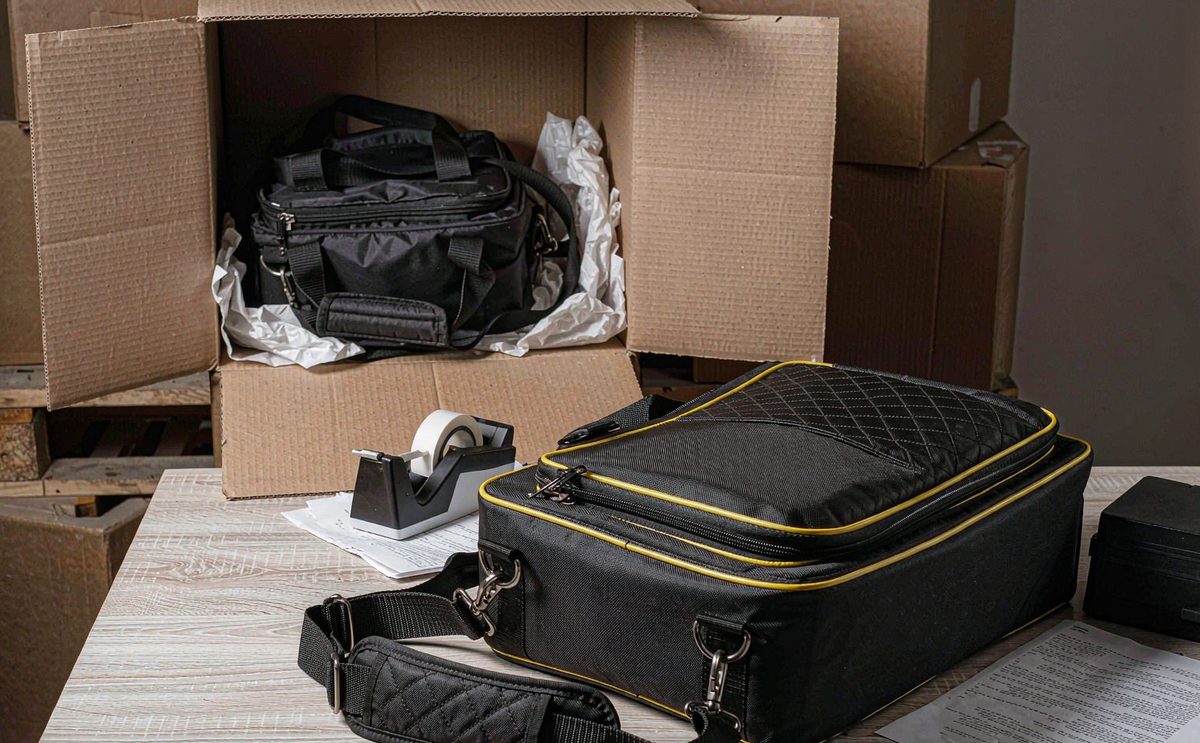
Four modes cover almost every bag campaign, and they are not interchangeable. Postal parcel services are cheapest for single small parcels under 2 kg and offer the widest coverage, at the cost of slower and less reliable tracking. Courier services cost more and give reliable tracking, customs brokerage and faster transit. Air freight moves consolidated bulk to a hub. Sea freight moves cartons in volume at the lowest cost per unit over the longest transit.
The selection logic is a function of parcel count and urgency. Below roughly 200 parcels spread thinly, postal or a courier economy service is usually right. Between 200 and 1,500 parcels concentrated in a few zones, air freight into a regional hub followed by domestic injection usually wins. Above 1,500 parcels with a known destination mix, sea freight to a fulfilment warehouse plus domestic parcel delivery is cheapest and slowest.
Transit times matter as much as cost, because they determine whether you hit the delivery date promised on the campaign page. Indicative ranges from origin: postal 12 to 35 days, courier economy 6 to 12 days, air freight plus injection 9 to 16 days including handling, and sea freight 28 to 45 days plus 3 to 7 days for deconsolidation and domestic delivery.
One practical rule saves a great deal of grief: never quote a single transit number. Quote a range on the campaign page, quote the worst case to yourself, and plan the dispatch date backwards from the worst case. A campaign that promises 4 weeks and delivers in 5 is a success. A campaign that promises 3 weeks and delivers in 5 is a failure, even though the physical performance is identical.
DDP versus DDU: who owns the duty bill
Under DDU (delivered duty unpaid) the backer receives a bill from the carrier before delivery and must pay duty and tax to release the parcel. Under DDP (delivered duty paid) you collect and remit those charges in advance and the backer receives the parcel with nothing further to pay. The choice is one of the highest-leverage decisions in international fulfilment.
DDU is cheaper for the creator and worse for the backer. A backer surprised by a 28 EUR charge on delivery frequently refuses the parcel, which returns it to you at your cost and leaves you with an unfulfilled pledge and a damaged good. Refusal rates on DDU parcels into Europe run 4 to 12 percent, and each refusal costs freight both ways plus handling.
DDP removes the surprise and therefore the refusal, at the cost of cash flow and administration: you pay the duty and tax up front and reclaim nothing. On a 1,000-backer campaign with a 60 USD declared value and an average 22 percent combined duty and VAT rate, that is roughly 13,000 USD of duty and tax sitting in your working capital for one to three months before the parcels even ship.
The pragmatic answer most campaigns land on is DDP into the markets with high refusal risk (most of Europe, Brazil, India) and DDU into the markets where backers expect to pay and refusal rates are low (usually the United States, Canada, Australia and Japan). Declare the choice per country on the campaign page, not globally, and price shipping per zone accordingly.
Duty and VAT on bags: HS codes and de minimis thresholds
Bags are classified under Harmonized System chapter 42, and the specific heading depends on the outer surface material and the construction. A bag with an outer surface of textile material sits in a different heading from one of leather or of plastic sheeting, and the duty rate differs. Getting the classification wrong is not a paperwork nicety; it changes the duty bill on the entire shipment.
Duty rates on textile bags into major markets typically run between 3 and 20 percent of declared value, while VAT or goods and services tax runs 0 to 27 percent depending on destination. What matters as much as the rate is the de minimis threshold, the value below which no duty or tax is collected. These thresholds vary enormously and have changed repeatedly in recent years, so verify current values with your broker rather than relying on a table in an article.
Declared value strategy is where creators get into trouble. Under-declaring to slip under a threshold is customs fraud, it is detected more often than creators assume, and the penalty is seizure plus a fine plus a delay measured in months. Declare the actual transaction value, which for a crowdfunding reward is the pledge amount for that reward tier, and keep the documentation to support it.
If you sell into the European Union after the campaign, look at the import one-stop shop scheme for consignments below 150 EUR, which lets you collect and remit VAT at the point of sale rather than at import. It simplifies the backer experience considerably, but it requires registration and it applies to goods sold into the EU, so confirm the treatment of rewards specifically with an adviser before relying on it.
Currency exposure between pledge and payment
A crowdfunding campaign collects money in one currency and pays costs in another, often six to eleven months apart. Between those two moments the exchange rate moves, and for a campaign with thin margins that movement can erase the profit. Campaigns collecting in USD and paying freight and duty in USD while producing in Asia have a specific exposure: the production currency moves against the collection currency.
The exposure is bigger than most creators model because of timing. Pledges arrive at campaign close. The deposit, typically 30 percent under T/T 30/70 terms, goes out shortly after sample approval. The balance, the remaining 70 percent, goes out at or before shipment. Freight and duty are paid at dispatch. That is a nine to twelve month window with three separate payment events, each exposed.
Three mitigations are practical at campaign scale. First, price rewards with an explicit FX assumption stated in the model, such as a 5 percent adverse movement, rather than at the spot rate on the day you build the spreadsheet. Second, if the campaign collects in multiple currencies, match them to costs where possible rather than converting everything immediately. Third, for campaigns above roughly 200,000 USD of projected reward value, speak to your bank about a forward contract on the largest payment event.
There is a simpler structural mitigation that costs nothing: shorten the gap. Every month between pledge collection and production payment is a month of exposure. A campaign that approves its sample quickly, pays the deposit and moves into bulk inside the 35 to 50 day production window has far less exposure than one that spends four months in revision. Speed is a hedging strategy, and it is free.
A cost table by zone for a 1.2 kg bag parcel
The table below is indicative and is meant to show structure rather than to be quoted to backers. It models a single reward parcel with a folded backpack, volumetric weight around 4 kg, declared value 60 USD, shipped DDP into Europe and DDU into North America. Rates move constantly, so treat these as planning bands and replace them with live quotes during the campaign.
| Zone | Freight | Duty and tax | Handling | Landed cost |
|---|---|---|---|---|
| United States, DDU | 9 to 16 USD | 0 to 4 USD | 1.50 USD | 11 to 22 USD |
| Canada, DDU | 12 to 20 USD | 2 to 9 USD | 1.50 USD | 16 to 31 USD |
| Western Europe, DDP | 14 to 24 USD | 11 to 20 USD | 2.50 USD | 28 to 47 USD |
| Nordics, DDP | 18 to 30 USD | 14 to 24 USD | 2.50 USD | 35 to 57 USD |
| Australia and NZ, DDU | 16 to 27 USD | 3 to 11 USD | 1.80 USD | 21 to 40 USD |
| Latin America, DDP | 22 to 38 USD | 16 to 30 USD | 3.00 USD | 41 to 71 USD |
| Middle East and Africa | 24 to 42 USD | 12 to 28 USD | 3.00 USD | 39 to 73 USD |
Two things jump out of that structure. The first is that landed cost into some zones approaches or exceeds the manufacturing cost of the reward itself, which is why flat shipping to all countries is almost always a losing strategy. The second is the spread between the low and high figures, which is 100 percent or more in every row. That spread is the real argument for per-zone shipping charges rather than a single global price.
Note also that these figures exclude the replacement and returns reserve. A parcel that has to be sent twice costs twice, and the zones with the highest landed cost are exactly the zones where a failed delivery is most expensive. Build the reserve as a percentage of landed cost rather than of product cost.
Consolidation, hubs and the regional injection trick
Regional injection means moving parcels in bulk to a hub inside the destination region, breaking the bulk, and handing individual parcels to a domestic carrier for the last leg. It converts an expensive international parcel into a cheap consolidated freight move plus a cheap domestic parcel, and the saving on a 1,000 parcel campaign into one region is routinely 30 to 55 percent.
The mechanics are straightforward. Cartons travel by air or sea freight to a deconsolidation facility. The facility breaks them, applies domestic labels generated from your manifest, and injects into the local network. Tracking then continues on a domestic number, which backers usually prefer because it works with the national postal service they already use.
The catch is fixed cost and lead time. Setting up injection into a new region involves a manifest format, a label specification, a customs entry and usually a minimum volume, often 150 to 300 parcels. Transit adds 3 to 7 days for deconsolidation. Below the volume threshold, direct international parcel service is simpler and usually cheaper once you count the setup labour.
A useful middle option for smaller campaigns is a fulfilment warehouse in the largest market holding stock shipped by sea freight. This is what most campaigns that go on to sell at retail end up doing, and it turns the leftover buffer inventory into a working asset. It also makes returns and replacements dramatically cheaper, because a replacement becomes a domestic shipment.
One cost in consolidation is routinely missed: the hub handling fee charged per parcel for receiving, breaking bulk and re-labelling, typically 0.80 to 2.40 USD. It is small per unit and large in aggregate, and it is the line that decides whether injection beats direct service on marginal lanes. Always ask for it separately rather than accepting a single blended rate, because a blended rate hides the comparison you are trying to make.
Customs paperwork that actually gets parcels released
Customs delays are almost always paperwork delays, and the paperwork for bags is not complicated. Three documents do the work: a commercial invoice showing seller, buyer, description, quantity, unit value, total value, HS code and country of origin; a packing list matching the invoice line by line; and, for consolidated freight, a bill of lading or airway bill tying the cartons together.
The single most common rejection is a description that is too vague. "Bag" is not a description. "Polyester backpack, 18 litre, style number XYZ, country of origin as declared" is a description. Vague descriptions trigger manual inspection, and manual inspection on a consolidated shipment costs days and sometimes a full container examination fee.
The second most common is a mismatch between the invoice, the packing list and the physical carton count. Carriers and customs authorities check this routinely, and a discrepancy of one carton can hold 200. Build the packing list from the same data that generated the labels, never retype it, and reconcile carton count at the door before the truck leaves.
Declare country of origin accurately and consistently. For bags made in China and shipped from FOB Xiamen, the origin declaration is China and the port of export is Xiamen. Conflating the two is a frequent and avoidable error that causes problems particularly into markets with origin-specific duty programmes.
Keep a document pack per lane rather than per shipment. Each lane has a hub, a broker and a carrier, and each will ask for the same three documents in a slightly different format. Building the pack once per lane and reusing it with updated quantities removes most of the scrambling that happens at dispatch, and it means the person who understands the format is not the person packing the cartons.
Building the shipping line into the reward price
Once the landed model exists, pricing becomes arithmetic. Three structures are common, and each has a failure mode. Free shipping is the strongest converter and the largest risk, because it is only safe when the shipping cost is inside the margin across every zone. Flat global shipping is simple and loses money on the expensive zones. Per-zone shipping is the most accurate and adds friction at checkout.
The hybrid most campaigns converge on is free shipping into the two or three largest zones, with a visible per-zone charge elsewhere, and the charge set at or slightly below the modelled landed cost. This protects margin where volume is high and converts well where it matters, while keeping the tail honest.
Add a contingency line of 6 to 10 percent to every shipping figure. Freight rates on the lanes that serve crowdfunding move significantly within a year, fuel surcharges are adjusted monthly, and peak season surcharges appear between October and January without much notice. A campaign that ships in Q4 without a peak surcharge line in its model will be surprised.
Finally, price shipping on the worst case configuration, not the average. The heaviest tier with the most add-ons into the most expensive zone is the number that determines your worst case. If the reward ladder makes that number unacceptable, the answer is to restrict the heaviest configuration in that zone rather than to average it away.
Revisit the model at three fixed moments: when the survey closes and the real destination mix is known, when freight is booked and rates are live, and after the first dispatch wave when actual landed cost replaces estimates. Three revisions of an existing model take an hour each. Discovering at wave three that your price was built on an estimate that no longer holds is a much more expensive way to learn the same thing.
What to put in the shipping section of the campaign page
The shipping section is read more carefully than any other part of a campaign page, because it is where backers look for reasons not to pledge. State five things plainly: which countries you ship to, whether shipping is included or charged, whether duty and tax are included, the estimated delivery month rather than a date, and how address changes are handled.
Name the exclusions explicitly. If you are not shipping to a country, say so on the page rather than in a comment three weeks later. Backers in excluded countries who discover the exclusion after pledging are the most vocal complaint source in crowdfunding, and the fix costs one sentence before launch.
Include the duty position in words a non-specialist understands. "Import duty and VAT are included for EU backers" is clear. "Shipped DDP to selected destinations" is not. Backers do not know the acronym, and ambiguity here is read as a hidden charge waiting to appear.
Close with the delivery estimate as a month, not a date, and add one sentence about what happens if it slips. Campaigns that state their communication commitment in advance, such as an update every two weeks during fulfilment, consistently receive fewer angry comments when something does go wrong.
Send us your destination mix and tier weights, and our campaign bag specialist will model landed cost per zone before you set reward prices.
Add a line about address changes and cut-off dates, because it is the highest volume support request in the whole campaign and it is entirely self-service if the process is stated. Name the date after which addresses cannot be changed, tell backers how to change them before that date, and repeat it in the dispatch notification.
Frequently Asked Questions
What is the difference between a freight quote and landed cost?
A freight quote covers movement between two points. Landed cost adds duty, tax, handling, packaging and a share of failed deliveries, and typically runs 40 to 90 percent above the freight line. Only landed cost tells you whether a reward tier is profitable, so build one row per zone with a column for each element. Build the model in one currency and convert at the end, because mixing currencies inside a landed cost sheet compounds errors silently.
Should I ship DDP or DDU to international backers?
Use DDP into markets with high refusal risk such as most of Europe, Brazil and India, because an unexpected 28 EUR charge on delivery produces refusal rates of 4 to 12 percent. Use DDU where backers expect to pay and refusal is rare, such as the United States, Canada, Australia and Japan. Declare the choice per country. Ask for a hub handling fee as a separate line, typically 0.80 to 2.40 USD per parcel, since a blended rate hides the comparison you need.
Why is my bag billed at 6 kg when it weighs 1.2 kg?
Because carriers bill volumetric weight on bulky light goods. A 40 x 30 x 25 cm parcel divides by 5,000 to give 6 kg of volumetric weight. Packing the bag folded rather than stuffed can cut billed weight by 30 to 50 percent, which is why packaging and freight must be designed together. Test any compression method on ten units through a full transit cycle before committing a thousand, because foam-backed panels can crease permanently.
How do I protect the campaign against currency movement?
Model rewards with an explicit 5 percent adverse assumption rather than the spot rate, shorten the gap between pledge collection and production payment, and consider a forward contract on the largest payment event above roughly 200,000 USD of reward value. Under T/T 30/70 there are three exposed payment events over nine to twelve months. Note the rate and the date against every converted cost line, so a later review can see which figures moved because of FX and which moved because of cost.
Can I declare a lower value to avoid import duty?
No. Under-declaring is customs fraud, it is detected more often than creators expect, and the consequence is seizure, a fine and a delay measured in months. Declare the actual transaction value, which for a reward is the pledge amount for that tier, and keep the documents to support it. Remember that on a consolidated entry the exposure scales with the whole shipment rather than with one parcel, which raises the stakes considerably.
When is regional injection worth the setup?
Usually above about 150 to 300 parcels into a single region, below which the fixed setup cost dominates. Above that threshold, consolidated freight plus domestic injection typically saves 30 to 55 percent against individual international parcels, at the cost of 3 to 7 extra days for deconsolidation. Reassess the threshold after the survey closes, because the real destination mix usually differs from the mix assumed during campaign design.
What paperwork do I need to clear customs on a bag shipment?
A commercial invoice with description, quantity, unit value, HS code and country of origin, a packing list matching it line by line, and an airway bill or bill of lading for consolidated freight. Vague descriptions such as bag alone trigger manual inspection, so be specific about material and style number. Keep a document pack per lane and reuse it with updated quantities, rather than rebuilding three documents under time pressure at dispatch.
How much should I add to shipping figures for contingency?
Add 6 to 10 percent. Freight rates on crowdfunding lanes move materially within a year, fuel surcharges adjust monthly, and peak season surcharges appear between October and January. A Q4 dispatch without a peak surcharge line in the model will be surprised by the invoice. Revisit the model when the survey closes, when freight is booked, and after the first dispatch wave replaces estimates with actuals.
Should I offer free worldwide shipping?
Rarely. Free shipping into the two or three largest zones plus a visible per-zone charge elsewhere is the structure most campaigns converge on. Flat global shipping loses money on the expensive zones, where landed cost of 39 to 73 USD per parcel can approach or exceed the manufacturing cost. Free shipping into two or three zones with visible charges elsewhere is the structure most campaigns converge on after their first run.
What is the HS code for a bag and why does it matter?
Bags fall under HS chapter 42, with the heading depending on outer surface material and construction. Textile, leather and plastic sheeting surfaces are classified differently and carry different duty rates. Getting it wrong changes the duty bill on the whole shipment, so confirm the heading with a broker. Confirm the heading with a broker before the campaign closes, because a classification error discovered at entry affects every parcel in the shipment.
What are remote area and oversize surcharges?
Remote area surcharges apply to postcodes a carrier considers expensive to serve and can add 18 to 40 USD per parcel. Extended dimension surcharges apply above length or girth thresholds and hit duffels and travel bags hardest. Request both lists up front and check backer postcodes against them. Run the backer list against both lists before labels are printed, since a surcharge discovered after dispatch cannot be recovered.
How should I state delivery timing on the campaign page?
Give a month rather than a date, plan backwards from the worst case transit figure, and add one sentence committing to an update cadence during fulfilment. A campaign promising four weeks and delivering in five is a success; one promising three and delivering in five is not, despite identical physical performance. State an address change cut-off date as well, which removes the highest volume support request in the whole campaign.
People Also Ask
What does landed cost include?
Freight, duty, tax, handling, packaging and a share of failed deliveries. It typically runs 40 to 90 percent above the freight quote alone, and it is the only figure that tells you whether a reward tier makes money in a given country.
Why do two neighbouring countries have different shipping costs?
Carriers price by commercial zone rather than distance, grouping destinations by their own cost to serve. A cheap rate to Germany says nothing about Poland. Always work from the specific rate card of the carrier you intend to use.
What is volumetric weight?
The billed weight calculated from parcel dimensions rather than scales, usually by dividing cubic centimetres by 5,000. Light bulky goods like bags are almost always billed volumetrically, which is why packing method drives freight cost.
Is DDP always better than DDU?
No. DDP removes refusal risk but ties up duty and tax cash for one to three months. The pragmatic answer is DDP into high-refusal markets and DDU where backers expect to pay and refusal rates are low.
How much is import duty on a bag?
Textile bags typically attract 3 to 20 percent duty depending on destination and classification, plus VAT or GST of 0 to 27 percent. De minimis thresholds determine whether anything is collected at all, and they change frequently, so verify current values with a broker.
When should a campaign use sea freight?
Above roughly 1,500 parcels with a known destination mix, where 28 to 45 days of transit plus 3 to 7 days for deconsolidation is acceptable. Below that, air freight into a regional hub or direct parcel service usually wins.
How do I stop customs holding my shipment?
Write specific descriptions naming material, capacity and style number, keep the packing list identical to the invoice, reconcile carton count before the truck leaves, and declare country of origin separately from port of export.
Should shipping be free or charged per zone?
A hybrid works best: free into the two or three largest zones, visible per-zone charges elsewhere set at or slightly below modelled landed cost. Flat global shipping loses money on the expensive tail.