MOQ Negotiation for Bags: Where a Minimum Can Flex and Where It Cannot
A bag minimum of 500 pcs per style and per colourway is a published commercial threshold, and roughly half of it is negotiable while the other half is physics. Flexible: a trim-driven colour split inside one fabric lot, a combined total across two sizes, sample fee credit against bulk, deposit structure and delivery splitting. Structural: mill dye lots at 1,000 to 3,000 metres, label minimums at 500 to 1,000 pieces per artwork, tooling at USD 300 to 900, and line setup of two to four hours. This guide separates the two, gives the four levers that actually move the number, and shows how to ask in a way that gets a better outcome rather than a worse relationship.
- Why the minimum exists before you argue with it
- What is genuinely flexible in a bag minimum
- What is structural and will not move
- The four levers that actually change the number
- How to ask without burning the relationship
- Timing flexibility: slots, windows and split deliveries
- Money flexibility: deposits, sample credits and tooling
- Specification flexibility: the cheapest concession available
- Red flags in a minimum order conversation
- What a good outcome actually looks like
Creators arrive at minimum order conversations with one of two attitudes and both are unhelpful. The first treats the number as fixed and sacred, asks for nothing, and pays a premium they did not need to pay. The second treats it as arbitrary, pushes hard on everything, and is quietly quoted a worse price or a later slot in return. The productive attitude is diagnostic: work out which parts of the minimum are a commercial decision someone can make, and which parts are a physical constraint inside someone else's supply chain. Then apply pressure only to the first.
This article is a practical map of that distinction for campaign bag programmes, written against a standard minimum of 500 pcs per style and per colourway with sampling at 6 to 10 working days, bulk at 35 to 50 days, inspection at AQL 2.5 to ISO 2859-1, and FOB Xiamen on T/T 30/70. The background on why the minimum is what it is sits in the low MOQ bag production route for creators, and how programmes are structured around it is covered in bag manufacturing for campaign creators.
Why the minimum exists before you argue with it
A minimum order quantity is the point at which the fixed costs of setting up a run stop dominating the unit price. That is the whole definition, and every argument about flexibility is an argument about who absorbs those fixed costs. There are four groups of them, and they behave differently. Pattern and sample development costs roughly USD 110 for pattern making and USD 40 to 120 per sample round plus courier, and it is already sunk by the time a minimum is discussed. Material purchasing floors are the mill lot at 300 to 500 metres, zip tape at 200 to 300 metres per colour, and labels at 500 to 1,000 pieces per artwork.
Line and machine setup is two to four hours of skilled time before a saleable unit exists, plus jigs and threading. Branding setup is USD 15 to 35 per screen colour per placement, USD 25 to 60 per embroidery digitising file, USD 80 to 250 per foil or emboss die, and USD 300 to 900 for a custom puller mould. Together those four groups account for roughly USD 970 of one-off cost on a mid-weight tote, which is USD 1.94 per bag at 500 pcs and USD 0.10 at 10,000 pcs. When you ask someone to go below 500, you are asking them to spread USD 970 over fewer units, and the gap has to be closed somewhere.
The useful insight is that the gap can be closed in more ways than by raising the unit price. It can be closed with money, with timing, with specification or with a commitment to future volume. Those are the four levers, and a creator who offers one of them is making a proposal rather than a demand. A creator who simply asks for 300 pcs at the 500-pcs price is asking the other party to absorb roughly USD 1.16 per unit of un-amortised setup on every unit, which on 300 units is about USD 348 of straight loss. Deals that start as losses get repriced later, usually in the least visible line on the quotation.
Every minimum order conversation is a conversation about who absorbs roughly USD 970 of setup cost. Offer to absorb it somewhere else and the conversation changes shape.
What is genuinely flexible in a bag minimum
Start with the parts that are commercial policy. The first and most commonly granted is a trim-driven colourway split inside one run. If two colourways share an identical base fabric and differ only in zip tape, puller, binding, lining and print colour, the fabric purchase stays one mill lot and the only extra cost is trim minimums and one additional line changeover. Some programmes will accept 250 and 250, or 300 and 200, inside a combined 500, typically with a per-unit uplift of USD 0.15 to 0.40. This is the most useful concession available and it is the one most creators do not know to ask for.
The second is a combined total across sizes or minor variants. A tote offered in two sizes, or a pouch with and without a wrist strap, can sometimes share one 500-unit total where the differences are confined to dimensions or trim, because the fabric lot and the line setup are shared. Availability depends on how busy the line is and whether the mill lot covers both. The third is sample fee credit against the bulk order: a sample fee in the USD 40 to 120 band plus courier is frequently credited once the bulk is placed, and asking for that is entirely normal and rarely refused.
The fourth is delivery splitting: taking 500 units but shipping 300 now and 200 in eight weeks, which helps a creator's cash cycle without changing the production economics at all, because the run is still one run. The fifth is deposit structure, where 30 percent is standard but a first-time buyer with a documented campaign may be offered a different split or a staged deposit against a booked slot. The sixth is slot reservation without commitment, holding a production window for a likely re-order or stretch goal at no cost, which is worth more than most price concessions and is almost never refused if asked early.
| Request | Typically flexible? | Usual cost of the concession | How to frame it |
|---|---|---|---|
| Trim-driven split, 250 plus 250 | Often yes | USD 0.15-0.40 per unit | Same fabric lot, one purchase |
| Combined total across two sizes | Sometimes | USD 0.10-0.30 per unit | One pattern family, one fabric lot |
| Sample fee credited to bulk | Usually yes | No cost to either side | Asked at quotation stage |
| Split delivery of one run | Usually yes | Extra freight on the second shipment | One production event, two shipments |
| Deposit below 30 percent | Occasionally | Later slot or tighter terms | Offer a booked window in exchange |
| Reserved re-order slot | Almost always | No cost | Ask before the first run is placed |
What is structural and will not move
Now the parts that are physics, and where pushing wastes goodwill. The first is the mill dye lot. Fabric is sold by the lot, commonly with a minimum of 300 to 500 metres for a stocked colour and 1,000 to 3,000 metres for a custom Pantone dye. Nobody in the assembly chain can change that number, because it belongs to the mill and the dye house. A creator who wants an exact brand Pantone on 300 bags is asking for a purchase the mill will not make, and the honest answer is to choose the nearest colour from the existing card and carry the exact brand colour on zip tape, puller, print and labels, which can be matched cheaply.
The second is trim and component minimums. Woven and printed labels carry minimums of 500 to 1,000 pieces per artwork because the loom or the print setup is a fixed cost. Zip tape ships in rolls of 200 to 300 metres per colour. Elastic, webbing and drawcord come in similar bands. A plating bath for custom hardware costs the same whether it processes 300 or 3,000 pieces. These are not policies; they are the shape of the component industry, and no amount of negotiating changes them. What can change is the design: use stocked components and the minimums disappear entirely.
The third is tooling. A custom shaped metal or silicone puller needs a mould at USD 300 to 900; a bespoke emboss die is USD 80 to 250; an embroidery file is USD 25 to 60 per artwork. Tooling is charged once and belongs to the programme, and it is genuinely non-negotiable because it is a third-party invoice. The fourth is line setup time. Two to four hours of skilled setup cannot be compressed by goodwill. The fifth, and least obvious, is carton and freight thresholds: below a certain volume a shipment is less-than-container-load and priced accordingly, and no negotiation with the production side changes the freight market.
Finally, there is the constraint people forget: calendar. Bulk production takes 35 to 50 days after deposit and approved pre-production sample. That window does not shrink because a creator needs it to. If a campaign closes on 1 December and promises March delivery, the deposit has to clear in December and the sample has to be approved before it, which means the design was frozen in November. Asking for a shorter lead time in exchange for a smaller order is asking for something nobody can deliver, and it is the fastest way to be marked as a difficult account.
The four levers that actually change the number
Once the flexible and structural parts are separated, four levers do the real work, in descending order of effectiveness. Lever one is specification. Removing the constraint is more effective than negotiating against it. Choosing a stocked fabric instead of a custom dye removes a 1,000 to 3,000 metre lot minimum. Choosing a stocked puller instead of a moulded one removes USD 300 to 900 of tooling. Choosing a stocked zip tape colour instead of a dyed-to-match one removes a 200 to 300 metre roll minimum. Specification changes typically move the achievable minimum further than any conversation does, and they cost nothing to ask about.
Lever two is consolidation. Bringing two styles, two colourways or two delivery dates into one production event removes one full setup. Two 500-unit colourways booked together and run back to back share the line setup, share the inspection visit and often share the container, which is typically worth USD 0.20 to 0.45 per unit. It also improves the answer to any minimum request, because the total commitment is 1,000 rather than 500. A creator who says I will book both colourways with you but I need them run together is offering something of value.
Lever three is timing. A production window in a quiet month is worth more to a scheduling team than a small price premium, because an idle line is pure lost capacity. Asking for flexibility in a quiet period, and saying explicitly that the timing is flexible, converts a hard no into a possible yes. Our production floor runs 7 lines with 149 machines and a monthly capacity of 200,000 pcs, so there are quieter windows in most quarters, and the way to find them is to ask which month would suit rather than to state a date and defend it.
Lever four is commitment. A credible statement of future volume is worth real money. A first run of 500 with a documented intention to run 1,500 within nine months is a different commercial proposition from a single 500-unit order that may never repeat, because the setup cost is recovered across the relationship rather than the transaction. Say so plainly, in writing, at quotation stage. It costs nothing to promise something you intend to do, and it is the single most effective thing a small brand can bring to a negotiation. Our programme coordinator records stated re-order intent and it does inform how a first programme is structured.
- Specification: use stocked fabric, stocked hardware and standard trim to delete the minimums rather than negotiate them.
- Consolidation: book colourways and styles into one production event so one setup covers both.
- Timing: offer scheduling flexibility and ask which month suits, instead of stating a date and defending it.
- Commitment: state re-order intent in writing at quotation stage; it is free and it changes the commercial picture.
- Never lead with price: leading with a unit price demand on a small order invites a quietly worse specification.
How to ask without burning the relationship
The mechanics of the ask matter as much as its content. Three rules cover almost all of it. First, ask at quotation stage, not after. A request made before the quotation is a specification; the same request made after the price is agreed is a renegotiation, and renegotiations are remembered. Second, ask once, with a reason. A single clear request with a commercial reason reads as professional. Three rounds of incremental requests read as a buyer who will keep pushing, and the defensive response is a quotation padded against further concessions.
Third, offer something in the same sentence. Every request should arrive with a concession attached: I need 300 in the first colourway, and I will place the second 500 within four months. I need the deposit lower, and I can accept a later delivery window. I need a split across two trims, and I will approve the fabric from the existing card. A request with nothing attached is a request for margin, and margin is the one thing nobody gives away for free.
Wording is worth a moment because it is cheap to get right. Avoid asking whether the minimum can be waived, which invites a flat no. Ask instead what structure would make a smaller first run work: is there a trim-driven split available on this construction, is there a combined-total option across the two sizes, and what would the unit price be at 300 compared with 500. Three specific questions produce three answers, one of which is often yes. An open question produces one answer, which is usually the published number.
One more thing: accept the no gracefully when it comes. A structural no is information, not rejection, and the creator who thanks the other side and asks what would work instead is the creator who gets the next concession. Our campaign bag specialist will say plainly when something is not available and will usually propose the alternative in the same reply, because the point of the conversation is to find a structure that works for both sides rather than to win a point.
Key takeaways
- A
- s
- k
- s
- p
- e
- c
- i
- f
- i
- c
- q
- u
- e
- s
- t
- i
- o
- n
- s
- a
- t
- q
- u
- o
- t
- a
- t
- i
- o
- n
- s
- t
- a
- g
- e
- ,
- a
- t
- t
- a
- c
- h
- a
- c
- o
- n
- c
- e
- s
- s
- i
- o
- n
- t
- o
- e
- v
- e
- r
- y
- r
- e
- q
- u
- e
- s
- t
- ,
- a
- n
- d
- t
- r
- e
- a
- t
- a
- s
- t
- r
- u
- c
- t
- u
- r
- a
- l
- n
- o
- a
- s
- i
- n
- f
- o
- r
- m
- a
- t
- i
- o
- n
- r
- a
- t
- h
- e
- r
- t
- h
- a
- n
- r
- e
- j
- e
- c
- t
- i
- o
- n
- .
Timing flexibility: slots, windows and split deliveries
Timing is the most underrated currency in a minimum conversation, because it costs the production side nothing in a quiet period and it is worth a great deal to a creator. Slot reservation is the clearest example. Holding a production window for a likely stretch goal or re-order costs nothing at the time and is impossible to arrange after the fact, when the calendar is full. A creator who says at quotation stage that a stretch goal may unlock a second colourway in March and asks for an adjacent window is asking for something that is nearly always available and worth more than a small price move.
Split delivery is the second. A 500-unit run can often be shipped as 300 now and 200 in six to ten weeks, which matches a campaign's cash cycle far better than a single shipment and costs only the extra freight on the second leg. It does not change the production economics at all, because the run was already one event, and it is frequently granted where the storage is available. Staged approval is the third: approving the pre-production sample in stages, with fabric approved first and branding second, can pull the sampling window forward without shortening the 6 to 10 working days of actual work.
There is a fourth that is subtle and valuable: flexible delivery windows instead of fixed dates. A creator who states bags must arrive by 15 March invites a quotation priced against a compressed schedule, often with air freight built in as a contingency. The same creator saying the window is March to early April gets a quotation built on ocean transit, which is roughly 4 to 7 times cheaper per kilogram than air. That single change of wording can be worth more than any minimum concession, and it costs nothing.
| Concession | Cost to production side | Value to creator | Availability |
|---|---|---|---|
| Reserved adjacent slot | None if booked early | Removes 35-50 day re-entry risk | Almost always |
| Split delivery of one run | Storage for the held units | Matches cash cycle to sales | Usually |
| Flexible delivery window | Allows ocean rather than air | Freight saving of 4-7x per kg versus air | Always |
| Staged sample approval | No extra work | Pulls the sampling window forward | Usually |
| Lower deposit | Working capital exposure | Helps a pre-funding campaign | Occasionally |
Money flexibility: deposits, sample credits and tooling
Standard terms are T/T 30/70 on FOB Xiamen: 30 percent deposit to release materials and book the slot, 70 percent balance before shipment. On a 500-unit tote at USD 3.90 that is USD 585 then USD 1,365. The deposit is not a margin, it is material purchasing, and that is why it is the hardest money element to move. A mill will not release fabric against a promise. What can move is the structure around it, particularly where a creator is pre-funding and the campaign has not closed.
Three money concessions are realistic. Sample fee credit against the bulk order, typically USD 40 to 120 plus courier, is usually granted as a matter of course and should simply be asked for. Tooling amortisation is the second: rather than paying USD 300 to 900 for a custom puller mould up front, ask for it to be amortised into the unit price across the first run, which converts a capital charge of USD 600 into roughly USD 1.20 per unit at 500 pcs. That is often easier for a pre-revenue brand to absorb and it is a normal request.
Staged deposits against a booked window are the third, and they are occasionally available where the creator commits to a date. Instead of 30 percent now, a programme may accept a smaller booking deposit to hold the window and the balance of the deposit on a stated date. This is a working capital decision for the other side, so it is the least reliably available of the three, and it should be asked for with something attached, such as accepting the window the production side prefers rather than the one the creator first asked for.
What should not be asked for is a price reduction in exchange for nothing. On a 500-unit run the fixed cost share is around USD 1.94 per unit and the variable cost is roughly USD 1.96, so the entire theoretical margin available to concede is thin. A demand for 10 percent off with no specification change, no volume commitment and no timing flexibility is a demand on a number that does not have 10 percent in it, and the realistic outcomes are a refusal or a quietly substituted lining. Both are bad.
Specification flexibility: the cheapest concession available
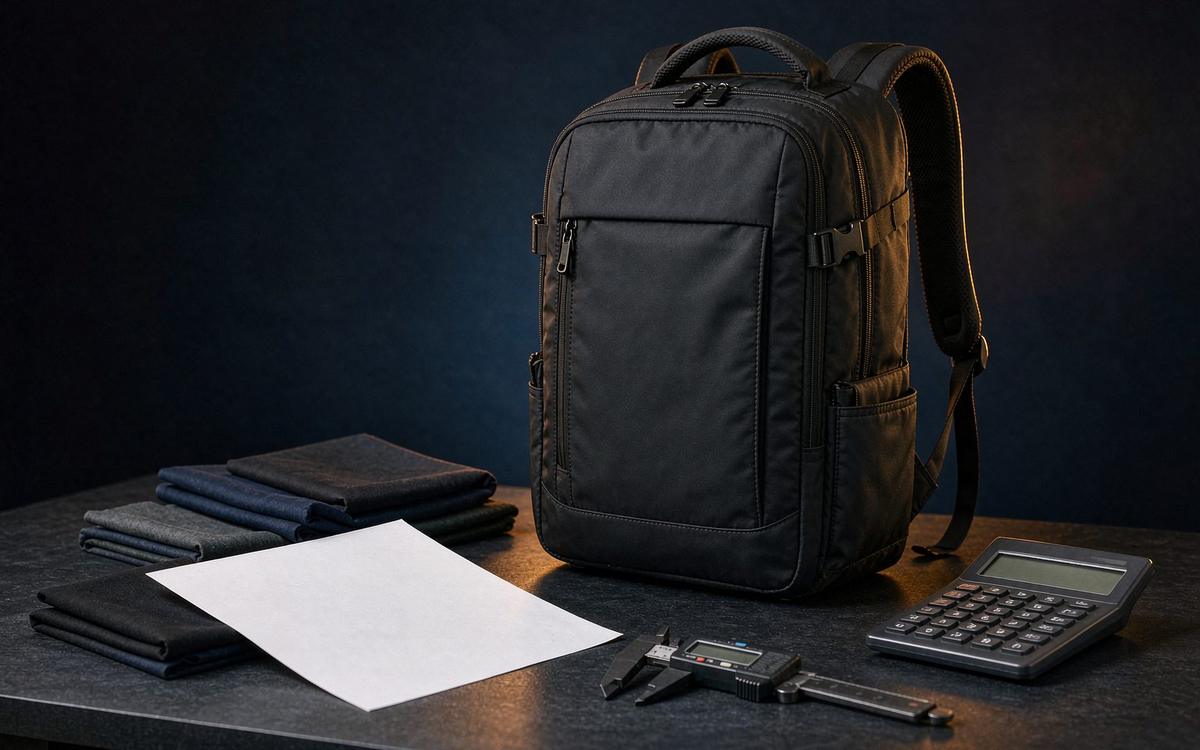
If there is one idea to take from this article, it is that specification flexibility beats negotiation. Every structural minimum in a bag programme is attached to a specific component choice, and changing the choice deletes the minimum. A custom Pantone dye carries a 1,000 to 3,000 metre lot minimum; the nearest card colour carries none. A moulded puller carries USD 300 to 900 of tooling; a stocked puller in a standard finish carries none. A dyed-to-match zip tape carries a 200 to 300 metre roll minimum; a stocked tape colour carries none.
The objection is always the same: the brand loses its identity. In practice it rarely does, because the elements that carry identity on a bag are the ones with the lowest minimums. A brand can hold its exact Pantone on the woven label, the printed care label, the zip tape, the puller finish, the print or embroidery thread and the hangtag, all of which have minimums far below the fabric lot. What it gives up is an exact match on the face fabric, and on most bags the face fabric colour is within a shade or two of something already on the card. The three re-order growth ladder is built on exactly this principle: carry identity on the cheap components and keep the fabric standard.
A concrete example makes the point. A creator wants a specific dusty rose on a pouch and is quoted a 2,000-unit minimum because the dye lot is 1,500 metres. Choosing the nearest card rose, which is within about two shades, and carrying the exact brand colour on a woven label at a 500-piece minimum and on dyed-to-match zip tape at a 200-metre minimum takes the order back to 500 units. The visual difference on camera is small; the difference in committed cash is roughly USD 5,000. That is what specification flexibility is worth.
Red flags in a minimum order conversation
Some answers are not concessions but warnings. The first is an immediate yes to everything. A partner who agrees to 200 units at the 500-unit price, a lower deposit, free tooling and a compressed schedule is either not going to deliver or is planning to recover the difference later, typically by substituting a cheaper component without saying so. Every real minimum has a cost somewhere, and a quotation that shows no cost is hiding it.
The second is refusal to state the inspection standard in writing. Inspection should be AQL 2.5 to ISO 2859-1, and a partner who will not confirm that is telling you how problems will be handled. The third is a quotation with no bill of materials, which makes it impossible to tell whether a lower quantity price was achieved by changing the specification. The fourth is pressure to skip the sample, which removes the only enforceable quality gate in the whole programme. Sampling is 6 to 10 working days, and anyone who suggests skipping it to save a week is not offering a concession.
The fifth is less obvious and worth watching for: a minimum that is much lower than everyone else's without an explanation. If the standard published minimum for this class of product is 500 and one quote comes back at 100 with no tooling and no uplift, ask what is different. Frequently the answer is that the run will be made from stocked fabric in whatever colour is available, or that it will be scheduled in a gap and subject to pre-emption by larger orders. Neither is necessarily bad, but both should be stated rather than discovered.
What a good outcome actually looks like
A good outcome is not the lowest possible number. It is a structure the creator can actually execute, with the risks named. Concretely, that usually means: a first run at 500 pcs rather than 300, with a trim-driven split so two looks come from one fabric lot; the sample fee credited against the bulk; stocked fabric and stocked hardware so no dye lot or tooling minimum applies; an adjacent slot reserved for a likely stretch goal or re-order; a flexible delivery window so ocean freight applies; AQL 2.5 confirmed in writing; and a unit price quoted at 500, 1,000 and 2,000 pcs so the re-order was priced at the same time as the first order.
That package is worth considerably more than 200 units off the minimum, and it is available to almost any creator who asks for it in the right order. The 200 units would have saved roughly USD 780 of committed cash and cost the second colourway, the reserved slot and probably the sample credit. The package saves nothing at the point of order and removes the two failure modes that actually damage campaigns: a missed delivery window and a quality dispute with no agreed standard.
The final practical point is about record-keeping. Whatever is agreed, get it in one document: quantities per colourway, unit prices at three quantities, specification with supplier codes, sample lead time and fee, tooling, carton dimensions and units per carton, inspection standard, delivery window and payment terms. That document is what makes the re-order fast and the dispute short. Our team returns all of it as standard in the quotation, which is why the first exchange usually produces a decision rather than three more rounds of email.
Send us a brief with your silhouette, target quantity per colourway and delivery window, and our campaign bag specialist will tell you within one working day which parts of the minimum are flexible for your construction.
Key takeaways
- D
- e
- l
- e
- t
- e
- m
- i
- n
- i
- m
- u
- m
- s
- w
- i
- t
- h
- s
- p
- e
- c
- i
- f
- i
- c
- a
- t
- i
- o
- n
- ,
- b
- u
- y
- f
- l
- e
- x
- i
- b
- i
- l
- i
- t
- y
- w
- i
- t
- h
- c
- o
- n
- s
- o
- l
- i
- d
- a
- t
- i
- o
- n
- a
- n
- d
- t
- i
- m
- i
- n
- g
- ,
- a
- n
- d
- n
- e
- v
- e
- r
- t
- r
- a
- d
- e
- a
- w
- r
- i
- t
- t
- e
- n
- A
- Q
- L
- 2
- .
- 5
- s
- t
- a
- n
- d
- a
- r
- d
- f
- o
- r
- 2
- 0
- 0
- u
- n
- i
- t
- s
- o
- f
- f
- t
- h
- e
- o
- r
- d
- e
- r
- .
Frequently Asked Questions
Can a 500 pcs bag minimum be negotiated lower?
Sometimes, usually to a combined total rather than a lower number. A trim-driven split of 250 plus 250 inside one fabric lot is often available at a USD 0.15 to 0.40 per unit uplift. A combined total across two sizes is sometimes available. A straight reduction to 300 units of one style in one colourway at the 500-unit price is rarely available, because it leaves about USD 348 of setup un-amortised.
What parts of a bag MOQ are genuinely non-negotiable?
Mill dye lots at 1,000 to 3,000 metres for custom Pantone, stocked colour lots at 300 to 500 metres, woven and printed label minimums at 500 to 1,000 pieces per artwork, zip tape rolls at 200 to 300 metres per colour, tooling at USD 300 to 900 for a moulded puller, and bulk lead time of 35 to 50 days.
How do I ask for a smaller first run without damaging the relationship?
Ask at quotation stage rather than after the price is agreed, ask once with a commercial reason, and attach a concession to the request. Offer a stated re-order intent, accept a flexible delivery window, or agree to use stocked fabric. Avoid asking whether the minimum can be waived, which invites a flat refusal.
Can I get two colourways inside one 500 pcs run?
Often, when both share an identical base fabric and differ only in zip tape, puller, binding, lining and print colour. The fabric purchase stays one mill lot and the extra cost is trim minimums plus one line changeover, typically USD 0.15 to 0.40 per unit. Two genuinely different fabric colours are two colourways and therefore two 500-unit blocks.
Is the sample fee negotiable on a first bag order?
The fee itself is usually fixed in the USD 40 to 120 band plus courier, but crediting it against the bulk order is standard practice in most programmes and is rarely refused. Ask for the credit at quotation stage rather than after the sample has been shipped. Sampling itself runs 6 to 10 working days, or 12 to 15 for a complex construction.
Can tooling costs be spread into the unit price?
Yes, and it is a normal request. A custom puller mould at USD 300 to 900 can be amortised across the first run instead of invoiced up front, which converts a USD 600 charge into roughly USD 1.20 per unit at 500 pcs. Foil and emboss dies at USD 80 to 250 and embroidery digitising at USD 25 to 60 per artwork can usually be handled the same way.
Does offering a future re-order help a minimum negotiation?
Yes, it is one of the four effective levers. A first run of 500 with a documented intention to run 1,500 within nine months is a different commercial proposition from a single order, because the roughly USD 970 of setup is recovered across the relationship. State re-order intent in writing at quotation stage; it costs nothing.
Can I split delivery of one production run?
Usually yes. A 500-unit run can often ship as 300 now and 200 six to ten weeks later, which matches a campaign cash cycle far better than one shipment. The production economics do not change because the run is still one event, and the only extra cost is freight on the second shipment plus storage for the held units.
Why is a flexible delivery window worth more than a price cut?
Because it allows ocean freight instead of air. Ocean transit of 25 to 40 days is roughly 4 to 7 times cheaper per kilogram than air. A creator who states a fixed date invites a quotation priced against a compressed schedule with air freight contingency built in; one who offers a March to early April window gets ocean pricing.
What is a red flag in an MOQ negotiation?
An immediate yes to every request, because every real minimum has a cost somewhere. Also refusal to confirm AQL 2.5 inspection in writing, a quotation with no bill of materials, pressure to skip the sample to save a week, and a minimum far below the market norm with no explanation of what is different.
How much setup cost is behind a 500 pcs bag minimum?
Roughly USD 970 on a mid-weight tote: USD 110 for pattern making, USD 40 to 120 per sample round plus courier, USD 240 of carried fabric lot surplus, USD 95 of trim and label minimum waste, USD 150 for about three hours of skilled line setup, and USD 210 for branding screens and dies. That is USD 1.94 per unit at 500 pcs.
Should I accept a much lower minimum from one quotation?
Ask what is different before accepting. If the market norm is 500 and one quote returns 100 with no tooling and no uplift, the likely explanation is stocked fabric in whatever colour is available, or a gap in the schedule that can be pre-empted by larger orders. Both may be fine, but both should be stated rather than discovered later.
People Also Ask
Is a bag MOQ negotiable?
Partly. Trim-driven splits, combined totals, sample credits and reserved slots are usually flexible. Mill dye lots, label minimums, tooling and the 35 to 50 day bulk lead time are structural and will not move.
Can I order 300 bags instead of 500?
Rarely at the 500-unit price, because about USD 348 of setup would go un-amortised. More often available is a 250 plus 250 trim-driven split inside one fabric lot, or a combined total across two sizes.
What is the cheapest concession to ask for?
Specification change. Using stocked fabric instead of a custom dye removes a 1,000 to 3,000 metre lot minimum; a stocked puller removes USD 300 to 900 of tooling. Carry brand colour on labels and trim instead.
How do I get two colourways at one minimum?
Keep one base fabric and vary zip tape, puller, binding, lining and print colour. The mill lot stays one purchase and the run stays at 500, typically with a USD 0.15 to 0.40 per unit uplift.
Should the sample fee be credited to the bulk order?
Yes in most programmes. The fee is USD 40 to 120 plus courier and is usually credited once bulk is placed. Ask at quotation stage rather than after the sample ships.
Does promising a re-order help me negotiate?
Yes. Stating re-order intent of 1,500 units within nine months changes the commercial picture, because setup is recovered across the relationship. It costs nothing to say and it is one of the four effective levers.
What should never be traded away in an MOQ deal?
Written confirmation of AQL 2.5 inspection to ISO 2859-1, the pre-production sample gate at 6 to 10 working days, and a stated bill of materials. Those protect the campaign far more than 200 units off the order.