Small Batch Cosmetic Bags: What a Beauty Startup Can Order
A beauty startup can realistically order one cosmetic bag silhouette in one colourway at 500 pcs, and build several kit configurations around it rather than ordering several bag styles. At 500 pcs a wipe-clean pouch typically lands between USD 3.20 and USD 6.80 FOB Xiamen, sampling runs 6 to 10 working days, bulk 35 to 50 days, and inspection is set at AQL 2.5 to ISO 2859-1. The mistake most beauty founders make is treating the bag as a separate SKU for every kit, which multiplies the 500 pcs minimum across colours and sizes. This guide shows how to consolidate, where to spend on lining and closure, and how to carry seasonal identity through trim rather than fabric.
- What a beauty startup actually needs from a bag programme
- The SKU maths: one bag serving several kits
- Ordering the bag as part of a kit rather than alone
- Materials that matter in beauty: linings, closures and leak resistance
- Seasonal shades and limited drops without doubling the minimum
- Branding at pouch scale: what actually holds on a small surface
- Unit cost, kit margin and what a beauty bundle can carry
- Sampling for beauty: lining approval, leak resistance and colour
- Packaging and presentation at 500 pcs
- Planning the second drop and the repeat run
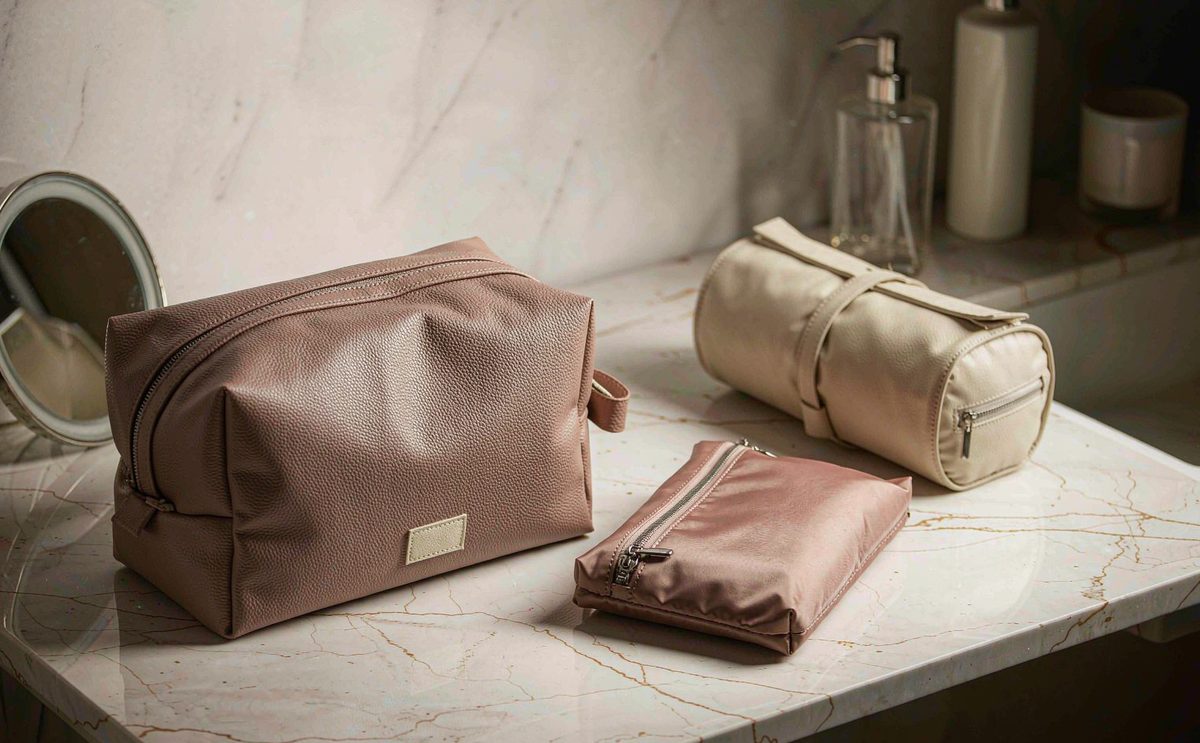
Beauty founders approach bag sourcing with a retail instinct that does not transfer. In cosmetics, a shade is a SKU, a SKU is cheap to create, and variation is how the category sells. In bag production, a colourway is a 500 pcs commitment against a mill lot, and variation is how a small brand converts working capital into unsold inventory. The two logics collide the moment a founder specifies a different bag for each kit, each season and each launch, and the resulting quotation is four or five times what the business can absorb.
The resolution is structural rather than financial: consolidate the bag and differentiate the kit. One pouch silhouette, one approved colourway, several configurations built around it through contents, trim, print and packaging. This article sets out how that works in practice, what a beauty startup can genuinely customise at 500 pcs per style and per colourway, where the money should go on a pouch that has to survive contact with product, and how to plan the second drop. The category detail sits in custom cosmetic bags for Kickstarter, and the mechanics of the minimum itself are covered in the low MOQ bag production route for creators.
What a beauty startup actually needs from a bag programme
A cosmetic bag in a beauty business does three jobs, and it is worth naming them because they pull in different directions. It is packaging, in the sense that it is the first physical thing a customer touches and it has to look considered. It is functional containment, meaning it has to hold product that leaks, stains and spills, and survive being wiped. And it is a brand object, which means it has to photograph well and carry a logo legibly. Most sourcing decisions in this category are a trade-off between the first and the second, because the finishes that look best in a photograph are frequently the ones that stain worst.
Rank them for your own business before anything is specified. A bag sold as part of a USD 120 skincare kit is mainly packaging and should be specified for appearance, with a lining chosen for wipe-clean performance and nothing more. A bag sold as a standalone USD 34 wash bag is mainly functional containment and should be specified for durability, with a closure and seam construction chosen for repeated use. A bag given away as a gift-with-purchase above a USD 75 basket is mainly a brand object and should be specified for print quality and shape retention in transit, with the cheapest lining that passes a wipe test.
The second thing a beauty startup needs is an honest timeline, because beauty launches are date-driven in a way few other categories are. Sampling runs 6 to 10 working days for a standard pouch and 12 to 15 working days for a structured case with moulded panels. Bulk runs 35 to 50 days after deposit and approved pre-production sample. Ocean transit adds 25 to 40 days. A realistic plan from brief to warehouse is 10 to 13 weeks, and 14 to 16 if a lab dip is needed for an exact brand colour. A founder planning a spring drop should have the brief out in the preceding autumn.
Decide whether your pouch is packaging, containment or a brand object. The answer determines the lining, the closure and about a third of the unit cost.
The SKU maths: one bag serving several kits
Here is the arithmetic that most often surprises founders. Suppose a business runs three kits: a travel kit, a brush kit and a gift-with-purchase. The instinct is three bags. At 500 pcs per style and per colourway, three silhouettes is 1,500 units, and if each also comes in two shades it is 3,000. At an indicative USD 4.60 for a mid-spec pouch, that is USD 13,800 committed before a single kit has sold. The alternative is one pouch silhouette in one colourway at 500 units, or USD 2,300, with the three kits differentiated by contents, trim and print.
| Approach | Bag SKUs | Units committed | Indicative spend | Differentiation available |
|---|---|---|---|---|
| A bag per kit, one shade | 3 styles | 1,500 | USD 6,900 | Silhouette, size, contents |
| A bag per kit, two shades | 3 styles x 2 | 3,000 | USD 13,800 | Silhouette, shade, contents |
| One pouch, trim variation | 1 style | 500 | USD 2,300 | Zip tape, puller, print, contents, packaging |
| One pouch, two trim looks | 1 style, split | 500-600 | USD 2,400-2,700 | Two visible looks plus contents and packaging |
The consolidated rows are not a compromise in the way they appear. Customers experience a kit as a whole, and the difference between a travel kit and a brush kit is far more strongly signalled by what is inside it, by the print on the pouch, by the hangtag and by the outer box than by the pouch silhouette. A single well-specified pouch with two trim looks, a printed interior and three different outer cartons reads as three products to a customer and as one production run to the balance sheet.
Where a second silhouette is genuinely needed, size it correctly rather than reflexively. A brush roll and a flat pouch are different constructions and cannot be consolidated; that is legitimate and worth the second 500. A 20 cm pouch and a 24 cm pouch of the same construction, however, are usually a size variant inside one pattern family, and can often share a combined total where the fabric lot and line setup are shared. Ask for that explicitly at quotation stage rather than assuming two full minimums.
Ordering the bag as part of a kit rather than alone
Beauty bags rarely ship alone, and the kit assembly decision affects cost more than most founders expect. There are three models. Model one: bags ship to you, you assemble. The bag run arrives cartoned, you or your fulfilment partner insert product, and the finished kit ships. This gives maximum control and is the right model when the contents change frequently or have short shelf life. Model two: bags ship to a third-party assembler, who receives both the bags and the product and returns finished kits, which is efficient at volume but adds a handling fee of roughly USD 0.60 to 1.50 per kit.
Model three: co-packing at the production site, where the bag is made, the product is inserted and the finished kit is cartoned before shipment. This saves a leg of freight and one handling step, and it is genuinely efficient when the product is stable and non-hazardous. It is less suitable when the product is regulated, because cosmetics shipped into and out of a facility may trigger additional documentation depending on destination market rules. Ask your fulfilment partner before choosing this route, not after the goods are made.
Whichever model applies, the bag specification has to anticipate assembly. Three things matter. The bag must arrive presentation-ready: individually polybagged, with tissue or a shape insert if the silhouette needs support, because a structured case crushed in transit photographs badly and a crushed case in a kit is a return waiting to happen. The carton count must match your kit pack-out, so bags arrive in quantities that align with how kits are assembled, commonly multiples of 25 or 50. And the bag must be barcoded or labelled in a way that matches your inventory system before it reaches the assembly bench.
Materials that matter in beauty: linings, closures and leak resistance
The face fabric gets the attention and the lining does the work. A cosmetic bag meets foundation, serum, oil, nail polish and occasionally an exploded lipstick, and the difference between a lining that wipes clean and one that stains permanently is the difference between a bag that is kept and one that is thrown away. Coated polyester and TPU laminates are the reliable choices for wipe-clean performance, typically adding USD 0.20 to 0.55 per unit over a standard polyester lining. Uncoated cotton and canvas linings are the worst performers and should be avoided anywhere product contact is likely.
Seam construction is the second decision, and it is where a pouches either survives or fails. A bag that holds liquids needs sealed or bound seams at the base, because a standard turned seam on an uncoated lining will wick. The two workable options are high-frequency welded seams on a TPU or PVC laminate, which are genuinely leak-resistant, and bound internal seams with a coated lining, which resist wicking without full waterproofing. Neither is expensive at 500 pcs; both are far cheaper than the returns they prevent.
The closure is the third. A zip is the default and is correct for most pouches, but the specification matters: a nylon coil zip with a reverse tape resists snagging better than a metal teeth zip on a soft pouch, and a water-resistant zip with a coated tape adds roughly USD 0.25 to 0.60 per unit and is worth it wherever leak resistance is claimed. Test the closure by cycling it 30 times on the approval sample and by running it with a small amount of product residue on the tape, because a zip that jams once product gets on it is the most common complaint in this category.
- Wipe-clean lining: coated polyester or TPU laminate, typically USD 0.20 to 0.55 per unit over standard lining.
- Sealed base seams: high-frequency welded on laminate, or bound internal seams on coated lining.
- Closure: nylon coil with reverse tape as default; water-resistant coated tape zip adds USD 0.25 to 0.60.
- Structure: a gusseted base of 5 to 8 cm lets a pouch stand for photography without a moulded insert.
- Avoid: uncoated cotton or canvas linings, metal teeth zips on soft pouches, and unbound base seams on any liquid-holding product.
Seasonal shades and limited drops without doubling the minimum
Beauty is a seasonal category and the instinct is a seasonal bag. That instinct is affordable if the seasonality is carried by the right elements. Because the minimum is 500 pcs per style and per colourway, a seasonal fabric colour is a 500-unit commitment on a product with a three-month selling window, which is the classic way a beauty brand ends up with dead stock. A seasonal print, zip tape colour, puller finish, hangtag and outer carton carry the same signal at a fraction of the commitment, because those suppliers have minimums far below a fabric mill lot.
The workable pattern is a permanent base and a seasonal accent. Specify the pouch body in one neutral that will sell across every season, and vary the accent elements each drop. A black pouch with a rose tape and a rose puller for spring, the same black pouch with a bronze tape and a bronze puller for autumn, and the same pouch with a silver tape and a foil hangtag for a holiday drop. Three visibly distinct products, one fabric lot, one 500-unit commitment if the accents are run together, and no seasonal dead stock on the most expensive component.
If a seasonal fabric colour is genuinely non-negotiable, size it to the drop rather than to the minimum. A limited drop of 500 units that is expected to sell out in eight weeks is a reasonable purchase even at a premium; the same 500 units with no sell-through plan is not. Ask your partner for a split run across two accent-driven looks inside one fabric lot where the base is shared, which typically carries a per-unit uplift of USD 0.15 to 0.40 and keeps the total at 500 rather than 1,000.
| Element | Minimum attached | Seasonal flexibility | Indicative uplift |
|---|---|---|---|
| Face fabric colour | 500 pcs per colourway | Low, commits the whole run | New 500-unit block |
| Zip tape colour | 200-300 m per colour | High | USD 0.05-0.15 per unit |
| Puller finish | Stock catalogue | High | USD 0.05-0.20 per unit |
| Print or foil colour | Per screen or die | High | USD 15-35 per screen, USD 80-250 per die |
| Woven label artwork | 500-1,000 pcs per artwork | Medium | USD 0.10-0.35 per unit |
| Hangtag and outer carton | Print minimum | High | USD 0.15-0.50 per unit |
Branding at pouch scale: what actually holds on a small surface
A pouch presents a small branding area, and logos designed for a website banner routinely fail at pouch scale. Two physical limits govern what is possible. Foil stamping needs stroke widths above roughly 3 mm to hold on a woven or coated face, below which the foil bridges and the edges break up. Embroidery needs letter heights above roughly 4 mm, and on a lightweight coated lining it can pucker unless a backing is used. Logos below those thresholds should be simplified rather than shrunk, and the simplification is usually a better mark anyway.
Four methods cover the category. Screen print is the cheapest at USD 15 to 35 per screen colour per placement and works on most flat faces. Heat transfer handles multi-colour and photographic artwork at a slightly higher unit cost and no screen charge, which makes it the right choice for a small run with a complex logo. Foil gives the premium finish beauty brands want, at USD 80 to 250 for the die plus a small unit cost. Embroidery reads as durable and tactile, at USD 25 to 60 per digitising file, and is usually better on a canvas or twill face than on a coated one.
Placement matters more than method on a pouch. The three positions that work are the front face centred, which is what photographs; the zip puller, which is the only branded element visible when the bag is in a handbag; and the interior label, which is where the brand is read every time the bag is opened. A small brand on a budget should take the woven interior label and the branded puller before spending on a large front print, because the first two are seen repeatedly and the third is seen once.
One caution specific to beauty. A branded metal or silicone puller is the single most effective branding element on a pouch, and it is also the one with tooling at USD 300 to 900. At 500 units that is USD 0.60 to 1.80 per unit of amortised tooling, which is a large share of a USD 4.60 bag. The trade is usually worth it for a bag sold standalone and usually not worth it for a bag used as gift-with-purchase packaging. Ask for the tooling to be amortised into the unit price rather than invoiced up front, which is standard and easier on cash flow.
Unit cost, kit margin and what a beauty bundle can carry
At 500 pcs, a wipe-clean pouch typically lands between USD 3.20 and USD 6.80 FOB Xiamen. A simple recycled polyester pouch with a standard coil zip, a coated lining and a single foil logo sits near the bottom; a structured vegan leather case with a gusseted base, a wipe-clean laminate lining, bound seams and a custom puller sits near the top, commonly USD 6.20 to 7.80. Doubling to 1,000 pcs usually cuts 8 to 15 percent per unit, and doubling again to 2,000 cuts a further 8 to 12 percent.
| Cost element | 500 pcs | 1,000 pcs | 2,000 pcs |
|---|---|---|---|
| Face fabric and coated lining | USD 1.15 | USD 1.06 | USD 0.99 |
| Zip, puller and hardware | USD 0.90 | USD 0.83 | USD 0.78 |
| Cut, sew and seam binding | USD 1.20 | USD 1.11 | USD 1.04 |
| Branding, foil plus label | USD 0.58 | USD 0.44 | USD 0.35 |
| QC, polybag, packing | USD 0.47 | USD 0.34 | USD 0.28 |
| Indicative FOB unit | USD 4.30 | USD 3.78 | USD 3.44 |
What matters is the landed number, not the FOB number. Add ocean freight, duty and per-unit fulfilment and a USD 4.30 FOB pouch becomes roughly USD 6.80 to 8.80 landed in the US or EU at these volumes. A kit priced at USD 89 containing USD 22 of product and a USD 7.50 landed bag carries the bag comfortably. A gift-with-purchase threshold of USD 75 with a 28 percent product margin and a USD 7.50 bag does not. Run that arithmetic before the specification is finalised, because the fix at that stage is a lining or a closure choice, and after it the fix is the kit price.
Payment terms are T/T 30/70: 30 percent deposit to release materials and book the slot, 70 percent before shipment. On 500 pouches at USD 4.30 that is USD 645 down and USD 1,505 about five to seven weeks later, which most beauty startups can absorb. Note that the deposit lands before the drop generates any revenue, so a founder planning a seasonal drop should have the deposit available one full production cycle ahead of the launch date rather than at it.
Sampling for beauty: lining approval, leak resistance and colour
Sampling runs 6 to 10 working days for a standard pouch and 12 to 15 working days for a structured case, and beauty programmes should budget two rounds rather than one. The first round verifies silhouette, proportion and closure function. The second verifies the things that matter in this category specifically: lining performance, seam integrity and colour on the actual bulk material. Budget a sample fee in the USD 40 to 120 band per round plus courier, and ask for it to be credited against the bulk order, which is standard practice.
Test the lining the way a customer will. Put a small amount of foundation, a lip balm and a few drops of a facial oil on the lining of the approval sample, leave it for an hour, and wipe with a damp cloth. A coated polyester or TPU laminate should clean completely; an uncoated fabric will show a mark. This test takes one hour and prevents the single most common failure in the category. Test the closure at the same time: cycle the zip 30 times, then run a little balm along the tape and cycle it another 10 times.
Colour needs physical approval, not screen approval. A Pantone reference matched on polyester will not look identical on a coated laminate or a vegan leather, and a beauty brand's shade is usually its most protected asset. Request a fabric swatch card or lab dip in the actual bulk base, approve it under daylight and under the lighting used for product photography, and only then approve the sample. Where an exact match is essential, build an extra 5 to 7 working days into the plan for a second dip. Our sourcing partner handles dip submission and approval as a tracked step with the sampling and prototyping process.
Packaging and presentation at 500 pcs
Beauty customers judge a bag by how it arrives, and presentation packing is cheap relative to its effect. Three elements are worth specifying at 500 pcs. Individual polybag with a printed warning and a barcode is standard and costs roughly USD 0.05 to 0.12 per unit. Tissue wrap or a shape insert keeps a structured case from crushing, at USD 0.08 to 0.25 per unit, and is the difference between a case that photographs flat and one that photographs as designed. A printed hangtag or belly band carries the shade name and the brand story at USD 0.15 to 0.50 per unit.
Carton specification deserves a specific instruction because it affects both freight and assembly. Ask for units per carton and carton dimensions with the quotation, and set the count to match your kit pack-out, commonly multiples of 25 or 50. A pouch that packs 60 per carton instead of 40 ships at roughly a third less per unit, and at small volumes freight is a large share of landed cost. Also ask whether the pouch can be nested or flat-packed without creasing, because a soft pouch nested in twos can sometimes raise the carton count by 20 to 30 percent.
Inspection is the final gate. AQL 2.5 to ISO 2859-1 sets an acceptance threshold rather than a zero-defect guarantee, and on a cosmetic pouch the defects that matter most are cosmetic rather than structural: a misaligned print, a zip that pulls roughly, a stained lining panel, or a logo placed off-centre. Ask for the defect breakdown by category rather than just the pass or fail line, and hold a 4 to 6 percent replacement buffer on every run. On a 500-unit run serving 420 kits, that is about 25 units for replacements, 20 for press and seeding, and 35 left for the website.
Planning the second drop and the repeat run
The second drop is where a beauty bag programme either becomes efficient or repeats every mistake. Re-orders carry the same 500 pcs per style and per colourway minimum, and the unit price improves only modestly, typically 3 to 6 percent, because pattern and sample development are removed while fabric lot, trim and line setup are still charged. What improves substantially is lead time, usually by two to three weeks, because the sampling round becomes a confirmation rather than a development cycle.
Three instructions make the second drop work. Freeze the specification with supplier codes rather than descriptions, so the mill fabric code, the hardware finish code and the zip tape colour code are recorded rather than described. Keep a physical reference sample from the approved production lot in your own office, labelled with the run number and date. Tell your partner at quotation stage that a repeat is likely within six to twelve months, so the pattern file and any tooling are kept live rather than archived or scrapped.
Finally, use the first drop to learn the thing that matters most: which accent sells. If the rose zip tape outsold the bronze three to one, the second drop should carry that information into the specification rather than repeating the original split. That is a piece of market data a beauty brand can only obtain by running both, and it is the strongest argument for consolidating the silhouette and varying the accent, because the variation is the experiment and the experiment is affordable only when it is carried on the cheap components.
Send us your pouch silhouette, lining requirement, quantity per colourway and drop date, and our campaign bag specialist will return a costed 500 / 1,000 / 2,000 pcs quotation with lining and closure options within one working day.
Key takeaways
- C
- o
- n
- s
- o
- l
- i
- d
- a
- t
- e
- t
- h
- e
- s
- i
- l
- h
- o
- u
- e
- t
- t
- e
- ,
- v
- a
- r
- y
- t
- h
- e
- a
- c
- c
- e
- n
- t
- .
- S
- p
- e
- n
- d
- o
- n
- t
- h
- e
- l
- i
- n
- i
- n
- g
- a
- n
- d
- t
- h
- e
- c
- l
- o
- s
- u
- r
- e
- ,
- c
- a
- r
- r
- y
- t
- h
- e
- s
- e
- a
- s
- o
- n
- o
- n
- z
- i
- p
- t
- a
- p
- e
- a
- n
- d
- p
- r
- i
- n
- t
- ,
- a
- n
- d
- s
- t
- a
- i
- n
- -
- t
- e
- s
- t
- b
- e
- f
- o
- r
- e
- y
- o
- u
- a
- p
- p
- r
- o
- v
- e
- .
Frequently Asked Questions
What is the smallest cosmetic bag order a beauty startup can place?
500 pcs of one silhouette in one approved colourway. Sampling runs 6 to 10 working days, or 12 to 15 for a structured case, and bulk production runs 35 to 50 days after deposit and approved pre-production sample. A realistic plan from brief to warehouse is 10 to 13 weeks, extending to 14 to 16 weeks if a lab dip is needed for an exact brand colour.
How much does a small batch cosmetic bag cost per unit?
A wipe-clean pouch typically lands between USD 3.20 and USD 6.80 FOB Xiamen at 500 pcs. A simple recycled polyester pouch with a coated lining and one foil logo sits near the bottom; a structured vegan leather case with a gusseted base and a custom puller reaches USD 6.20 to 7.80. Landed in the US or EU, budget USD 6.80 to 8.80 per unit.
Can I use one cosmetic bag for several different kits?
Yes, and it is usually the right structure. One pouch in one colourway at 500 pcs can serve a travel kit, a brush kit and a gift-with-purchase, differentiated by contents, print, zip tape colour, puller, hangtag and outer carton. Three separate bag styles would mean 1,500 units and roughly USD 6,900 instead of USD 2,300.
What lining should a cosmetic bag use?
Coated polyester or a TPU laminate, which typically adds USD 0.20 to 0.55 per unit over a standard lining and wipes clean after contact with foundation, oil or balm. Avoid uncoated cotton and canvas linings anywhere product contact is likely. Pair the lining with sealed or bound base seams so liquids do not wick through the seam.
How do I make a cosmetic bag leak-resistant?
Three elements together: a coated or laminated lining, high-frequency welded seams on that laminate or bound internal seams on a coated lining, and a water-resistant zip with a coated tape, which adds roughly USD 0.25 to 0.60 per unit. Test by cycling the zip 30 times and wiping product residue off the lining on the approval sample.
Can I get my exact brand shade on 500 cosmetic bags?
An exact Pantone match on the face fabric usually needs a custom dye lot of 1,000 to 3,000 metres, which is far more than 500 pouches consume. At 500 pcs, choose the nearest colour from the existing card and carry the exact brand shade on zip tape, puller, print, woven label and hangtag, all of which have much lower minimums. A lab dip is possible with 5 to 7 extra working days.
How can I do seasonal drops without doubling my order?
Carry the season on the accent elements rather than the fabric. Keep one neutral pouch body across every drop and vary zip tape, puller finish, print colour, hangtag and outer carton. Those suppliers have minimums far below a mill fabric lot, so a spring, autumn and holiday version can come from one fabric purchase and one 500-unit commitment.
What branding works on a small cosmetic pouch?
Screen print at USD 15 to 35 per screen colour, heat transfer for multi-colour artwork, foil at USD 80 to 250 for the die, and embroidery at USD 25 to 60 per digitising file. Foil needs stroke widths above about 3 mm and embroidery needs letter heights above about 4 mm. Prioritise the woven interior label and a branded puller over a large front print.
Is a custom zipper puller worth the tooling at 500 pcs?
For a bag sold standalone, usually yes, because the puller is the only branded element visible when the pouch is inside a handbag. For a gift-with-purchase bag, usually not. Tooling runs USD 300 to 900, or USD 0.60 to 1.80 per unit amortised over 500. Ask for it to be amortised into the unit price rather than invoiced up front.
How should cosmetic bags be packed for kit assembly?
Individually polybagged at USD 0.05 to 0.12 per unit, with tissue or a shape insert at USD 0.08 to 0.25 for structured cases, and a printed hangtag at USD 0.15 to 0.50. Set units per carton to match your kit pack-out, commonly multiples of 25 or 50, and ask whether soft pouches can be nested to raise the carton count by 20 to 30 percent.
How many spare cosmetic bags should I hold back?
A 4 to 6 percent buffer. Inspection at AQL 2.5 to ISO 2859-1 sets an acceptance threshold rather than a zero-defect guarantee, and on a pouch the defects that matter are usually cosmetic: a misaligned print, a rough zip or an off-centre logo. On 500 units serving 420 kits, that is about 25 for replacements, 20 for press, and 35 for the website.
Does a cosmetic bag re-order get cheaper?
Modestly, typically 3 to 6 percent at the same quantity, because pattern and sample development are removed while fabric lot, trim and line setup are still charged. Lead time improves more, usually by two to three weeks. Freeze the specification with supplier codes, keep a physical reference sample, and tell your partner at quotation stage that a repeat is likely.
People Also Ask
What is the MOQ for small batch cosmetic bags?
500 pcs per style and per colourway. One silhouette in one approved combination of face fabric, lining, zip tape and hardware. A second colourway or a second silhouette adds another 500 units.
How much does a 500 pcs cosmetic bag order cost?
Between USD 3.20 and USD 6.80 per unit FOB Xiamen, so USD 1,600 to 3,400 for the run, plus sampling, tooling and freight. Landed in the US or EU, budget USD 6.80 to 8.80 per unit.
Can one bag serve multiple beauty kits?
Yes. Consolidate the silhouette and differentiate with contents, print, zip tape, puller, hangtag and outer carton. Three separate bag styles would mean 1,500 units instead of 500.
What lining is best for a cosmetic bag?
Coated polyester or TPU laminate, which wipes clean and adds USD 0.20 to 0.55 per unit. Avoid uncoated cotton and canvas, and pair the lining with welded or bound base seams.
Can small beauty brands do seasonal bag colours?
Only by carrying the season on accent elements. A seasonal fabric colour commits another 500-unit block; a seasonal zip tape, puller, print or hangtag carries the same signal at a fraction of the cost.
How long does a cosmetic bag order take?
10 to 13 weeks from brief to warehouse: 6 to 10 working days for sampling, 35 to 50 days for bulk, plus 25 to 40 days of ocean transit. Add 5 to 7 working days per extra lab dip.
What branding holds on a small pouch?
Screen print, heat transfer, foil and embroidery all work, subject to minimum sizes: about 3 mm stroke width for foil and 4 mm letter height for embroidery. A woven interior label and a branded puller are seen most often.