Custom Crossbody Bags for Kickstarter
The MOQ for custom crossbody bags on a Kickstarter campaign is 500 pcs per style and colourway. Sampling takes 6-10 working days, or 12-15 where moulded components or complex hardware are specified, and production 35-50 days after deposit and approved pre-production sample. Every shipment is inspected at AQL 2.5 to ISO 2859-1, moves FOB Xiamen, and is settled T/T 30/70. Crossbody bags are the most flexible reward in a campaign ladder: they work as an entry tier, an add-on and a bundle component. That flexibility is also the trap, because each colourway carries its own minimum. This page covers the strap, hardware, costing and QC decisions behind a compact-bag programme.
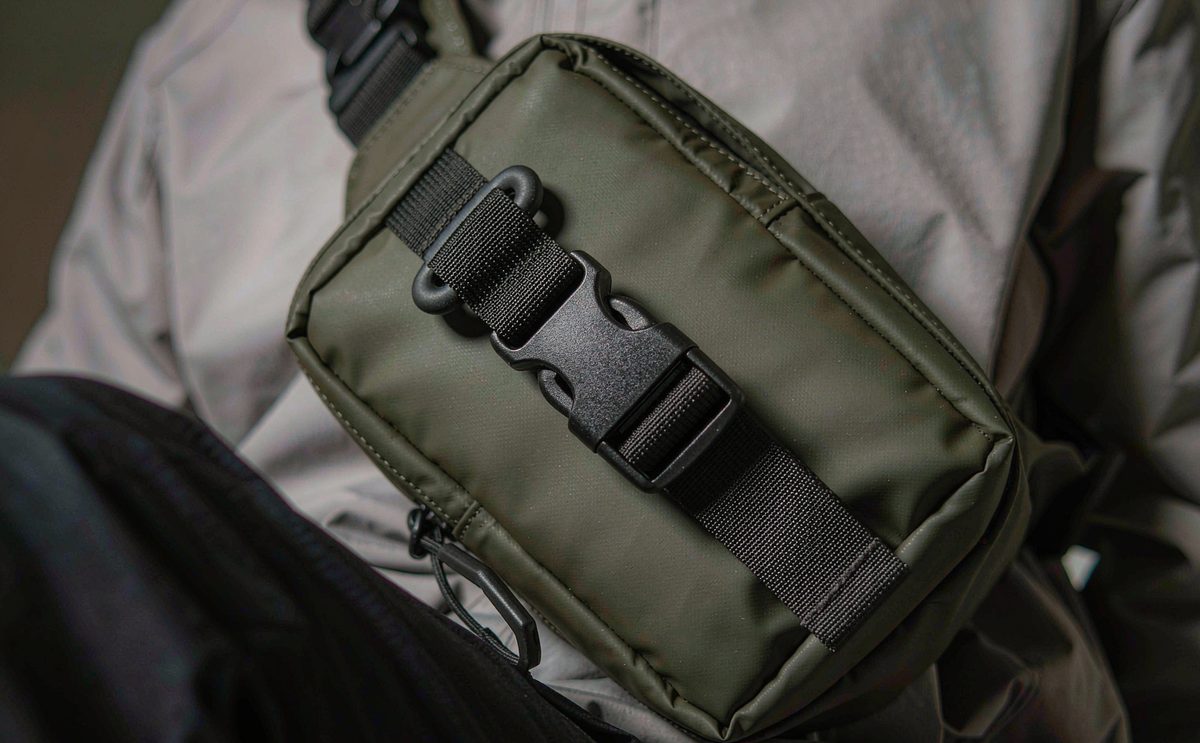
Key takeaways
- MOQ is 500 pcs per style and colourway; each additional colourway resets the 500 pc minimum.
- Sampling takes 6-10 working days, extending to 12-15 for moulded components or complex hardware.
- production 35-50 days after deposit and approved pre-production sample.
- Inspection is AQL 2.5 to ISO 2859-1, applied per colourway, with a report before the 70% balance.
- Cargo ships FOB Xiamen under T/T 30/70 terms.
- Compact silhouettes pack flat, which is the biggest freight advantage in the whole bag category.
Why crossbody bags carry a reward ladder
A crossbody bag is the most commercially flexible item in a crowdfunding reward ladder. It is cheap enough to be an entry tier, desirable enough to be a mid tier, and small enough to be an add-on that lifts average pledge value without adding much to the fulfilment bill. That is why it appears in so many campaigns. It is also why it is so often mismanaged: the flexibility tempts creators into four colourways and three sizes before a single unit has been made.
From a sourcing standpoint, the arithmetic is simple and worth stating at the planning stage. The minimum order is 500 pcs per style and colourway, so four colourways across two sizes is not one order of 500, it is eight production runs. Our production team advises creators to launch with one hero silhouette in one or two colourways, then add colourways on the re-order once the pattern, jigs and material supply are proven.
The second planning point is that compact bags still carry full-size specification obligations. A crossbody is worn against the body all day, so strap comfort, hardware noise, zipper smoothness and lining quality get more scrutiny per square centimetre than almost any other category. A small bag that feels cheap is a small bag that gets returned. The wider programme frame is on the custom bags for Kickstarter page.
Strap engineering: width, adjustability and load comfort
On a crossbody, the strap is the product. It carries the load, it is the first thing a backer touches, and it is the surface most likely to show wear within weeks. Specification here means width, core material, edge finishing, adjustment mechanism and the attachment method at each end. Get any one of those wrong and the bag is uncomfortable or, worse, the strap twists and the bag sits wrong on the body.
| Element | Entry option | Recommended option | Why it matters |
|---|---|---|---|
| Webbing width | 20 mm | 25 mm tape or webbing | Spreads load across the shoulder |
| Core | Flat webbing | Webbing with soft edge binding | Prevents edge bite on the neck |
| Adjustment | Plastic tri-glide | Metal or branded tri-glide | Holds position under load |
| Drop range | Fixed length | 55-130 cm adjustable | Fits a wider range of backers |
| Attachment | Stitched to body | Bartacked through reinforcement, or D-ring | Determines safe working load |
| Detachability | Fixed | Swivel clips at both ends | Enables a strap accessory ecosystem |
Specify the drop range rather than a single strap length. A 55-130 cm adjustable range fits most backers whether they wear the bag high on the chest or low on the hip, and it removes the awkward sizing question from the campaign page. Where the strap is detachable, specify the clip rating and test it, because a clip is a bought-in component with the same substitution risk as any other.
Closure, hardware and anti-theft detailing
Hardware on a compact bag does two jobs: it secures the contents and it signals quality. A backer who cannot identify the metal will still register the weight, the sound and the finish. Plastic hardware keeps unit cost down but reads as entry-level; zinc-alloy hardware with a consistent finish reads as mid-market; branded or custom-moulded pulls read as premium and are one of the few upgrades a backer consciously notices.
- Main closure: a covered or reverse-coil zipper is quieter, more secure and looks cleaner than an exposed coil.
- Zipper garage: a covered end detail stops the pull rattling and protects the contents from scratch.
- Puller: a branded metal or TPU pull is a low-cost upgrade with high perceived value, roughly $0.35 to $0.90.
- Rear pocket: a hidden body-side pocket with a reverse-coil zipper is the standard anti-theft feature.
- Magnetic flap: a hidden magnetic closure under a flap gives one-handed access without visible hardware.
- Hardware finish consistency: specify the plating and check all visible hardware matches across the batch.
A rattling zipper pull or a clacking magnetic closure is noticed every time the bag moves. Specify a zipper garage, a quiet puller and a damped magnet, then carry the bag for a full day during sampling. This is a two-minute check at the sample stage and an unfixable complaint once 500 units are with backers.
Material and lining choices for a small-format bag
Small-format bags use less fabric per unit than any other category, which means the fabric decision has a smaller absolute effect on unit cost and a larger effect on perceived value. That makes it one of the few places where upgrading material is genuinely good value: moving from a 300D polyester to a 600D coated shell might add a modest percentage to unit cost while substantially changing how the reward is received.
| Material | Hand feel | Durability | Colourfastness | Cost index |
|---|---|---|---|---|
| 300D polyester | Light, slightly crisp | Medium | Good | 1.0 |
| 600D polyester, PU coated | Firm, structured | High | Good | 1.3 |
| Recycled rPET 600D, GRS | Firm, matte | High | Good | 1.5 |
| Nylon twill, DWR finish | Soft, premium | Medium-high | Very good | 1.8 |
| PU-coated canvas | Soft, matte | Medium-high | Good | 1.6 |
| Vegan leather, PU faced | Smooth, premium | Medium | Very good | 2.0 |
Lining deserves more attention than it usually gets. A dark lining makes a small bag feel like a black hole; a lighter or high-visibility lining makes contents findable and reads as considered design. Specify the lining weight, colour and whether it carries a printed pattern, then check colourfastness, because a dark shell against a light lining is the classic crocking risk. Material and coating options are set out on the material customization for Kickstarter bags page.
Sampling a small-format bag: what to check in two rounds
Sampling is 6-10 working days from approved artwork and confirmed materials, extending to 12-15 where moulded components, custom hardware or complex strap systems are specified, because tooling has to be cut first. Compact bags sample fast, which is an advantage worth using: run two rounds and carry the second sample for several days before signing it off.
- Round one: assess proportions against the body, strap drop range, and whether the bag sits flat when worn.
- Round one testing: load with the items you expect a backer to carry and check for strap bite and twisting.
- Round two: confirm hardware finish consistency, zipper smoothness and lining fit on bulk materials.
- Logo check: approve the logo method at production size, because a design that works at 200 mm can fail at 40 mm.
- Approval: sign the pre-production sample, which becomes the physical reference for the AQL 2.5 inspection.
Compact bags are the category where logos fail most often, because artwork designed on a large canvas is reduced to a fraction of its size. Approve the print, embroidery or badge at the actual production dimension on the actual material. production 35-50 days after deposit and approved pre-production sample, so the clock only starts once that reference is signed. The gate sequence is on the crowdfunding bag sample prototyping page.
MOQ and unit cost on a compact silhouette
The minimum order is 500 pcs per style and colourway. Because compact bags use less material, they are the cheapest category to make in absolute terms, which is exactly why the 500 pc threshold is worth understanding rather than resisting. The binding constraint is not fabric cost, it is line setup: pattern loading, machine threading, colour changeover and the QC setup that has to happen before any unit is made.
| Cost driver | What changes | Effect on unit cost |
|---|---|---|
| Shell material | 300D polyester to vegan leather | +15% to +100% |
| Hardware grade | Plastic to zinc alloy with branded pull | +12% to +45% |
| Strap system | Fixed webbing to detachable padded strap | +9% to +34% |
| Logo method | Screen print to TPU badge | +$0.30 to +$1.90 |
| Lining | Plain taffeta to printed high-visibility | +$0.25 to +$1.40 |
| Order volume | 500 pcs to 3,000 pcs | -10% to -23% |
Compact bags show the steepest volume curve in the category, because setup is a larger share of the total at low absolute material cost. That makes the re-order conversation particularly worthwhile here. A creator asking how much does a custom crossbody bag cost should ask for two numbers: the 500 pc price and the 2,000 pc price, because the gap is where the post-campaign margin is made.
Reward tiers work when each level is priced from its landed cost, with the gap between tiers reflecting real spec differences.
Kickstarter Creator Handbook
Production scheduling when the SKU count is high
Crossbody campaigns tend to run more SKUs than any other category, and SKU count is what stretches the calendar. Each colourway is a separate line setup, and each setup carries the same fixed overhead. production 35-50 days after deposit and approved pre-production sample for the programme as a whole, but a four-colourway order does not take 35-50 days per colourway — it takes that window plus the sequential setup time, which has to be planned for.
| Stage | Working days | Owner |
|---|---|---|
| RFQ, tech pack review and hardware plan | 2-4 | Creator and production partner |
| Material sourcing and colour approval per colourway | 5-8 | Production team |
| Sampling round one | 6-10 | Production team |
| Wear test and logo correction | 3-7 | Creator |
| Pre-production samples per colourway | 6-15 | Both |
| Bulk production | 35-50 | Production team |
| AQL 2.5 inspection and packing | 3-5 | QC team |
| Freight, customs and fulfilment | 12-38 | Freight and fulfilment partners |
Where the reward ships as a bundle or an add-on alongside other items, the kitting operation needs its own specification, cost and inspection. The crowdfunding rewards fulfilment page covers kitting, add-on handling and the DDP route for international backers.
QC at AQL 2.5 across multiple colourways
Pre-shipment inspection is set at AQL 2.5 to ISO 2859-1, which fixes the sample size, the accept and reject counts and the defect classification. Critical defects — a clip that opens under load, a broken zipper, a sharp hardware edge — are zero tolerance. Major defects such as shade variation between panels or a misaligned logo are capped by the AQL 2.5 table. Minor defects such as a stray thread carry a higher allowance but must still be logged.
- Shade check: compare each colourway against its approved swatch, and compare panels within a single unit.
- Inline check: strap attachment bartacks, zipper run and hardware alignment on the first 50 units of each colourway.
- Hardware check: plating consistency and function tested across a sample drawn from every colourway.
- Load check: strap and clip loaded to the specified weight and cycled through the adjustment range.
- Final AQL 2.5 inspection: random carton selection, defect logging and a photographic report before release.
- Compliance file: REACH, CPSIA or Prop 65 documentation assembled for each destination market.
Shade is the most common defect in multi-colourway orders, and it is invisible if the inspection sample is drawn from the whole batch rather than per colourway. Specify that the AQL sample is drawn separately for each colourway, and approve a physical swatch for each one before production. Colour matching is a specification, not a preference.
The staged inspection model, defect classification and the reporting pack are covered on the Kickstarter campaign bag QA/QC page, including the decision path when a batch lands just under the accept threshold.
Branding, packaging and the flat-pack freight advantage
Compact bags pack flat, which is the single biggest logistics advantage in the category and one that should be designed for rather than discovered. A crossbody that folds without creasing can be packed at high density per carton, which lowers freight per unit and reduces the carton count a warehouse has to handle. Specify the packing method in the tech pack so it is costed rather than assumed.
- Branding: screen print from about $0.30, embroidery around $1.20, woven label around $0.45, TPU badge around $1.90.
- Logo placement: approve at production size, because compact bags make logo errors obvious rather than subtle.
- Carton grade: five-ply export carton, sized to the pallet footprint rather than to the bag.
- Packing method: folded flat with tissue at hardware points, or lightly stuffed to hold shape for premium positioning.
- Presentation: a printed card or dust bag adds perceived value at a small absolute cost on a compact item.
Logo method selection for this category is covered in more depth on the print and embroidery for custom bags page. Programmes of this kind run from a 4,950 m² SGS-verified production floor with 137 staff across 7 production lines and 149 machines, giving 200,000 pcs of monthly capacity. Established in 2014 with trade roots reaching back to 2004, the team has supported more than 20 crowdfunding campaigns.
How to choose a production partner for a multi-SKU drop
How to choose between bidders on a multi-colourway programme is a question about process discipline. Will the bidder quote per colourway or as a blended average? Will they approve a physical swatch per colourway before production? Will they draw the inspection sample separately for each colourway? A supplier shortlist built on a blended quote almost always produces an unpleasant conversation about shade three weeks after the deposit clears.
- Request a quotation that states the 500 pc minimum per colourway explicitly rather than blending it.
- Confirm a physical swatch approval step for every colourway before bulk starts.
- Ask how the inspection sample is drawn across colourways and whether you receive per-colourway reports.
- Ask what happens to unit cost if you drop from three colourways to two, and vice versa.
- Ask for the re-order price band in writing while the first purchase order is still open.
Creators building a ladder with a larger everyday silhouette should compare against the custom tote bags for Kickstarter page, and the full production map is on custom bag categories. Entry-tier planning guidance sits on the low MOQ bag production for creators page.
Re-order, colourway rotation and volume pricing
Compact bags are the category where colourway rotation works best commercially. Once the pattern and jigs exist, a new colourway on the re-order costs less to introduce than it did on the first order, because only material and setup change. Raising volume from 500 to 3,000 pcs typically reduces unit cost by 10% to 23%, the steepest curve in the range, so the commercial case for consolidating colourways and pushing volume is strong.
- Minimum order quantity
- 500 pcs per style / colourway
- Sampling lead time
- 6-10 working days (12-15 for complex builds)
- Bulk production
- 35-50 days after deposit and approved pre-production sample
- Inspection standard
- AQL 2.5 to ISO 2859-1
- Trade term
- FOB Xiamen
- Payment terms
- T/T 30/70
- Production capacity
- 200,000 pcs per month, 7 lines, 149 machines
- Facility
- 4,950 m² SGS-verified floor, 137 staff
- Programme experience
- 20+ crowdfunding campaigns supported since 2014
Request a crossbody bag quotation
Send the silhouette, dimensions, strap and hardware preferences, logo artwork at production size, colourway count, quantity per colourway, destination markets and target reward price. The team will return a structured quotation, a per-colourway cost breakdown, a sampling schedule and the inspection plan that will govern the order.
- Custom bags for Kickstarter programmes
- Custom tote bags for Kickstarter
- Low MOQ bag production for creators
- Print and embroidery for custom bags
- Material customization for Kickstarter bags
- Sample prototyping for crowdfunding bags
- QA and QC for campaign bags
- Request a quotation
Request a crossbody quotation
Email service@junyuanbags.com with your tech pack, logo artwork at production size, colourway count and target delivery month. A campaign bag specialist will return a cost breakdown and sampling schedule within two working days.
Frequently Asked Questions
What is the MOQ for custom crossbody bags on a crowdfunding order?
The minimum order is 500 pcs per style and colourway. Two sizes across three colourways is six production runs, not one, because each colourway needs its own line setup, material booking and QC arrangement. Most first campaigns launch with one hero silhouette in one or two colourways and expand on the re-order.
How long does sampling take for a crossbody bag?
Standard sampling is 6-10 working days from approved artwork and confirmed materials. Moulded components, custom hardware or complex strap systems extend that to 12-15 working days, because tooling has to be cut first. Budget 20-30 working days for two rounds, including a wear test on the second sample.
How much does a custom crossbody bag cost per unit?
Unit cost turns on shell, hardware, strap system, logo method and lining. Moving from 300D polyester to vegan leather adds 15% to 100%; moving from plastic to zinc-alloy hardware adds 12% to 45%. Raising volume from 500 to 3,000 pcs typically reduces unit cost by 10% to 23%, the steepest curve in the range.
What strap width should a crossbody reward use?
Use 25 mm tape or webbing rather than 20 mm, because it spreads the load across the shoulder without looking bulky on a compact bag. Specify a 55-130 cm adjustable drop range so the bag fits backers who wear it high on the chest or low on the hip, which removes a sizing question from the campaign page.
What inspection standard applies before a crossbody shipment leaves?
Pre-shipment inspection runs at AQL 2.5 to ISO 2859-1, fixing sample size, accept and reject counts and defect classification. Critical defects such as a clip opening under load or a broken zipper are zero tolerance. You receive a photographic report before releasing the 70% balance payment.
How is shade variation controlled across multiple colourways?
Approve a physical swatch for each colourway before production, then require the AQL sample to be drawn separately for each colourway rather than from the batch as a whole. Shade is the most common defect in multi-colourway orders and it is invisible if the sample is blended across 2 or more colourways.
Which logo method works best on a small crossbody panel?
Screen print from about $0.30 suits flat panels; embroidery around $1.20 reads premium but can pucker on lightweight shells; a woven label around $0.45 is reliable and size-stable; a TPU badge around $1.90 reads most premium. Approve whichever you choose at the actual production dimension, not at design size.
How much does hardware noise matter on a crossbody bag?
A great deal, because the bag is worn against the body all day and moves with every step. Specify a reverse-coil zipper with a covered garage, a quiet puller and a damped magnetic closure, then carry the sample for a full day. It is a two-minute check at sampling and an unfixable complaint after 500 units ship.
When should a crossbody order be placed relative to the campaign?
Complete sampling before launch so the pre-production sample exists when funds clear. production 35-50 days after deposit and approval, inspection and packing add 3-5 days, and transit adds 12-38 days. With multiple colourways, add sequential line setup time on top of that window.
Do crossbody bags need compliance documentation for backers?
Yes. Assemble a REACH declaration, CPSIA or Prop 65 documentation and EU GPSR product information for the destination markets, plus OEKO-TEX Standard 100 for shell and lining fabrics where applicable. Confirm destinations in the RFQ, because the compliance file has to be built before production rather than after inspection.
How should crossbody bags be packed for freight?
Compact bags pack flat, which is the biggest logistics advantage in the category. Specify folding flat with tissue at hardware points, or light stuffing for premium positioning, in a 5-ply export carton sized to the pallet footprint. Folded-flat packing typically lifts units per carton by 30-50%.
What happens to the unit price on a post-campaign re-order?
Raising volume from 500 to 3,000 pcs typically reduces unit cost by 10% to 23%, the steepest curve in the bag range, because setup is a large share of the total at low material cost. New colourways on the re-order also cost less to introduce once the pattern and jigs exist.
People Also Ask
Are crossbody bags a good entry-tier Kickstarter reward?
Yes. They are cheap to make, pack flat for freight, and work as an entry tier, add-on or bundle component. The trap is colourway count: each colourway carries its own 500 pc minimum, so two sizes across three colourways is six production runs rather than one.
How many colourways should a first campaign launch with?
One or two. Each additional colourway resets the 500 pc minimum and adds a line setup, material booking and swatch approval step. Launch narrow, prove demand, then rotate colourways on the re-order once the pattern and jigs exist and setup cost is lower.
Why does my crossbody strap twist when worn?
Twisting usually means the strap attachment is too narrow, the tape is too stiff, or the drop range does not suit the wearer. Move to 25 mm webbing with soft edge binding, widen the adjustment range to 55-130 cm, and check the attachment is bartacked through reinforcement.
Should a crossbody strap be detachable?
Detachable straps with swivel clips let you sell a strap accessory later, which is a genuine post-campaign revenue line. They add 9% to 34% to unit cost. Specify the clip rating and test it, because a clip is a bought-in component with substitution risk.
How long does a crossbody order take from approval to delivery?
Allow 35-50 days for bulk production after deposit and approved pre-production 35-50 days for inspection and packing, and 12-38 days for freight. Sampling of 6-10 working days per round comes first, plus sequential setup time for each additional colourway.