Custom Golf Bags for Crowdfunding
Golf bags are the heaviest and most component-dense category a campaign can source, and they punish optimistic planning. A stand bag carries a divider system, a stand mechanism, 6-10 pockets and custom embroidery, which puts sampling at 12-15 working days rather than 6-10. production 35-50 days after deposit and approved pre-production sample at a 500 pcs minimum per style and colourway. Freight, not unit cost, is usually the surprise. This page covers the three golf bag families, the specification backers compare, tooling lead times and the QC gates.
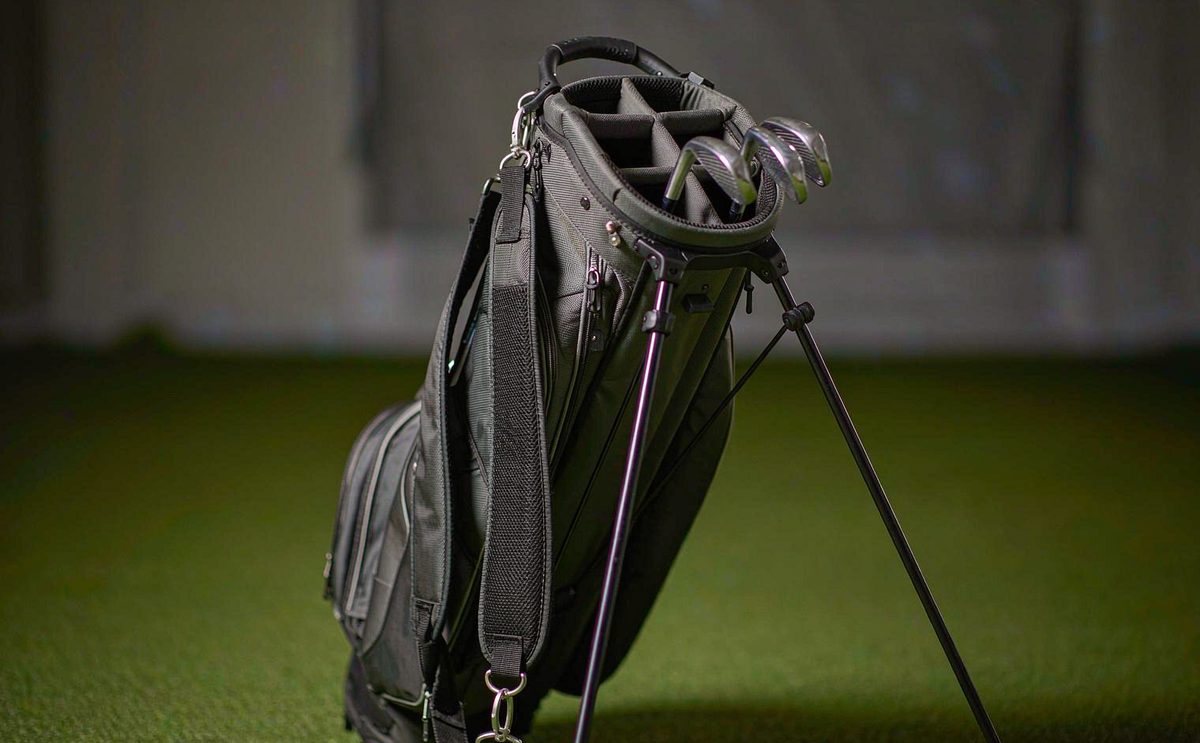
- Why golf bags are a different sourcing problem
- Three golf bag families: stand, cart and travel cover
- The specification backers actually compare
- Divider systems and top construction
- Materials and coatings for golf
- Embroidery and branding on golf bags
- Sampling a golf bag: structural checkpoints
- Tooling, component lead times and MOQ planning
- QC priorities specific to golf bags
- Freight: the biggest single cost shock
- Compliance and market requirements
- Briefing a golf bag RFQ
Why golf bags are a different sourcing problem
A golf bag is closer to a piece of sports equipment than to a soft good. It has a structural top, a load-bearing base, a mechanical stand or a wheeled chassis, and a pocket architecture that has to be specified pocket by pocket. That means more components, more separate component sources feeding one assembly, and more places for a first production run to go wrong than in any other category on this site.
It also means the commercial variables are different. Unit cost is high, so the 500 pcs minimum represents a much larger inventory commitment than it does for a tote. Sampling takes longer because structural samples cannot be shortcut. And freight is severe: a golf bag is long, rigid and bulky, and dimensional weight on a 1.2 metre carton is the single line item most likely to break a pledge-level margin that looked comfortable on a spreadsheet.
- Minimum order quantity
- 500 pcs per style / colourway
- Sampling
- 12-15 working days for structural golf builds
- Bulk production
- 35-50 days after deposit + approved pre-production sample
- Inspection
- AQL 2.5 to ISO 2859-1
- Trade term
- FOB Xiamen
- Payment
- T/T 30/70
- Production floor
- 4,950 m² SGS-verified, 137 staff, 7 lines, 149 machines
- Monthly capacity
- 200,000 pcs per month
- Programme contact
- service@junyuanbags.com
Key takeaways for sourcing golf bags
- Golf bags need the 12-15 working day sampling window, not the 6-10 day standard.
- Freight on a long, rigid carton usually exceeds the cost difference between material grades.
- Specify pocket count, divider configuration and stand mechanism individually; they are not implied by the shape.
- Component lead times for moulded tops and stand mechanisms sit upstream of the 35-50 day bulk window.
- Launch one colourway: 500 golf bags is already a substantial inventory commitment.
Three golf bag families: stand, cart and travel cover
The first decision is which family to build, because it fixes the component set, the structural engineering and the freight profile before any material is chosen. Stand bags are the most popular crowdfunding reward because they are usable without a cart, but they are also the most mechanically complex. Cart bags are simpler structurally and carry more storage. Travel covers are the simplest to make and the cheapest to ship flat, but they carry the lowest perceived value.
| Variable | Stand bag | Cart bag | Travel cover |
|---|---|---|---|
| Structural complexity | Highest — stand mechanism and leg geometry | High — rigid base and full-length dividers | Low — padded sleeve, minimal frame |
| Typical empty weight | 2.0-3.0 kg | 3.0-5.0 kg | 1.5-3.0 kg |
| Component count | Highest | High | Low |
| Sampling window | 12-15 working days | 12-15 working days | 6-10 working days |
| Unit cost position | Highest | High | Lowest of the three |
| Freight exposure | High — long rigid carton | Highest — heaviest and bulkiest | Medium — soft and compressible |
| Perceived value | Highest for most golfers | High for cart users | Lower; best as an add-on |
Most campaigns that succeed in this category launch a stand bag as the hero and hold a travel cover as an add-on or stretch goal. That pairing works commercially for a reason: the stand bag carries the pledge, and the travel cover is cheap to make, compresses well in transit and adds a second item without adding a second structural engineering programme.
The specification backers actually compare
Golf audiences are unusually specification-literate. They read pocket counts, divider configurations and weights the way a camera audience reads sensor specifications, and a campaign page that omits them loses credibility immediately. The table below is the set of line items that belong on the page and in the tech pack, with the tolerance or decision each one requires.
| Specification | Common range | Why it matters commercially |
|---|---|---|
| Divider configuration | 4-way, 6-way, 14-way | The headline specification golfers compare first |
| Pocket count | 6-10 pockets | Drives component cost and the perceived value story |
| Empty weight | 2.0-5.0 kg by family | Carry comfort on a stand bag; freight on all three |
| Top diameter and club capacity | Set by the divider mould | Determines whether a full set fits without crowding |
| Strap system | Single, dual, or padded dual | Dual strap is the most requested comfort upgrade |
| Stand mechanism | Spring or lever actuated | Highest mechanical failure risk in the category |
| Base construction | Moulded or reinforced panel | Stability and the most common wear point |
| Water resistance | Coated fabric plus rain hood | Supports a weather claim only if tested |
| Valuables pocket | Lined, sometimes waterproof zipped | Expected at premium tiers; absence is noticed |
| Embroidery area and stitch count | Panel dependent | Drives decoration cost and the durability impression |
The trap in that list is the divider configuration. A 14-way top is a moulded component with its own tooling charge and its own lead time, and it materially raises both cost and schedule risk. A 4-way or 6-way top delivers most of the functional benefit at a fraction of the tooling exposure, and for a first campaign it is usually the better commercial choice even when the 14-way reads better on a comparison table.
Divider systems and top construction
The top of a golf bag is where the structural engineering lives. It has to hold full-length dividers rigid enough to stop shafts tangling, survive being dragged across a cart, and do all of that at a weight the golfer will carry for four hours. Two construction routes are available, and the choice is one of the biggest single decisions in the programme.
- Moulded top with integrated dividers: the premium route. One moulded component, clean appearance, consistent geometry across 500 units, but a tooling charge typically in the USD 1,500-4,000 range and a mould lead time upstream of bulk.
- Fabric-wrapped divider system: the flexible route. Lower tooling exposure, easier to modify between sampling rounds, slightly bulkier appearance, and more dependent on operator skill for consistency.
- Full-length versus partial dividers: full-length separators stop shaft tangle and read as premium, but add material and labour to every unit.
- Top grab handles: usually two or three, and a frequent failure point; specify the attachment reinforcement explicitly.
Where the budget allows only one structural upgrade, spend it on the top. It is the part the golfer interacts with on every shot, the part that appears in every product photograph, and the part most likely to generate a complaint if it is made cheaply. The base is second: a moulded base with a stable footprint prevents the tip-over complaints that plague lightweight stand bags.
A moulded divider top has a tooling and mould lead time that sits upstream of the 12-15 working day sampling window and the 35-50 day bulk window. Confirming the top configuration late is the most reliable way to lose four to six weeks on a golf programme.
Materials and coatings for golf
Golf bags live outdoors and get dragged, rained on and loaded into car boots, so material selection is driven by abrasion and water performance rather than by hand feel. Nylon and coated polyester dominate; vegan leather appears as trim and on pocket faces where a premium impression matters. Canvas is rarely the right answer here, for the reasons set out on the material customisation page.
| Area | Recommended material | Note |
|---|---|---|
| Body shell | Nylon 420-900D or coated polyester | Denier driven by abrasion exposure at the base and strap path |
| Base and wear panels | Coated fabric or moulded panel | The highest-wear area; reinforcement here prevents most returns |
| Pocket faces | Body fabric or vegan leather trim | Vegan leather raises perceived value at modest cost |
| Lining | Coated polyester, often with a waterproof valuables pocket | Wipe-clean and moisture management |
| Strap webbing | High-tenacity webbing with padding | Padding density is a comfort claim backers feel immediately |
| Rain hood | Coated lightweight nylon | Usually stored in a dedicated pocket; specify it or omit the claim |
| Hardware | Corrosion-resistant zips, buckles and stand pivots | Outdoor use makes finish durability a real requirement |
Water resistance is worth being precise about. A coated body fabric plus a rain hood supports a weather-resistant claim; neither supports a waterproof one unless the seams are sealed and the zips are rated. State the claim you can test, then test it during sampling, because a golf audience will find out within a season whether the claim was honest.
Embroidery and branding on golf bags
Embroidery is the default decoration on golf bags and the one the audience expects. It survives outdoor use, reads as premium, and handles the curved pocket faces that defeat most print methods. The cost driver is stitch count rather than area, so a large open logo can be cheaper than a small dense one, and a dense crest on a padded pocket face needs a stabiliser to avoid puckering.
- Digitising is a one-off charge, typically USD 80-250 per logo, and is reusable on a re-order.
- Placement is limited by the pocket and panel architecture; nominate positions during sampling, not after.
- Contrast thread on a dark body reads best in photography, which matters for the campaign page.
- A woven label or a vegan leather debossed patch works as a secondary brand mark at lower cost.
- Custom zipper pullers are the cheapest way to extend the brand into hardware without a tooling programme.
Approve the embroidery strike-off on the actual production fabric and on the actual panel, not on a flat swatch. A logo that registers cleanly on a flat test square can distort across a padded, curved pocket face, and that distortion is visible in every product photograph. The method-by-material compatibility grid is on the print and embroidery page.
Sampling a golf bag: structural checkpoints
Golf bag sampling is a structural exercise, not a cosmetic one. The sample has to prove that the top holds dividers rigid, that the stand deploys and retracts reliably, that the base keeps the bag upright on a slope, and that the strap system carries a full set without digging in. Those are mechanical questions and they need mechanical answers at the pre-production stage.
- Confirm the divider top geometry holds a full set of clubs without shaft crowding or tangling.
- Cycle the stand mechanism repeatedly and check leg deployment symmetry on level and uneven ground.
- Load the bag to its full capacity and carry it, checking strap attachment, padding and balance.
- Test base stability empty and loaded, including on a slope, and inspect the wear panel attachment.
- Open and close every pocket under load and check zip alignment along curved runs.
- Verify the embroidery strike-off on the production panel, including across padded and curved faces.
- Pack one unit into the intended carton, measure it closed, and quote freight from that measurement.
Step seven is listed last and is the one most often skipped, with the most expensive consequence. A golf bag carton is long and rigid, and the freight quote produced from a nominal specification will be wrong. Build one unit, pack it as it will ship, measure the closed carton and quote from the measurement. The difference on an express route is routinely large enough to change the pledge price.
Tooling, component lead times and MOQ planning
The 500 pcs minimum per style and colourway applies to golf bags exactly as it does to a tote, but its financial weight is an order of magnitude higher. Five hundred golf bags at a premium unit cost is a serious commitment, which is the strongest argument in this category for launching one colourway and one configuration.
| Item | Typical charge or lead time | Planning note |
|---|---|---|
| Moulded divider top | USD 1,500-4,000 tooling | Sits upstream of sampling; confirm configuration first |
| Moulded base | USD 800-2,000 tooling | Often shares a platform with an existing base |
| Embroidery digitising | USD 80-250 per logo | Reusable on re-orders |
| Stand mechanism sourcing | 2-4 weeks component lead time | Order at pre-production sample approval |
| Custom zipper pullers | USD 300-1,200 tooling | Optional; a stock puller with custom finish is faster |
| Metal or deboss plate | USD 120-400 tooling | One-off per artwork, reusable |
| Pre-production sample units | Charged at sample-unit rate | Usually absorbed against the bulk order |
| Compliance testing | USD 150-800 per material | Plan alongside sampling, not after bulk |
The scheduling insight is that moulded components and stand mechanisms are procured, not made, and their lead time runs in parallel with nothing. Order them at pre-production sample approval and they arrive inside the bulk window; order them after and they delay it. For a campaign with a published delivery month, that is the difference between hitting it and explaining a slip.
QC priorities specific to golf bags
Pre-shipment inspection runs at AQL 2.5 to ISO 2859-1 across every category, but the defect types that matter on a golf bag are mechanical. Inspecting stitch density alone will pass a batch whose stand legs deploy asymmetrically, and that batch will generate returns within a season. Build the mechanical checks into the inspection checklist explicitly.
- Stand mechanism: deployment symmetry, retraction reliability, leg tip condition, pivot bolt torque.
- Divider top: rigidity, separator alignment, absence of sharp mould flash inside club channels.
- Base: stability on level ground and on a slope, wear panel attachment, moulded foot condition.
- Strap system: attachment bar-tacks, padding position, adjuster function under load.
- Zips: alignment on curved runs, smoothness under load, puller attachment strength.
- Embroidery: registration on curved panels, thread tension, backing condition, absence of puckering.
- Packing: carton fit, edge protection, and whether the carton survives ISTA 3A-style handling.
Because a golf bag has more components than any other category, a first-piece approval matters more here too. The first unit off the line should be fully assembled, mechanically cycled and measured before the run continues, because an assembly error repeated across 500 units is a rework programme rather than a defect. The full protocol is documented on the QA and QC page.
Freight: the biggest single cost shock
If there is one number a golf campaign should model before launch, it is landed freight per unit. A golf bag carton is roughly 1.2 metres long and rigid, so dimensional weight is applied to a very large volume, and on air or express routes the freight line can rival the manufacturing cost. On sea freight it is far more manageable, which is why this category almost always ships by sea.
Never quote a golf reward from a nominal specification. Pack one unit, measure the closed carton, and get a freight rate on that measurement. Creators who skip this step routinely discover at the invoice stage that the pledge margin has gone.
Two design decisions can reduce the exposure. A travel cover as a separate SKU ships soft and compressible, so it is far cheaper to move than a rigid stand bag. And a stand bag designed with a removable or folding top section can ship in a shorter carton, which cuts dimensional weight substantially. Raise both with the production team during sampling, while geometry is still changeable. Freight planning belongs with the rewards fulfilment plan.
Compliance and market requirements
Golf bags are not a regulated product in most markets, but the materials and components in them are, and the campaign destination determines which documentation is needed. Plan it during sampling so the bulk build uses tested materials, because a test report on a fabric that later changes is worthless.
- REACH and EU GPSR conformity documentation for rewards delivered into the European Union.
- CPSIA and Prop 65 documentation for the United States market, including metal components and coatings.
- OEKO-TEX Standard 100 for fabrics in contact with skin, principally strap padding and handles.
- GRS transaction certificates where a recycled fabric content claim appears on the campaign page.
- Care labelling and fibre composition declarations matching the actual materials used in bulk.
Briefing a golf bag RFQ
A golf bag quotation cannot be produced from a rendering. The component set is too large and the structural decisions too consequential. Send the items below and the quote will be firm; send less and it will be an estimate with a wide band, which is not a safe basis for setting a pledge price.
- Family: stand, cart or travel cover, and the intended use case.
- Divider configuration, pocket count and target capacity in clubs.
- Target empty weight in kilograms and target overall dimensions in centimetres.
- Body fabric, base construction, lining and hardware finish preferences.
- Strap system specification, including whether a dual padded strap is required.
- Embroidery artwork with placement, size and an indication of acceptable stitch count.
- Quantity per style and colourway, target landed cost in USD and destination market.
- Delivery window, and whether sea freight is acceptable on the campaign timeline.
Send the brief to our sourcing team for a costed golf programme including tooling, sampling schedule and a carton-accurate freight estimate. If the category is still open, compare it against the other premium options on the category map, or review how similar premium programmes are structured on the success cases page.
Get a golf bag quotation and structural sampling plan
Send the bag family, divider configuration, pocket count and target quantity. As your sourcing partner we will return a component-level cost breakdown at 500 pcs, a tooling schedule with lead times, a 12-15 working day sampling plan and a carton-accurate freight estimate. Email service@junyuanbags.com or use the quote form.
- Custom bags for Kickstarter
- Custom sports bags for Kickstarter
- Custom travel bags for Kickstarter
- Crowdfunding bag sample prototyping
- Crowdfunding rewards fulfilment
- Bag manufacturing for campaign creators
Frequently Asked Questions
What is the minimum order quantity for a custom golf bag?
The minimum is 500 pcs per style and colourway. Because a golf bag carries a far higher unit cost than a tote or pouch, 500 units represents a much larger inventory commitment. Launching one colourway and one divider configuration is the standard way to keep that commitment manageable on a first campaign.
How long does golf bag sampling take?
Structural golf builds run 12-15 working days, against 6-10 for a flat bag, because the sample has to prove the divider top, the stand mechanism and the base stability. A soft travel cover can be sampled in the 6-10 day window. Add a correction round if the stand or top geometry needs adjustment.
How much does tooling cost for a custom golf bag?
A moulded divider top typically runs USD 1,500-4,000, a moulded base USD 800-2,000, embroidery digitising USD 80-250 per logo and custom zipper puller tooling USD 300-1,200. A fabric-wrapped divider system avoids the largest of those charges, which is why it is the usual recommendation for a first run.
Should a golf campaign choose a 4-way or a 14-way divider top?
For a first campaign, a 4-way or 6-way top is usually the better commercial choice. A 14-way top reads well on a comparison table but requires a moulded component with tooling of USD 1,500-4,000 and a lead time that sits upstream of the 35-50 day bulk window. The functional benefit rarely justifies that exposure at 500 pcs.
How much does it cost to ship a golf bag to backers?
Freight is usually the largest single surprise. A golf carton is roughly 1.2 metres long and rigid, so dimensional weight applies to a large volume, and on express routes the freight line can rival the manufacturing cost. Pack one unit, measure the closed carton and quote from that, and plan sea freight.
Which material is best for a golf bag body?
Nylon in the 420-900D range or a coated polyester, chosen for abrasion resistance at the base and along the strap path. Vegan leather works well as pocket-face trim where a premium impression matters. Canvas is rarely appropriate here because it absorbs water and weighs more at equal strength.
Is embroidery the right branding method for golf bags?
Yes. Embroidery survives outdoor use, reads as premium and handles the curved padded pocket faces that defeat most print methods. Cost is driven by stitch count rather than area, with digitising a one-off charge of USD 80-250 per logo. Approve the strike-off on the actual production panel, not a flat swatch.
What QC checks matter most on a golf bag run?
Pre-shipment inspection runs at AQL 2.5 to ISO 2859-1, but the checks that matter are mechanical: stand deployment symmetry, divider rigidity, base stability on a slope, strap bar-tacks under load and zip alignment on curved runs. A first-piece approval is essential because assembly errors repeat across all 500 units.
Can a golf bag be both waterproof and lightweight?
A coated body fabric plus a rain hood supports a weather-resistant claim at 2.0-3.0 kg on a stand bag. A true waterproof claim needs sealed seams and rated zips, which add weight and cost. State the claim you can test and test it during sampling, because golfers will find out within a season.
How heavy is a custom golf stand bag?
A stand bag typically weighs 2.0-3.0 kg empty, a cart bag 3.0-5.0 kg and a travel cover 1.5-3.0 kg. Weight is a genuine purchase criterion for golfers who carry, so publish it on the campaign page and treat it as a specification with a tolerance rather than an approximate figure.
What compliance documents does a golf bag need?
REACH and EU GPSR documentation for the European Union, CPSIA and Prop 65 documentation for the United States, and OEKO-TEX Standard 100 for skin-contact fabrics such as strap padding. GRS transaction certificates substantiate any recycled content claim. Request these during sampling so bulk uses the tested material.
Should a golf campaign also offer a travel cover?
Usually yes, as an add-on or stretch goal rather than as the hero. A travel cover has a far lower component count, samples in 6-10 working days, costs less per unit and ships soft and compressible, so its freight exposure is much lower than a rigid stand bag sharing the same carton network.
People Also Ask
Are golf bags too complex for a first crowdfunding campaign?
They are the most complex soft good a campaign can source, but they are workable with 12-15 working days of sampling, one colourway and a fabric-wrapped divider instead of a moulded top. The two things that break golf campaigns are freight budgeting and late tooling decisions.
Why is golf bag freight so expensive?
Because the carton is long and rigid, roughly 1.2 metres, so carriers apply dimensional weight to a very large volume. On air or express routes that can rival the manufacturing cost. Sea freight changes the economics entirely and is the standard choice for this category.
Can I use stock golf bag components instead of custom tooling?
Yes, and it is often the smartest route at 500 pcs. A stock stand mechanism, base and divider system with a custom fabric, colourway and embroidery delivers a branded product without USD 1,500-4,000 in top tooling or the associated lead time.
How many pockets should a golf bag have?
Six to ten is the normal range and the number golfers compare. More pockets raise component and labour cost and add assembly variables. Specify each pocket's purpose rather than just the count, because a valuables pocket and a rain hood pocket are expected at premium tiers.
What is the difference between a stand bag and a cart bag?
A stand bag weighs 2.0-3.0 kg and has deployable legs for carrying. A cart bag weighs 3.0-5.0 kg, has no stand mechanism and offers more storage because it is designed to ride on a trolley. Cart bags are structurally simpler but heavier and bulkier to ship.