Bag Factory Capabilities: Cutting, Sewing, Printing and QC In-House Explained
Every bag partner claims cutting, sewing, printing and QC in-house. The claim is worthless on its own; what matters is the second answer: which knife, what tolerance, what stitch density, which print method on which fabric, and what happens when a batch fails. This article walks the four operations where bag quality is actually decided, gives the numbers to expect from each, and lists the questions whose answers tell you whether the claim is real. It is written for creators running a reward tier of 500 pcs per style and colourway on a 35-50 day bulk window.
- Why capability questions matter more than a capability list
- Cutting: die, laser and the tolerance that follows
- Sewing: line layout, stitch density and operator skill
- Printing and decoration by fabric
- Hardware attachment and where bags fail
- In-house QC versus third party inspection
- What in-house actually means
- Capacity maths: 200,000 pcs and your 500
- Capability questions and the answers to expect
- When outsourcing a step is fine
Every bag partner claims cutting, sewing, printing and QC in-house. The claim is worthless on its own, because it costs nothing to print and almost nobody checks it. What separates a real workshop from a capability list is the second answer: which knife, what tolerance, what stitch density, which print method on which fabric, and what happens when a batch fails. This article walks the four operations where bag quality is genuinely decided, gives the numbers to expect from each, and sets out the questions whose answers tell you whether the claim holds. If you are still shortlisting partners, read the bag manufacturing guide for campaign creators alongside this.
Why capability questions matter more than a capability list
A capability list is marketing and a capability answer is evidence. The difference shows up the moment you ask a follow up question. A partner running the work will answer in specifics without pausing: a clicker press with a 25 tonne capacity, panels die cut to plus or minus 1.5 millimetres, seven to nine stitches per inch on structural seams, screen print with a 0.5 millimetre registration tolerance on polyester, and AQL 2.5 with a named rework path. A partner brokering the work will answer in generalities and offer to send a photo later.
For a crowdfunding creator this matters more than it does for a retail buyer, because a campaign reward has exactly one production shot. A retail buyer who receives a flawed batch can reorder, discount the line and move on. A creator who receives 500 flawed backpacks has already spent the pledge money, has a public comment thread asking where the bags are, and cannot quietly run the programme again by Christmas. Failure modes concentrate in four operations, and every one of them can be checked before bulk starts.
There is a schedule reason too. Capability questions are really calendar questions in disguise. A workshop that cuts in-house does not wait two days for a subcontractor van. A workshop that prints in-house does not lose a week when the print shop is busy with a larger client. Every operation that leaves the building adds transit time plus queue time, and queue time at a busy subcontractor is invisible on any plan you will be shown. Ask where each step happens, and then ask how many days that step normally waits.
- Cutting, where panel accuracy and material yield are decided before a single stitch is sewn
- Sewing, where construction strength, symmetry and visible quality are decided by line layout and operator skill
- Printing and decoration, where brand impression is decided and where most colour arguments start
- Inspection, where the difference between a good batch and a shipped batch is decided by a written standard
Cutting: die, laser and the tolerance that follows
Cutting is the first operation and it constrains everything downstream. If panels are cut out of tolerance, no amount of sewing skill will make the assembly square, and the error compounds: a 1.5 millimetre error on a gusset becomes a visible twist on a 45 centimetre panel once it is sewn and turned. Most bag workshops use three cutting methods, and a credible partner can tell you which one your job will run on and why.
| Method | Best for | Typical tolerance | Watch out for |
|---|---|---|---|
| Clicker press with steel rule die | Repeat panels at volume, foam and laminated fabric | Plus or minus 1.5 mm | Die cost and lead time on a new shape |
| Straight or band knife | Stacks of woven fabric, low volume, sampling | Plus or minus 2-3 mm | Stack height drift, operator dependent |
| Laser cutting | Small parts, synthetic edges, intricate shapes | Plus or minus 0.5 mm | Edge discolouration on light fabric, sealed edge feel |
Two numbers are worth asking for. The first is cutting tolerance, which on a well run line is plus or minus 1.5 millimetres for die cut panels. The second is material yield, meaning how much of the fabric roll ends up in the bag rather than in the bin. Nesting software and experienced markers typically recover 3 to 8 percent more usable area than a hand laid marker, and on a programme with several hundred units of a technical fabric, that difference is real money on the unit price you were quoted.
Ask one more question that almost nobody asks: how cut parts are identified and stored before sewing. Bundles should be tagged by size, colourway and panel, and stored flat rather than folded, because folded panels arrive at the sewing line creased and a crease in a laminated fabric does not press out. A tidy cutting store is one of the fastest indicators of how the rest of the floor is run, and it takes ten seconds to see on a video walkthrough.
Sewing: line layout, stitch density and operator skill
A backpack is not one operation, it is somewhere between 40 and 120 depending on how many pockets, dividers and reinforcements the design carries. Those operations are split across a line, and the split is called line balancing. A balanced line moves a unit through every station in roughly the same time, so nothing piles up. An unbalanced line produces a queue in front of the slowest station, and queues are where panels get handled twice, creased, and occasionally sewn wrong side out.
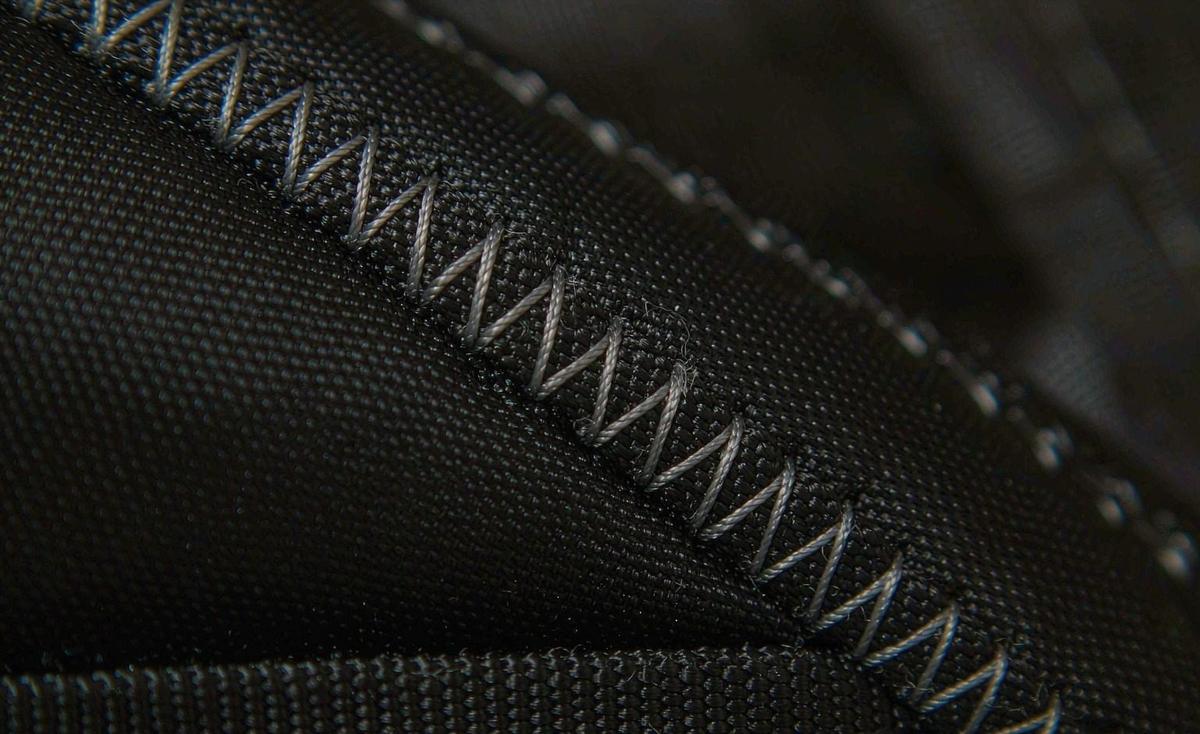
Stitch density is the number to know. Structural seams on a bag that will carry a laptop and a day of gear typically run 7 to 9 stitches per inch, which gives strength without perforating the fabric along the seam line. Decorative topstitching often runs lower, around 6 to 8, for a cleaner look. If a sample comes back with visible gaps or thread showing under load, ask what the machine was set to, because a density change is a five minute fix during sampling and a structural problem in bulk.
- Bar tacks or box stitches at every load point: strap roots, handle roots, haul loops and webbing joins
- Consistent seam allowance, typically 8 to 10 millimetres, showing evenly on the inside
- No skipped stitches on curves, especially where a gusset turns a corner
- Symmetry left to right on straps, pockets and panel placement, checked flat on a table
- Thread colour and thickness matched to the fabric weight, with no puckering on light shells
Operator skill is the variable nobody puts in a quotation. Sewing quality on a bag correlates with how long the operators have been on that specific construction and with whether the line uses jigs and templates for repeatable placement. Ask two things: what the average tenure is on the floor, and whether the job will run with templates for pocket placement and strap alignment. A workshop that builds a template for your design is spending an hour to save five hundred small errors, and that is the kind of trade you want made on your behalf.
When you review a sample, review it the way the line will build it. Lay the bag flat and check panel symmetry, then turn it inside out and read the seam allowances, then load it with the weight it is designed to carry and hang it for an hour. Our sample approval checklist sets out that sequence in full, and it is the same sequence you should apply to a pre-production sample before bulk is released.
Printing and decoration by fabric
Decoration is where brand impression lives and where most colour arguments begin. The method is chosen by three things: the fabric, the order quantity, and how the mark has to survive washing and abrasion. Choosing by price alone is how a logo cracks after a month, so it is worth understanding what each method actually does to the surface it sits on.
| Method | Works on | Practical minimum | Durability |
|---|---|---|---|
| Screen print | Polyester, nylon, canvas | Low setup, 100 pieces and up | Good, can crack on heavy stretch |
| Heat transfer | Most synthetics | Very low, good for sampling | Fair, edge lift over time if applied cold |
| Dye sublimation | Polyester only, light colours | Low, no screens needed | Excellent, colour sits in the fibre |
| Embroidery | Canvas, heavier woven | Low after digitising | Excellent, adds stiffness to light fabric |
| Woven or rubber patch | Any | Patch minimum often 500-1000 | Excellent, best perceived value |
The number to ask for is registration tolerance, which is how far a multi colour mark can drift between colours. On a well set up screen print that is around 0.5 to 1 millimetre, and it is the difference between a crisp edge and a halo you can see from arm's length. Ask also about cure: plastisol inks need the right temperature for the right time, and an undercured print looks perfect on the day and washes off in week three.
Colour is the other half of the argument and it should never be argued from a screen. Specify a Pantone reference, approve a physical lab dip or a printed strike off, and keep the approved swatch as the reference for bulk. Screen rendering varies by display and no ink room can match a screenshot. Where your brand uses a spot colour across bag, label and print, ask for all three to be approved against the same standard, because a matched bag with a slightly off logo reads as a mistake to every backer who notices.
One practical note for campaigns: put the decoration artwork into the tech pack as a vector file with dimensions and placement coordinates measured from a stated reference point, not as a render. A render shows what the mark looks like; it does not tell a print operator where the bottom edge sits in millimetres from the panel seam. That single line of missing information is one of the most common causes of a second sampling round, and a second round costs 6-10 working days, or 12-15 on a complex construction.
Hardware attachment and where bags fail
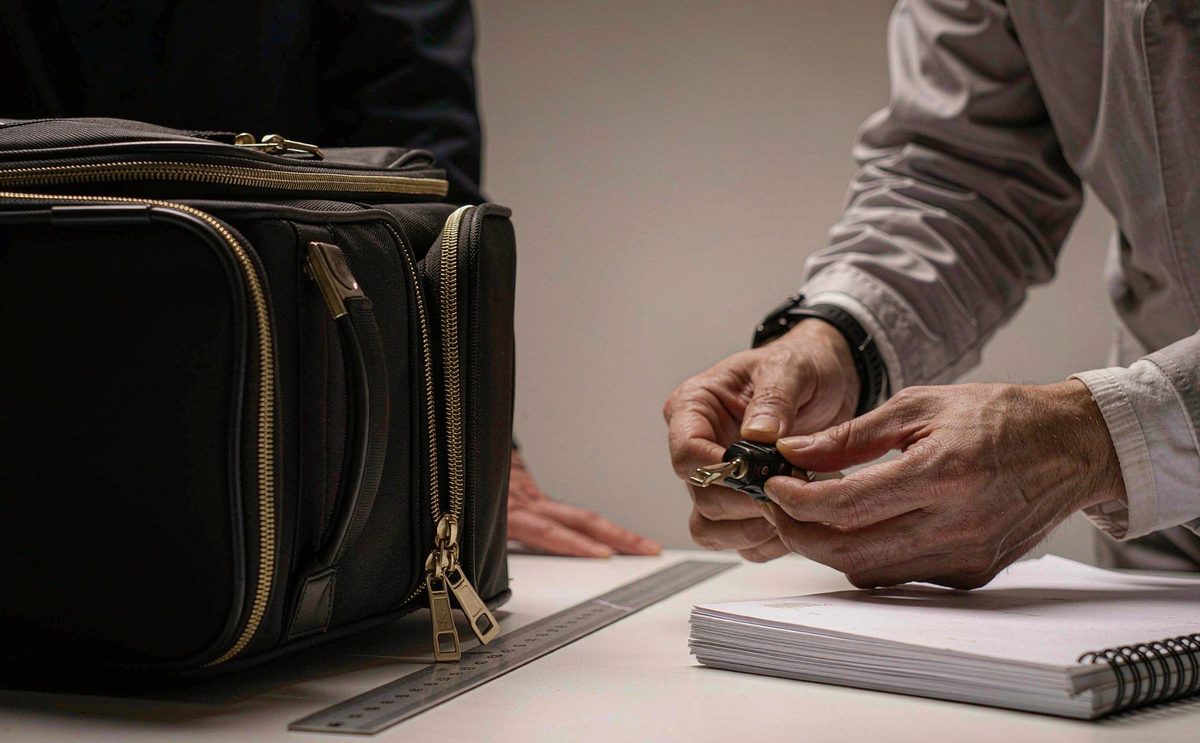
If you want to know where bags fail in the field, look at hardware rather than fabric. Rivets pull out, magnetic snaps lose strength, buckles crack at the moulding line, plating peels off a zip puller after a season, and eyelets tear through webbing under load. Fabric rarely fails first. That makes hardware specification and attachment the highest value few minutes you can spend on a tech pack.
Specify hardware in five parts: size, type, material, finish and pull test value. A number five reversed coil zip with black tape, a metal puller and a nickel free finish is a specification. A black zip is a question. The same applies to buckles: state the webbing width it must accept, the material, and whether it needs to meet a load rating for the market you are selling into. Where a component matters structurally, ask for the supplier's pull test figure in kilograms or newtons and put it in the pack.
Attachment is a setting, not an opinion. Rivets should be set with the correct die so the post spreads fully rather than partially, which is what causes the slow pull out failure that shows up months after delivery. Bar tacks at strap roots should catch the webbing and the panel, not just the panel. Box stitches should sit where the load path actually runs. When you review a sample, pull on every handle, strap and loop by hand with real force, because a failure you can produce on the sample table is a failure that will show up five hundred times in the field.
- Pull every strap root and handle root by hand, hard, and look at whether the stitch moves
- Open and close every zip twenty times and check for catching at the turns
- Check plating consistency across all visible hardware on the same unit
- Confirm buckle and webbing widths match, since a 1 mm mismatch causes slip under load
- Ask for the pull test value on any component that carries weight
In-house QC versus third party inspection
These two are not substitutes, they do different jobs. In-house quality control catches process drift while the run is happening. Third party inspection is an acceptance gate on a finished batch. A programme with only in-house QC has no independent check. A programme with only a final inspection discovers a systematic problem after the whole batch is built, which is the worst possible time.
Ask what in-house QC actually consists of, and expect four stages. An incoming material check confirms fabric shade, weight and width against the approved standard before anything is cut, which is where a wrong shade can still be caught cheaply. A first piece approval signs off the first unit off the line against the approved sample. In-process patrol walks the line during the run looking for recurring faults. A final check counts and grades finished goods before they are packed.
The acceptance gate should be written as AQL 2.5 under ISO 2859-1, which is the standard level we work to on bulk bag orders. AQL defines the sample size drawn from the batch and the number of defects at which the batch fails, split into critical, major and minor classifications. Ask which classification your defects fall into and get it in writing, because a misaligned logo can be argued as minor when you consider it major, and that argument should be settled before the inspection rather than during it.
- Inspection standard
- AQL 2.5 to ISO 2859-1
- Defect classes
- Critical, major, minor, agreed in writing
- In-house stages
- Incoming, first piece, in-process patrol, final
- Reference sample
- Approved pre-production sample, signed and dated
- Rework path
- Named in the order, with a standstill on the balance date
There is a third layer worth knowing about: testing. Where a bag is sold into a market with substance restrictions or child safety rules, a laboratory test on materials is a separate exercise from inspection and it takes its own time. Build it into the plan early rather than discovering it after bulk, because a failed substance test on a finished batch has no cheap remedy. Our cost breakdown article explains where testing and compliance sit in the unit price.
What in-house actually means
In-house is a claim about a machine, a room and a person, and it can be verified in about ten minutes. The easiest test is a live, unedited video walkthrough at a time you choose rather than a time they choose. Ask to start at the cutting store, walk to the sewing lines, stop at the printing area, and finish at the inspection tables. Ask the operator questions as you go. A genuine floor has the answer available on the spot, because the people doing the work know what they are doing.
The most revealing question is the reverse one: what is not done here? Every workshop outsources something. Sublimation needs different equipment from screen printing. Moulding a custom puller needs an injection machine. Leather work needs its own room. A partner who says everything is in-house, including operations that require incompatible machinery, is telling you they have not understood the question. A partner who names three outsourced steps and tells you who does them is giving you something you can verify.
Also ask about the machines themselves rather than the count. Machine count is a vanity metric; machine age, service state and the availability of spare parts matter more. A floor with 149 machines of mixed types tells you the range of operations available. A floor that can tell you which of those machines runs your job, and what the fallback is if that machine goes down, tells you something more useful: that they have planned for your order rather than around it.
Capacity maths: 200,000 pcs and your 500
Capacity figures are frequently misunderstood by creators on both sides of the argument. A workshop with a stated monthly output of 200,000 pieces across seven production lines is not busy or quiet because of your 500 units; your order is a rounding error in volume terms. What actually matters is whether a line slot exists in the window you need, and that depends on the queue, not on the total.
Here is the practical version of the maths. Every style change costs setup time: cutting dies are fetched or made, machine settings change, thread and needle sizes change, operators are re-briefed, and the first units are slower while the line settles. That setup cost is exactly why a minimum quantity exists at all, and it is why the minimum is expressed as 500 pcs per style and colourway rather than per order. Below that level the setup time dominates the run time and the unit price stops making sense for either side.
- Monthly capacity
- 200,000 pcs across 7 production lines
- Facility size
- 4,950 square metres, SGS-verified
- Team
- 137 staff across production, quality and programme support
- Equipment
- 149 machines covering cutting, sewing and finishing
- Working since
- 2014, with the founder in the trade since 2004
- Campaigns supported
- 20 plus crowdfunding programmes
So the question to ask is not how much capacity do you have, it is when can you book my line slot and what has to be confirmed to hold it. A good answer names the conditions: approved pre-production sample, deposit cleared, bulk materials in house. A vague answer saying soon is a warning, because it means your order is not yet in the plan. Get the slot conditions into the order confirmation and the delivery date starts to mean something.
One more piece of capacity maths that helps planning. If production 35-50 days from material availability, and materials are released only after the deposit clears and the sample is approved, then the critical path is sampling plus clearance plus bulk. Sampling is 6-10 working days per round on a standard construction and 12-15 on a complex one. Two rounds is normal on a new design. On a 500 piece minimum, that is the whole schedule, and it is why the onboarding milestone plan is worth writing down before you commit to a launch date.
Capability questions and the answers to expect
Here are the questions that produce the most information per minute, with the weak and strong versions of each answer. Ask them in writing and keep the answers, because they become the reference if a disagreement appears later. None of them is aggressive; all of them are normal in the trade, and a partner who has run campaigns before will recognise them immediately.
| Question | Weak answer | Strong answer |
|---|---|---|
| How are panels cut? | We cut accurately | Clicker press with a steel rule die, plus or minus 1.5 mm |
| What stitch density? | Normal | 7 to 9 per inch on structural seams, bar tacks at load points |
| Which print method? | Best one for the job | Screen print on polyester, 0.5 mm registration, Pantone matched |
| What is your QC? | We check everything | Four stages, final gate at AQL 2.5 to ISO 2859-1 |
| What is outsourced? | Nothing, all in-house | Sublimation, moulding and lab testing, with named partners |
| When is my line slot? | Soon | Booked on sample approval, deposit and materials in house |
Notice the pattern in the strong column: a number, a standard, or a named condition. That is what competence sounds like in writing. Notice also that the strong answers are all things a partner can state in one sentence without checking, which means you can ask them in a live call and get an immediate read on whether the person answering is close to the work.
If you want a fuller version of this exercise, our production partner capability checklist covers the same ground across materials, compliance, communication and financials, and the audit questions article gives twelve broader questions with the same weak and strong structure.
When outsourcing a step is fine
Outsourcing is not a red flag and insisting on everything under one roof is a mistake. A specialist step that needs a machine the workshop does not own is better done by someone who runs that machine every day. The rule is about where the risk sits, not about geography or ownership.
Outsourcing is fine when the step needs specialist equipment, when the output can be checked before it enters assembly, and when the queue time is known and short. Dye sublimation, moulded hardware, woven labels, leather trimming and laboratory testing all fall into this category in practice. Each produces something you can inspect on its own before it becomes part of a bag.
Outsourcing is not fine when the step is the one you cannot inspect before it disappears into the assembly, or when the queue is invisible. Cutting and sewing of the main panels should stay where the programme is managed, because a panel cut out of tolerance becomes invisible the moment it is sewn. Equally, any step whose delay would push your delivery date should have a stated turnaround in days, written into the schedule you track.
- Fine to outsource: sublimation, moulding, woven labels, leather trim, laboratory testing
- Not fine to outsource: cutting of main panels, main assembly sewing, final inspection
- Always ask: who runs it, how many days it takes, and how the output is checked on return
- Always record: the name of the subcontractor and the agreed turnaround in the order confirmation
A campaign bag specialist will usually ask one final question that ties this together: if the outsourced step is late, who tells you and on what day? The answer should be a person and a date, not a promise. That answer is the difference between a schedule you manage and a schedule that happens to you, and it is worth getting before you pay a deposit.
Capability is not a list of machines. It is the ability to answer a second question with a number.
Want a capability walkthrough of the floor your programme would run on? Send your design, quantity by colourway and target ship month to the contact quotation form or service@junyuanbags.com and we will book a live video walk.
Frequently Asked Questions
What does in-house capability actually mean for a bag programme?
That the operation is performed with equipment and staff the partner controls, so the step can be scheduled and corrected directly. It should always be verified, and the reverse question, what is not done here, is the most revealing one.
What cutting tolerance should I expect on bag panels?
Plus or minus 1.5 millimetres for die cut panels on a clicker press. Laser cutting can hold around 0.5 millimetres but may discolour light fabric. Hand guided knife cutting is looser, at 2 to 3 millimetres.
What stitch density is right for a backpack?
Seven to nine stitches per inch on structural seams, with bar tacks or box stitches at every load point such as strap roots, handle roots and haul loops. Decorative topstitching often runs slightly lower.
Which print method should I choose for a campaign bag?
It depends on fabric and quantity. Screen print suits polyester and nylon at volume, sublimation suits light polyester with no screen cost, embroidery suits canvas, and woven or rubber patches give the highest perceived value at a higher minimum.
Is AQL 2.5 strict enough for a crowdfunding reward?
It is the standard level used on bulk bag orders and it is appropriate for campaign rewards. What matters as much as the level is agreeing the defect classification in writing so that a dispute during inspection is settled by a document.
What is the difference between in-house QC and third party inspection?
In-house QC catches process drift while the run is happening, across incoming material, first piece, in-process patrol and final checks. Third party inspection is an independent acceptance gate on the finished batch.
Does high capacity mean my order will be prioritised?
No. Total monthly capacity says nothing about your place in the queue. What matters is whether a line slot is booked for your order and what conditions hold it: approved sample, cleared deposit and materials in house.
Why is the minimum 500 pcs per style and colourway?
Because setup dominates below that level. Every style and colour change costs cutting setup, machine setting changes and operator re-briefing, which is why the minimum is expressed per style and colourway rather than per order.
Is it a problem if a partner outsources part of the work?
Not necessarily. Specialist steps such as sublimation, moulding, leather trimming and lab testing are commonly outsourced. The test is whether the output can be inspected before assembly and whether the turnaround in days is known.
How can I verify a capability claim before paying a deposit?
Ask for a live, unedited video walkthrough at a time you choose, going from cutting store to sewing lines to printing to inspection. Ask operators questions as you go and ask what is not done on site.
How many operations does a backpack involve?
Typically between 40 and 120 depending on pocket count, dividers and reinforcement. That range is why line balancing and templates matter: repeatable placement should be a setting rather than an operator judgement.
What should I check on hardware before approving a sample?
Size, type, material, finish and pull test value. Then pull every strap and handle root by hand, run each zip twenty times, and confirm buckle and webbing widths match so nothing slips under load.
People Also Ask
What capabilities should a bag production partner have in-house?
Cutting, sewing, decoration and a four stage QC process. Specialist steps such as sublimation, moulding and lab testing are commonly and acceptably outsourced.
What is a good cutting tolerance for bag panels?
Plus or minus 1.5 millimetres on a clicker press with a steel rule die.
How do I check sewing quality on a bag sample?
Check stitch density at 7 to 9 per inch, bar tacks at load points, even seam allowance inside, and left to right symmetry with the bag laid flat.
Which is better, screen print or sublimation?
Sublimation for light polyester with no screen cost and excellent durability; screen print for broader fabric choice and volume. Heat transfer suits sampling only.
What is AQL 2.5?
An acceptance quality limit under ISO 2859-1 defining sample size and the defect count at which a batch fails, split into critical, major and minor classes.
Why does a bag order have a 500 piece minimum?
Setup time dominates below that quantity, and the minimum applies per style and colourway, not per total order.
Can I visit the production floor remotely?
Yes. Request a live, unedited video walkthrough at a time you choose and ask to see cutting, sewing, printing and inspection in that order.