How to Size Real Demand for a Crowdfunding Bag Reward
Market sizing for a bag reward is not about proving a market exists. It is about deciding how many units to commit to before you know the answer. Start bottom-up: count your reachable list, apply a 8 to 20 percent click rate, then a 2 to 6 percent pledge conversion, then 1.1 to 1.6 items per backer. Most first campaigns land below 500 units, which is the MOQ floor per style and per colourway. That gap is a marketing problem, not a sourcing problem.
- Why Market Sizing Comes Before Tooling Spend
- Bottom-Up Sizing From Your Own Funnel
- Top-Down Sizing From Category Funding Volume
- Segmenting the Niche by Carry Type and Price Band
- Converting a Size Estimate Into an Order Quantity
- The MOQ Floor and Exactly Where It Bites
- Post-Campaign Demand: Replacement, Repeat and Retail
- Sensitivity Testing Three Demand Scenarios
- Sizing Errors That Cost Creators Real Money
- From Sizing Straight Into a Production Brief
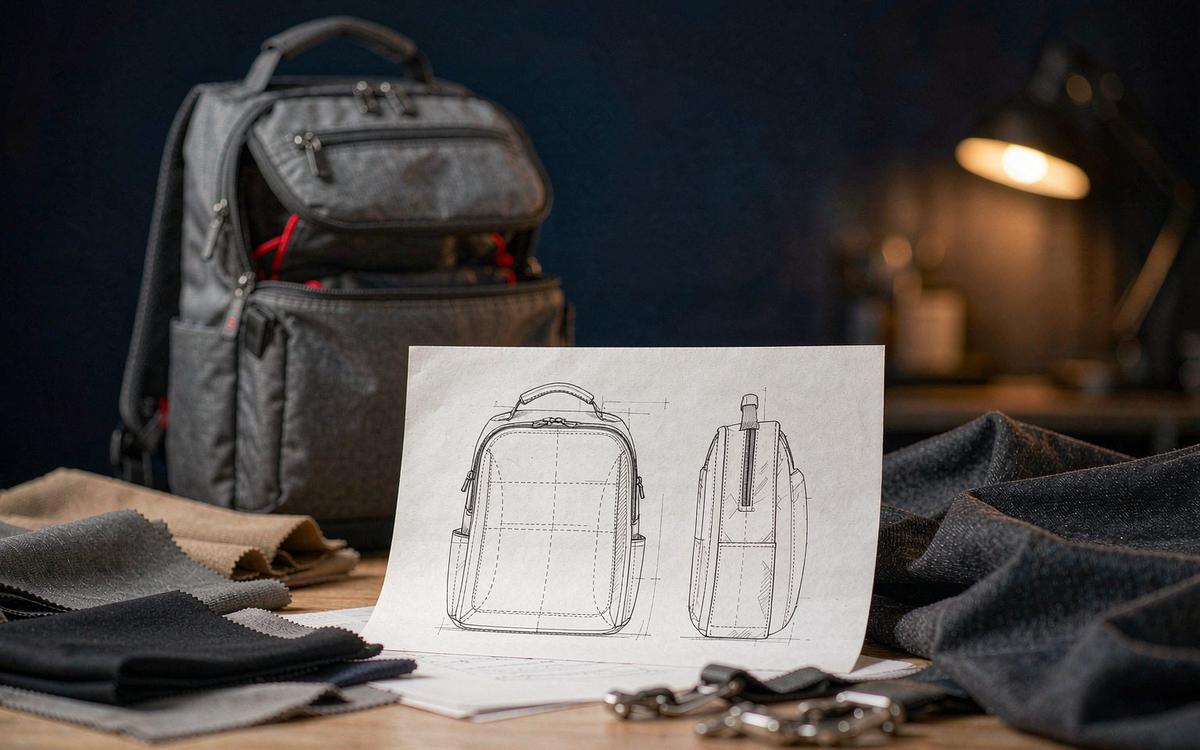
Market sizing for a crowdfunding bag reward is not an exercise in proving a market exists. It is an exercise in deciding how many units to commit to before you know the answer, and then testing whether that commitment survives a demand estimate that is honestly built. The number that matters is not total addressable market; it is serviceable obtainable market, because that is the figure you convert into an order quantity, and under a MOQ 500 pcs per style and per colourway structure that conversion has a hard floor.
This article walks through the sizing method our campaign bag specialists use with creators before a brief is written. It covers bottom-up sizing from your own funnel, top-down sizing from category funding volume, segmenting the niche by carry type and price band, converting the result into an order quantity, and sensitivity testing the answer. If you want the production-side figures that sit behind it, our MOQ calculator runs the same arithmetic from the order side.
The output of market sizing is not a market number. It is an order quantity you can defend to yourself and to your backers.
Why Market Sizing Comes Before Tooling Spend
The reason to size demand before spending on tooling or sampling is that the two decisions are coupled in an unhelpful direction. Tooling, moulds, custom hardware and bespoke fabric all improve the product and all lengthen the critical path. They also lock you into a specification at the moment you know least about demand. A creator who commits to a custom moulded back panel before testing demand has converted a marketing question into a fixed cost.
The alternative is not to avoid customisation. It is to sequence it so that the spend that locks the specification happens after the sizing work, and the sizing work happens before the campaign page is written. In practice that means using stock or near-stock components for the first sample round, sizing the market from your list and your category, then deciding which elements genuinely justify custom tooling. Most campaigns find that between one and three elements do, and the rest are better sourced from existing component ranges.
- Custom tooling buys differentiation and costs calendar time, typically adding 10 to 20 days to the critical path.
- Stock hardware costs almost no time and is the right default for a first campaign.
- Bespoke fabric is the largest schedule risk, because it adds a dye lot and a mill lead time before cutting.
- The locking decision should be the last one, not the first one.
There is a cash dimension too. Payment terms of T/T 30/70 mean 30 percent is due at production start, so the tooling decision and the cash decision are the same decision made twice. A specification that requires custom tooling also requires the deposit earlier, because the tooling has to be made before bulk begins. Sizing demand first does not remove that cash requirement, but it does mean the commitment is sized against something rather than against optimism.
Key takeaways
- C
- u
- s
- t
- o
- m
- t
- o
- o
- l
- i
- n
- g
- i
- s
- a
- s
- p
- e
- c
- i
- f
- i
- c
- a
- t
- i
- o
- n
- l
- o
- c
- k
- .
- M
- a
- k
- e
- i
- t
- t
- h
- e
- l
- a
- s
- t
- d
- e
- c
- i
- s
- i
- o
- n
- i
- n
- t
- h
- e
- s
- e
- q
- u
- e
- n
- c
- e
- ,
- n
- o
- t
- t
- h
- e
- f
- i
- r
- s
- t
- .
Bottom-Up Sizing From Your Own Funnel
Bottom-up sizing starts with assets you actually control and works forwards to a unit estimate. It is the more reliable of the two methods for a crowdfunding reward, because your own audience is the only demand you can convert with any confidence. The sequence has four steps, and each step applies a rate that should come from your own history rather than from an industry average.
- Count the reachable audience: email subscribers, social followers, community members and any press or partner reach you can credibly count.
- Apply a page visit rate: typically 8 to 20 percent of a warm list will open and click through to a campaign page.
- Apply a pledge conversion rate: for bag rewards, a well-built page converts roughly 2 to 6 percent of visitors.
- Apply an average items per backer: usually 1.1 to 1.6 once add-ons are counted.
Worked through with conservative rates: a 12,000 person list at a 12 percent click rate gives 1,440 page visitors; at 4 percent conversion that is 58 backers; at 1.3 items per backer that is about 75 units. That is a very different number from the one most creators have in their head, and it is the number that matters, because it is roughly what a first campaign converts without paid media.
The honest conclusion from bottom-up sizing is that most bag campaigns need external traffic to reach 500 units, which is exactly the point. The MOQ floor is not an obstacle to be negotiated away; it is a signal that the campaign plan has to include paid media, partnerships, or a pre-existing retail commitment. Our market sizing notes in the benchmark report show how typical funded campaigns bridge that gap.
Top-Down Sizing From Category Funding Volume
Top-down sizing works from the category rather than from your list, and it is useful mainly as a sanity check on the bottom-up number. The method is to estimate the annual funding volume flowing through bag campaigns in your niche, divide by a typical reward price to get units, then identify the share you could plausibly capture. The result is almost always a larger number than the bottom-up estimate, and the gap between the two is the most informative part of the exercise.
| Step | Input | Typical value |
|---|---|---|
| Category funding volume | Annual pledges in the niche | Niche specific, model a range |
| Average reward price | Mid-tier bag tier price | 70 to 130 |
| Implied annual units | Funding volume divided by price | Tens of thousands |
| Realistic capture share | First campaign, no paid media advantage | 0.05% to 0.5% |
| Implied first-campaign units | Units multiplied by capture share | Often below 500 |
The capture share row is where the method either works or misleads. A first-time creator with no existing audience, no press relationships and no paid media budget captures a very small share of category volume, regardless of how large that volume is. A creator with a strong list, a category following and a media plan captures materially more. The category size is the same in both cases, which is precisely why top-down sizing on its own produces plans that fail.
The practical use is reconciliation. If your bottom-up estimate is 75 units and your top-down estimate with a generous capture share is 400, the honest planning range is somewhere between the two, and the gap represents the work you have to do. If your bottom-up estimate is 600 and your top-down is 200, your list assumptions are probably too optimistic and should be tested before you commit to a 500-unit order.
Segmenting the Niche by Carry Type and Price Band
Segmenting the niche means deciding which carry type and which price band you are actually selling into, because "bags" is not a market. A 24 dollar foldable tote, a 89 dollar everyday backpack and a 249 dollar travel system attract different backers, require different production capability and carry different fulfilment economics. Sizing without segmenting produces a blended number that is wrong for every product in the range.
- Entry band, 20 to 45: totes, drawstrings, pouches and packing cubes. Simple builds, low landed cost, high volume needed to clear MOQ.
- Mid band, 60 to 130: everyday backpacks, duffles, gym and laptop bags. The core crowdfunding band, where most funded bag campaigns sit.
- Premium band, 150 and above: travel systems, camera bags, technical outdoor. Lower volumes, higher margin, much higher quality expectation.
- Accessory band, 8 to 25: add-ons attached to a primary reward. Marginal picking cost and the strongest contribution in the ladder.
The band you choose sets the rest of the plan. In the entry band, volume is everything, because a 24 dollar reward with a 9 dollar landed cost and 11 dollars of shipping leaves very little contribution at 500 units. In the mid band, the economics work at 500 to 1,000 units and the production risk is manageable. In the premium band, 500 units is comfortable on margin but the quality expectation is unforgiving, and a single shade mismatch can generate a return rate that wipes out the year.
Most first campaigns should sit in the mid band with accessory add-ons around it. That combination clears the 500 pcs per style and per colourway floor without requiring a very large backer count, and the add-ons lift average order value without adding a new SKU to the sewing line. Our reward pricing data breaks down what backers actually pay in each band.
Converting a Size Estimate Into an Order Quantity
Converting a size estimate into an order quantity is where most sizing work quietly fails, because the conversion has three adjustments that are easy to skip. The first is the pledge-to-unit ratio: some backers pledge for multiple units, some tiers include two bags, and some pledges include no bag at all. The second is the attrition rate: a share of pledges fail to settle, and on flexible funding campaigns that share can be substantial. The third is the buffer for replacements and warranty.
| Adjustment | Typical rate | Effect on 600 pledges |
|---|---|---|
| Pledges including a bag | 85% to 95% | 510 to 570 units |
| Items per backer with add-ons | 1.1 to 1.6 | 561 to 912 units |
| Payment attrition | 2% to 8% | 516 to 894 units |
| Replacement and warranty buffer | 1% to 3% | 521 to 921 units |
| Round to MOQ blocks | 500 per colourway | 1,000 units at two colourways |
The last row is the one creators find annoying and is the one that matters. You cannot order 521 units in two colourways, because each colourway is its own 500-unit block. Rounding up to 1,000 units means carrying roughly 80 units of surplus into post-campaign sales, which is fine if you have a channel and dead stock if you do not. That is the real argument for a single colourway at 500 units on a first campaign.
The arithmetic also explains why the 500-unit floor feels high to creators whose bottom-up estimate came out at 75 units. It is high. The floor is not calibrated to a first campaign; it is calibrated to a production line that needs a minimum run to be economical. Closing that gap is a marketing job, not a sourcing job, and pretending otherwise is how campaigns end up with 400 unsold bags.
The MOQ Floor and Exactly Where It Bites
MOQ 500 pcs per style and per colourway has two distinct edges, and creators tend to hit one or the other without noticing which. The style edge is the minimum for a given bag design. The colourway edge is the minimum for each colour of that design. They are separate commitments, which means a single style in three colours is three times the volume commitment of the same style in one colour, at the same unit price assumption.
- One style, one colour: 500 units. The safest first order.
- One style, two colours: 1,000 units. Requires roughly 900 to 1,000 backers.
- One style, three colours: 1,500 units. Requires a strongly funded campaign.
- Two styles, one colour each: 1,000 units, but two sets of patterns and two first articles.
The last row is the one most often misread. Adding a second style doubles the pattern work, the sampling rounds and the first article inspections, and it usually lengthens the schedule more than adding a colourway to an existing style does. If your goal is variety rather than a genuinely different function, extra colourways are the cheaper route. If the second style solves a different carry problem, it may be worth the extra calendar time.
The negotiation reality is worth stating plainly. The floor exists because a production line has a setup cost that has to be amortised, and below roughly 500 units the setup dominates the unit price. Our team can sometimes structure a mixed-colour order within a single block where the shell fabric is shared, and the MOQ explained guide sets out where that is genuinely possible and where it is not.
A second style costs more calendar time than a second colourway. Buy variety with colour, buy function with a new style.
Post-Campaign Demand: Replacement, Repeat and Retail
Sizing does not stop at the campaign, and creators who size only for the pledge period systematically under-order. Three demand sources follow a funded campaign, and all three are servable from the same production programme if they are planned early enough. The first is replacement and warranty demand, typically 1 to 3 percent of units. The second is late pledge and post-campaign direct sales, which for a well-run campaign can add 10 to 40 percent of the original volume. The third is retail and wholesale.
- Replacement and warranty: 1 to 3 percent of units, budget it into the first order.
- Late pledges: often 5 to 15 percent of funded volume if the page stays open.
- Post-campaign direct sales: 10 to 40 percent for campaigns that keep marketing.
- Retail and wholesale: lumpy, negotiated, and usually 6 to 12 months out.
The reason to include these in the sizing model is that they change the rounding decision. If post-campaign demand is realistically 20 percent of funded volume, then rounding 900 units up to 1,000 is not carrying 100 units of dead stock; it is pre-positioning inventory you will sell anyway. If post-campaign demand is realistically zero, the same rounding is a write-off. The two situations look identical during the campaign and are completely different afterwards.
Retail deserves a specific caution. Wholesale buyers want volume commitments, consistent colour across repeat orders and compliance documentation, which is a different operating model from a one-off campaign. It is a good second-year business and a poor first-year plan. Our benchmark report tracks how the campaigns we have supported handled the transition, and the crowdfunding bag guide places it in sequence.
Sensitivity Testing Three Demand Scenarios
A demand estimate is a range, and the useful output of sizing is three scenarios rather than one number. The purpose is not to predict which will happen; it is to decide in advance what you will do in each case, so that the decision is made calmly rather than during the campaign. We use a low case at roughly 60 percent of target, a mid case at target, and a high case at 140 percent of target.
| Scenario | Units implied | Pre-agreed production response |
|---|---|---|
| Low, 60% of target | 300 to 600 | Single colourway at 500, or consolidate colours |
| Mid, 100% of target | 500 to 1,000 | Two colourways, standard sampling plan |
| High, 140% of target | 700 to 1,400 | Two colourways plus a re-order slot held |
The low case is the one that saves campaigns, because it forces the honest conversation before money is spent. If the low case produces 300 units and the floor is 500, you have three options and you should pick one before launch rather than during fulfilment: consolidate to a single colourway and tell backers early, accept a below-minimum surcharge, or carry the balance into post-campaign sales. All three are survivable if they are planned. None are pleasant if they are discovered.
The high case matters for a different reason, which is that a campaign that overshoots needs a re-order slot rather than a bigger first order. Holding capacity for a second run costs nothing in inventory and protects you from the opposite failure, which is running out of a colourway while the campaign is still live. Our re-order notes cover how to reserve that slot.
Sizing Errors That Cost Creators Real Money
Five sizing errors account for most of the plans we have to unpick. They are worth listing plainly because each one is easy to make and each one produces a confidently wrong number. None of them require bad faith; they come from using an average where you needed your own rate, or from sizing the market when what you needed was to size your reachable audience.
- Using category size instead of reachable audience: the category is large and your list is small. Size the list.
- Ignoring payment attrition: 2 to 8 percent of pledges fail to settle, more on flexible funding.
- Forgetting the MOQ floor: 500 per colourway, not per style, so three colours is 1,500 units.
- Sizing for the campaign only: late pledges and post-campaign sales can add 10 to 40 percent.
- Mixing gross and net figures: always apply platform fees and shipping before comparing to unit cost.
The last one is the most common and the most damaging, because it produces a plan that looks profitable on a spreadsheet and is not. A 89 dollar pledge is not 89 dollars of income. After platform and payment fees of 8 to 12 percent, and backer shipping of 15 to 22 dollars, the amount available to cover the bag itself is roughly 55 to 65 dollars. Comparing that to a 26 dollar landed cost gives a healthy margin; comparing 89 to 26 gives a fantasy.
Key takeaways
- A
- l
- w
- a
- y
- s
- s
- i
- z
- e
- d
- e
- m
- a
- n
- d
- f
- r
- o
- m
- y
- o
- u
- r
- r
- e
- a
- c
- h
- a
- b
- l
- e
- a
- u
- d
- i
- e
- n
- c
- e
- ,
- a
- n
- d
- a
- l
- w
- a
- y
- s
- c
- o
- m
- p
- a
- r
- e
- n
- e
- t
- i
- n
- c
- o
- m
- e
- t
- o
- l
- a
- n
- d
- e
- d
- u
- n
- i
- t
- c
- o
- s
- t
- .
From Sizing Straight Into a Production Brief
The output of sizing should be a number that goes straight into a production brief, and the brief should state it in the same units your sourcing partner will quote against. That means units per style, units per colourway, target landed cost per unit, and the date the goods need to leave the consolidation point. Anything less precise forces the quoting side to make assumptions, and assumptions in a quote are assumptions you will be held to later.
- Units per style, stated separately for each design in the programme.
- Units per colourway, each at or above the 500-unit floor.
- Target landed cost per unit, so the quote is built to a number rather than to hope.
- Required despatch date, which works backwards to set the sampling start.
- Compliance requirements for each destination market, stated up front.
Stating the compliance requirements up front is the item most often left out, and it is the one that can invalidate an otherwise good quote. Testing requirements differ by destination and by product type, and discovering them after sampling means either a second round or a shipment that cannot be sold. Include them in the brief and the quote will include them; leave them out and you will be negotiating them later, at the worst possible moment.
Once the brief exists, the sequence is straightforward. Sampling runs 6 to 10 working days for a standard build and 12 to 15 working days for a complex one. Bulk production runs 35 to 50 days after approval. Inspection is to AQL 2.5 to ISO 2859-1, and goods move FOB Xiamen. Our sampling data and lead time analysis cover each stage in more detail.
Send us your audience numbers and target date and we will size an order quantity you can commit to with confidence.
Frequently Asked Questions
Why should I size the market before sampling a bag?
Because tooling and custom components lock your specification at the moment you know least about demand. A bottom-up estimate built from your own list tells you whether 500 units is realistic before you spend on moulds, bespoke fabric or custom hardware. Sizing first costs a spreadsheet; sizing second costs a re-order, a delay, or a warehouse full of surplus stock.
What is the difference between bottom-up and top-down sizing?
Bottom-up starts from assets you control, meaning your email list, social following and partner reach, then applies your own click and conversion rates. Top-down starts from category funding volume and asks what share you could capture. Bottom-up is more reliable for a first campaign, while top-down is best used as a sanity check on it. Where the two disagree by a wide margin, trust the bottom-up figure and treat the gap as the marketing work you still have to do.
What conversion rate should I assume for a bag campaign page?
For a warm audience, plan on roughly 2 to 6 percent of page visitors pledging, with a well-built page sitting in the upper half of that band. Cold paid traffic converts materially lower. Apply your own historical rates where you have them, since a blended industry average will usually flatter your plan. Cold paid traffic converts materially lower than a warm list, so keep the two in separate rows rather than blending them.
How do I account for pledges that never settle?
Deduct 2 to 8 percent from pledged volume before converting to units. The rate runs higher on flexible funding platforms, where a share of pledges either fail payment or are cancelled before capture. Modelling attrition during sizing is what prevents the gap between funded total and deliverable units appearing in month four. The rate rises where a campaign runs long or where the pledge manager stays open for an extended period after close.
Does MOQ apply per style or per colourway?
Both, and they are separate commitments. The structure is MOQ 500 pcs per style and per colourway, so one style in one colour is 500 units, but the same style in three colours is 1,500 units. Colourways are separate because each colour requires its own dye lot of fabric, webbing, zipper tape and thread. That is the structural reason colourway minima are not negotiable in the way style minima sometimes are.
What price band should a first bag campaign target?
The mid band, roughly 60 to 130 per reward tier. Entry band products need very high volume to clear the 500-unit floor economically, while premium band products carry quality expectations that are unforgiving for a first programme. Pair a mid band hero bag with accessory add-ons. Add-ons lift average order value without adding a new SKU to the sewing line, which is the cheapest variety available.
How much buffer should I add for replacements and warranty?
Add 1 to 3 percent of units to the first order. That covers backer-reported defects, transit damage and warranty claims without triggering a re-order, which would cost 35 to 50 days you do not have. Budget it during sizing rather than discovering the shortfall after despatch. At 2,000 units that is 20 to 60 parcels, which is manageable if planned and a crisis if it is not.
Should I plan for post-campaign sales in my first order?
Yes, if the channel realistically exists. Late pledges and post-campaign direct sales commonly add 10 to 40 percent of funded volume, which changes the rounding decision completely. Rounding 900 up to 1,000 is pre-positioning inventory if you will sell it, and dead stock if you will not. The two situations look identical during the campaign and are completely different afterwards, which is why the decision belongs in planning.
Is retail a realistic channel after a first campaign?
Usually not in year one. Wholesale buyers want volume commitments, consistent colour across repeat orders and compliance documentation, which is a different operating model from a one-off campaign. It is a reasonable second-year business and a poor first-year plan, so do not size your first order around it. Wholesale requires volume commitments and consistent colour across repeat orders, which a one-off campaign programme is not built to deliver.
How do I turn a demand estimate into an order quantity?
Work through four adjustments: the share of pledges that include a bag, items per backer once add-ons are counted, payment attrition, and a replacement buffer. Then round each colourway up to a 500-unit block. The rounding step is the one that surprises people, so model it before you commit. Rounding each colourway to its own 500-unit block is what turns a 900 unit estimate into a 1,000 unit commitment.
What is the most common market sizing mistake creators make?
Using category size instead of reachable audience. The bag category is large, which tells you nothing about how many of your 3,000 subscribers will pledge. Size from your own list and your own historical rates, then use the category figure only to check the result is plausible. A large category and a small list are both true at the same time, and only one of them tells you how many units to order.
When should compliance testing be included in the sizing model?
From the start. Testing requirements differ by destination and product type, and they affect both cost and calendar. Include them in the production brief so the quote carries them, rather than discovering the requirement after sampling and paying for a second round. Testing affects both the unit cost and the calendar, so it belongs in the brief from the first draft rather than the final one.
People Also Ask
How do I size demand for a crowdfunding bag?
Start bottom-up: count your reachable list, apply a 8 to 20 percent click rate, then a 2 to 6 percent pledge conversion, then 1.1 to 1.6 items per backer.
What is SAM for a bag reward?
Serviceable obtainable market: the share of the bag category you can realistically reach with your existing audience, media plan and budget. It is the only sizing figure worth planning from.
How many units do I need to hit MOQ?
500 per style and per colourway. One colour is 500 units, three colours is 1,500 units, because each colourway is a separate production block.
Should I size for post-campaign sales?
Yes, if you have a channel. Late pledges and direct sales commonly add 10 to 40 percent of funded volume, which changes how you round the order.
What pledge conversion rate is realistic?
Plan on 2 to 6 percent of page visitors for a warm audience. Cold paid traffic converts materially lower, so do not blend the two.
How much warranty buffer do I need?
1 to 3 percent of units. That covers defects, transit damage and warranty claims without forcing a 35 to 50 day re-order.
When does compliance testing affect sizing?
Immediately. Requirements vary by destination and product type, and they change both unit cost and the calendar, so put them in the brief.