Custom Fanny Packs for Kickstarter
The MOQ for custom fanny packs on a Kickstarter campaign is 500 pcs per style and colourway. Sampling takes 6-10 working days, or 12-15 where moulded buckles or curved-panel construction are specified, and production 35-50 days after deposit and approved pre-production sample. Inspection is set at AQL 2.5 to ISO 2859-1, cargo ships FOB Xiamen and payment is T/T 30/70. A belt bag is the smallest reward in most ladders and carries one of the longest specification lists, because the buckle, the belt and the zipper are all loaded components on a very small surface. This page works through those decisions in detail.
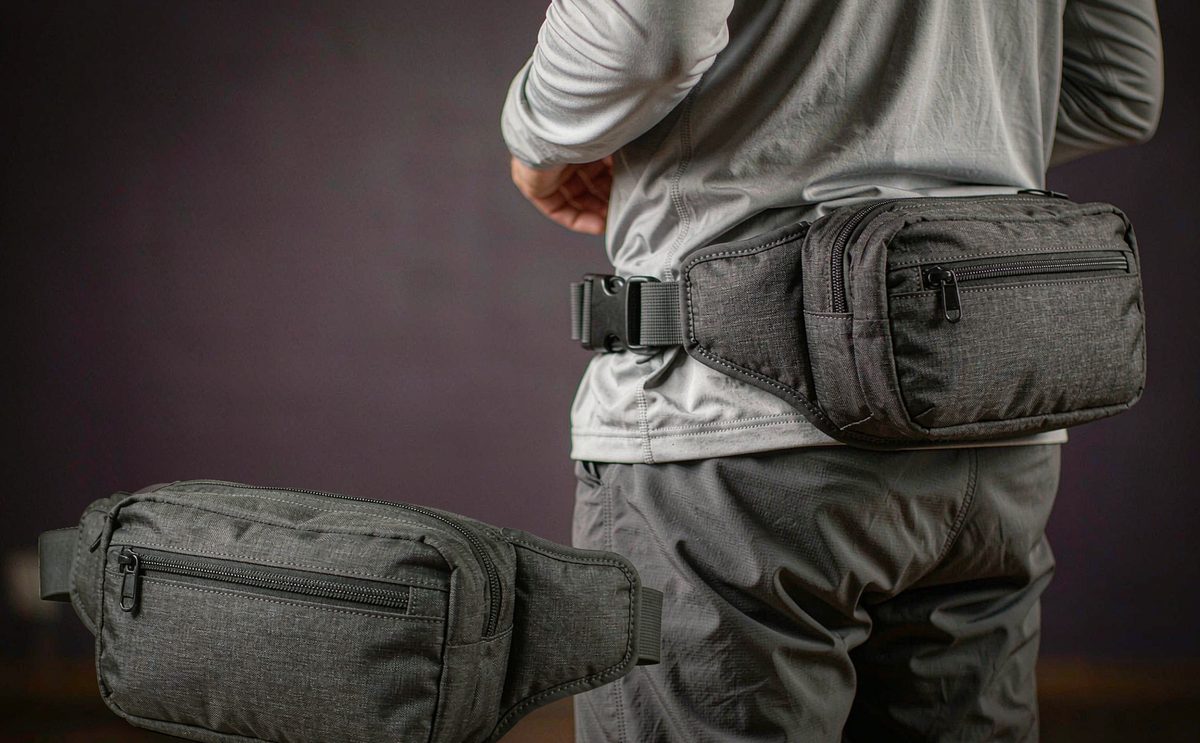
Key takeaways
- MOQ is 500 pcs per style and colourway; each colourway carries its own minimum.
- Sampling takes 6-10 working days, extending to 12-15 for moulded buckles or curved-panel construction.
- production 35-50 days after deposit and approved pre-production sample.
- Inspection is AQL 2.5 to ISO 2859-1, with a photographic report before the 70% balance payment.
- Cargo ships FOB Xiamen under T/T 30/70 terms.
- The buckle takes the full load of the bag; specify its breaking strength and test it, do not assume it.
A small-format reward with a long specification list
A fanny pack, or belt bag, is usually the smallest item in a reward ladder. It works as an entry tier, as an add-on, as a bundle component and as a brand carrier at events after the campaign. The commercial appeal is obvious: low unit cost, flat packing and a broad audience. The specification trap is equally obvious once it is written down, because a belt bag concentrates all the load-bearing components of a full-size bag into a fraction of the surface area.
Our production team reads a belt-bag RFQ on the same four axes used for larger bags, and the answers matter more per gram here: load path, hardware, closure and material. The buckle takes the entire weight of the bag and its contents, the belt webbing takes the tension, and the zipper is opened more often per hour of use than on almost any other category. There is no slack in the system, so there is nowhere to hide a weak specification.
The second point worth making at planning stage is about fit. A belt bag has to sit comfortably on a wide range of body shapes and over different clothing, from a t-shirt to a winter coat. Specify the belt adjustment range rather than a single length, and test it across that range during sampling. Programme-level context is on the custom bags for Kickstarter page.
Belt and buckle engineering: the part that fails
The buckle is the single most loaded component on a belt bag and the most commonly under-specified. It takes the static weight of the bag, the dynamic load of walking or running, and the shock load of the bag catching on something. A buckle specified only by colour and width is a buckle that has not been specified at all. Ask for the material, the breaking strength in kilograms or newtons, and the operating temperature range, then test to that figure.
| Element | Entry option | Recommended option | Why it matters |
|---|---|---|---|
| Buckle type | Standard side-release | Side-release with a stated breaking strength | Takes the entire bag load |
| Buckle material | Recycled POM | POM or nylon with cold-rated grade | Brittle plastic cracks in winter use |
| Belt webbing | 20 mm flat webbing | 25 mm webbing, soft edge | Comfort and load spread |
| Adjustment range | 70-110 cm | 60-130 cm | Fits over a winter coat |
| Belt attachment | Stitched to the body | Bartacked through a reinforcement plate | Prevents tearing at the join |
| Excess management | Loose tail | Elastic keeper or webbing loop | Stops the tail flapping |
The adjustment range deserves particular attention because it is a fit question disguised as a hardware question. A 60-130 cm range covers the vast majority of backers whether they wear the bag around the waist or across the chest, and over a coat rather than a t-shirt. A narrower range produces a fit complaint that no amount of build quality will fix, and fit complaints on a small item are disproportionately damaging to reviews.
Pocket layout and security detailing
Backers carry a phone, keys, cards and cash in a belt bag, and they carry it against the body where pickpocketing is a real concern in travel use. Layout therefore has two jobs: make the contents reachable, and make the valuable contents secure. The standard answer is a main compartment for bulk, an internal slip or mesh pocket for organisation, and a hidden body-side pocket for cards and cash.
- Main compartment: sized to the largest phone in the stated range plus a small margin, not to a drawing.
- Internal organisation: one slip pocket and one key clip covers most backers without adding bulk.
- Hidden rear pocket: a body-side zippered pocket is the standard anti-theft feature and costs little.
- Reverse-coil zipper: a covered or reverse-coil zipper on the rear pocket is quieter and more secure.
- Zipper garage: a covered end detail stops the pull rattling and protects contents from scratch.
- Panel curve: a lightly curved back panel follows the body and stops the bag looking boxy when worn.
Phone dimensions change, and a compartment designed to a drawing rather than to the largest current handset will exclude a meaningful share of backers. State the largest device the reward must accept in the tech pack, add a few millimetres of margin for a case, and test the fit during sampling. This is the most common fit complaint in the category and the cheapest to prevent.
Shell, lining and zipper specification for a belt bag
Shell choice on a belt bag is a balance between structure and softness. Too stiff and the bag looks boxy and refuses to curve around the body; too soft and it loses shape within weeks and looks cheap. A mid-weight coated polyester or nylon with a light interlining usually lands in the right place. Where the reward is positioned as premium, a lightweight ripstop nylon or a PU-faced vegan leather changes the perception substantially for a modest absolute cost increase.
| Element | Entry option | Recommended option | Cost index |
|---|---|---|---|
| Shell fabric | 300D polyester | 600D polyester, PU coated | 1.0 to 1.3 |
| Premium shell | n/a | Nylon ripstop or PU-faced vegan leather | 1.8 to 2.1 |
| Lining | Plain taffeta | High-visibility polyester or printed | 1.0 to 1.4 |
| Main zipper | Coil #5 | Reverse-coil #5 with garage | 1.0 to 1.2 |
| Premium zipper | n/a | Water-resistant coated #5 | 1.5 to 1.9 |
| Backing | None | Light interlining for shape retention | 1.1 to 1.3 |
Back abrasion and tear claims should be backed by test data rather than adjectives. Independent Martindale or Wyzenbeek rub testing on the shell, plus tensile and tear testing to ASTM D5034 on the belt attachment panel, gives a defensible figure for the campaign page. Recycled and certified inputs, including GRS-certified rPET, are covered on the material customization for Kickstarter bags page.
Sampling a belt bag: two rounds and a wear test
Sampling runs 6-10 working days from approved artwork and confirmed materials, extending to 12-15 where moulded buckles or curved-panel construction are specified, because tooling has to be cut first. Belt bags sample quickly, which makes a proper two-round sequence affordable. The crucial addition is a wear test: carry the second-round sample for several days, over different clothing, with the contents a backer would actually carry.
- Round one: assess proportions on the body, the panel curve and whether the bag sits flat when worn.
- Round one testing: load with the stated contents and check buckle security, belt comfort and zipper smoothness.
- Round two: confirm hardware consistency, lining fit and logo placement at production size on bulk materials.
- Wear test: carry the sample for several days over a t-shirt and over a coat, at both ends of the adjustment range.
- Approval: sign the pre-production sample built from bulk materials, which becomes the AQL 2.5 reference.
production 35-50 days after deposit and approved pre-production sample, so the clock starts only when that physical reference exists and the buckle load test has passed. Do not release the 30% deposit against a render. The gate sequence is documented on the crowdfunding bag sample prototyping page.
MOQ, unit cost and the accessory-tier equation
The minimum order is 500 pcs per style and colourway. Belt bags are the least material-intensive item in the range, which makes them the most affordable per unit and makes the volume curve the steepest of all. The binding constraint is line setup, not fabric: pattern loading, machine threading, colour changeover and QC arrangement cost the same whether the item is a fanny pack or a travel bag.
| Cost driver | What changes | Effect on unit cost |
|---|---|---|
| Shell material | 300D polyester to vegan leather | +18% to +110% |
| Buckle and hardware | Standard plastic to cold-rated branded | +10% to +38% |
| Belt system | Fixed webbing to padded adjustable | +8% to +30% |
| Pocket count | One compartment to three compartments | +9% to +28% |
| Logo method | Screen print to TPU badge | +$0.30 to +$1.90 |
| Order volume | 500 pcs to 3,000 pcs | -11% to -25% |
A creator asking how much does a custom fanny pack cost should request two quotations: one at 500 pcs and one at 2,000 pcs. The gap between them is the steepest in the category, because setup dominates a very low material cost, and that gap is where the post-campaign margin and the retail refill business both come from. Ask for the band in writing while the first purchase order is still open.
Add-ons should be priced from landed cost with freight included, because a light item with poor packing can still lose money.
Kickstarter Creator Handbook
Scheduling an accessory SKU inside a multi-item programme
When a fanny pack sits inside a multi-item reward, its schedule has to be aligned with the hero product rather than run in parallel. Both items should reach pre-production approval together, because a mismatch means one item finishes and waits in a warehouse while the other completes. production 35-50 days after deposit and approved pre-production sample for the programme, and the accessory should share that window.
| Stage | Working days | Owner |
|---|---|---|
| RFQ, tech pack review and hardware plan | 2-4 | Creator and production partner |
| Material sourcing and hardware selection | 5-8 | Production team |
| Sampling round one | 6-10 | Production team |
| Wear test, buckle load test and correction | 3-7 | Creator |
| Pre-production sample and approval | 6-15 | Both |
| Bulk production | 35-50 | Production team |
| AQL 2.5 inspection and packing | 3-5 | QC team |
| Freight, customs and fulfilment | 12-38 | Freight and fulfilment partners |
Where the reward ships as a bundle or an add-on, the kitting and addressing operation needs its own specification, cost and QC step. The crowdfunding rewards fulfilment page covers kitting, add-on handling and the DDP route that keeps a surprise duty invoice away from an international backer.
QC at AQL 2.5 on small-format runs
Pre-shipment inspection is set at AQL 2.5 to ISO 2859-1, which fixes the sample size, the accept and reject counts and the defect classification. Critical defects — a buckle that releases under load, a broken zipper, a sharp hardware edge — are zero tolerance. Major defects such as shade variation between panels or a misaligned logo are capped by the AQL 2.5 table. Minor defects such as a stray thread carry a higher allowance but must still be logged.
- Incoming check: shell weight, webbing width, buckle breaking strength certificate against the specification.
- Inline check: belt attachment bartacks, zipper run and pocket alignment on the first 50 units of each colourway.
- Buckle test: a load test to the stated breaking strength on a sample drawn from every colourway and batch.
- Cycle test: buckle and zipper cycled a defined number of times, because belt bags are opened constantly.
- Final AQL 2.5 inspection: random carton selection, defect logging and a photographic report before release.
- Compliance file: REACH, CPSIA or Prop 65 documentation assembled for each destination market.
The buckle carries the full load of the bag and it is a bought-in component, which makes it the highest substitution risk in the build. Require a breaking-strength certificate on incoming hardware and run a load test on a sample from every batch. A buckle that releases under load turns a wearable reward into a dropped phone, and no inspection later in the process can detect it by eye.
The staged inspection model, defect classification and the reporting pack are explained on the Kickstarter campaign bag QA/QC page, including the decision path when a batch lands marginally under the accept threshold.
Packaging, branding and the flat-pack advantage
Belt bags pack flat and light, which is a genuine logistics advantage that should be designed for rather than discovered. Folded flat with the belt coiled, a carton holds far more units than the same bag loosely packed, which lowers freight per unit and reduces the carton count a warehouse has to handle. Specify the packing method in the tech pack so it is costed rather than assumed.
- Branding: screen print from about $0.30, embroidery around $1.10, woven label around $0.45, TPU badge around $1.90.
- Logo size: approve at production size, because a belt bag offers a small placement area and detail is lost quickly.
- Carton grade: five-ply export carton, sized to the pallet footprint rather than to the bag.
- Packing method: belt coiled and the unit folded flat, with tissue at buckle and hardware points.
- Presentation: a printed card or a dust bag adds perceived value at a small absolute cost on a low-cost item.
Logo method selection for this category is covered in depth on the print and embroidery for custom bags page. Programmes of this kind run from a 4,950 m² SGS-verified production floor with 137 staff across 7 production lines and 149 machines, giving 200,000 pcs of monthly capacity. Established in 2014 with trade roots going back to 2004, the team has supported more than 20 crowdfunding campaigns.
How to choose a production partner for an accessory SKU
How to choose between bidders on an accessory SKU is a question about component evidence rather than price. Will the bidder name the buckle breaking strength, the webbing width and the zipper specification in writing? Will they require a certificate on incoming hardware? Will they release the inspection report before the 70% balance payment? A supplier shortlist built on the lowest headline number tends to produce exactly the hardware substitution this category is most vulnerable to.
- Request a quotation that names the buckle grade, webbing width and zipper specification separately.
- Confirm a breaking-strength certificate is required on incoming hardware for every batch.
- Ask how the inspection sample is drawn across colourways and whether per-colourway reports are issued.
- Ask for the packing specification, units per carton and carton dimensions as part of the quote.
- Ask for the re-order price band in writing while the first purchase order is still open.
Creators building a ladder with other everyday-carry silhouettes should compare against the custom crossbody bags for Kickstarter and custom sports bags for Kickstarter pages. Entry-tier planning guidance sits on the low MOQ bag production for creators page.
Re-order, colour drops and volume pricing
Belt bags suit colour drops better than almost any other category, because the pattern and jigs are simple and a new colourway is largely a material change. Raising volume from 500 to 3,000 pcs typically reduces unit cost by 11% to 25%, the steepest curve in the range, which makes the commercial case for consolidating colourways and pushing volume particularly strong here. Plan the drop calendar with the production window in mind.
- Minimum order quantity
- 500 pcs per style / colourway
- Sampling lead time
- 6-10 working days (12-15 for complex builds)
- Bulk production
- 35-50 days after deposit and approved pre-production sample
- Inspection standard
- AQL 2.5 to ISO 2859-1
- Trade term
- FOB Xiamen
- Payment terms
- T/T 30/70
- Production capacity
- 200,000 pcs per month, 7 lines, 149 machines
- Facility
- 4,950 m² SGS-verified floor, 137 staff
- Programme experience
- 20+ crowdfunding campaigns supported since 2014
Request a fanny pack quotation
Send the silhouette, dimensions, largest device the main compartment must hold, buckle and belt preferences, logo artwork at production size, colourway count, quantity per colourway, destination markets and target reward price. The team will return a structured quotation, a hardware specification proposal, a sampling schedule and the inspection plan that will govern the order.
- Custom bags for Kickstarter programmes
- Custom crossbody bags for Kickstarter
- Custom sports bags for Kickstarter
- Low MOQ bag production for creators
- Print and embroidery for custom bags
- Material customization for Kickstarter bags
- Sample prototyping for crowdfunding bags
- QA and QC for campaign bags
Request a fanny-pack quotation
Email service@junyuanbags.com with your tech pack, logo artwork at production size, colourway count, quantity per colourway and target delivery month. A campaign bag specialist will return a cost breakdown and sampling schedule within two working days.
Frequently Asked Questions
What is the MOQ for custom fanny packs on a crowdfunding order?
The minimum order is 500 pcs per style and colourway. Belt bags are the least material-intensive item in the range, so the threshold is the most affordable to absorb. The binding constraint is line setup rather than fabric, and each additional colourway resets the 500 pc minimum because the line has to be re-set.
How long does sampling take for a custom belt bag?
Standard sampling is 6-10 working days from approved artwork and confirmed materials. Moulded buckles or curved-panel construction extend that to 12-15 working days, because tooling has to be cut first. Budget 20-30 working days for two rounds plus a wear test on the second sample.
How much does a custom fanny pack cost per unit?
Unit cost turns on shell, buckle and hardware, belt system, pocket count and logo method. Moving from 300D polyester to vegan leather adds 18% to 110%; moving from standard plastic to cold-rated branded hardware adds 10% to 38%. Raising volume from 500 to 3,000 pcs typically reduces unit cost by 11% to 25%.
What buckle specification should a fanny pack use?
Specify a side-release buckle with a stated breaking strength, commonly 40-60 kg for a belt bag, made from POM or nylon in a cold-rated grade. Require a certificate on incoming hardware for every batch and run a load test on a sample from each batch, because the buckle takes the entire bag load.
What belt adjustment range should a fanny pack have?
Use a 60-130 cm range rather than the narrower 70-110 cm entry option. The wider range covers wearing the bag around the waist or across the chest, and over a winter coat rather than a t-shirt. A narrow range produces a fit complaint that build quality will not fix.
What inspection standard applies before a fanny-pack shipment leaves?
Pre-shipment inspection runs at AQL 2.5 to ISO 2859-1, fixing sample size, accept and reject counts and defect classification. Critical defects such as a buckle releasing under load or a broken zipper are zero tolerance. You receive a photographic report before releasing the 70% balance payment.
How is the main compartment sized for a phone?
State the largest device the reward must accept in the tech pack, add 5-8 mm of margin for a case, and test the fit during sampling. A compartment designed to a drawing rather than to the largest current handset will exclude a meaningful share of backers, and this is the most common fit complaint in the category.
Which logo method works best on a belt bag?
Screen print from about $0.30 suits flat panels; embroidery around $1.10 reads premium but can pucker on lightweight shells; a woven label around $0.45 is reliable; a TPU badge around $1.90 reads most premium. Whatever you choose, approve it at the actual production dimension, because the placement area is small.
When should a fanny-pack order be placed relative to the campaign?
Complete sampling before launch so the pre-production sample exists when funds clear. Where the bag is a bundle component, align its schedule with the hero product so neither waits in a warehouse. production 35-50 days after deposit and approval, inspection and packing add 3-5 days, and transit adds 12-38 days.
Do fanny packs need compliance documentation for backers?
Yes. Assemble a REACH declaration, CPSIA or Prop 65 documentation and EU GPSR product information for the destination markets, plus OEKO-TEX Standard 100 for shell and lining fabrics where applicable. Confirm destinations in the RFQ, because the compliance file has to be built before production rather than after inspection.
How should fanny packs be packed for freight?
Coil the belt and fold the unit flat, with tissue at the buckle and hardware points, in a 5-ply export carton sized to the pallet footprint. That typically lifts units per carton by 30-50% against loose packing. Confirm units per carton in the tech pack and quote freight on that basis.
What happens to the unit price on a post-campaign re-order?
Raising volume from 500 to 3,000 pcs typically reduces unit cost by 11% to 25%, the steepest curve in the range, because setup dominates a very low material cost. New colourways are also cheap to introduce once the pattern and jigs exist, which suits a colour-drop calendar after the campaign.
People Also Ask
Are fanny packs a good entry-tier Kickstarter reward?
Yes. Unit cost is low, they pack flat for freight and the audience is broad. The risk is under-specified hardware: the buckle takes the entire bag load. Specify its breaking strength, require a certificate per batch, and test the fit over a coat as well as a t-shirt.
Why does my belt bag buckle slip or release?
Usually because the buckle was specified by colour and width alone. Ask for the material, the breaking strength in kilograms or newtons and the operating temperature range, require a certificate on incoming hardware, and run a load test on a sample from every batch.
Should a fanny pack be worn on the waist or across the chest?
Backers do both, so the belt has to support both. A 60-130 cm adjustment range covers waist and chest carry over different clothing. A narrower range produces fit complaints that no amount of build quality will fix.
How many pockets should a belt bag have?
Three zones is the practical answer: a main compartment sized to the largest current phone, an internal slip pocket with a key clip, and a hidden body-side zippered pocket for cards and cash. Adding more pockets raises unit cost by 9% to 28% and adds bulk.
How long does a fanny-pack order take from approval to delivery?
Allow 35-50 days for bulk production after deposit and approved pre-production 35-50 days for inspection and packing, and 12-38 days for freight. Sampling of 6-10 working days per round, or 12-15 for moulded buckles, comes first.