Custom Bag Pre-Production Samples: The Final Check Before Mass Production
A pre-production sample is the last physical check before a bulk bag order is cut. Unlike a prototype, it is built with the production material lot, the production tooling, the production decoration setup and the production packing, so it represents what the 500-unit run will actually be. This article sets out what has to be verified on that unit: the coordinated colourway, the material references, the decoration position, the function tests, the packing rule and the retained reference. It also explains what the approval authorises commercially, which deposits and windows it triggers, and the narrow moment after which a change stops being a revision and becomes a re-run.
- What a pre-production sample is
- How it differs from prototype and first article
- What must be production-intent
- The approval checklist
- Colourway confirmation across the coordinated set
- Decoration position and appearance
- Function and load checks on the final unit
- Packing, labelling and carton verification
- The retained reference and the seal
- What approval authorises commercially
- Changes after approval: the last cheap moment
- When to reject a pre-production sample

What a pre-production sample is
A pre-production sample, sometimes called a PP sample or a confirmation sample, is one unit built exactly as the bulk order will be built. Same material lot, same patterns, same hardware, same decoration setup, same packing. It is not an exploration and it is not a refinement. It is a demonstration that the specification, as written, produces the bag the campaign promised, and it is the last chance to change anything before the cutting table opens.
The distinction matters because the two units that come before it answer softer questions. A development prototype answers whether the idea works, and it is frequently built with whatever components are to hand. A revised prototype answers whether the feedback was applied. Neither guarantees that the bulk lot, made from a different roll of fabric by a different crew on a different day, will look like the unit the creator approved. The pre-production sample is the unit that makes that guarantee possible.
The strategic point is that the pre-production sample converts a promise into a standard. Once the unit is approved and retained, every subsequent question, from a mid-production query to a delivery complaint, is settled by comparing a bag with that unit. It is the physical definition of what the campaign sold, and it is the reason the approval step deserves more attention than it usually receives.
Timing places it immediately before the bulk window. production 35-50 days from deposit and approved sample, and the approved sample in that sentence is the pre-production unit. Everything that happens afterwards is execution against a frozen standard, which is why the prototyping programme treats this gate as the end of development rather than as another iteration.
How it differs from prototype and first article
Three units with three jobs get confused constantly, and the confusion produces the wrong expectations at the wrong moment. Learning the difference is a five-minute exercise that prevents the most common dispute in bag programmes: the creator believes an earlier approval covered something the production side never agreed to.
| Unit | Question answered | Built with | What it does not prove |
|---|---|---|---|
| Development prototype | Does the idea work? | Available components, sample room | That bulk will match it |
| Revised prototype | Was the feedback applied? | Available or specified components | That the line can repeat it |
| First article | Can the line build it? | Production tooling and crew | Consistency across the lot |
| Pre-production sample | Is this the bulk bag? | Production lot, tooling, packing | Consistency across the lot |
| Bulk lot | Was it built consistently? | Everything, at quantity | Nothing beyond the sample |
The first article and the pre-production sample sit closest together and are sometimes the same physical unit, which is a legitimate practice when the programme is straightforward. The difference is the question being asked. The first article asks whether the process works; the pre-production approval asks whether this is the bag being sold. A single unit can answer both, but only if both questions are asked and both answers recorded.
The retained reference is normally the pre-production unit rather than an earlier prototype, because it is the one built from the production lot. If a programme retains an earlier prototype instead, the reference is subtly wrong from the start: it was made from different material by different hands, and every later comparison inherits that difference.
Our programme coordinator keeps the three approvals as separate records with separate dates, even when two of them cover the same physical bag. The reason is practical: when a re-order arrives eight months later, the file has to show which unit was the standard and what it was approved against. The first article inspection record and the pre-production approval are complementary, not interchangeable.
What must be production-intent
Production-intent is the whole value of a pre-production sample, and it is worth checking element by element rather than assuming. Six things have to come from the actual bulk supply rather than from stock or from whatever is convenient, and a single substitution among them reduces the unit to another prototype wearing a more important name.
- Shell and lining fabric: from the production lot, not from a sample roll of a nominally identical reference.
- Hardware: the specified items in the specified finish, from the bulk purchase rather than from stock.
- Webbing, binding, zip tape and thread: from the coordinated colourway set, matched as a set.
- Decoration: applied with the production setup, on the production jig, in the production position.
- Labels and packaging: the actual woven label, care label, hangtag and polybag.
- Packing configuration: the actual fold, the actual insert and the actual carton quantity.
The fabric lot point is the one that surprises creators. Two rolls of the same reference from the same mill can differ slightly in shade, and that difference is normal and accepted in the trade. But if the pre-production unit is built from one roll and the bulk lot from another, the approved reference no longer represents the delivered product. Confirming which roll the unit came from is a legitimate question and a quick one.
Decoration deserves the same scrutiny. A logo embroidered on a sample machine with a sample file is not the same as a logo embroidered with the production file on the production jig. Position, density and edge quality all vary between the two, and the version a backer receives is the production one. Approving decoration from a non-production setup is the most common cause of a bulk lot that looks slightly different from the approved photograph.
Packing is the element most often left out of the pre-production unit altogether, and it is the one that determines freight cost and warehouse handling. A unit that ships flat and a unit that ships stuffed occupy different volumes, and a carton quantity calculated on one and shipped as the other changes the freight quotation. Insisting that the pre-production unit is packed as the bulk will be packed removes that variable.
The approval checklist
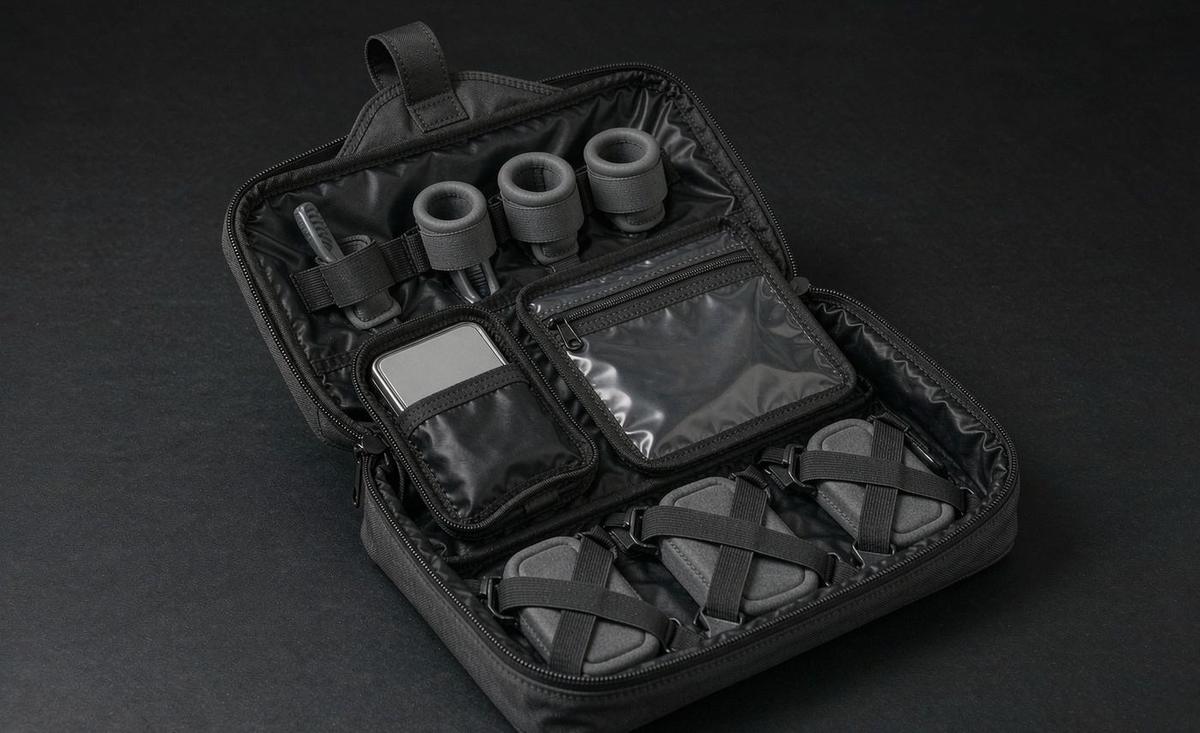
Approval should be a checklist exercise rather than an impression. A creator who looks at the bag, feels good about it and says yes has not verified anything, and the items that were not consciously checked are the ones that appear as complaints after delivery. The list below is deliberately practical and can be worked through in under an hour with a tape measure and the specification.
- Dimensions measured against the specification, with the stated tolerance, on the empty and relaxed unit.
- Capacity claim checked with the actual device the campaign names, not with a substitute.
- Colourway checked element by element against the approved reference set.
- Material references confirmed as the production lot, with the roll or batch noted.
- Hardware references and finish confirmed, including any adjacent metal parts that must match.
- Stitch density counted and compared with the specification on at least two seam types.
- Reinforcement present at every load-bearing attachment: strap roots, handle roots, webbing ends.
- Decoration measured for position from the stated datum, and checked for size and colour.
Continue the list through the functional and presentational items, because these are the ones that generate returns rather than complaints. Every closure cycles smoothly, every adjuster holds under load, the lining is tidy with no loose threads or trapped fabric, the interior is clean, and the unit carries no workshop marks, no stray chalk and no adhesive residue.
Then finish with the documentary items, which are the ones that protect the campaign later. Photograph the unit from the same angles the campaign page uses. Record the specification revision number it was built to. Note the date. Confirm in writing that this unit, at this revision, is approved as the reference for the bulk lot.
The last item on any checklist is the comparison a creator rarely runs and should: put the approved unit next to the campaign page and read the page against the bag. Every claim on the page, from the litre figure to the laptop size to the pocket count to the colour name, should be verifiable on the unit in front of you. Any claim that cannot be verified is a page edit waiting to happen, and it is far cheaper now than after delivery.
Colourway confirmation across the coordinated set
A colourway is not the shell colour. It is the coordinated set: face fabric, lining, webbing, binding, zip tape, thread, labels, decoration materials and any contrast panels. All of those have to be matched to the approved standard as one lot, and the pre-production unit is where the coordination is either confirmed or found wanting.
The most common finding at this gate is a partial match. The shell is right and the lining is right, but the webbing reads a shade lighter than the approved swatch, or the zip tape is a stock colour that approximates rather than matches. Individually each element is within a reasonable commercial tolerance. Together they produce a bag that reads as slightly uncoordinated, and a backer who pledged against a clean hero image will see it immediately.
| Element | Check against | Common finding | Consequence if missed |
|---|---|---|---|
| Shell fabric | Approved swatch or lot reference | Roll-to-roll shade variance | Colour complaints at delivery |
| Lining | Approved swatch | Shade drift on a second roll | Visible every time it opens |
| Webbing and binding | Approved set | Stock substitute, lighter shade | Visible on straps and edges |
| Zip tape and puller | Approved reference | Nearest stock colour used | Visible on the main closure |
| Thread | Approved reference | Shade mismatch per seam | Visible on contrast stitch |
| Labels and hangtag | Artwork and colour | Print colour differs from proof | Reads as unbranded |
Light source is the variable that decides whether the check is meaningful. Two elements that match under warm workshop lighting can separate under daylight, a phenomenon the trade calls metamerism. Checking the coordinated set under the light the product will be photographed and used in, and photographing it there, is the version of the check that predicts the backer experience.
There is also a documentary step worth taking: photograph the coordinated set together in one frame, with the approved references in the same frame, under a recorded light source. That single image settles any later colour question by direct comparison, and it is the most efficient piece of evidence a campaign can hold. The material guidance explains how the references are established earlier in the programme.
Decoration position and appearance
Decoration is checked last among the visual items and carries the least tolerance, because it is the element a backer recognises as the brand and the element most likely to be captured in a photograph. A dimension can be 3 mm out without comment. A logo 5 mm out of position appears in every image the backer takes and every image they post.
Position is measured, not judged. The specification should state a datum and two coordinates, and the pre-production unit is measured against both. If the specification says 60 mm below the top edge and centred on the panel width, then two measurements settle the question. If the specification says centred on the front panel, there is nothing to measure against and any later disagreement is unwinnable.
- Method matches the specification: embroidery, woven label, heat transfer, screen print, silicone patch or metal plate.
- Position measured from the stated datum on two axes, on the unit and ideally on a second one.
- Size within the stated maximum, measured rather than estimated.
- Colour matched to the approved thread, film or ink reference, not to a screen image.
- Edge quality: no loose stitches, no film lift, no print cracking when the panel is folded.
- Registration: multi-colour artwork aligned with no shift visible at normal viewing distance.
Each method has a characteristic failure worth looking for specifically. Embroidery fails on density and on pucker around a dense fill, which shows as a rippled panel around the logo. Heat transfer fails on edge lift and on cracking at a fold, which shows only when the fabric is flexed. Screen print fails on registration and on opacity over a dark ground. Silicone patches fail on adhesion at the corners, which lift first.
The check should also be done on a folded and loaded bag, not only on a flat one. A logo that sits correctly on an empty bag can distort when the bag is full, and a decoration placed near a stress point can crack when the panel flexes. Those two conditions predict the backer experience far better than a flat inspection, and the branding method guidance explains which methods tolerate flex and which do not.
Function and load checks on the final unit
Function checks on the pre-production unit are shorter than on a first article, because the first article already proved the line can build the bag. What remains is to confirm that this specific unit, with the production decoration and the production packing, still performs. The checks are quick and worth running anyway, because decoration and packing are exactly the two things that can change function.
| Item | Check | Why it is re-checked here |
|---|---|---|
| Main closure | Cycle open and close repeatedly | Decoration near the closure can snag |
| Straps and adjusters | Load and slide under load | Packing can distort a strap |
| Handles | Load to the stated weight | Handle root is the commonest failure |
| Buckles and hooks | Engage and release cycles | Hardware lot may differ from sample |
| Magnetic closures | Cycle and check retention | Plating lot variance affects strength |
| Interior pockets | Load and check seam behaviour | Lining lot may differ in weight |
The load figure is not a universal standard, it is a promise. If the campaign says the bag carries a 16-inch laptop and a change of clothes, test it with that. If it says it carries camera bodies and lenses, test it with that weight distributed as it would be distributed in use. Testing against the campaign promise rather than against a generic figure is what makes the result meaningful.
One check deserves separate mention because it is specific to this gate: the packed-unit check. A bag packed flat for transit, or compressed into a carton at the stated quantity, can take a set that affects how it looks when the backer opens it. Unpacking one unit after a simulated packing period and checking whether it recovers is a test many campaigns never run and should, because first impressions on unboxing are the moments backers photograph.
Our production team records the outcome of these checks against the unit identification, so the bulk run has a documented starting point. Combined with the lot inspection at AQL 2.5 to ISO 2859-1, that gives the campaign two independent controls: one proving the standard, one proving the lot held it.
Packing, labelling and carton verification
Packing is the most under-specified part of most briefs and the part that causes the most friction after production, because it affects freight, warehousing, customs and the unboxing experience at the same time. The pre-production unit is the right moment to verify all four, since a packing change after bulk has started is a manual rework at the end of the line.
- Individual packing: polybag, tissue, stuffing, desiccant, or none, exactly as the bulk will use.
- Fold method: flat, rolled or stuffed, and whether it recovers after unpacking.
- Labelling: barcode, SKU identity, country-of-origin marking, care label, in the stated position.
- Carton quantity: the actual number per carton, verified by packing one carton.
- Carton data: dimensions and weight of a packed carton, measured rather than estimated.
- Marking: shipping marks, carton numbering and any handling symbols required.
Carton quantity deserves a specific warning. A quotation built on 20 pieces per carton and a production run packed at 16 pieces produces more cartons, higher freight and a warehouse that receives a different cube than it planned for. Packing one carton at the pre-production stage and measuring it converts an estimate into a fact, and it costs fifteen minutes.
Labelling position matters more than it appears. A barcode applied at origin costs a fraction of the same label applied at a destination warehouse, and a label applied in the wrong position can be unscannable at the packing bench. Confirming the position on the pre-production unit, against the warehouse requirement, is a check that pays for itself across 500 pieces.
The unboxing sequence is the last thing to verify, and it is a marketing asset rather than a logistics one. Open the packed pre-production unit the way a backer will open it, and photograph it. If the sequence is awkward, the fold is wrong or the bag arrives creased, that is fixable now and unfixable later. Campaigns that run this check routinely publish the unboxing sequence as content, and it converts.
The retained reference and the seal
Once the unit is approved, it stops being a sample and becomes evidence. Two habits make that transition real: retain the unit rather than shipping it, and record the approval against a unit identification and a specification revision. Together they convert a good feeling into something that can be referred to months later when nobody remembers the conversation.
Retention costs one unit out of a 500-pcs minimum per style and per colourway, and it is the cheapest insurance in the programme. The retained bag is what settles any question about colour, dimension, construction or decoration by direct comparison. Without it, the same question is settled by recollection, which is unreliable and usually favours whoever argues most confidently.
A counter sample, which is a second unit kept by the production side and signed or marked as the agreed standard, is the other half of the mechanism. One unit stays with the creator and one stays with the line, and both carry the same identification. If a dispute arises, the two are compared, and if they match the question is answered.
Photographs of the retained unit, taken from the same angles as the campaign page and stored with the approval record, complete the file. A photograph cannot replace the physical unit, but it travels instantly and it is what a remote team will actually consult day to day. Our programme coordinator stores the images with the approval record and the revision number, and reopens the same file for every re-order.

What approval authorises commercially
Approval is not a formality. It is the event that commits money and calendar, and being explicit about what it triggers prevents the argument that follows when a creator wants to change something a week later and discovers the material is already cut.
Four things are released by approval. The bulk material lot is purchased or allocated. The cutting is scheduled. The 35-50 day production clock starts. And the deposit structure is triggered, with payment under T/T 30/70 and trade terms at FOB Xiamen. Each of those is a real commitment with a real cost to unwind, which is why approval should rest on a written record rather than on a message saying looks good.
The deposit point deserves a note for creators budgeting a campaign. Under T/T 30/70, 30% is due to release production and 70% against the balance, typically before shipment. That means the bulk commitment is not fully funded by campaign receipts at the moment it is made, and a creator needs working capital or a funding structure that covers the gap. Understanding that before approval is the difference between a smooth run and a stressful one.
Approval also fixes the inspection basis. The finished lot is judged at AQL 2.5 to ISO 2859-1 against the approved reference, so the approval is literally setting the standard the lot will be measured against. Approving a unit that is slightly off specification because it looks fine is approving a looser standard than the campaign promised, and the lot will then be built correctly to a standard nobody intended.
Changes after approval: the last cheap moment
There is a narrow window after approval during which a change is still cheap, and knowing where its edges are is genuinely useful. Broadly, the cost of a change rises in three steps: before cutting, before the bulk sewing starts, and after the lot is part-built. The first step is a revised instruction, the second is a schedule disruption, and the third is a commercial negotiation.
| Moment | Cost of a change | What is still possible | What is not |
|---|---|---|---|
| Before approval | Low | Anything, within the quotation | Nothing is committed |
| After approval, before cutting | Low to moderate | Material or trim swap if stock exists | Already-purchased lots |
| After cutting, before assembly | High | Re-cut a panel at cost | The cut panels |
| During bulk assembly | Very high | Stop the line, partial write-off | Time already spent |
| After inspection | Highest | Rework or re-run | Cannot unmake the lot |
The practical advice is to use the pre-production gate for everything, including the small things. A creator who notices a preference after approval is not wrong to raise it, but they should raise it knowing which column they are in, and they should expect an honest answer about cost rather than a reassurance.
There is also one change that is always worth raising regardless of cost: anything affecting safety, a stated claim or compliance. A strap that fails a load test, a claim the bag cannot deliver, or a compliance document that has not arrived are not preferences, and the cost of fixing them late is always lower than the cost of shipping them.
Our campaign bag specialist will answer a post-approval change request with three things: what it costs, what it does to the delivery date, and whether it requires a new approval. That triad is the honest form of the answer, and a creator who receives only a reassurance should ask for the other two parts.
When to reject a pre-production sample
Rejection feels drastic and is sometimes correct. The decision rule is not aesthetic. Reject when the unit does not meet a stated specification, does not deliver a claim the campaign makes, or does not use a material or component that was agreed. Those are conformance failures and they are corrected without commercial discussion.
- A dimension breaks a claim on the campaign page, such as a 16-inch laptop that does not fit.
- A material or component is not the agreed reference, regardless of whether it looks equivalent.
- A function test fails: a closure catches, an adjuster slips, a strap or handle fails under load.
- The decoration position, size or colour is outside the stated specification.
- The coordinated colourway does not match the approved set under the stated light source.
- Compliance documentation for the destination market is missing.
Do not reject for preferences that can be recorded for the next run. A lining that would look better in a darker shade, a puller that would feel nicer in metal, a pocket that could be 10 mm deeper: these are improvements, and the right place for them is the re-order file rather than a delayed campaign. Rejecting on preference costs a sampling window and, more importantly, costs the delivery date.
Rejection also has a process, and following it keeps the relationship intact. State which specification line failed, attach the measurement or the photograph, ask for the correction and a revised date, and confirm whether the correction needs a new approval. A rejection written that way is a technical instruction, and it gets a technical response in one pass.
After approval, the programme moves into execution: the 35-50 day bulk window, the lot inspection at AQL 2.5 to ISO 2859-1, and packing and shipment on FOB Xiamen terms. The pre-production unit stays behind as the standard. That is the whole purpose of the gate, and the reason it deserves an hour of measured checking rather than a glance and a yes.
Ready to close your pre-production gate? Send the specification revision, the campaign claims and the packing rule through the contact quotation form and we will confirm what the approval unit will be checked against before bulk is released.
Frequently Asked Questions
What is a pre-production sample for a bag order?
One unit built exactly as the bulk order will be built: production material lot, production tooling, production hardware, production decoration setup and production packing. It is the last physical check before cutting starts, and once approved it becomes the retained reference the bulk lot is judged against at AQL 2.5 to ISO 2859-1.
How is a pre-production sample different from a prototype?
A prototype asks whether the idea works and is often built with available components. A pre-production sample asks whether this is the bulk bag and is built from the production lot. A prototype can be made from a different roll of fabric by different hands, which is exactly why it cannot serve as the reference for the delivered lot.
What must be production-intent on the unit?
Six things: shell and lining fabric from the production lot, the specified hardware from the bulk purchase, the coordinated webbing, binding, zip tape and thread, decoration applied with the production setup and jig, the actual labels and packaging, and the real packing configuration including fold and carton quantity.
Why does the fabric roll matter?
Two rolls of the same reference from the same mill can differ slightly in shade, which is normal and accepted in the trade. But if the pre-production unit comes from one roll and the bulk lot from another, the approved reference no longer represents the delivered product. Asking which roll the unit was built from is a legitimate and quick question.
What should be on the approval checklist?
Dimensions against the stated tolerance, the capacity claim checked with the actual device named on the campaign page, the colourway element by element, material references, hardware and finish, stitch density on two seam types, reinforcement at every load-bearing attachment, and decoration position measured from the stated datum.
How should decoration be checked on the pre-production unit?
By measurement, not by eye. The specification should state a datum and two coordinates, and both are measured on the unit. Check size against the stated maximum, colour against the approved thread or film reference, and edge quality for the failure typical of the method: pucker for embroidery, edge lift for heat transfer, registration for print.
Should the pre-production unit be packed?
Yes, exactly as the bulk will be packed. Packing affects freight volume, warehouse handling, customs data and the unboxing experience, and a carton quantity estimated rather than packed produces more cartons and higher freight than the quotation allowed for. Pack one carton and measure it.
What is a retained reference or counter sample?
The approved unit kept rather than shipped, plus a second identical unit held by the production side, both carrying the same identification. One stays with the creator and one stays with the line. Any later dispute is then settled by comparison instead of by recollection, at the cost of one unit out of 500.
What does approving the sample commit me to?
Four things: the bulk material lot is purchased or allocated, cutting is scheduled, the 35-50 day production clock starts, and the deposit is triggered under T/T 30/70 with trade terms at FOB Xiamen. It also fixes the standard the finished lot is inspected against at AQL 2.5 to ISO 2859-1.
Can I change something after I approve the sample?
Yes, but the cost depends on the moment. Before cutting, a stock material or trim swap may be possible. After cutting it is a re-cut at cost. During assembly it means stopping the line. Always ask for the three parts of the answer: what it costs, what it does to the delivery date, and whether a new approval is needed.
When should I reject a pre-production sample?
Reject on conformance, not on preference: a dimension that breaks a claim on the campaign page, a material that is not the agreed reference, a failed function test, decoration outside the stated position or colour, a colourway that does not match the approved set, or missing compliance documentation for the destination market.
How long does the pre-production gate add to my schedule?
The check itself is short, typically a day of inspection and photography. The risk is what it finds. A conformance failure corrected at this gate costs a revised unit and a sampling window of 6-10 working days, or 12-15 for a complex build, which is far cheaper than the same failure found after the 35-50 day bulk run has started.
People Also Ask
What does PP sample mean?
Pre-production sample: one unit built exactly as the bulk lot will be built, approved as the reference before cutting starts.
Is a pre-production sample the same as a first article?
Not quite. A first article asks whether the line can build it; a pre-production approval asks whether this is the bag being sold. One unit can answer both.
Should I keep the approved sample?
Yes. Retain one unit rather than shipping it, so any later question about colour or construction is settled by comparison.
How many pre-production samples should I get?
One per style and colourway as a minimum, plus a second counter sample held by the production side.
Can decoration be approved from a photograph?
Position and size can be checked from a measured photograph, but edge quality, density and flex behaviour need the physical unit.
What if the approved bag differs from my campaign page?
Edit the page before shipping. A claim the bag cannot deliver is a promise problem, and correcting it costs a page edit rather than a refund wave.
Does approval start the production clock?
Yes. production 35-50 days from deposit and approved sample, and the deposit under T/T 30/70 is triggered by the same approval.